An Optimized way for Static Channel Allocation in
Mobile Networks using Genetic Algorithms
T.K. Ramesh Babu
Department of Information TechnologyNIT Durgapur West Bengal, India
Nanda Dulal Jana
Department of Information Technology NIT Durgapur
West Bengal, India
ABSTRACT
In this paper, we are proposing a new Genetic Algorithmic approach to solve Static Channel Allocation Problem. Genetic Algorithms are one of the better optimization techniques. The main goal of this paper is to assign channels to cells with efficient usage of bandwidth. This new methodology consists of new crossover and mutation techniques, based on the reuse distance of channels. In crossover the selected channels from an individual will be used for generating a new child for next generation through which utilization and reassign of channels will be efficient. In mutation by selecting the channel, checks within individual and reassigns the channel based on the reuse distance.
Keywords
Genetic Algorithms, Channel Allocation, Chanel Allocation Problem, Cells.
1.
INTRODUCTION
Now a day‟s usages of mobile services are increasing gradually. The service provider has to provide good services for users. As Bandwidth is very limited, it has to be utilized properly. We have to give good services with less bandwidth to high users. The basic idea with cellular systems is to reuse channels in different cells, increasing the capacity. But a problem arises: the same frequency assignments cannot be made in adjacent cells. The assignment [8] [9] must be spaced far enough apart geographically to keep interference to tolerable levels. This problem is called as Channel Allocation Problem (CAP). Genetic Algorithms (GAs) [1] are one of the search technique based on the Darwin‟s theory of “Survival of the best”. GAs will used to search the better solution in very large search space with less time. Through which optimization takes place. The present paper has been implemented with GAs for Static Channel Allocation [6].
2.
GENETIC ALGORITHMS
Many practical optimum design problems are characterized by mixed continuous–discrete variables, and discontinuous and nonconvex design spaces. If standard nonlinear programming techniques are used for this type of problem they will be inefficient, computationally expensive, and, in most cases, find a relative optimum that is closest to the starting point. Genetic algorithms (GAs) [1] [5] [6] are well suited for solving such problems, and in most cases they can find the global optimum solution with a high probability. The genetic algorithm (GAs) [1] [5] [11] [14] is an optimization and search technique based on the principles of genetics and natural selection. A GAs allows a population composed of many individuals to evolve under specified selection rules to a state that maximizes the “fitness” (i.e., minimizes the cost
function). The method was developed by John Holland over the course of the 1960s and 1970s and finally popularized by one of his students, David Goldberg.GA is the difficulty of speeding up the computational process, as well as the intrinsic nature of randomness that leads to a problem of performance assurance. Nevertheless, GA development has now reached a stage of maturity, thanks to the effort made in the last few years by academics and engineers all over the world. It has blossomed rapidly due to the easy availability of low-cost but fast speed small computers. Those problems once considered to be “hard” or even “impossible,” in the past are no longer a problem as far as computation is concerned. Therefore, complex and conflicting problems that require simultaneous solutions, which in the past were considered deadlocked problems, can now be obtained with GAs.
The main components of GAs are.
a. Encoding.
b. Initial population.
c. Fitness function.
d. Operators.
i. Selection.
ii. Crossover.
iii. Mutation.
Encoding is the representation of the solutions in the search space it may be of boolean or real or alpha numeric values.
Initial population will have set of individuals which are generated randomly in general.
With the help of fitness function we can decide which infidel is best for generating next generation for obtaining optimized solution.
Operators play a vital role. With the help of operators only we can achieve our solution soon.
Selection operator is to select the individuals from the present generation which can be moved to mating pool. Some of the techniques are Rank Selection [1] and Roulette Wheel Selection [1].
Crossover operator will mate the two selected individuals which lead to produce new children for next generation. Some of the techniques are Single point Crossover [1], Two Point Crossover [1], etc.
2.1
Working procedure of GAs
Step 1: There will be some collection of individuals in the pool which are considered a initial population.
Step 2: By using fitness function each and every individual will get some fitness values.
Step 3: Based on the fitness values some of the individuals are selected by selection operator.
Step 4: The selected individuals are send to crossover and obtains new children. The obtained new children will be sent for mutation.
Step 5: The finally obtained child after mutation will be sent to next generation.
Step 6: Repeat Step 2 – Step 5 until we obtains a optimized solution.
3.
CHANNEL ALLOCATION
In recent years, the rates of increase in the popularity of mobiles are becoming very high. In mobile network, the area is divided into number of cells which are of hexagonal in shape. Base station [8] (in general located at center of the cell) controls and serve the communication to and from the mobile hosts. The available bandwidths for mobile users are divided into channels or frequencies, which are limited in number. Assigning frequencies to each and every cell in the network is called as Channel Allocation (CA) [3] [5]. There are two types of CA [2] types,
3.1
Static Channel Allocation
[3][5][6] The channels are assigned to each and every cell, but they are fixed which are not changeable.
3.2
Dynamic Channel Allocation
[5][6] No set relationship exists between channels and cells. Instead, channels are part of a pool of resources. Whenever a channel is needed by a cell, the channel is allocated under the constraint that frequency reuse requirements cannot be violated.
4.
CHANNEL ALLOCATION PROBLEM
As the users increases day by day the problem of frequency assignment [5] [13] also increases. We can solve it by reassigning the channels. But while reassigning we have to consider about interferences.
There are basically three sources of interference, namely:
4.1.
Co-Channel Interference (CCI)
Another caller within same range using the same channel.
4.2. Adjacent Channel Interference (ACI)
Another caller within the same region using an adjacent channel.
4.3. Co-site Interference (CI)
Another caller within the same region using another channel within some range.
5.
GAs IN CHANNEL ALLOCATION
PROBLEM
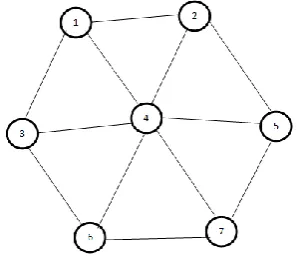
[image:2.595.368.481.73.190.2]We are proposing a new technique for implementation of channel allocation in mobile networks using GA. The solving of CAP is somewhat similar to Graph Coloring Problem, why can we use that graphs to solve this. In the process firstly the network (set of hexagonal cells) has to be represented in the form of graph. Let us consider the cell network shown in the Fig.1, which has 7 cells in it.
Fig 1: 7 Cell display
[image:2.595.356.505.274.402.2]The cell network has to represent in the form of graph. The graph representation of the above cell network is showing in Fig.2. The adjacent cells will have direct path in the graph. As cell 1 is having 2, 3 and 4 as neighboring cells they will have direct path as shown in Fig.2, the remaining graphs is drawn based on neighboring cells of each and every cells.
Fig 2: Graph representation of 7 Cell display
[image:2.595.353.496.578.702.2]From the obtained graph we can easily find the distance matrix. Till now most the previous papers concentrated on adjacency matrix for solving CAP, but we are considering firstly, the distance matrix though which we can find the distance between any two cells easily. The „D‟ distance matrix is calculated for each and every cell considers its shorted distance between the cells both directly and indirectly. If we consider cell 1, it is directly connected to 2, 3 and 4 cells that means the distance between 1 – 2, 1 – 3, 1 – 4 are 1 only. Suppose if we want to find the distance from 1 – 5 which is connected indirectly through cell 2, the distance is 2, i.e. 1- 2 – 5. The Fig.3 shows the distance matrix of the obtained graph.
Fig 3: ‘D’ Distance Matrix of the Graph
The size of distance matrix will be n x n were the n is the number of cells in the network. (Above matrix is 7 x 7).
We have to consider the „R‟ Reuse Distance, of cells because based on that factor; a frequency can be assigned for other cells Fig.4.
1 2 3 4 5 6 7
1 1 1 1 1 1 1
Fig 4: ‘R’ Reuse Distance Matrix of the Graph
The number of frequencies kept in pool, the frequency is taken from the pool and assigned to particular cells Fig. 5
1 2 3 4 5 6 7
Fig 5: ‘F’ Frequency Matrix
The Demand Matrix (d) will have, which cell wants the frequency, based on that the frequency is assigned. If the value at di = 0, then the ith cell don‟t want frequency.
di = The number of frequencies wanted by the ith cell.
The Cell Matrix (C) will have the cells Fig. 6
C1 C2 C3 C4 C5 C6 C7
Fig 5: ‘C’ Cell Matrix
The Number of frequencies/channels assigned in the solution has to be calculated for getting the fitness values and fitness scaling.
For finding the weight of the ith solution we can use,
Fitness of ith solution = Total number frequencies used in ith solution + penalty
Penalty (P) can be calculated by using the derived formula
P=
The %fitness can be calculated by,
%fitness =
n
i
th th
path i of fitness
path i of fitness
1
*100
Based on the obtained %fitness a Roulette wheel is drawn. We are using Roulette wheel Selection technique [1] [11], in which we are going to select the random two parents and send for crossover operation.
While coming to crossover there are many type of crossover are used till now, such as, Partially matrix Crossover (PMX) [1] [11] , Ordered Crossover (OX) [1] [11] and Cyclic Crossover (CX) [1][11] .
The power of GAs arises from crossover. Crossover causes a structured, yet randomized exchange of genetic material between solutions, with the possibility that good solutions can generate „better‟ ones. Term penalty can be defined as repairing an infeasible solution.
6.
PROPOSED CROSS DI CROSSOVER
(DIX)
We are proposing a new crossover named “DI Crossover (DIX)” which is entirely based on the based on the distance and direct path of the cells which can give better optimization. DIX can give better optimization due to its working procedure. For DIX we can give distance matrix, reuse matrix and parents which are selected as input.
6.1
Operation of DI Crossover
In this the two selected parents from selection process are taken. The crossover points c1 and c2 randomly taken. The element from c1 to c2 has to be exchanged for producing new children. We have two cases in this.
Case 1:
Selected element of opposite parent (from c1 to c2) is not in the new child then the corresponding channel has to be keep in an queue and has to be used in future, and have to assign channel based on reuse distance (in future).
Case 2:
Selected element of opposite parent (from c1 to c2) is already exist in the new child path, then we have to assign the same channel to the non – neighboring cell based on the reuse distance and process until all cells are checked according to distance matrix. Finally we have to find the element which is not visited from the parent (c1 to c2) and has to copy. The missing elements has to be inserted once again by using WBX [9] algorithm
If we want to assign channel k in the solution then we will do the process of DIX, but while assigning we have to consider, if the obtained channel is in ith cell, then we have to select the jth such that the distance between ith and jth cell must be greater than reuse distance of ith cell. If it is greater then assign the same channel else go for other cell and repeat the process. After that now we have to consider jth cell and go on further.
P1 = 1 2 3 4 5 6 7
P2 = 2 4 1 5 3 7 6
Let the randomly selected c1=3 and c2=5 then initially the children will be as
CH01 = 1 2 0 0 0 6 7
CH02 = 2 4 0 0 0 7 6
Now for CH01 we have to insert 1, 5 and 3 of P2 that can be done on DIX algorithm.
Let us first consider channel 1, by seeing CH01 we can find channel 1 is already assigned to cell 1, so now we have to consider cell 1, its reuse distance and its distance to remaining cells. We cannot assign channel 1 to cell 2 because, the reuse distance of cell 1 is 1 and the distance of cell 1 to cell 2 is also 1. We can assign the same channel
if the reuse distance(1) < distance(1,2)
CH01 = 1 2 0 0 1 6 7
As cell 5 is new assigned cell we have to consider it for further continuation. Here comes a main point that the process of compares of reuse distance and distance matrix is not only for cell 5 and other cells, but it has to consider the cell 1 reuse distances also.
Simply, if we want to assign channel k to cell j, which is coming from cell i, previously cell i is assign from cell l then, we have to consider both the cell i reuse distance cell i to cell j distance matrix and cell l reuse distance, cell l to cell j distance matrix. If the both distance are greater then the reuse distance of cell i and cell l, we can assign channel k to cell j.
Clearly, as well cell 5 is assigned from cell 1, we have to consider both
CH01 = 1 2 0 0 1 1 7
Channel 5 is not in the CH01, we can consider the cell which is not assigned by any channel and that cell has to be assigned by channel 5
Cell 3 is not assigned so we considered it and assigned channel 5 to cell 3.
CH01 = 1 2 5 0 1 1 7
Continue the same previous process we get
CH01 = 1 2 5 0 1 1 5
CH01 = 1 2 5 3 1 1 5
Finally, the obtained solution is
[image:4.595.308.547.105.422.2]CH1 = 1 2 5 3 1 1 5
Table 1: Algorithm for DI Crossover
Step 1: Select the two parent P1, P2 by using some selection technique
Step 2: Select two crossover point randomly C1,C2
Step 3: Copy the elements of both parents to form two new children, but elements. Must not copy from c1 to c2. (CH01, CH02)
Step 4: Search the CH01 that the from c1 to c2. If any one is equal then go to the cell Assign the same channel to the other cell whose reuse distance (CH01) is less than the Distance (CH01, cell).
Step 5: By considering the previous assigned cell the Step 4 has to be repeat until it reach nth cell. But by consider the reuse distance and distance of all the previous assigned cells.
Step 6: Repeat Step 4 to Step 5 for both the children
7.
PROPOSED DI MUTATION (DIM)
We are proposing a new algorithm for mutation named “DI mutation (DIM)”. We are going to select randomly a cell and
its channel. In which the two cells are selected randomly and its channels are swapped. After swapping the channel has to be reuse for remaining cells based on the reuse matrix and distance matrix.
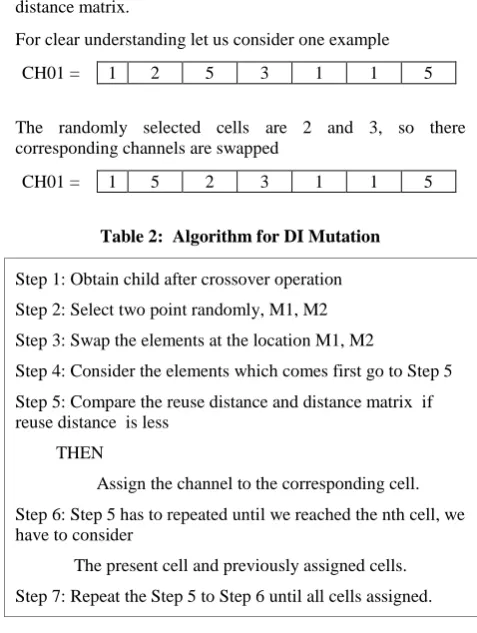
For clear understanding let us consider one example
CH01 = 1 2 5 3 1 1 5
The randomly selected cells are 2 and 3, so there corresponding channels are swapped
CH01 = 1 5 2 3 1 1 5
Table 2: Algorithm for DI Mutation
Step 1: Obtain child after crossover operation
Step 2: Select two point randomly, M1, M2
Step 3: Swap the elements at the location M1, M2
Step 4: Consider the elements which comes first go to Step 5
Step 5: Compare the reuse distance and distance matrix if reuse distance is less
THEN
Assign the channel to the corresponding cell.
Step 6: Step 5 has to repeated until we reached the nth cell, we have to consider
The present cell and previously assigned cells.
Step 7: Repeat the Step 5 to Step 6 until all cells assigned.
Now we have the again repeat the reassigning of channels based on reuse distance and distance matrix for assigned cells.
Firstly we have to take cell 2, and check the remaining cell which is having the distance (from cell 2) is greater than the reuse distance of cell 2. As reuse distance of cell 2 is less than the distance from cell 2 to cell 3, we can assign the channel 5 to cell 3. Again this has to repeat by considering from cell 3 and cell 2, cell 5 satisfies the condition. So we can assign it.
CH01 = 1 5 5 3 1 1 5
The obtained child after mutation is
CH1 = 1 5 5 3 1 1 5
8.
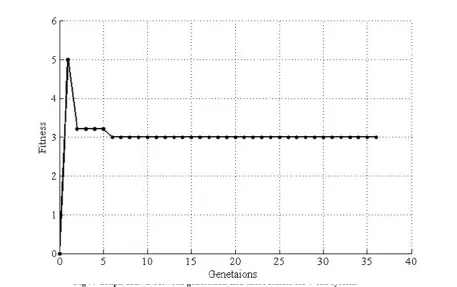
SIMULATED RESULTS
[image:4.595.317.540.524.584.2]Fig 9: Graph drawn between generation and there fitness for 7 cell system
9.
ACKNOWLEDGMENTS
We would like to say our sincere thanks to Head of Information Technology Dept., NIT Durgapur, West Bengal, India for his support. We would like to say our thanks to all the people who helped us for completing this work successfully.
10.
REFERENCES
[1] A.A.R. Townsend, A Genetic Algorithm: Tutorial, Jul. 2003 .
[2] Albert Y. Zomaya, Senior Member, IEEE, and Michael Wright. “Observations on Using Genetic-Algorithms for Channel Allocation in Mobile Computing” . IEEE Transactions on Parallel and Distributed Systems, Volume. 13, No. 9, Sep. 2002.
[3] .Y. Ngo and V.O.K Li, "Fixed channel assignment in cellular radio networks using modified genetic algorihtms" IEEE Trans Veh. Technol., vol 47, pp. 163 - 172, Feb. 1998
[4] D. E Goldberg, Genetic Algorithms in Search, Optimization and Machine Learning. Reading, MA: Addison Wesley. 1989
[5] Darrell whitley , A genetic algorithm tutorial, Technical Repot CS93-103, March 10, 1993. Colorado State University.
[6] I. Katzela and M. Naghshineh, "Channel Assignment Schemes for Cellular Mobile Telecommunication
Systems: A Comprehensive Survey," IEEE Personal Communications, pp. 10-31, June 1996.
[7] J. H. Holland, "Adaptation in natural and artificial systems" University of Michigan press `1975.
[8] Mischa Schwatz, " Mobile Wireless Communicaitons", Cambridge University Press, 2005.
[9] Nandadulal Jana, T.K. Ramesh Babu and Samarjit Kar, "Genetic Algorithm for the Travelling Salesman Problem using new Crossover and Mutation Operators", Proc. of the Ninth International conference on Information and management Sciences, Urumchi, China, ISSN 1539-2023, volume 9, Aug 2010.
[10] Release notes of mathworks for Matlab and GA tool box
[11] S.N.Sivanandam · S.N.Deepa, Introduction to Genetic Algorihms", Springer Publications, 2007
[12] Tobias Bilckle and Lothar Thiele, A comparison of selection schemes used in Genetic Algorithms, Evolutionary Computation (1995), Volume: 4, Issue: 11.
[13] W.K. Hale, " Frequency assignment theory and applications", Proc. IEEE, vol. 68 pp. 1497 - 1514, Dec, 1980.