International Journal of Industrial Engineering Computations 6 (2015) 405–418
Contents lists available at GrowingScience
International Journal of Industrial Engineering Computations
homepage: www.GrowingScience.com/ijiec
Solving uncapacitated multiple allocation p-hub center problem by Dijkstra’s algorithm-based genetic algorithm and simulated annealing
Masoud Rabbani* and Seyed Mahmood Kazemi
School of Industrial Engineering, College of Engineering, University of Tehran, Tehran, Iran C H R O N I C L E A B S T R A C T
Article history:
Received September 14 2014 Received in Revised Format January 10 2015
Accepted February 5 2015 Available online February 8 2015
In the existing literature, there are a huge number of studies focused on p-hub median problems and inventing heuristic or metaheuristic algorithms for solving them. But such analogous body of literature does not exist for its counterpart problem; p-hub center problem. In fact, since p-hub center has been lately introduced and has a particular objective function, minimizing the maximum cost between origin-destination nodes, there are few studies investigating the problem and the challenges for solving it. In this study, after presenting a complete definition of the uncapacitated multiple allocation p-hub center problem (UMApHCP) two well-known metaheuristic algorithms are proposed to solve the problem for small scale and large scale standard data sets. These two algorithms are one single solution-based algorithm, Simulated Annealing (SA), and one population-based metaheuristic, Genetic Algorithm (GA). Because of the particular nature of the problem, Dijkstra’s algorithm has been incorporated in the fitness function calculation part of the proposed methods. The numerical results of running the GA and SA for standard test problems show that for smaller scale test problems, single solution-based SA shows greater performance versus GA but for larger scales of data sets the GA generally yield more desirable solutions.
© 2015 Growing Science Ltd. All rights reserved
Keywords:
P-hub center problem Dijkstra’s algorithm Genetic Algorithm Simulated Annealing
1. Introduction
In some networks, for example, telecommunication or transportations systems, there exist many nodes whose flows should depart from one origin node and arrive in a destination node. Since establishing a direct link between every pair of nodes needs considerable investments and is financially inefficient, some nodes are chosen as hubs, which operate as switching, transshipment and sorting centers and the flow of every node is conveyed to destination points through these nodes.
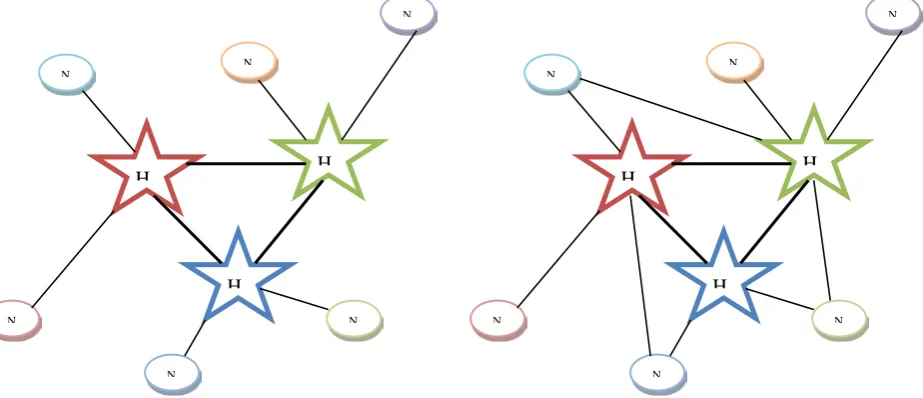
The problem of optimally locating these hubs and allocating demand nodes to them is called hub location problem. There are two basic types of hub networks: single allocation and multiple allocations. Their difference is in the way of allocating non-hub nodes to hub centers. According to Alumur and Kara (2008) “In single allocation, all the incoming and outgoing traffic of every demand center is routed through a single hub; in multiple allocation, each demand center can receive and send flow through more
* Corresponding author.
than one hub.”. Fig. 1 shows the mentioned difference of single allocation and multiple allocation hub networks.
Fig. 1. A single allocation (left hand side) and multiple allocation (right hand side) hub network
The p-hub center problem is a well-known NP-hard problem (Kara & Tansel, 2000) which was firstly introduced and formulated by Campbell (1994). It is worth noting that it is a minimax type problem and is similar to the p-center problem. Campbell (1994) categorized this problem into three different types:
• The maximum cost for movement on any single link (origin-to-hub, to-hub and hub-to-destination) is minimized.
• The maximum cost of movement between a hub and an origin/destination is minimized (vertex center).
• The maximum cost for any origin–destination pair is minimized.
When a hub system involves perishable or time sensitive items and because of that time is really important, we can replace cost with time and in such cases the first type of p-hub center problem becomes important. An example of the second type of p-hub is the vehicle drivers that are subject to a time limit on continuous service. Similar examples to the second type can be given for the third type problem, considering that hub-to-hub links may have some particular characteristics. Campbell (1994) presented formulations for both single and multiple allocation versions of the all three types of p-hub center problem mentioned above.
Based on the results of the study of Alumur and Kara (2008), the total number of papers on the p-hub center problem is very few compared with other hub models. The main reason is that these problems are proposed in 1994 and remain untouched until 2000. However, in the last decade this indicator is growing and the research community is giving more and more attention to the problem.
Kara and Tansel (2000) studied the computational aspects of the single-assignment p-hub center problem on the basis of Campbell’s first type model and their proposed model. As reported by the authors, the new model outperformed different linearizations of the basic model regarding CPU times.
Ernst et al. (2009) developed a new formulation for the single allocation p-hub center problem. A new variable 𝑟𝑟𝑘𝑘 was defined to model the maximum collection/distribution cost between hub k and the nodes allocated to hub k. Their model for single allocation was as follows:
H H
H
N
N
N
N N
N
H H
H
N
N
N
N N
(1)
Min 𝑍𝑍
subject to
(2)
∀𝑖𝑖 � 𝑋𝑋𝑖𝑖𝑘𝑘
𝑘𝑘
= 1
(3)
∀𝑘𝑘 � 𝑋𝑋𝑘𝑘𝑘𝑘
𝑘𝑘
=𝑝𝑝
(4)
∀𝑖𝑖,𝑘𝑘 𝑟𝑟𝑘𝑘 ≥ 𝐶𝐶𝑖𝑖𝑘𝑘𝑋𝑋𝑖𝑖𝑘𝑘
(5)
∀𝑘𝑘,𝑚𝑚 𝑍𝑍 ≥ 𝑟𝑟𝑘𝑘+𝑟𝑟𝑚𝑚+𝛼𝛼𝐶𝐶𝑘𝑘𝑚𝑚
(6)
∀𝑖𝑖,𝑘𝑘 𝑋𝑋𝑖𝑖𝑘𝑘 ≤ 𝑋𝑋𝑘𝑘𝑘𝑘
(7)
∀𝑖𝑖,𝑘𝑘 𝑋𝑋𝑖𝑖𝑘𝑘 ∈{0,1}
(8)
∀𝑘𝑘 𝑟𝑟 ≥0
Baumgartner (2003) proposed a branch-and-cut algorithm by investigating the polyhedral properties of a formulation proposed by Ernst in an unpublished report and identified some facet-defining inequalities and defined separation procedures. Pamuk and Sepil (2001) addressed the p-hub center problem. They proposed the first heuristic for the single allocation p-hub center problem as a means of generating location-allocation strategies in a reasonable amount of time, and superimposed tabu search on the underlying algorithm, so as to decrease the possibility of being trapped by local optima. Kratica and Stanimirovic (2006) proposed a genetic algorithm with binary coding for the uncapacitated multiple allocation p-hub center problems. They constructed and implemented problem-specific genetic operators in their genetic algorithm. Yaman et al. (2007) analyzed the latest arrival hub location problem with stopovers and included the transient times, the time spent for unloading, sorting and loading at hubs in their model. Campbell et al. (2007) presented complexity results and IP formulations for several versions of the p-hub center allocation problem including both capacitated and uncapacitated cases and established that some special uncapacitated cases are solvable in polynomial times.
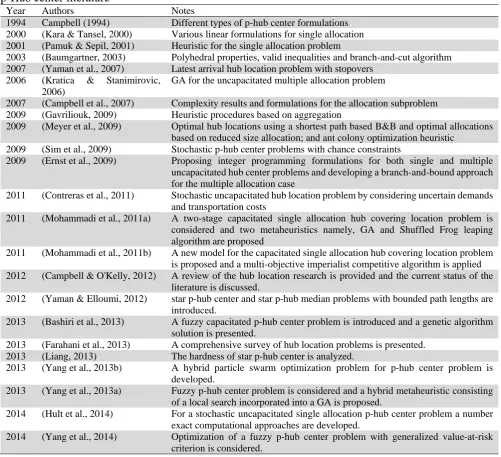
while, Liang (2013) analyzed the hardness of the star p-hub center problem. Bashiri et al. (2013) considered a number of qualitative parameters for the hub location problem and proposed a GA based heuristic to solve this problem under capacitated constraints. In order to deal with uncertainty and qualitative parameters, fuzzy systems were utilized. Yang et al. (2013b) proposed a hybrid particle swarm optimization algorithm for fuzzy p-hub center problem. In their problem travel times were considered to be uncertain and modeled by normal fuzzy vectors. In a similar study, Yang et al. (2013a) considered a fuzzy p-hub center problem with fuzzy travel times and developed a genetic algorithm with local search to deal with the problem. Hult et al. (2014) proposed a reformulation for the p-hub center problem when the uncertainty of travel times was considered. Then a number of exact solution approaches based on variable reduction were developed to solve small-medium sized problems to optimality. The literature is rich enough with high-quality reviews in the context of hub location problem. In 2012, Campbell and O'Kelly (2012) provided a comprehensive review on hub location problems and discussed the present status of the literature. They also explored the shortcomings of the literature and suggested future research directions. A short after, Farahani et al. (2013) provided a latest review of models, classification, solution techniques and applications of hub location problems. To provide a concise overview of the literature review, the paramount feature of each studies mentioned above are encapsulated in Table 1.
Table 1
p-Hub center literature
Year Authors Notes
1994 Campbell (1994) Different types of p-hub center formulations
2000 (Kara & Tansel, 2000) Various linear formulations for single allocation
2001 (Pamuk & Sepil, 2001) Heuristic for the single allocation problem
2003 (Baumgartner, 2003) Polyhedral properties, valid inequalities and branch-and-cut algorithm
2007 (Yaman et al., 2007) Latest arrival hub location problem with stopovers
2006 (Kratica & Stanimirovic,
2006)
GA for the uncapacitated multiple allocation problem
2007 (Campbell et al., 2007) Complexity results and formulations for the allocation subproblem
2009 (Gavriliouk, 2009) Heuristic procedures based on aggregation
2009 (Meyer et al., 2009) Optimal hub locations using a shortest path based B&B and optimal allocations
based on reduced size allocation; and ant colony optimization heuristic
2009 (Sim et al., 2009) Stochastic p-hub center problems with chance constraints
2009 (Ernst et al., 2009) Proposing integer programming formulations for both single and multiple
uncapacitated hub center problems and developing a branch-and-bound approach for the multiple allocation case
2011 (Contreras et al., 2011) Stochastic uncapacitated hub location problem by considering uncertain demands
and transportation costs
2011 (Mohammadi et al., 2011a) A two-stage capacitated single allocation hub covering location problem is
considered and two metaheuristics namely, GA and Shuffled Frog leaping algorithm are proposed
2011 (Mohammadi et al., 2011b) A new model for the capacitated single allocation hub covering location problem
is proposed and a multi-objective imperialist competitive algorithm is applied
2012 (Campbell & O'Kelly, 2012) A review of the hub location research is provided and the current status of the
literature is discussed.
2012 (Yaman & Elloumi, 2012) star p-hub center and star p-hub median problems with bounded path lengths are
introduced.
2013 (Bashiri et al., 2013) A fuzzy capacitated p-hub center problem is introduced and a genetic algorithm
solution is presented.
2013 (Farahani et al., 2013) A comprehensive survey of hub location problems is presented.
2013 (Liang, 2013) The hardness of star p-hub center is analyzed.
2013 (Yang et al., 2013b) A hybrid particle swarm optimization problem for p-hub center problem is
developed.
2013 (Yang et al., 2013a) Fuzzy p-hub center problem is considered and a hybrid metaheuristic consisting
of a local search incorporated into a GA is proposed.
2014 (Hult et al., 2014) For a stochastic uncapacitated single allocation p-hub center problem a number
exact computational approaches are developed.
2014 (Yang et al., 2014) Optimization of a fuzzy p-hub center problem with generalized value-at-risk
In this study, our focus is on the p-hub center problem which is a minimax type problem and has the number of hubs as an exogenous parameter and previously determined p. The problem considered here is of multiple allocation type problems. Since the problem could be modeled as a graph, where the nodes represents the origin/destination or prospective location and edges represent the linkages between the nodes with weights denoting distances (or costs), Dijkstra’s algorithm could be successfully used in order to find the shortest path from each node to any other node. Having the information obtained from running Dijkstra’s algorithm once for each node, one can minimize the maximum length between any origin/destination nodes by incorporating this algorithm into a heuristic or metaheuristic method. Achieving this aim is exactly equivalent with solving a UMApHCP.
Hence, in essence, the objective of this study considering the literature provided above, is to propose well-qualified metaheuristic methods for solving the UMApHCP, improve the existing GA in the literature, develop SA for the first time for solving the problem and compare the results of the two algorithms for both small-scale and large-scale data sets. The rest of the paper is organized as follows: In section 2, the problem formulation is presented. In section 3, the proposed algorithms are explained in detail. The numerical experiments are illustrated in section 4. Finally, the concluding remarks are drawn in section 5.
2. Problem definition
The p-hub center multiple allocation problems is to allocate each non-hub node to one or more hubs such that the maximum travel time between any o–d pair is minimized. It is clear that the multiple allocation problems will have an objective function value no larger than that of the single allocation problem since the unique allocation constraints are relaxed in the multiple allocation problems. Thus, the solution to a multiple allocation problem can be used as a lower bound for solving a single allocation problem. Here, the model developed by Ernst et al. (2009) is presented.
Min 𝑧𝑧 (9)
� 𝑧𝑧𝑘𝑘 𝑛𝑛
𝑘𝑘=1
=𝑝𝑝 (10)
� � 𝑦𝑦𝑖𝑖𝑖𝑖𝑘𝑘𝑚𝑚 𝑛𝑛
𝑚𝑚=1 𝑛𝑛
𝑘𝑘=1
= 1, 𝑖𝑖,𝑗𝑗 = 1, … ,𝑛𝑛 (11)
� 𝑦𝑦𝑖𝑖𝑖𝑖𝑘𝑘𝑚𝑚
𝑛𝑛
𝑘𝑘=1
≤ 𝑍𝑍𝑚𝑚 𝑖𝑖,𝑗𝑗,𝑚𝑚= 1, … ,𝑛𝑛 (12)
� 𝑦𝑦𝑖𝑖𝑖𝑖𝑘𝑘𝑚𝑚
𝑛𝑛
𝑚𝑚=1
≤ 𝑍𝑍𝑘𝑘 𝑖𝑖,𝑗𝑗,𝑘𝑘= 1, … ,𝑛𝑛 (13)
𝑧𝑧 ≥ � � 𝑦𝑦𝑖𝑖𝑖𝑖𝑘𝑘𝑚𝑚 𝑛𝑛
𝑚𝑚=1
(𝑐𝑐𝑖𝑖𝑘𝑘+𝛼𝛼𝑐𝑐𝑘𝑘𝑚𝑚+𝑐𝑐𝑚𝑚𝑖𝑖) 𝑛𝑛
𝑘𝑘=1
, 𝑖𝑖,𝑗𝑗= 1, … ,𝑛𝑛 (14)
𝑍𝑍𝑘𝑘,𝑦𝑦𝑖𝑖𝑖𝑖𝑘𝑘𝑚𝑚 ∈{0,1} 𝑖𝑖,𝑗𝑗,𝑘𝑘,𝑚𝑚 = 1, … ,𝑛𝑛 (15)
for the objective function z, which represents the maximum transportation cost between all origin– destination pairs.
3. Proposed methods
Based on the results of the study of Alumur and Kara (2008), the total number of papers on the p-hub center problem is very few compared with other hub models. The main reason is that these problems are proposed in 1994 and remain untouched until 2000. These problems are a fairly new research area and there is still a lot of ground to cover; there is a need to develop more exact solution procedures and heuristic algorithms for these problems. To the best knowledge of authors, application of metaheuristics in p-hub center problems is very limited and has not well been studied. Therefore, in this section we propose two metaheuristics for solving UMApHCP; simulated annealing and genetic algorithm.
Because of the nature of the problem and its objective function, which makes it different from p-hub median problems, a special procedure is needed to calculate the fitness function. This procedure is based on Dijkstra’s algorithm to find the maximum distance between every origin-destination pairs that is the amount of objective function value. Since the problem could be modeled as a graph, where the nodes represents the origin/destination or prospective hub location and edges represent the linkages between the nodes with weights denoting distances (or costs), Dijkstra’s algorithm could be successfully used in order to find the shortest path from each node to any other node. Having the information obtained from running Dijkstra’s algorithm once for each node, one can minimize the maximum length between any origin/destination nodes which is exactly equivalent with solving an UMApHCP.
3.1. Genetic Algorithm
Before explaining the main steps of the proposed GA, it is worth mentioning that it is not the first GA implemented for solving UMApHCP. Kratica and Stanimirovic (2006) proposed an efficient GA for the problem and reported the numerical results. The aim of this paper, in addition to improve the performance of their proposed GA, is comparing the performance of a population-based algorithm (GA) and a single solution-based algorithm (SA) while the fitness function calculation procedure operates based on Dijkstra’s algorithm.
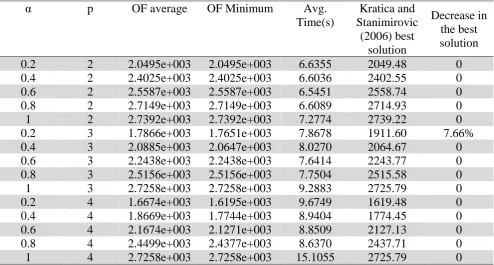
The pseudo code of the Dijkstra’s algorithm is illustrated in Fig. 2 to provide the respected reader with a general view of the algorithm. The obtained results of the SA and GA will guide the respected reader to suitably choose between these two different categories of metaheuristics for coping with different real size problems of UMApHCP. Pseudo code for the proposed GA is presented in the following:
STEP 1: Generate Npop random solutions.
STEP 2: Calculate fitness function for each solution
In this step a Dijkstra’s algorithm is implemented to calculate the fitness of each solution. (The Dijkstra’s pseudo code is shown in Fig. 2). For each solution, Dijkstra’s algorithm is run by number of genes times. For example, if a chromosome has n genes (number of nodes) Dijkstra’s algorithm will be run n times for that solution in order to calculate the minimum distance of every node from other nodes. The maximum of these distances is regarded as the fitness function of that solution and the goal of the GA is minimizing it.
STEP 3: Sort the solutions based on their fitness values.
STEP 5: Select good solutions by Tournament selection method and crossover a fraction of them and move to the new generation
STEP 5: Mutate a number of solutions and transfer them to the new generation.
STEP 6: Check if the termination criteria are met. If so, terminate the algorithm otherwise, go to STEP 2.
Function Dijkstra (Graph, Source):
for each vertex v in Graph: dist[v] := infinity;
previous pv[ := undefined; end for;
dist[Source] :=0;
Q := the set of all nodes in graph;
While Q is not empty:
u := vertex in Q with smallest distance in dist []; if dist [u] = infinity:
break; endif;
remove u from Q;
for each neighbor v of u:
alt := dist [u] + dist_between(u, v); if alt < dist [v]:
dist[v] := alt; previous [v] := u; decrease-key v in Q; end if;
end for; end while;
return dist[]; end Dijkstra.
Fig. 2. Dijkstra's algorithm pseudo code (Taken from contributors (2014))
3.1.1. Solution representation
In this GA implementation the binary encoding of individuals is used. Each solution is represented by the binary string of length n. Gene 1 in the genetic code denotes that particular hub is established, while 0 shows it is not. Since users can be assigned only to open hub facilities, only array 𝑧𝑧𝑘𝑘is obtained from the genetic code.
3.1.2. Selection
3.1.3. Crossover operator
The Crossover operator employed in the proposed GA is just like the operator employed by Kratica and Stanimirovic (2006). Here, the operator is elaborated in detail. Generally, crossover operator executes a swap between two random parts of a selected pair of parents producing two offsprings. However, because of the specific structure of the solution representation, where number of ones stands for number of hubs, this action will yield infeasible solution. To cope with the problem, Kratica and Stanimirovic (2006) proposed a modified version of the classical crossover operator. In this version, the operator is simultaneously tracing the genetic codes of the parents from right to left searching the position i on which the first parent has 1 and second 0. The individuals exchange genes on the found position (that is identified as crossover point), and similar process is performed starting from the left side of genetic codes. Operator seeks for the position j where the first parent is 0 and the other one is 1. Genes of the jth position are swapped while the total number of located hubs remains unaffected. The process is repeated until j ≥ i.
3.1.4. Mutation Operator
Each offspring produced by crossover operator is mutated only one time by probability of MutateRate. If a random number chosen uniformly between [0,1] is less than MutateRate, two genes, one with value 1 and the other with value 0, are randomly selected from the chromosome and their values are exchanged. This Mutation procedure keeps the feasibility characteristics of the solutions.
3.2. Simulated annealing
Simulated annealing whose name come from annealing in metallurgy is a suitable probabilistic algorithm for finding the optimum value of a cost function that may have several local minima. This is a single solution based method that starts with an initial solution and searches the neighbors of that solution in each iteration by a local search mechanism. In fact, SA emulates the physical process of slowly cooling of a material to increase the size of its crystals and reduce their defects. One important advantage of using SA is its simple implementation. The pseudo code is really straightforward and the idea behind the algorithm could be easily understood. The pseudo code of the algorithm used in this paper is briefly presented below:
𝑟𝑟= 0,𝑇𝑇=𝑇𝑇0,𝐵𝐵𝐵𝐵𝐵𝐵𝐵𝐵𝐵𝐵𝐵𝐵𝐵𝐵 =∅
𝐺𝐺𝐵𝐵𝑛𝑛𝐵𝐵𝑟𝑟𝐺𝐺𝐵𝐵𝐵𝐵𝐼𝐼𝑛𝑛𝑖𝑖𝐵𝐵𝑖𝑖𝐺𝐺𝐵𝐵𝐵𝐵𝐵𝐵𝐵𝐵𝑠𝑠𝐵𝐵𝑖𝑖𝐵𝐵𝑛𝑛𝑋𝑋0
𝐵𝐵𝐵𝐵𝐵𝐵𝐵𝐵𝐵𝐵𝐵𝐵𝐵𝐵= 𝑋𝑋0
{𝑊𝑊ℎ𝑖𝑖𝐵𝐵𝐵𝐵𝑟𝑟<𝑅𝑅𝑑𝑑𝐵𝐵 (𝑂𝑂𝑠𝑠𝐵𝐵𝐵𝐵𝑟𝑟𝐵𝐵𝐵𝐵𝐵𝐵𝑝𝑝)
𝑛𝑛 = 0
〈𝑊𝑊ℎ𝑖𝑖𝐵𝐵𝐵𝐵𝑛𝑛< 𝑁𝑁𝑑𝑑𝐵𝐵(𝐼𝐼𝑛𝑛𝑛𝑛𝐵𝐵𝑟𝑟𝐵𝐵𝐵𝐵𝐵𝐵𝑝𝑝)
𝐵𝐵𝐵𝐵𝐵𝐵𝐵𝐵𝑐𝑐𝐵𝐵𝐺𝐺𝑚𝑚𝐵𝐵𝑚𝑚𝐵𝐵𝑟𝑟𝐺𝐺𝑛𝑛𝑑𝑑𝐵𝐵𝑚𝑚𝐵𝐵𝑦𝑦𝐺𝐺𝑛𝑛𝑑𝑑𝑟𝑟𝑠𝑠𝑛𝑛𝐵𝐵𝑚𝑚𝐵𝐵𝑟𝑟𝑋𝑋𝑛𝑛𝐺𝐺𝐵𝐵∆𝐶𝐶 =𝐶𝐶𝐵𝐵𝐵𝐵𝐵𝐵(𝑋𝑋𝑛𝑛𝑛𝑛𝑛𝑛)− 𝐶𝐶𝐵𝐵𝐵𝐵𝐵𝐵(𝐵𝐵𝐵𝐵𝐵𝐵𝐵𝐵𝐵𝐵𝐵𝐵𝐵𝐵)
𝑖𝑖𝑖𝑖∆𝐶𝐶 < 0 𝐵𝐵ℎ𝐵𝐵𝑛𝑛
𝐵𝐵𝐵𝐵𝐵𝐵𝐵𝐵𝐵𝐵𝐵𝐵𝐵𝐵 =𝑋𝑋𝑛𝑛𝑛𝑛𝑛𝑛𝐺𝐺𝑛𝑛𝑑𝑑𝑋𝑋𝑛𝑛 = 𝑋𝑋𝑛𝑛𝑛𝑛𝑛𝑛
𝐸𝐸𝐵𝐵𝐵𝐵𝐵𝐵
𝐵𝐵𝐵𝐵𝐵𝐵𝑍𝑍= exp (−∆𝐶𝐶
𝑇𝑇𝑟𝑟)
𝑖𝑖𝑖𝑖𝑦𝑦 <𝑍𝑍𝐵𝐵ℎ𝐵𝐵𝑛𝑛𝑋𝑋𝑛𝑛 =𝑋𝑋𝑛𝑛𝑛𝑛𝑛𝑛
𝑛𝑛 =𝑛𝑛+ 1〉
𝑟𝑟=𝑟𝑟+ 1
𝑇𝑇𝑟𝑟 =𝐴𝐴𝐵𝐵𝑝𝑝ℎ𝐺𝐺×𝑇𝑇𝑟𝑟−1}
𝑅𝑅𝐵𝐵𝐵𝐵𝑠𝑠𝑟𝑟𝑛𝑛𝐵𝐵𝐵𝐵𝐵𝐵𝐵𝐵𝐵𝐵𝐵𝐵𝐵𝐵𝐺𝐺𝐵𝐵𝐵𝐵ℎ𝐵𝐵𝐵𝐵𝑝𝑝𝐵𝐵𝑖𝑖𝑚𝑚𝑠𝑠𝑚𝑚
Remark. 𝐶𝐶𝐵𝐵𝐵𝐵𝐵𝐵(𝑋𝑋) denotes the objective function value of solution X. Thus, a calculation similar to that one mentioned in STEP 2 of the proposed GA is required.
Remark. In the inner loop of the proposed SA, a local search is performed on the current solution. A non-hub node of the current solution is randomly selected and changed to a hub and an arbitrarily chosen hub is changed to a non-hub node. Thus, at each inner loop iteration only two digits of the solution are changed.
The respected reader should keep in mind that the solution representation of the SA is just like the one employed in genetic algorithm. (A string of digits where 1 denotes a hub node and 0 denotes a non-hub one).
4. Results and discussions
In this section, the performance of the proposed algorithms above is assessed and compared using two sets of modified ORLIB instances. The proposed algorithms were programmed in MATLAB (R2009a) software and were run on a PC with 2.2 GHz CPU and 2.0 GB RAM. The first set of test problem instances belong to Civil Aeronautics Board (CAB) data set based on airline passenger flow between cities of the United States. The instances we used for analysis have 25 nodes, 2, 3 or 4 hubs and 𝛼𝛼 values from 0.2 to 1. The other data set is of Australian Post (AP) that is drawn from study of postal delivery system. The instances used in this paper for assessment have 200 nodes, a maximum of 25 hubs and 𝛼𝛼 =
0.75.
4.1. Parameter tuning
As is known, the quality of genetic algorithm and simulated annealing solutions is significantly influenced by its parameter. Thus, considering the objective function values of these algorithms as a response of input parameters, response surface methodology (RSM) can be perfectly applied to optimize the parameter values. In most RSM applications, the form of the relationship between the response and the input variables is unknown. Therefore, finding an appropriate approximation for the true functional relationship between y (response) and the set of independent variables is the first step in RSM.
2 0
1 1 1
k k k k
i i ij i j ii i
i i i j i
y β β x β x x β x ε
= = < =
= +
∑
+∑∑
+∑
+ (16)By analyzing the second order model the optimum parameter values will be determined. The convergence of RSM is negatively affected by an increase in the number of independent variables. Thus, it is encouraging to keep the number of input variables at a minimum. To do so, we first set 𝑁𝑁 = 40,𝐴𝐴𝐵𝐵𝑝𝑝ℎ𝐺𝐺 =
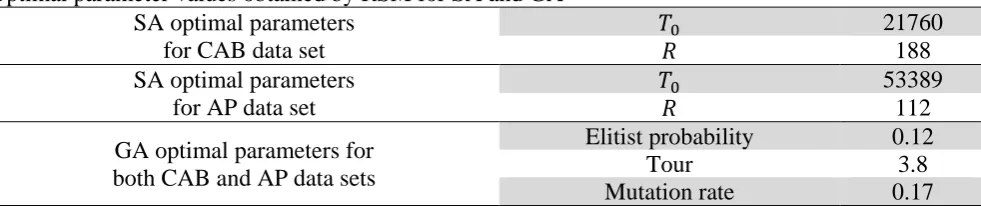
0.9 for SA and Number of generations = 100 for GA using a trial-and-error approach. Afterward, we let RSM choose the optimum values of 𝑇𝑇0,𝑅𝑅 and Elitist probability, Tour and Mutation rate for both SA and GA and for both CAB and AP data sets. Table 2 shows the initial values we considered for SA and GA parameters.
Table 2
Initial parameter values of SA and GA for RSM
SA initial parameters 𝑇𝑇0 30000
𝑅𝑅 150
GA initial parameters
Elitist probability 0.2
Tour 4
Mutation rate 0.1
In order to fit the second-order models, central composite design (CCD) which is a very effective design is employed. Commonly, CCD consists of a 2𝑘𝑘factorial (or fractional factorial of resolution V) with 𝑛𝑛𝐹𝐹 runs, 2𝑘𝑘 axial runs and 𝑛𝑛𝐶𝐶center runs. Our CCD created by MATLAB software for 3 input variables, contains 𝑛𝑛𝐹𝐹 = 8 factorial runs, 6 axial runs and 𝑛𝑛𝐶𝐶 = 10 center runs. Considering rotatability property, parameter 𝛼𝛼 (distance of axial runs from the design center) is set to 1.6818 (= (𝑛𝑛𝐹𝐹)1�4 = √4 8).
Rotatability is needed to have a consistent variance of the predicted response at different set of parameter values. The optimum parameter values obtained by RSM methodology for SA and GA based on the experiments designed above are shown in Table 3.
Table 3
Optimal parameter values obtained by RSM for SA and GA SA optimal parameters
for CAB data set
𝑇𝑇0 21760
𝑅𝑅 188
SA optimal parameters for AP data set
𝑇𝑇0 53389
𝑅𝑅 112
GA optimal parameters for both CAB and AP data sets
Elitist probability 0.12
Tour 3.8
Mutation rate 0.17
4.2. Discussions
Table 4 shows the results of the SA for different CAB data set instances. Likewise, the outputs of the GA for the same test problem instances are provided in Table 5.
Table 4
Results of the SA for different CAB data set instances
α p OF average OF Minimum Avg.
Time(s)
Kratica and Stanimirovic
(2006) best solution
Decrease in the best solution
0.2 2 2.0495e+003 2.0495e+003 4.3746 2049.48 0
0.4 2 2.4025e+003 2.4025e+003 4.4543 2402.55 0
0.6 2 2.5587e+003 2.5587e+003 4.4305 2558.74 0
0.8 2 2.7149e+003 2.7149e+003 4.4813 2714.93 0
1 2 2.7392e+003 2.7392e+003 4.4631 2739.22 0
0.2 3 1.7729e+003 1.7651e+003 17.0272 1911.60 7.66%
0.4 3 2.0673e+003 2.0647e+003 17.5873 2064.67 0
0.6 3 2.2438e+003 2.2438e+003 18.1846 2243.77 0
0.8 3 2.5156e+003 2.5156e+003 18.9688 2515.58 0
1 3 2.7258e+003 2.7258e+003 24.5331 2725.79 0
0.2 4 1.6585e+003 1.6195e+003 28.7445 1619.48 0
0.4 4 1.8111e+003 1.7744e+003 25.4180 1774.45 0
0.6 4 2.1293e+003 2.1271e+003 28.0046 2127.13 0
0.8 4 2.4377e+003 2.4377e+003 29.1487 2437.71 0
1 4 2.7258e+003 2.7258e+003 76.9415 2725.79 0
Table 5
Results of the GA for different CAB data set instances
α p OF average OF Minimum Avg.
Time(s)
Kratica and Stanimirovic
(2006) best solution
Decrease in the best solution
0.2 2 2.0495e+003 2.0495e+003 6.6355 2049.48 0
0.4 2 2.4025e+003 2.4025e+003 6.6036 2402.55 0
0.6 2 2.5587e+003 2.5587e+003 6.5451 2558.74 0
0.8 2 2.7149e+003 2.7149e+003 6.6089 2714.93 0
1 2 2.7392e+003 2.7392e+003 7.2774 2739.22 0
0.2 3 1.7866e+003 1.7651e+003 7.8678 1911.60 7.66%
0.4 3 2.0885e+003 2.0647e+003 8.0270 2064.67 0
0.6 3 2.2438e+003 2.2438e+003 7.6414 2243.77 0
0.8 3 2.5156e+003 2.5156e+003 7.7504 2515.58 0
1 3 2.7258e+003 2.7258e+003 9.2883 2725.79 0
0.2 4 1.6674e+003 1.6195e+003 9.6749 1619.48 0
0.4 4 1.8669e+003 1.7744e+003 8.9404 1774.45 0
0.6 4 2.1674e+003 2.1271e+003 8.8509 2127.13 0
0.8 4 2.4499e+003 2.4377e+003 8.6370 2437.71 0
1 4 2.7258e+003 2.7258e+003 15.1055 2725.79 0
Observing the results of the proposed algorithms in Tables 4 and 5, the following conclusions can be drawn for CAB data set:
2. The proposed GA is computationally more efficient than the SA because needs less time to solve larger CAB instances although for the smaller ones the SA performs better.
3. The average of obtained objective function values for the SA are less than or equal to those of the GA and hence, from the quality of solutions view point the SA shows greater performance.
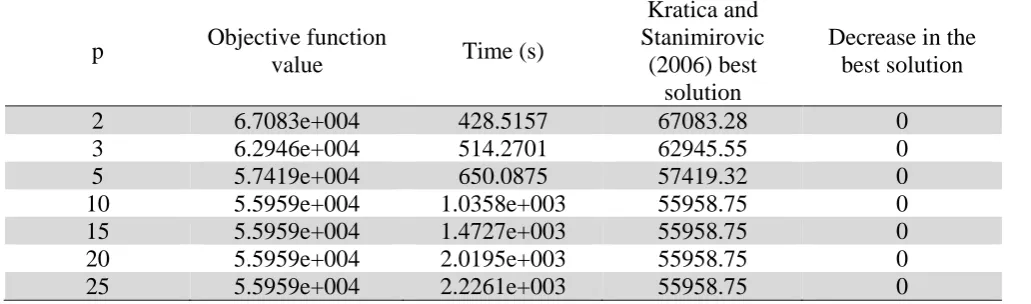
For AP data set, both SA and GA were run for five times and the best obtained results are presented in Tables 6 and 7.
Table 6
Results of the GA for different AP data set instances
p Objective function
value Time (s)
Kratica and Stanimirovic
(2006) best solution
Decrease in the best solution
2 6.7083e+004 428.5157 67083.28 0
3 6.2946e+004 514.2701 62945.55 0
5 5.7419e+004 650.0875 57419.32 0
10 5.5959e+004 1.0358e+003 55958.75 0
15 5.5959e+004 1.4727e+003 55958.75 0
20 5.5959e+004 2.0195e+003 55958.75 0
25 5.5959e+004 2.2261e+003 55958.75 0
Table 7
Results of the SA for different AP data set instances
p Objective function
value Time (s)
Kratica and Stanimirovic
(2006) best solution
Decrease in the best solution
2 6.7083e+004 691.7911 67083.28 0
3 6.2550e+004 1.2726e+003 62945.55 0.63%
5 5.7419e+004 1.9504e+003 57419.32 0
10 5.5959e+004 1.6374e+003 55958.75 0
15 5.5959e+004 2.1720e+003 55958.75 0
20 5.6003e+004 3.1328e+003 55958.75 0
25 5.5959e+004 3.6111e+003 55958.75 0
5. Conclusion
Since p-hub center has been lately introduced and has a specific objective function (minimizing the maximum cost between origin-destination nodes), there are few studies investigating the problem and the challenges for solving it. Because of the specific structure of the problem Dijkstra’s algorithm could be successfully used in order to find the shortest path from each node to any other node. Using the information obtained from running Dijkstra’s algorithm once for each node, one can minimize the maximum length between any origin/destination nodes which is exactly equivalent with solving a UMApHCP. In this paper, two well-known metaheuristics were adapted to suit to solving the NP-hard problem. The computational results of applying the proposed algorithms (SA and GA) shows that for smaller scale test problems, single solution-based SA shows greater performance versus GA but for larger scales of data sets the GA generally yield more desirable solutions.
References
Alumur, S., & Kara, B. Y. (2008). Network hub location problems: The state of the art. European Journal of Operational Research, 190(1), 1-21.
Bashiri, M., Mirzaei, M., & Randall, M. (2013). Modeling fuzzy capacitated p-hub center problem and a genetic algorithm solution. Applied Mathematical Modelling, 37(5), 3513-3525.
Baumgartner, S. (2003). Polyhedral analysis of hub center problems (Doctoral dissertation, Technische Universität Kaiserslautern).
Campbell, A. M., Lowe, T. J., & Zhang, L. (2007). The p-hub center allocation problem. European Journal of Operational Research, 176(2), 819-835.
Campbell, J. F. (1994). Integer programming formulations of discrete hub location problems. European Journal of Operational Research, 72(2), 387-405.
Campbell, J. F., & O'Kelly, M. E. (2012). Twenty-five years of hub location research. Transportation Science, 46(2), 153-169.
Contreras, I., Cordeau, J. F., & Laporte, G. (2011). Stochastic uncapacitated hub location. European Journal of Operational Research, 212(3), 518-528.
Contributors, W. (2014). Dijkstra's algorithm. Wikipedia, The Free Encyclopedia. .
Ernst, A. T., Hamacher, H., Jiang, H., Krishnamoorthy, M., & Woeginger, G. (2009). Uncapacitated single and multiple allocation p-hub center problems.Computers & Operations Research, 36(7), 2230-2241.
Farahani, R. Z., Hekmatfar, M., Arabani, A. B., & Nikbakhsh, E. (2013). Hub location problems: A review of models, classification, solution techniques, and applications. Computers & Industrial Engineering, 64(4), 1096-1109.
Gavriliouk, E. O. (2009). Aggregation in hub location problems. Computers & Operations Research, 36(12), 3136-3142.
Hult, E., Jiang, H., & Ralph, D. (2014). Exact computational approaches to a stochastic uncapacitated single allocation p-hub center problem. Computational Optimization and Applications, 59(1-2), 185-200.
Kara, B. Y., & Tansel, B. C. (2000). On the single-assignment p-hub center problem. European Journal of Operational Research, 125(3), 648-655.
Kratica, J., & Stanimirović, Z. (2006). Solving the uncapacitated multiple allocation p-hub center problem by genetic algorithm. Asia-Pacific Journal of Operational Research, 23(04), 425-437.
Liang, H. (2013). The hardness and approximation of the star -hub center problem. Operations Research Letters, 41, 138-141.
Meyer, T., Ernst, A. T., & Krishnamoorthy, M. (2009). A 2-phase algorithm for solving the single allocation p-hub center problem. Computers & Operations Research, 36(12), 3143-3151.
Mohammadi, M., Tavakkoli-Moghaddam, R., & Rostami, H. (2011b). A multi-objective imperialist competitive algorithm for a capacitated hub covering location problem. International Journal of Industrial Engineering Computations, 2, 671-688.
Pamuk, F. S., & Sepil, C. (2001). A solution to the hub center problem via a single-relocation algorithm with tabu search. IIE Transactions, 33(5), 399-411.
Sim, T., Lowe, T.J., & Thomas, B.W. (2009). The stochastic -hub center problem with service-level constraints. Computers & Operations Research 36(12), 3166-3177.
Yaman, H., & Elloumi, S. (2012). Star p-hub center problem and star p-hub median problem with bounded path lengths. Computers & Operations Research, 39, 2725-2732.
Yaman, H., Kara, B.Y., & Tansel, B.Ç. (2007). The latest arrival hub location problem for cargo delivery systems with stopovers. Transportation Research Part B: Methodological, 41, 906-919.
Yang, K., Liu, Y.-K., & Yang, G.-Q. (2013a). Solving fuzzy p-hub center problem by genetic algorithm incorporating local search. Applied Soft Computing, 13, 2624-2632.
Yang, K., Liu, Y., &Yang, G. (2013b). An improved hybrid particle swarm optimization algorithm for fuzzy p-hub center problem. Computers & Industrial Engineering, 64, 133-142.