PCA plus LDA on Wavelet Co-occurrence Histogram
Features for Texture Classification and its Applications
Shivashankar S.
Dept. of Computer Science Karnatak Science College, Dharwad,
Karnataka, India
Hiremath P.S.
Dept. of Computer Science, Gulbarga University, Gulbarga,
Karnataka, India
ABSTRACT
In this paper, we propose a combined approach, namely, PCA plus LDA on Wavelet Co-occurrence Histogram Features (WCHF) for texture classification. The texture features are extracted using the Wavelet Co-occurrence Histogram (WCH) from wavelet decomposed images, which capture the information about relationships between each high frequency subband and that in low frequency subband of the wavelet transformed image at the corresponding level. The correlation between the subbands at the same resolution exhibits a strong relationship, indicating that this information is significant for characterizing a texture. Thus WCH features thus extracted form a feature vector of dimension 384 for gray scale image which is very high. A combination of Principal Component Analysis (PCA) and Linear Discriminant Analysis (LDA) is applied on WCH feature vector for dimensionality reduction and enhancement of the class separability respectively. The vectors obtained from the LDA are representative of each image. The classification performance is tested on a set of 32 Brodatz textures. The results are compared with the method proposed in [Hiremath and Shivashankar, 2008]. The effectiveness of proposed method is demonstrated for two different applications, i.e., CBIR and script identification (both printed and handwritten). The classification performance is analyzed using the k-NN classifier. It is evident from the experimental results that the proposed method exhibits superior performance in the reduced feature set.
Keywords
Texture classification; PCA and LDA; Wavelet; CBIR; document image; script identification
1.
INTRODUCTION
In human vision, the texture analysis plays a significant role in object recognition by the human brain. Thus, in the computer vision, the object recognition algorithms rely on the effectiveness of texture analysis. Textures provide important characteristics for surface and object identification from aerial or satellite photographs, biomedical images and many other types of images. The texture classification is fundamental to many applications such as automated visual inspection, biomedical image processing, content based image retrieval, script identification and remote sensing. Much research work has been done on the texture classification and segmentation for the last four decades. Despite these efforts, the texture classification is still considered an interesting but difficult problem in image processing. Suppose there is a finite number of texture classes Ci, i = 1,2,3,…,n, and a number of
training samples of each class are available. Based on the information extracted from the training samples, a decision
rule is designed which classifies a given sample of unknown class into one of the n classes.
To design an effective algorithm for the texture classification, it is essential to find a set of texture features with good discriminating power. More recently, a number of new algorithms for extracting features from the coefficients of a wavelet transform have been proposed in the literature. In each of these feature extraction techniques, the filter coefficients for each subband are analyzed separately. Moreover, the correlation between the bands of the same and that at the different resolution levels is ignored, even though it is well-known that strong relationships between the neighbour bands exist. Portilla and Simoncelli have shown that without knowledge of these relations, accurate reconstruction of the texture is not possible, indicating that this information is significant for characterizing a texture [14]. However, Hiremath and Shivashankar proposed a texture feature extraction method based on the co-occurrence histograms of wavelet decomposed images, which capture the information about relationships between each high frequency subband and that in low frequency subband of the transformed image at the corresponding level. The features extracted form a feature vector of dimensionality 384 for the gray scale image [13]. Despite having excellent discriminative power, the feature set suffers from high dimensionality.
This high dimensionality of the feature vectors creates problems in constructing efficient data structures for classification. One of the problems with high-dimensional feature sets is that, in many cases, not all the measured features are important. For this reason, there is considerable interest in reducing the dimensionality of the descriptors while preserving the original topology of the high dimensional space. An ideal dimensionality reduction technique has the capability of efficiently reducing the data into a lower-dimensional model, while preserving the properties of the original data. The traditional and current state-of-the-art dimension reduction methods are published in the statistics, signal processing and machine learning literature.
Motivated by the success and power of the two-phase framework (PCA plus LDA) in pattern classification tasks, the objective of the present paper is to propose PCA plus LDA on Wavelet Co-occurrence Histogram Features (WCHF) for texture classification. The classification performance of the proposed approach is tested on a set of 32 Brodatz textures using k-NN classifier[1]. The results are compared with the method proposed in [13]. It is evident from the experimental results that the proposed method exhibits superior performance in the reduced feature set. The proposed method is applied on two different applications, namely, CBIR and script identification. First, in case of CBIR, the retrieval efficiency is considerably increased when compared to that with the original feature set. Second, in case
of document script identification, the proposed scheme has been tested on eight Indian language scripts including English and the results are encouraging. The rest of the paper is organized as follows: In the Section 2, the proposed system is discussed in detail. In Section 3, the results of the classification experiments done on the Brodatz texture images using the proposed are analyzed. The applications to CBIR and script identification problems are discussed in the Section 4. Finally Section 5 concludes the discussion.
2.
PROPOSED METHOD
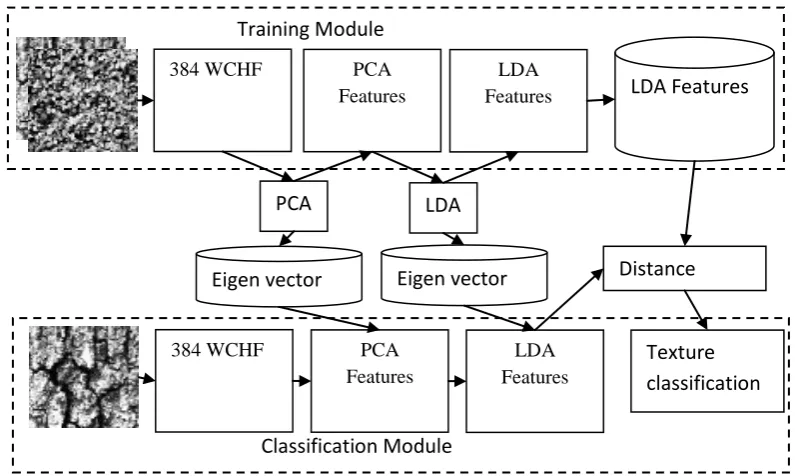
[image:2.595.99.497.246.484.2]The Fig. 1 represents the architecture of the proposed system, which consists of two modules, namely, training module and classification modules, which are described below.
Fig.1 Architecture of the proposed system
2.1
Texture Training Module
Each texture image is subdivided into 16 equal sized blocks out of which 8 randomly chosen blocks are used as the training samples and the remaining blocks are used as the test samples for that texture class.
2.1.1. Wavelet feature
We extract WCHF from each texture sample [Hiremath and Shivashankar, 2008]. The ith texture sample is represented by a t dimensional vector (where t=384), i=1,2,…,8. These
features are extracted using Wavelet Co-occurrence Histogram (WCH) from wavelet decomposed images, which capture the information about relationships between each high frequency subband and that in low frequency subband of the transformed image at the corresponding level. The correlation between the subbands at the same resolution exhibits a strong relationship, indicating that this information is significant for characterizing a texture. The vectors obtained in this manner from all 8 training samples will be denoted by the feature vector . Further these features are used for
2.1.2. The PCA subspace
Given a set of data, the PCA finds the linear lower-dimensional representation of the data such that the variance of the reconstructed data is preserved [9.10,11]. So, the main idea behind using PCA in our approach is to reduce the dimensionality of the WCHF.
Given a t dimensional vector representation of each sample, the PCA is used to find a subspace whose basis vectors correspond to the maximum-variance directions in the original space. Let W represent the linear transformation that maps the original t-dimensional space onto a f-dimensional feature subspace where normally . The new feature vectors are defined by . The columns of W are the eigenvectors obtained by solving the eigenstructure decomposition , where Q= is the covariance matrix and the eigenvalue associated with the eigenvector . Before obtaining the eigenvectors of Q, the eigen vectors are normalized such that =1 in order to make the system invariant to the intensity of the illumination
384 WCHF PCA
Features
LDA
Features
LDA Features
PCA
LDA
Training Module
Eigen vector
Eigen vector
384 WCHF PCA
2.1.3.The LDA subspace
The LDA searches for those vectors in the underlying space that best discriminate among classes (rather than those that best describe the data). Thus, given a number of independent features relative to which the data is described, LDA creates a linear combination of these which yields the largest mean differences between the desired classes. Mathematically speaking, for all the samples of all classes, we define two measures; namely, within-class scatter matrix and between-class scatter matrix.
The within-class scatter matrix , is defined by
where is the sample of class j, is the mean of class j, C is the number of classes, and the number of samples in class j.
The between-class scatter matrix is defined by
where represents the mean of all classes.
The goal is to maximize the between-class measure while minimizing the within-class measure, which is achieved by maximizing the ratio . The advantage of using this ratio is that it has been proven [8] , if is a nonsingular matrix then this ratio is maximized when the column vectors of the projection matrix, W, are the eigenvectors of It should be noted that: (i) There are at most C-1 nonzero generalized eigenvectors and, so, an upper bound on f is C -
1,(ii) We require at least f + C samples to guarantee that does not become singular (which is almost impossible in any realistic application). To solve this, [7] and [10] have proposed to use PCA subspace as an intermediate space. Thus, the original t-dimensional space is projected onto an intermediate f-dimensional space using PCA and then onto a final g-dimensional space using LDA. These LDA features for each image are stored in the database, which is further used for texture classification.
2.2
Texture Classification Module
In the classification phase, the 384 WCHF are extracted from the test sample as described in the Section 2.1.1. These features are projected on PCA eigen vectors to obtain PCA feature subspace of dimensionality 40 as explained in the Section 2.1.2. Further, these features are projected on LDA eigen vectors, which generate LDA feature subspace as explained in the Section 2.1.3. These LDA features are compared with those stored in the feature database by using the Euclidian distance.
where, N is the number of features, represents feature of the test sample X, while represents the feature of the texture class in the feature database. Then, the test texture X is classified using the k-Nearest Neighbor classifier [15]. In the k-NN classifier, a test sample is classified by a majority vote of its neighbors, with the test sample being assigned the class most common among its k-nearest neighbors, where k is a positive integer, it is helpful to choose k to be an odd number as this avoids difficulties with tied votes.
[image:3.595.165.439.469.676.2]
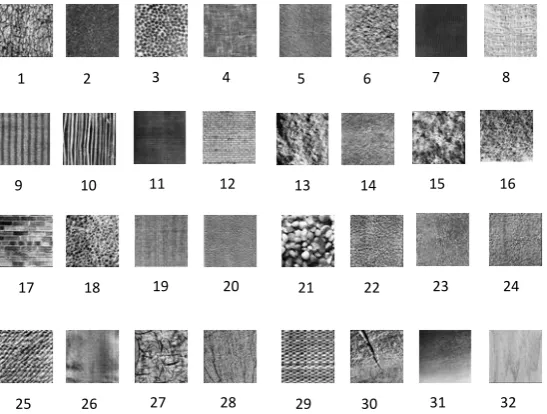
Fig. 2 Texture images from Brodatz album. The image Nos 1 to 32 correspond to the texture Sl.No. 1 to 32 in Table 1, respectively.
1 2 3 4 5 6 7 8
9 10 11 12 13 14 15 16
17 18 19 20 21 22 23 24
3.
EXPERIMENTAL RESULTS
3.1 Experimental data
In order to assess the discrimination capability of a wavelet based feature set, we have performed experiments tests using the same data presented in [13], where we define 32 test categories from the selected images of Brodatz (1966) collection as shown in the Fig. 2. For the 32-category problem, the texture samples are obtained from a 256X256 image with 256 gray levels. Each image is subdivided into 16 blocks of 64 X64 pixels and each block is transformed into a new block by 900 rotation. This produced 1024 blocks. Half of the data set is selected by randomly choosing 8 blocks and the corresponding transformed blocks, which define the texture classes. The remaining blocks are used to evaluate the classification process.
3.2 Classification results
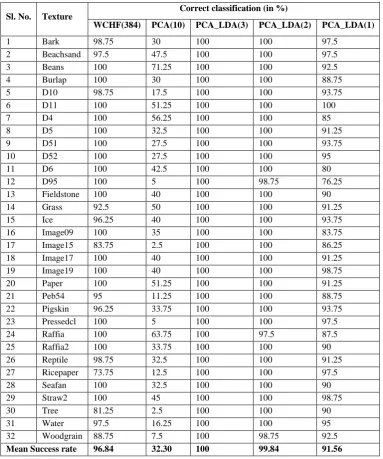
[image:4.595.107.491.288.748.2]The Table 1 represents classification performance for different approaches using k-NN classifier with k=3. The WCHF(384) denotes the classification accuracy with wavelet co-occurrence histogram features of dimensionality 384, the PCA(10) specifies the classification accuracy after applying the PCA on WCHF and considering only first 10 eigen vectors after projecting the features on eigen vectors, whereas PCA_LDA(3), PCA_LDA(2), PCA_LDA(1) denote the classification accuracies after applying LDA on PCA and considering only 3,2,1 eigen values, respectively. It is evident from the results that the proposed method exhibits superior performance in the reduced feature subspace. The classification efficacy is 100% for proposed method based on only 3 features whereas it is 96.84% for the original feature set which is based on wavelet co-occurrence histogram having 384 features.
Table-1 - Average classification accuracies (%) over 10 experiments for 32 texture category
Sl. No. Texture
Correct classification (in %)
WCHF(384) PCA(10) PCA_LDA(3) PCA_LDA(2) PCA_LDA(1)
1 Bark 98.75 30 100 100 97.5
2 Beachsand 97.5 47.5 100 100 97.5
3 Beans 100 71.25 100 100 92.5
4 Burlap 100 30 100 100 88.75
5 D10 98.75 17.5 100 100 93.75
6 D11 100 51.25 100 100 100
7 D4 100 56.25 100 100 85
8 D5 100 32.5 100 100 91.25
9 D51 100 27.5 100 100 93.75
10 D52 100 27.5 100 100 95
11 D6 100 42.5 100 100 80
12 D95 100 5 100 98.75 76.25
13 Fieldstone 100 40 100 100 90
14 Grass 92.5 50 100 100 91.25
15 Ice 96.25 40 100 100 93.75
16 Image09 100 35 100 100 83.75
17 Image15 83.75 2.5 100 100 86.25
18 Image17 100 40 100 100 91.25
19 Image19 100 40 100 100 98.75
20 Paper 100 51.25 100 100 91.25
21 Peb54 95 11.25 100 100 88.75
22 Pigskin 96.25 33.75 100 100 93.75
23 Pressedcl 100 5 100 100 97.5
24 Raffia 100 63.75 100 97.5 87.5
25 Raffia2 100 33.75 100 100 90
26 Reptile 98.75 32.5 100 100 91.25
27 Ricepaper 73.75 12.5 100 100 97.5
28 Seafan 100 32.5 100 100 90
29 Straw2 100 45 100 100 98.75
30 Tree 81.25 2.5 100 100 90
4.
APPLICATIONS
The efficacy of the proposed method for texture classification is demonstrated by considering two applications, namely, content based image retrieval (CBIR) and document image script identification.
4.1 Application to CBIR
With an ever-increasing use and demand for digital images in the areas of medicine, engineering, sciences, digital photography, and advertisement. The importance of content-based image retrieval (CBIR) is on the rise and is considered as a subject of intense research [18]. The CBIR technique focuses on searching for images in database which are similar to the query image according to the image features related to content. This technique is based on automatic extraction of image features, and then image retrieval automatically by comparing the features of query image (such as color, shape, texture, etc.) with the corresponding features in image feature library, and finally presents the best matching images and its corresponding information.
The proposed system is implemented on WANG database[17], which is a subset of Corel images consisting of 1000 images of natural scenes divided into 10 labeled categories of 100 images each. These images were arranged in 10 semantic groups: tribesmen, elephants, horses, flowers,
foods, greek architecture, buses, Dinosaurs, mountains, and beaches.
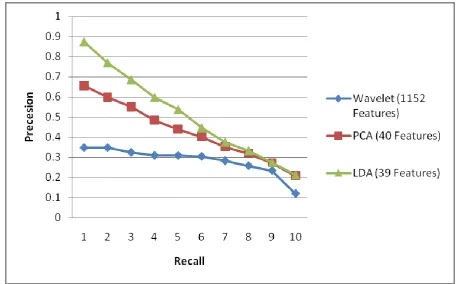
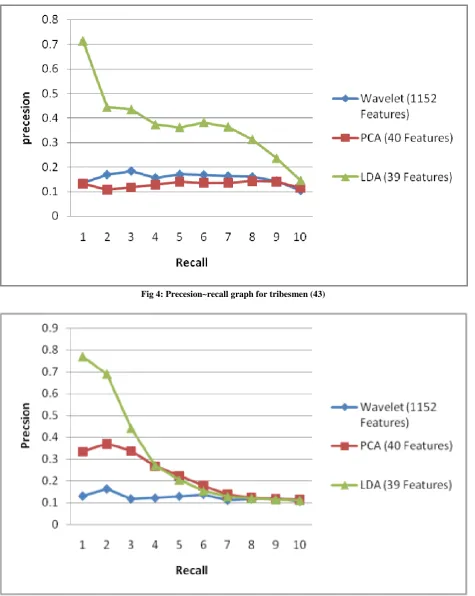
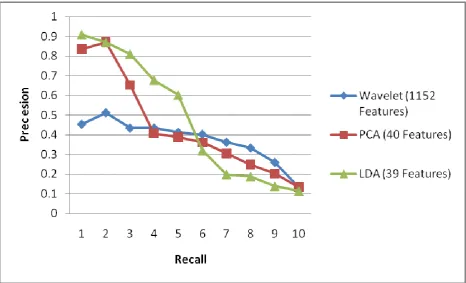
In these experiments, the features are extracted by considering whole image ( i.e., non-segmented approach). The experimental results of the proposed method are compared with WCHF extracted on each of the Red, Green and Blue bands (1152 features), PCA (40 features) and PCA+LDA (39 features). The Fig. 3 shows a precesion~recall graph with the averaging done over 10 query images one image randomly choosen from each category. It is evident that the result of the proposed method outperforms the other two methods in the reduced feature set (i.e., retrieval efficiency is 87% for proposed method, 66% for PCA and 35% for original set based on wavelet features). The precesion~recall graph for few queries are shown in the Fig. 4-7. The Fig. 8 shows the sample query images and top 10 retrievals for each query obtained by the proposed method. The first image is the query image, followed by the corresponding retrieved images. We are able to retrieve all the top 10 images for the categories, namely, buses, Dinosaurs, flowers, horses and mountains. For the greek architecture, elephants and food categories the top 9 images are of the same category, the top 8 images are from the tribesman category, whereas a poor results of only 6 images are retrieved for beaches category.
[image:5.595.68.526.374.658.2].
Fig 4: Precesion~recall graph for tribesmen (43)
Fig 6: Precesion~recall for graph Elephant (510)
Fig. 8 Sample query image followed by top ten retrievals in ten examples.
4.2. Application to Script Identification
Although a great number of optical character reader (OCR) techniques have been developed over the years, almost all the existing works on OCR make an important implicit assumption that the script and/or language of the document to be processed is known a priori. In practice, this implies that human intervention in identifying the script/language of each document is essential, which severely restricts its utility. For minimal human involvement, there should be an automatic mechanism where by the language of the input document is first identified and the appropriate OCR module is then selected. Since each script often has a distinctive visual appearance, a block of text in a script document (regardless of content) may be considered as a texture. Therefore, the problem of script identification may be tackled by means of the texture classification [2, 16]. This observation motivates us to utilize the proposed texture classification algorithm for the script identification. A texture based approach does not
Table 2. Average classification accuracies (%) for different printed scripts Wavelet PCA(3) PCA_LDA(1) PCA_LDA(2)
Bengali 86.4 99.1 98.8 100
English 90.4 99.8 99.2 100
Hindi 96.1 99.9 100 100
Kannada 88.8 99.3 96.1 100
Malayalam 93.3 99.6 96.9 100
Tamil 85 98.7 99.5 100
Telgu 86.9 98.1 97 100
Urdu 99.7 100 100 100
Average 90.825 99.31 98.438 100
Fig. 10. Some sample image of the handwritten scripts used for the identification problem (Left to right row 1: Bengali, English, Hindi, Kannada, row 2: Malayalam, Tamil, Telugu, Urdu)
[image:9.595.146.450.285.438.2] [image:9.595.158.440.505.636.2]Table 3. Average classification accuracies (%) for different hand written scripts Wavelet PCA(3) PCA_LDA(1) PCA_LDA(2)
Kannada 99.6 100 97.7 100
English 100 100 100 100
Tamil 83.6 92.5 99.9 100
Urdu 100 100 100 100
Telugu 96.8 97.5 100 100
Bengali 100 100 100 100
Hindi 100 100 97 100
Malayalam 100 100 100 100
Average 97.5 98.75 99.325 100
5. CONCLUSION
In the computer vision, the object recognition algorithms rely on the effectiveness of texture analysis. In this paper, a combined approach, namely, proposed PCA plus LDA on Wavelet Co-occurrence histogram features for texture classification is proposed. Wavelet co-occurrence histogram features capture the information about relationships between each high frequency subbands and that in low frequency subband of the transformed image at the corresponding level. From the experimental results, we observe that:
1. The texture classification performance is improved upto 100% with only 3 features.
2. In case of CBIR, the retrieval efficiency is 87% for proposed method with 39 features as compared to 66% for PCA with 40 features and 35% for original 1152 WCHF. 3. In case of both printed and handwritten document images, the script identification is 100% for proposed method with only 2 features.
It is evident from experimental results that the proposed method is effective in terms of both dimension reduction and the classification accuracy in comparison with PCA and WCHF.
6. ACKNOWLEDGEMENTS
Authors are indebted to the reviewers for their helpful comments.
7. REFERENCES
[1]. Brodatz, P., 1966. Textures: A Photographic Album for Artists and Designers. Dover, New York.
[2]. Busch, A., Boles, W.W., Sridharan, S., 2005. Texture for script identification. IEEE Trans. Pattern Anal. Machine Intell. 27 (11), 1720–1732.
[3]. C. Chiu, H. Lin, S. Yang., 2003. A Fuzzy Logic CBIR System. The IEEE International Conference on Fuzzy Systems. pp. 1171- 1176.
[4]. C.M. Bishop.,1995. Neural Networks for Pattern Recognition. Oxford University Press.
[5]. Carlton W. Niblack, Ron Barber, Will Equitz, Myron D. Flickner, Eduardo H. Glasman, Dragutin Petkovic, Peter Yanker, Christos Faloutsos, and Gabriel Taubin, 1993.
[6]. Chang, T., and C.C.J.Kuo. 1993. Texture analysis and classification with tree-structured wavelet transform. IEEE Trans. on Image Processing 2(4):429-441.
[7]. Crandell. 1994. Projects in scientific computation. Springer-Verlag, New York:197- 198,211-212.
[8]. D. J. Hand., 1981. Discrimination and Classification. New York: John Wiley.
[9]. D. Swets, and J. Weng, Oct. 1996. “Discriminant Analysis and Eigenspace Partition Tree for Face and Object Recognition from Views, ” In Proc. IEEE International Conference on Automatic Face and Gesture Recognition, pp.192 - 197.
[10].D.L. Swets and J.J. Weng, Aug. 1996. “Using Discriminant Eigenfeatures for Image Retrieval,” IEEE Trans. Pattern Analysis and Machine Intelligence, vol. 18, no. 8, pp. 831-836.
[11].F. Li, Q. Dai, W. Xu. , 2006. Improved Similarity-Based Online Feature Selection In Region-Based Image Retrieval. IEEE. ICME. pp. 349-352 .
[12].Jian Yang, Jing-yu Yang, 2003. “Why can LDA be performed in PCA transformed space”, Pattern Recognition, 36, 563-566.
[13].P.S. Hiremath, S. Shivashankar, 2008. “Wavelet based co-occurrence histogram features for texture classification with an application to script identification in a document image”, Pattern Recognition Letters 29, 1182–1189.
[14].Portilla, Javier, Simoncelli, E.P., 2000. A parametric texture model based on joint statistics of complex wavelet coefficients. Internat. J. Comput. Vision 40 (1), 49–70.
[15].R.O. Duda, P.E. Hart, D.G. Stork, 2001. Pattern Classification, Wiley, New York.
[16].Tan, T.N., 1998. Rotation invariant texture features and their use in automatic script identification. IEEE Trans. Pattern Anal. Machine Intell. 20 (7), 751–756.
[17].Wang database, http://wang.ist.psu.edu/.