Successful software adoption - A study of Software
implementation methodologies
Madhusudan Varadaraj
Research Scholar, PES Institute of Technology
Rajajinagar, Bangalore 10
Nagalingappa Goud
Director and Professor, BNM Insititute of Technology
BSK II Stage, Bangalore 85
ABSTRACT
Software applications are being implemented by many organizations and in many countries. Traditionally most software vendors have a common global framework for implementation.
The results of a survey amongst the major packaged software vendors and system integration partners involved in the field of Enterprise resource planning and Product Lifecycle management are analyzed and the challenges in successful implementation of the projects are discussed. This research paper compares the aspects of project management and organizational change management covered in their software implementation methodologies.
The study suggests that challenges in people change management need to be addressed in a comprehensive manner with a need to incorporate the country specific cultural aspects towards managing the resistance of end users within the framework of the software implementation methodology..
General Terms
Project Management , Organizational Change Management, Software methodology.
Keywords
Software Implementation, Methodology, Organizational Change Management, Project Management , Resistance to change.
1.
INTRODUCTION
Many organizations today consider implementation of Packaged software as a driver for transforming their organization and bringing about a change in the organization. It is not just the technology that is being implemented, but processes are re-engineered and people are re-organized to perform better in the organization. Processes are made more agile and lean to the requirements of business needs and non-value added activities of people are removed, so as to maximize the output of the human intellectual and make them focus on their core activities.
The success of a software implementation depends a lot on people adopting and accepting this new process and technology. Also this implementation needs to be on time, within the budget and to the right quality. Reputed software vendors and system integrators rely a lot on their software implementation. A robust methodology that includes all the project management aspects are very essential. In addition to the project management, this methodology needs to
incorporate all the aspects of organizational change management, as there is a need to address the “Resistance to change” from people in the organization. A poor implementation process of software could prove to be very expensive for an organization and may be counterproductive.
A successful software implementation and adoption requires to address four elements, namely, commitment from leadership, the right technology, the right business process and getting it right with the people inside the organization towards adoption of this technology.
The aim of this research paper is to study of the software implementation methodologies of major software vendors and system integrators and identify the gaps if any in their approach, with specific focus in the area of People issues and change management.
2.
SOFTWARE IMPLEMENTATION
METHODOLOGIES
A software implementation methodology is a lifeblood for any packaged software vendor or system integrators implementing the packaged software.
BusinessDictionary.com defines methodology as “A system of broad principles or rules from which specific methods or procedures may be derived to interpret or solve different problems within the scope of a particular discipline. Unlike an algorithm, a methodology is not a formula but a set of practices”. The primary reason for packaged software vendors and implementation partners to consider an implementation methodology is to ensure
a. A Consistent and repeatable delivery of the software product
b. Provide visibility to the all the parties involved in the software implementation, both inside and outside the organization.
c. Control costs and deliver to commitments made in terms of quality and time.
d. Successful adoption of the software with the customers to ensure they derive the benefits of implementation and also provide a reference to other prospective customers in future.
Institute(PMI) and AGILE a software product delivery framework,
Software implementation in early days followed a waterfall methodology. Projects were quite large and were in a new area where the customers were early adopters of the technology solution and software vendors and implementation partners were also interested in managing the scope and defining the requirements clearly to deliver the solution. This sequential and often heavy approach made many customers to demand a more flexible and iterative approach to software implementation. This lead to the development of agile methodologies. In this agile process, the focus was on using the best processes through empowered teams, customer involvement and the ability to analyze and quickly control changes to the project scope at the inception and throughout the lifecycle of the project. The focus in this methodology is primarily on managing the technology aspects and many other areas, like project level budgeting, contracts, risks, human resource management, cost management and integration management are not addressed to much detail. Also organizational change management has also not been addressed completely in agile methodologies.
The project management body of knowledge is the sum of knowledge within the profession of project management. These are more general in nature and widely accepted practices spanning across multiple industry domains. It is therefore acknowledged by PMBOK that it is constantly evolving, based on its application across various domains. The major areas of project management that are addressed as a part of the PMBOK are
a. Project Integration Management, which includes development of project charter , preliminary project scope definition with a project management plan, managing project execution, with monitoring and control aspects , Integrated change control and finally project closure management.
b. Project Scope Management which includes Scope planning, definition, work breakdown structures, scope verification and control
c. Project Time Management which includes activity definition, sequencing, resource estimation with duration and schedules and schedule control. d. Project Cost management which includes cost
estimation, budgeting and control
e. Project Quality management which includes Quality Planning, quality assurance and quality control. f. Project human resource management which
includes human resource planning, acquiring project teams, development and management of the teams. g. Project communications management which
includes communications planning, information distribution, performance reporting and managing stakeholders
h. Project risk management which includes risk management planning, risk identification, qualitative and quantitative risk analysis, risk response planning and risk monitoring and control. i. Project procurement management which includes
the aspects of purchases, contracts and contract administration and closure.
The PMBOK is very exhaustive and addresses the areas as seen from a project management perspective. If we consider the perspective of a software vendor or an implementation partner or a systems integrator, the packaged implementation of the software in a company or organization is a project. It can be seen as a temporary endeavor undertaken to create a unique product, service or result in the organization. However if we look at it from the perspective of the organization that is adopting the software, as a process of transforming the organization, it is more long term and operational in nature. It therefore needs to consider additional aspects of organization change management.
Organizational change management encompasses leadership, engagement, communications, organizational alignment and learning and development and at an individual level the change includes aspects of culture, motivation of the individual and empowerment. This transformation of the people involves the process of anticipating change, preparation, managing, monitoring and measurement to support the stakeholders through the process of transition. This is an essential part of any software or Information technology adoption. In an earlier study done by us at automotive companies implementing software(2009), it was highlighted that people issues are one of the most important factors that determine the success or failure of a software implementation project. In another study done in understanding the resistance issues in software implementation (2011) , cultural issues were seen to influence the type of resistance. People were more expressive in their resistance in western countries, while in the eastern countries like China and India the resistance was more passive and not externally demonstrated.
This leads us to the question if organizational change management has been addressed as a part of PMBOK. The PMBOK in Sections of 4.5 and 5.5 sees change management as a part of an overall integration of best practice of processes that include change requests, approval or rejection of processes and management that includes deliverables, organizational process assets, project documents and project plan. They can include corrective action, preventive action and repairs. This context is quite narrow when we consider organizational change management, but quite exhaustive when we look at it from a project management perspective. Risk management is another area that has been addressed in PMBOK, and could be an area where people issues can be considered. It can therefore be concluded that PMBOK does provide a framework and an underlying foundation to addresses these issues, but does not provide a mechanism in detail to address organization change management, as it does for the other areas of project management.
3.
RESEARCH METHODS
A two step approach was followed to gather the practices in their software delivery methodology. As a first step, a structured questionnaire was designed and administered for data collection from the target companies. We implemented this approach because the data being sought could only be sourced from individuals exposed to their software implementation methodology and are experts within their organization on the topic of their implementation methodology. In addition to this input we were also interested in approaching the right experts who also had experience with customers in implementation and practice of their methodology. The Questionnaires were hosted on a website and the link distributed to participants by email, for completion at their own convenience.
As a next step we conducted a more detailed interview with an expert project manager in Siemens Industry Software and SAP in India. This detailed discussion was done to validate some of the gaps identified in the survey and reconfirm the need to address them in an Indian context.
Further the results were compared with a previous survey done with companies that had implemented software and the challenges they faced in the process of software implementation.
3.1
Survey Measures
A survey was designed and after the study of the various aspects for successful software adoption. The basic details of the organization and methodology were captured. In addition specific questions were formulated to gather inputs for identification of the areas addressed by their methodology. The areas of methodology captured were in
a. Alignment of software product , Technology aspects b. Business Process management
c. Project management aspects. d. End user training
e. People Change f. Organizational Change g. Cultural aspects of Country h. Cultural aspects of Organization Additionally, inputs were gathered to find if
a. These organizations had a separate Change Manager, in addition to a project manager for their projects.
b. Profiling of end users to identify and predict their anticipated resistance towards adoption of software, and
c. Experience with the issues seen in software adoption with customers was also gathered. The survey was specifically sent to known experts in their organization and the respondents were briefed about the research study, as most of these product software vendors and system integrators were competitors in the area of ERP and PLM Software.
The organizations approached for the survey response were SAP, an ERP Company that also offers PLM in their portfolio, Siemens Industry Software a PLM vendor, Dassault Systems a PLM vendor, Parametric Technology a PLM
vendor. The system integrators selected for the survey from India were Tata Consultancy Services ,Hewlett Packard (HP) , Cap Gemini(Sogeti), IBM, HCL Technologies and Accenture. These were large System integrator companies that have a large team to deliver PLM Software in India and also have a global practice to deliver this software across many countries.
4.
RESULTS AND DISCUSSION
4.1
Results Summary
The statistical results of the survey are reported this section. The companies that participated in this survey along with their methodology were
Table 1 : Companies surveyed with their methodology.
Name of Company Methodology Name
[image:3.595.314.545.233.433.2]The summary of the companies’ surveyed is presented below
Fig 1: Survey Results : Product Profile of Companies
The responses for the areas in methodology survey are : a. Aspects that impact successful software
Fig 2: Survey Results : Issues in Adoption
[image:4.595.317.562.131.218.2]b. Completeness of the Methodology: The survey indicated that all the methodologies had a addressed project management , business process and Technology Aspects. Only one company addressed cultural aspects of the organization and a select few had their framework to address organizational and people change management aspects.
Fig 3: Survey Results : Methodology Coverage
c. Profiling anticipated End users for resistance in adoption of software : Majority of the surveyed companies indicate that they do not do any profiling for anticipated resistance of software adoption in the company where it is being implemented.
Fig 4: Survey Results : Number of Companies
that profile for resistance of end users
d. A dedicated Change Manager in additional to a project manager: Again a majority of them do not have a dedicated change manager. This seems to be in alignment with the previous question.
Fig 5: Survey Results : Number of companies that have a Change Manager in project
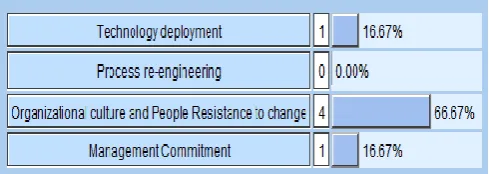
In a Study done earlier with companies that use Product Lifecycle Management and other enterprise software, customers confirmed that the biggest challenge in software implementation was addressing organizational culture and people resistance issues.
Fig 5: Survey Results : Perspective of Companies that implemented software
Overall the survey highlights the deficiency of the software methodologies. Almost all companies agree that people issues are the most important for a successful software implementation, while very few have addressed it systematically with a specialist change manager or profiling of end users. Cultural issues specific to a country are not addressed by any of them.
In order to reconfirm the findings , an interview was conducted further with an expert from Siemens Product Lifecycle Management and SAP in India.
4.2
Siemens Value Delivery Methodology
[image:4.595.89.297.281.421.2]Siemens Industry Software delivers their Product Lifecycle Management (PLM) Software though a Value Delivery Methodology (VDM) . This has a repeatable services delivery process, with checkpoints in their methodology.
Fig 6: Siemens Value Delivery Methodology
The product lifecycle management value delivery methodology (PLM VDM) provides a structured process for delivering a PLM solution. PLM VDM emphasizes the unique aspects of delivering an enterprise-wide solution using Siemens PLM Software products and has been adopted across the Siemens PLM Software services organization.
PLM VDM encompasses both project management and technical delivery work streams. It is structured to allow iterative and flexible project delivery while maintaining “quality gates” and milestones between phases.
The seven methodology phases are:
Pre-align: The purpose of the pre-align phase is to gain a sufficient understanding of customer requirements and scope of the project in order to define the high-level solution outline and statement of work.
[image:4.595.317.544.451.510.2]Plan: In the plan phase, the project team works with the customer to develop the remaining documents that are used to execute and control the project and to develop the technical design
Build: In the build phase, the team works with the customer to create the defined solution, keeping strict adherence to the requirements.
Test: In the test phase, the team validates that the solution is ready for production use
Deploy: In the deploy phase, the team delivers the production-ready solution to the end users
Close: In the close phase, the team assures that all administrative aspects of the project are complete
As seen in this methodology there is a large focus on alignment of the customers requirement with the OOTB(out of the box) Technology Solution and has all the project management aspects in the solution.
In large projects that are transformational in nature, the feedback from project manager indicates a need for managing the “People Change” and adoption issues. This has been managed well by the experience of the project managers, however the methodology as such does not provide prescribe any approach.
4.3
SAP ASAP Delivery Methodology
The ASAP Methodology from SAP is a repeatable and successful approach to implementing the SAP Software. The ASAP Methodology has Five steps and is aligned with the formal project management standards and procedures from PMBOK. This process helps in simplifying and streamlining the delivery process within SAP and with its implementation partners.
ASAP employs three tools , Solution Composer Tool, ASAP roadmaps , and SAP Solution Manager application management solution.
Solution Composer Tool supports a framework to gather the requirements from the customer and define and understand the existing processes of the customer. ASAP describes this as a tool for evaluation, visualization, planning and communication of business process. This helps in aligning the requirements with the SAP Technology.
ASAP Roadmaps outline the activities involved in the implementing, upgrading and enhancing SAP Software. SAP Solution manager is a platform that provides the integrated content, tools, and methodologies needed to implement, support, operate and monitor the SAP Application.
This methodology from SAP is comprehensive and addresses both project management and organization change management. OCM is a layer across all the 5 steps in their methodology and specific approach has been provided to address Leadership, skills, organizational design, governance and compliance, Performance management, incentives and rewards and communications across the organization. The discussions indicated that specific profiling of end users at an individual level for resistance and cultural aspects of the country are still not formally incorporated into this methodology.
This was the only product software company amongst the survey that has elements of organizational change management, as part of their methodology.
5.
SUMMARY OF FINDINGS
The study indicated that all the software vendors and system integrators have a unique methodology for delivery of the software with their customers. The methodology of packaged software vendors were focusing on aligning the requirements of the customer to their out of the box technology Solution, and ensure minimum customization of the software. This ensures the smooth transition to later versions of the software. The system integrators were focusing more on the project management and contractual aspects to manage the scope and change requirements from the technology perspective. The survey amongst the leading PLM and EPR vendors and System integrators confirmed that organization change management and individual people issues and cultural aspects are not addressed in their methodology. Managing People related issues were also seen at the primary factor towards successful adoption of software.
Previous research indicated that customers also see organizational change and resistance as a major success factor for software implementation in their organization.
Overall the focus of the existing packaged software vendors and system integrators was more towards the technology and business process aspects. A Leadership alignment was also addressed for the organizational change management. The methodology was also towards a common global process that was repeatable. People issues at an individual level and cultural aspects of the country and organization were either weak or not present in their methodology.
Addressing this human aspect is a challenge, when multinational organizations focus more on a standard process across the globe. Customers from their perspective also see the human aspect as a major success factor for successful software adoption in their organization. It is therefore important to address this gap of Cultural aspects and people aspects, as they are bound to be different and methodologies should factor this and provide a mechanism to address it as a part of the standard rollout in different countries.
5.1
Limitations
This study has some limitations that are acknowledged with this research .
First, the data collection method used was very structured and administered over the web. This approach did not allow the opportunity to identify, measure and test other significant variables that may be associated with their definition of the methodology. Second, the respondents were identified based the judgment and access of the researchers ,Third, self-reporting on a questionnaire is subjective rather than objective. Finally, respondents may have underestimated or overestimated their responses based on their experience with customers.
Despite these limitations, which are common in most social research, the design and methodology was considered adequate.
6.
AREAS OF FUTURE RESEARCH
software deployment methodologies of large multinational organizations. Addressing the human side of software adoption within an organization is a critical success factor, for organizations embarking on a transformation with their technology implementations. A study of the organizational change models and their applicability to the software domain needs to be further studied.
As this study is also intended to progress in an Indian context, a study of the rich, ancient vedic literature that is a part of the basic cultural life in India can be considered. There are elements in Indian philosophies that can be extracted for the modern management context and studied further for development of a more holistic approach to address the areas of people resistance emanating from change introduced by software implementations.
7.
ACKNOWLEDGMENTS
We would like to thank all the respondents from Siemens Industry Software, Parametric Technology, Dassault systems, SAP India, Novellus, Cap Gemini, Tata Consultancy, HCL Technologies, IBM, HP and Accenture.
A special thanks to KwikSurveys.com for the web survey platform.
8.
REFERENCES
[1] A Guide to the Project Management Book Of Knowledge (PMBOK) 2009 Fourth edition Project Management Institute PA 19073 USA
[2] SAP Services 2008. ASAP: Proven Methodology for fast, successful implementation. Online library SAP http://www.sdn.sap.com/irj/bpx/asap .
[3] SIEMENS PLM Value Delivery Methodology 2010 http://www.plm.automation.siemens.com/en_us/support/ sps.shtml.
[4] Madhusudan.V and Nagalingappa.G. 2009 Greener by Design- Product Lifecycle Management strategies in automotive companies. Indian Institute of Technology, NPDC 09 .