KOLEJ UNIVERSITI TEKNOLOGI TUN HUSSEIN ONN
BORANG PENGESAHAN STATUS TESIS·
JUDUL: SMART THERMAL COMFORT SYSTEM: A DEVELOPMENT OF
THE FUNDAMENTAL CONTROL ALGORITHM.
SESI PENGAJIAN: 2004/2005
Saya SHAZMIN ANIZA BINTI ABDUL SHUKOR
(HURUF BESAR)
mengaku membenarkan tesis (PSM/ Sarjana/ Doktor Falsafah)* ini disimpan di Perpustakaan dengan syarat-syarat kegunaan seperti berikut:
1. Tesis adalah hakmilik Kolej Universiti Teknologi Tun Hussein Onn. 2. Perpustakaan dibenarkan membuat salinan untuk tujuan pengajian sahaja.
3. Perpustakaan dibenarkan membuat salinan tesis ini sebagai bahan pertukaran antara institusi pengajian tinggi.
4. **Sila tandakan (.y)
ILII
sum
(Mengandungi maklumat yang berdaIjah keselamatan atau kepentingan Malaysia seperti yang termaktub di dalam AKTARAHSIARASMI 1972)o
TERHAD (Mengandungi maklumat TERHAD yang telah ditentukan oleh organisasil badan di mana penyelidikan dijalankanII
~
II
T1DAK TERHADAlamat Tetap:
~ \
DJIi~h:t(an oleh
~~-::::---(TANDATM GAN PENYELIA)
14, Tmn. Tok Perdana, Jln Raja Omar, 32000 Sitiawan, Perak Darul Ridzuan.
PM. DR ZAINAL ALAM HARON (Nama Penyelia)
Tarikh: 22 NOVEMBER 2004 Tarikh: 22 NOVEMBER 2004
CATATAN:
*
Potong yang tidak berkenaan.**
Jika tesis ini SULIT atau TERHAD, sila lampirkan surat daripada pihak berkuasa organisasi berkenaan dengan menyetakan sekali sebab dan tempoh tesis ini perlu dikelaskan sebagai SULIT atau TERRAD ."l/ We hereby acknowledge that the scope and quality of this report is qualified for the award of the Bachelor / Master / Doctor of Philosophy degree of
~I~.c;:.tri~HJ.Enw~.~rmg".
Name of Supervisor Date
Signature
: PRQF.,J:?R .. KA.R.L.KQHLHQf
:
2.~.NQY.E~.ER..2.Q.9.4Name of Co-Supervisor:
A.S.SQ.C, ... .F.:.P.R.:.ZAJN.AL.AL.AM . .HMQN
Date : 2.~..
NQY.EM~.ER..2.Q.Q4Signature
Name of Co-Supervisor:
AS.s.QCc.P.R.QfJ2K.2JJ.L.AZHAR.Z.ABJP.JAMtJ.,
SMART THERMAL COMFORT SYSTEM: A DEVELOPMENT OF THE FUNDAMENTAL CONTROL ALGORITHM
SHAZMIN ANIZA BINTI ABDUL SHUKOR
THIS PROJECT REPORT IS SUBMITTED IN
PARTIAL FULFILLMENT OF THE REQUIREMENTS FOR THE DEGREE OF MASTER OF ELECTRICAL ENGINEERING
FACULTY OF ELECTRICAL ENGINEERING KOLEJ UNIVERSITI TEKNOLOGI TUN HUSSEIN ONN
NOVEMBER 2004
II
"All the trademark and copyrights use herein are property of their respective owner. Reference of information from other sources are quoted accordingly; otherwise the
information presented in this report is solely work ofthe author".
Signature ...
U; ... .
Name of Author : .S.H!.\[email protected]~.S.J:HJKO'R.
To my parents, Abdul Shukor Shamsuddin and Hamidah Mohd. Yusop, to my sister, Suriati Akmal, and my fiance, Afdzan Rizal Abdul Razak.
You are my inspiration.
ACKNOWLEDGEMENT
First and foremost, praise to Allah S.w.t. for the given time and energy in developing this project. Without His permission, it is impossible to fmish the task on schedule.
IV
Next, my gratitude goes to Prof. Karl Kohlhoffrom University of Applied Science, Cologne, Germany, for his willingness in supervising this project. His assistance and guidance throughout the whole duration of this project will not be forgotten. Not forgetting to my co-supervisors from Kolej Universiti Teknologi Tun Hussein Onn (KUiTTHO) and Kolej Universiti Kejuruteraan Utara Malaysia
(KUKUM), Assoc. Prof. Dr. Zainal Alam bin Haron and Assoc. Prof. Dr. Zul Azhar bin Zahid Jamal for their help when needed. The encouragement given has always been a
spirit for me
in
carrying out the project.Special thanks to my colleagues - in KUiTTHO, KUKUM as well as from
University of Applied Science Cologne, for their help and guidance
in
ensuring thatthese project a success. To all staff and lecturers of Faculty of Electrical Engineering and Centre for Graduate Studies, KUiTTHO, thank you for their valued time spent in helping and supervising the development of this project.
Last but not least, my appreciation towards everybody who has been involved
v
ABSTRACT
This paper reports on the development of the fundamental algorithm for a smart thermal comfort system. Using Predictive Mean Vote (PMV) as a means of measuring thermal comfort, this system would able the user to define their own expression towards the surroundings, from slightly warm to slightly cold. Here, the operator only needs to
insert its respective value ofPMV (ranging from -1 to
+
1) and the system will generatethe compressor and fan of the air conditioning system so that it will create a thermally comfortable environment, based on the operator's desires. This differentiates the system with the conventional air conditioning system where the operator needs to set separately fan speed and degree of cooling. The PMV value here will be calculated as input instead of the normal PMV equation where these values depend on the air temperature, relative humidity and air velocity. All these parameters values are set from the standard range allowed by the ISO 7730 of thermal comfort at a workplace for sedentary activity. Since previous researches use PMV as the output value, the help of Microsoft Excel is used to obtain air temperature and air velocity for respective values ofPMV. Finally, the
VI
ABSTRAK
Laporan ini menyentuh tentang pembangunan algoritma asas bagi sebuah sistem keselesaan haba yang pintar. Dengan menggunakan 'Predictive Mean Vote (PMV), sebagai cara untuk mengukur peringkat keselesaan haba, sistem ini berupaya untuk membenarkan pengguna mendefinisikan tahap keselesaan masing-masing terhadap persekitaran. Dengan cara ini, pengguna hanya periu memasukkan nilai 'PMV' mereka
(dari -1 ke
+
1) dan berpandukan nilai ini, sistem akan mengawal kompressor dan kipassistem penghawa dingin mengikut kehendak pengguna. Ini dapat menghasilkan situasi selesa kepada pengguna. Kaedah ini berbeza dengan sistem penghawa dingin yang sedia ada memandangkan sistem yang ada sekarang hanya membenarkan pengguna
mengawal keselesaan bilik dengan mengatur nilai suhu bilik dan kelajuan kipas secara manual. Dalam projek ini, nilai 'PMV' akan digunakan sebagai input, berbeza dengan kajian dan projek yang sedia ada yang menggunakan 'PMV' sebagai keluaran. Di sini, nilai 'PMV' bergantung kepada suhu angin, kelembapan dan kelajuan angin. Kesemua parameter ini dikira berdasarkan standard yang dikeluarkan oleh ISO 7730 bagi
TABLE OF CONTENTS
TITLE
TITLE OF THE PROJECT DISCLAIMER
DEDICATION
ACKNOWLEDGEMENT ABSTRACT
ABSTRAK
LIST OF TABLES LIST OF FIGURES LIST OF SYMBOLS LIST OF APPENDIXES
CHAPTER I - INTRODUCTION
1.1 Introduction
1.2 Research Background
1.2.1 Thermal Comfort
1.3 Problem Statement
1.4 Objectives
1.5 Aim / Scope of Research
CHAPTER II - LITERATURE REVIEW
2.1 Thermal Comfort
2.1.1 Physical Parameters
2.1.1.1 Air Temperature
Vlll
2.1.1.2
Air Velocity9
2.1.1.3
Relative Humidity10
2.1.1.4
Mean Radiant Temperature 112.1.2
Physiological Conditions12
2.1.2.1
Clothing's Insulation12
2.1.2.2
Activity 132.2
Microsystem for Smart Control of Thermal Comfort14
2.3
Thermal Comfort Sensor15
2.4
Comfort Sensing System for Indoor Environment16
2.5
Improving Human Thermal Comfort with Smart Clothing17
2.6
A Fuzzy Control System Based on the Human Sensationof Thermal Comfort
18
2.7
Silicon-Based Thermal Comfort Sensing Device19
2.8
Thermal Comfort Sensor based on ProbabilisticEnergy Neural Network
20
2.9
Performance Comparison for Thermal Comfort Sensors21
2.10
Model-Based Method to Measure ThermalComfort in Buildings
21
CHAPTER III - RESEARCH METHODOLOGY
3.1
Studied the thermal comfort background23
3.2
Revised the energy balance equation, PMV equationand all necessary procedures
in
calculating PMV25
3.2.1
Energy balance equation25
3.2.2
PMV equation26
3.2.3
Procedure for the calculation of parameters26
3.3
Calculate PMV value for respective air temperature,relative humidity and air velocity values; reversibly, obtained air temperature and air velocity for different
3.4 Graph plotting of draught rate and air velocity vs. air temperature
3.5 Get polynomial equation for all air velocity vs. air
temperature graphs
3.6 Find interception value ofPMV graph and 0%
turbulence of draught rate graph
3.7 Use results obtained as input values in plotting graphs
of RH vs. T and v vs. T graph
3.8 Divide graph into regions of velocity and temperature
CHAPTER IV - RESULTS AND DISCUSSION
4.1 Results of Calculations from Microsoft Excel
4.2 Obtain Turbulence Equations Values
4.3 Graph and Interception Value Development
4.4 Final Result
CHAPTER V - RECOMMENDATIONS FOR FUTURE WORKS
5.1
Experimentation5.2
Implementation in air conditioning system5.3
Application in software5.4
CommercializeCHAPTER VI - CONCLUSION
x
LIST OF TABLES
NO. OF TABLE TITLE PAGE
2.1 Suitable temperature for different human activity 8
2.2 Occupants reaction to room air motion 10
2.3 Example of metabolic rates 14
4.1 The fundamental value in the calculation 31
4.2 The air temperature values at v = 0.1 mls 32
4.3 Air temperature values at v = 0.2 mls 32
4.4 Air temperature values at v = 0.3 mls 33
4.5 Air temperature values at v = 0.4 mls 33
4.6 Air temperature values at v = 0.5 mls 34
4.7 Turbulence Values 35
XI
LIST OF FIGURES
NO. OF FIGURE TITLE PAGE
1.1 The relationship between PMV and PPD 3
1.2 Recent air conditioning system 5
1.3 The air conditioning system control knob. Users tend to misuse it - thus produce an unhealthy environment and
consume extra energy 6
2.1 Example of Clo scale 13
2.2 Thermal Comfort Sensor 16
2.3 A block diagram of the PMV -indicator 17
2.4 The diagrammatic plan of the undershirt 18
2.5 Schematic diagram of the thermal comfort sensing device 19 2.6 Fabrication steps of the thermal comfort sensing device 19
2.7 PENN for thermal comfort sensor 20
3.1 The flow chart of methodology 24
3.2 The 7 -point thennal sensation scale of PMV 26
4.1 Graph v vs. T and turbulence for RH = 0% 36
4.2 Graph v vs. T and turbulence for RH = 10% 36
4.3 Graph v vs. T and turbulence for RH = 20% 37
4.4 Graph v vs. T and turbulence for RH = 30% 37
4.5 Graph v vs. T and turbulence for RH = 40% 38
4.6 Graph v vs. T and turbulence for RH = 50% 38
4.7 Graph v vs. T and turbulence for RH = 60% 39
4.8 Graph v vs. T and turbulence for RH = 70% 39
xu
4.10 Graph v vs. T and turbulence for RH
=
90% 40 4.11 Graph v vs. T and turbulence for RH=
100% 414.12 The final graph 42
4.13 The air temperature and velocity region 44
4.14 Example of functionality for RH
=
70% 454.15 Example of functionality for RH
=
50% 46Xlll
LIST OF SYMBOLS
Cres
Respiratory convective heat exchangeDR Draught Rate
Ec Evaporative heat exchange at the skin
Eres
Respiratory evaporative heat exchange£;;1 Clothing area factor
l1c Convective heat transfer coefficient
H Dry heat loss
leI Clothing insulation
M Metabolic rate
Pa Humidity
PMV Predicted Mean Vote
PPD Predicted Percentage of Dissatisfied
RH Relative Humidity
T, ta Air temperature
tel
Clothing surface temperaturetr, MRT Mean Radiant Temperature
tsk Mean skin temperature
Tu Turbulence intensity
v Air velocity
Var Relative Mean Air Velocity
LIST OF APPENDICES
APPENDIX
A B
C
D
Gantt chart
Metabolic rate value table Clo values table
Fundamental Calculations
TITLE PAGE
54 55 56 58
1
CHAPTER I
INTRODUCTION
1.1 Introduction
Thennal comfort has always been very important in human life, as it
contributes towards health and welfare of human beings. People can work, play and do whatever activity they intended with ease when the surroundings have achieved its thennal comfort. History and recent situation show that man has always
attempted very hard to create a thennally comfortable environment.
Thennal comfort is being defined as a condition of mind that expresses satisfaction with the thennal ambience. The physical basis of comfort lies in the thennal balance of the body. The heat produced by the body's metabolism must be dissipated to the environment; otherwise, the body would overheat. In other words, if the rate of heat transfer is higher than the rate of heat production, the body cools down and we feel cold; if the rate is lower, we feel hot [1].
2
In summer or for tropical countries like Malaysia, the use of air conditioners and fans are very ess'ential in creating thennal comfort inside a room. The recent situation of the air conditioning system only allows the operator to manually control the cooling compressor and the ventilation fan by controlling the temperature switch. But, in this situation, the humidity content of the air is neither detected nor regulated. Here, the occupants would set the degree of cooling and the fan speed according to hislher choice intention and they tend to set to maximum cooling, which yield to uncomfortable climate problem according to the standard as well as consuming extra energy.
From the above problem, therefore it is important to develop a smart thermal comfort system for air-conditioned rooms, which allows the climate control system to consider not only the temperature but also other parameters as well.
1.2 Research Background
1.2.1 Thermal Comfort
Human has always work hard in creating a thermally comfortable
environment. It is very important to establish and maintain appropriate conditions for thermal comfort as it contributes towards positive effect on health and quality of life.
In a thermal comfort measurement, the system monitors on six variables _ four physical parameters and two physiological conditions - like air temperature, relative humidity, air velocity, mean radiant temperature, clothing insulation and human's level of activity. All the physical parameters are expected to be measured and calculated using electronic devices, such as sensor.
3
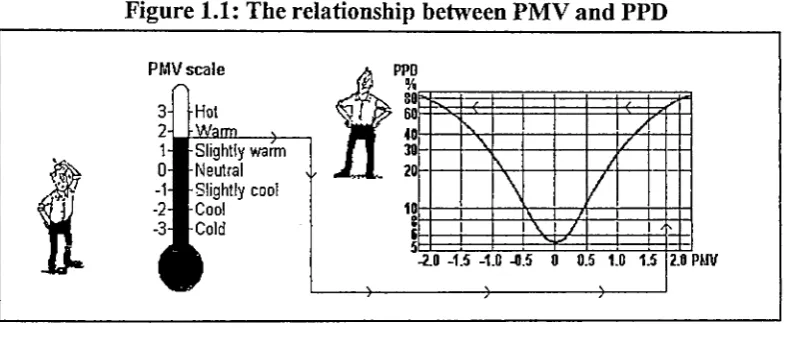
One of the methods to determine thennal comfort, in fact is going to be used in this study, is through the Predictive Mean Vote (PMV) index. The PMV-index predicts the mean value of the subjective ratings of a group of people in a given environment [2].
The PMV scale is a seven-point thennal-sensation scale ranging from-3 (cold) to +3 (hot), where
°
represents the thermally neutral sensation. Even when the PMV-index is 0, there will still be some individuals who are dissatisfied with the temperature level, regardless of the fact that they are all dressed similarly and have the same level of activity - as comfort evaluation differs a little from person to person.To predict how many people are dissatisfied in a given thermal environment, the PPD-index (Predicted Percentage of Dissatisfied) has been introduced. In the PPD-index people who vote -3, -2, +2, +3 on the PMV scale are regarded as
thermally dissatisfied. Notice that the curve showing the relationship between PMV and PPD never gets below 5% dissatisfied. Figure below shows on how the
[image:21.595.117.512.585.755.2]relationship works.
Figure 1.1: The relationship between PMV and PPD
PMVscale
.... :::illahtlV warm
1.3 Problem Statement
In the present type of air conditioning systems the room's occupants are allowed to control the system as they needed. Thus, as they feel hot and
uncomfortable with the room's climate, they tend to control the system into maximum cooling. This yields to uncomfortable climate - too cold environment would bring diseases such as cold, fever and stiff neck - as well as energy consuming. Actually, the cooling method used by the system can be replaced by blowing for better consumption of energy, since it allows the creation of thermally comfortable environment through higher air velocity and higher air temperature compared to before (as air temperature controls the air conditioning's compressor and air velocity controls the fan).
Most of the commercial system and sensor to measure thermal comfort available in the market at the moment is constructed by a macroscopic system, which is not suitable to be implemented. Therefore, by using MEMS technology, it is possible to build a system to measure the thermal comfort in the room.
Microsystem is being preferred due to: • High accuracy and sensitivity
• Capable to facilitate measurement of air velocity • Lower power consumption
4
Figure 1.2: Recent air conditioning system
Client's request Air temperatur'e (T =16 .•. 24°C)
Fan speed (medium,high)
Macrosensor
Electric
Air conditioner
r---~----~ r---~----~
Fan
I
I<:O,"p~so..1
1.4 Objectives
The objectives of this project are:
• To study the concept ofthennal comfort
• To understand on the parameters that detennine thennal comfort • To evaluate thennal comfort through PMV
5
• To define the calculations, graphs and equations needed in a thennal comfort system
1.5 Aim I Scope of Research
system would also provides with advantages -lower energy consumption at lower cost and able to prevent any uncomfortable feelings towards operators.
[image:24.595.214.388.171.262.2]6
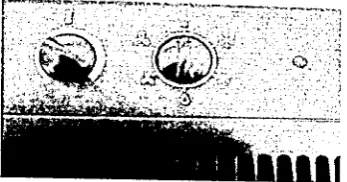
Figure 1.3: The air conditioning system control knob. Users tend to misuse it-thus produce an unhealthy environment and consume extra energy
:l;. I' .... ~ "'~ "," t~ • ~ •