THE BACKGROUND AND CHALLENGES FACED BY THE SMALL MEDIUM ENTERPRISES: A HUMAN RESOURCE DEVELOPMENT PERSPECTIVE
Siti Sarah Omar¹ & Lawrence Arokiasamy² ¹University Tun Hussein Onn Malaysia, MALAYSIA
²University Tunku Abdul Rahman, MALAYSIA [email protected] & [email protected]
Abstract
In the recent years, a number of emerging issues are posing serious challenges to the small and medium sized enterprises (SME’s) in Malaysia. Hence, these enterprises enter the new era, dramatic challenges begun such as establishing new enterprises, globalization, financial constraints, high turnover, low motivation among employees, lack of human capital building, and many more challenges. Thus understanding the problems and challenges are a fundamental solution to expand and strategies SME’s to future progress and grows. Therefore this article examines the background and challenges faces by SME’s which is play a vital role in the nation growth. The uniqueness of this paper focuses on the human resource development perspective which is important for SME’s to progress and competitive. Finally, this article maps out how future research can be more sensitive to how SME’s actually do develop their own human resource development for future development. Keywords: training and development, small medium sized enterprises, and human resource development
INTRODUCTION
The increasing demand of the SMEs is a recognized feature of most nations. In Malaysia, this norm is no exception. In vision 2020 to be fully developed and industrialized nation by the year 2020, and future progress to be seen depend greatly upon development of SMEs. In the 2020, the country will be developing to industrialize by capitalizing on the country’s strengths and able to overcome weaknesses.
In response to the drastic changes, SMEs play an important role in developing country to the higher level. According Schlogl (2004) stated that small and medium-sized firms dominate our economies in terms of employment and number of companies, yet their full potential remains remarkably untapped. Although there is a broad assumption the SMEs generally has positive effects on country economic growth, the notion of economic imperatives for SMEs remains largely untested. Hence, this paper attempts to look into background and challenges faced by the SMEs.
The literature based paper begins by defining the Small and Medium Enterprises (SMEs) and the background of SMEs in Malaysia. It then explores the roles of the SMEs in the economic development and challenges faced. The discussion leads to consideration on the importance of Human Resource Development (HRD) taking into account the SMEs. The final section concludes the important of SMEs in economic development.
DEFINITION OF SMALL AND MEDIUM SIZED ENTERPRISES (SMES)
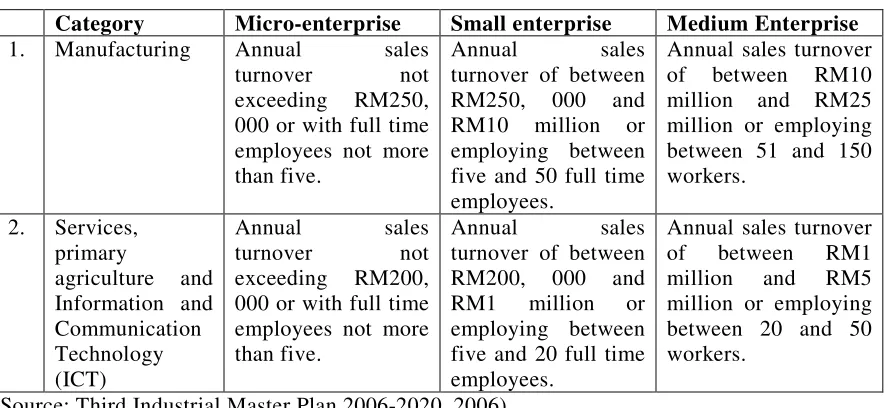
RM5 million’. These SMEs are further categorized into medium-sized companies, small enterprises and micro-enterprises, as indicated in Table 1 as below.
Table 1: Definitions of SMEs
Category Micro-enterprise Small enterprise Medium Enterprise 1. Manufacturing Annual sales
turnover not exceeding RM250, 000 or with full time employees not more than five.
Annual sales turnover of between RM250, 000 and RM10 million or employing between five and 50 full time employees.
Annual sales turnover of between RM10 million and RM25 million or employing between 51 and 150 workers.
2. Services, primary
agriculture and Information and Communication Technology (ICT)
Annual sales turnover not exceeding RM200, 000 or with full time employees not more than five.
Annual sales turnover of between RM200, 000 and RM1 million or employing between five and 20 full time employees.
Annual sales turnover of between RM1 million and RM5 million or employing between 20 and 50 workers.
(Source: Third Industrial Master Plan 2006-2020, 2006)
Background of SMEs in Malaysia
It is reported by Malaysian Department of Statistics as at 2003, that there were 523,132 total establishments in Malaysia which SMEs accounted the most for 99.2% (518,996). While only 0.8 percent remaining were occupied by large companies. SMEs comprise three key economic sectors namely manufacturing, services and agriculture. Micro establishments constitute the largest number with more than three quarters out of total SMEs formations. They are primarily represented in the services and agriculture sectors with the proportions for 80.4 and 93.3 percent respectively. Small companies make up of 18.4 percent and medium companies 2.2 per cent. The manufacturing sector also having the same pattern nevertheless the percentage of micro firms was lower (55.3 percent), while small firms accounted 39.5 percent (Normah, 2007). According to Khairuddin (2000), the SMEs in Malaysia may be categorized into three components; (1) general business, (2) manufacturing and (3) agricultures. The general business sector was includes in construction, wholesaling and retailing, transport and storage, business services and activities, and providing services such as hotel and restaurant. Main activities in the manufacturing sector consist of processing and production of raw materials. The agriculture sector was involved in rubber, oil palm, paddy, coconuts, fruits, and vegetables. From the three components; manufacturing sector has emerged as the most important for SMEs in Malaysia. Below are descriptions of the three components in details.
(i) Manufacturing Sector
Table 2: Distribution of Small and Medium Enterprises in manufacturing by Sub-Sector
SMEs Sub-sector Total Establishments Number of
Number Share (%)
Total 39,219 37,866 100.0
Textile and apparel 8,855 8,779 23.2
Food and beverages 5,804 5,664 15.0
Metals and metals products 4,809 4,686 12.4 Paper, printing and publishing 3,549 3,483 9.2
Furniture 2,352 2,286 6.0
Rubber and plastics products 2,343 2,166 5.7
Wood and wood products 2,149 2,052 5.4
Non-metallic mineral products 1,708 1,650 4.4
Machinery and equipment 1,435 1,390 3.7
Electrical and electronics 1,362 1,077 2.8
Chemicals and chemicals products 1,115 1,047 2.8
Transport equipment 769 699 1.8
General manufacturing 2,969 2,887 7.6
(Source: Census of Establishments and Enterprise, 2005)
In correspond to geographical location, Saleh and Ndubisi (2006) found that a vast number of manufacturing companies in Malaysia located in the West Coast of Malaysia which is industrialized location and equip with ports services. They found that Johor has the largest concentration of manufacturing companies such as textiles and apparel and wood based industries with 17.5 percent, followed by Selangor (16.7 percent), Perak (9.4 percent) and Pulau Pinang (8.7 percent). Johor was being the leader of the countries because of the accessibility of cheap labour and logging activities in there.
(ii) General business
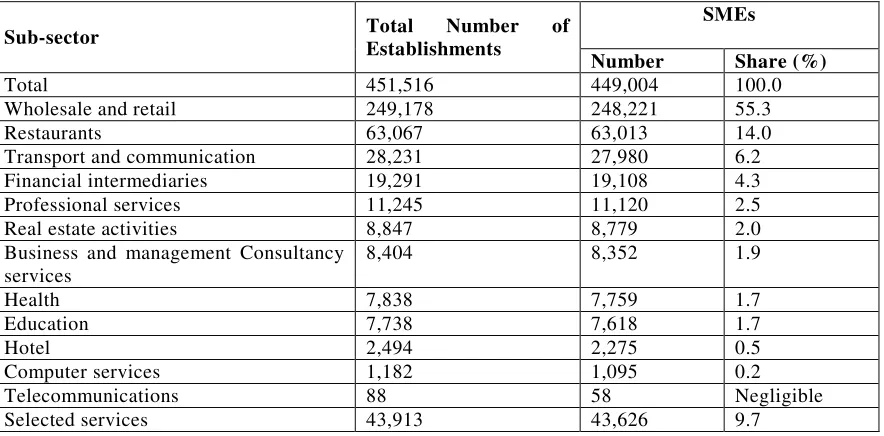
In the general business or service sector, about 449,004 out of total establishments were SMEs which constitute 99.4 percent. In the sector, 69.3 percent of SMEs were in the distributive trade (wholesale, retail and restaurants), followed by transport and communication (6.2 percent), financial intermediaries (4.3 percent) and professional services (2.5 percent). Table 3 has shows the detail of establishments by this sub-sector.
Table 3: Distribution of Small and Medium Enterprises in services by Sub-Sector
SMEs Sub-sector Total Establishments Number of
Number Share (%)
Total 451,516 449,004 100.0
Wholesale and retail 249,178 248,221 55.3
Restaurants 63,067 63,013 14.0
Transport and communication 28,231 27,980 6.2
Financial intermediaries 19,291 19,108 4.3
Professional services 11,245 11,120 2.5
Real estate activities 8,847 8,779 2.0
Business and management Consultancy
services 8,404 8,352 1.9
Health 7,838 7,759 1.7
Education 7,738 7,618 1.7
Hotel 2,494 2,275 0.5
Computer services 1,182 1,095 0.2
Telecommunications 88 58 Negligible
Selected services 43,913 43,626 9.7
[image:3.595.83.525.534.752.2]Saleh and Ndubisi (2006) mentioned the list of activities for the transportation and communication sub-sector services such as logistics and freight forwarding services, storage and warehousing, road haulage, sea and inland transport, highway operations, courier services, public bus transport, car parking services.
Meanwhile, a professional sub-sector service is defined under the Malaysian Standard Industrial Classification such as (1) Non-technical related: legal, accounting, business and management consultancy, advertising and (2) Technical related: architectural, engineering, surveying and other technical activities.
(iii) Agriculture Sector
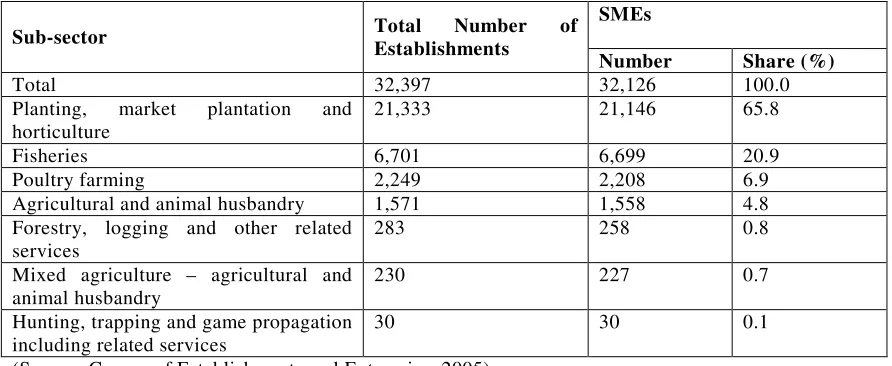
[image:4.595.79.525.353.536.2]In the agriculture sector, out of 32,397 active companies 99.2 percent were SMEs. Based on SMEs total establishments, 65.8 percent were in the planting, market plantation and horticulture, followed by fisheries (20.9 percent), poultry farming (6.9 percent) and agricultural and animal husbandry services (4.8 percent). Refer Table 4 for detailed number of firms and proportions. Normah (2007) mentions the concentration of SMEs in the states has a close relationship with the dominant economic activity. In Kedah where agriculture is the main stay of the economy, the number of SMEs was the largest with 8,803 (27.4 percent) followed by the east coast states with 26.6 percent.
Table 4: Distribution of Small and Medium Enterprises in agriculture by Sub-Sector
SMEs Sub-sector Total Establishments Number of
Number Share (%)
Total 32,397 32,126 100.0
Planting, market plantation and
horticulture 21,333 21,146 65.8
Fisheries 6,701 6,699 20.9
Poultry farming 2,249 2,208 6.9
Agricultural and animal husbandry 1,571 1,558 4.8 Forestry, logging and other related
services 283 258 0.8
Mixed agriculture – agricultural and
animal husbandry 230 227 0.7
Hunting, trapping and game propagation
including related services 30 30 0.1
(Source: Census of Establishments and Enterprise, 2005)
Impact of SMEs on Malaysian Economy
SMEs play a vital role in the development of Malaysian economy. Its contributions resulted in big impacts to the economy as a whole. SMEs are also important trader and service providers to primary industries. Furthermore, a large number of SMEs are also producers of finished goods and services. Collectively, these SMEs contributed to the growth of manufacturing, services and agriculture sectors, as well as ICT services, in terms of output, value-added, employment and exports (Industrial Malaysia Plan, 2006). Additionally, Hashim and Wafa (2002) also mention that SMEs offer employment opportunities, initiate improvement, accelerate competition and support big company.
Table 5: Output and value added by Sector, 2003
Output
(RM billion) Value added (RM billion)
Sector Total SMEs % Total SMEs %
Manufacturing 549.1 191.6 34.9 128.1 47.5 37.1 Services 361.7 204.9 56.7 187.6 102.7 54.7
Agriculture 20.6 8.7 42.1 9.1 3.6 39.7
Total 931.4 405.2 43.5 324.7 153.7 47.3
(Source: Department of Statistics, 2003)
According to the table above, in terms of share contribution SMEs accounted for 43.5 percent of total output and 47.3 percent of value added. It is noted that SMEs in services sector contributed the largest share, 56.7 percent 54.7 percent respectively. SMEs in the manufacturing sector saw a 34.9 percent contribution in output and 37.1 percent in value added.
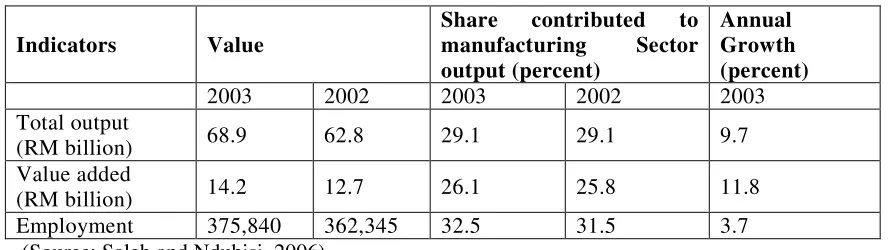
While the Table 6 indicates the contributions of SMEs in terms of total manufacturing output, manufacturing value-added and employment in manufacturing from 2002 and 2003. The output of SMEs has grown by 9.7 percent during 2003, value added production increased by 11.8 percent and employment by 3.7%.
Table 6: Contribution of SMEs in the Manufacturing Sector
Indicators Value Share contributed to manufacturing Sector output (percent)
Annual Growth (percent)
2003 2002 2003 2002 2003
Total output
(RM billion) 68.9 62.8 29.1 29.1 9.7
Value added
(RM billion) 14.2 12.7 26.1 25.8 11.8
Employment 375,840 362,345 32.5 31.5 3.7 (Source: Saleh and Ndubisi, 2006)
CHALLENGES
The Small and Medium Enterprises has special features compared with the larger organizations. SMEs must consider the motivations, constraints and uncertainties facing smaller firms and recognize that these differ from those facing larger firms. According Westhead and Storey (1996) noted the characteristics which distinguishes small organizations form larger ones other than size itself is that of uncertainty. For the small organization external uncertainty affected the most such as lack of power and influence in a market place, larger customer and vulnerability. Therefore, the SMEs seem unpredictable and ruthless market. Therefore, uncertainties become a major problem in the small organizations.
[image:5.595.77.523.367.492.2]Gupta and Cawthon (1996) argued small organization especially managers required the most training. Therefore, training is an essential tool for developing employee and the organization.
The small organization receives major challenges form larger firms, whose command of resources and global reach can be significant. Some great innovations have come from SMEs, particularly in technological fields, but these often owe much to larger firms. This being a trend for many entrepreneurs is seizing their opportunities. Small firms receive more information such as global market accessible, tax, regulatory frameworks, trade rules, and other legal and advisory services. Helping them to gain access to finance is also important. By receiving all information, small firms prefers to join with larger organization. Indeed, financing is frequently a major hurdle to overcome on the way to setting up and staying in business, with access to risk capital.
According Hill and Stewart (2000), on case study research into human resource development within three SMEs firms, investigate employers attitudes towards learning, examined the link between career structures and training in organizations of all sizes. Evidence from this study found that small organization lack of career structure did not guarantee promotion and training. Therefore, small firms have difficulties to progress and compete with larger firms whereby the employees have low motivation to outperform. This is major hurdles that small firms faced especially in developing countries.
In today’s firms are very much exposure to market pressure, SMEs are frequently at a disadvantage relative to their larger counterparts regarding their ability to attract, retain, and motivate the best human resources (Beaver and Hutchings, 2005). Consequences of this practice, the SMEs unable to attract and retain highly qualified staff in the firms. These have led for poor performance and eventually the small sized firms unable to be competitive in the market.
According Schlogl (2004) small sized firms are failed to improve the basic infrastructure like expanding broadband and secure servers. This impacts the small sized firms to take to e-business approach. One of the main reasons is costs. Also, for the SMEs frequently cannot afford or find qualified e-business staff to operate the business. These major impediments for smaller firms simply lengthen the usual problems relating to trust, traction security and, crucially concerns about violations of intellectual property rights. Therefore, HRD is the solutions for trains the staff to more equip with knowledge and skills on handling e-business.
THE HUMAN RESOURCE DEVELOPMENT (HRD) PERSPECTIVE
Recent studies of SMEs have witnessed a major contribution to the developing economics. From the HRD point of view, SMEs need to improve in order to be competitive in market and continues survival. According Harrison (1997) argued that HRD literature is now strategically focused and well integrated with fields of human resource management, business strategy and organizational learning. A number of dimensions of HRD initiations are investment in human resource capabilities, change in both organizational and individual concern on enhancing the core competencies, organizational and individual learning, and enhancement of human resource competencies.
From the HRD perspective, it’s encompasses activities that improve the performance of individuals and the organizations. The central notion is that HRD may include training and development, organizational development and career development. Training involves the fostering of learning and education activities are designed to improve the overall competence of an employee. Therefore at its most basic, HRD increases workforce competence, skills development and quality, motivation, commitment and development of the organization. According McLagan, (1989) argued that HRD strategic has linked training and development to organizational objectives and able to respond to the changes in the environment and technology. Therefore, HRD strategic is a tool for developing the firms and long term survival. However, the only consent tat the SMEs worried is the cost, poor strategic planning and lack of managerial support.
According Rigg and Trehan (2002) argued that HRD in small organizations of taking a discourse perspective on organizational, learning and development. A qualitative approach used to identify the three elements. As a finding the HRD practices was misconstrued in SMEs. In today’s organization learning and development go well beyond the individual who did attend the course and formal HRD investment is undermined by organization processes that block learning. Therefore, formal HRD activity alone can give a highly distorted perspective. Moreover, the HRD within SMEs indicates a need for research and that enable the HRD in action for small firm development.
HRD is equally central for both small and large companies. However, HRD in small organization failed to realized and the important for organizational learning. According Essi Saru (2007) argued HRD and organizational learning issues form the perspective of small firms. In this study argued that learning is about developing the organization or its individual, and therefore it is closely connected to the HRD processes. As can be understood form this description, HRD issues are very important for the sake of the survival of the small firms. Competencies and learning in organizations are ways to overcome some of the problems and HRD are the solution provider for the firms.
CONCLUSION
This article has set a context and rationale for research into human resource development within SMEs. Our discussion has focused on the background and challenges of SMEs and the important of human resource development. Based on the study, we have described human resource development is fundamental for small sized firms to develop.
In conclusion, the HRD activities are essential for SMEs for long term survival. HRD activities such as training and development, career planning, self-directed learning, employee motivation have led toward a better performance, higher creativity and innovation, retaining, staff, better service, equality and enrich human capital. It is believed that small firms should put in place strategies to enhance knowledge, skills, and expertise. In terms of HRD, these have led to better performance and encouraged individual for higher commitment to the organizational performance. In today’s HRD in important for all sized organization and not exceptional for small firms as well (Hill and Stewart, 2000).
REFERENCES
Beaver, G., & Hutchings, K. (2005). Training and developing an age diverse workforce in SMEs: The need for a strategic approach. Education & Training. Vol. 47 No. 8/9. pp.592.
Census of Establishments and Enterprises. (2005). Preliminary Report – Profile of Small and Medium Enterprises. Putrajaya.
Department of Statistics. (2003). Census of Manufacturing Industries. Putrajaya
Gupta, M., & Cawthon, G. (1996). Managerial implication of flexible manufacturing for small/medium enterprises. The International Journal of Technological Innovation,
Entrepreneurships and Technology Development. Vol. 16 No. 2 pp. 77-83.
Harrison, R. (1997). Employee Development, Institute of Personnel and development, London. Hashim, M.K. and Abdullah, M.S. (2000c). Developing SMEs taxonomies in Malaysia, Malaysian
Management Journal, June/Dec, 4(1), pp.43-50
Hashim, M.K. and Wafa, S.A. (2002) Small and medium sized enterprises in Malaysia: Development issues (Petaling Jaya: Prentice Hall).
Hill, R. and Stewart, J. (2000). Human resource development in small organizations. Journal of European Industrial Training. Vol. 24. Nos 2/3/4, pp.105-17.
Hooi, L.W. (2006). Implementing e-HRM: The readiness of SME manufacturing companyin Malaysia. Asia Pacific Business Review, Vol.12, No.4, 465-485
Khairuddin, H. (2000): Redefining SMEs in Malaysia: One Industry One Definition.Asian Academy of Management Journal, Jan–June, 2000.
McLagan, P. (1989). Models for HRD Practice, ASTD Press, St. Paul, MN.
Ministry of International Trade and Industry Malaysia, The Third Industrial Master Plan (IMP3), 2006.
Normah Mohd Aris, (2007), SMEs: Building Blocks for Economic Growth. Paper presentedin National Statistics Conference 4-5 September 2006. Department of Statistics.
Rigg, C., & Trehan. K. (2002). Do they or don’t they? A comparison of traditional and discourse perspective of HRD in SMEs. Education & Training. Vol. 44 No. 8/9 pp. 388-397.
Saleh, A.S. and Ndubisi N.O. (2006), An Evaluation of SME Development in Malaysia, International Review of Busienss Research Papers, Vol.2,1,2006, pp1-14
Saru, E. (2007). Organizational learning and HRD: how appropriate are they are for small firms? Journal of European Industrial Training. Vol. 31 No. 1 pp. 36-51.
Schlogl, H. (2004). Small and medium enterprises: Seizing the potential. Organizational for Economic Cooperation and Development. No. 243 pp.46-48.
SMIDEC. (2008). Promoting Innovation –led and Technology –Driven SMEs. Paper presented in Asia Pacific Conference of Technology and Technology Entrepreneurship.
Snell, R., & Lau, A. (1994). Exploring Local Competencies salient for expanding small businesses. Journal of Management Development. Vol. 13 No. 4 pp.4-15.
Westhead, P. and Storey, D. (1996). Management training and small firm performance: why is the link so weak? International Small Business Journal. Vol. 14 No. 4 pp.13-24.
BIODATA OF PRESENTERS/AUTHORS: