Research Article
CODEN: IJPNL6
FORMULATION AND EVALUATION OF FAST DISSOLVING TABLETS OF
LORNOXICAM
Jyothi Rani L*, K. Abbulu, Nagabushan Rao T, A Akhila
Mallareddy Institute of Pharmaceutical Sciences, Dhulapally, Secunderabad-14, India
*Corresponding author e-mail:
[email protected]
ABSTRACT
Mouth dissolving tablets are also known as fast disintegrating, fast dissolving, fast melt, quick melt tablets. Lornoxicam is an NSAID with 100% bioavailability having a bitter taste. So by formulating it as an ODT the absorption and the bioavailability of the drug will fasten and hence the action of the drug will be faster .The mode of action of Lornoxicam is mainly by inhibition of prostaglandin synthesis (inhibition of cyclooxygeanase enzyme). So the purpose of the present work is to formulate a taste masked mouth dissolving tablet of Lornoxicam. Taste masking was done by using Eudragit (EPO 100) in different ratios. Three superdisintegrants were used namely sodium starch glycolate, crospovidone, crosscarmellose sodium. The tablets were evaluated for various parameters like hardness, friability, drug content, disintegration and in vivo dissolution. Among all the formulations F5 showed 98% drug release with in 15 min. So it was considered as best formulation.
Keywords: Lornoxicam, Eudragit EPO 100, Super disintegrants, Mouth dissolving tablets.
INTRODUCTION
Oral drug delivery has been known for decades as the most widely used route of administration among all the routes that have been used for the systemic delivery of drugs via various pharmaceutical products of different dosage forms. The reason for that the oral route achieved such popularity mainly be due to its ease of administration as well as the traditional belief that by oral administration the drug is well absorbed as the food stuffs ingested daily. In fact, the development of pharmaceutical products for oral delivery, irrespective of physical form involves varying extents of optimization of dosage form within the inherent constraints of GIT physiology. For the successful development of a dosage form for an oral drug delivery system consists of a basic understanding of the following aspects:
i. Physicochemical, pharmacokinetic
and pharmacodynamic
characteristics of the drug,
ii. The anatomic and physiologic characteristics of the GIT, and
iii. Physicochemical characteristics and the drug delivery mode of the dosage form to be designed1.
Oral route of drug administration have wide acceptance up to 50-60% of total dosage forms. Solid dosage forms are popular because of ease of administration, accurate dosage, self-medication, pain avoidance and most importantly the patient compliance. The most popular solid dosage forms are being tablets and capsules. Apart from that drinking water plays an important role in the swallowing of oral dosage forms2.
The orally disintegrating tablets are also called as oral dispersible tablets, quick disintegrating tablets, fast disintegrating tablets, porous tablets, rapimelts,mouth disintegrating tablets. However of all the above terms, United States Pharmacopoeia (USP) approved these dosage forms as ODTs. Recently, European Pharmacopoeia has used the term “oral dispersible tablet” for tablets that disperse readily and within three minutes before swallowing. United States Food and Drug Administration (FDA)
International Journal of Pharmacy
www.pharmascholars.com
580
defined ODT as “A solid dosage form containing medicinal substances or active ingredient which disintegrates rapidly usually within a matter of seconds when placed upon the tongue”. The disintegration time for ODTs generally ranges from several seconds to about a minute5.
MATERIALS AND METHODS
Chemicals: Lornoxicam was obtained as a gift sample from Ranbaxy Pvt Ltd,Gurgoan; Mannitol,Qualigen fine chemicals ,Bombay .India;Magnesium stearate , Oxford laboratory,Mumbai,India ;Na2HPO4,KH2PO4, FINAR reagents,Ahemadabad,India;Sodium saccharine , Jhonson and george chemicas co , Mumbai, India;Aerosil,Yarrow chem. Products,Mumbai,India;SSG,CCS , CP,L-HPC A to Z chemicals,chennai,India.
Compatability studies:The compatability of Lornoxicam with different excipients was tested using FTIR Spectrophotometer.
Preparation of Taste masked granules using Eudragit EPO: Lornoxicam taste was masked by the following procedure: The taste masking agent (i.e) Eudragit EPO was maintained at about 50-550c for 3 minutes. When the taste masking agent started melting the drug was added and mixed. The drug: taste masking agent ratio was maintained at 1:2.
PEPERATION OF MOUTH DISSOLVING TABLETS BY DIRECT COMPRESSION
Method: Oral dispersible tablets are prepared by direct compression. The various disintegrants like crospovidone, croscarmellose and sodium starch glycolate were used. Required quantity of each ingredient is taken for each specified formulation and all ingredients were mixed. Aerosil and magnesium stearate were then passed through mesh no.60 mixed and blended with initial mixture. The resulting mixture is compressed into tablet using 16 station rotary press.
POST FORMULATION STUDIES
Weight variation: 20 tablets were selected randomly from the lot and weighted individually to check for weight variation. The weight variation test was performed and the weights of the tablets were between 99 to 101 mg, As the weight of the tablet is 100mg, The weight variation limit is ± 7.5%.
Hardness, Friability (F) and Thicknes: Hardness or tablet crushing strength is the force required to break a tablet in a diametric compression was measured using Monsanto tablet hardness tester and the friability was tested using a Roche friabilator. The thickness of the tablets was measured using a Vernier callipers.
Content uniformity: Ten tablets were randomly selected and tested for their drug content. Each tablet was powdered and dose of the drug equivalent was taken and to it 10 ml of 6.8 pH phosphate buffer was added and the resulting solution was diluted appropriately and measured for its absorbance at 375nm using a UV-Visible spectrophotometer.
Disintegration time: Tablet was placed in the disintegrating apparatus or a disintegrator having pH 6.8 phosphate buffer solutions at 37 0.5o C. Time
required for complete dispersion of a tablet was measured.
Wetting time or water absorption Ratio:The water uptake characteristic of the loose disintegrant powder allows and evaluation of both the intrinsic swelling and the wettability of the super disintegrants .Water uptake were performed at room temperature. Water absorption ratio R was determined by using the following formula.
Water absorption = [Wa-Wb / Wb] *100
In-vitro Release studies: The invitro drug release studies were carried out in an USP Type II ( Paddle ) dissolution apparatus to suite the physiological conditions of the GIT. The medium used for dissolution is Phosphate buffer with a pH of 6.8.The volume of the medium in the dissolution apparatus was maintained at 900ml.The stirring rate was 50 rpm and the temperature was maintained at 37± 0.50C.Aliquots of dissolution medium were withdrawn at predetermined time intervals and the same volume of medium was replaced to maintain the constant volume.
RESULTS AND DISCUSSIONS
Compatability study: From the FT-IR study the drug was found to be compatible with all the excipients.
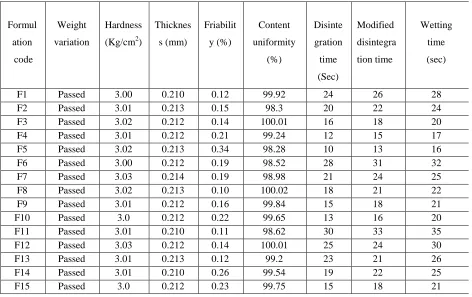
Post Compression Evaluation parameters of formulated ODT’s: Lornoxicam tablets were uniform in weight (99.9 to 100.2 mg), the thickness (0.210 to 0.213 mm) of all tablets were uniform. The hardness of all the tablets was found to be between 3.00 to 3.03kg/cm2 ,While the friability of the ODT’S ranged from 0 .10 to 0.26%.The content uniformity of all the formulations were ranged from 98.28% to 100.02% w/w .The disintegration time of all the formulations ranged from 30 to 10 seconds, the modified disintegration test values ranged from 33 to 13 seconds and the wetting time values ranged from 35 to 16 seconds .Fifteen formulations were tried by taking different superdisintegrants with different ratios. The post compressional parameters are presented in the table 3.
InVitro release study of the tablets: Invitro dissolution study of formulations using Eudragit EPO as taste masking agent: F1 to F15 formulations were prepared using Eudragit EPO as taste masking agent. F1 to F5 formulations were prepared using crospovidone as the superdisintegrant at a concentration of 2,3,4, 5 and 7.5% .F6 to F10
formulations were prepared using cross carmellose sodium as the superdisintegrant at a concentration of 2,3,4, 5 and 7.5% .F11to F15 formulations were prepared using croscarmellose sodium as the superdisintegrant at a concentration of 2,3,4,5, and 7.5%.It was observed that all the formulations showed a gradient and proportional increase in the drug release.The results were tabulated in Table 4 .
CONCLUSION
F1 to F5 batches were formulated using crospovidone as superdisintegrant at different concentrations of 2,3,4,5%,5% and 7.5% respectively. F5 batch with 7.5% crospovidone showed better results. Though the results indicate that crosspovidone showed concentration dependent disintegration and dissolution in which higher concentration of crosspovidone is responsible for faster water uptake, It facilitates wicking action and brings about faster disintegration and dissolution when compared to other superdisintegrants like used crosscarmellose sodium and sodium starch glycolate.
FTIR STUDIES FOR DRUG AND EXCIPIENTS
EPO
www.pharmascholars.com
582
LORNOXICAM
LORNOXICAM + EPO
LORNOXICAM + CP
LORNOXICAM FORMULATION
Table:1 Formulation design of an oral disintegrating tablet
Ingredients/Formul ation(mg)
F1 F2 F3 F4 F5 F6 F7 F8 F9 F10 F11 F12 F13 F14 F15
Lornoxicum 8 8 8 8 8 8 8 8 8 8 8 8 8 8 8
Eudragit EPO 16 16 16 16 16 16 16 16 16 16 16 16 16 16 16
Mannitol 65.
8
64.8 63. 8
62.8 60. 3
65. 8
64. 8
63. 8
62. 8
60. 3
65. 8
64. 8
63. 8
62. 8
60. 3
L – HPC 2 2 2 2 2 2 2 2 2 2 2 2 2 2 2
Crospovidone 2 3 4 5 7.5 - - - -
Crosscarmellose sodium
- - - 2 3 4 5 7.5 - - - - -
Sodium starch glycolate
- - - 2 3 4 5 7.5
Aerosil 0.6 0.6 0.6 0.6 0.6 0.6 0.6 0.6 0.6 0.6 0.6 0.6 0.6 0.6 0.6
Aspartame 5 5 5 5 5 5 5 5 5 5 5 5 5 5 5
Magnesium stearate 0.6 0.6 0.6 0.6 0.6 0.6 0.6 0.6 0.6 0.6 0.6 0.6 0.6 0.6 0.6
Peppermint Flavour q.s q.s q.s q.s q.s q.s q.s q.s q.s q.s q.s q.s q.s q.s q.s
Total Wt in mg 100 100 0
100 100 100 100 100 100 100 100 100 100 100 100 100
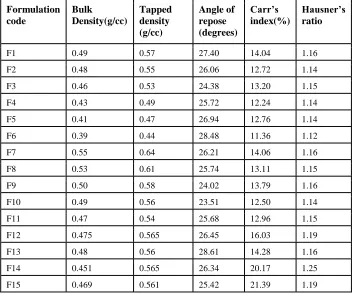
Table 2 :Micromeritic properties of the powder blend: (Pre formulation studies)
Formulation code
Bulk
Density(g/cc)
Tapped density (g/cc)
Angle of repose (degrees)
Carr’s index(%)
Hausner’s ratio
F1 0.49 0.57 27.40 14.04 1.16
F2 0.48 0.55 26.06 12.72 1.14
F3 0.46 0.53 24.38 13.20 1.15
F4 0.43 0.49 25.72 12.24 1.14
F5 0.41 0.47 26.94 12.76 1.14
F6 0.39 0.44 28.48 11.36 1.12
F7 0.55 0.64 26.21 14.06 1.16
F8 0.53 0.61 25.74 13.11 1.15
F9 0.50 0.58 24.02 13.79 1.16
F10 0.49 0.56 23.51 12.50 1.14
F11 0.47 0.54 25.68 12.96 1.15
F12 0.475 0.565 26.45 16.03 1.19
F13 0.48 0.56 28.61 14.28 1.16
F14 0.451 0.565 26.34 20.17 1.25
www.pharmascholars.com
584
Table3: Postcompressional charecteristics of the Formulated ODT:Formul
ation
code
Weight
variation
Hardness
(Kg/cm2)
Thicknes
s (mm)
Friabilit
y (%)
Content
uniformity
(%)
Disinte
gration
time
(Sec)
Modified
disintegra
tion time
Wetting
time
(sec)
F1 Passed 3.00 0.210 0.12 99.92 24 26 28
F2 Passed 3.01 0.213 0.15 98.3 20 22 24
F3 Passed 3.02 0.212 0.14 100.01 16 18 20
F4 Passed 3.01 0.212 0.21 99.24 12 15 17
F5 Passed 3.02 0.213 0.34 98.28 10 13 16
F6 Passed 3.00 0.212 0.19 98.52 28 31 32
F7 Passed 3.03 0.214 0.19 98.98 21 24 25
F8 Passed 3.02 0.213 0.10 100.02 18 21 22
F9 Passed 3.01 0.212 0.16 99.84 15 18 21
F10 Passed 3.0 0.212 0.22 99.65 13 16 20
F11 Passed 3.01 0.210 0.11 98.62 30 33 35
F12 Passed 3.03 0.212 0.14 100.01 25 24 30
F13 Passed 3.01 0.213 0.12 99.2 23 21 26
F14 Passed 3.01 0.210 0.26 99.54 19 22 25
F15 Passed 3.0 0.212 0.23 99.75 15 18 21
Table 4: Invitro dissolution studies of formulated ODT’s
Time/ Formulatio n code
5 min 10 min 15 min 30 min
F1 41 54 68 72
F2 59 66 81 84
F3 62 71 86 94
F4 67 82 94 98
F5 72 86 98 -
F6 42 51 62 74
F7 46 54 66 79
F8 50 64 72 81
F9 54 67 76 86
F10 67 82 94 98
F11 32 44 59 64
F12 36 49 61 71
F13 41 54 68 76
F14 59 66 81 84
F15 66 73 86 98
0 20 40 60 80 100
0 10 20 30 40
F1 F2 F3
0 20 40 60 80 100 120
0 10 20 30 40
F4 F5 F6
0 20 40 60 80 100
0 10 20 30 40
F7 F8 F9
0 20 40 60 80 100 120
0 10 20 30 40
F10 F11 F12
0 20 40 60 80 100 120
0 10 20 30 40
F13 F14 F15
X-AXIS: Time (min); Y-AXIS: % Drug Release
REFERENCES
1. P. Shih, M.s. Harosliya,, J.k.Pathan, S. Shruti , A review-Formulation of Mouth dissolving Tablet.International Journal of Pharmaceutical and Clinical Sciences ,2011; 1(1):1-8
2. Jashanth Singh and Rajmeet Singh. Optimization and Formulation of Orodispersible tablets of Meloxicam. Tropical Journal of Pharmaceutical research, April 2009; 8(2):153-159.
3. M. Nalini Krishan Reddy, Md. Aasif Hussein, T. Rama Rao, T. Ramya Krishan, V. Pavani. Formulation and Evaluation of Naproxen Oral Disintegrating Tablet;, 2012;2(2): 303-316.
4. Rajesh S. Jadon, Swadesh Nayak, Sabita Amplan ,Vikas Deep Aveda. International Journal of Drug Delivery, 2009;1: 27-31.
5. S.Z.Chemate, K.P.R. Chowdary, A Factorial study of Enhancement of Solubility and Dissolution Rate of Lornoxicam Employing ß-Cyclo Dextrin and surfactants. International Journal of Pharmaceutical Research and Development, 2011; 4(03) : 350-356.
6. Dipankar Das, B.K.Sridhar, Development and Evaluation of High porous Mouth Dissolving Tablets Containing Lamotrigine Complexation.Indian Journal of Research in Pharmacy and Biotechnology; 1( 1), 142-149.
7. Sanjay Wasudeo Upare, Dr. A.V. Chandewar, A formulation and development of Orodispersible Tablet of Lornoxicam. The Pharma Innovation, 2012.; 1(6) : 50-62.
8. Supriya C Patil, J.I. Disouza, Formulation and Evaluation of Oral Disintegrating Tablet of Lornoxicam. International Journal of Pharmaceutical and Biological Archives, 2011; 2(5): 1518-1523. 9. Upendra Kulkarni, N.G. Raghavendra Rao ,Design and Development of Multi-Application
Lornoxicam fast Dissolving Tablets by Novel Drug-Drug Solid Dispersion Technique with Ranitidine. Journal of Pharmaceutical Science and Bioscientific Research,2012;2(3): 103-108.
10. Supriya Shidhaye, Sheetal alike and Vilasraolo Kadam, Taste Masked Orally Disintegrating Tablet Containing Microspheres for Immediate Release. Journal of Pharmacy Research, 2008 ;1(2) : 225-229. 11. P.S. Zade, P.S. Kawtikwar, D.M. Sarakar, Formulation, Evaluation and optimization of Fast dissolving tablet containing Tizanidine Hydrochloride. International Journal of Pharma Tech Research, 2002; 1(1): 34-42.
12. Shishu, Ashima . Preparation of Tablets Rapidly Disintegrating in Saliva containing bitter Taste-Masked Granules by Compression Method. Indian Journal of Pharmaceutical Sciences, Jan-Feb 2007, Page: 80-83.
www.pharmascholars.com
586
14. S.K.Seth, S.J. Patel and J.B.Shukla, Formulation and Evaluation of Taste Masked Oral Disintegrating Tablet of Lornoxicam. International Journal of Pharma and Bio Sciences, 2010;1(2):
15. Pankaj P. Amrutkar, Sanjay B. Patil, Design and evaluation of taste masked chewable dispersible tablet of Lamotrigine by melt granulation. International Journal of Drug Delivery; 2010 :183-191. 16. Metker Vishal, Kumar Anuj, Pathak Naveen, Formulation and Evaluation of orodispersible tablets of
Lornoxicam. International Journal of Drug Development andResearch, Jan-Mar 2011, 3(1): 281-285. 17. Magda Targa Martins, Martin Steppe; Development of a dissolution tests for Lamotrigine in
tablet form using ultra violet method. Brazilian Journal of Pharmaceutical Sciences , 2010; 46 ( 2) 18. Upendra Kulkarni ,N G . Raghavendra Rao, Formulation and Evaluation of Lornoxicam Fast
Dissolving Tablets. Influence of Different excipients on property and performance of patient friendly dosage form, International Journal of Pharmaceutical and Chemical Sciences, 2012;1(1):
19. Gnana chaitanya , shailaja.d,Formulation and Evaluation of Fast Disintegrating tablets of Sitagliptin Phosphate. International Journal of Pharma World Research, 2012;3(3)
20. Sudarshan Singh and Dhaval shah, Development and characterization of Mouth dissolving Tablets of Zolmitriptan. Asian Pacific Journal of Tropical Disease ,2012; S457-S464.
21. Budavari S. The Merck Index. 12th ed. New Jersey, USA, Merck andCo. Inc. (1996) 6420.
22. Attimarad M., Rapid RP-HPLC method for quantitative determination of Lornoxicamin tablets. Journal of Biological and Clinical Pharmacy, 2010;1(2):115-118.
23. Patil K., Rane V, Sangshetti ,, Shinde D,LC method for analysis of Lornoxicam in the dosage form. Journal of Chromatographia, 2009; 69(9-10): 1001-1005.
24. Zhang JJ, Gao Y, Fan WM, Ren BJ. Development and Validation of HPLC method for the estimation of Lornoxicam in Pharmaceutical formulation. Journal of American Association of Pharmaceutical Scientists, 2004;63: 285-290.
25. Bhavsar SM, Patel DM, Khandhar AP, Patel CNValidated RP-HPLC method for simultaneous estimation of Lornoxicam and Thiocolchicoside in solid dosage form. Journal of Chemical Pharmaceutical Research , 2010; 2(2):563-572.
26. Hable AA, Raut RP, Chaudhari VP, Development and validation of a HPTLC method for simultaneous estimation of lornoxicam and thiocolchicoside in combined dosage form pharmaceutical methods, 2011;2(3):178-183.
27. Nemutlu E, Demircan S, Kir S. Determination of Lornoxicam in Pharmaceutical Preparation by Zero and First order derivative UV Spectrophotometric methods, Pharmazine ,2005;60(6):421-425.