B. Murgante et al. (Eds.): ICCSA 2013, Part I, LNCS 7971, pp. 413–426, 2013. © Springer-Verlag Berlin Heidelberg 2013
A New Back-Propagation Neural Network Optimized
with Cuckoo Search Algorithm
Nazri Mohd. Nawi, Abdullah Khan, and Mohammad Zubair Rehman
Faculty of Computer Science and Information Technology, Universiti Tun Hussein Onn Malaysia (UTHM)
P.O. Box 101, 86400 Parit Raja, Batu Pahat, Johor Darul Takzim, Malaysia
[email protected], [email protected], [email protected]
Abstract. Back-propagation Neural Network (BPNN) algorithm is one of the most widely used and a popular technique to optimize the feed forward neural network training. Traditional BP algorithm has some drawbacks, such as getting stuck easily in local minima and slow speed of convergence. Nature inspired meta-heuristic algorithms provide derivative-free solution to optimize complex problems. This paper proposed a new meta-heuristic search algorithm, called cuckoo search (CS), based on cuckoo bird’s behavior to train BP in achieving fast convergence rate and to avoid local minima problem. The performance of the proposed Cuckoo Search Back-Propagation (CSBP) is compared with artifi-cial bee colony using BP algorithm, and other hybrid variants. Specifically OR and XOR datasets are used. The simulation results show that the computational efficiency of BP training process is highly enhanced when coupled with the proposed hybrid method.
Keywords: Back propagation neural network, cuckoo search algorithm, local minima, and artificial bee colony algorithm.
1
Introduction
(BPNN) algorithm [11]. However, the BPNN algorithm suffers from two major draw-backs: low convergence rate and instability. The drawbacks are caused by a risk of being trapped in a local minimum [12], [13] and possibility of overshooting the minimum of the error surface [14]. Over the last years, many numerical optimization techniques have been employed to improve the efficiency of the back propagation algorithm including the conjugate gradient descent [15] [16]. However, one limitation of this procedure, which is a gradient-descent technique, is that it requires a differen-tiable neuron transfer function. Also, as neural networks generate complex error sur-faces with multiple local minima, the BPNN fall into local minima instead of a global minimum [17], [18]. Evolutionary computation is often used to train the weights and parameters of neural networks. In recent years, many improved learning algorithms have been proposed to overcome the weakness of gradient-based techniques. These algorithms include global search technique such as hybrid PSO-BP [19], artificial bee colony algorithm [20-22], evolutionary algorithms (EA) [23], particle swarm optimi-zation (PSO) [24], differential evolution (DE) [25], ant colony, back propagation algorithm [26], and genetic algorithms (GA) [27].
In order to overcome the weaknesses of the conventional BP, this paper proposed a new meta-heuristic search algorithm, called cuckoo search back propagation (CSBP). Cuckoo search (CS) is developed by Yang and Deb [28] which imitates animal beha-vior and is useful for global optimization [29], [30], [31]. The CS algorithm has been applied independently to solve several engineering design optimization problems, such as the design of springs and welded beam structures [32], and forecasting [33]. For these problems, Yang and Deb showed that the optimal solutions obtained by CS are far better than the best solutions obtained by an efficient particle swarm optimizer or genetic algorithms. In particular, CS can be modified to provide a relatively high convergence rate to the true global minimum [34].
In this paper, the convergence behavior and performance of the proposed Cuckoo Search Back-propagation (CSBP) on XOR and OR datasets is analyzed. The results are compared with artificial bee colony using BPNN algorithm, and similar hybrid variants. The main goals are to decrease the computational cost and to accelerate the learning process using a hybridization method.
The remaining paper is organized as follows: Section 2 gives literature review on BPNN. Section 3, explains Cuckoo Search via levy flight. In section 4, the proposed CSBP algorithm, and simulation results are discussed in Section 5. Finally, the paper is concluded in the Section 6.
2
Back-Propagation Neural Network (BPNN)
minimize the output error. The BPNN algorithm has become the standard algorithm used for training multilayer perceptron. It is a generalized least mean squared (LMS) algorithm that minimizes a criterion equals to the sum of the squares of the errors between the actual and the desired outputs. This principle is;
∑ (1)
Where the nonlinear error signal is
(2)
and are respectively, the desired and the current outputs for the ith unit. P
de-notes in (1) the pth pattern; j is the number of the output units. The gradient descent
method is given by;
(3)
Where is the weight of the ith unit in the (n-1)th layer to the kth unit in the nth
layer. The BP calculates errors in the output layer , and the hidden layer, are
using the formulas in Equation (4) and Equation (5) respectively [36] [37]:
′ (4) ∑ (5)
Here is the desired output of the ith output neuron, is the actual output in the
output layer, is the actual output value in the hidden layer, and k is the
adjusta-ble variaadjusta-ble in the activation function. The back propagation error is used to update
the weights and biases in both the output and hidden layers. The weights, and
biases, , are then adjusted using the following formulae;
1 (6)
1 (7)
1 (8)
Here k is the number of the epoch and is the learning rate.
3
Cuckoo Search Viva Levy Flight
a. Levy Flight
In nature, the flight movement of many animals and insects is recognized as a random manner. The foraging path of an animal commonly has the next move based on the current state and the variation probability to the next state. Which way it chooses be determined by indirectly on a probability that can be modeled mathematically. Levy Flights is a random walk that is characterized by a series of straight jumps chosen from a heavy-tailed probability density function [34]. In statistical term, it is a stochastic algorithm for global optimization that finds a global minimum [38]. A levy flight process step length can be calculated by using Mantegna algorithm using equation (9).
| |
(9)
Note that and are drawn from normal distribution with respect to these two
random variables;
~ 0. , ~ 0. (10) The symbol ~ in (10) means the random variable obeys the distribution on right hand
side; that is, samples should draw from the distribution. The and present in
equation (10) are the variance of distributions which come from equation (11);
/ , 1 (11)
b. Cuckoo Search (CS) Algorithm
Cuckoo Search (CS) algorithm is a novel meta-heuristic technique proposed by Xin-Shen Yang [28]. This algorithm was stimulated by the obligate brood parasitism of some cuckoo species by laying their eggs in the nests of other host birds. Some host nest can keep direct difference. If an egg is discovered by the host bird as not its own, it will either throw the unknown egg away or simply abandon its nest and build a new nest elsewhere. Some other species have evolved in such a way that female parasitic cuckoos are often very specialized in the mimic in color and pattern of the eggs of a few chosen host species. This reduces the probability of their eggs being abandoned and thus increases their population. The CS algorithm follows three idealized rules:
a. Each cuckoo lays one egg at a time, and put its egg in randomly chosen nest;
b. The best nests with high quality of eggs will carry over to the next generations;
c. The number of available host nests is fixed, and the egg laid by a cuckoo is
In this case, the host bird can either throw the egg away or abandon the nest, and build a completely new nest. The rule-c defined above can be approximated by the fraction
pa 0, 1 of the n nests that are replaced by new nests (with new random
solu-tions). For a maximization problem, the quality or fitness of a solution can simply be proportional to the value of the objective function. In this algorithm, each egg in a nest represents a solution, and a cuckoo egg represents a new solution, the aim is to use a new and a potentially better solution (cuckoo) to replace a not so good solution in the nests. Based on these three rules, the basic steps of the Cuckoo Search (CS) can be summarized as the following pseudo code:
When generating new solutions x for a cuckoo i, a Levy flight is performed
x x α levy λ (12)
Where > 0 is the step size, which should be related to the scales of the problem of
interest. The product means entry wise multiplications. The random walk via Levy
flight is more efficient in exploring the search space as its step length is much longer in the long run. The Levy flight essentially provides a random walk while the random step length is drawn from a Levy distribution as shown in the Equation 12:
Lavy~u t , 1 λ 3 (13)
This has an infinite variance with an infinite mean. Here the steps essentially con-struct a random walk process with a power-law step-length distribution and a heavy tail. Some of the new solutions should be generated by Levy walk around the best solution obtained so far, this will speed up the local search. However, a substantial fraction of the new solutions should be generated by far field randomization whose locations should be far enough from the current best solution. This will make sure the system will not be trapped in local minima.
The pseudo code for the CS algorithm is given below:
Step 1: Generate initial population of N host nest i= 1... N
Step 2: while (fmin<MaxGeneration) or (stop criterion) Do
Step 3: Get a cuckoo randomly by Levy flights and evaluate its fitness Step 4: Choose randomly a nest j among N.
Step 5: if F FThen
Step 6: Replace j by the new solution. End if
Step 7: A fraction of worse nest are abandoned and new ones are built.
Step 8: Keep the best solutions (or nest with quality solutions). Step 9: Rank the solutions and find the current best.
4
The Proposed CSBP Algorithm
The CS is a population based optimization algorithm, and like other meta-heuristic algorithms, it starts with a random initial population, The CS algorithm basically works in three steps: selection of the best source by keeping the best nests or solu-tions, replacement of host eggs with respect to the quality of the new solutions or cuckoo eggs produced based randomization via Levy flights globally (exploration) and discovering of some cuckoo eggs by the host birds and replacing according to the quality of the local random walks (exploitation) [29]. Each cycle of the search con-sists of several steps initialization of the best nest or solution, the number of available host nests is fixed, and the egg laid by a cuckoo is discovered by the host bird with a
probability 0, 1 .
In the proposed CSBP algorithm, each best nest represents a possible solution (i.e., the weight space and the corresponding biases for BPNN optimization in this paper). The weight optimization problem and the size of population represent the quality of the solution. In the first epoch, the best weights and biases are initialized with CS and then these weights are passed to the BPNN. The weights in BPNN are calculated and compared with best solution in the backward direction. In the next cycle CS will up-dated the weights with the best possible solution and CS will continue searching the best weights until the last cycle/ epoch of the network is reached or either the MSE is achieved.
The pseudo code of the proposed CSBP algorithm is:
Step 1: CS is initializes and passes the best weights to BPNN Step 2: Load the training data
Step 3: While MSE<stopping criteria
Step 4: Initialize all cuckoo nests
Step 5: Pass the cuckoo nests as weights to network
Step 6: Feed forward neural network runs using the weights initialized with CS Step 7: Calculate the error backward
Step8: CS keeps on calculating the best possible weight at each epoch until the network is converged.
End While
5
Experiments and Results
I.e. input layer, one hidden layer, and output layers. The number of hidden nodes is design of five and ten neurons. In the network structure the biases nodes are also used and the log sigmoid activation function is placed as the activation function for the hidden and output layers nodes. For each problem, trial is limited to 1000 epochs. And minimum error is keeping 0. A total of 20 trials are run for each case. The net-work results are stored in the result file for each trial.
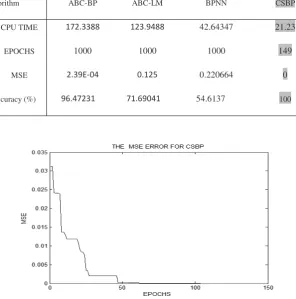
[image:7.439.57.398.255.376.2]The first test problem is the Exclusive OR (XOR) Boolean function of two binary input to a single binary output as (0 0; 0 1; 1 0 ; 1 1 ) -to -( 0; 1; 1 ;0). From the Table 1, we can see that the proposed CSBP method performs well on 2-bit XOR dataset. The CSBP converges to global minima in 21.23 second of CPU time with an average accuracy of 100% and achieves a MSE of 0. While other algorithms fall be-hind in-terms of MSE, CPU time and accuracy. The Figure 1 shows that the CSBP performs well and converges to global minima within 134 epochs for the 2-5-1 net-work structure.
Table 1. CPU time, Epochs and MSE error for 2- bit XOR dataset with 2-5-1 ANN architecture
Algorithm ABC-BP ABC-LM BPNN CSBP
CPU TIME 172.3388 123.9488 42.64347 21.23
EPOCHS 1000 1000 1000 149
MSE 2.39E-04 0.125 0.220664 0
Accuracy (%) 96.47231 71.69041 54.6137 100
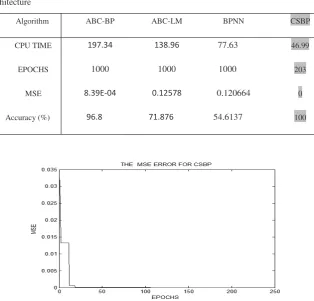
[image:7.439.79.376.260.560.2]Table 2 give an idea about the CPU time, number of epochs and the mean square error for the 2 bit XOR data sets with ten hidden neurons. From the table, we can identify that the proposed CSBP method has better result than the ABC-BP, ABC-LM and BPNN algorithm. The CSBP achieves a MSE of 0 in 100 epochs and in 28.9 second of CPU time. Meanwhile, the other algorithms have short performed with large MSE’s and CPU times. The Figure 2 shows the convergence performance of CSBP algorithm for the 2-10-1 network architecture.
Table 2. CPU time, Epochs and MSE error for 2- bit XOR dataset with 2-10-1 ANN architecture
Algorithm ABC-BP ABC-LM BPNN CSBP
CPU TIME 197.34 138.96 77.63 46.99
EPOCHS 1000 1000 1000 203
MSE 8.39E-04 0.12578 0.120664 0
Accuracy (%) 96.8 71.876 54.6137 100
Fig. 2. The CSBP convergence performance on 2 bit XOR with 2-10-1 ANN architecture
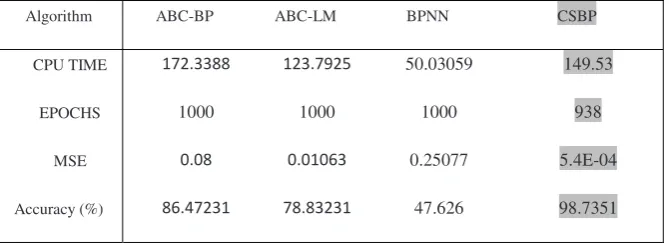
[image:8.439.43.383.183.303.2]in the Table 3 that the proposed algorithm has an MSE of 5.4E-04 within 938 epochs and in 149.53 of CPU time. In 3-bit XOR dataset has better performances in MSE and accuracy. But it has take long CPU time for the processing then the BPNN, and ABC
Table 3. CPU time, Epochs and MSE error for 3- bit XOR dataset with 3-5-1 ANN architecture
Algorithm ABC-BP ABC-LM BPNN CSBP
CPU TIME 172.3388 123.7925 50.03059 149.53
EPOCHS 1000 1000 1000 938
MSE 0.08 0.01063 0.25077 5.4E-04
Accuracy (%) 86.47231 78.83231 47.626 98.7351
[image:9.439.57.398.385.508.2]Table 4 provides an idea about the CPU time, number of epochs and the mean square error for the 3 bit XOR test problem with ten hidden neurons. The proposed CSBP method with 3-10-1 network structure also outperforms the other algorithm in term of CPU time and MSE errors. The CSBP gets an MSE of 7.4E-04 in 161.53 CPU time. While for the same network structure the ABC-BP achieves a less MSE of 0.0845. The conventional back propagation has 0.256 MSE achieved in 75.13748 CPU cycles.
Table 4. CPU time, Epochs and MSE error for 3- bit XOR dataset with 3-10-1 ANN architecture
Algorithm ABC-BP ABC-LM BPNN CSBP
CPU TIME 185.3388 153.7925 75.13748 161.53
EPOCHS 1000 1000 1000 1000
MSE 0.0845 0.01054 0.256 7.4E-04
Accuracy (%) 86.8971 79.83231 49.626 98.88
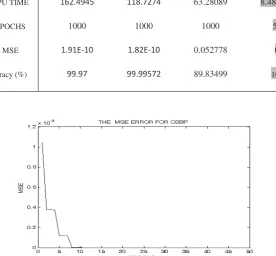
neurons. The proposed CSBP converged to a MSE of 0 within 51 epochs. While the ABC-LM algorithm has an MSE of 1.82E-10 and the ABC-BP has the MSE of 1.91E-05.
Table 5. CPU time, Epochs and MSE error for 4- bit OR dataset with 4-5-1 ANN architecture
Algorithm ABC-BP ABC-LM BPNN CSBP
CPU TIME 162.4945 118.7274 63.28089 8.486525
EPOCHS 1000 1000 1000 51
MSE 1.91E-10 1.82E-10 0.052778 0
[image:10.439.74.351.153.409.2]Accuracy (%) 99.97 99.99572 89.83499 100
Fig. 3. The CSBP convergence performance on 4 bit OR with 4-5-1 ANN architecture
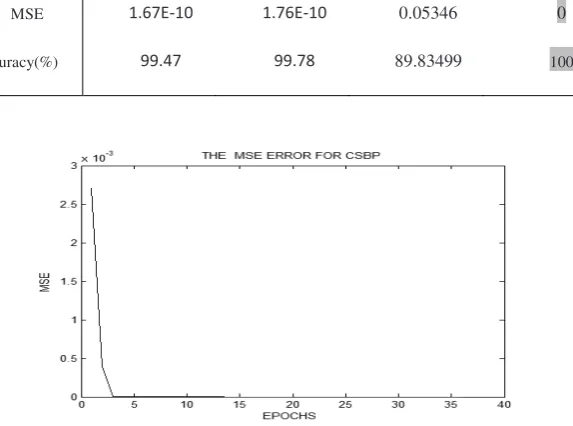
Table 6 illustrates the CPU time, number of epochs and the MSE for the 4 bit OR test problem with ten hidden neurons. In four bit OR datasets the proposed algorithm has outperformed other algorithms with 99 percent accuracy. Figure 4 shows the con-vergence performance of the proposed CSBP for the 4-10-1 network architecture.
Table 6. CPU time, Epochs and MSE error for 4- bit OR dataset with 4-10-1 ANN architecture
Algorithm ABC-BP ABC-LM BPNN CSBP
CPU TIME 180.4945 129.7274 67.28089 8.678
[image:10.439.92.328.269.415.2] [image:10.439.45.384.522.598.2]Table 6. (Continued)
MSE 1.67E-10 1.76E-10 0.05346 0
Accuracy(%) 99.47 99.78 89.83499 100
Fig. 4. The CSBP convergence performance on 4 bit OR with 4-10-1 ANN architecture
6
Conclusion
BPNN algorithm is one of the most widely used and a popular procedure to optimize the feed forward neural network training. Conventional BPNN algorithm has some drawbacks, such as getting stuck in local minima and slow speed of convergence. Nature inspired meta-heuristic algorithms provide derivative-free solution to optimize complex problems. A new meta-heuristic search algorithm, called cuckoo search (CS) is proposed to train BPNN to achieve fast convergence rate and to minimize the train-ing error. The performance of the proposed CSBP algorithm is compared with the ABC-LM, ABC-BP and BPNN algorithms by means of simulation on three datasets such as 2-bit, 3-bit XOR and 4-bit OR. The simulation results show that the proposed CSBP is far better than the previous methods in terms of simplicity, convergence rate and accuracy. In future the proposed model will be used on the benchmarks classifica-tion datasets collected from UCI machine learning repository.
[image:11.439.85.372.83.296.2]References
1. Dayhoff, J.E.: Neural-Network Architectures: An Introduction, 1st edn. Van Nostrand Reinhold Publishers, New York (1990)
2. Rehman, M.Z., Nazri, M.N.: Studying the Effect of adaptive momentum in improving the accuracy of gradient descent back propagation algorithm on classification problems. Inter-national Journal of Modern Physics (IJMPCS) 9(1), 432–439 (2012)
3. Ozturk, C., Karaboga, D.: Hybrid Artificial Bee Colony algorithm for neural network training. In: IEEE Congress of Evolutionary Computation (CEC), pp. 84–88 (2011) 4. Haykin, S.: Neural Networks, A Comprehensive Foundation. Prentice Hall, New Jersey
(1999)
5. Du, K.L.: Clustering: A neural network approach. Neural Networks 23(1), 89–107 (2010) 6. Guojin, C., Miaofen, Z., et al.: Application of Neural Networks in Image Definition
Rec-ognition, Signal Processing and Communications. In: ICSPC, pp. 1207–1210 (2007) 7. Romano, M., Liong, S., et al.: Artificial neural network for tsunami forecasting. Asian
Earth Sciences 36, 29–37 (2009)
8. Hayati, M., Mohebi, Z.: Application of Artificial Neural Networks for Temperature fore-casting. World Academy of Science, Engineering and Technology 28(2), 275–279 (2007) 9. Perez, M.: Artificial neural networks and bankruptcy forecasting: a state of the art. Neural
Computing & Application 15, 154–163 (2006)
10. Contreras, J., Rosario, E., Nogales, F.J., Conejos, A.J.: ARIMA Models to Predict Next-Day Electricity Prices. IEEE Transactions on Power Systems 18(3), 1014–1020 (2003) 11. Leung, C., Member, C.: A Hybrid Global Learning Algorithm Based on Global Search and
Least Squares Techniques for back propagation neural network Networks. In: International Conference on Neural Networks, pp. 1890–1895 (1994)
12. Ahmed, W.A.M., Saad, E.S.M., Aziz, E.S.A.: Modified Back Propagation Algorithm for Learning Artificial Neural Networks. In: Eighteenth National Radio Science Conference (NRSC), pp. 345–352 (2001)
13. Leigh, W., Hightower, R., Modena, N.: Forecasting the New York Stock exchange compo-site index with past price and invest rate on condition of volume spike. Expert System with Applications 28(1), 1–8 (2005)
14. Wen, J., Zhao, J.L., Luo, S.W., Han, Z.: The Improvements of BP Neural Network Learn-ing Algorithm. In: 5th Int. Conf. on Signal ProcessLearn-ing WCCC-ICSP, pp. 1647–1649 (2000)
15. Lahmiri, S.: Wavelet transform, neural networks and the prediction of s & p price index: a comparativepaper of back propagation numerical algorithms. Business Intelligence Jour-nal 5(2), 235–244 (2012)
16. Nawi, N.M., Ransing, R.S., Salleh, M.N.M., Ghazali, R., Hamid, N.A.: An improved back propagation neural network algorithm on classification problems. In: Zhang, Y., Cuzzo-crea, A., Ma, J., Chung, K.-I., Arslan, T., Song, X. (eds.) DTA and BSBT 2010. CCIS, vol. 118, pp. 177–188. Springer, Heidelberg (2010)
17. Gupta, J.N.D., Sexton, R.S.: Comparing backpropagation with a genetic algorithm for neural network training. The International Journal of Management Science 27, 679–684 (1999)
19. Zhang, J., Lok, T., Lyu, M.: A hybrid particle swarm optimization back propagation algo-rithm for feed forward neural network training. Applied Mathematics and Computa-tion 185, 1026–1037 (2007)
20. Shah, H., Ghazali, R., Nawi, N.M., Deris, M.M.: Global hybrid ant bee colony algorithm for training artificial neural networks. In: Murgante, B., Gervasi, O., Misra, S., Nedjah, N., Rocha, A.M.A.C., Taniar, D., Apduhan, B.O. (eds.) ICCSA 2012, Part I. LNCS, vol. 7333, pp. 87–100. Springer, Heidelberg (2012)
21. Shah, H., Ghazali, R., Nawi, N.M.: Hybrid ant bee colony algorithm for volcano tempera-ture prediction. In: Chowdhry, B.S., Shaikh, F.K., Hussain, D.M.A., Uqaili, M.A. (eds.) IMTIC 2012. CCIS, vol. 281, pp. 453–465. Springer, Heidelberg (2012)
22. Karaboga, D., Akay, B., Ozturk, C.: Artificial bee colony (ABC) optimization algorithm for training feed-forward neural networks. In: Torra, V., Narukawa, Y., Yoshida, Y. (eds.) MDAI 2007. LNCS (LNAI), vol. 4617, pp. 318–329. Springer, Heidelberg (2007) 23. Yao, X.: Evolutionary artificial neural networks. International Journal of Neural
Sys-tems 4(3), 203–222 (1993)
24. Mendes, R., Cortez, P., Rocha, M., Neves, J.: Particle swarm for feedforward neural net-work training. In: Proceedings of the International Joint Conference on Neural Netnet-works, vol. 2, pp. 1895–1899 (2002)
25. Ilonen, J., Kamarainen, J.I., Lampinen, J.: Differential Evolution Training Algorithm for Feed-Forward Neural Networks. Neural Processing Letters 17(1), 93–105 (2003)
26. Liu, Y.-P., Wu, M.-G., Qian, J.-X.: Evolving Neural Networks Using the Hybrid of Ant Colony Optimization and BP Algorithms. In: Wang, J., Yi, Z., Żurada, J.M., Lu, B.-L., Yin, H. (eds.) ISNN 2006. LNCS, vol. 3971, pp. 714–722. Springer, Heidelberg (2006) 27. Khan, A.U., Bandopadhyaya, T.K., Sharma, S.: Comparisons of Stock Rates Prediction
Accuracy using Different Technical Indicators with Backpropagation Neural Network and Genetic Algorithm Based Backpropagation Neural Network. In: Proceedings of the First International Conference on Emerging Trends in Engineering and Technology. IEEE Computer Society, Nagpur (2008)
28. Yang, X.S., Deb, S.: Cuckoo search via Lévy flights. In: Proceedings of World Congress on Nature & Biologically Inspired Computing, India, pp. 210–214 (2009)
29. Yang, X.S., Deb, S.: Engineering Optimisation by Cuckoo Search. International Journal of Mathematical Modelling and Numerical Optimisation 1(4), 330–343 (2010)
30. Tuba, M., Subotic, M., Stanarevic, N.: Modified cuckoo search algorithm for uncon-strained optimization problems. In: Proceedings of the European Computing Conference (ECC 2011), Paris, France, pp. 263–268 (2011)
31. Tuba, M., Subotic, M., Stanarevic, N.: Performance of a Modified Cuckoo Search Algo-rithm for Unconstrained Optimization Problems. WSEAS Transactions on Systems 11(2), 62–74 (2012)
32. Yang, X.S., Deb, S.: Engineering optimisation by cuckoo search. International Journal of Mathematical Modelling and Numerical Optimisation 1(4), 330–343 (2010)
33. Chaowanawate, K., Heednacram, A.: Implementation of Cuckoo Search in RBF Neural Network for Flood Forecasting. In: Fourth International Conference on Computational In-telligence, Communication Systems and Networks, pp. 22–26 (2012)
34. Walton, S., Hassan, O., Morgan, K., Brown, M.: Modified cuckoo search: A new gradient free optimisation algorithm. Chaos, Solitons & Fractals 44(9), 710–718 (2011)
36. Cichocki, A., Unbehauen, R.: Neural Network for Optimization and Signal Processing. Wiley, Chichester (1993)
37. Lippman, R.P.: An introduction to computing with neural networks. IEEE ASSP. Mag. 4(2) (April 1987)