International Seminar on the Application of Science & Mathematics 2011 ISASM 2011
ENGINEERING APPROACH SYSTEM TO ASSESS DEFECT
AND DETERIORATION OF BUILDING STRUCTURES
Syed Burhanuddi n Hil mi Sye d Mohamad1, (Wan Fakhari Hiza mi Wan Annuar2)
1Department of Construction Engineering & Architecture, Faculty of Civ il and Environ mental Engineering
Universiti Tun Hussein Onn Malaysia 86400 Parit Ra ja, Batu Pahat, Johor, MA LA YSIA
2
Faculty of Civil and Environ mental Eng ineering, Universiti Tun Hussein Onn Malaysia
A study has been conducted to obtain better knowledge about failures in building structures. Structural failure is also related to the forensic engineering which is the knowledge of engineering that applied for s tructural failu re investigation. The studies have been carried out on the selected buildings in Bandaraya Kuala Terengganu to determine the build ing inspection practices in order to detect the defect and failure. Data are collected through questionnaires, interviews and also from flow charts on assessment procedure which are produced by the Public Work Depart ment (PWD), Depart ment of Irrigation and Drainage (DID), developers, contractors, and consultants. The result has shown that the usage of low materia l quality is the ma jor proble m causing defect and deterioration to the building structures . Finally, the building structures assessment flow chart is proposed as the guideline to ease the building inspection activities.
Keywords: Assessment; flow chart for assessment procedure; defect and deterioration;
building structures.
1.0 INTRODUCTION
Building defect shall be determined by the products, components and elements come in all forms and levels of severity. Types of building deterioration will give an impact to the level of investigation and the required therapy process. Building failure can be categorized into a variety of group depending on their nature and source. These failures also can be classified physical (structural) failure (which result in loss of certain characteristics) or performance failures (which main a reduction in function below an established acceptable limit).
A. Richardson, 2001).
2.0 APPROACHES TO ASSESSMENT
A logical and systematic approach is essential in all stage of the appraisal. A typical sequence for an assessment is shown in the flow chart. Generally, it be necessary to carry out a loading „run-down‟, beginning with gravity loading, including dead and imposed loads and snow, and then accumulating these onto slabs and beams, down columns and walls, and finally to foundations and the ground. Imposed load reductions permitted by current loading codes may be applied. Wind loading must also be assessed.
Here, and particularly in the subsequent analysis of the structure to determine the forces model acting, the assessment will often be iterative, beginning with a simple model to obtain a „feel‟ for its adequacy before refining it, if necessary, to reach a firmer conclusion. These is much to be said for at least the first calculations being done by hand rather than by computer, and concentrating thought on the actual structure rather than the mathematical model used in the design.
An analysis of the structure will be made for strength. In the current limit state approach, as described above, the loads and material strengths will be applied with partial factors being used. This is a precedent from assessment carried out on high alumina cement element for using a reduced dead load factor of 1.2 where the actual thickness and weight of dead load elements has been determined. This acknowledges the reduced uncertainly on loading as a result of such a check. Stability and the effects of lateral loading must also be considered can the structure resist the applied loading without falling over and what are forces due to wind and other lateral loading (Susan Macdonald, 2003).
3.0 DEFECT AND DETERIORATION OF BUILDING STRUCTURES
A defect may be considered to be a failing or shortcoming in the function performance, statutory or user requirements of a building, and might manifest itself within the structure, fabric, services or other facilities of the affected building. When an inspection or survey is being undertaken, the set of requirement for particular building type or use will help to set performance benchmark against which the building can be measured. Where a performance benchmark is not achieved, this indicates a defect or deficiency, the severity of which is gauged by reference to the benchmark.
International Seminar on the Application of Science & Mathematics 2011 ISASM 2011
related to the perceptions and expectations of the owner and occupier, and to various other stakeholders with interests in the well-being of property.
The defect, or the action required to reduce or remove its effect on the building, will typically be ranked according to a pre-determined set of priorities for repair, maintenance or other work to improve either performance or capability. The various elements and associated service installation that make up a building, together with the contents that allow it to be used and enjoyed, are susceptible to various forms of defect and fault. Past and present research has helped to identify the principal causes, yet many of the problems relating to poor-quality design, construction, repair and maintenance continue to reduce the utility and value of the existing building.
4.0 METHODOLOGY
Figure 1 shows the methodology chart. Methodology is a part to display how the study was done from the beginning to the end until the study finished. It contained a few stages such as an introduction, literature review, data collection, conclusion and recommendations.
1) Data collection has been conducted in Bandaraya Kuala Terengganu, Terengganu.
2) Interviews were done with the site representative such as engineer, architect, and consultant to obtain information related to building assessment procedures. 3) 80 questionnaires been distributed to the construction companies in Bandaraya
Kuala Terengganu have and only 65 questionnaires have been received with a valid answer.
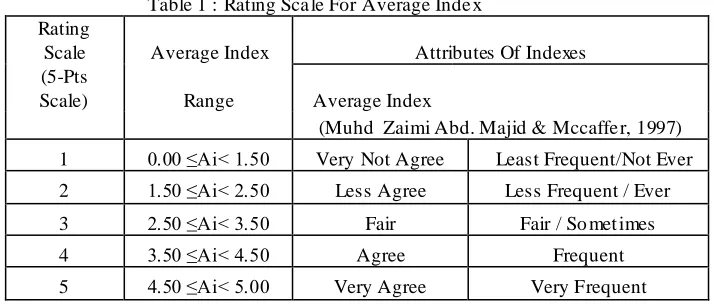
5.0 SATISFACTION INDEX
Scale Average Index Attributes Of Indexes (5-Pts
Scale) Range Average Index
(Muhd Zaimi Abd. Majid & Mccaffe r, 1997) 1 0.00 ≤Ai< 1.50 Very Not Agree Least Frequent/Not Ever 2 1.50 ≤Ai< 2.50 Less Agree Less Frequent / Ever
3 2.50 ≤Ai< 3.50 Fair Fair / So met imes
4 3.50 ≤Ai< 4.50 Agree Frequent
5 4.50 ≤Ai< 5.00 Very Agree Very Frequent
6.0 RESULT AND DISCUSSION
Objective 1: IdentifyDefect and Deterioration of Building Structures
[image:4.596.152.509.134.287.2]Wall, column, beam, slab and roof structure is a type of the upper structure defect due to the frequent failure of structures such as cracks, sediment and others. From the analysis, the walls and roof are classified as upper structural members that sometimes occur with defect and deterioration mean 3.170, and 2.754. Column, beams and slab classified as upper structural members the ever defect and deterioration which have respectively mean 2.231, 2.246, and 2.631. Results have been analyzed are shown in Figure 1.
Figure 1: Type of Super-Structures Defect and Deterioration
Type of Super-Structures
2.23 2.25
2.63 2.75
3.17
0 0.5 1 1.5 2 2.5 3 3.5
Column Beam Slab Roof Wall
S
up
er
-S
tr
uc
ture
s
[image:4.596.154.520.473.638.2]International Seminar on the Application of Science & Mathematics 2011 ISASM 2011
Objective 2 : Determine Causes of Defect and Deterioration of Building Structures
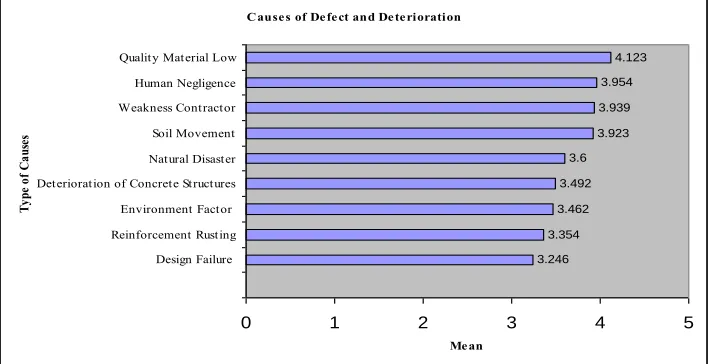
[image:5.596.164.518.325.507.2]The main cause of defect and deterioration in building structures is caused by the low materials quality. The analysis shows that low materials quality achieve the highest average mean of 4.123 and followed by human negligence, weakness contractor, soil movement, deterioration of concrete structures, environmental factors, and natural disasters that each has an average mean of 3.954, 3.939, 3.923, 3.492, 3.462 and 3.60. All sources are classified as agree by the respondents that these sources contributed to the defect and deterioration on the structure of the building. Therefore, monitoring and supervision should be done more often and regularly. Some of the respondents fair agree with the defect and deterioration caused by rusting reinforcement and design. This cause is with an average of mean 3.354 and 3.246.
Figure 2: Causes of Defect and Deteriorat ion to Building Structures
Figure 2: Causes of Defect and Deteriorat ion to Building Structures
CONCLUSIONS
Systematic flow chart need to be developed in order to make the assessment work becoming more easily and also as a guideline to avoid any mistakes during the investigation. A flow chart of methodology of structural failure investigation is proposed. Hopefully, these proposed flow charts can be applied in building structure investigation activity, either government or private project. Based on the proposed flow chart, the investigators will know the general procedures of the investigation activities involved the building structure investigation.
Causes of Defect and Deterioration
3.246 3.354
3.462 3.492 3.6
3.923 3.939 3.954 4.123
0 1 2 3 4 5
Design Failure Reinforcement Rusting Environment Factor Deterioration of Concrete Structures Natural Disaster Soil Movement Weakness Contractor Human Negligence Quality Material Low
T
yp
e
of
C
au
se
s
[1] Ahmad Zaki Sdn.Bhd. (2010). Carta Alir Prosedur Penilaian Kerosakan Dan Kemerosotan Bangunan, Kuala Lumpur : AZRB.
[2] Arkitek Embong Sdn.Bhd. (2010). Carta Alir Prosedur Penilaian Kerosakan dan Kemerosotan Bangunan, Kuala Terengganu : PAM.
[3] Barry A. Richardson (2001). Defect and Deterioration in Building 2nd Edition, London: Spon Press.
[4] Norzan Mohd Yusof (2010). Carta Alir Prosedur Penilaian Kerosakan Dan Kemerosotan Bangunan, Kuala Lumpur : DPI Konsult Sdn Bhd.
[5] Donald Friedmen (2007). The Investigation of Building, A Guide For Architects, Engineers, and Owners, London: Norton.
[6] Nor Azilawati Abu Talaha (2010). Carta Alir Prosedur Penilaian Kerosakan Dan Kemerosotan Bangunan, Kuala Lumpur : Cawangan Pakar Kejuruteraan Struktur Dan Jambatan JKR Malaysia.
[7] Jabatan Pengaliran Dan Saliran Kuala Terengganu (2010). Carta Alir Prosedur Penilaian Kerosakan Dan Kemerosotan Bangunan, Kuala Lumpur. JPS Malaysia
International Seminar on the Application of Science & Mathematics 2011 ISASM 2011
Appendix 1:Comprehensive Flow Chart for Assessment Procedure
No Defect (Rating 1)
No
Yes
No
Yes
Critical Defect (Rating 5)
Yes
Yes
Complaint from Occupancy
Site Visit for Detail Inspection
Report Submission to
Client.
Design and Geotechical Problems
Inform to Forensic Division
Structures or Geotechnical to
Assist Investigation
Material Quality Problem
Continue Start
Request from Client
Special Inspection
Continue
Identify Problem ConsequenceDesign, Geotechnical Situation or
Material Quality Not to Follow the Specification
.
Recommendation Action, Case
Closed
Yes
No
Yes
Yes
Yes
[image:8.596.118.504.132.647.2]Major Defect (Rating 4) Minor Defect (Rating 2-3)
Figure 3: Flow Chart Assessment Procedure to Defect and Deterioration of Building Structure (Syed Burhanuddin Hilmi & Wan Fakhari Hizami, 2010)
Material Testing It Necessary
Material Checklist Form, Inspection & Testing Form
Check the Testing Result
Rehabilitation Method, Prepare & Submit the Report
Reconstruction Repair /Rehabilitation/Strengthening Maintenance
Comply Maintenance Requirement & Assessment Procedure
Method
Hand On - Plastering Liquid - Grouting Soil Investigation
Spraying - Grounted Preplaced Aggregate
- Dry Mix Shotcrete
Method & Protetion Strategy
Design Period Certain Deal Load & Live Load Cost & Future
Rehabilitation
Finish
Condition Survey
Visual Inspection of Exposed Concrete
Identify & Define Area of Distress.
Map Deficiencies Core Drilling For Laboratory Testing (If Required)
Perform In-Situ Test
Any Defect Need to Supervise ?
Propose Supervision to Client for Carry Out