Arithmetic Progression Graphs
Michael J. Dinneen
∗,
Nan Rosemary Ke,
Masoud Khosravani
Department of Computer Science, University of Auckland, Private Bag 92019, Auckland, New Zealand
∗Corresponding Author: [email protected]
Copyright c⃝2014 Horizon Research Publishing All rights reserved.
Abstract
In this paper we study the problem of labeling the edges of a graph with positive integers such that the sequence of the sums of incident edges of each vertex makes a finite arithmetic progression. We give conditions for paths, cycles, and bipartite graphs to have such a labeling. We then address the opposite problem of finding an edge labeled graph for a given finite arithmetic progression. We use a constructive procedure to fully characterize those finite arithmetic progressions that have representations as edge la-beled graphs. Then by presenting a pseudo polynomial-time algorithm, we address a more general problem of finding edge labels for a graph when the vertex labels are given. Finally, we count the connected graphs, up to eight vertices, that accept such a labeling by using a simple algorithm that detects a valid edge labeling.Keywords
Graph Labeling, Arithmetic Progression, Graph Algorithm1
Introduction
A graph labeling is a mapping from graph elements (ver-tices, edges, faces, or a combination of them) to a nonempty set. Sometimes it is more convenient to consider the range as a set with a structure, like a ring, a field, or a subset of integers. Also, by restricting the type of mappings to injec-tive, surjecinjec-tive, or bijective maps, and also the range of a mapping, one can define many types of labeling. Gallian’s updated survey [4] is a comprehensive reference on the sub-ject, see also [12, 11]. Among the most studied methods of graph labeling we mention magic labeling [6], edge magic la-beling [7], graceful lala-beling [9, 3],(k, d)-arithmetic labeling [1], and super edge-antimagic labeling [2]. In these types of labeling the mapping and its domain are very restricted and few graphs accept those kinds of labelings. The problem of deciding whether every tree has a graceful labeling is an open problem.
One problem that arises naturally is how some of the re-strictions can be relaxed to allow for more labeled graphs. To achieve this objective, we will consider those edge la-belings of a graph that produce arithmetic progressions on the vertices. To be more specific, we study these two prob-lems: (1) Given a graphG, is it possible to assign positive integers to its edges such that the sequence of the sums of neighboring (incident) edges of each vertex makes a finite
1
1
2
1 2 4 2 8
[image:1.595.303.532.231.334.2]2 4 6 8 10 12
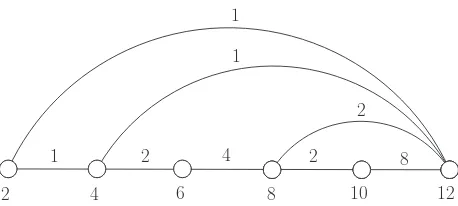
Figure 1.An AP-graph representing the sequence(2,4,6,8,10,12).
arithmetic progression? and (2) Given a finite arithmetic pro-gression of positive integers withn terms, is it possible to find an edge labeled graph withnvertices such that the se-quence of the sums of incident edges of its vertices produces the same arithmetic progression? As we see later, there are many graphs that are yes instances for the first question, and we refer to them asArithmetic Progression Graphs, or AP-graphs. We also refer to the type of edge labeling that pro-duces an AP-graph, as anAP-labeling. In Figure 1 a graph with its AP-labeling is depicted. We will also address the second question and give a full characterization of those fi-nite arithmetic progressions that have edge labeled graphs, with respect to our definition.
One applied application area of our research is a somewhat efficient algorithm for finding other graph labelings besides AP-labeling, the main focus of this paper. Our algorithm is constructive and simple but requires a nonconstructive proof of correctness.
2
Definitions and Basic Results
In this paper we assume that all graphs are simple con-nected graphs without any loops and multi-edges. We denote the set of the (exclusive) neighbors of a vertexv byN(v). LetG= (V, E)be a graph withnvertices, we sayGhas an
AP-labeling(X, a, d), whereX :E →Z+ is a total
func-tion,ais the initial value, anddis the constant difference of the arithmetic progressiona, a+d, ..., a+ (n−1)dsuch that for each vertexvi∈V(G),0≤i≤n−1, we have
∑
u∈N(vi)
X(uvi) =a+σ(i)d,
whereσis a permutation on{0,1, . . . , n−1}. If a graph has such a labeling we say it is anAP-graph.
Sometimes we just refer to an edge labelingXon a graph G(V, E)by the list of its values on the set of edges asX = (x1, . . . , xm), wheremis the number of edges, andX(ei) = xi,ei∈E. The following results are trivial consequences of the definition.
Proposition 1 Let G be a graph of order n and size
m. If there is an AP-labeling (X, a, d), such that X =
(x1, . . . , xm), then
K=
m
∑
i=1
xi= na
2 +
n(n−1)
4 d.
Proposition 2 Let G be a graph that has an AP-labeling
(X, a, d), then δ(G) ≤ a, whereδ(G)is the minimum de-gree ofG.
Proposition 3 Let P = v1, e1, v2, . . . , en−1, vn be a path,
that has an AP-labeling(X, a, d). Also suppose the labeling is such thatX(ei) = xi, 1 ≤ i ≤ n−1. Then ddivides |xi−xj|if bothiandjare even or odd.
Proposition 4 Let A be the incidence matrix of a graph
G = (V, E), where|V| = nand|E| =m. Also let(a, d)
be a pair of initial value and constant difference in an arith-metic progression. ThenGhas an AP-labeling (X, a, d)if and only if there is a permutationσof{0, . . . , n−1}and a linear equationAx=bthat has solutions of positive inte-gers, where
b=
a+dσ(0)
.. .
a+dσ(n−1)
.
Due to Proposition 1, each AP-labeling also corresponds to an integer partitioning ofK(the sum of an edge labeling) intompositive parts, that can be used as a naive algorithm for finding an AP-labeling for a graph. Also Proposition 4 reduces the problem of finding an AP-labeling for a graph to solving a system of linear equations with positive integer values. In Section 6 we will describe our emperical results by applying these algorithms and enumerating all AP-graphs with up to eight vertices.
3
Paths, Cycles and Bipartite Graphs
Note that with respect to Proposition 4, to find an AP-labeling (X, a, d)for a graph we need to choose not only
proper values foraandd, but also a proper permutationσ, that distributes terms of the corresponding arithmetic pro-gression among the vertices of the graph. In this section we show that, when dealing with paths and cycles, finding an AP-labeling is equivalent to finding a proper permutation.
Theorem 5 LetP be a path of lengthn, thenP has an AP-labeling(X, a, d)if and only if there is a permutationσthat satisfies the following conditions.
1. ∑ki=0−1(−1)iσ(i)>−a
d ifkis odd and1≤k < n, and
2. ∑ki=0−1(−1)iσ(i) >0ifkis even and2 ≤k < n−1, and
3. ∑ni=0−1(−1)iσ(i) = 0, when n is even, or
∑n−1
i=0(−1)i+1σ(i) =
a
d, whennis odd.
Proof. LetP =v1, e1, v2, e2, . . . , vn−1, en−1, vn. IfP has an AP-labeling(X, a, d)such thatX={x1, x2, . . . , xn−1},
whereX(ei) =xi, then we have
x1 = a+σ(0)d
x1+x2 = a+σ(1)d
.. .
xn−2+xn−1 = a+σ(n−2)d
xn−1 = a+σ(n−1)d
for a permutation σ on{0, . . . , n−1}. Now we multiply both sides of theith equation with(−1)i−1. By adding the
firstkterms,1≤k < n, for odd values ofkwe havexk = a+d∑ki=0−1(−1)iσ(i).
For even values of k, 2 ≤ k < n, we have xk =
∑k−1
i=0(−1)
iσ(i)and since the values of labels are positive integers, we get the desired inequalities of Statements 1 and 2 in the theorem. The same argument applies for Statement 3, by adding all terms.
For proving the sufficient condition note that given a per-mutationσ, that satisfies the conditions, we can compute the values of the edge labels by
xk =
{
a+d∑ki=0(−1)i+1σ(i) kis even,
d∑ki=0(−1)i+1σ(i) kis odd,
and Statements 1–3 ensure us that the values of the labels are
positive integers. ⊓⊔
Theorem 6 LetCbe a cycle of lengthn, thenChas an AP-labeling(X, a, d)if and only if there is a permutationσthat satisfies the following conditions.
1. If the value of n is odd, ∑ki=0−1(−1)i+k+1σ(i) +
∑n−1
i=k(−1)
i+kσ(i)> a
d, for0≤k < n
2. Ifnis even,∑ni=0−1(−1)iσ(i) = 0, and also there is a
positive integercsuch thata+d∑ik=0−1(−1)iσ(i)> c, forkeven, andc > d∑ki=0−1(−1)iσ(i), forkodd.
Proof. LetC =v1, e1, v2, e2, . . . , vn−1, en−1, vn, en, v1be
a cycle. If we write the appropriate system of linear equa-tions, we have:
x1+xn = a+σ(0)d x1+x2 = a+σ(1)d
.. .
xn−2+xn−1 = a+σ(n−2)d
Now, as in the case of paths, if we multiply eachith equation with(−1)i−1 and add all the resulting terms, for the case
whennis odd we havexn = a2+ d2
∑n−1
i=0(−1)
iσ(i),then by solving the other equations with respect to the value ofxn, for1≤k < n, we have
xk = a
2 +
d
2
(k−1 ∑
i=0
(−1)i+k+1σ(i) +
n−1
∑
i=k
(−1)i+kσ(i)
)
.
Whenn is even, all variable are cancelled and we have
∑n−1
i=0(−1)
iσ(i) = 0. Note that in this case by adding the firstkterms whenkis odd,1≤k < n, we have
xn+xk =a+d k−1
∑
i=0
(−1)iσ(i),
and whenkis even,2≤k < n−1, we have
xn−xk =d k−1
∑
i=0
(−1)iσ(i),
and since the values of edge labels are positive integers we have whenkis odd,
xn < a+d k−1
∑
i=0
(−1)iσ(i)
for1 ≤k < n, and alsod∑ik=0−1(−1)iσ(i)< x
n whenkis
even and2≤k < n−1. ⊓⊔
Corollary 7 There is no AP-labeling for paths and cycles of
lengthn, whenn≡2 (mod 4).
As we saw earlier, there are some paths and cycles that do not accept any AP-labeling. By the next theorem, we show it is not restricted to just those type of graphs. There are other bipartite graphs that have the same property. In Section 6 we use the following theorem and its corollary to prove that many of those graphs that are illustrated in Figures 3 and 5 are not AP-graphs.
Theorem 8 Let G be a bipartite graph with pand q ver-tices in each part such thatp≥q. IfGhas an AP-labeling
(X, a, d), then
(p−q)(p+q−1)
pq <2.
Proof. By constructing the appropriate system of linear equations and multiplying those terms that represent sums of vertices in the part withqvertices by−1, and adding the equations, we have
(p−q)a+
p∑−1
i=0
σ(i)−
p+∑q−1
j=p σ(j)
d= 0
that results
(p−q)a
d = p+q
∑
i=p+1
σ(i)−
p
∑
j=1
σ(j),
whereσis a permutation on{0,1, . . . , p+q−1}.
Ifp =qthen we have∑pi=+pq+1σ(i) =∑pj=1σ(j),also if(p−q)ad ≥0, then∑ip=+pq−1σ(i) ≥∑pj=1−1σ(j), both as necessary conditions.
The left hand side of the last inequality takes its largest value when σi ∈ {0, . . . , p − 1}, 0 ≤ i ≤ p−1, and σj∈ {p, . . . , p+q−1},p≤j≤p+q−1. So we have:
pq+q(q−1) 2 >
p(p−1)
2 .
That yields
(p−q)(p+q−1)
pq <2.
⊓ ⊔
The following corollary is a result of the proof of the previous theorem.
Corollary 9 A bipartite graph with n vertices and equal parts has no AP-labeling, whenn≡2 (mod4).
As easily seen by Theorem 8 one class of graphs that ac-cepts no AP-labeling is the set of stars{K1,p|p≥3}. The next theorem shows that if a graph is close to a star with re-spect to a few number of edge contractions, then it also has no AP-labeling.
Theorem 10 A graphGhas no AP-labeling if there is a se-quencee1, . . . , ek of edges inG, such that (i) by contracting
themGreduces to a star, where the induced connected
sub-graphH =G[{e1, . . . , ek}]is contracted to the center of the
star, and (ii)k < 2n−1− √
n2+(n−1)2
2 .
Proof. Let V(G) = {v0, v1, . . . , vn−1}. Also, suppose
that there is an AP-labeling (X, a, d) for G that defines a vertex labeling l0 : G → Z+ such that l0(vi) =
∑
u∈N(vi)X(viu) = a+σ(i)d. We considerG0 =Gand
we denote byGithe resulting graph of the contractingeiin Gi−1,i = 1, . . . , k. After contracting an edgeei =xyto a vertexvxy, we relabel the edges ofGiby the following rule. If a vertexwwas adjacent to bothxandy, we replace any multiple edges by a new edgewvxy and we assign the sum of the labels ofwxandwyinGi−1to it. The labels of other
edges remain unchanged. After iteration i we have a new vertex labelingli:Gi→Z+.
After contracting all edges we reach to a bipartite graph with two parts, partAthat has vertices that do not belong to H, and partBthat has only the centercof the starGk. Since each edge has one side in each part we have
∑
v∈A
lk(v) = lk(c) (1)
∑
vi∈V(G)−V(H)
(a+σ(i)d) =
∑
vj∈V(H)
(a+σ(j)d)−2
∑
uv∈E(H)
X(uv)
(2)
Now note that Equation 2 is valid if∑v
j∈V(H)(a+σ(j)d)
is strictly greater than the left hand side so we must have
∑
vi∈V(G)−V(H)
(a+σ(i)d)< ∑ vj∈V(H)
d 2d
d 3d 2d
Figure 2. A family of AP-labelings for an AP-graph representing the se-quences{(d,2d,3d)|d≥1}.
and since,k < 2n−1− √
n2+(n−1)2
2 <
n
2, the number of nodes
in the contracted part of graph is less that the number of nodes in the non-contracted part, so we have
∑
vi∈V(G)−V(H)
σ(i)< ∑ vj∈V(H)
σ(j)
to make right hand side as large as possible we need to find a value1≤k < nsuch that we have:
1 + 2 +. . .+ (n−k−1) < (n−k) +. . .+n−1
2(n−k)(n−k−1) < n(n−1)
0 < −2k2+ (4n+ 2)k−2(n2+n).
The statement of the theorem follows by solving the last in-equality with respect to the variablek. ⊓⊔
4
Graphs of Finite Arithmetic
Pro-gression
Let the sequenceS = (a, a+d, . . . , a+ (n−1)d)be a finite arithmetic progression of positive integers with the ini-tial valueaand the constant differenced. In this section we try to find out whether there is an AP-graphGwithn ver-tices, such that the set of the sums of neighboring edges of the vertices results in the same sequence asS. To this end, we first consider the case whena = dand we introduce a constructive procedure to make a desired graph for a given sequence. Also we show that there are arithmetic progres-sions that have no representation as an AP-graph. Later on, we extend our results for the case whena̸=d.
Throughout the proofs of the following results we suppose that the vertices of a graph are indexed with respect to the increasing order of their labels. Also we consider the op-eration ofpairing and incrementing bycon a sequence of even number of verticesvs, . . . , vs+k, wherekis odd. That is done by considering pairs of consecutive vertices(vi, vi+1),
i∈ {s, s+ 2, . . . , s+k−1}, and if there is an edge between them, we increment its label byc. When there is no edge, we connect them by an edge and we assign c as its label. Note that by this operation the vertex label of each vertex in vs, . . . , vs+k, is incremented byc.
Lemma 11 Let S = (d,2d, . . . , nd)be a finite arithmetic progression withn≥3terms and with initial value and con-stant difference both equal tod. ThenShas an AP-graph if and only if
1. the value ofdis even, or
2. the value of dis odd, and n ≡ 0 (mod 4)or n ≡ 3
(mod 4).
Proof. Let us first consider the case whendis even. IfShas three terms, sayS= (d,2d,3d), the graph shown in Figure 2 is an appropriate AP-graph. Now we follow the argument inductively by considering two cases, when the number of terms is odd or even.
Suppose we have an AP-graph Gfor S = (d, . . . ,(n−
1)d). Ifnis even then we do the pairing and incrementing bydoperation for the sequence of verticesv2, . . . , vn−1 in
G. Then we add a new vertexuand connect it to v1by an
edge labeled byd. The resulting graph is an AP-graph for the sequence(d,2d, . . . , nd).
For the case when n is odd, we do the pairing and incrementing operation by d for the sequence of vertices v3, . . . , vn−1inG. Then we add a new vertexuand we
con-nect it tov1andv2by two edges, each has d2 as its label. At
last, if there is an edge betweenv1andv2we increment it by
d
2, otherwise we connect them by a new edge that is labeled
by d2.
Now we prove that for odd value ofdandn≡3 (mod 4), if there is an AP-graphGforSwithn−4terms, then there is an AP-graph for S withn terms. The base case when n = 3follows easily by considering the graph illustrated in Figure 2, so we suppose that n ≥ 7. We first employ the pairing and incrementing by4don the sequence of vertices v2, . . . , vn−4inG, such that the label of each vertex in this
sequence increases by 4d. Then we add four new vertices u1, u2, u3, andu4. Finally, we add an edge fromu1tou4
la-beled byd, an edge fromu2tou3labeled by2d, an edge from
u3tov1labeled by2d, and an edge fromu4tov1labeled by 2d.
Now let consider the case when d is odd and n ≡ 0 (mod 4). Sincen−1 ≡ 3 (mod 4), there is an AP-graph Gfor the sequence(d,2d, . . . ,(n−1)d). We apply the op-eration of pairing and incrementing bydfor the sequence of vertices v2, . . . , vn−1 inG. By adding a new vertex uand
connecting it tov1with an edge labeled byd, we get the
de-sired graph.
To prove that there is no AP-graph whendis odd andn≡
1,2 (mod 4). Let(X, d, d)be an AP-labeling of a graphG with the edge labels X = (x1, x2, . . . , xm). Then due to Proposition 1 the value of
m
∑
i=1
xi= dn
2 +
n(n−1)
4 d,
must be an integer. But when one computes the right hand side of the equation for those values ofdandn, the resulting
values are not integers. ⊓⊔
Theorem 12 LetS= (a, a+d, . . . , a+ (n−1)d)be a finite arithmetic progression with the initial valuea, the constant
differenced, andn ≥4terms. Then Shas an AP-graph if
and only if
1. the value ofdandaare both even, or
2. dis even,ais odd, andnis even, or
3. dis odd,ais even, andn≡0,1 (mod 4), or
Proof. To prove this theorem we first apply Lemma 11 to produce an AP-graph G with n − 1 vertices for S′ = (d,2d, . . . ,(n−1)d), for valid numbers of d and n. We use two procedures to construct an AP-graph fromGforS based on the number of terms inS′. The first procedure is used when the number of terms inS′ is odd. It is done by pairing and incrementing operation byafor the sequence of v2. . . . , vn−1, and then adding a new vertex and joining it
tov1 with an edge labeled bya. The second procedure is
used when the number of terms inS′andaare both even. In this procedure we apply the operation of pairing and incre-menting byaonv3, . . . , vn−1, then we add a new vertex and
attach it tov1andv2by edges that are labeled bya2. Finally,
if there is an edge betweenv1andv2we increment it by a2,
otherwise we join them by a new edge labeled by a2. These procedures, when applied properly, give the proofs for State-ments 1–3 and the part of Statement 4 whenn≡0 (mod 4). Now let us consider the case wheredandaare odd and n≡3 (mod 4). Sincen≡3 (mod 4), we haven−3≡0 (mod 4). So by Lemma 11 there is an AP-graphGfor the sequence(d,2d, . . . ,(n−3)d). We first apply a pairing and incrementing bya+ 2dfor the sequencev3, . . . , vn−3. Then
we add three new vertices u1, u2, andu3 to the resulting
graph. To complete the construction, we add two edges la-beled by a+2d fromu3to bothv1andv2. Also we connect
u1 tou2by an edge labeled bya, andu2tou3 by an edge
labeled byd. At last if there is any edge betweenv1 andv2
we increment it by a+32d, otherwise we add them via a new edge labeled bya+32d.
With respect to Proposition 1, the same argument as pre-sented for Lemma 11 also applies to the no instances in this
theorem. ⊓⊔
To complete the characterization of those arithmetic pro-gression sequences that are vertex labels for some AP-graph, first note that there are no sequences of length less than three. Also, forn = 3there are only two graphs to consider. It is easy to see that the path (see Figure 2) must havea=d. For the complete graphK3we get only those sequences
satisfy-inga > danda+deven.
5
Decision algorithms
In this part we present two complexity results on edge la-beling of a graph that is closely related to the problem of deciding if a graph has an AP-labeling. We first consider the problem of finding edges labels for a graph such that the sums of the edge labels incident to each vertex yield a spec-ified target set of vertex labels. We show that the problem is NP-complete by reducing a restricted version of the parti-tion problem into two equal-sized partiparti-tions, denoted here by EQUALPARTITION, (see [SP12] in [5]).
Problem 13. FREEINCIDENTEDGELABELABLE
Input: Graph G = (V, E) and a (multi-)set A =
{a1, . . . , a|V|}
Question: Does there exist a bijectionf : V → A and an
edge labeling∑ h: E →Z+such that for allv ∈V,f(v) =
u∈N(v)
h(uv)
Theorem 14 The problem FREEINCIDENTEDGE -LABLABLEis NP-complete.
Proof. It is easy seen that the problem is NP. To show NP-hardness of the problem we reduce from EQUALPARTITION. Let{s1, s2, . . . , sn}be an instance of EQUALPARTITION. If
eithernorS′ =∑ni=1siis odd then we map to a known no instance of FREEINCIDENTEDGELABELABLE, sayG=K2
andA = {1,2}. Otherwise, we transform it to a graphG withn+ 2vertices created by adding an edge between the centers of two starsK1,n/2and setA={s1, . . . , sn, S′, S′}. Clearly, if the graphGcan be edge labeled by someh, yield-ing vertex labels A = {f(1), . . . , f(n+ 2)}, then the two center vertices must end up with the two labelsS′. The only way to do this is for the connecting edge to have labelS′/2
and the edges incident to the pendant vertices having labels that partition {s1, . . . , sn} into two parts of sizen/2, each
part summing up toS′/2. ⊓⊔
Our next result shows that by assigning fixed values to ver-tices, finding a proper edge labeling that produces that vertex labeling is almost polynomial-time solvable.
Problem 15. FIXEDINCIDENTEDGELABELABLE
Input: Connected undirected graphG= (V, E)with a
ver-tex labelingf :V →Z+.
Question: Does there exist an edge labelingg : E → Z+
such that for allv∈V,f(v) = ∑
u∈N(v)
g(uv)?
Theorem 16 There exists a pseudo polynomial-time
algo-rithm to decide the problem FIXEDINCIDENTEDGELA
-BELABLE.
Proof. We give a decision algorithm that runs in time that is bounded by a polynomial ofn = |V| and the sumT =
∑
v∈V f(v).
The idea for the algorithm is to start with an initial assign-ment of edge weights and gradually increase them until the incident edges sum up to the desired vertex labels. We say a vertex isunsaturated if the sum of its incident edges is strictly less than its label. We use an approach similar to the augmenting path techniques used in many maximal matching algorithms. If there is an odd length sequence of edges, start-ing and endstart-ing at a unsaturated vertices (which could be the same vertex), then we can improve the saturation level of the system by adding, in an alternating fashion, +1 and -1 to the edges in this walk sequence. Here only the saturation levels of the first and last vertices increase by one. To ensure that each edge label stays positive we only apply this augmenta-tion when all of the even-indexed edges have value at least 2. We call such a path animproving walk. The details of the algorithm are sketched in the procedure given in Figure 4.
The program will terminate with at mostT /2iterations of the while loop at line L1 since the sum of saturation levels always increases by two. To find an improving walk we need to do a graph traversal using breadth-first search. We need to consider whether each of the other vertices is reachable at only an odd or even distance (not all the distances) from the starting vertex. Thus the search tree size is bounded by2n, and this can be computed inO(n2) =O(m)steps.
There is a special case where there may be an improving walk (circuit) fromvto itself buts[v] + 2 > f[v]. Consider that we could have augmented this circuit (i.e. increases[v]
by 2) then decrease another incident edgevw of v by 1 to gets[v] = f[v]. This would mean that another unsaturated vertexyis the start of an improving path that ends atw. Thus we only do this special case if we can find a replacement improving path fromytow.
Now suppose the procedure can not find an improving walk from an unsaturated vertexv. This means that we have created a reachability tree from v (of all saturated vertices except v) where each edge e at even level has g[e] ≥ 2. Each leaf u of this tree must either have all its neighbors already in the tree, oruis an odd distance fromv and the edge label is 1 to a vertex not in the tree. By contradic-tion, assume the graph has an edge labelable g′ such that each vertex is saturated but the algorithm halts with unsat-urated vertices, given byg. Consider the edges incident to an unsaturated vertexu0. There must be an edgeu0u1such
thatg[u0u1] < g′[u0u1]. We will show that there exists an
improvable walk in the graph (not necessarily starting atu0).
Increaseg[u0u1]by one. Vertexu1must have been saturated
before the increase (otherwise we would have an improv-able walk of length 1). Thus sinceu1is (now) oversaturated
there must be an edgeu1u2 such thatg′[u1u2] < g[u1u2].
Decreaseg[u1u2] by one. Then the process of
increment-ing/decrementing values ofg[uiui+1] continues. Since the
relabeling ofgis converging tog′we must eventually reach an unsaturated vertex ui+1. If i+ 1is odd then we found
an improving walk. Otherwise, start a new walk at the un-saturated vertexui+1and continue the process of converting
g tog′. Since we assumed the graph is edge labelable and
∑
e∈E|g′[e]−g[e]|is bounded we eventually have to increase the value of an unsaturated vertexu2k+1. This only happens
if we have an odd length walk (or discover an improving walk u2(k−j), . . . , u2k, u2k+1,0≤j ≤k). Thus, our assumption
that the algorithm halts is wrong. Thus, the algorithm will
find some labeling if one exists. ⊓⊔
Note the running-time of the algorithm given in the pre-vious proof of Theorem 16 should be implementable in time O(n3T). Thus if the maximum vertex label is bounded by
some constant k then we have an algorithm that is fixed-parameter tractable via anO(kn4)time algorithm. To solve
our AP-labeling problem we have to apply this algorithmn!
times, once for each permutation of{a, a+d, a+2d, . . . , a+ (n−1)d}assigned as vertex labels. This running time is the-oretically better than both our brute-force integer partition al-gorithm (Proposition 1) and integer programming alal-gorithm (Proposition 4).
6
Experimental Results
In this section, as a part of our study, we are concerned with the problem of classifying all small graphs (with order at most eight) as having an AP-labeling or not. Our computational results are summerized in Table 1. Drawings of the smaller set of no instances are shown in Figures 3, 5 and 6. To achieve this goal, we implemented (using in Sage [10] libraries) the two simple brute-force algorithms based on the results of Propositions 1 and 4. When the
number of edgesmwas at most the number of verticesnwe used the simple algorithm based on Proposition 1, that is, we generated all integer partitions ofKintomparts. However, in most cases, the sizemwas larger than the ordernand we reduced our problem to an equivalent integer programming problem and called the efficient Sage/Singular IP solver for n linear equations. In both cases, we considered a wide range of the values ofaanddand tried all permutations of its edges or vertices, respectively.
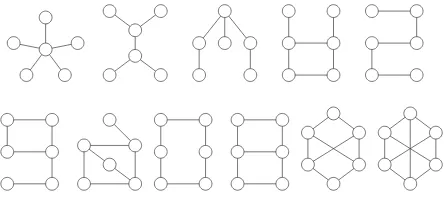
Figure 3.Connected graphs with six vertices that have no AP-labelings.
We used geng program [8] to produce all simple connected graphs up to eight vertices. For each graph, if the invoked algorithm finds an AP-labeling, then it saves the result and terminates. For example, Figure 7 displays AP-labelings for each of the AP-graphs with four vertices. Both our Sage programs and the first found AP-labelings for the other yes instances (8 ≥ n ≥ 5) are available from the authors, on request.
Note that even if the algorithm fails in finding any solu-tion for a given graph, it does not guarantee the nonexistence of an AP-labeling (since we did not try all combinations of a andd). So we need a formal proof for the no instances. Fortunately, all of these remaining cases are easily confirmed as not having an AP-labeling from our theoretical results of Section 3, as discussed below.
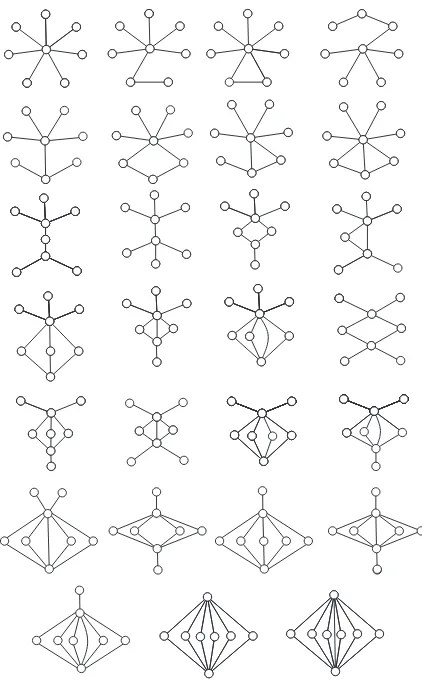
Note that by Theorem 8 we know that any star with more than four vertices is not an AP-graph; this applies to the three stars in the figures. The other graphs in Figure 3 have six vertices and are bipartite and as they have parts with equal size, by Corollary 9 we know that they do not accept any AP-labelings. To prove that the remaining three graphs in Fig-ure 5 are not AP-graphs we use Theorem 10. We see, in each case, that only one edge (i.e. k= 1) needs to be contracted to produce the starK1,5allowing us to use Theorem 10.
[image:6.595.321.545.192.291.2]Likewise, the fact that none of the graphs in Figure 6 is an AP-graph follows from Theorem 8 and (using k ≤ 2) Theorem 10.
Table 1.The number of AP-graphs for connected graphs up to eight vertices.
Ordern 1 2 3 4 5 6 7 8
Yes 0 0 2 5 20 101 849 11090
ProcedureMembership(GraphG, Vertex labelsf[1..n])
begin
Edge labelsg[1..m] = (1,1, . . . ,1)
Saturation valuess[v] =∑uv∈Eg[uv], for allv∈V
if∃v, s[v]> f[v]returnfalse L1: while∃v, s[v]̸=f[v]do
for eachvsuch thats[v]̸=f[v]do
ifthere exists animproving walkstarting atvdo
# Note special case of ending atvifs[v] + 1 =f[v]
Augment the edges of the improving walk by updating the values ofg[]ands[]
nextL1
returnfalse
returntrue
[image:7.595.63.495.42.408.2]end
Figure 4.Pseudo code for using improving walks to decide APG.
Figure 5.Connected graphs with seven vertices that have no AP-labelings.
Figure 6.Connected graphs with eight vertices that have no AP-labeling.
1
1 3 1
2
3
4
1 2
3 4
1 1
1
2
1
1 2
3
2 3
5 4
1 3
1
1 1
5 4
3 2
1 2
3
1 1
1
3
6 5
[image:7.595.296.539.277.409.2]4
Figure 7. The AP-graphs with four vertices, with AP-labelings (a =
δ(G), d= 1).
7
Conclusions
In this paper we have introduced a new graph labeling problem to decide whether a graph’s vertices can be labeled as an arithmetic progression (under constraints of being in-duced from edge labelings by positive integers). We have developed three different algorithms: a simple brute-force integer partition algorithm, a mapping to an instance of inte-ger programming, and, one based augmenting improvement of vertex saturations. By experimental search, we have dis-covered that most connected graphs are AP-graphs. It is ob-served that most of the ‘no’-cases are sparse graphs and star-like. In the other direction, we have characterized all arith-metic sequences that are representable by some AP-graphs.
There are several open questions related to our work in this new area. First, we would like to find a polynomial-time algorithm or (more likely) a proof that the AP-graph decision problem is NP-complete. For a given graph we know that we can scale an edge-labeling(X, a, d)to get an-other(X′, k·a, k·d)labeling by simply settingX′(e) =
[image:7.595.56.267.421.761.2]REFERENCES
[1] B. D. Acharya and S. M. Hedge, Arithmetic graphs, J. Graph Thoery, 14, 175-299, 1990.
[2] M. Baˇca and M. Miller, Super Edge-Antimagic Graphs, BrownWalker Press, Boca Raton, 2008.
[3] G. S. Bloom and S. W. Golomb, Numbered complete graphs, unusual rulers, and assorted applications, Theory and ap-plications of graphs (Proc. Internat. Conf., Western Mich. Univ., Kalamazoo, Mich., 1976), Lecture Notes in Math., Vol. 642, Springer, Berlin, 53–65, 1978.
[4] J. A. Gallian, A dynamic survey of graph labeling. Electron. J. Combin. 16, 2009.
[5] M. R. Garey and D. S. Johnson, Computers and intractabil-ity, A guide to the theory of NP-completeness, W. H. Free-man and Co., San Francisco, Calif., 1979.
[6] A. Kotzig and A. Rosa, Magic valuation of finite graphs Canad. Math. Bull. 13, 451-461, 1970.
[7] S.-M. Lee, E. Seah, and S.-K.Tan, On edge magic graphs, Congresus Num, 86, 179-191, 1992.
[8] B. McKay, nauty software, version 2.4, 2008,
http://cs.anu.edu.au/∼bdm/nauty
[9] A. Rosa, On certain valuations of the vertices of a graph, Theory of Graphs (Internat. Sympos., Rome, 1966), Gordon and Breach, New York, 349–355, 1967.
[10] W. A. Stein et al., Sage Mathematics Software (Ver-sion 3.3), The Sage Development Team, 2009,
http://www.sagemath.org.
[11] K. A. Sugeng, Magic and antimagic labeling of graphs. Phd. Thesis, University of Ballarat, Ballarat, Australia, 2005.