for Distributed PKI
Leonid Reyzin and Sophia Yakoubov Boston University
{reyzin, sonka}@bu.edu
Abstract. Cryptographic accumulators are a tool for compact set rep-resentation and secure set membership proofs. When an element is added to a set by means of an accumulator, a membership witness is generated. This witness can later be used to prove the membership of the element. Typically, the membership witness has to be synchronized with the accu-mulator value: it has to be updated every time another element is added to the accumulator, and it cannot be used with outdated accumulator values. However, in many distributed applications (such as blockchain-based public key infrastructures), requiring strict synchronization is pro-hibitive. We define low update frequency, which means that a witness only needs to be updated a small number of times, andold-accumulator compatibility, which means that a witness can be used with outdated ac-cumulator values. Finally, we propose an acac-cumulator that achieves both of those properties.
Keywords: cryptographic accumulators
1
Introduction
Cryptographic accumulators, first introduced by Benaloh and DeMare [BdM94], are compact binding (but not necessarily hiding) set commitments. Given an accumulator, an element, and a membership witness (or proof), the element’s presence in the accumulated set can be verified. Membership witnesses are gen-erated upon the addition of the element in question to the accumulator, and are typically updated as the set changes. Membership witnesses for elements not in the accumulator are computationally hard to find.
that they are in the accumulated set. In this paper, we focus on distributed applications, which were the original motivation for accumulators [BdM94].
A trivial accumulator construction simply uses digital signatures. That is, when an element is added to the accumulator, it is signed by some trusted central authority, and that signature then functions as the witness for that element. The public verification key of the central authority functions as the accumulator value. However, this solution is very limited, since it requires trust in the central authority who holds the secret signing key. Many distributed applications have no central authority that can be trusted, particularly if they are executed by a number of mutually distrusting peers. In this paper, we are interested in so-called
strong accumulators (defined formally in Section 2), which require no secrets. A classic example of a strong accumulator construction is a Merkle tree [Mer89]. A set element is a leaf of the tree, and the corresponding witness is its authen-ticating path (that is, the sequence of the element’s ancestors’ siblings). The Merkle tree root is the accumulator value. Unfortunately, like all existing strong accumulator constructions, this construction has the significant drawback of re-quiring strict synchronization: membership witnesses need to be updated every time a new element is added to the accumulated set, and can then only be verified against the current accumulator. If elements are added at a high rate, having to perform work linear in the number of new elements in order to retain the ability to prove membership can be prohibitively expensive for the witness holders. Additionally, because of the high update rate, the verifier might have trouble maintaining the most current accumulator to use in verifications.
To address these issues, we introduceasynchronous accumulators, which have two additional properties.Low update frequency allows witnesses to be updated only a sub-linear number of times (in the number of element additions), which in particular means that it is possible to verify a witness that is somewhat older than the current accumulator value. Conversely, old-accumulator compatibility
allows membership verification against an old accumulator, as long as the old accumulator already contains the element whose membership is being verified.
Section 3 describes these properties in more detail.1
Our New Accumulator In this work, we introduce the first strong asyn-chronous accumulator construction. It leverages Merkle hash trees, but main-tains multiple Merkle tree roots as part of the accumulator value, not just one. Our construction has a low update frequency; it requires only a logarithmic amount of work (in the number of subsequent element additions) in order to keep a witness up to date. It is also old-accumulator compatible; unlike any prior construction, it supports the verification of an up-to-date witness against an outdated accumulator, enabling verification by parties who are offline and without access to the most current accumulator. Our construction is made even
1 The question of whether accumulators updates can be batched, as in our scheme,
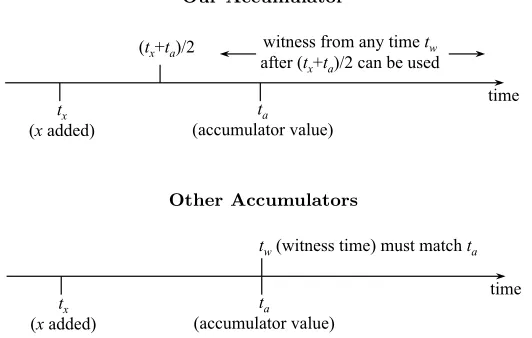
more well suited for distributed applications by the fact that it does not require knowledge of the accumulated set (or any other information linear in the num-ber of elements) for the execution of element additions. Section 4 describes our construction in detail, and provides comparisons to prior constructions. Figure 1 describes the asynchrony of our construction.
Our Accumulator
tx (x added)
ta
(accumulator value)
(tx+ta)/2 witness from any time tw after (tx+ta)/2 can be used
tx (x added)
ta
(accumulator value)
tw (witness time) must match ta time
time
Other Accumulators
tx (x added)
ta
(accumulator value)
(tx+ta)/2 witness from any time tw after (tx+ta)/2 can be used
tx (x added)
ta
(accumulator value)
tw (witness time) must match ta time
time
Fig. 1. A membership witness w can either be outdated, or up-to-date. Our accu-mulator construction is asynchronous because even if w is older or newer than the accumulator, verification can still work. This table illustrates the constraints on how outdated w can be. Note that in all other strong accumulator schemes, w must be perfectly synchronized with the accumulator.
1.1 Application: Distributed PKI
The original distributed application proposed by Benaloh and DeMare [BdM94] involved a canonical common state, but did not specify how to maintain it. Public append-only bulletin boards, such as the ones implemented by Bitcoin [Nak08] and its alternatives (altcoins, such as Namecoin [Namrg]), provide a place for this common state. Bitcoin and altcoins implement this public bulletin board by means of blockchains; in Bitcoin they are used primarily as transaction ledgers, while altcoins extend their use to public storage of arbitrary data.
Altcoins such as Namecoin can be used for storing identity information in a publicly accessible way. For instance, they can be used to store (IP address, domain) pairs, enabling DNS authentication [Sle13]. They can also be used to store (identity id, public key pk) pairs, providing a distributed alternative to certificate authorities for public key infrastructure (PKI) [YFV14].
board is implemented as a blockchain, it falls to the blockchain miners, who act as the conduit by means of whom content is posted, to verify the validity of this registration. They must, for instance, check that there is not already a public key registered to Bob. Details of the verification process are described by Yakoubov et al. [YFV14]. If the registration is invalid, the miners do not post it to the bulletin board. As a result of the miners’ verifications, the bulletin board does not contain any invalid entries.2
When Alice needs to verify Bob’s public key, she can look through the bulletin board to find this pair. However, when executed naively, this procedure requires Alice to read the entire bulletin board—i.e., a linear amount of data. Bob can save Alice some work by sending her a pointer to the bulletin board location where (“Bob”, pkBob) is posted, which Alice will then follow to check that it
points to Bob’s registration, and retrievepkBob. However, that still requires that
Alicehave access to a linear amount of data during verification. What if Alice doesn’t have access to the bulletin board at the time of verification at all, or wants to reduce latency by avoiding on-line access to the bulletin board during verification?
Adding our accumulator to the bulletin board can free Alice from the need for on-line random access to the bulletin board [YFV14] (see also [GGM14] for a similar use of accumulators). The accumulator would contain all of the (id, pk) pairs on the bulletin board, with responsibility for the witnesses distributed among the interested individuals. When Bob posts (“Bob”,pkBob) to the bulletin
board, he also adds (“Bob”, pkBob) to the accumulator, and stores his witness
wBob. He posts the updated accumulator to the bulletin board. The validity of
this new accumulator needs to be checked, by the same parties who check the validity of Bob’s registration. In the blockchain setting, this check is performed by all of the miners. Since our accumulator construction is strong (meaning trapdoor-free, as explained in Section 2) and deterministic, the validity of the new accumulator can be checked simply by re-adding (“Bob”, pkBob) to the old
accumulator and comparing the result to the new accumulator.
With our accumulator in place, Alice can simply download the latest accumu-lator from the end of the bulletin board at pre-determined (perhaps infrequent) intervals. When Alice wants to verify thatpkBobis indeed the public key
belong-ing to Bob, all she needs is wBob and her locally cached accumulator. As long
as Bob’s registration pre-dates Alice’s locally cached accumulator, Alice can use that accumulator and wBob to verify that (“Bob”, pkBob) has been posted to
the bulletin board. She does not need to refer to any of the new bulletin board contents because our scheme is old-accumulator compatible.
Our construction also reduces the work for Bob, as compared to other ac-cumulator constructions. In a typical acac-cumulator construction, Bob needs to update wBob every time a new (id, pk) pair is added to the accumulator.
How-ever, in a large-scale PKI, the number of entries on the bulletin board and the frequency of element additions can be high. Thus, it is vital to spare Bob the
2
need to be continuously updating his witness. Because it has a low update fre-quency, our accumulator reduces Bob’s burden: Bob needs to update his witness only a logarithmic number of times. Moreover, Bob can update his witness on-demand—for instance, when he needs to prove membership—by looking at a logarithmic number of bulletin board entries (see Section 5 for details).
2
Background
As described in the introduction, informally, a cryptographic accumulator is a compact representation of a set of elements which supports proofs of member-ship.3 In this section, we provide a more thorough description of accumulators, their algorithms and their security definitions. In Section 3, we introduce new properties for asynchronous accumulators.
2.1 Accumulator Algorithms
A basic accumulator construction consists of four polynomial-time algorithms:
Gen,Add,MemWitUpOnAddandVerMem, described below. They were first
intro-duced in Baric and Pritzmann’s [BP97] formalization of Benaloh and DeMare’s [BdM94] seminal work on accumulators, and a more general version was provided by Derler, Hanser and Slamanig [DHS15]. For convenience, we enumerate and explain all of the input and output parameters of the accumulator algorithms in Figure 2.
k:The security parameter.
t:A discrete time / operation counter.
at:The accumulator at timet.
x, y:Elements which might be added to the accumulator.
wtx:The witness that elementxis in accumulatoratat timet.
upmsgt:A broadcast message sent (by the accumulator manager, if one exists) at time
tto all witness holders immediately after the accumulator has been updated. This message is meant to enable all witness holders to update the witnesses they hold for consistency with the new accumulator. It will often contain the new accumulator at, and the nature of the update itself (e.g. “x has been added and witnesswtx has been produced”). It may also contain other information.
Fig. 2.Accumulator algorithm input and output parameters.
We separate the accumulator algorithms into (1) those performed by the accumulator manager if one exists, (2) those performed by any entity responsible
3
for an element and its corresponding witness (from hereon-out referred to as
witness holder), and (3) those performed by any third party.
Algorithms performed by the accumulator manager:
– Gen(1k)→a
0 instantiates the accumulatora0(representing the empty set). In some accumulator constructions, a secret keyskand auxiliary storagem are additionally generated for the accumulator manager if these are needed to perform additions. However, this is not the case in our scheme.
– Add(at, x)→(at+1, wxt+1,upmsgt+1) adds the elementxto the accumulator, producing the updated accumulator valueat+1, and the membership witness wtx+1 for x. Additionally, an update messageupmsgt+1 is generated, which can then be used by all other witness holders to update their witnesses.
Note that accumulator constructions whereGen and Add are deterministic and publicly executable are alsostrong(as defined by Camacho, Hevia, Kiwi and Opazo [CHKO08]), meaning that the accumulator manager does not need to be trusted. An execution of Gen or Add can then be carried out by an untrusted accumulator manager, and verified by any third party in possession of the inputs simply by re-executing the algorithm and checking that the outputs match. In fact, an accumulator manager is not necessary at all, since GenandAddcan be executed by the (possibly untrusted) witness holders themselves and verified as needed.
Algorithms performed by a witness holder:
– MemWitUpOnAdd(x, wx
t,upmsgt+1)→wtx+1updates the witness for element xafter another elementy is added to the accumulator. The update message
upmsgt+1 might contain any subset of {wty+1, at, at+1, y}, as well as other parameters.
Algorithms performed by any third party:
– VerMem(at, x, wx
t)→b∈ {0,1}verifies the membership ofxin the accumu-lator using its witness.
2.2 Accumulator Security Properties
Now that we have defined the basic functionality of an accumulator, we can describe the security properties an accumulator is expected to have. Informally, the correctness property requires that for every element in the accumulator it should be easy to prove membership, and the soundness (also referred to as
security) property requires that for every element not in the accumulator it should be infeasible to prove membership.
Definition 1 (Correctness).A strong accumulator is correctif an up-to-date witnesswxcorresponding to valuexcan always be used to verify the membership
of xin an up-to-date accumulatora.
More formally, for all security parametersk, all valuesxand additional sets of values[y1, . . . , ytx−1],[ytx+1, . . . , yt]:
Pr
a0←Gen(1k); (ai, wyi
i ,upmsgi)←Add(ai−1, yi)fori∈[1, . . . , tx−1]; (atx, wtxx,upmsgtx)←Add(atx−1, x);
(ai, wyi
i ,upmsgi)←Add(ai−1, yi)fori∈[tx+ 1, . . . , t];
wix←MemWitUpOnAdd(x, wxi−1,upmsgi) fori∈[tx+ 1, . . . , t] :
VerMem(at, x, wxt) = 1
= 1
In Section 3, we modify the correctness definition for asynchronous accumu-lators. In asynchronous accumulators, the witness wx does not always need to be up-to-date in order for verification to work (as described in Definition 4), and the accumulator itself can be outdated (as described in Definition 6).
Definition 2 (Soundness). A strong accumulator is sound (or secure) if it is hard to fabricate a witness w for a value x that has not been added to the accumulator.
More formally, for any probabilistic polynomial-time stateful adversary A, there exists a negligible functionnegl in the security parameterk such that:
Pr
a0←Gen(1k);t= 1;x1← A(1k, a0);
whilext6=⊥
(at, wtxt,upmsgt)←Add(at−1, xt); t=t+ 1;
xt← A(at−1, w xt−1
t−1 ,upmsgt−1); (x, w)← A:
x6∈ {x1, . . . , xt} andVerMem(at−1, x, w) = 1
≤negl(k)
3
New Definitions: Asynchronous Accumulators
the accumulator, meaning that more values have been added to the accumulator since the witness was last updated. Second, the accumulator can be “old” relative to the witness, meaning that the witness has been brought up to date relative to a newer accumulator value, but an old accumulator value is now being used for verification. We describe correctness definitions for these two scenarios in Sections 3.1 and 3.2, respectively. The soundness definition doesn’t change.
3.1 Low Update Frequency
We consider an accumulator to have alow update frequencyif the frequency with which a witness for element xneeds to be updated is sub-linear in the number of elements which are added afterx. The fact that witnesses do not need to be updated with every addition naturally implies that they can be “old” relative to the accumulator, and still verify correctly. Of course, the fact that updates are needed at all implies that witnesses can’t bearbitrarily old without verification failing.
Low update frequency requires a change in the correctness definition (but not in the soundness definition). In the new correctness definition, we intro-duce a function UpdateTimes(t, tw, tx) which describes when the witness needs to be updated. It returns a set T of times between tw andt at which the wit-nessw last updated at time tw for an elementxadded at time tx needs to be updated. Note that UpdateTimes(tw, tw, tx) = ∅ and UpdateTimes(t1, tw, tx)⊆
UpdateTimes(t2, tw, tx) ift1< t2.
Definition 3 (Low Update Frequency (LUF)). An accumulator has low update frequency if there exists a function UpdateTimes(t, tw, tx) such that (a)
|UpdateTimes(t, tw, tx)| is sublinear int for all fixed tw, tx s.t.tw≥tx, and (b) the accumulator is UpdateTimes(t, tw, tx)-LUF-correct, as described in Defini-tion 4.
Definition 4 (Low Update Frequency (LUF) Correctness). An accumu-lator is UpdateTimes(t, tw, tx)-LUF-correctif an outdated witness wxfrom time twcorresponding to valuexadded at timetxcan be used to verify the membership
of xin an up-to-date accumulator a at timet as long as UpdateTimes(t, tw, tx)
is empty.
More formally, for all security parametersk, for all valuesxand additional sets of values[y1, . . . , ytx−1], [ytx+1, . . . , yt], the following probability is equal to
1:
Pr
a0←Gen(1k); (ai, wyi
i ,upmsgi)←Add(ai−1, yi)fori∈[1, . . . , tx−1]; (atx, wx
tx,upmsgtx)←Add(atx−1, x);
(ai, wyt
i ,upmsgi)←Add(ai−1, yi)fori∈[tx+ 1, . . . , t];
wxi ←MemWitUpOnAdd(x, wxi−1,upmsgi)fori∈UpdateTimes(t, tx, tx) :
VerMem(at, x, wxi) = 1 fori= max(UpdateTimes(t, tx, tx))
3.2 Old-Accumulator Compatibility
We consider an accumulator to beold-accumulator compatibleif up-to-date wit-nesseswxt can be verified even against an outdated accumulatoratawhereta < t,
as long asxwas added to the accumulator before (or at)ta.4 Old-accumulator compatibility allows the verifier to be offline and out of sync with the latest accumulator state.
Like low update frequency, old-accumulator compatibility requires a change in the correctness definition (but not in the soundness definition). Note that unlike Definition 4, Definition 6 is not parametrized by a function; we expect a witness to be compatible with an old accumulator no matter how out of sync they are, as long as the accumulator already contains the element in question.
Definition 5 (Old-Accumulator Compatibility (OAC)).An accumulator is old-accumulator compatibleif the accumulator is OAC-correct, as described in Definition 6.
Definition 6 (Old-Accumulator Compatiblity (OAC) Correctness).An accumulator isOAC-correctif an up-to-date witnesswxcorresponding to valuex
can always be used to verify the membership ofxin any out-of date accumulator awhich already containsx.
More formally, for all security parametersk, all valuesxand additional sets of values[y1, . . . , ytx−1],[ytx+1, . . . , yt]:
Pr
a0←Gen(1k); (ai, wyi
i ,upmsgi)←Add(ai−1, yi)fori∈[1, . . . , tx−1]; (atx, wx
tx,upmsgtx)←Add(atx−1, x);
(ai, wyi
i ,upmsgi)←Add(ai−1, yi)fori∈[tx+ 1, . . . , t];
wix←MemWitUpOnAdd(x, wxi−1,upmsgi) fori∈[tx+ 1, . . . , t] :
∀j∈ {tx, . . . , t},VerMem(aj, x, wxt) = 1
= 1
4
Our New Scheme
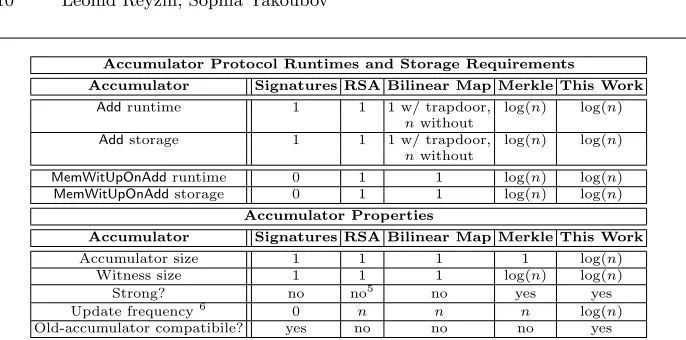
There are several known accumulator constructions, including the RSA construc-tion [BdM94,CL02,LLX07], the Bilinear Map construcconstruc-tion [Ngu05,DT08,ATSM09], and the Merkle tree construction [CHKO08]. (Other similar Merkle tree construc-tions are described in [BLL00] and [BLL02].) Their properties are described in Figure 3. None of these constructions have low update frequency or old-accumulator compatibility.
We present a different Merkle tree construction which, unlike the construc-tions given in [CW09,CHKO08,BLL00,BLL02], is asynchronous: that is, it has low update frequency and old-accumulator compatibility. However, unlike some of those Merkle tree constructions, it is not universal (meaning that it does not support proofs of non-membership).
4 Note that this does not compromise the soundness property of the accumulator,
because if xwas not a member of the accumulator atta, wtx does not verify with
Accumulator Protocol Runtimes and Storage Requirements
Accumulator Signatures RSA Bilinear Map Merkle This Work
Addruntime 1 1 1 w/ trapdoor, log(n) log(n) nwithout
Addstorage 1 1 1 w/ trapdoor, log(n) log(n) nwithout
MemWitUpOnAddruntime 0 1 1 log(n) log(n)
MemWitUpOnAddstorage 0 1 1 log(n) log(n)
Accumulator Properties
Accumulator Signatures RSA Bilinear Map Merkle This Work
Accumulator size 1 1 1 1 log(n)
Witness size 1 1 1 log(n) log(n)
Strong? no no5 no yes yes
Update frequency6 0 n n n log(n)
Old-accumulator compatibile? yes no no no yes
Fig. 3.Various accumulator constructions and their protocol runtimes, storage re-quirements, and properties. For each ofAddandMemWitUpOnAdd, this table gives the algorithm runtime, and the storage required for the algorithm execution. Ad-ditionally, the table describes other accumulator properties, such as accumulator size, witness size, strength, update frequency and old-accumulator compatibility. We letndenote the total number of elements in the accumulator. The RSA Con-struction is due to [BdM94,CL02,LLX07]. The Bilinear Map conCon-struction is due to [Ngu05,DT08,ATSM09]. The Merkle tree construction is due to [CW09], though it is not described as an accumulator construction. (Other Merkle tree constructions are given in [CHKO08,BLL00,BLL02].) Big-O notation is omitted from this table in the interest of brevity, but it is implicit everywhere.
4.1 Construction
Let nbe the number of elements in our accumulator, and let hbe a collision-resistant hash function. Whenhis applied to pairs or elements, we encode the pair in such a way that it can never be confused with a single elementx– e.g., a pair is prefaced with a ‘2’, and a single element with ‘1’. Additionally, we encode accumulated elements in such a way that they can never be mistaken for the output ofh. For instance, we might preface each element with ‘elt’, and the output of the hash function with ‘hash’.
Our accumulator maintains a list of D = dlog(n+ 1)e Merkle tree roots rD−1, . . . , r0(as opposed to just one Merkle tree root). The leaves of these Merkle trees are the accumulated elements.rdis the root of a complete Merkle tree with 2d leaves if and only if thedth least significant bit of the binary expansion of n is 1. Otherwise, rd = ⊥. Note that this accumulator is very similar to a binary counter of elements, but instead of having a 1 in thedth least significant
5
Sander [San99] shows a way to make the RSA accumulator strong by choosing the RSA modulus in such a way that its factorization is never revealed.
6
position representing the presence of 2d elements, the accumulator has root of the complete Merkle tree containing those elements.
A witness wx for x is the authenticating path for x in the Merkle tree that contains x. That is, if x is in the Merkle tree with root rd, then wx = ((z1,dir1), . . . ,(zd−1,dird−1)), where eachzi is in the range of the hash function
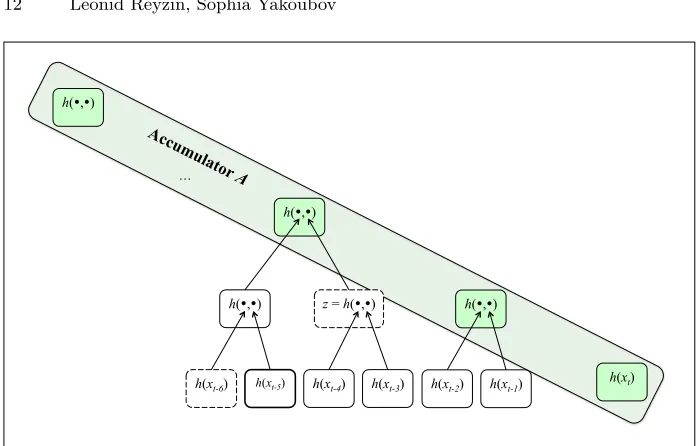
h, and eachdir is eitherrightorleft. These are the (right / left) sibling elements of all of the nodes along the path from elementxto the Merkle tree root of depth d. These siblings, together with the elementx, can be used to reconstruct the root of the Merkle tree. Note that, ifxis in the Merkle tree of depth 0, then the witness is empty. An illustration of an accumulator aand a witness wis given in Figure 4.
Membership Verification Verification is done by using the authenticating path wx and the elementxin question to recompute the Merkle tree root and check that it indeed matches the accumulator rootrd, wheredis the length ofwx. In more detail, this is done by recomputing theancestorsof the elementxusing the authenticating pathwxas described in Algorithm 1, where the ancestors are the nodes along the path fromxto its root, as defined byxand by elements in wx. If the accumulator is up to date, the last ancestor should correspond to the appropriate accumulator rootrd.
If the accumulator is outdated but still containsx, one of the recomputed ancestors should still correspond to one of the accumulator roots. This is because, as described in Algorithm 4 of Appendix C, witnesses (and thus the ancestors they are used to compute) are append-only.
If the witness is outdated (that is, it is from time tw < t), verification can be done at time t as long as t < tw+ 2d. In Figure 1, we lower-bound d as log2(tw−tx), wheretx is the time at which the element in question was added. This results in the condition t <2tw−tx.
Verification is described in full detail in Algorithm 5 of Appendix C.
Element AdditionElement addition is done by merging Merkle trees to create deeper ones. Specifically, when thenth elementxis added toa= [rD−1, . . . , r0], ifr0=⊥, we setr0=h(x). If, however,r06=⊥, we “carry” exactly as we would in a binary counter: we create a depth-one Merkle tree rootz=h(r0, h(x)), set r0 = ⊥, and try our luck with r1. If r1 = ⊥, we can set r1 = z. If r1 6= ⊥, we must continue merging Merkle trees and “carrying” further up the chain. Element addition is described in full detail in Algorithm 3 of Appendix C, and is illustrated in Figures 5 and 6 of Appendix B.
Membership Witness UpdatesMembership witness updates need to be per-formed only when the root of the Merkle tree containing the element in ques-tion is merged, or “carried”, during a subsequent element addiques-tion. This occurs at most D times. Membership updates use the update message upmsgt+1 = (y, wty+1) (wherey is the element being added andwty+1is the witness generated fory) in order to bring the witnesswx
h(xt-5) h(,)
h(xt-6) h(xt-4) h(xt-3) h(xt-2) h(xt-1) h(xt)
h(,)
h(,)
…
z = h(,)
Accumu
lator
A
h(,)
Fig. 4.An illustration of our accumulator. The accumulator itself is shaded; the unshaded elements are elements of the Merkle trees which are not actually a part of the accumulator. The elements with dashed outlines belong to the authenticating path forxt−5 (which itself has a bold outline). So, the witness forxt−5 would be
wxt−5= ((h(x
t−6),left),(z,right)).
4.2 Properties
The accumulator construction presented in this paper is sound (Theorem 1), has low update frequency (Theorem 2) and is old-accumulator compatible (Theorem 3).
Theorem 1. The construction presented in this paper is soundas described in Definition 2 as long as his collision resistant.
Proof. We prove soundness using the classical technique for Merkle trees. Say we have an adversaryAa who can break soundness (i.e., who can find a witness for an element that has not been added to the accumulator). We construct the accumulator Merkle forest using the elements x1, . . . , xt−1 that Aa requests be added to the accumulator.Aathen gives us an authenticating path for an element x /∈ {x1, . . . , xt−1}, and therefore not in any of the accumulator Merkle trees. Using that path, we reconstruct the ancestors of that element. The first ancestor that actually appears in any of our accumulator Merkle trees is a collision, since we have two values that hash to it: the value or pair of values that legitimately appears in our accumulator Merkle tree, and the value or pair of values provided by the adversary.
Theorem 2. The construction presented in this paper has low update frequency
Proof. A witness for elementxneed only be updated when the Merkle tree in whichxresides is merged (or “carried”), which happens at mostD=dlog(n+1)e
times.
Theorem 3. The construction presented in this paper is old-accumulator com-patibleas described in Definition 5.
Proof. Correctness (as described in Definition 1) is self-evident; a Merkle tree root can be correctly reconstructed given its authenticating path. Old accumula-tor compatibility (OAC) correctness (as described in Definition 6) follows from the fact that witnesses are append-only; whenever they are modified, the en-tire prior witness state remains and new information is tacked on at the end. Thus, for every past accumulator (as long as it already contains the elementx in question), there is a subset of the current witnesswtx which can be used for verification against that outdated accumulator.
StrengthAdditionally, the construction presented in this paper isstrong, mean-ing that it does not rely on a trusted accumulator manager. Since every operation is deterministic and publicly verifiable, the accumulator manager would have no more luck breaking soundness than a witness holder would. This is important for distributed use-cases, where there might not be a central trusted party to execute element additions.
Distributed Storage The construction presented in this paper has fully dis-tributed storage; all storage requirements are logarithmic in the number of ments. The accumulator manager does not need to store the accumulated ele-ments, or any other additional data, to perform additions. This, too, is important for distributed use-cases, because storing a lot of data might be too burdensome for the users of the distributed system, and there might not be a central manager willing to store the necessary data.
5
Taking Advantage of Infrequent Membership Witness
Updates in a Distributed PKI
We now return to the PKI application of our accumulator described in Section 1.1, where we have a membership witness holder who may not be able to make a witness update whenever a new element is added. As highlighted in Section 4.2, our accumulator scheme requires that the witness for a given elementxbe updated at most D = dlog(n+ 1)e times, wheren is the number of elements added to the accumulator after x. However, one might observe that having to
“Going back in time” is possible in the public bulletin board setting of our PKI application, in which our accumulator is maintained as part of a public bulletin board. The bulletin board is append-only, so it contains a history of all of the accumulator states. Along with these states, we will include the update message, and a counter indicating how many additions have taken place to date. Additionally, we will include pointers to a selection of other accumulator states, so as to allow the bulletin board user to move amongst them efficiently. The pointers from accumulator statetwould be to accumulator statest−2i for alli such that 0<2i< t(somewhat similarly to what is done in a skip-list). These pointers can be constructed in logarithmic time: there is a logarithmic number of them, and each of them can be found in constant time by using the previous one, since t−2i = t−2i−1−2i−1. Note that storing these pointers is not a problem, since we are already storing a logarithmic amount of data in the form of the accumulator and witness.
Our witness holder can then ignore update messages altogether, performing no checks or work at all. Instead, he updates his witness only when he needs to produce a proof. When this happens, he checks the counter of the most recently posted accumulator state. The counter alone is sufficient to deduce whether his witness needs updating. If his witness does not need updating, he has merely performed a small additional constant amount of work for the verification at hand. If, as happens a logarithmic number of times, his witness does need up-dating, the pointers and counters allow him to locate in logarithmic time the (at most logarithmic number of) bulletin board entries he needs to access in order to bring his witness up to date, as described in Algorithm 9 of Appendix C. Thus, the total work performed by our witness holder will remain logarithmic in the number of future element additions.
Acknowledgements
This research is supported, in part, by US NSF grants 1012910, CNS-1012798, and CNS-1422965. Leonid Reyzin gratefully acknowledges the hospi-tality of IST Austria and ´Ecole normale sup´erieure, where part of this work was performed.
The authors would like to thank Dimitris Papadopoulos and Foteini Baldimtsi for their insightful feedback.
References
ATSM09. Man Ho Au, Patrick P. Tsang, Willy Susilo, and Yi Mu. Dynamic univer-sal accumulators for DDH groups and their application to attribute-based anonymous credential systems. In Marc Fischlin, editor,Topics in Cryptol-ogy — CT-RSA 2009, volume 5473 ofLecture Notes in Computer Science, pages 295–308. Springer Berlin Heidelberg, 2009.
of Cryptographic Techniques on Advances in Cryptology, EUROCRYPT ’93, pages 274–285, Secaucus, NJ, USA, 1994. Springer-Verlag New York, Inc. BLL00. Ahto Buldas, Peeter Laud, and Helger Lipmaa. Accountable certificate
management using undeniable attestations. InProceedings of the 7th ACM Conference on Computer and Communications Security, CCS ’00, pages 9–17, New York, NY, USA, 2000. ACM.
BLL02. Ahto Buldas, Peeter Laud, and Helger Lipmaa. Eliminating counterevidence with applications to accountable certificate management.J. Comput. Secur., 10(3):273–296, September 2002.
BP97. Niko Bari´c and Birgit Pfitzmann. Collision-free accumulators and fail-stop signature schemes without trees. In Advances in Cryptology - EU-ROCRYPT ’97, International Conference on the Theory and Application of Cryptographic Techniques, Konstanz, Germany, May 11-15, 1997, Proceed-ing, pages 480–494, 1997.
Cam09. Philippe Camacho. On the impossibility of batch update for cryptographic accumulators. Cryptology ePrint Archive, Report 2009/612, 2009.
CHKO08. Philippe Camacho, Alejandro Hevia, Marcos Kiwi, and Roberto Opazo. Strong accumulators from collision-resistant hashing. In Tzong-Chen Wu, Chin-Laung Lei, Vincent Rijmen, and Der-Tsai Lee, editors, Information Security, volume 5222 of Lecture Notes in Computer Science, pages 471– 486. Springer Berlin Heidelberg, 2008.
CL02. Jan Camenisch and Anna Lysyanskaya. Dynamic accumulators and applica-tion to efficient revocaapplica-tion of anonymous credentials. In Moti Yung, editor, CRYPTO, volume 2442 ofLecture Notes in Computer Science, pages 61–76. Springer, 2002.
CW09. Scott A. Crosby and Dan S. Wallach. Efficient data structures for tamper-evident logging. InProceedings of the 18th Conference on USENIX Security Symposium, SSYM’09, pages 317–334, Berkeley, CA, USA, 2009. USENIX Association.
DHS15. David Derler, Christian Hanser, and Daniel Slamanig. Revisiting crypto-graphic accumulators, additional properties and relations to other primi-tives. In Kaisa Nyberg, editor,Topics in Cryptology — CT-RSA 2015, vol-ume 9048 ofLecture Notes in Computer Science, pages 127–144. Springer International Publishing, 2015.
DT08. Ivan Damgrd and Nikos Triandopoulos. Supporting non-membership proofs with bilinear-map accumulators. Cryptology ePrint Archive, Report 2008/538, 2008.
FN03. Nelly Fazio and Antonio Nicolosi. Cryptographic accumulators: Definitions, constructions and applications, 2003.
GGM14. Christina Garman, Matthew Green, and Ian Miers. Decentralized anony-mous credentials. In 21st Annual Network and Distributed System Secu-rity Symposium, NDSS 2014, San Diego, California, USA, February 23-26, 2014, 2014.
LLX07. Jiangtao Li, Ninghui Li, and Rui Xue. Universal accumulators with effi-cient nonmembership proofs. In Jonathan Katz and Moti Yung, editors, Applied Cryptography and Network Security, volume 4521 ofLecture Notes in Computer Science, pages 253–269. Springer Berlin Heidelberg, 2007. Mer89. Ralph C. Merkle. A certified digital signature. InAdvances in Cryptology
Nak08. Satoshi Nakamoto. Bitcoin: A peer-to-peer electronic cash system, 2008. Namrg. Namecoin, https://www.namecoin.org/.
Ngu05. Lan Nguyen. Accumulators from bilinear pairings and applications. In Al-fred Menezes, editor,Topics in Cryptology — CT-RSA 2005, volume 3376 ofLecture Notes in Computer Science, pages 275–292. Springer Berlin Hei-delberg, 2005.
San99. Tomas Sander. Efficient accumulators without trapdoor extended abstracts. InInformation and Communication Security, Second International Confer-ence, ICICS’99, Sydney, Australia, November 9-11, 1999, Proceedings, pages 252–262, 1999.
Sle13. Greg Slepak. Dnschain + okturtles. http://okturtles.com/other/ dnschain_okturtles_overview.pdf, 2013.
A
Limited Dynamism
In 2002, Camenisch and Lysyanskaya [CL02] introduced the notion ofdynamic accumulators, which support the deletion of elements from the accumulator. Deletions can, of course, be performed simply be generating a new accumula-tor and re-adding all the elements which have not been deleted. This takes a polynomial amount of time in the number of elements, and so is, strictly speak-ing, efficient. However, a dynamic accumulator should support deletions in time which is either independent of the number of elements altogether, or is sublinear in the number of elements. A dynamic accumulator has the following additional algorithms:
– Del(at, x)→(at+1,upmsgt+1) deletes the elementxfrom the accumulator.
– MemWitUpOnDel(x, wx
t,upmsgt+1)→wxt+1updates the membership witness
for elementxaftery is deleted from the accumulator.
We can make our accumulator construction dynamic by giving the accumu-lator manager auxiliary storage m consisting of the leaves of the Merkle trees (i.e., the set of elements in the accumulator). Then, to perform a deletion Del, the manager replaces the leaf in the tree corresponding toxwith⊥, updates the ancestors of this leaf, and broadcasts the updated ancestors of⊥as the update messageupmsg. To perform a witness updateMemWitUpOnDel(upon receipt of
upmsg), each witness holder whose valuexis in the same Merkle tree replaces
one node on its path (namely, the child node of the lowest common ancestor of the deleted value andx) with the corresponding value fromupmsg.
This modification degrades the space efficiency of the manager by adding auxiliary linear storage on top of the very short (logarithmic) accumulator. (We note that this extra storage can be avoided if the witness holder, or perhaps several other cooperating witness holders, can provide the necessary portions of the Merkle tree to the manager when needed. However, this would only truly work if withdrawing an element from the accumulator was a voluntary act— for instance, this would not work in the application of credential revocation.) This modification would also degrade the low update frequency property, and old-accumulator compatibility.
To keep both distributed storage and low update frequency, we can limit deletions to newer elements (e.g. an element can only be deleted within a con-stant number of turns of being added), since newer elements are in the shallow Merkle trees. While this appears to be limiting, it should be noted that in many applications, deletions of older elements can be avoided altogether by wrapping “time to live stamps” or “expiration dates” into the elements themselves.
B
Element Addition
h(,)
h(xt-2) h(xt-1) w = h(xt)
y = h(,)
Trying to add h(xt+1) in the “least
significant digit” accumulator location. h(,)
h() h()
h() h() h() h() h() h()
h(,)
h(,) h(,) h(,) h(,)
⊥
Step 1
h(,)
h(xt-2) h(xt-1) ⊥
y = h(,)
h(,)
h() h()
h() h() h() h() h() h()
h(,)
h(,) h(,) h(,) h(,)
Cannot add in “least significant digit” accumulator location. Placing an ⊥ in that location, storing
a new Merkle hash tree of depth 2, and trying the next accumulator
location.
z = h(w,h(xt+1)) ⊥
Step 2
Fig. 5.An illustration of an addition operation in our accumulator - part 1.
C
Algorithms
h(,)
⊥ ⊥
h(,)
h() h()
h() h() h() h() h() h()
h(,)
h(,) h(,) h(,) h(,)
Cannot add in that location either. Placing an ⊥ in that location, storing
a new Merkle hash tree of depth 3, and trying the next accumulator
location.
z = h(y,h(w,h(xt+1))) ⊥
Step 3
h(,)
⊥ ⊥
h(,)
h() h()
h() h() h() h() h() h()
h(,)
h(,) h(,) h(,) h(,)
Can add in that location! z = h(y,h(w,h(xt+1))) is now one of the accumulator values, as shown.
z = h(y,h(w,h(xt+1)))
h(xt-1)
y = h(,)
h(xt-2) w = h(xt) h(xt+1)
z = h(,)
h(,)
Step 4
Fig. 6.An illustration of an addition operation in our accumulator - part 2.
C.1 Accumulator Algorithms
In this section, we give the pseudocode for the basic accumulator algorithms, such asGen (Algorithm 2),Add (Algorithm 3),MemWitUpOnAdd(Algorithm 4) and
VerMem (Algorithm 5).L[i] denotes the ith element of a list. For convenience,
Algorithm 1GetAncestors: a helper function forMemWitUpOnAdd(Algorithm 4) andVerMem(Algorithm 5).
Require: p,x
1: c=h(x) 2: p= [c]
3: for(z,dir) inpdo 4: if dir=rightthen 5: c=h(c||z)
6: else if dir=leftthen 7: c=h(z||c)
8: appendctop
9: return p
Algorithm 2Gen
Require: 1k 1: return a0 =⊥
Algorithm 3Add
Require: at,x
1: at+1=at(the new accumulator starts out as a copy of the old one) 2: wxt+1= [] (the witness starts out as an empty list)
3: d= 0 (the depth of the witness starts out as 0) 4: z=h(x)
5: whileat+1[d]6=⊥do
6: if the length ofat+1< d+ 2then
7: append⊥toat+1
8: z=h(at+1[d]||z)
9: append (at+1[d],left) towtx+1
10: at+1[d] =⊥
11: d=d+ 1 12: at+1[d] =z
13: return at+1, wxt+1,upmsg= (x, wxt+1)
Algorithm 4MemWitUpOnAdd
Require: y,wyt+1,wx t 1: letdxt be the length ofwxt 2: letdyt+1be the length ofwyt+1
3: if dyt+1< d
x t then
4: return wxt (the witness has not changed) 5: else
6: dxt+1=dyt+1
7: wx
t+1=wxt (the new authenticating path starts out as a copy of the old one) 8: wyt+1=GetAncestors(w
y t+1, y)
9: append (wyt+1[dx
t],right) towxt+1
10: appendwty+1[d
x
t + 1, . . .] towxt+1
Algorithm 5VerMem
Require: at,x,wx 1: p=GetAncestors(wx, x)
2: if at andrhave any elements in common (computable in linear time)then 3: return TRUE
4: else
5: return FALSE
C.2 Batch Witness Updates
In this section, we give the pseudocode for the algorithms which allow our wit-ness holder to avoid reading to every update message, and instead do only a logarithmic amount of work upon every verification in order to bring the witness up to date. In the following algorithms, we assume the existence of a public append-only random accessbulletinboard.bulletinboard[ptr] gives theptrth entry
ofbulletinboard. However, since bulletinboardmay be used for things other than
accumulator entries, the ptrth entry ofbulletinboardis not guaranteed to corre-spond to theptrth accumulator update. Instead, we lett0 =bulletinboard[ptr].t denote the timestept0 such that the ptrth entry ofbulletinboardcorresponds to the t0th accumulator update. GetPointers (Algorithm 6) and GetPointer (Algo-rithm 7) are helper algo(Algo-rithms for creating the pointers and using them to move amongst the entries of bulletinboardwhich are relevant to the accumulator.
Letibe the number of irrelevant entries onbulletinboard after the last rele-vant entry, and letn be the number of elements which have been added to the accumulator. GetPointers(Algorithm 6), which finds the pointer to include in a new bulletin board entry, takesO(i) +O(log(n)) time. (TheO(i) is present be-cause GetPointersfinds the newest accumulatorbulletinboardentry by iterating over the entries ofbulletinboardbackwards.) Similarly,GetPointer(Algorithm 7), which finds a pointer to a desired bulletin board entry given another pointer at which to start, takesO(log(n)) time.
BatchMemWitUpOnAdd(Algorithm 9), the batch witness update algorithm
Algorithm 6 GetPointers: finds all the pointers needed for a new accumulator update bulletin board entry. If the accumulator update happens at timestept, the pointers should be to all accumulator updates at timestepst−2i forisuch that 0<2i< t. This is a helper function forBatchMemWitUpOnAdd(Algorithm 9).
Require: the bulletin boardbulletinboard
1: ptrs= []
2: find the last occurring addition entry (lt, alt, y, wylt) onbulletinboard. 3: if one does not existthen
4: return ptrs
5: letlptrbe the pointer to the last entry 6: appendlptrtoptrs
7: exp= 1 8: stuck= FALSE 9: whilenotstuckdo
10: lptr=ptrs[−1] (the last element ofptrs)
11: let numPointersAtLastPointer be the number of pointers stored at
bulletinboard[lptr]
12: if numPointersAtLastPointer<expthen 13: stuck= TRUE
14: else
15: ptr=bulletinboard[lptr].ptrs[exp−1] 16: appendptrtoptrs
17: exp=exp+ 1 18: return ptrs
Algorithm 7 GetPointer: finds a pointer to the bulletin board entry cor-responding to the t∗th accumulator update. This is a helper function for
BatchMemWitUpOnAdd(Algorithm 9).
Require: the bulletin board bulletinboard, the timestep t∗, and a pointer ptr to a bulletin board entry corresponding tot0≥t∗
1: t0=bulletinboard[ptr].t
2: whilet06=t∗do 3: difference=t0−t∗
4: letexpbe the largest exponent such that 2expis smaller thandifference
5: ptr=bulletinboard[ptr].ptrs[exp] 6: t0=bulletinboard[ptr].t
Algorithm 8GetUpdateTimeSteps: finds the timesteps at which a witness needs to be updated. This is a helper function forBatchMemWitUpOnAdd(Algorithm 9).
Require: the bulletin boardbulletinboard, the timestepluptat which the last witness update occurred, the timesteplt at which the last accumulator update occurred, and the depthdof the witness in question
1: relevantTimeSteps= [] 2: power= 2d
3: t=lupt+power
4: whilet≤ltdo
5: appendttorelevantTimeSteps
6: whilet modpower×2 = 0do 7: power=power∗2
8: t=t+power
9: return relevantTimeSteps
Algorithm 9BatchMemWitUpOnAdd
Require: the bulletin board bulletinboard, the witness wx, and the timesteplupt at whichwx was last updated
1: letdbe the length ofwx
2: find the last occurring addition entry (lt, alt,upmsg= (y, wylt)) onbulletinboard, and letptrbe the pointer to this entry
3: relevantTimeSteps=GetUpdateTimeSteps(lupt,lt, d) 4: reverse the order ofrelevantTimeSteps
5: relevantPointers= []
6: fort∈relevantTimeStepsdo
7: ptr=GetPointer(bulletinboard, t,ptr) 8: appendptrtorelevantPointers
9: reverse the order ofrelevantPointers
10: forptr∈relevantPointersdo
11: get (t, at,upmsg= (y, wyt)) usingptrfrombulletinboard 12: wx=MemWitUpOnAdd(y, wty, w