Because of an impending ban on burning of residues, more rice growers will be incorporating rice straw in their fields and will depend more than ever on soil microbes to break down the straw and aid rice production the following season. A variety of methods were used to character- ize the effects of various rice straw management methods and winter flooding on the microbial community in a typical rice soil. Microbial biomass increased in straw-incorporated plots by the
second year, and both flooding and rice straw incorporation caused changes in the relative abundances of specific groups of microorganisms. Although the heavy clay soil and wide variety of soil water contents in this study posed problems for microbial analyses, promising results were obtained with a biochemical char- acterization of phospholipids of soil microbes. This type of analy- sis can provide insight into man- agement effects on soil microbial communities.
A 75-acre field study of rice straw incorpo- ration methods and winter flooding effects was conducted on a commercial farm near Maxwell in Colusa County.
0 -
50 - growers will have to incorporate rice
straw disposal into their production systems. Another change to rice pro- duction management that is being ex- plored is winter flooding of rice fields. The desire to understand the potential impacts of winter flooding is moti- vated by increasing interest in using fallow rice fields as habitat for migrat- ing birds.
who begin to incorporate rice straw in their fields is whether straw decom- poses rapidly enough to permit timely planting of the following year’s crop. Over the long term, soil organic matter and nutrient cycling changes driven by soil microbial activity and straw in- puts may alter fertilizer requirements, disease incidence and pest interactions in the rice production system.
potential effects of changes in straw management is to characterize the changes in the soil microbial commu- nity resulting from rice straw manage- ment and flooding treatments. The mi- crobial biomass is relatively sensitive to perturbations to the soil and, as the most labile fraction of soil organic matter, is an early indicator of changes in soil organic matter in general. Our
A primary concern of rice growers
The first step in understanding the
Soli respiration rate
objective was to characterize the ef- fects of straw management and winter flooding treatments on the size, activ- ity and composition of the soil micro- bial community.
Measuring soil microorganisms
Soil microbiological studies are lim- ited by the small size of the organisms, the difficulty in extracting them from the soil and the immense diversity of the community. Culture plate methods are highly selective for specific soil mi- croorganisms, possibly representing as
few as 1 % to 5% of the species present. Those organisms able to form colonies on plates cannot be assumed to be im- portant in overall community func- tions. Our approach was to use a number of different methods that measured different aspects of the whole soil microbial community. These measures fall into two catego- ries: (1) traditional measures of bio- mass and activity including fumiga- tion extraction, respiratory activity and direct counts; and (2) new meth- ods that attempt to measure whole community composition or functional abilities and to provide more detail than the traditional measures.
We attempted to characterize the microbial community as a whole, rather than individual isolates, using two new approaches. One method, substrate utilization analysis (Biolog), measures the decomposition of 95 or- ganic compounds in microtitre plates inoculated with a dilution of the soil. Changes in substrate utilization pat- terns indicate that those members of the microbial community able to grow on the plates have changed with re- spect to their metabolic capacity. This pattern can be used as a fingerprint of the culturable microbial community and can be compared among treatments.
The second method, phospholipid fatty acid (PLFA) analysis, differs
T
2o
4
~;;te-induced respirationI
109I
Active bacteriaI
Jan 3 Feb 2 Mar7 Mar30
Date
Fig. 1. Substrate induced respiration and basal respiration over time in 1994. BF =
burn flooded; BNF = burn not flooded; IF =
incorporated flooded; INF = incorporated not flooded. Error bars are standard devia- tions of four replicate plots.
107
30 B 25
2
-?
2o g! 15 P)E 10 5 0
Jan 3 Fob 2 Mar7 Mar 30
Date
Fig. 2. Direct counts of active bacteria and fungal hyphae over time in 1994. BF =
burn flooded; BNF = burn not flooded; IF =
incorporated flooded; INF = incorporated not flooded. Error bars are standard devia- tions of four replicate plots.
[image:2.594.8.377.49.286.2]substantially from substrate utilization analysis because PLFA requires nei- ther growth nor metabolism of the soil community in vitro. Fatty acids, which make up living cell membranes, are extracted directly from soil and identi- fied with gas chromatography. This method provides a fingerprint of the microbial community that reflects the species composition of the community, rather than its metabolic capabilities. In addition, the total amount of PLFA can be used to estimate the biomass of microorganisms, and individual PLFAs can be used as biomarkers to quantify specific groups of microor- ganisms, such as fungi, bacteria, acti- nomycetes, anaerobes and methane oxidizers.
It was particularly challenging to study microbial ecology in this rice production system because soil water content ranged widely in the plots and the soil was a heavy clay. A number of different methods were used to char- acterize the microbial community in this rice soil. Because this broad range of methods - including the two newer methods that characterize the functional and compositional changes in the soil microbial community - have rarely been used together in a replicated field trial, their strengths and limitations in measuring soil mi- croorganisms are discussed.
A 75-acre field study of rice straw incorporation methods and winter flooding effects was initiated in Octo- ber 1993 on a commercial farm near Maxwell in Colusa County. It was a randomized complete-block experi- ment with split plots; two water treat- ments were used on the main plots (winter flood or no flood), and four rice straw management methods were used on the split plots (straw burned, removed, rolled or incorporated). All treatments were replicated four times.
In the first year, highly contrasting treatment plots (straw burned and straw incorporated plots, both flooded and not flooded) were sampled four times. Representative surface soil samples (0-6 inches) were taken by pooling 20 cores from a 328-foot (100 m) transect in each plot in early winter (Jan. 3); midwinter (Feb. 2); predrain (March 7); and 1-month postdrain
(March 30,1994). In 1995 samples were taken from all treatment plots twice: predrain (Feb. 27) and postdrain (April 10)
.
As a field index of microbial activ- ity, mesh bags filled with chopped rice straw were buried in treatment plots on Feb. 2,1994, along the same transect used for soil sampling. Bags were sampled Feb. 17, March 7, March 18 and March 29,1994.
Total microbial biomass carbon and nitrogen were determined in 1994 samples by fumigation extraction. Ac- tive microbial biomass was measured in three ways in the 1994 samples: (1)
substrate-induced respiration (glucose added) measured as CO2 production; (2) direct counts of fluorescein diacetate-active (FDA) bacteria and fungal hyphae length; and (3) total phospholipid fatty acid analysis (PLFA).
In 1995 samples, active microbial biomass was measured by total PLFA and direct counts of FDA-active bacte- ria and fungi. Microbial activity was measured by determining basal respi- ration (no glucose substrate added) as COz production in 1994 samples. In 1995 basal respiration was measured in samples at field moisture (that is, unmixed and without addition of water).
To analyze changes in microbial community function, we used a new method based on sole-carbon-source utilization. Carbon-source utilization patterns were determined on Biolog GN microplates inoculated with a soil dilution and incubated.
PLFA analysis was conducted by extracting triplicate subsamples with a one-phase extraction mixture contain- ing ch1oroform:methanol:phosphate buffer. Phospholipids were separated from neutral lipids and glycolipids, then subjected to mild alkaline methanolysis. Samples were analyzed by gas chromatography.
Analysis of variance was used to test for significant effects of treatments on traditional measures of microbial biomass and activity. Multivariate sta- tistical analysis techniques used in vegetation community ecology, redun- dancy analysis (RDA) and canonical correspondence analysis (CCA) were used to determine the impact of treat- ments on carbon-source utilization patterns and PLFA profiles. These analyses are very similar to principal components analysis in that similar samples are grouped together and dis- similar samples are separated along artificial axes created by the analysis.
[image:3.594.212.564.53.210.2]100
95
cn $ 9 0
E
85-
0E e
z
8075
Winter flooded period
-
.-
Feb2 Febl7 Mar7 Marla Mar29 Date
Fig. 4. Straw decomposition in mesh bags buried in straw-burned and straw-incorpo- rated, flooded and not flooded plots in 1994. BF = burn flooded; BNF = burn not flooded; IF = incorporated flooded; INF =
incorporated not flooded. Error bars are standard deviations of four replicate plots.
Straw
\ Burn 0) I
incorporate\
Water P = 0.001
-;.o
1
-1.0Fig. 5. Canonical correspondence analysis ordination biplot of Biolog sub- strate-utilization pattern treatment plot scores and significant environmental vari- ables for Jan. 3, Feb. 2 and March 7 sample dates from Maxwell site.
+
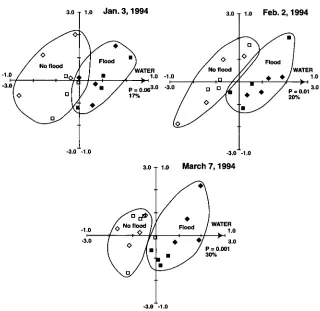
= straw incorporated, no flooding; 0 = straw incor- porated, winter flooding; W = straw burned, no flooding; A = straw burned, winter flooding. The 1 .O scale refers to en- vironmental variables; the 3.0 scale refers to treatment plot scores. Reprinted by per- mission from the American Society for Mi- crobiology.Samples are plotted based on weighted averages of Biolog well scores (or relative abundance of PLFAs in later figures). Ar- rows show direction of high carbon in- puts, soil water contents (flooding) or date. Sample plots close together are most similar; plots farthest apart are most different. Length of axes representing en- vironmental variables indicates impor- tance variables had in explaining variation in data. Significance levels (P values) for environmental variables based on the Monte Carlo permutation test.
With RDA and CCA, however, envi- ronmental variables
-
such as carbon inputs, soil water or straw manage- ment regime-
are used to constrain the created axes in such a way that the relationship between the multivariate data and the known, measured envi- ronmental variables is illustrated and quantified.The Monte Carlo permutation test was used to test the statistical signifi- cance of the variables. Polygons have been drawn around like treatment plots on the figures to facilitate interpretation.
Changes in soil microbiology Microbial biomass. Microbial bio- mass did not differ with management practices in 1994. Fumigation extrac- tion carbon ranged from 76 @/g soil to 114 pgC/g soil over the 1995 sample season, but treatments did not differ, nor did the treatments differ in fumi- gation extraction nitrogen, which ranged from 3 pgN/g soil to 6.5 pgN/
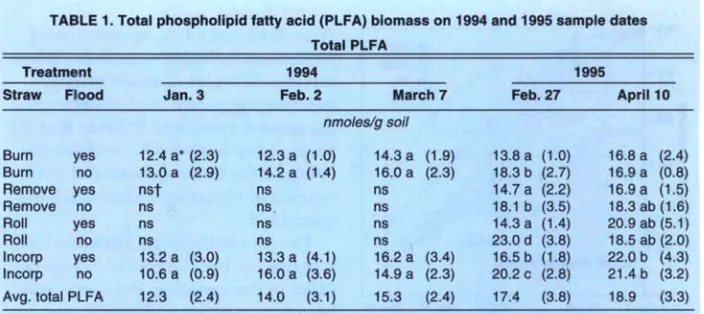
g soil. Measures of active microbial biomass - substrate, induced respira- tion (fig. 11, direct counts (fig. 2) and to- tal PLFA (table 1) - were also similar in all treatments, except that small in- creases in bacteria direct counts were found in incorporated flooded plots. Active fungi declined over the winter in 1994 and were lower in flooded plots by March (fig. 2). This was in accord with the fact that fungi are less com- petitive than bacteria in wet soils. In 1995 microbial biomass as measured by total PLFA increased in straw-in- corporated plots compared to all other treatments and was lower in winter flooded than unflooded plots during the flooded period (table 1). Microbial biomass showed smaller increases in straw-rolled than in straw-incorpo- rated plots, which was probably due to less contact between straw and soil in the rolled plots. Active bacteria counts showed no difference in 1995, however, and active hyphae counts were variable and not sigruhcantly dif- ferent.
ration was high and increased over time in flooded plots (fig. 11, decreas- ing after the drain in all plots. This
Basal respiration. Measured respi-
was probably due to a buildup in flooded plots of anaerobic decomposi- tion products that were readily me- tabolized when samples were aerated during soil sampling and analysis. This effect was less apparent when respiration was measured in 1995, when the methodology resulted in less disturbance of the samples (fig. 3 ) .
One month after draining of flooded plots in 1995, basal respiration was lowest in straw-burned and -removed plots, and highest in straw-incorpo- rated plots (fig. 3 ) . Still, differences were small at this time, probably indi- cating that readily available organic matter had substantially decomposed in straw-incorporated plots.
Straw bag decomposition. Straw in mesh bags buried in treatment plots in 1994 decomposed more slowly in not-flooded plots in which straw was burned than in the other plots (fig. 4). Across all straw treatments, winter flooding enhanced rates of decomposi- tion. This was unexpected because de- composition was assumed to be slower under the more anaerobic con- ditions present in the flooded soils. Flooding may have had a positive im- pact on decomposition rates because of increased temperature buffering or increased contact between microor- ganisms and the straw. It is also pos- sible that these soils, which are adapted to periods of flooding, have a higher potential for anaerobic decom- position than previously assumed.
Substrate utilization patterns (Biolog). Substrate utilization patterns as a fingerprint of the soil bacterial community were reproducible and sensitive to both straw incorporation and flooding in the first year of treat- ments (fig. 5). Biolog patterns were similar in flooded and not-flooded plots in the second year, however, probably because the very wet winter of 1995 diminished the difference be- tween the treatments. Substrate utili- zation patterns were relatively insensi- tive to temporal changes between winter and spring.
PLFA profiles provided replicable fingerprints of the soil microbial community. Changes in the commu-
Phospholipid fatty acid analysis.
[image:4.594.33.200.65.220.2] [image:4.594.36.202.315.467.2]nity that were strongly correlated with flooding increased over the duration of flooding (fig. 6). This is evident by the increased significance ( P = 0.06 to P = 0.001) of the soil water variable from Jan. 3 to March 7,1994, and by the increased amount of variation ex- plained by the axis constrained by the soil water gradient (17% in January to
30% in March). Straw management caused measurable changes in PLFA profiles in the second but not the first year of treatments; thus the straw-in- corporated and straw-rolled plots separate completely from the burned and removed plots in March 1995 (fig. 7). Flooding was also highly sig- nificant in March 1995 (during the winter flooded period), consistent with the 1994 results. After the drain in April 1995, straw-incorporated plots were found to be significantly differ- ent from straw-rolled plots (fig. 8),
whereas straw-rolled plots were not different from straw-removed plots. Temporal shifts in microbial commu- nities were greater than differences as- sociated with treatments, yet differ- ences specific to straw management and flooding were still clearly distin- guishable. This was in contrast with Biolog results, in which changes over time were much smaller than changes associated with management.
Strengths and limits of measures
The multitude of approaches avail- able for describing microbial commu- nities often makes it difficult to decide which methods are appropriate for a particular study. Several methods were used the first year of this study because of the uncertainty about which were feasible to use at this field site, which had heavy clay soil and a wide range of soil water contents.
Uncertainties in the interpretation of results from several measures re- sulted from the wide range in soil wa- ter content. Fumigation extraction for estimating biomass depends on diffu- sion of chloroform into soil, and thus extraction efficiency may have varied among treatment plot types owing to different amounts of water. The heavy clay soil also impedes diffusion so it would be difficult to compare these
3.0
,
1.0 Jan. 3,1994 3.0, 1.0 Feb. 2,1994-1 .o
-3.0
I
I
-3.0 -1.0
I
-3.0 -1.0
3.0 1.0 March 7,1994
T
I
-3.0 -1.0
Fig. 6. Redundancy analysis ordination biplots of PLFA profiles, with the first ordination axis representing soil water contents for Jan. 3, Feb. 2 and March 7, 1994. = straw burned;
+
= straw incorporated; open symbols = not flooded. Axis scale and biplot inter- pretation as described in Fig. 5. Reprinted by permission from Springer-Verlag.Straw
\
If
i n y p o r a t e )/T
Water
P = 0.001
-
I
-;.o
1
-1 .oFig. 7. Redundancy analysis ordination biplot of PLFA profiles and significant en- vironmental variables from Feb. 27, 1995. 4 = straw burned; 0 = straw removed; A =
straw rolled;
+
= straw incorporated; and open symbol = not flooded. Axis scale and biplot interpretation as described in Fig. 5.Reprinted by permission from Springer- Verlag.
-3.0 --1 .O
Fig. 8. Redundancy analysis ordination biplot of PLFA profiles, centroids of straw management regime and the soil water content axis from April 10, 1995. = straw burned; 0 = straw removed; A = straw rolled;
+
= straw incorporated; open sym- bols = not flooded. Reprinted by permis- sion from Springer-Verlag. [image:5.594.220.540.52.363.2] [image:5.594.213.560.420.728.2]Across all straw treatments, winter flood- ing enhanced rates of decomposition.
results of fumigation extraction with those from a lighter-textured soil.
Measures of respiration were prob- lematic in samples from flooded treat- ments also because sampling and analysis introduced oxygen into the samples. High rates of respiration were found in samples from flooded plots (fig. 1). This was probably caused by the rapid aerobic decompo- sition, during the analysis, of readily available carbon substrates, such as or- ganic acids, built up under anaerobic conditions. Standing water varying from none to several inches would also cause variation in a field measure of respiration activity.
In 1995, after the soil was drained and the different plots had similar wa- ter contents, the laboratory measure of
CO2 release was sensitive to differ- ences in straw placement, for example, in incorporated versus straw-rolled plots (fig. 3). As a measure of readily available substrate in similarly aerated soil, it is very useful. Because the mea- sure is sensitive to dilution factors, di- rect counts of active bacteria could also be affected by flooding.
Treatments with varying amounts of straw incorporated were problem- atic for the direct counts of active bac-
teria and fungi, which were con- founded by significant clumping of microorganisms on pieces of decom- posing straw. These clumps, which were most abundant in plots where straw was rolled or incorporated, con- tained hundreds of individual bacte- ria, too numerous to count. This mea- sure is not reliable for contrasting microbial populations in soils receiv- ing different amounts of incorporated organic matter.
Substrate utilization patterns were highly sensitive, particularly to straw inputs. However, PLFA analysis de- tected changes in the microbial com- munity structure that were not evident with the Biolog plate measure of func- tion. It is clear that substrate utiliza- tion cannot be assumed to reflect dif- ferences in microbial community composition. The substrate utilization method probably fails to provide con- ditions appropriate for many organ- isms, and not all members of a com- munity are metabolically active. Whether the subset of the community detected by Biolog substrate utilization is indeed important to the rice soils can- not be determined in this study.
PLFA profiles provided sensitive fingerprints of microbial communities,
and these profiles provided more in- formation about the community than did many of the other measures used. The extraction procedure, involving harsh solvents, is likely to retrieve more cells than the direct count extrac- tion procedure and is not affected by soil moisture, as is fumigation extrac- tion. Therefore this method is the least likely of the methods used to be biased by the nature of the treatments and soil type encountered in this study.
Community composition shifts The relative amounts of specific groups of fatty acids were changed by straw treatments and winter flooding. In an attempt to relate those fatty acids that changed to specific taxonomic or functional groups of microorganisms, we compared the field data to specific peaks reported to be associated with certain microbial groups. In several cases, existing data were useful in in- terpreting the results (table 2). For ex- ample, fungal populations were lower under flooded conditions and higher in plots with straw incorporation after
2 years. Anaerobic bacteria were more abundant in flooded plots. A number of the PLFAs that responded to man- agement or season are ones with which no specific taxonomic or func- tional association has yet been made. When compared with PLFA pro- files from the Sustainable Agriculture Farming Systems (SAFS) project at UC
Davis, it was evident that all treat- ments in the rice soil had smaller pro- portions of fungi and actinomycetes than the SAFS soil, and larger propor- tions of bacterial fatty acids that have been previously associated with spe- cies selected under oxygen limitations. The same set of fatty acids were en- riched in both SAFS and rice soils that received high amounts of organic mat- ter. This suggested that similar groups of microorganisms respond to organic inputs in two soils that differed sub- stantially in soil type and agricultural management.
Our study is one of few to suc- cessfully apply PLFA analysis in a replicated agricultural field trial. Numerous questions concerning the interpretation of the changes that
occur in the fingerprints remain, par- ticularly with respect to which particu- lar organisms or functional groups are sensitive to management. Many of the PLFAs proposed to be biomarkers for specific microbial groups (for example, methanotrophs) have their basis in laboratory studies of only a few iso- lated members of a particular group. Therefore the biomarkers may not be representative of all members of that group occurring in nature, nor are they necessarily exclusive to the group that they are supposed to represent. Future research is needed to relate those PLFAs consistently enriched or reduced by certain management prac- tices to specific groups of microorgan- isms. Nevertheless, the essentially un- biased nature of the assay - that is, it measures a specific type of molecule from all organisms present in the soil - makes it the most promising new technique for whole soil microbial community studies readily available at present. Some of the newly emerging DNA- or RNA-based methods for characterizing whole communities may soon provide other alternatives.
Summary of changes
We found no change in the overall size of the microbial biomass in the first year of straw treatments and win- ter flooding. However, changes did oc- cur in the composition of the microbial community and possibly in its func- tional abilities because winter flooding
treatments. By the second year, changes in the microbial community composition from both winter flood- ing and straw incorporation were evi- dent, and an overall increase in the mi- crobial biomass had resulted from straw inputs. These data indicate that the long-term result of on-site straw disposal, whether incorporated or rolled, will be an increase in the size of the active microbial community. The microbial biomass represents an ac- tively cycling pool of nutrients, and changes in this pool size have been as- sociated with altered nutrient dynam- ics in other systems. Linking the changes observed in the microbial community of rice soils to nutrient dy- namics during the rice-growing season should be a research priority. Long- term changes in decomposition rates in this soil resulting from higher mi- crobial biomass may also occur.
Contrary to expectations, winter flooding caused somewhat faster de- composition of incorporated straw. Therefore providing overwintering habitat for waterfowl is apparently not in conflict with on-farm straw dis- posal. At the International Rice Re- search Institute in the Philippines, however, researchers have found that when soil is maintained in a flooded condition for much of the year, altered decomposition pathways change the soil organic matter. These changes in the quality of the organic matter have been implicated in sequestration of ni-
trogen and yield declines. We identi- fied many specific changes in PLFA profiles of the microbial community resulting from winter flooding. The detailed look at the active microbial community provided by PLFA r?17cJj~-
sis may provide an opportunity to look at processes that may, in the long term, result in important changes in soil organic matter quality.
The variety of methods used in this study together provide a robust foun- dation of baseline information about the microbial community in this rice soil. Early impacts of rice straw man- agement and winter flooding treat- ments have been characterized based on both traditional and promising new methods. The observed changes in the microbial community can be associ- ated with important aspects of the sys- tem, such as rice straw decomposition rates, disease suppression, methane production and denitrification rates, to provide an understanding of the inter- actions between management, soil mi- crobes and important agroecosystem functions. Such analyses can provide a
basis for an understanding of the man- ageable aspects of the soil microbial activity.
D.A. Bossio is Postdoctoral Researcher and K.M. Scow is Associate Professor, De- partment of Land, Air and Water Re- sources, UC Davis.
The authors would like to thank Steven Dennis of Canal Farms, Maxwell, for par- ticipating in this project and Steve Scardaci, Jim Hill and Sylvie Brouder for overall management of the field study. Funding was provided by a Ducks Unlim- ited grant as part of the Sacramento Val- ley RicelandslWetlands Conjunctive Use Study of the California Central Valley Joint Venture Program, which is funded by the U.S. Department of the Interior, Bureau of Reclamation. Additional sup- port was provided by the U.S. Environ- mental Protection Agency (R879658) Center for Ecological Health Research at UC Davis and a grant from the Kearney Foundation of Soil Science. Although the information in this document has been funded in part by the U S . EPA, it may
(continued from page 39)
not necessarily reflect the views of the agency and no official endorsement should be inferred.
Further reading
Bossio DA, Scow KM. 1995. Impact of carbon and flooding on the meta- bolic diversity of microbial communi- ties in soils. Appl Environ Microbiol
61 (1 1):4043-50.
Bossio DA, Scow KM. In press. Im- pact of carbon and flooding on soil mi- crobial communities: phospholipid fatty acid profiles and substrate utili- zation patterns. Microb Ecol.
Bossio DA, Scow KM, Gunapala N, Graham K. In press. Determinants of soil microbial communities: effects of agricultural management, season and soil type on phospholipid fatty acid profiles. Microb Ecol.
cation and characterization of het- erotrophic microbial communities on the basis of patterns of community- level sole-carbon-source utilization. Appl Environ Micro 57(8):2351-59.
Scow KM Somasco 0, Gunapala N, et al. 1994. Transition from conventional to low-input agriculture changes soil fertility and biology. Cal Ag 48(5):20-6.
Temple SR, Somasco OA, Kirk M, Friedman D. 1994. Conventional, low- input and organic farming systems compared. Cal Ag 48(5):14-19.
Vestal JR, White DC. 1989. Lipid analysis in microbial ecology. BioScience 39(8):53541.
White
DC,
Davis WM, Nickels JS, et al. 1979. Determination of the sedimen- tary microbial biomass by extractable lipid phosphate. Oecologia 40(1):5142.Garland JL, Mills AL. 1991. Classifi-
Wet rolling of rice straw promotes decomposition of residues as well as providing overwintering habitat for waterfowl in the Sacramento Valley.
CALIFORNIA AGRICULTURE ASSOCIATE EDITORS Animal, Avian, Aquaculture Human & Community Pest Management
& Veterinary Sciences Development Edward G . Platzer Christopher M. Dewees Linda M. Manton Joseph G. Hancock, Jr. Kathryn Radke Karen P. Varcoe Michael K. Rust
Land, Air & Water Sciences Plant Sciences
Bennie I. Osburn
Garrison Sposito Jodie S. Holt Barbara A. Reed
Economics & Public Po/icy Henry J. Vaux, Jr. Lee F. Jackson
G. Steven Sibbett
Natural Resources
Richard A. Howitt
Barbara H. Allen-Diaz Alvin Sokolow
Food & Nutrltion Daniel W. Anderson Barbara Schneeman Richard B. Standiford Eunice Williamson
http://danr.ucop.edu/calag/ CALAG @ucop.edu PH: 510 987-0044 FAX: 51 0 465-2659