4490
GAMIFICATION: STRENGTHENING THE RELATIONSHIP
BETWEEN THE GOVERNMENT AND THE CITIZENS
1GUNAWAN WANG, 2ARFANIE YANU ARIYANTO
1, Information Systems Management Department, BINUS Graduate Program–Master of Information Systems
Management, Bina Nusantara University, Jakarta, Indonesia, 11530 E-mail: 1[email protected], 2[email protected],
ABSTRACT
The level of internet utilization in the field of public services in the form of complaint reports is still very low. Although the e-Government program has been carried out by the Jakarta Capital City Provincial Government since 2015 through Jakarta Smart City, by implementing Citizen Relationship Management (CiRM) through eight complaint channels, where citizens can participate in city development. But in the past three years the number of complaints has continued to decline. On the other hand, the use of social media in the field of governance is a major trend in e-government practices throughout the world, in an effort to support public information disclosure, efficiency, effectiveness, and accountability of governance. The gamification effect is believed to be able to overcome this problem, many studies have shown that the gamification effect has a major influence in activating individual motivation. We are using the Octalysys Gamification Framework to analyze Gamification in implementing CiRM. We obtained data from observations of the current system, interviews with related parties, and questionnaires to citizens of Jakarta as users of the complaint channel. The results of the analysis show the lack of use of game design elements in the CiRM complaint channel, additional gamification techniques is needed to increase citizens engagement and participation. The conclusion of our study is that Gamification is very instrumental in supporting the implementation of CiRM. So that hopes to strengthening the relationship between the Government and Citizens can be achieved.
Keywords : Gamification, Social Media, Citizen Relationship Management, Octalysis Gamification Framework
1. INTRODUCTION
In the past few years, there has been a substantial growth of electronic government projects (e-Government) that use information and communication technology (ICT) to assist the government in providing services and providing information online based on Presidential Instruction No. 3 of 2003 About E-Government Development Policies and Strategies. The development of information technology infrastructure is also increasingly massive, especially in the Jakarta Capital City Provincial Government. From the data of the Jakarta Capital City Potential Statistics Year 2018 [1] shows that 92% of the Subdistric area in the DKI Jakarta Province has been reached by 4G / LTE signals.
Jakarta Capital City Provincial Government has implemented e-Government programs through Jakarta Smart City since 2015. Jakarta Smart City (JSC) implements Citizen Relationship Management through providing new spaces for people to participate in Jakarta's development through applications and website that can be accessed even through cellphones. Through several complaints channels provided by Jakarta Smart City as
administrator, the public can report problems that can be directly followed up by related officials and agencies. Various applications and websites in the complaints channel are mediators that are expected to increase interaction and communication between the community and the government.
In addition to managing applications that provide reporting services for the community, JSC also creates a forum for the government to manage all forms of community participation called Citizen Relation Management (CRM) Mobile. This application is made to respond quickly, concisely and accurately to citizen requests or questions regarding answers to questions and general information about policies, practices, and procedures. CRM Mobile is made for Agency and Subdistrict in the Jakarta Capital City Provincial Government to be able to coordinate and resolve citizen reports more easily.
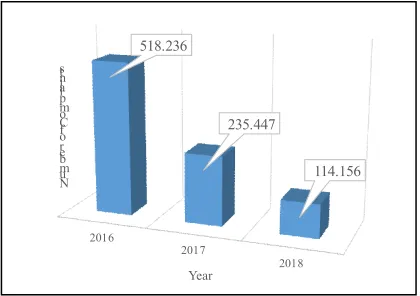
4491 518,236 reports while in 2017 there were 235,447 reports, the number of reports dropped by around 45%. In 2018 the number of complaints reports declined to 114,156 reports or around 48% of the number of complaints in 2017.
Figure 1: Decrease of Complaint Reports
In this regard, a new strategy needs to be done, in order to increase community participation in terms of the utilization of public services, especially in complaints reports. Solutions to problems in Jakarta must be more effective and efficient by utilizing integrated information and communication technology in all public sectors. Thus, it is expected that more things can be done for Jakarta with a lighter effort to improve living standards and the welfare of citizens and happy citizens.
In this decade Gamification has become a new way of thinking about building closer and intertwined relationships between government and citizens. Gamification has been used successfully to achieve improvements in many challenges. Gamification has been successfully implemented to increase citizen involvement and participation in Smart City. Among other things in research motivating change for sustainable urban mobility [2], increasing citizen awareness through Mobile Social Reporting [3], and potential gamification mechanisms to encourage changes in voluntary behavior [4].
Gamification is the addition of game elements and game techniques into the non game context [5] [6] which persuasively tries to influence user behavior by activating individual motivation through game design elements [7]. Whereas according to Chou, Gamification is the skill to reduce all elements that are fun and addictive in the game and apply them to real or productive activities [8].
In assessing the role of gamification in a system, a Framework is needed. Lots of gamification frameworks are available, but the Octalysis Framework is the most appropriate to be used to
assess the level of gamification in the Government system. In relation to Citizen Relationship Management, gamification is a design that most emphasizes human motivation in the process [9] in line with the principle of Citizen Relationship Management in strengthening government relations with citizens.
From the results of the gamification analysis on the implementation of Citizen Relationship Management, it is hoped that the design recommendations of the right gamification form will be generated and can increase people's motivation to play an active role with the government in realizing Jakarta as a modern city that is neatly arranged and consistent with regional spatial plans, building community culture urbanism that is tolerant while having an awareness in maintaining the city and building a clean and transparent government and oriented to public services.
2. LITERATUREREVIEW
2.1 Citizen Relationship Management
Citizen Relationship Management is an effort that develops at all levels of government to respond quickly, concisely and accurately to citizen requests or questions for answers to questions and general information about policies, practices, and procedures [10]. Citizen Relationship Management (CiRM) is a collection of management methods and information technology used by the government to interact effectively with citizens [11]. CiRM evolves from commercial customer relationship management (CRM) technology, and is most commonly used by municipalities as a set of information technology tools and processes to answer citizen telephone questions, route email requests, provide information through websites, and process online transactions. The goal is to foster closer, more effective and efficient working relationships, to better anticipate and meet customer/citizen needs and to develop a more detailed working understanding of what customers/citizens want, expect, and need from those who serve them. The fundamental objective of Citizen Relationship Management is to increase citizen participation through the use of Internet technology, or e-participation. The government uses CRM to connect more effectively with citizens, for transparency and accountability [12] and to analyze what services are valued and how citizens want them to increase, and further, how citizens imagine the future of their community.
CRM is dedicated to the conception, development, sustainable maintenance, and control of economically effective citizen orientation. It can be described as a technology-based relationship between the government and its citizens. The design
2016
2017
2018
518.236
235.447
114.156
N um be r of C om pl ai nt s
4492 of this relationship must make it as easy as possible for citizens through various channels to participate in government affairs. The interest of CRM in interacting with customers is focused on citizen participation. With administrative transparency produced, citizen trust is increasing. Enabling citizens to participate and provide solutions to problems, this simplifies executive and legislative dialogue with citizens. Interaction and communication between parties also becomes more efficient and easier by increasing the speed of internal administration processes. The effect of this has a direct influence on the government's knowledge of its citizens.
2.2 Social Media
Social media is a general term for a series of web-based applications and services where users create and exchange homemade content [13]. Kaplan and Haenlein describe that social media can be categorized into six categories based on the level of social existence and self-presentation.
Social media removes the limitations of humans to socialize, limit space and time, with this social media it is possible for people to communicate with each other wherever they are different and whenever, no matter how far they are, and no matter day or night. Social media consists of users who produce content, exchange content and form social networks [13][14][15]. The essence of social media is users who form communities and are surrounded by content and activity.
Government employment of social media offers several key opportunities for the technology [16] :
Democratic participation and engagement, using social media technologies to engage the public in government fostering participatory dialogue and providing a voice in discussions of policy development and implementation.
Co-production, in which governments and the public jointly develop, design, and deliver government services to improve service quality, delivery, and responsiveness.
Crowdsourcing solutions and innovations, seeking innovation through public knowledge and talent to develop innovative solutions to large- scale societal issues. To facilitate crowdsourcing, the government shares data and other inputs so that the public has a foundational base on which to innovate
2.3 Gamification
Gamification has several definitions, but the most common explanation is the addition of game elements and game techniques into the non-game context [5] [6] which persuasively tries to influence user behavior by activating individual motivation through game design elements [7]. The main purpose of gamification is to support the overall value creation of users by providing a pleasant experience [17].
The gamification is a method that refers to the process of introducing, changing and operating a service system and the interaction between humans and computers that draws inspiration from game mechanics that make business processes more enjoyable by incorporating elements of the game. This method offers an opportunity for all government resources to have better involvement, create more interactive, useful, attentive and feedback government officials faster than the government's desired achievement.
2.4 Previous Research
Research conducted by Crowley [3] concerning Gamification of Citizen Sensing through Mobile Social Reporting. Outlined a mobile social reporting framework that utilises the social web and social gaming to create an enjoyable, sticky experience for the users. By embedding game elements within the framework, it allows the possible measurement of the gain in user engagement through gamification. Research conducted by Yfantis [18] about Exploring Gamification in the Public Sector Through The Conceptual Model Octalysis. The purpose of this study is to explore the use of gamification in the public sector and specifically the adoption of game elements for further use on existing public platforms. Octalysis is used to evaluate game elements by detecting the performance of each element in the existing form from a government website. The value of this research lies in the fact that the public sector is an underestimated research area for the implementation of gamification, so hopefully this work will spark research interest in the community of public policy makers and information technology scientists. Suggestions for further research in this area are improvements to the Octalysis framework to meet the needs of different usage contexts
4493 various frameworks that have been used to build a game. Octalysis Framework Gamification is most appropriate to be applied in government in relation to smart city because gamification is from the point of view of chou, gamification is the design that most emphasizes human motivation in the process. This approach is very appropriate to be implemented in government, because the direct relationship between government and citizens, citizens are the main focus of the government.
3. METHODOLOGY
This paper studies the role of the use of content gamification in several social media used by the Jakarta Capital City Provincial Government through the Jakarta Smart City Management Unit in supporting the implementation of Citizen Relationship Management, and identifying whether the CRM implementation process is running well and to know where CRM processes need to be considered. can make improvements and improvements so that the implementation of Citizen Relationship Management can be carried out effectively and efficiently in fostering more harmonious relations between the government and citizens.
Primary data is obtained through questionnaires and interviews with respondents using in-depth interviews with several selected informants who can provide accurate information. In addition, primary data will also be obtained through direct observation throughout the conduct of the research.
Secondary data is data that was previously available at the Jakarta Smart City Work Unit as a work unit that coordinates the implementation of CiRM in DKI Jakarta Province. Data that can be obtained such as monthly and annual reports, regulations and policies regarding the implementation of Citizen Relationship Management, technology and information systems used and other related resources at the research location. Secondary data is also obtained from journals, books that can be accessed in print or via the internet
3.1 Method of collecting data
Data collection is done through observation by making direct observations of the gamification system in the CiRM by researching and receiving the required data. Interviews by preparing questions and conducting a question and answer process with related sources and literature studies by finding information in literary sources such as journals,
books and others that discuss research on gamification.
Questionnaires were given to Jakarta residents as users of the complaints channel. The population of the city of Jakarta reaches 10,374,235 people, with this population, the sample size to be used must be determined. Sampling size calculation using Slovin's Formula. In this study the expected bias is 10%. So that in accordance with the calculation of the Slovin formula the number of correspondents obtained is 100 people. The questionnaire was distributed using the google form distributed in 44 sub-districts in Jakarta.
3.2 Data Analysis Method
The current Citizen Relationship Management system is analyzed by using the Octalysis Gamification Framework to see how the conditions are and find facts about the findings in the field. So that it knows the weaknesses and strengths of the system that is running. From these findings can determine what must be done to develop the system. Identify system findings, namely researching and reviewing system requirements needed.
4494 Figure 2: Octalysis Gamification Framework [9]
4. FINDINGS
4.1 Jakarta Smart City
That with consideration in the framework of the management of the City of Jakarta by developing and synergizing all potential and resources in an integrated manner by utilizing information technology to realize Jakarta as a modern city that is neatly arranged and consistent with regional spatial plans, building a culture of urban society that is tolerant and has awareness in maintaining the city and building a clean and transparent government and oriented to public services.
As well as to implement The Provisions of Article 183 Regional Regulation No. 12 of 2014 concerning Regional Organizational Organizations and Article 57 of Governor Regulation No. 234 of 2014 concerning Organization and Work Procedures of the Office of Communication, Information and Public Relations, the Provincial Government of DKI Jakarta forms a Smart City Jakarta Management Unit. On the basis of these considerations, a Governor Regulation Number 280 Year 2014 concerning the Establishment, Organization and Work Procedure of the Management Unit of Smart City Jakarta was established. The legal basis is then updated in the Governor Regulation Number 306 of 2016 concerning the Establishment, Organization and Work Procedure of the Smart City Jakarta Management Unit.
The smart city concept in Jakarta is based on 6 pillars: Smart Governance, Smart People, Smart Living, Smart Mobility, Smart Economy, and Smart Environment [20]. Smart city must be beneficial for the entire community so that they can get a better life. With smart city, data is presented more transparently. In addition, smart city increases citizen participation such as making data, applications, giving input, and giving criticism. So that the city becomes a smart city because it involves its citizens, involves its government, its
power, its money, and its space to make all life better.
Figure 3: Jakarta Smart City Concept [20]
4.2 CRM Mobile Application
The legal basis for the use of the Citizen Relation Management (CRM) application is Governor Regulation No. 128 of 2017 concerning the Implementation of Public Complaint Handling Through the Citizen Relation Management Application which is then updated and refined through Governor Regulation Number 39 of 2019 concerning Amendment to Governor Regulation No. 128 of 2017 concerning Organizing Public Complaints Handling Through the Citizen Relation Management Application.
The CRM Mobile application was created in order to improve the efficiency and effectiveness of public complaint handling services, it requires integrated handling through the integration of handling handling on SKPD / UKPD and / or BUMD through the Citizen relation Management (CRM) application integrated in the Jakarta Smart City application system.
[image:5.612.308.524.93.295.2]4495
4.3 Complaint Channel
The complaints channel is used by the citizens of Jakarta Province to convey their aspirations, complaints, suggestions, and input on government services.
Complaints from the public are followed up by the User directly and indirectly. For public complaints that are followed up directly is a public complaint accompanied by a coordinate point feature (geo-tagging) that is followed up by being received directly by each district to then be resolved / handled in accordance with their duties, functions and territory. For public complaints that are followed up indirectly, it is a public complaint that is not accompanied by a geo-tagging feature that is followed up by being received directly by the official complaint channel to be resolved and / or forwarded to SKPD/UKPD and / or BUMD in accordance with the assignment. and their respective functions
The official complaint channel provided by the Jakarta Capital City Provincial Government for its citizens is in accordance with the Appeal of Regional Secretary Number 2 of 2018 concerning the Official Canal of Public Complaints of 8 (eight) channels, including the following:
4.3.1 Facebook (Pemprov DKI Jakarta)
The Facebook address of the Jakarta Capital
Provincial Government is
https://www.facebook.com/DKIJakarta/ if citizens want to submit a complaint can send messages via Facebook message or give comments in one of the posts on the Facebook page of the Jakarta Capital Provincial Government.
Overall, Facebook has a little gamification. The most visible is a system of gathering information such as quizzes used throughout the home page. Facebook users, which are very numerous, should be able to be used by the Government to increase community involvement in complaints reports.
4.3.2 Twitter (@DKIJakarta)
Twitter @DKI Jakarta has been used since July 2010. Through this social media, the Jakarta Capital Provincial Government provides the latest update information about the program and information to residents of Jakarta Capital Province.
Twitter has its own advantages compared to other social media including simple, fast update and open.
Similar to Facebook, Twitter's social media channels can be applied to information collection systems such as quizzes.
4.3.3 Qlue
Qlue is an application that is integrated with Jakarta Smart City in a social media form that invites public participation to report complaints and care about the surrounding environment.
Qlue was launched in 2014. Qlue is one of the partner applications of the Jakarta SmartCity which serves to facilitate community participation in building awareness along with issues around the environment, through the support of mobile technology. This web-based application and mobile phone can be used by residents of Jakarta to report complaints or complaints in real time to environmental conditions such as garbage problems, flooding, congestion, damaged roads, fires and others. This application based on the Android and IOS operating system, can be downloaded for free on the Play store or Apple store.
Some gamification features that already exist in the Qlue Application such as Ranking, Gems, Exp, Avatar, Environment, Level, Favorites, Report & Review. With this application, Jakarta residents can report complaints about environmental conditions such as garbage, floods, congestion, damaged roads, fires, and others. In addition, each report can be monitored on its progress to ensure all complaints submitted are followed up. Some of the gamification techniques contained in the Qlue application include:
1. Ranking
Ranking is a rank based on the total points earned. The ranking is divided into 3 (three) parts, namely Public, Government, and Private. Public Ranking is the sequence of points earned by Qlue users based on their follow-up reports. Government Ranking is divided into 5 (five) types, namely Ranking of District, Municipality, Service Ranking, and Staff Ranking. This ranking is a sequence of points acquisition from each related institution based on the follow-up done. Private Ranking is a ranking based on incoming reports related to private companies.
The ranking calculation scheme is based on points obtained from the results of the follow-up (TL) conducted. There are various aspects that affect these points, such as the type of report that is TL, TL time, the weight of TL category, and so on. 2. Gems
Gems are used to buy Qlue's unique avatars in the Avatar Shop. How to get gems is to invite friends and through posts. Gems can be obtained if the user submits a report in Qlue and also if the report is followed up. Each avatar provided in the shop also has special skills that can add to the acquisition of Gems when posting.
3. Exp
4496 that is collected will increase the user's level. The higher the level, the more benefits and benefits you can get (example: buy a special avatar).
4. Avatar
Avatars are icons that are representative of user profiles. There are many unique avatar options that can be used to interact with other users. Avatars are divided into 2 (two), namely public avatars (can be used for general users) and staff avatars (specifically for Government Officials and need to be verified first).
To be able to collect the avatars, how to buy at the avatar shop using Gems. Each avatar has its own uniqueness in terms of abilities and privileges. Qlue always releases the latest avatars every time. 5. Environment
When you first log in to Qlue, the user will be asked to choose the environment they are in to be able to see what is happening in that environment. By joining a specific environment, users can see posts of fellow citizens, report problems around, and review the most recent and most popular public places in the environment.
6. Level
The level indicates the level that has been reached in Qlue. There are 6 (six) levels in Qlue, from the lowest level Newbie, Citizen, Elder, Council, Town Leader, Ambassador. To be able to go up to each level, it is necessary to collect as much Exp as possible by submitting reports (and followed up) and posting in the environment. The higher the level, the more privileges you have, such as the increasing choice of unique avatars you can have in an avatar shop.
7. Favorite
Users can add specific reports to your Favorites gallery to keep abreast of developments from the report.
8. Check in & Review
This feature is to help inform fellow users about a place such as a restaurant, café, hotel, and so on. Users can submit reports in the form of positive reviews (appreciation) and negative (complaints) that are shown specifically to the company / business
4.3.4 Email ([email protected])
Email [email protected] is an official electronic letter from the Jakarta Capital Provincial Government. Residents can submit complaints or complaints via the email.
This complaint channel does not have gamification element, because it is only a one-way communication from citizens.
4.3.5 Citizen's hall (www.jakarta.go.id)
Citizens' Hall is a sub menu of the official website of the Jakarta Capital Provincial Government. Citizens' Hall can be used to submit suggestions, complaints, or complaints.
Before entering the complaint channel to make a complaint report, residents are required to create an account first at the Citizens' Hall.
There is no gamification content in this complaint channel, residents who have entered the complaint will only get the complaint registration complaint number. Communication is also done in one direction.
4.3.6 LAPOR 1708
Online People's Aspiration and Complaint Service (LAPOR) is an accessible and integrated social media based complaints and complaints facility with 81 Ministries / Institutions, 5 Regional Governments, and 44 State Owned Enterprises in Indonesia. LAPOR! developed by the Office of the President's Staff in order to increase public participation in the supervision of programs and government performance in the implementation of development and public services.
The general public can send reports to LAPOR! through various media including sites https://www.lapor.go.id/, SMS 1708, Instagram @lapor1708, Facebook LAPOR, and also a mobile application. The report is then verified first by the LAPOR administrator! for clarity and completeness, and then forwarded to the relevant ministries / agencies / relevant regional governments no later than 3 working days after reporting is donen. For residents of Jakarta Capital Province who report through this channel, they can refer to the Government of Jakarta Capital Provincial. Furthermore, the report will be processed by the admin to be processed through the Jakarta Capital Provincial Government CRM application, and the report can be monitored on the page http://pengaduanwarga.jakarta.go.id.
4.3.7 SMS (08111272206)
Through short messages, residents can submit complaints and complaints about the problems faced related to public services. The fee charged for the report is the normal SMS rate.
This complaint channel does not have gamification element too, because it is only a one-way communication from citizens.
4.3.8 Open house sub-district
4497 complaints. Citizens are welcome to submit their complaints according to their domicile of residence. There is no application of the gamification element in the subdistrict open house complaint method
4.4 Existing Condition
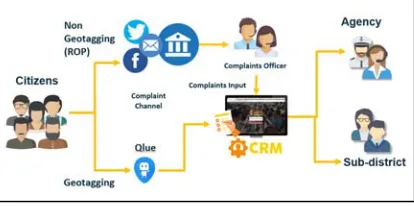
The implementation of the Citizen Relationship Management by the Provincial Government of DKI Jakarta carried out through the CRM Mobile application has not been changed since it was first launched in 2015. The flow of the public complaints process is carried out through several channels of complaints both using geotagging (Qlue) and non-geotagging. For reports that enter through Qlue, the implementation of the follow-up can be done directly through the CRM Mobile application, whereas for complaints reports through the non-geotagging complaints channel, the follow-up process through complaint officers who input into the CRM complaint input is then forwarded to the relevant agencies, to the district / Bureau / Agency. Figure 3.6 shows the flow of the process of following up on the complaint report.
Figure 4: The flow of the Follow-up Process of Citizens Complaints
The condition of the Jakarta City community is increasingly developing and the change of leadership of the Governor, many points must be adjusted to current conditions. The Jakarta Smart City Management Unit as the person in charge of the implementation of Citizen Relationship Management realizes the importance of doing an improvisation so that its implementation remains in line with the Vision and Mission of the Province of DKI Jakarta.
Most complaints reports are submitted through the Qlue application, from data obtained from Jakarta Smart City, almost 80% of the complaints were submitted through the Qlue application. In the last three years the number of complaints coming through the several channels provided has decreased. The number of complaints in 2016 was 518,236 reports while in 2017 it was 235,452 reports, the number of reports fell by around 45%. In
2018 the number of complaints reports decreased to 114,156 reports or around 48% of the number of complaints reports in 2017.
The number of residents reporting also has declined in the past three years. With the number of reporters as many as 110,468 people is the highest number of reporters in 2016, then in 2017 the number of reporters decreased to only 27,437 people or 34% worth from 2016. For 2018 the number of reporters became 17,987 people, down about 48% from in 2017.
Table 1: Number of Complaints and Reporters in CRM Mobile
The follow-up time for the completion of the complaint report was also a major problem. The report completion time is calculated from the time the report is entered in the district CRM account until it is finished by the district.
5. ANALISYS
5.1 Citizen Relationship Management Analysis
To find out the performance of the implementation of the CiRM, measurements were made on the complaint channel using a questionnaire method to the citizens of Jakarta with a sample of 100 people. The questions contained in the questionnaire based on 8 (eight) Core Drives in the Octalysis Framework.
[image:8.612.93.300.370.473.2]For the measurement scale the Likert scale is used with the choice of answers and the score for each answer is as follows:
Table 2: Measures for Questionnaire Answers
The rank of all respondents' answers from each statement is very low, low, medium, high, and very high with the following calculation:
Year Number of
Reports Number of Reporters
2016 518.236 110.468
2017 235.452 37.437
2018 114.156 17.987
Answer Choice Positif Value Negatif
Strongly agree 5 1
Agree 4 2
Neutral 3 3
Agree Less 2 4
[image:8.612.311.522.595.674.2]4498 The lowest score is obtained if all respondents
answered 'Strongly Disagree', then the lowest score is 100 x 1 = 100
The highest score is obtained if all respondents answered 'Strongly Agree', then the highest score is 100 x 5 = 500
The difference between the lowest score and the highest score is 400. With the answer rank of 5, the range rank is obtained by dividing the difference between the lowest score and the highest score by the number of answer ranks, which is 80 so:
Total score of 100 - 180 has a rank of 'very low'. Total score of 180 - 260 has a rank of 'low'. Total score of 260 - 340 has a rank of 'medium'. Total score of 340 - 420 has a rank of 'high'. Total score of 420 - 500 has a rank of 'very high'.
The following are the results of the questionnaire that was conducted on 100 samples of Jakarta residents:
[image:9.612.317.522.96.174.2]Core Drive 1: Epic Meaning & Calling
Table 3: Results of Questions about Core Drive 1
Question:
“The complaints channel is a means of the moral responsibility of the citizens of Jakarta to participate in development”.
The total score for statement 1 is 403, which shows the level of complaints channel as a means of moral responsibility for the citizens of Jakarta to participate in development is High.
Core Drive 2: Development And Accomplishment
Question:
“Complaints channel has an internal drive that shows the progress of citizens in reporting complaints”
Table 4: Results of Questions about Core Drive 2
The total score for statement 2 is 236, which indicates the level of internal encouragement in the complaints channel that shows the progress of citizens in making complaints reports is Low.
Core Drive 3: Empowerment Of Creativity And Feedback
Question:
[image:9.612.314.523.333.411.2]“Complaints channels give citizens freedom to submit complaints reports through various channels”
Table 5: Results of Questions about Core Drive 3
[image:9.612.91.300.389.470.2]The total score for statement 3 is 410, which shows the level of freedom of citizens in submitting complaints through the Complaint Channel is High.
Table 6: Results of Questions about Core Drive 4
Core Drive 4: Ownership Andosession
Question:
“Residents feel they have and are responsible for the Complaint Report submitted in the Complaint Channel”
The total score for statement 4 is 290, which shows the level of ownership and responsibility of citizens for the complaint report submitted in the Complaint Channel is Medium.
Option Answer Answer Value Total
Strongly Agree 11 5 55
Agree 19 4 76
Neutral 26 3 78
Agree Less 37 2 74
Strongly Disagree 7 1 7
Count 290 Option Answer Answer Value Total
Strongly Agree 36 5 180
Agree 43 4 172
Neutral 16 3 48
Agree Less 5 2 10
Strongly Disagree 0 1 0
Count 410 Option Answer Answer Value Total
Strongly Agree 1 5 5
Agree 12 4 48
Neutral 20 3 60
Agree Less 56 2 112
Strongly Disagree 11 1 11
Count 236
Option Answer Answer Value Total
Strongly Agree 24 5 120
Agree 58 4 232
Neutral 15 3 45
Agree Less 3 2 6
Strongly Disagree 0 1 0
[image:9.612.311.523.489.568.2]4499
Core Drive 5: Social Influence And Relatedness
Question:
[image:10.612.315.523.114.192.2]“Residents who reort complaints have social influence and attachment to the Complaints Channel”
Table 7: Results of Questions about Core Drive 5
The total score for statement 5 is 225, which shows the level of social influence and engagement of citizens reporting complaints in the Complaints Channel is Low.
Core Drive 6: Scarcity and Impatience
Question:
[image:10.612.90.301.180.259.2]“Complaints channels provide time limits to residents in reporting complaints”
Table 8: Results of Questions about Core Drive 6
The total score for statement 6 is 419, which shows the level of Citizens' desire to not be limited by time in reporting complaints on the complaints channel is
High. From the results of the above measurements, to find out the level of gamification in the CiRM system that is already running. The following are conclusions from the results of the questionnaire measurements shown in the following table:
Core Drive 7: Unpredictability And Curiosity
Question:
[image:10.612.312.523.329.408.2]“Complaints channels provide uncertainty in following up on Citizen complaints reports”
Table 9: Results of Questions about Core Drive 7
The total score for statement 7 is 257, which shows the level of confidence of the citizens that the report will be followed up by the Government is Low.
Core Drive 8: Loss And Avoidance
Question:
“Residents feel that their complaint report is not heeded if they do not report through the Complaints Channel”
Table 10: Results of Questions about Core Drive 8
Table 11: Conclusions on the Complaints Canal Questionnaire Results
The total score for statement 8 is 373, which shows the level of disregard for citizens' complaints reports if not reported through the Complaints Canal is High.
5.2 Analysis of CiRM in Octalysis
After knowing the results of the questionnaire from the Complaints Channel, then to assess overall gamification in the Complaints channel needs to be displayed in the Octalysis Score to produce the Octalysis Framework Graph. Each Core Drive has a maximum value of 10 and a minimum value of 0.
Option Answer Answer Value Total
Strongly Agree 36 5 180
Agree 25 4 100
Neutral 21 3 63
Agree Less 12 2 24
Strongly Disagree 6 1 6
Count 373 Option Answer Answer Value Total
Strongly Agree 7 5 35
Agree 15 4 60
Neutral 19 3 57
Agree Less 46 2 92
Strongly Disagree 13 1 13
Count 257
Option Answer Answer Value Total
Strongly Agree 0 1 0
Agree 11 2 22
Neutral 12 3 36
Agree Less 24 4 96
Strongly Disagree 53 5 265
Count 419 Option Answer Answer Value Total
Strongly Agree 0 5 0
Agree 17 4 68
Neutral 10 3 30
Agree Less 54 2 108
Strongly Disagree 19 1 19
Count 225
Core Drive Octalysis Result 1 Epic Meaning & Calling High 2 Development And
Accomplishment Low
3 Empowerment Of Creativity And
Feedback High
[image:10.612.93.301.395.473.2] [image:10.612.314.520.453.580.2]4500
Figure 5: Octalysis graph of the DKI Jakarta Provincial Government's CiRM Score scores obtained in the questionnaire are then
converted into Octalysis Graph values.
As for converting questionnaire score and Octalysis chart scale values are as follows:
The lowest score of the questionnaire is 100 The highest score of the questionnaire is 500
The difference between the highest score and the lowest score of the questionnaire is 400. The total value of the scale in the Octalysis Graph is 10, then the value of the scale is obtained by dividing the difference in the lowest score and the highest score by the total value of the scale, which is equal to 40 so that:
Total score of 100 - 140 has a scale of 1 Total score of 140 - 180 has a scale of 2 Total score of 180 - 220 has a scale of 3 Total score of 220 - 260 has a scale of 4 Total score of 260 - 300 has a scale of 5 Total score of 300 - 340 has a scale of 6 Total score of 340 - 380 has a scale of 7 Total score of 380 - 420 has a scale of 8 Total score of 420 - 460 has a scale of 9 Total score of 460 - 500 has a scale of 10
Table 12: CiRM Octalysis Score
While the Octalysis score is the square of the Octalysis scale value. The total Octalysis score is the overall value of the system being analyzed. Here is a table calculating the conversion value of the questionnaire score with the Octalysis scale and the Octalysis score.
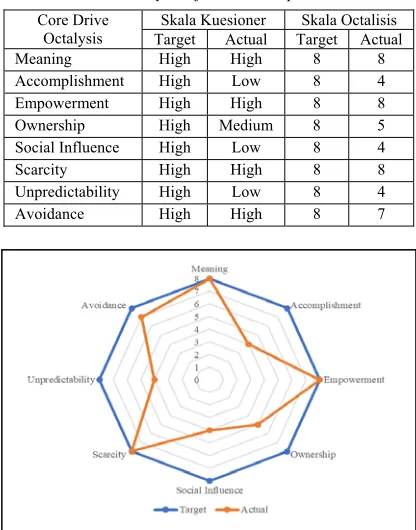
The assessment based on the Octalysis chart is that the Complaints Channels in CiRM have Good Motivation, but there are some core drives that need to be further improved. The following is an analysis and explanation of each core drive from the Gameplay octalysis Framework
Core Drive Octalysys
Score Kuesioner
Scale Octalysis
Score Octalysis
Meaning 403 8 64
Accomplishment 236 4 16
Empowerment 410 8 64
Ownership 290 5 25
Social Influence 225 4 16
Scarcity 419 8 64
Unpredictability 257 4 16
Avoidance 373 7 49
[image:11.612.148.463.413.695.2]4501
Core Drive 1: Epic Meaning and Calling
The implementation of CiRM through several complaint channels that are available indirectly has provided education to the community on the importance of citizen participation in participating in developing the City of Jakarta. This represents Core Drive 1 in Octalysis, a feeling of wanting to participate in development, and a call to action greater for the development of the City of Jakarta. Therefore the octalysis score for this core drive gets a high score of 8.
Core Drive 2: Development and Accomplishment
In its implementation the CiRM does not give awards to residents who have provided input or complaint reports, whether of economic value or not. Only in the Qlue application, users and reporters can see the report points for each complaint.
Core Drive 3: Empowerment Of Creativity And Feedback
With a variety of complaint channels provided by the DKI Jakarta Provincial Government, residents feel easy and free to report complaints. Either through channels that use social media or by coming directly to district in accordance with the residence domicile.
Core Drive 4: Ownership Andossession
The implementation of the follow-up to complaints that are included in the non-Geotagging Complaints Channel requires further information from the reporter, both the location of the problem occurred and the problem, usually this problem is personal in nature. For reports that are geotagging follow-up complaints can be directly carried out. Citizens are more likely to just want to report, without following the complaints report follow-up process.
Core Drive 5: Social Influence And Relatedness
The implementation of the CiRM through several complaint channels did not have a social impact on the complainant. Residents who report complaints are even more likely not to reveal their identities. This may be related to security and life safety issues. There is an opinion in the community if citizens make a complaint report, it will even be difficult later when dealing with the Government.
Core Drive 6: Scarcity and Impatience
Reports on complaints can be made by citizens through social media complaints channels at any time. For complaints channels that go through the openhouse both sub-district and district can only be done at a certain time.
Core Drive 7: Unpredictability and Curiosity
Follow up handling for complaints reports in the Complaints Channels that require further handling usually takes time. Citizens' wishes are that the Government provides certainty in the time limit and certainty the problem can be solved. In the Qlue application there are red, yellow and green indicators that identify the complaints follow-up process. Whereas for other complaints channels, every complaint report that comes in is only given a report registration number.
Core Drive 8: Loss and Avoidance Refers
Complaints channels are the main means of communication between citizens and the Government. Through the complaints channel the residents participated in the process of building the City of Jakarta for the better
5.3 GAP Analysis of CiRM
GAP analysis is obtained by comparing expected targets with actual conditions. The target rank is obtained from interviews with the Head of the Jakarta Smart City Implementing Unit with consideration of the scale of the Octalysis Graph Framework. While the actual rank rank is based on the results of the questionnaire score.
[image:12.612.313.521.450.715.2]The following table presents the results of the gap analysis:
[image:12.612.313.521.453.713.2]Table 13: GAP Analysis of CiRM Complaints Channels
Figure 6: GAP Analysis of CiRM Complaints Channels
Core Drive Octalysis
4502
5.4 GAP Evaluation of CiRM
After knowing the GAP between the desired conditions and the actual needs to be evaluated what is the cause of the GAP. The following are possible causes that occur from the perspective of Framework Octalysis.
1. Epic Meaning and Calling Target Statement: High
The complaints channel is a means of the moral responsibility of the citizens of Jakarta to participate in development
Actual Evaluation: High
Education and guidance to residents has been carried out appropriately in accordance with Governor Regulation Number 128 of 2017 which is carried out in stages, but there is a need for ongoing guidance so that the implementation of CiRM can be maximized
2. Development And Accomplishment Target Statement: High
Complaints channel has an internal drive that shows the progress of citizens in reporting complaints
Actual Evaluation: Low
The CiRM complaint report method through the complaint channel in social media and open house does not show the number of complaint reports that have been submitted
3. Empowerment Of Creativity And Feedback Target Statement: High
Complaints channels give citizens freedom to submit complaints reports through various channels
Actual Evaluation: High
The large number of complaint channels that are opened gives citizens the opportunity to freely choose the desired complaint channel in accordance with their wishes
4. Ownership And Possession Target Statement: High
Residents feel they have and are responsible for the Complaint Report submitted in the Complaint Channel
Actual Evaluation: Medium
Reports that are personal complaints are usually more guarded by the owner. However, for complaints reports that are for the public, citizens are more likely not to give out their personal identities so they do not have a sense of responsibility for reports that have been submitted
5. Social Influence And Relatedness Target Statement: High
Residents who report complaints have social influence and attachment to the Complaints Channel
Actual Evaluation: Low
The CiRM complaints channel does not have a feature to show complaints reports to others with a view to seeking support or just as a notification 6. Scarcity And Impatience
Target Statement: High
Complaints channels provide time limits to residents in reporting complaints
Actual Evaluation: High
There are no time limits to submit reports on social media complaints, whereas if there is a certain time for open houses for residents to come to the sub-district / district Office
7. Unpredictability and Curiosity Target Statement: High
Complaints channels provide uncertainty in following up on Citizen complaints reports Actual Evaluation: Low
There is not yet a 100% guarantee that every complaint report problem will be resolved and acted upon by the Government
8. Loss And Avoidance Refers Target Statement: High
Residents feel that their complaint report is not heeded if they do not report through the Complaints Channel
Actual Evaluation: High
The CiRM complaint channel is the main means of communication between citizens and the government
6. RECOMMENDATIONS
Based on the results of GAP evaluations that have been carried out on CiRM at the Provincial Government of DKI Jakarta, the recommendations for the form of gamification that can be carried out include:
1. The Provincial Government of DKI Jakarta must make its own complaint application
4503 Government is only related to data availability and publication facilities. From the results of interviews with Jakarta Smart City employees, sometimes at certain times the data sharing connection of complaint reports between Qlue and CRM Mobile is out of sync. For example, there are 10 reports in Qlue, but the CRM Mobile application only displays 9 reports. By making a new complaint application it is expected that the data connection will be more accurate so that the follow-up of the complaint report can be carried out quickly, precisely, and accurately.
2. Give reward points on complaints reports By providing reward points that are of economic value as did the City of Cascais Government in Portugal who developed City Point Cascais. Points can be generated from various activities that are environmental, social, social, transportation, and others. Where these points can be used as entrance tickets to museums, book purchases, tax deductions or other levies. Citycascais Point is a prize program that encourages good citizenship practices, using the application to provide opportunities to earn points and with them getting products and services. When users carry out predetermined activities in the field of environment, citizenship, social responsibility, mobility, and others. User gets points. By collecting points, users will have different vouchers that can be redeemed for prizes offered by local partner networks.
Based on the gamification and recognition of citizens, the application encourages participants to take an active role in transforming the community into a better place to live. With one City Point at a time, participants increase their involvement in a sustainable city.
Led by the city government and with low investment, local partnerships can promote common goals for social good, while promoting its services and products. Cascais City Points also paves the way for basic pricing, activities / profiles, city service prices.
3. Empowering citizens' creativity and backlash From the ongoing CiRM analysis shows that for core drive 3 regarding the empowerment of creativity and feedback the level of gamification is still low, this can be increased by providing a motivation to the citizens so that they can express their creativity. For example, giving green to those areas that are free from complaints such as garbage, scribbles, or wild banners. 4. Increase the Government's contribution through
social media
The use of social media as a means of implementing CiRM can be further increased. Communication between the Government and citizens through social media should be more flexible and relaxed so that the relationship between the Government and citizens can be more closely and intertwined. Social media is not only used to convey information, but can also be used to improve communication by using several gamification techniques.
5. Guarantee the follow-up to the completion of the complaint report
Providing progress information on the follow-up to the completion of the complaint report by using a number of gamification techniques is an appropriate step to further give citizens a sense of trust. Gamification techniques that can be used such as progress bars, notifications, Achievement Symbols.
The progress bar gamification technique can be demonstrated to see the extent to which the complaints report process is followed up, from the report submission stage to the completion stage.
6. Carry out interactive CiRM socialization
The implementation of the socialization was carried out through a campaign to use the complaint channel more interactively, in contrast to socialization in general. Gamification techniques can be used to help streamline and make them effective. Some gamification techniques that can be used include Group Quest, Friending, Social Treasure, Water Cooler. As was done by the Mayor of Vancouver City in Canada, holding a bicycle tour together to simply provide information and explanation to residents about the new bicycle paths on the streets of the protocol.
7. Cooperating with Other City Governments By collaborating and benchmarking with other big cities around the world that have implemented CiRM, it is hoped that they will be able to provide new ideas. So that CiRM can be implemented more optimally.
4504 Providing ease of communication will encourage citizens to report complaints
7. CONCLUSION
From the results of the research that we have done, it shows that the level of enthusiasm of citizens in reporting through media channels in citizen relationship management has indeed declined in the last three years. The addition of game elements in several social media used as a reporting medium needs to be followed up further, because it is proven to increase motivation and improve relations between the government and citizens. Citizens of Jakarta need to fit new and fresh so that they are more inclined to participate in the development of the city of Jakarta. Giving rewards and harmonious relationships can create mutual benefits. Jakarta society has unique characteristics.
Gamification can work well, if applied seriously. Because actually people really need refreshment, something new that continues to grow.
It is hoped that the DKI Jakarta provincial government program in citizen relationship management to improve community participation and build good governance through a collaborative approach with the community can work well. This is done solely to realize an effective and efficient and clean government figure and serve in order to realize the performance of professional State Apparatus towards clean and good governance
REFERENCES:
[1] BPS DKI Jakarta, Statistik Potensi Kelurahan Provinsi DKI Jakarta 2018. 2018.
[2] S. Gabrielli et al., “Design challenges in motivating change for sustainable urban mobility,” Comput. Human Behav., vol. 41, pp. 416–423, 2014.
[3] D. N. Crowley, J. G. Breslin, P. Corcoran, and K. Young, “Gamification of Citizen Sensing through Mobile Social Reporting,” 2012 IEEE Int. Games Innov. Conf., pp. 1–5, 2012.
[4] R. Kazhamiakin et al., “Using Gamification to Incentivize Sustainable Urban Mobility.” [5] A. Domínguez, J. Saenz-Navarrete, L.
De-Marcos, L. Fernández-Sanz, C. Pagés, and J. J. Martínez-Herráiz, “Gamifying learning experiences: Practical implications and outcomes,” Comput. Educ., vol. 63, pp. 380– 392, 2013.
[6] S. Deterding, D. Dixon, R. Khaled, and L. Nacke, “From game design elements to gamefulness: Defining gamification,” Proc. 15th Int. Acad. MindTrek Conf. Envisioning Futur. Media Environ. - MindTrek ’11, pp. 9– 11, 2011.
[7] P. Petkov, F. Köbler, M. Foth, R. Medland, and H. Krcmar, “Engaging energy saving through motivation-specific social comparison,” Proc. 2011 Annu. Conf. Ext. Abstr. Hum. factors Comput. Syst. - CHI EA ’11, no. May, p. 1945, 2011.
[8] Y.-K. Chou, “What is Gamification,” Website,
2017. [Online]. Available:
https://yukaichou.com/gamification-examples/what-is-gamification/. [Accessed: 01-May-2019].
[9] Y.-K. Chou, “Octalysis: Complete Gamification framework,” Website, 2015.
[Online]. Available:
https://yukaichou.com/gamification- examples/octalysis-complete-gamification-framework/. [Accessed: 01-May-2019]. [10] R. Shaikh and M. R. Khan, “Citizen
relationship management: a decisive parameter of G2C e-governance web portals of Maharashtra, India,” Int. J. Recent Innov. Trends Comput. Commun., vol. 2, no. 8, pp. 2234–2239, 2014.
[11] A. Schellong, Citizen relationship
management: A study of CRM in government, vol. 560. Peter Lang, 2008.
[12] G. Cardoso, “From Knowledge to Policy,” no. January 2006, 2016.
[13] A. M. Kaplan and M. Haenlein, “Users of the world, unite! The challenges and opportunities of Social Media,” Bus. Horiz., vol. 53, no. 1, pp. 59–68, 2010.
[14] T. Ahlqvist, A. Back, M. Halonen, and S. Heinonen, Social Media Roadmaps Exploring the futures triggered by social media. VTT Tiedotteita – Valtion Teknillinen Tutkimuskeskus, no. August. 2012.
[15] J. H. Kietzmann, K. Hermkens, I. P. McCarthy, and B. S. Silvestre, “Social media? Get serious! Understanding the functional building blocks of social media,” Bus. Horiz., vol. 54, no. 3, pp. 241–251, 2011.
[16] J. C. Bertot, P. T. Jaeger, and D. Hansen, “The impact of polices on government social media
4505 recommendations,” Gov. Inf. Q., vol. 29, no. 1, pp. 30–40, 2012.
[17] J. Hamari, J. Koivisto, and H. Sarsa, “Does gamification work? - A literature review of empirical studies on gamification,” Proc. Annu. Hawaii Int. Conf. Syst. Sci., pp. 3025– 3034, 2014.
[18] V. Yfantis and D. Tseles, “Exploring Gamification In The Public Sector Through The Octalysis Conceptual Model,” eRA-12International Sci. Conf., no. October, 2017. [19] A. Mora, D. Riera, C. Gonzalez, and J.
Arnedo-Moreno, “A Literature Review of Gamification Design Frameworks,” VS-Games 2015 - 7th Int. Conf. Games Virtual Worlds Serious Appl., 2015.
[20] Jakarta Smart City, “Jakarta Smart City - Profil,” 2016. [Online]. Available: http://interactive.smartcity.jakarta.go.id/. [Accessed: 01-May-2019].
4506
ANNEXUREI
QUESTIONNAIRE
The Role of Gamification in Supporting the Implementation of Citizen Relationship Management in the Provincial Government of the Special Capital Region of Jakarta
---
This questionnaire was created as material for analysis of the implementation of Citizen Relationship Management in the Provincial Government of the Special Capital Region of Jakarta
=====================================
Part I. Respondent Data
Name:
Domicile address :
a. Jakarta
b. Outside Jakarta
Age : a. <20 years b. 20-30 years c. 30 - 40 years d. 40-50 years e. > 50 years
Gender : a. Man b. Woman
Last education : a. No school b. SD / equivalent
c. Middle School / equivalent d. SMA / equivalent
e. Diploma f. Bachelor
Occupation: a. Civil servants b. Private employees c. entrepreneur d. Student / Student e. Does not work
f. Other, please specify ...
Part II Implementation of Citizen Relationship Management
How to Answer:
Put an (X) in the column choices provided that indicate the level the suitability that is most relevant to you.
Information:
SD : Strongly Disagree D : Disagree
N : Neutral A : Agree VA : Very agree
1. Epic Meaning & Calling
The complaints channel is a means of the moral responsibility of the citizens of Jakarta to participate in development
Reason:
---
2. Development And Accomplishment
Complaints canal has an internal drive that shows the progress of citizens in reporting complaints
Reason:
---
3. Empowerment Of Creativity And Feedback Complaints channels give citizens freedom to submit complaints reports through various channels
Reason:
---
4. Ownership Andossession
Residents feel they have and are responsible for the Complaint Report submitted in the Complaint Channel
SD D N A VA
SD D N A VA
SD D N A VA
SD D N A VA
4507 Reason:
---
5. Social Influence And Relatedness
Residents who report complaints have social influence and attachment to the Complaints Channel
Reason:
---
6. Scarcity And Impatience
Complaints channels provide time limits to residents in reporting complaints
Reason:
---
7. Unpredictability And Curiosity
Complaints channels provide uncertainty in following up on Citizen complaints reports
Reason:
---
8. Loss And Avoidance Refers
Residents feel that their complaint report is not heeded if they do not report through the Complaints Channel
Reason :
---
ANNEXUREII
LIST OF QUESTIONS AND ANSWER TO INTERVIEW
List of Questions and Answers Interview with Mr. Setiaji, as Head of the Jakarta Smart City
Implementing Unit in the Special Capital Province of Jakarta
The results of the interview are related to the expected target of implementing Citizen Relationship Management:
1. Question:
The complaints channel is a means of the moral responsibility of the citizens of Jakarta to participate in development
Answer: High
2. Question:
Complaints canal has an internal drive that shows the progress of citizens in reporting complaints Answer: High
3. Question:
Complaints channels give citizens freedom to submit complaints reports through various channels Answer: High
4. Question:
Residents feel they have and are responsible for the Complaint Report submitted in the Complaint Channel
Answer: High
5. Questions:
Residents who report complaints have social influence and attachment to the Complaints Channel
Answer: High
6. Question:
Complaints channels provide time limits to residents in reporting complaints
Answer: High
7. Question:
Complaints channels provide uncertainty in following up on Citizen complaints reports
Answer: High
8. Question:
Residents feel that their complaint report is not heeded if they do not report through the Complaints Channel
Answer: High
SD D N A VA
SD D N A VA
SD D N A VA
SD D N A VA
![Figure 3: Jakarta Smart City Concept [20]](https://thumb-us.123doks.com/thumbv2/123dok_us/8898486.953980/5.612.89.310.70.247/figure-jakarta-smart-city-concept.webp)