4282
APPLYING EFFECTIVE KNOWLEDGE MANAGEMENT
MATURITY MODEL
1WANG GUNAWAN, 2KRISTIAN, 3MARISA KARSEN, 4HENDRA ALIANTO
1,2 Information Systems Management Department, BINUS Graduate Program – Master of Information
System Management, Bina Nusantara University, Jakarta, Indonesia.
3,4Information Systems Department, School of Information Systems, Bina Nusantara University, Jakarta,
Indonesia. E-mail: 1[email protected]; 2[email protected]; 3[email protected]; 4[email protected];
ABSTRACT
In today's world, knowledge has become valuable assets in any organization. Therefore,
the use of knowledge should be managed and developed properly to produce maximum
benefits, and to support the organisation's objectives. Although knowledge is considered
important, many organisations in Indonesia still face many difficulties to measure and
implement effective knowledge management (KM). Many corporations have reported
major failures in adopting KM system. There is very few reference can be found
especially for Indonesian corporations, to apply an effective KM that provides maximum
benefits. The article examines the application of knowledge management system (KMS)
in XYZ Co., a large IT service company, that serves major large corporations in
Indonesia with the purpose to provide a reference of KMS application. The article adopts
the successful KMS implementation based on the maturity level that was developed by
Uday Kulkarni, Robert St. Louis, and Intel Corp. KMS maturity level has advantages in
providing systematic thinking that commonly ignored by the Indonesian corporations.
The KMS maturity model has been widely applied in major corporations and produced
significant results. The article combines both KMS maturity model and 10-step KM
roadmap developed by Armit Tiwana to maximize the output of KMS. The outcome of
article is
expected to be usedas a reference for large corporation in Indonesia to apply KMS.
Keywords:Knowledge Management, Knowledge Management Maturity Level, Knowledge Management System, KM Maturity Model.
1. INTRODUCTION
Currently, knowledge has become one of the most important things, because knowledge is one of the most valuable assets in the company. For this reason, knowledge should be managed properly by the company [1]. However, managing knowledge within the organisation is not an easy task, since it involves complex process starting from knowledge creation, dissemination, exchange and storage [2]. The process is known as knowledge management (KM) mechanism [3].
The common use of KM in the organization can be found in identifying requirement process, code development process, testing, and helpdesk operation. KM has become an essential key to
4283 accomplish their works.
Scholars have addressed the use of KM has highly related to developing organisational learning [8] and corporate sustainability strategy [9]. Effective organizational learning enables to maintain and enhance certain knowledge of any staff, while he/she is no longer works with the organization [10]. With application of KM, it is expected the knowledge transfer will run smoothly with better documented activities, deliver significant benefits for the organisation, keep important knowledge and store it in organization memory [11].
Due to its advantages, the effective use of KM is still rarely can be found in the major corporations in Indonesia. The article adopts the KMS maturity level method to assist the development KM in a large IT service company in Indonesia, that serves major large corporations and governments. The use of KMS maturity level is expected to provide a valuable guidance for large corporation to apply KMS [12].
II. LITERATURE REVIEW A. Knowledge Management (KM)
KM is a process for identifying, capturing, organizing and disseminating intellectual assets that are critical to the organization's long-term performance [13]. There are three components of KM that can improve organizational productivity [14] such as: (1) people, refers to someone has appropriate knowledge to do his/her work; (2) process, is an unity of strategy, principles, and implementation of KMS until its applied smoothly in the organization [15], and; (3) technology, related to application of KMS.
People are presented as components because they focus on keeping users in sharing knowledge in existing KM. The activity of process components such as [16]: search, create, capture, and share knowledge. The technological aspect supports easy and effective storage; makes the knowledge can be easily retrieved and supports collaboration amongst users [17].
In addition to these components, the most important thing related to KM is the alignment of knowledge with the organisation’s goals, and to make sure that goals can be achieved smoothly. Successful KM implementation has direct link with successful of corporate goals [18].
B. Knowledge Management Cycle (KMC).
KM process is a cyclic process, where it enables
to enhance itself to reach corporate objectives. KM cycle is illustrated as the flow of information in order to become strategic assets in the company [13]. The flow of KM proceeds the following steps (see figure 1): (1) knowledge capture and/or creation. The knowledge capture refers to mechanism to identify and codify internal/external available knowledge. The knowledge creation refers to process of developing new knowledge based on previous knowledge or existing knowledge; (2) knowledge sharing and dissemination, refers to mechanism to share and exchange the knowledge. It has objective to assess whether the new knowledge is relevant with the needs of the organisation; and (3) knowledge acquisition and application, refers to acquiring new knowledge as result of knowledge dissemination/ exchange. This knowledge is updated and applied in the organisation.
[image:2.612.315.522.325.482.2]
Figure 1. Knowledge Management Cycle [19].
4284 reviews/reflection, innovation time, benchmarking, analytics, visualization, metrics, and reporting, and developing knowledge gap analysis; (5) improve [25], involves adapting lesson learned, and improving topics discussed in learning process. The KMC steps above are being adapted and used in KMS development in XYZ Co. XYZ Co. has regular schedule to review the application of KMC.
C. Knowledge Management System (KMS)
KMS is a tool that acts as a supporter and manager of all knowledge in the company as their intellectual assets [13][26]. KMS has several key characteristics as follows [27]: (1) creating communication between KMS and users; (2) establish coordination on user activity in KMS; (3) forming the collaboration of different user groups in the process of creating, modifying, and distributing products; (4) conduct processing controls for integrity assurance and is useful for tracking project progress.
KMS provides supports in many information functions such as the following [19]: (1) acquire, index, capture, archive information; (2) finding and accessing information; (3) combine, organize and modify information; (4) search information.
D. Knowledge Management Maturity Model (KMMS)
[image:3.612.90.297.453.726.2]
Table 1: Knowledge Management Maturity level [8].
Level Description
Level 1 : Possible (Not Discouraged)
At this level, the company has a desire to share knowledge, but it has not been done well. Employees have not been encouraged to apply KM. At this level only some people who already understand the value of KM can do it.
Level 2 : Encouraged
At this level, the value of knowledge has been realized by the company. The company has started to have a culture to encourage all activities to share knowledge. Where at this stage knowledge sharing activities are known and recognized.
Level 3 : Enabled/ Practiced
At this level, sharing knowledge activities have been implemented and all activities related to knowledge management are required as part of the daily workflow.
Level 4 : Managed
At this level, employees can easily find results from sharing knowledge activities. Employees can quickly and easily find the required documentation or knowledge.
Level 5 : At this level, the mechanisms and
Continuously Improved
tools to support the process of knowledge management activities are well received and used.
Knowledge Management Maturity Model (KMMS) refers to measuring the level of maturity KM within organization. KMMS is a measurement model that was developed by Uday Kulkarni, Robert St. Louis, and the collaboration with Intel Corporation in 2003 [14]. KMMS model is inherited in their scientific work entitled Organization Self-Assessment of Knowledge Management Maturity, or commonly known as KMMS measurement model [14].
The KMMS model itself is a further development model that derived from Carnegie Mellon's Capability Maturity Model (CMM) [28]. The Carnegie Mellon’s CMM (CMCMM) model has been applied widely in major corporations and received wide applauses. It discusses wide range of maturity level, and not specific to KMS [29]. The formation of KMMS is done through the use of questionnaire instrument as follows [14] [30]: (1) formation of maturity level in general KM; (2) determination of key areas of knowledge or variables to be measured; (3) mapping the key areas or predefined variables to the general level of maturity until finally get a specific level of maturity with key areas or variables; (4) after the specific maturity level is obtained, the next step is to determine indicators that is adjusted to the specific level of maturity with key areas or variables to be measured; (5) according to determined indicator and specific maturity level the next step is the formation of the questionnaire instrument. Where in each question in the questionnaire given the relationship with existing maturity level.
KMM Model also measures the level of maturity of knowledge within a company. The results of the KM maturity level can be analyzed and then mapped into the 5 levels of KMM, as result of the measurements that have been made. It is shown in the following table 1 above.
2.4. The 10-Phase KM Roadmap
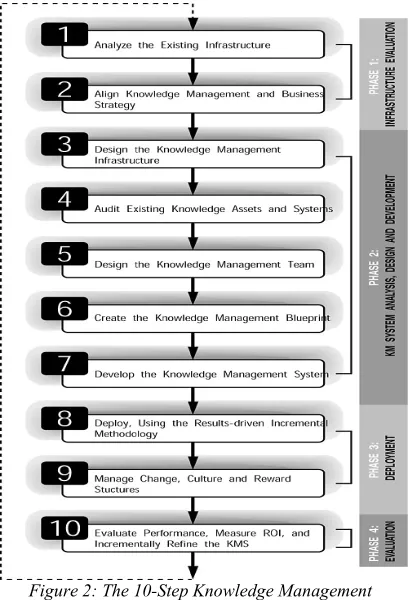
4285 infrastructure, audit existing knowledge assets and sytem, design KM team, create KM blueprint and develop KMS; (3) deployment, comprises of using results-driven incremental methodology and managing organization change, culture and reward structures. See the figure 2 for the entire phases of KM roadmap.
Figure 2: The 10-Step Knowledge Management Roadmap [9].
2.5. Knowledge Codification.
Knowledge codification refers to a converting process from tacit into explicit knowledge. It also addresses to converting undocumented materials into documented materials [31]. Knowledge codification is essential to assist the organization to acquire important knowledge and use it for better decision making process [32].
Knowledge codification involves of using tools such as [19]: (1) knowledge map, is a visual representation of knowledge. It arranges all necessary information into a big and transparent map that links one with another, so that it assists in easy reading and understanding the knowledge. Normally, the map enables to cover both tacit and explicit knowledge of each worker/department; (2) decision tree, also useful to map the problems and potential solutions in organization, by assessing alternative factors and conditions in the form of nodes and direct them to final decision; (3)
case-based reasoning, enables to identify events and propose alternative solutions.
The article applies the knowledge codification method in acquiring necessary knowledge from user/department. In XYZ Co., KM and HR team has periodic schedule to collect information and codify it into appropriate useful knowledge and store it in corporate dashboard.
3. METHODS 3.1.Research Method
The article applies case study method to examine the design of KMS in XYZ Company, one of the largest IT service company in Indonesia. The use of case study is considered a robust research method particularly when a holistic, in-depth investigation is required [33]. The use of case study method allows the researcher to get entire picture or actual conditions that occurs in the company [34]. The article adopts the case study method in the following steps: (1) determining the key topic in KM. The article examines the current trend in KM application in business, such as: KM Maturity Model; (2) literature study. The article examines the keyword “Knowledge Management Maturity Model” from various well- known sources such as IEEE, Association of Information Systems (AIS) and Association of Computing Machinery (ACM) databases. The selected articles are summarized and verified according to the needs of the latest trend of the industry, and current situation in the XYZ company; (3) data collection and analysis. Based on the study from those library mentioned above, the article adopts Kulkarni’s questionnaire (see table 3) [14], and follows with focus group interviews and observation methods to the major stakeholders, with the objective to examine the application KMMS in XYZ Co.
Table 2: Sample Size and Sampled Respondent.
Section Total
Respon-dents Percen-tages (%) Compliance &
Pre-Sales Dept. 7 5 71%
Imeplemen-tation Dept. 11 8 73%
Maintenance
Dept. 10 5 50%
R&D Dept. 7 7 100% System
Development Dept.
11 6 55%
Banking Solutions Division Head
1 1 100%
[image:4.612.313.521.558.731.2]4286 The article examines the staffs (respondents) from banking solution division, that has 6 sections. It has 422 staffs in total, while for the interviews purposes, we use 47 respondents (See Table 2). The respondents were selected from the key persons that play vital roles in developing and maintaining KMS in banking solution.
The findings are later verified with relevant articles and experts in the KM field. After the validity and reliability data have been confirmed and continued with; (4) measuring KM Maturity Level. KM Maturity level is important to identify the current stage and next expected stage of KM development. Knowing KM maturity level is important to assist further KM strategy plan; (5) analysis, design and development of the KM roadmap; (6) result simulation, to make sure all requirements have been validated and implemented.
3.2. Company Profile.
XYZ is one of the largest IT vendors in Indonesia, which provides IT integrated solution and consulting. XYZ Co. was established in 1975, and have affiliation with major global IT vendors such as: IBM, Cisco, NCR, VMware, Oracle and Microsoft. Currently, XYZ Co. acquires main IT memberships as IBM Premier partner, Cisco gold partner, and authorised technology provider (ATP), VMware Premier partner.
XYZ Co. serves main customers in national banks and financial institutions, telecommuni- cation, health care, global/local multinational companies, major national/global oil and gas companies, major national retails, and local/central governments. Currently, XYZ company applies ISO 9001 and registered as public company.
4. FINDINGS
4.1. KM Maturity Analysis.
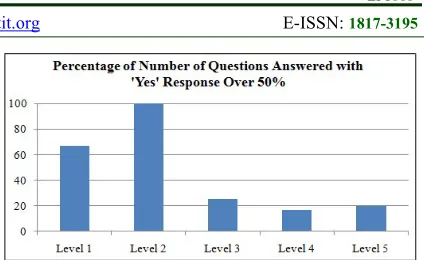
[image:5.612.311.523.67.197.2]The questionnaires were divided into 5 maturity levels, according to measurement domains. The results of questionnaires show that more than 50% of respondents said “Yes” in both level 1 and 2, based on the maturity levelling category (see figure 3).
Figure 3: Questionnaire Results Bar Chart.
While for level 3, 4, and 5 the number of questions responded with 'Yes' below 50%. Based on these results it can be concluded that overall the best level of maturity is at Level 2 with “Encouraged Status”. Encouraged status means that the value of knowledge and lesson learned has been recognized by the company as a valuable asset. In addition, the company has also started to have a culture to encourage all activities to share knowledge. At level 2 of this activity knowledge sharing also been realized and known.
[image:5.612.312.529.408.733.2]The details of each maturity levelling categories are shown in the following:
Table 3. KM Maturity Level Questionnaires [14].
Maturity
Level Culture Questions
(%) Yes
(%) No 1 1. There is a willingness to share
lessons learned in my group. 90.6 9.4
2 2. In my group, lessons learned from projects, both successful and unsuccessful, are considered valuable.
90.6 9.4
2 3. Activities associated with
lessons learned (from capturing to using) are recognised and/or rewarded in my group.
81.3 18.7
2 4. Successful instances of
sharing lessons learned are
consistently publicized
throughout my group.
53.1 46.9
Maturity Level
Culture Questions (%) Yes
(%) No 3 5. In my group, lessons learned
are shared routinely with fellow teammates and members of other groups.
43.8 56.2
Documentation Questions
1 6. In my group, employees
document lessons learned from projects.
84.4 15.6
3 7. Documenting lessons learned
from projects is required in my group.
62.5 37.5
3 8. Does a classification scheme
4287 learned by project type, problem
type, subject area, etc.? 4 9. I found it easy to use the
classification scheme for
documenting lessons learned.
43.8 56.2
3 10. Is there a structured format, such as templates/forms, to follow when documenting lesson learned?.
46.9 53.1
3 11. The structured format helped
me capture the key points of
lessons learned that I
documented.
59.4 40.6
4 12. Training/instruction on using
the structured format for
documenting lessons learned is available to me.
34.4 65.6
Table 3. KM Maturity Level Questionnaires [14] (continued).
Storage and Retrieval Questions
3 13. In my group, employees look
for lessons learned from similar
earlier projects prior to
beginning a new project.
65.6 34.4
3 14. In my group, looking for
lessons learned from similar earlier projects is a required part of work practices.
31.3 68.7
4 15. When I look for documented
lessons learned from similar earlier projects, I am able to find them.
56.3 43.7
1 16. I find that the documented lessons learned are available from sources other than the original author (owner).
37.5 62.5
3 17. Are the documented lessons learned stored in a database, or other repository, that allows direct access by potential users?
37.5 62.5
3 18. I can search the lessons
learned database.
37.5 62.5
4 19. I believe that the search tool exhibits intelligence.
34.4 65.6
5 20. I believe that the search to
tool exhibits intelligence. 21.9 78.1
Maturity Level
Process Questions (%) Yes
(%) No
4 22. Training/instruction on
incorporating lessons learned into normal work practices is available to me.
12.5 87.5
5 23. In my group, processes for
sharing lessons learned are widely accepted as part of normal work practices,
71.9 28.1
5 24. Processes for documenting
lessons learned are regularly improved and updated in my group.
25 75
5 25. Processes for cataloging/
classifiying lessons learned are regularly improved and updated
31.3 68.7
in my group.
5 26. In my group, processes for searching for lessons learned are regularly improved and updated.
31.3 68.7
With major voices in level 2, indicates it needs further KMS development that can increase current KM mechanism to achieve higher level of maturity.
4.2.Design for Development of KMS 4.2.1. Phase 1: Infrastructure Evaluation
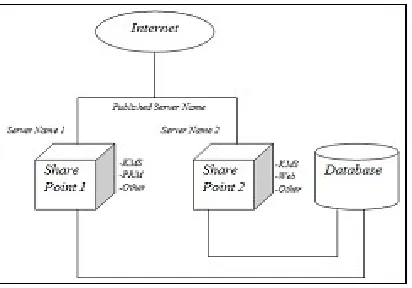
[image:6.612.318.524.355.499.2]The infrastructure evaluation comprises of following steps: (1) analyse the existing infrastructure. Based on the results of interviews, the XYZ company already has a very capable infrastructure to support the process of KM mechanism through the use of KMS. The company has installed the LAN and WAN networks with a fairly high speed connections. In addition, the company also has remote access through the ISP. The overview of network infrastructure at XYZ Co. related to KMS is illustrated as follow:
Figure 4: Existing KMS Infrastructure.
4288 further development of KMS. Existing KMS and other internal systems can be accessed through intra and internet. As well known technology company, XYZ Co. has reliable human resources in technology field and supported with good organisation culture. It contributes to creating advantages in easy adoption of KMS for all staffs. The company also has no difficulty to initiate other advance features in KMS; (2) weakness, KMS that has been running now in XYZ Co. has not fully functioned, especially related to technical matters. It is caused by less update on a regular basis. The user interface also is considered less interesting and lack of user friendly. The level 2 in maturity level indicates that KMS needs further upgrades to higher level; (3) opportunity, XYZ Co. is a technology company where the main products rely on intensive knowledge. The intensive knowledge is built in any organisation product and service. It infers the organisation needs to manage its knowledge properly. Based on the results of the questionnaire obtained, it can be seen that most staffs have realized that KM is very important thing to accomplish; (4) threat, There is a need for special attention and direction from XYZ Co. in relation to the implementation and use of the KMS. Without proper support of management, it will be difficult to achieve full success in KMS implementation. In addition, it also needs the proactive of entire staffs to consistently use KMS as a container to manage organisation knowledge so that KMS can continues to have the most updated knowledge. The findings highlight the need for improving knowledge culture, knowledge documentation, knowledge storage and retrieval, and knowledge process so that all KM activities can be improved and running well.
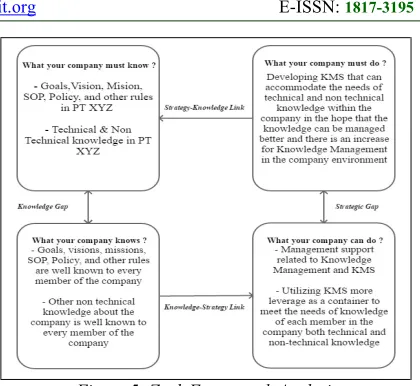
The use of Zack Framework Knowledge Gap Analysis is essential to capture the entire KMS strategy in organization. It has advantages in mapping the knowledge gap, strategy knowledge link, knowledge strategy link, and strategic gap. It is shown the following figure.
[image:7.612.313.523.75.268.2]
Figure 5: Zack Framework Analysis.
The findings show that most of knowledge gap lies in the technical knowledge. To overcome this, support from the company's management is required to guide proper KM and KMS development.
4.2.2. Phase 2: KMS Analysis, Design, and Development.
The current KMS is built in a web-based and supported with cloud infrastructure. The KMS is maintained in operation since it fits with the needs of the company needs. It has advance features to support the work of high mobility staffs. Major staffs spend most of their time in the customer’s place that spread in major cities and onsite mining fields. The current KMS platform can be accessed easily with mobile devices without having to do installation process first. For the management view, the KMS application development effort is quite low and efficient, with a single application to serve all type of operating system.
4289 knowledge, such as knowledge related to technical products provided by XYZ Co. (such as knowledge of modules and features in products provided by XYZ Co. including core banking system products), Knowledge of Problem Log (PRL) for handling the problem (with being handled and completed status). knowledge of requirement document, Functional Specification Document (FSD), Program Modification Form (PMF), Module Setting Guide as technical knowledge in process of solution design, development, and implementation and maintenance, knowledge of programming language that is used by companies in product development.
4.2.3. KM Team Formulation.
KM Team formulation plays essential roles to ensure the successful of KMS project. The team is assigned in several focus areas such as: team across multiple departments, technology division, and management area. The cross-department team links with the departmental users of: banking solutions, electronic channel, BI solutions, infrastructure and hardware operation and maintenance, project management office (PMO). Legal and compliance office, public relation and marketing communication office, legal and SHE, account management, HR, and another user team.
4.2.4. Creating KM Blueprint.
Creating KM blueprint is the sixth step of KM roadmap. The KM blueprint needs approval from top management, and has been consulted with employees, managers and division heads, and the scholars with expertise in KMS. To make sure the blueprint suits with organization objectives and targets, we need input from KM scholars. For this reason, we invited the KM scholars from several well-known universities to present their inputs for KMS development. The scholars were invited in focus group discussion and attached in the team development.
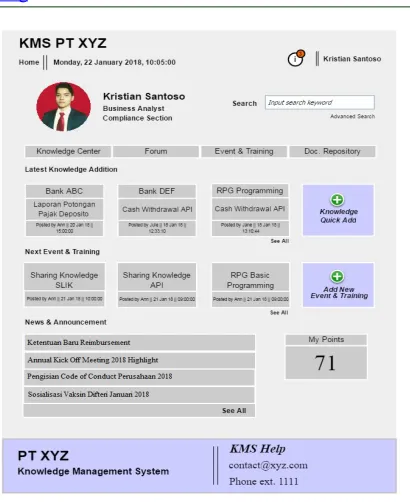
[image:8.612.317.522.82.333.2]The outcome of KMS design based on team collaboration with KMS developers and management were agreed with following features: (1) role in KMS, comprises user and admin role; (2) KMS modules, comprises of corporate dashboard, knowledge centre, forum, event and training, document repository, news and information, my points (personal folder), and user management; (3) features in KMS, comprises of search and advance search, notification, knowledge quick add.
Figure 6. KMS design (1).
4.2.5. KMS Development Phase.
The design of KMS is built under web platform and development tools, such as: HTML, PHP, CSS, JavaScript, XML, and MySQL programming. The KMS design accommodates various inputs from key stakeholders. The design was presented to the board of key managers and directors, developer teams, and representatives of division head (see figure 6 and 7).
After the consultation session, the board director decided to apply the pilot project in directorate of solution and business infrastructure in XYZ Co. The KMS pilot project had started since June 2017-December 2018, and continues with further features enhancement.
4.2.6. KMS Simulation Phase.
4290 Figure 7. KMS design (2).
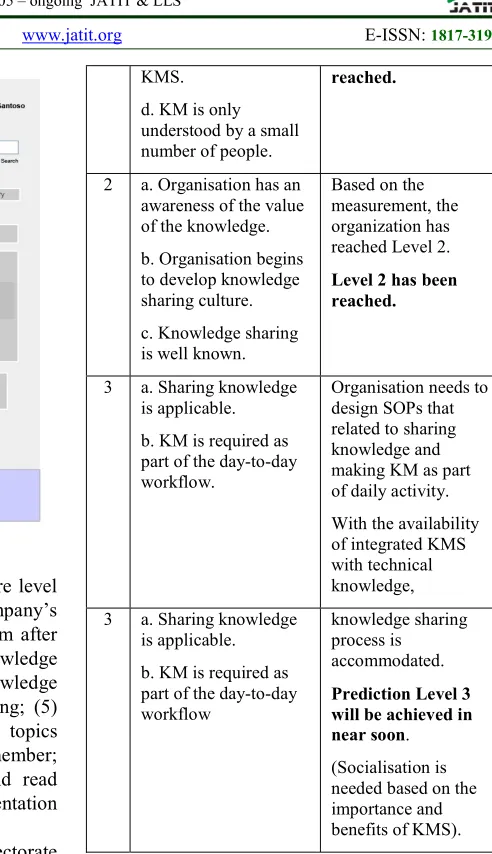
Based on evaluation of the users, there are level of KMS suitability that addresses to company’s needs are: (1) knowledge sharing mechanism after implementation; (2) new modules knowledge sharing; (3) problem solving and knowledge sharing; (4) inter-member knowledge sharing; (5) modules implementation to Client; (6) topics highlighted; (7) job transfer from resigned member; (8) project documentation; (9) publish and read news related to company info; (10) documentation of non-technical document.
[image:9.612.93.348.69.343.2]Figure 6 shows the KM design for directorate infrastructure and business solution. It comprises of the folder of knowledge centre, forum, event and training and document repository. While figure 7 illustrates the space for knowledge sharing and collaboration process. After the simulations were completed, the process continued with assessing potential increment of the KMS maturity level. The assessment is essential to identify the step of next implementation and its challenges. It is shown in following table 4.
Table 4: KM Maturity Level Assessment.
No Fulfilled Criteria Analysis
1 a. Organisation desires to share knowledge.
b. KM has not been applied properly.
c. Staffs have not been encouraged to apply
Based on the measurement, the organization has reached Level 2.
Level 1 has been
KMS.
d. KM is only understood by a small number of people.
reached.
2 a. Organisation has an awareness of the value of the knowledge.
b. Organisation begins to develop knowledge sharing culture. c. Knowledge sharing is well known.
Based on the measurement, the organization has reached Level 2.
Level 2 has been reached.
3 a. Sharing knowledge is applicable. b. KM is required as part of the day-to-day workflow.
Organisation needs to design SOPs that related to sharing knowledge and making KM as part of daily activity. With the availability of integrated KMS with technical knowledge,
3 a. Sharing knowledge is applicable. b. KM is required as part of the day-to-day workflow
knowledge sharing process is accommodated.
Prediction Level 3 will be achieved in near soon. (Socialisation is needed based on the importance and benefits of KMS).
Table 4: KM Maturity Level Assessment (continued).
No Fulfilled Criteria Analysis
4 Staffs easily find documentation and knowledge.
The availability of integrated KMS with technical and non-technical knowledge, with knowledge centre and document features, repository. Staffs can easily find required documents and various kinds of knowledge.
Prediction Level 4 will be achieved in near soon.
[image:9.612.117.517.533.740.2]in-4291 depth training of
KMS is required).
5 KM mechanism and tools are acceptable and applied properly.
The availability of KMS with various supporting features can be used as important tool to support KM process, and it needs longer time to make adjustment.
Achievement of Level 5 cannot be done in near soon.
It needs further adjustment by HR policy of the organization and acceptance of the users to KMS.
The table 4 shows the current maturity level is in level 2, and the gap with level 3 is not too far. It infers with more socialization campaign and encouraging knowledge sharing mechanism enables to boost to level 3. As soon as level 3 is reached, the corporate culture has supported efforts to reach level 4. So, the status of level 4 also can be achieved in near soon. The major hurdles will be with level 5, where KM mechanism and intensive use of tools needs further corporate policy and incentives. The analysis highlights the shift of HR policy and developing further features.
5. Conclusion and Suggestions
Applying KMS in corporate setting is not an easy task since it needs collaboration with multiple departments/division that spread regions. Major Indonesian corporations have reported major failures with their KMS. For this reason, the article applies the KMS measurement based on the work of Uday Kulkarni, Robert St. Louis, and Intel Corporation in XYZ Co. and combined with the 10 step of KM roadmap to provide effective KM implementation framework.
The result of findings shows that level of maturity of XYZ Co. in applying KMS in level 2, with “Encouraged” status. It indicates the value of knowledge and lesson learned has been realized by the organization as important asset, however, it still needs further development to reach corporate objectives. In addition, the organization has started to develop holistic culture that encourages all activities to share knowledge and also at this level, knowledge sharing activities have also been recognized and known.
The results of these KMS measurements can be used as an evaluation material for the organization, and to be used as a motivation for improvement to achieve a higher level of KM maturity level. The KMS pilot project has been successfully integrated with technical and non-technical knowledge at XYZ Co., with the guidance of 10-Step KM roadmap. The KM pilot project has got wide applauses due to its benefits and approval from board of directors to be applied in entire organization.
Based on the results, the article proposes some suggestions for further KMS implementation in entire organisation such as: (1) KMS development needs full participation and supports from top management; (2) it needs continuous evaluation and development on current KM needs, and establishes close monitoring to ensure the KM can run effectively in harmony with business and customer’s expectation; (3) Organisation should include knowledge sharing program as its daily business process; (4) further KMS enhancement needs to be done on display, modules, and additional features to ensure conformity with the needs of the organization.
REFERENCES
[1] A. Tiwana and M. Williams, The Essential Guide to Knowledge Management:: E-Business and Crm Applications. Prentice Hall PTR, 2000.
[2] J. Chigada, “The Role of Knowledge Management in
Enhancing Organisational Performance in Selected Banks of South Africa,” Information Science, University of South Africa, Pretoria, 2014.
[3] M. Alavi and D. E. Leidner, “Knowledge management
and knowledge management systems: Conceptual foundations and research issues,” MIS Q., pp. 107– 136, 2001.
[4] A. Foote and L. A. Halawi, “Knowledge management
models within information technology projects,” J. Comput. Inf. Syst., vol. 58, no. 1, pp. 89–97, 2018. [5] N. J. Ahuja, N. Singh, and A. Kumar, “Development
of Knowledge Capsules for Custom-Tailored Dissemination of Knowledge of Seismic Data Interpretation,” pp. 189–196, 2018.
[6] D. E. O. Leary, “Knowledge Management in
Enterprise Resource Planning Systems : Support for Financial Transactions,” 2000.
[7] A. M. Abubakar, H. Elrehail, M. A. Alatailat, and A. Elçi, “Knowledge management, decision-making style and organizational performance,” J. Innov. Knowl., pp. 1–15, 2017.
[8] C. Argyris and D. A. Schön, “Organizational learning: A theory of action perspective,” Rev. Esp. Invest. Sociol., no. 77/78, pp. 345–348, 1997.
[9] R. J. Baumgartner and D. Ebner, “Corporate
sustainability strategies: sustainability profiles and maturity levels,” Sustain. Dev., vol. 18, no. 2, pp. 76– 89, 2010.
4292 [11] R. Klemke, “Context Framework-an Open Approach
to Enhance Organisational Memory Systems with Context Modelling Techniques.,” in PAKM, 2000, vol. 3.
[12] H.-D. Evers, “Transition towards a knowledge society: Malaysia and Indonesia in comparative perspective,” Comp. Sociol., vol. 2, no. 2, pp. 355–373, 2003. [13] K. Dalkir, Knowledge management in theory and
practice. Routledge, 2013.
[14] U. Kulkarni and R. St Louis, “Organizational self assessment of knowledge management maturity,” AMCIS 2003 Proc., p. 332, 2003.
[15] S. Debowski, “Knowledge management: A strategic management perspective,” Aust. John Wiley, 2005. [16] I. Nonaka and A. Hirose Nishihara, “Introduction to
the Concepts and Frameworks of Knowledge-Creating Theory,” in Knowledge Creation in Community Development: Institutional Change in Southeast Asia and Japan, I. Nonaka, K. Yokomichi, A. Hirose Nishihara, and M. Matsunaga, Eds. Tokyo: Palgrave Macmillan, 2018, pp. 1–15.
[17] J. Park and J. L. Gabbard, “Factors that affect scientists’ knowledge sharing behavior in health and life sciences research communities: Differences between explicit and implicit knowledge,” Comput. Human Behav., vol. 78, pp. 326–335, 2018.
[18] I. Becerra-Fernandez, R. Sabherwal, and A. Gonzalez, Knowledge management. Pearson Education, 2003. [19] K. Dalkir, Knowledge Management in Theory and
Practice, vol. 2. Cambridge, MA, 2011.
[20] M. Evans, K. Dalkir, and C. Bidian, “A holistic view of the knowledge life cycle: the knowledge management cycle (KMC) model,” Electron. J. Knowl. Manag., vol. 12, no. 2, pp. 85–97, 2014. [21] P. Bera, A. Burton-Jones, and Y. Wand, “Guidelines
for designing visual ontologies to support knowledge identification,” Mis Q., pp. 883–908, 2011.
[22] P. Haapalainen and K. Pusa, “Knowledge management
processes: Storing, searching and sharing knowledge in practice,” Int. J. Inf. Syst. Serv. Sect., vol. 4, no. 3, pp. 29–39, 2012.
[23] B. J. Hicks, S. J. Culley, R. D. Allen, and G. Mullineux, “A framework for the requirements of capturing, storing and reusing information and knowledge in engineering design,” Int. J. Inf. Manage., vol. 22, no. 4, pp. 263–280, 2002.
[24] D. Shapere, “What can the theory of knowledge learn from the history of knowledge?,” in Reason and the Search for Knowledge, Springer, 1984, pp. 182–202. [25] P. B. Batalden and P. K. Stoltz, “A framework for the
continual improvement of health care: building and applying professional and improvement knowledge to test changes in daily work,” Jt. Comm. J. Qual. Improv., vol. 19, no. 10, pp. 424–447, 1993.
[26] M. Grundstein, “Assessing the enterprise’s knowledge management maturity level,” Int. J. Knowl. Learn., vol. 4, no. 5, pp. 415–426, 2008.
[27] A. H. Gold, A. Malhotra, and A. H. Segars,
“Knowledge management: An organizational
capabilities perspective,” J. Manag. Inf. Syst., vol. 18, no. 1, pp. 185–214, 2001.
[28] C. Weber, B. Curtis, and M. B. Chrissis, “The capability maturity model, guidelines for improving the software process,” Harlow: Addison Wesley, 1994.
[29] APQC, “USING APQC ’ S LEVELS OF KM
MATURITY SM A road map for moving from immature , inconsistent knowledge.” APQC, pp. 1–6, 2017.
[30] P. J. Hsieh, B. Lin, and C. Lin, “The construction and
application of knowledge navigator model (KNM�): An evaluation of knowledge management maturity,” Expert Syst. Appl., vol. 36, no. 2, pp. 4087–4100, 2009.
[31] P. Cohendet and W. Edward Steinmueller, “The codification of knowledge: a conceptual and empirical exploration,” Ind. Corp. Chang., vol. 9, no. 2, pp. 195– 209, 2000.
[32] T. Morris, “Asserting property rights: Knowledge codification in the professional service firm,” Hum. relations, vol. 54, no. 7, pp. 819–838, 2001.
[33] R. K. Yin, Case study research: Design and methods. Sage publications, 2013.
[34] P. Baxter and S. Jack, “Qualitative Case Study Methodology : Study Design and Implementation for
Novice Researchers Qualitative Case Study
Methodology : Study Design and Implementation,” vol. 13, no. 4, pp. 544–559, 2008.
![Figure 1. Knowledge Management Cycle [19].](https://thumb-us.123doks.com/thumbv2/123dok_us/8898628.954032/2.612.315.522.325.482/figure-knowledge-management-cycle.webp)
![Table 1: Knowledge Management Maturity level [8].](https://thumb-us.123doks.com/thumbv2/123dok_us/8898628.954032/3.612.90.297.453.726/table-knowledge-management-maturity-level.webp)