International Journal of Emerging Technology and Advanced Engineering
Website: www.ijetae.com (ISSN 2250-2459,ISO 9001:2008 Certified Journal, Volume 4, Issue 11, November 2014)
65
A Multi-phase Mixture Theory for Debris Flows:
Part III - Critical Angle of an Infinite Slope
Huang Li-Jeng
1, Hsiao Darn-Horng
2Associate Professor, Department of Civil Engineering, National Kaohsiung University of Applied Science, 80778, Taiwan, Republic of China
Abstract—This paper presents theoretical formula, based on the theory of multi-phase mixture, for the prediction of critical slope angle for which the sediment deposits rested on an infinite slope will be initiated to be debris flows. The deposit sediment is assumed to be a mixture of four constituents, i.e., stone, mud, water and air. Two-dimensional steady uniform flow field is considered. Critical slope angles can be calculated from the consideration of momentum equations or static balance of driving force and resisting force. Comparison of the present results with those obtained by seepage flow theory, Takahashi theory and modified Takahashi theory shows that the theoretical formula derived from multi-phase mixture theorygives the same prediction as Takahashi theory and can be extended to the sediments containing more than two kinds of constituents. Variation of critical angle slope with volume fraction of gravel and sand for stony flow, mud flow and mixed flow is also conducted and the results are reasonable as expected.
Keywords—Critical Slope Angle, Debris Flow, Flow
Initiation, Multi-phase Mixture Theory, Theoretical Analysis.
I. INTRODUCTION
Landslide and debris flow often occur in the region where deposit and mud saturated after strong and/or continuous stormy rainfall. The initiation of mudslide can be considered to be a mechanism of unbalance of gravitational force (driving force) and the shearing force (frictional force). The critical slope angle is defined to be the smallest angle that the gravitational force of deposit greater than the frictional force and thus unstable condition is reached and deposit starts to move [1, 2]. The analysis of the inherent characteristics of the debris flows and the development of prevention and precaution techniques are urgently required. Correct analysis of dynamic characteristics of debris flow is a fundamental basis for designing effective Sabo dams for prevention of debris flows.
Occurrence of debris flow depends highly on local topographic, meteorologic, geologic, and hydrologic conditions. However, there are many factors influence the occurrence of debris flow in a region. For example, the special features and natural reasons that cause debris flows often occur in Taiwan:
(1) Climate factors: Taiwan is located at the border of western Pacific and the eastern Asian plateau and belongs to subtropical marine climate. Yearly averaged rainfall reaches a high value of 2500 mm. Many typhoons occur in Taiwan between July and October (concentrated from summer to autumn) each year and carry with tremendous rainfall and strong wind and then lead to flood in rivers and softening of the slope of mountain. The storms cased from typhoons, thunder shower, thunder cell, and stationary front usually leads to continuously tremendous rainfalls which in turn soften the soil stratum and rock in mountain area. This is the first influence factor leads to highly potential of debris flow disaster.
(2) Tectonics factors: Taiwan is located at the intersection of Eurasian Plate and Philippine Sea Plate. The upper part of the crust is primarily made from a series of collision of these two plates. The Philippines Sea Plate is converging with the continent at 7 cm per year in the western north direction. This cause many seismic faults, fracture surfaces, folded zones, mud volcanoes and hot springs in Taiwan. The mountain area plays an important part of Taiwan up to 75% and often contains steepest slope angles, high crest and quick flow along with long-term strong erosion. This forms the first influence factor leads to highly potential of debris flow disaster.
(3) Seismic factors: Taiwan is also located at the Circum-Pacific Seismic Belt and thus many earthquakes occur each year. The horizontal and vertical accelerations induced by earthquakes usually leads to liquefaction of perfectly and/or partially saturated stratum as well as softening, peel-off, separation and deposit of rocks. When waterfall combined with these deposits might leads to the origin of debris flow.
International Journal of Emerging Technology and Advanced Engineering
Website: www.ijetae.com (ISSN 2250-2459,ISO 9001:2008 Certified Journal, Volume 4, Issue 11, November 2014)
66
There have been a lot of flow models for analysis of mechanical characteristics of debris flow in a slope. Among these research works, the following models are useful and significant: the dilatant fluid model initiated by Bagnold (1954) [3] and extended by Takahashi (1977, 1978) [4, 5]; the Bingham fluid model, pseudo- or generalized visco-plastic fluid model such as those proposed by Chen (1986) [6], O’Brien and Julien (1988) [7], Chen et al. (1991) [8], Julien and Lan (1991)[9], etc.; Prandtl mixing-length model employed by Matsumura and Mizuyama (1990) [10]; modified turbulent flow model proposed by Yu and Chen (1990) [11]; a mixed-layer model proposed by Su et al (1993) [12]; a two-layer model, proposed by Ho (1997) [13] in which an inertia sub-region and a viscous sub-region exist.In the design of disaster prevention of debris flows the accurate prediction of initiation of debris flows from unsaturated or saturated deposits along a slope is of the most importance. From this the analysis of movement, stoppage, deposit and impact on structures can be studied. There also are many theoretical formula for the prediction of the critical slope for the initiation of debris flow such as the seepage flow theory by Harris (1977) [14], Empty pore pressure theory by Takahashi (1977) [4], modified seepage flow theory by Sidle (1985) [2], Zheng and Chiang (1986)[15]; modified Takahashi theory by Yu (1987) [16], extended seepage flow theory by Huang (1991) [17], incompressible uniform flow model by Egashira and Ashida (1992) [18], Combined run-off and seepage flow theory by Lin et al. (1993) [19], and varied slope and thickness theory by Chen et al. (1993) [20]. The fundamental defects existing in the present formula arise from the assumption of the constituents of debris flows, i.e. only solid and fluid particles are considered. In fact most debris flows comprise more than two kinds of composites such as stone (larger particles), mud (smaller particles), water and air. The constitutive (rheological) relationships for each of them are quite different.
Thus we can develop a rheological model based on the theory of multi-phase mixture, in which the debris flow is considered to be a mixture of four constituents, i.e., stone, mud, water and air. The total shear stress is the sum of the shear stresses contributed from each phase through its volume fraction. Once the constitutive relationship is built up we can theoretically derive the critical slope angle for debris flow along an infinite slope based on momentum equations or static balance of driving force and resisting force.
II. THREE DISASTER CASES OF DEBRIS FLOW IN TAIWAN
The recorded investigation on these three real disasters caused by debris flow is summarized in Table I. It is very important that the slope angles in the source area (initiation zone) of these three disasters lie between 15o to 25o . This range is the easiest occurrence of debris flow.
TABLEI
RECORDED INVESTIGATION OF SLOPE ANGLES OF THREE DISASTERS CAUSED BY DEBRIS FLOWS IN TAIWAN
(1) (2) (3) Period 1990/06/23 1994/07/10~
1994/07/11
1996/07/31~ 1996/08/01 Place Hwa-Lien,
Sho-Lin, Tung-Men
Village
Hwa-Lien, Fun-Bin, Tun-Shin Village
Nan-Tou, Shin-Yi, Shen-Mu Village Type of debris flow Mixed Muddy Mixed Cause Typhoon Typhoon Typhoon Disaster 24 Houses
Desdroyed; 29 dead; 6 disappeared,
7 hurt
20 houses buried, 50 dead
27 dead 14 disappeared
Deposit
56,000 m3 122,000 m3 450,000 m3
Magnitude IV IV IV Slope
angles
Source Area
19o 16o ~17o 18o ~21o
Flow Track
25o 12o ~16o 10o ~20o
Deposition Region
9o 6o 6o ~9o
III. CRITICAL SLOPE ANGLE PROPOSED BY PREVIOUS
RESEARCHERS
In the following we summarized the formula for critical slope angle of occurrence of debris flow proposed by previous researchers:
(1) Seepage flow theory by Harris (1977) [14]:
S sat
w
sat
tan
tan (1)
where
of water t
unit weigh w
it t of depos unit weigh
saturated sat
eposit ction of d nernal fri
angle of i S
channel e of open slope angl
: : : :
International Journal of Emerging Technology and Advanced Engineering
Website: www.ijetae.com (ISSN 2250-2459,ISO 9001:2008 Certified Journal, Volume 4, Issue 11, November 2014)
67
(2) Empty pore pressure theory by Takahashi (1977) [4]:S h H w w d n w d n tan / ) 1 ( ) )( 1 ( ) )( 1 ( tan
(2)
where
e ear failur ayer of sh
depth of l
he water depth of t
t of water unit weigh
w
it t of depos unit weigh
d
eposit ction of d nernal fri
angle of i S
channel e of open slope angl : h : H : : : :
(3) Modified seepage flow theory by Sidle (1985) [2]:
S a H sat a m a H m sat a m tan ) ( ) )( ( tan
(3)
(4) Modified seepage flow theory by Zheng and Chiang (1986)[15]:
(a) Partially saturated case:
) / 1 ( )] / 1 ( [ )] / 1 ( [ cos / tan H a H a C H a C qH c w w d d w d d
(4a)
(b) Saturated case:
) / 1 ( ) [( ] [ cos / tan 0 H h C C qH c w w d d w d d
(4b)
(5) Modified Takahashi theory by Yu (1987) [16]:
tan ] ) ( ) ( [ 1 1 tan a H n H a H w sat w
(5)
(6) Extended seepage flow theory by Huang (1991, 1993) [17, 18]:
(a) run-off over and on surface of debris flow:
S sat w sat tan
tan (6a)
(b) run-off under surface of debris flow:
S H m a H sat a m a H sat a m tan )] ( [ ) ( tan
(6b)
(7) Incompressible uniform flow model by Egashira and Ashida (1992) [19]:
] tan ) 1 /( [tan ) 1 / ( 2 1 tan s C w s (7)
(8)Combined run-off and seepage flow theory by Lin et al. (1993) [20]: S h w H sat H w sat tan 0 ) ( tan
(8)
(9) Varied slope and thickness theory by Chen et al. (1993) [21].
(a) Sliding Instability case:
cos 0 0 tanh ) ( ) ( ) ( tan g dx w dh dx dh H w w h a w a w d C a w d C (9a)
(b) Overturning Instability case:
) 0 ( 2 1 tanh 3 / ) ( ) ( ) ( tan dx w dh dx dh H w w h a w a w d C a w d C (9b)
It should be noticed that these formula are derived from different consideration and may not be compared with one another.
IV. MODEL EQUATIONS FOR DEBRIS FLOWS
International Journal of Emerging Technology and Advanced Engineering
Website: www.ijetae.com (ISSN 2250-2459,ISO 9001:2008 Certified Journal, Volume 4, Issue 11, November 2014)
[image:4.612.324.563.424.572.2]68
Figure 1. Illustration of debris flow along a slope
4.1 Basic assumptions
In the formulation of the governing equations of debris flow some assumptions are employed as depicted in Huang and Hsiao [22]. Furthermore, cohesion of muddy sediments is neglected when critical condition is considered.
4.2 Macroscopic balance equations for debris flow
The debris flow is composed of stone, mud, water and air. Thus the density of the mixture can be expressed as
4 1
a a w w m m g g
(10)
Where g,m,w,a denotes the density of stone, mud, water and air, respectively. It is obviously seen that
1 4
1
i .
Follow the derivation of balance equations of the mixture as proposed by Hassanizadeh and Gray (1979, 1980) [22], we can obtain the following balance equations in indicial form:
0 , )
(
k k v Dt
D
(11a)
0
.
tklk gl Tl
Dt l v D
(11b)
lk t kl
t (11c)
0 ,
,
Q h
k k q k l v kl t Dt
E D
(11d)
qk k h
Dt S D
, )
( (11e)
subjected to
0 4
1
Tl (12a)
0 ) (
4
1
Tl vl Q (12b)
When the temperature in each phase is the same (isothermal condition), i.e.,
g m w a (13)
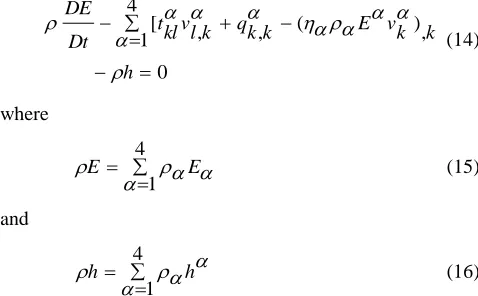
As a result, energy equations for each phase need not be considered. Rather a total energy equation obtained as the sum of each phase energy equations will be
0
, ) (
, 4
1[ ,
h
k k v E k
k q k l v kl t Dt
DE
(14)
where
4
1
E E (15)
and
4
1
h h (16)
The definition of all variables in the above balance equations of a multi-phase system can be found in [22]. Since the problem is two-dimensional and steady uniform flow is assumed thus in the above governing equations
() /
() Dt vk grad
D , i.e., ()/t0 and the indices l
International Journal of Emerging Technology and Advanced Engineering
Website: www.ijetae.com (ISSN 2250-2459,ISO 9001:2008 Certified Journal, Volume 4, Issue 11, November 2014)
69
For a mixture of immiscible solids and fluids it is reasonable to use the volume fraction in the whole volume to replace the volume fraction of a representative element volume, i.e.,) , , , ( g m w a dV
dV V
V
C (17)
4.3 Constitutive relationship
The shear stress in the debris flow can be considered as the superposition of those resulting from the solid phases (stone and mud) and the fluid phases (water and air).
) (
)
(Cg g Cm m Cw w Ca a f
s
(18)
in which g is the contribution of shear stress from stony phase and, based on the dilatant fluid model conducted by Bagnold (1954) and Takahashi (1977), can be expressed as [3, 4]
dy du g gs s P dy
du g Y g
g
tan
2
(19a)
Where
gs s P
Y
g
tan denotes the yield stress ofgrain with
P
S being the normal stress and gs the static
friction of sediment; g asinsds22 with a being a
constant, the kinetic friction of sediment, s the density of sediment, dsthe diameter of particle of sediment, the characteristic length related to the concentration. It is noticed that g is a factor represents the contribution of dispersive pressure of particles in which grain inertia effect dominates [3-5].
m
is the contribution of shear stress from mud phase and, based on the Bingham fluid model conducted by Takahashi (1977), can be expressed as [4,5]
dy du m m c ms s P dy du m Y m
m
tan
(19b)
Where
s s P Y
m
tan denotes the yield stress of mudwith
P
S being the normal stress and ms the static friction
of mud. It is well known that the cohesion of the mud,
c
m
, is usually very small and can be neglected. It is noticed that this is a linear relationship between the shear stress and rate of deformation.It is noticed thatw,a is the contribution of shear stress from water phase and air phase, respectively; which can be considered to be Newtonian fluids and thus [1, 2]
dy du w w
(19c)
dy du a a
(19d)
Where w,a are the dynamic viscosity of water and air, respectively. From Eq. (19c) and (19d) we can find that there is no yield stresses in the Newtonian fluids (water and air).
V. CRITICAL CONDITION OF SLOPE ANGLE
5.1 Derivation from the balance equations:
For a two-dimensional steady uniform debris flow the continuity equation implies that the velocity field is
0 ),
(
u y v
u in
x
and y direction, respectively. The momentum equations can be rewritten in explicit form asz XY g
Dt Du x
0 sin
: (20a)
y p g
Dt Dv y
0 cos
: (20b)
It can be deduced that the pressure is )
( cos )
(y f g H y
p .
International Journal of Emerging Technology and Advanced Engineering
Website: www.ijetae.com (ISSN 2250-2459,ISO 9001:2008 Certified Journal, Volume 4, Issue 11, November 2014)
70
Sa a C w w C m m C g g C
a a C w w C m m C g g C
tan
) 1 ( ) 1 (
tan
(21) 5.2 Derivation from the static balance:
Considering the typical sediment along an infinite slope with height
H
, lengthb
and unit thickness (Fig. 1). The driving force due to gravitational force is
sin ) (
) 1 )( )( ( sin
bHg a a C w w C m m C g g C
H b g T
(22) The resisting force due to granular and mud sediment can be expresses as
S bHg
a a C w w C m m C g g C
H b S g
f R
tan cos
] ) 1 ( ) 1 ( [
) 1 )( )( ( tan cos ) (
(23) Sediment begins to move when the driving force exceeds the resisting force, i.e.,
T
R
. Thus we have the critical condition the same as Eq. (21).VI. RESULTS AND DISCUSSION
In order to check the validity of theoretical expression of critical slope angle obtained by the theory of multi-phase mixture, two groups of cases are considered as testing examples each of which contains three different sediment constituents:
6.1 Sampled data
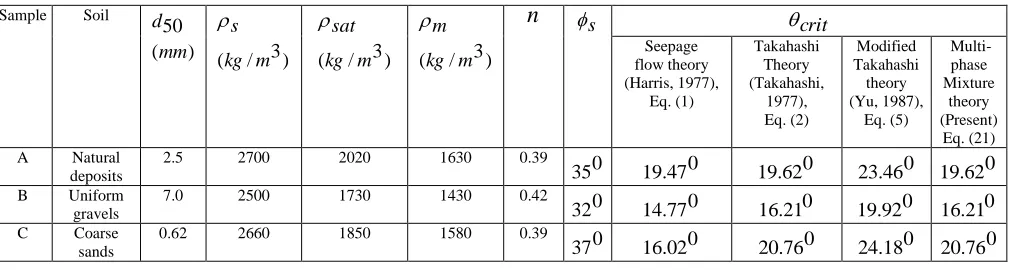
The sampled specimen are referred to Yu (1987) and listed in Table II. Three sediments include natural deposits, uniformly distributed gravels and coarse sands, respectively. The critical slope angles evaluated from the seepage flow theory (Harris 1977) [14], Takahashi theory (Takahashi 1977) [4], modified Takahashi theory (Yu, 1987) [16], and the present formula based on multi-phase mixture theory, Eq. (21), are also summarized in Table 1.
It is noticed that for three samples the present theory gives the same prediction as the Takahashi theory, while seepage flow theory yields non-conservative results but the modified seepage flow theory gives too conservative critical slope angles.
6.2 Three kinds of sediments initiated to different debris flows
In Table III the critical slope angles for three different types of sediment constituents deposits in infinite slope are analyzed based on seepage flow theory, Takahashi theory, modified Takahashi flow theory, and the present theory, Eq. (21). We found that only modified Takahashi flow theory gives different and conservative predictions while the other three agree well with one another. The very low critical slope occurs in mud flow due to its low static friction angle of sands.
To examine the variation of critical slope angle with the volume fractions of three different kinds of debris flow, we change the parameters and calculate the critical slope angles from Eq. (21).
Figure 2 shows that variation of critical slope angle with the volume fraction of gravel, Cg, for stony flow. It is obvious that the relationship is nonlinear and the larger the volume fraction is the larger the critical slope angle. This means the less content of water, the more stable of the sediment.
Figure 3 shows that variation of critical slope angle with the volume fraction of sand, Cm, for mud flow. It is obvious that the relationship is nonlinear too and the larger the volume fraction is the larger the critical slope angle. This means the less content of water, the more stable of the sediment.
International Journal of Emerging Technology and Advanced Engineering
Website: www.ijetae.com (ISSN 2250-2459,ISO 9001:2008 Certified Journal, Volume 4, Issue 11, November 2014)
71
TABLEII
THREE SAMPLED DEPOSITS AND THEIR CORRESPONDING CRITICAL SLOPE ANGLE BASED ON VARIOUS THEORIES
Sample Soil
) (
50 mm d
) 3 / (kg m
s
) 3 / (kg m
sat
) 3 / (kg m
m
n
s critSeepage flow theory (Harris, 1977),
Eq. (1)
Takahashi Theory (Takahashi,
1977), Eq. (2)
Modified Takahashi
theory (Yu, 1987),
Eq. (5)
Multi-phase Mixture
theory (Present)
Eq. (21) A Natural
deposits
2.5 2700 2020 1630 0.39 0
35 19.470 19.620 23.460 19.620
B Uniform gravels
7.0 2500 1730 1430 0.42 0
32 14.770 16.210 19.920 16.210
C Coarse sands
0.62 2660 1850 1580 0.39 0
37 16.020 20.760 24.180 20.760
TABLEIII
THREE DIFFERENT DEBRIS FLOWS AND THEIR CORRESPONDING CRITICAL SLOPE ANGLE BASED ON VARIOUS THEORIES
Case Sediment type
) 3 / (kg m
s
Volume Fractions
s
crit
g
C
C
mC
w flow theory Seepage(Harris, 1977), Eq. (1)
Takahashi Theory (Takahashi,
1977) Eq. (2)
Modified Takahashi theory
(Yu, 1987) Eq. (5)
Multi-phase Mixture
theory (Present)
Eq. (21)
A Stony 2650 0.45 0.0 0.55 0
32 14.900 14.910 18.770 14.910
B Muddy 2650 0.0 0.39 0.61 0
5 1.960 1.960 2.550 1.960
C Mixed 2650 0.26 0.50 0.24 0
38 23.490 23.490 27.570 23.490
Figure 2. Variation of critical slope angle with volume fraction of gravel, Cgfor stony flow
[image:7.612.56.564.156.291.2] [image:7.612.334.538.333.650.2]International Journal of Emerging Technology and Advanced Engineering
Website: www.ijetae.com (ISSN 2250-2459,ISO 9001:2008 Certified Journal, Volume 4, Issue 11, November 2014)
[image:8.612.64.271.145.311.2]72
Figure 4. Variation of critical slope angle with volume fraction of gravel, Cgfor mixed flow with constant Cg
VII. CONCLUDING REMARKS
Theoretical formula for evaluating the critical slope angle for initiation of a two-dimensional steady uniform debris flow along an infinite slope is derived based on the theory of multi-phase mixture. The debris flow is in general assumed to be a mixture of four constituents, i.e., stone, mud, water and air. Critical slope angles can be calculated from the consideration of momentum equations or static balance of driving force and resisting force. Comparison of the present results with those obtained by seepage flow theory, Takahashi theory and modified Takahashi theory shows that the theoretical formula derived from multi-phase mixture theory gives the same prediction as Takahashi theory and can be extended to the sediments containing more than two kinds of constituents.
REFERENCES
[1] Jan, C. D. 2000. Introduction to Debris Flows, Science and Technology Books Company, Taiwan, R. O. C. (in Chinese). [2] Huang, L. J. 2001. Introduction to Theory and Practice of
Debris-Flow Hazards Mitigation, Chuan-Hwa Publishing Ltd. Taiwan, R.O.C. (in Chinese).
[3] Bagnold, R. A. 1954. Experiments on a Gravity-Free Dispersion of Large Solid Spheres in a Newtonian Fluid Under Shear. Proc. of Royal Soc. of London, Ser. A. 225, 49-63.
[4] Takahashi, T. 1977. A Mechanism of Occurrence of Mud-Debris Flow and Their Characteristics in Motion. Annuals, Disaster Prevention Res. Inst., Tokyo University, 20B(2), 405-435 (in Japanese).
[5] Takahashi, T. 1978. Mechanical Characteristics of Debris Flow. J. of Hydrau. Div., ASCE, 104(HY8), 1153-1169.
[6] Chen, C. L. 1986. Generalized Visco-Plastic Modeling of Debris Flow,” J. of Hydrau. Engng., 114(3), 237-258.
[7] O’Brien, J. S. and Julien, P. Y. 1988 Laboratory Analysis of Mud Flow Properties. J. of Hydrau. Engng., 114(8), 877-887.
[8] Chen, C.L., Lin, C. H. and Jan, C. D. 1991. Rheological Model for Ring-Shear Type Debris Flows. Proc. of the 5th Fed. Inter. Sedi. Conf., (5), 1-8.
[9] Julien, P. Y. and Lan, Y. 1991. Rheology of Hyperconcentrations. J. of Hydrau. Engng., 117, 346-353.
[10] Matsumura, K. and Mizuyama, T. 1990. Experimental Study on Mechanism of Debris Flow Using Light Materials. Shin-Sabo, 43(1), 16-22. (In Japanese).
[11] Yu, F. C. and Chen, C. G. 1990. Basic Study on the Debris Flow: (II) Preliminary Study on the Flow Velocity of Debris Flow. J. Soil & Water Cons. 21-22(2), 115-142 (in Chinese)
[12] Su, C. G., Lien, H. P. and Chiang, Y. C. 1993. Study on the Velocity Distribution of Debris Flow. J. Chi. Soil & Water Cons. 24(1), 75-82. (in Chinese)
[13] Ho, M. L. 1997. Study on Initiation Mechanism and Blocking Structures of Debris Flows. Doctoral Dissertation, Institute of Civil Engineering, National Taiwan University (in Chinese).
[14] Harris, C. 1977. Engineering Properties, Ground-Water Conditions, and the Nature of Soil Movement on a Solifluction Slope in North Norway. Quart. J. of Engng. Geology, 10, 27-43.
[15] Zheng, R. T. and Chiang, Y. C. 1986. Preliminary Study on the Characteristics of Occurrence of Debris Flow. J. Chi. Soil & Water Cons. 17(2), 50-69 (in Chinese).
[16] Yu, F. C. 1987. Basic Study on the Debris Flow: (I) Study on the Mechanism of the Occurrence of Debris Flow J. Chi. Soil & Water Cons. 18(2), 28-40 (in Chinese)
[17] Huang, H. B. 1991. Fundamental Study of Debris Flow. Report of National Science Council, No. 80-12. (In Chinese).
[18] Huang, H. B. 1993. Study on Relationship Between Critical Angle for Occurrence of Debris Flow and Water Content in Unsaturated Deposits. J. Chi. Soil & Water Cons. 24(1), 21-28 (in Chinese) [19] Egashira, S. and Ashida, K. 1992. Unified View of the Mechanics of
Debris Flow and Bed-Load. Advances in Micromechanics of Granular Materials, Elsevier Science Publishers B. V. 391-400. [20] Lin, P. S., Feng, T. Y. and Lee, C. M. 1993. A Studyon the Initiation
Characteristics of Debris Flow in Gravelly Deposits. J. Chi. Soil & Water Cons. 24(1), 55-64 (in Chinese).
[21] Chen, R. H., Huang, T. H., Tsay, T. K., Fan, C., Lin, M. L., Chen, F. Y. 1993. Study on the Debris Flows in Hua-Lien Aera (I), Report of National Science Council, NSC 81-0414-P002-16-B. (In Chinese). [22] Huang, L. J. and Hsiao, D. H. 2014. A Multi-phase Mixture Theory