4401
DEVELOPING A MATHEMATICAL MODEL AND
INTELLECTUAL DECISION SUPPORT SYSTEM FOR THE
DISTRIBUTION OF FINANCIAL RESOURCES ALLOCATED
FOR THE ELIMINATION OF EMERGENCY SITUATIONS
AND TECHNOGENIC ACCIDENTS ON RAILWAY
TRANSPORT
1AKHMETOV B., 2LAKHNO V., 2MALYUKOV V.,1OMAROV A.,1ABUOVA К.., 1ISSAIKIN D., 2LAKHNO M.
1 Kazakh University Ways of Communications, Almaty, Kazakhstan 2 National University of Life and Environmental Sciences of Ukraine, Kiev, Ukraine
E-mail: 1 [email protected], 2 [email protected], 1[email protected]
ABSTRACT
The article substantiates the need to use intelligent computer technologies in order to automate the process of analyzing the selection of a rational strategy for the distribution of financial and material resources allocated for the elimination of technogenic situations or emergencies on railway transport. The authors have proposed a model for developing recommendations to the situation center for emergency situations elimination and to the liquidators working directly at the accident place or in the emergency area. The model allows to create predictive estimates for various options for the distribution of financial and material resources spent on emergency situations elimination and its consequences. This model is a component of the intellectual decision support system in the tasks of choosing the financial component of a emergency situations elimination strategy and technogenic situations on railway transport. The model is based on solving an endless antagonistic quality game with discontinuous gain functions. A distinctive feature of such a game is to determine the optimal mixed strategies, there was proposed a constructive method for searching them. This made it possible to develop specific recommendations for determination the amount of financial and material resources that are sufficient to eliminate the consequences of emergency situations and technogenic situations on railway transport in practice. In our opinion, the model is quite universal. Its application can be extended to the solution of similar problems associated with the choice of a rational financial and material strategy for emergency situations elimination in other sectors.
Keywords: Decision support system, Emergency situation analysis, Financial and material strategy, Recommendation generation, Model
1. INTRODUCTION
In modern conditions of the socio-economic development of Kazakhstan, the role of railway transport for the carriage of goods and passengers is increasing. Intensification of traffic and an increase in rolling stock speeds, especially taking into account the prospects for the development of high-speed railway transport, is connected with the risk of technological accidents on railways.
It is necessary to take into account the fact that railway transport can transport cargo that represents chemical, fire, explosion danger, etc. All this creates potential threats both directly to the employees of the railways and to the people along
the route of dangerous goods, as well as to the environment.
In order to reduce the negative effects of technogenic accidents or emergency situations (ES) on railway transport is possible by decision-making processes optimization. This relates both to the pre-accident period and directly to the time of the elimination of the consequences of the accident or emergency.
4402 objectification and timely implementation of measures on the elimination the consequences of accidents or emergencies is the widespread use of computer equipment and related software. This technique and software can be located either directly in the emergency area (or a technogenic accident area) or in special situational centers (SC) [1], [2]. However, we should note that the use of modern computer tools and software а general use may be insufficient. This is due to the fact that each specific accident on railway transport or emergency situations, and the associated consequences are characterized by unpredictable flow and possible outcomes.
A sufficient condition for making qualitative decisions in this situation, in our opinion, can be the use of intellectualized decision support systems (IDSS) in the tasks of technogenic accidents or emergency situations elimination on railway transport. In particular, the development of appropriate methods and software for such
automated IDSS, based on the structuring the tasks, as well as models and methods for their solution, remains an urgent task. For example, in order to determine the optimal (quasioptimal) distribution of financial resources or other material resources (equipment, special means, etc.) for emergency situations elimination on railway transport and the development of a rational strategy (for example, financial) for elimination the consequences of a technogenic accident or emergency situation on the railway.
In our study, we focus on the application of mathematical models and computer technologies for evaluating strategies, primarily the financial component of these strategies in the process of dealing with the consequences of disasters and major emergencies, on the example of railway transport. Our approach can be extended to solve similar problems in other areas.
2. LITERATURE REVIEW
Solution methods in the tasks of rescuers or emergency situations liquidator actions control on railway transport and the corresponding mathematical models describing the functioning of the operational units for their elimination are considered in [2, 3]. Particular attention was paid to the principles of construction and to the architecture of automated DSS in fire extinguishing [3], [4].
Some aspects of an integrated expert-informational DSS creation on the elimination of chemical accidents, flood situations and forest fires were considered in articles [5], [6]. However, these developments have not given the final software product in the form of DSS. Decision support problems in identifying and elimination emergency situations based on dynamic expert systems (ES) [4], intellectualization of the decision support process in emergency situations at enterprises using information on the state of the environment are described in [5], [6], [7].
But it should be noted that many publications [5], [6], [7], [8], [9] do not contain descriptive information related to the prediction of the emergency situations development on railway transport for the purpose of developing recommendations to managers (decision makers or hereinafter - DM) for elimination its consequences [9], [10], [11]. Meanwhile, none of the analyzed works consider the use of specialized intellectualized DSS (IDSS) in order to develop a rational financial and resource emergency situation elimination strategy at railway transport facilities.
The absence of such IDSS at the present time complicates the process of analyzing the circumstances that occurred on railway, extends the time to make timely, reasonable decisions by the head of emergency situation or technogenic accident elimination (hereinafter ES), that leads to the increase of losses from it [12].
The above mentioned causes the need to reduce the time for the development and adoption of an reasonable decision by the leaders of emergency situation elimination on railway transport of technogenic nature due to the computerization of the identification of such situations. It is proposed to solve this relevant problem on the basis of the application of the game theory positions.
3. THE PURPOSE AND OBJECTIVES OF THE RESEARCH
The purpose of the article is to develop a model for a decision support system for the distribution of financial and material resources (FMR), aimed at elimination the consequences of technogenic accidents and emergency situations (ES) on railway transport.
In order to achieve this goal it is necessary to develop:
- an adaptive model for choosing a rational strategy for the distribution of financial and material resources allocated for the elimination of technogenic accidents or emergency situations on railway transport;
4403 simulation modeling for various FMR distribution strategies allocated for the elimination of technogenic accidents or emergency situations on railway transport.
4. METHODS AND MODELS
4.1. Problem statement
Let describe the problem of a situational center (SC) financing for elimination the consequences of emergency situations on railway transport.
We accept that two sides are involved in the interaction. One side is the SC for Emergency situations elimination (hereinafter - SCESE), whose head makes the decision. The other side is the emergency situation liquidators on railway transport in the area of corresponding works (hereinafter - LAES). The condition of each side is characterized by financial and material resources (FMR). It is assumed that the head of the SCESE will make decisions on the allocation of financial and material resources, for example, special or construction equipment, (with the exception of human ones), which is involved in the process of elimination the consequences of ES.
In the emergency zone, the decision maker can allocate the FMR, which is spent on attracting the appropriate specialists for elimination the consequences.
The following assumption has been made: the change rates of the FMR values of the parties are given:
g
1
first side (SCESE),g
2
second side (LAES).Let introduce the following notation:
t
x
FMR value at the moment of time
t
0
,
1
,...,
N
*
t
of SCESE;
t
y
FMR value at the moment of time
t
0
,
1
,...,
N
*
t
, of LAES;
*
N
natural number;
1
r
the response coefficient of the second side (LAES) on the allocation by the first side (SCESE) of the FMR for elimination the consequences of an emergency situation (this is due to the fact that there is a need to work with the FMR that was allocated by SCESE);
2
r
the response coefficient of the SCESE on the allocation by the LAES of the FMR on specialists for elimination the consequences of an emergency situation (this is due to the fact that the SCESE needs to ensure the specialists working in the emergency area with the FMR).The interaction of the sides can be written in the following form:
); ( ) ( ) ( ) ( ) ( )
1 (
); ( ) ( ) ( ) ( ) ( ) 1 (
1 1 2
2
2 2 1
1
t x g t u r t y g t v t y g t y
t y g t v r t x g t u t x g t x
(1)
where u(t),u(t)[0,1] implementation of the first-side strategy at the moment of time
t
, and] 1 , 0 [ ) ( ), (t v t
v , implementation of the second-side strategy at the moment of time
t
;.
,
0
0
,
else
x
x
x
(2)Let describe the procedure.
The first side (for example, the head of the SCESE, or a DM) at the initial moment of time
0
t
increases (or decreases) his financial resources (FMR) fromx
0
to g1x(0). Then selects a part of the FMR for the acquisition of material resources that are directed to the emergency situations elimination. The first side chooses the valueu
0
in order to determine the size ofu
(
0
)
g
1
x
(
0
)
.The second side, at the initial moment of time
0
t
, increases (or decreases) its FMR fromy
0
to g2y(0). Then, selects a part of resources to finance emergency situations elimination specialists. That is, choosing a value
v
0
in order to determine this value of FMR - v(0)g2y(0).The selection of the values
u
(
0
)
g
1
x
(
0
)
and)
0
(
)
0
(
g
2y
v
by both sides leads to additional investments for emergency situations elimination on the railway using reaction coefficients:)
0
(
)
0
(
11
u
g
x
r
,)
0
(
)
0
(
22
v
g
y
r
.The result is an expression for one-step interaction. Similarly, there is described the interaction for the moments of time
t
1
(see expression (1)).We define the gain function for two sides in the interaction:
;
,
0
;
0
,
0
,
1
;
0
,
0
,
1
)
,
(
else
y
x
y
x
y
x
K
4404 The interaction ends at the moment of time
T
.
Due to inconsistency, lack of proper awareness, we can admit that each side can assume that the other side will act towards it in the “worst” way. We believe that the first side (SCESE) seeks to maximize the gain functionK
x
T
,
y
T
, and the second one (LAES) - to minimize the function
x
T
,
y
T
.
K
The function of the board is not continuous; it is also neither an upper semicontinuous nor lower semicontinuous function. Ultimately, the pure strategies solutions for games in the case do not exist. Hence it is essential to switch from the pure strategy to the class of mixed strategy. In order to define the optimal mixed strategy for the aforementioned functions, it is required to establish the certain approaches. In this paper, authors implemented own method of dominance, which has been expanded from the matrix games to the endless antagonistic games. Herewith, the given method allowed determining the optimal mixed strategies and they are also atomic. Each optimal mixed strategy has been lined up with the probability measure carrier comprising a definite number of points and the determined values of the probability measure at these points. In case of specific practical tasks, the mentioned properties should be considered as an advantage because identifying specific optimal mixed strategies is an utterly complex process.
It is easy to see that in the class of pure strategies [13] there are no optimal strategies. But in the class of mixed strategies there is a value of the game
v
* and for any
0
(where the icon
means dominance) there are optimal mixed strategies. They are found using the dominance method developed for endless antagonistic games [14], [15].These strategies are atomic probabilistic measures concentrated in a finite amount of points. Depending on how the initial resources of the sides and the parameters defining the interaction correlate, there may be situations in which both sides suffer losses. These relations can be determined if, for example, we consider a dynamic game with a non-fixed interaction time for description of such an interaction.
4.2. Formalization of the game model with a fixed interaction time between the sides involved in emergency situation elimination process
Let present the formalization of the game with a fixed interaction time .T .
We denote by
P
0
,
1
the set of all probability measures defined on the
algebra of Borel subsets [0,1].We denote by
T
the set
0
,
1
,...,
N
*
, where
*
N
is a natural number. Let introduce the definitions.Definition 1. The pure strategy
u
v
of the first (second) player (or, in our case, the sides - SCESE and LAES) is a functionu
v
:
R
R
R
T
v
u
:
(
:)
, which sets to the information state
t
x
,
y
the value])
1
,
0
[
))
,
(
,
(
](
1
,
0
[
))
,
(
,
(
t
x
y
v
t
x
y
u
.Definition 2. A mixed strategy
(
)
of the first(second) player (SCESE and LAES) is a function
]
1
,
0
[
:)
(
:
:
)
(
T
R
R
P
which sets to the information state
t
x
,
y
a probabilistic measure])
1
,
0
[
))
,
(
,
(
](
1
,
0
[
))
,
(
,
(
t
x
y
P
v
t
x
y
P
.Let denote by
K
*(
,
)
the following value:
,
))
(
),
(
(
x
T
y
T
d
d
K
,i.е.
,
*
(
,
)
K
(
x
(
T
),
y
(
T
))
d
d
K
. (4)The value
K
*(
,
)
is a gain function in amixed expansion of the considered game with a fixed interaction time.
As it is known [14], [15], there is a value
v
* of such a game in the class of mixed strategies, i.e.) , ( sup inf ) , ( inf
sup * *
*
K K
v , (5)
and for each
0
players have
optimal mixed strategies.4405 Let consider more detailed the case
T
1
.In this case, the gain function
K
x
T
,
y
T
is written in the following form: ), 0 ( ) 0 ( ) 0 ( ) 0 ( ) 0 ( ), 0 ( ) 0 ( ) 0 ( ) 0 ( ) 0 ( , 1 ), 0 ( ) 0 ( ) 0 ( ) 0 ( ) 0 ( ), 0 ( ) 0 ( ) 0 ( ) 0 ( ) 0 ( , 1 ))) 0 ( ), 0 ( ( )), 0 ( ), 0 ( (( 2 2 1 2 2 2 1 1 2 2 2 2 1 2 2 2 1 1 2 2 y g r u x r r v y g r x g u x g v y g r y g r u x r r v y g r x g u x g v y g r v y u x K
(6)
.
,
0
))
0
(
),
0
(
((
)),
0
(
),
0
(
((
x
u
y
v
else
K
(7)Depending on the ratio of the game parameters there are found are optimal mixed strategies
* *
,
and areas
x
0,y0
in which the value of the gamev
* takes a constant value. Let make a record for the values of the gamev
* in these areas.In case
r
1
r
2
1
we will obtain:) 8 ( ; 0 ) 0 ( , 0 ) 0 ( , 0 ), 0 ( )) 1 /( 1 ( ) 0 ( , 0 ) 0 ( , 1 ), 0 ( ] ) ( 1 /[ ] 1 [ ) 0 ( ), 0 ( )] 1 /( 1 [ ) 0 ( , 2 / 1 ... ... ... ... ... ... ... ... ), 0 ( ] ) ( ... 1 /[ ) ( ... 1 [ ) 0 ( ), 0 ( ] ) ( ... 1 /[ ] ) ( ... 1 [ ) 0 ( , 0 ) 0 ( , / 1 ... ... ... ... ... ... ... ... ), 0 ( ) 0 ( ), 0 ( ) 0 ( , 0 ) 0 ( , 0 ... ... ... ... ... ... ... ... ), 0 ( ] ) ( ... 1 /[ ] ) ( ... 1 [ ) 0 ( ), 0 ( ] ) ( ... 1 /[ ] ) ( ... 1 [ ) 0 ( , 0 ) 0 ( , / 1 ... ... ... ... ... ... ... ... ), 0 ( ] 1 /[ ] ) ( 1 [ ) 0 ( ), 0 ( ] 1 [ ) 0 ( , 0 ) 0 ( , 2 / 1 ), 0 ( ) 1 ( ) 0 ( , 0 ) 0 ( , 1 1 1 2 1 2 1 1 2 2 1 2 1 2 1 2 1 1 2 1 2 1 1 2 1 1 2 1 2 1 1 1 2 1 2 2 1 2 1 1 2 1 2 2 1 1 2 1 2 1 2 2 1 2 2 1 1 2 1 2 2 1 2 1 2 2 1 2 1 2 2 1 2 1 2 2 1 2 1 2 2 * y x x g r r r y g x x g r r r r r r r y g x g r r r y g x r g r r r r y g x r g r r r r y g x k x g r y g x g y g r x x g r r r r y g r x g r r r r y g r y k x g r r r r r r y g r x g r r y g r y x g r r y g r y v k k k k k k k k
In case
r
1
r
2
1
the record for the game valuediffers only by the recording in the area of players' financial resources in which
v
*
0
This area will be recorded as:). 0 ( ) 0 ( ), 0 ( ) 0 ( , 0 ) 0 ( 1 2 2 2 1 1 x g y g r y g x g r y (9)
The optimal mixed strategies of players will be probabilistic measures, with carriers consisting of a finite amount of points. Moreover, if the game value is equal to
1
/
k
, then the carrier of such probability measures hask
points. At the points,the value of the probability measure of each player is 1k.
Let describe the record of carrier points of these probabilistic measures in case when the value of the game is positive. If the value of the game is equal to
k
1 then the recording of carrier points of the optimal mixed strategies is following:
4406 If the value of the game is negative, then the record for the carrier points of the optimal mixed strategies is symmetric. Namely, it is necessary to change the index 1 to 2 and the variables
x
0
to
0
y
,u
k* tov
*k.In the case when
v
*
0
there are optimal purestrategies. At
); 0 ( )
0 ( ), 0 (
) 0 ( , 1
1 1 2
2 2
1 2 1
x g r y g y g r
x g r r
)))]. 0 ( /( )) 0 ( (
1 (
)) 1 /( 1 ( 1 [
))] 0 ( /(
) 0 ( [
))], 0 ( /( ) 0 ( (
1 [ )] 1 /( 1 [
1 2
2 2 1
2 2 1
* 1
1 2
2 2
1 *
1
x g y g r
r r
y g r x g v
x g y g r r
r u
(11)
In the same way there are determined optimal pure strategies at
); 0 ( ) 0 ( ), 0 ( ) 0 ( ,
1 1 1 2 2 2 1 2
1 r r g x g y r g y g x
r (12)
At
r
1
r
2
1
optimal pure strategies of playersare
u
1*
0
,
v
1*
0
.
Therefore, at
T
1
there are found optimal mixed strategies of players and the value of the game for all ratios of the parameters and initial financial and material resources of the players (sides of SCESE and LAES).In addition, there is an important circumstance worth to mention. Considering the game with such dynamics of interaction as given in the task and assume the end of the interaction time is not fixed, the following formulation can be formulated. While solving a game of quality dimension in this statement, the set of preferences in k steps coincides with the set of result achievement in this statement with probability 1 / k.
After finding the optimal mixed strategies of the players in the game with the gain function
)
,
(
*
K
we will find the expectationMy
1
, if the players apply these optimal mixed strategies, and the standard deviationD
of the random variabley
1
from the mathematical expectation. There are possible various options for the choice of the FMR value by the head of the SC (DM) for the elimination of technogenic accidents or emergencies on railway transport..
0
)
1
(
,
0
)
1
(
)
1
My
My
D
In this case, the DM in the SC can reserve as a FMR the resource value equal to
D
.The probability that the resource is not enough will be equal to
P
(
:
y
(
1
,
)
0
).
.
0
)
1
(
,
0
)
1
(
)
2
My
My
D
Here the DM in the SC can reserve as a FMR the resource value equal to
My
1
.
The probability that the resource is not enough will be equal to
P
(
:
y
(
1
,
)
0
).
.
0
)
1
(
,
0
)
1
(
)
3
My
My
D
In this case, the DM in the SC can reserve as a FMR the resource value equal to
My
1
D
.
The probability that the resource is not enough will be equal to
P
(
:
y
(
1
,
)
0
).
.
0
)
1
(
,
0
)
1
(
)
4
My
My
D
In this case, the DM in the SC can reserve as a FMR the resource value equal to W, where W – maximum value of the random variable y
1, ifW>0 and there is a possibility to determine the value of W. the probability that the resource is not
enough will be equal to
P
(
:
y
(
1
,
)
0
).
If
W
0
,
then at such initial FMR with probability 1 FMR, if it is impossible to determine the value ofV
(V
the minimum value of the random variable y
1 ) for the emergency situation elimination is not enough.If the value
V
can be determined, then the head of the SC can choose the absolute value of this value. And with probability 1, he guarantees himself the elimination of a technogenic accident or an emergency situation on railway transport.We should note that the probability that the FMR is not enough is the least in the first variant. In the second variant it is less, than in the third variant. And in the third variant it is less, than in the fourth variant.
We should also note that we can consider a game with a non-fixed interaction time. In this direction, our research continues. In this case, we can find a set of preferences of the players. Then, knowing the FMR of one of the sides, we can find the resource of the other side, at which the first side (player) will not be able to lead the second player to the loss of his resource by his “actions” [15-19].
4407 In addition, we can determine the standard deviation from the mathematical losses expectations. And then, considered the sum of the absolute value of the mathematical expectation and standard deviation, we obtain the value of the FMR, which guarantees (with some probability) the maintenance of the situation in the area of the technogenic accidents elimination or emergency situation on railway transport at a positive financial level if the first side applies the optimal strategy.
This value of the FMR will be the main recommendation to the head who deals with the issues of emergency situation elimination on railway transport.
5. EXPERIMENT
The computational experiment is implemented in the Mathcad environment. Let consider a few specific cases of the process of FMR selection in order to eliminate the consequences of an accident or emergency situation on railway transport.
The case
r
1
r
2
1
.
There is the following set of input data: . 1 , 2 , 4 , 3 , 4 ) 0 ( , 7 ) 0
( 1 2 1 2
*
* y g g r r
x
With such a set of input data, the sides SCESE and LAES have optimal mixed strategies
*,
*.
Themeasure
* is concentrated at the points:.
7
/
5
,
21
/
5
*2 *
1
u
u
The measure * isconcentrated at the points:
1
,
*3
/
8
.
2*
1
v
v
The measures
*,
*.
apply at these points a value equal to (1/2). The value of the gamev
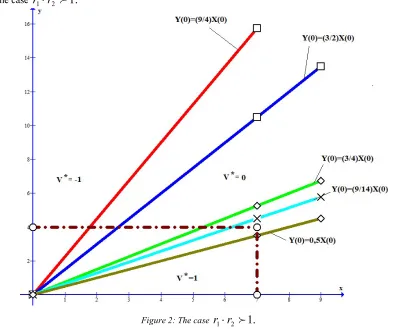
*, if the players apply optimal strategies, it is equal to (1/2).In Mathcad there was obtained the following graph, shown on Fig. 2. On the plane
(
x
(
0
),
y
(
0
)),
[image:7.612.107.500.364.693.2]on which there are indicated the areas in which the value of the game takes different values.
4408
Figure 3: The case
r
1
r
2
1
.
In the second case
r
1
r
2
1
the following set of input data is considered:. 1 , 2 / 1 , 4 / 1 , 2 , 13 ) 0 ( ,1 ) 0
( 1 2 1 2
*
* y g g r r
x
In this case, the players have optimal pure strategies. The first player will have the optimal pure strategy
u
1*
1
;
the second player -.
13
/
9
* 1
v
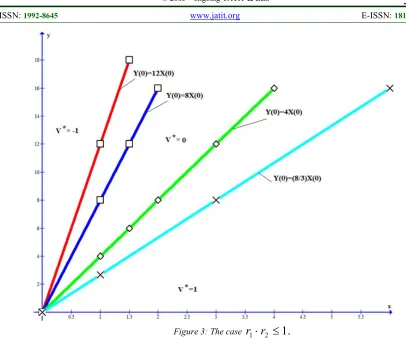
Such a graph for this case is obtained on fig. 3. On the plane(
x
(
0
),
y
(
0
)),
there are indicated the areas in which the value of the game applies the calculated values.As part of the article, we stopped only on these cases, because they illustrate the most common situations in the interaction of the sides.
6. DISCUSSION OF THE EXPERIMENT
RESULTS
Figure 2 illustrates the situation when the first side (SCESE) does not have the opportunity to find his optimal pure strategy at the distribution of FMR in the emergency zone, which will allow to achieve his goal with a probability 1. However, he has an optimal mixed strategy, which with a probability of ½ will allow him to achieve it.
Figure 3 demonstrates a situation in which the second side (LAES), applying his optimal pure strategy at the distribution of FMR spent in the emergency situation elimination area - this is probably an emergency situation on railway transport, achieves his goal.
The proposed model is a process of forecasting the results of the FMR distribution between the sides (SCESE and LAES) involved in the elimination of the consequences of a technogenic accident or an emergency situation on transport. The disadvantage of the model is the fact that at this stage there is no full-fledged software implementation. This circumstance still makes it difficult to obtain a forecast estimate at choosing strategies for FMR distribution, allocated by the SCESE for emergency situations elimination.
4409 decision makers about the FMR distribution for elimination the consequences of an accident or an emergency situation on railway transport on an average by 11–16% [4], [6], [8].
7. PROGRAM IMPLEMENTATION OF DECISION SUPPORT SYSTEM FOR THE
DISTRIBUTION OF FINANCIAL
RESOURCES FOR UTILIZATION OF
EMERGENCY SITUATIONS IN RAILWAY TRANSPORT
After the computational experiments had been conducted in the Mathcad environment and confirmed correctness of the obtained analytical
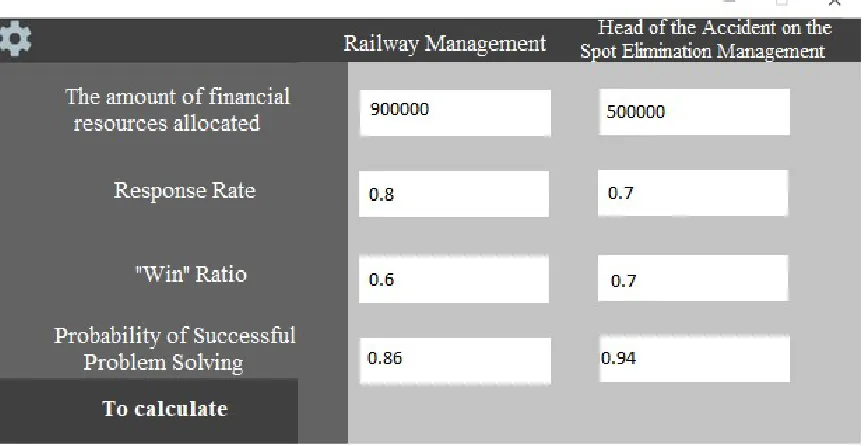
dependencies, the mathematical model has been implemented as a finished software product in the Visual Studio 2017 environment. The software product “Decision support system for the distribution of financial resources allocated for the elimination of emergency situations and
technogenic accidents on railway transport” has been written using the C# programming language. Figure 4, 5 illustrates the general overview of the software program.
After conducting computational experiments in the Mathcad environment, which confirmed the correctness of the obtained analytical dependencies, our mathematical model was implemented as a finished software product in Visual Studio 2017. The software product “Decision Support System for the Distribution of Financial Resources for Utilization of Emergency Situations in Railway Transport” was written on algorithmic C # language. The general view of the program is shown in Figure 3.
[image:9.612.95.527.354.577.2]The variables obtained from the analysis of financial resources distribution, aimed at the elimination of the consequences of accidents on the railway transport in the Republic of Kazakhstan were taken as initial data.
Figure 4 : General overview of the program window,
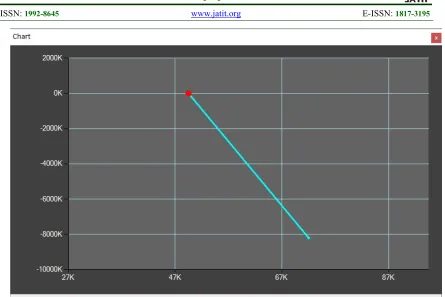
During the approbation of the software product, it has been determined that the proposed model makes it feasible to adequately describe the decisions on the choice of resource allocation strategies, aimed at emergency situations and accidents on the railways transport. The solution
4410
Figure 5 : Program Interface and Solutions Window General View. The graph for decisions obtained during strategies evaluation process
In comparison with the existing models [2, 4, 9, 11], the proposed solution also improves the performance and predictability indicators for management teams by an average of 11% to 15%.
8. CONCLUSIONS
The following main results were obtained in the article:
- there was substantiated the necessity of using intelligent computer technologies in order to automate the process of analysis of the selection of a rational strategy for the distribution of financial and material resources allocated for the elimination of technogenic accidents or an emergency situation on railway transport;
- there was described a mathematical model for a decision support system for developing recommendations to the situational center for emergency situation elimination and for liquidators working directly at the accident area or in the emergency situation area. The proposed model allows to automate the production of forecast
estimates for various variants of the FMR distribution spent on emergency situation elimination and its consequences. The model is based on solving an endless antagonistic quality game with discontinuous gain functions. A distinctive feature of our model is that for determining the optimal mixed strategies there has been proposed a constructive method for finding them. This made it possible to develop specific recommendations for determining the value of the FMR, which are sufficient to eliminate the consequences of emergency situations and/or technogenic accidents on railway transport in practice;
4411
REFRENCES:
[1] Mengshu, W. J. Z. D. W. “Current Damage Situation of Railway Operation Tunnels and Their Inspection and Evaluation”, China Safety Science Journal, 2003, 6, 016.
[2] Lakhno, V., Akhmetov, B., Korchenko, A., Alimseitova, Z., Grebenuk, V. “Development of a decision support system based on expert evaluation for the situation center of transport cybersecurity”, Journal of Theoretical and Applied Information Technology, 2018, Vol. 96, Iss. 14, pp. 4530–4540.
[3] Ivashchenko A.V., et al. “Multi-agent technologies for development of network-centric control systems”, News of Southern Federal University. Technical science, 2011, V. 116. №. 3
[4] Gelovani, V. A., Bashlykov, A. A., Britkov, V. B., & Vyazilov, E. D. “Intellectual decision support systems in emergency situations using information about the state of the environment”. M .: Editorial URSS, 304, 3. [5] Kuznetsov O. P. “Intellectualization of control
decisions support and creation of intellectual systems”, Problems of management, 2009. №. 3.1.
[6] Yamalov I. “Modeling of control and decision-making processes in emergency situations” -
Liters, 2014.
[7] Trakhtengerts E. A. “Computer support systems for making control decisions”, Problems of management, 2003. №. 1.
[8] Medvedev, V. I., Teslenko, I. O., & Kalinichenko, E. A. “New emergency cards for the prevention on liquidation of extreme situation with dangerous goods on the railway”. In International Workshop on «Early warning and crises/disaster and emergency management, 2010, April, pp. 28-29.
[9] Katsman, M., Kryvopishyn, O., & Lapin, V. “Mathematical models of decision support system for the head of the firefighting department on railways”, Reliability: Theory & Applications, 2011, 6(3 (22)).
[10] Monoši, M., & Ballay, M. “Analysis of risks and technical securing of rescue services at traffic accidents on railway crossing”, Advances in Fire, Safety and Security Research 2014 i Editors note, 121. [11] János, B. E. N. Y. E. “The role of information
of the population in elimination of accidents
involving dangerous substances” Hadmérnök, 2017, 12(1).
[12] Buts, Y. V., Kraynyuk, E. V., Kozodoy, D. S., & Barbashin, V. V. “Evaluation of emergency events at the transportation of dangerous goods in the context of the technogenic load in regions”, Science and Transport Progress. Bulletin of Dnipropetrovsk National University of Railway Transport, 2018, (3 (75)), pp. 27–35.
[13] Akhmetov, B., Lakhno, V. “System of decision support in weaklyformalized problems of transport cybersecurity ensuring”,
Journal of Theoretical and Applied Information Technology, 2018, Volume 96, Issue 8, pp. 2184–2196.
[14] Lakhno, V., Malyukov, V., Gerasymchuk, N., Shtuler, I. “Development of the decision making support system to control a procedure of financial investment”, Eastern-European Journal of Enterprise Technologies, 2017, Vol. 6, Iss. 3-90, pp. 35-41. DOI: 10.15587/1729-4061.2017.119259
[15] Malyukov, V.P. “Conflict interaction of economic models”, Cybernetics, 1979, Vol. 15, Iss. 6, pp. 867-875. DOI: 10.1007/BF01069398
[16] Lakhno, V., Buriachok, V., Parkhuts, L., Tarasova, H., Kydyralina, L., Skladannyi, P., Skrypnyk, M., Shostakovska, A. Development of a conceptual model of adaptive access rights management with using the apparatus of petri nets, International Journal of Civil Engineering and Technology, 2018, 9 (11), pp. 95–104.
[17] Akhmetov, B., Kydyralina, L., Lakhno, V., Mohylnyi, G., Akhmetova, J., Tashimova, A. Model for a computer decision support system on mutual investment in the cybersecurity of educational institutions, International Journal of Mechanical Engineering and Technology, 2018, Vol. 9, iss. 10, pp. 1114-1122.
[18] Lakhno, V., Malyukov, V., Bochulia, T., Hipters, Z., Kwilinski, A., Tomashevska, O. (2018). Model of managing of the procedure of mutual financial investing in information technologies and smart city systems,
International Journal of Civil Engineering and Technology, 9 (8), pp. 1802-1812.