CLOUD TECHNOLOGIES IN EDUCATIONAL SYSTEM OF
REPUBLIC OF KAZAKHSTAN
1
AIGUL SADVAKASSOVA, 2MERUERT SERIK
1
Department of Informatics, Faculty of Information Technology, L.N.Gumilov Eurasian National University, Astana, Kazakhstan
2
Department of Informatics, Faculty of Information Technology, L.N.Gumilov Eurasian National University, Astana, Kazakhstan
E-mail: [email protected], [email protected]
ABSTRACT
Objectives: analysis of using cloud technologies in High education system of Republic of Kazakhstan, determination of theoretical basis, development and practical realization of academic cloud storage on local network of university on improvement training of future teachers of computer science.
Methods: during this study there were used pedagogical studies’ methods, such as study analysis on theme, methods of theoretical comparison and generalization, studying international experience, questioning.
Findings: Academic cloud storages were developed by authors, which nowadays are realized by local network, but further are planned with internet access. For realization were analyzed cloud solutions and development strategy of IT-system for Kazakhstan universities on this issue. On work were described designed cloud storages, were provided practical and methodical guidance for its usage, which are convenient for students. In article reviewed and evaluated the benefits of developing and using cloud storage in educational process on training of future teachers of computer science, as well as practical recommendations given for realization of cloud technologies on educational process in universities.
Application/Improvements: Practical significance of study lies in the fact that proposed scientific and methodological results of study will be used to improve the training of future teachers in universities of republic.
Keywords: Cloud Storage, Cloud Technologies, Development Of Cloud Reserves, Education, Network
Training.
1. INTRODUCTION
On state program “Informational Kazakhstan 2020” noticed that future of educational system of Kazakhstan is symbiosis of internal and networked forms of learning, so new ways of development of information and communication technologies will help to bring the country’s education to a new level [1].
On today’s rapidly changing world of
technology, educational institutions often need to
introduce new technologies, software and
continuous improvement of learning technologies on preparation of future teachers of computer science. Development of learning technologies takes one of the leading places among the many new areas of education, attracting special attention of high school scholars to the problems over the past two or three decades.
Modern developing educational organization needs specialist with knowledge in the field of cloud technologies, which helps to reduce the cost of infrastructure, as well as reduce the cost of used software. Firstly, he needs to know theoretical basis and architecture of cloud computing. Secondly, he has to work in the sphere of cloud computing realization. Thirdly, the modern teacher of informational technologies needs the skills in development of academic cloud storage, its installation and organization of access on a local network of educational institutions etc.
In state educational standards of the Republic of Kazakhstan (SES RK 5.04.019-2011) noted that a graduate must be competent on modern trends of informational technologies development and ways of its usage on scientific research, design,
production-technological and organizational
we highlight: informational competence, intellectual competence, profile competence.
Currently in Kazakhstan expanded academic freedom of universities in determining curriculum content: increased component of your choice - in a bachelor degree from 30% to 50%, masters degree from 50% to 60%, and a doctorate from 70 to 80%.
In typical curriculum specialty 5V011100 – Computer, reflected curtain number of subjects, which student has to learn in amount of 84 credits or 3780 hours of compulsory component and 44 credits or 1980 hours of selection component [3]. We introduced elective courses on the basis of cloud technologies and development and usage of cloud services.
Thus, it highlighted the need for development of education system on preparation of specialists with competence on cloud technologies and willingness of future specialists to use them effectively in their professional activities.
In aspect of requirements compliance of state educational standards there were previously developed and implemented special courses on distributed technologies in the educational process of L.N. Gumilyov ENU, which are predecessors for
following special courses, namely cloud
technologies.
The object of our study is the process of improving the training of future informational technologies teachers in universities of Republic of Kazakhstan.
One of the objectives of our research work is improvement of students training in the aspect of cloud technologies.
2. LITERATURE REVIEW
2.1 Overview of Experience in Implementation
of Cloud Technologies in Educational System
The experience of developed foreign countries [4, 5, 6] shows that the best solution of above-mentioned problems is the implementation of “cloud computing” in educational process.
Italian scholar Fini [7] in his writings said that the main perspective direction of informational technologies development on the basis of cloud computing is the ability to leverage the students of effective usage of convenient online tools to learn and generate new knowledge.
This paper [8, 9, 10, 11] describes how effectively use cloud computing on education and training process of students.
Scholars study the problem of usage of cloud computing in education [12] cloud computing in
electronic learning [13], cloud-based learning [14], adaptation of learning process in cloud environment [15], education system in cloud computing environment [16], creation of virtual learning communities [17], introduction of cloud computing [18].
The analysis of scientific literature and internet resources shows that the cloud technology courses implemented to high education process in foreign universities (Commonwealth of Independent States, Europe countries, USA, etc.), however, there are examples in some universities of the Republic of Kazakhstan.
In scientific-pedagogical literature of Kazakhstan the study on implementation of cloud technology problems in educational system are presented by Serik, Bakiyev, & Balgozhina [19], Serik et al. [20], Serik, & Nurkassymova [21].
The educational institutions of Kazakhstan cloud services initially appeared mainly as free hosting mail services for students and teachers. Other numerous tools of cloud computing for education were not used due to lack of information about them and the lack of skills to use them on educational purposes. Only recently the student community and teachers start to evaluate innovative IT-applications, for example, Google Groups, Microsoft Office Web Apps, Amazon EC [22].
In Kazakhstan, there have been many studies in the field of future teachers training of computer science, but not too much in the aspect of cloud technology. According to experts, analysts and scientists in the information technology industry, cloud solutions is the most promising technology
for predicting the transfer of information
technologies to "cloud" in the future. Therefore, the knowledge of these technologies is essential for any specialist working in the field of IT. To this end, we believe it is necessary to pay more attention to the implementation of cloud technologies in the learning process.
2.2 About Cloud Technologies
Currently, all large companies (Microsoft, Google, Amazon, IBM, HP, Dell, Oracle, etc.) are developing their systems of cloud computing; there is a trend towards integration of enterprise systems into a single user accessible "cloud." However, there are some private "clouds", accessible only to employees of a particular company.
technologies”. There are many definitions of these terms.
Cloud computing - a model of computation, based on dynamically scalable and virtual resources - data, applications, operating systems, etc., - which are available and used as a service over the Internet and are implemented with the help of powerful data centers.
Analyzing the existing definitions of the term, we think that the following definition most accurately describes the term.
Cloud computing is a technology of distributed data, where computer resources and capacity are provided as an Internet service.
Cloud technology is a convenient environment for processing and information storage in various formats, which combines hardware, software and provides support for web users [23, 24].
A feature of cloud computing is scalability, ie, no reference to the geography and hardware platform, can work with any device that has Internet access.
From the point of users’ view, there are "clouds" (public or private), provided by various companies to use the powerful computing resources, that are not available at the individual user.
The objective of our study include the introduction to educational process of the university distributed database technologies, including cloud computing, which allows users to manage their data and programs.
3. CLOUD TECHNOLOGIES IN
EDUCATION
3.1 Peculiarities of web server installation for
the operation of cloud data storage
Since one of the main issues of this work is the installation of a web server. As stated above, we are using for the preliminary time the local university network.
As a web server, we use the Open Server, i.e. portable server platform and software environment is assigned for web designers, their requests and suggestions. The software package is rich with the server software provision, easy to use; the interface is laid out and has a multi-functional capabilities administration components and settings. The platform is widely used in the creation of web-projects, their support and testing, is also used in local area networks for web services.
The idea of Open Server does not depend on the workplace. The work of creators is usually linked to a specific computer, operating system and programs installed on the computer, even if it is at work or home. You take a portable (not requiring
installation) program group. Along with this, you get a powerful server platform capable of working with web projects. Do not think on which computer you are working: on your friend’s or yours. You will not waste time searching for and installing a new program at the Windows startup, you only need an external disc to the Open Server or USB flash drive, so you can gain access to their programs.
In our case, further at the web server there has been designed a site for the installation of a cloud storage. In our case, the site is called bult.kz.
3.2 The Study And Analysis Of Solutions For
The Development Of The Own Academic Cloud Storage
Today, instead of individual isolated development on the own computer, the program software is developed as a set of network applications and services, and the main tendency for users - the use of ready-made services through the Web.
Analysis of the available free solutions for cloud data storage organization revealed the undoubted leader in this area - service OwnCloud. OwnCloud source code is distributed under a free license AGPLv31. In order to deploy OwnCloud the web-server is required with PHP interpreter and a database MySQL, PostgreSQL or SQLite [25]. In this paper, we study the installation of the cloud storage OwnCloud on a local web-server. Specially for students of Computer science major there were developed guidelines on the subject Cloud technologies. The aim of the work is installing OwnCloud cloud storage on a local Web-server. Students learn OwnCloud and get familiar with project KDE SC (K Desktop Environment Software Compilation), learn to install the Web-server Open Server on the computer, set the cloud OwnCloud at Open Server, work with cloud storage OwnCloud.
OwnCloud - free and open Web application for data synchronization, for general use of documents and storage of documents in the remote "cloud". The distinctive feature - ownCloud can be installed on your server without additional cost.
OwnCloud is written in the languages of the PHP programming and JavaScript. OwnCloud supports SQLite database, MariaDB, MySQL, Oracle Database and the PostgreSQL, running on servers with Linux, also on the Raspberry Pi (small size as the Credit Card the cheap computer with built-in video player which is used for the office work, the consumer file server, the platform for education).
The latest versions of OwnCloud file
ringtone, contacts, etc. - all this will be transmitted with your server or desktop [26]. There is a possibility of using customers while synchronizing data with personal computers with the Windows OS X, Linux and mobile devices iOS and Android. This gives access to educational materials from any location. Therewith, the web-interface allows access to the data stored in any browser [27].
And in the OwnCloud there are such useful functions as the synchronization of the files, the exchange of files and a great web interface as Dropbox and Google.
OwnCloud is running on your personal "iron", server. The students are to learn how to control
their data by their own. Do not need to download data to the DropBox, Google, Facebook or Flickr. They may use many of the features of the Cloud Services on their computers as the local domain.
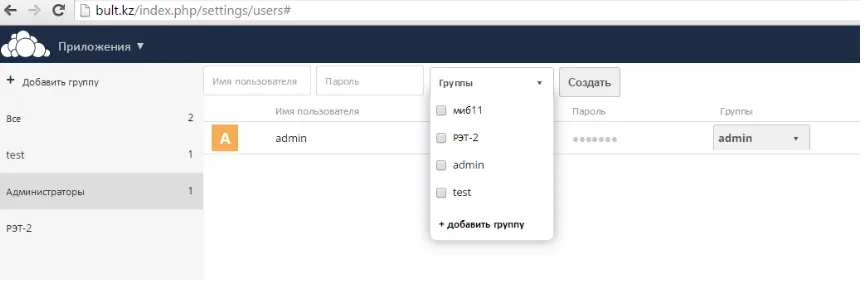
You may rent an affordable hosting. Students in practice will know that they do not need the skills of the administrator, do not need the root access, they need a server only in the form of computer (reminding that we are doing it for training), installed on the ownCloud and be able to organize the actions of the users in the self-designed cloud
[image:4.612.92.525.266.408.2]storage such as Fig.1.
Figure 1: Window Of Cloud Data Storage Developed By Students
After organizing the own cloud data storage the students try themselves in a future profession, in a role of the teacher, test capabilities of Owncloud.
One of the functions of the cloud data storage is the organization of joint access, i.e. the online service for the management of the group work and distribution list. The organization of joint access in our case to the files of the local domain of different users - one of the most convenient mechanisms by which it becomes possible only by using the cloud data storage. The teachers give access to students to their electronic versions of the lectures, laboratory jobs and other instruments.
Also teachers use groups (one of the groups is shown in the figure) as a tool for informing all participants of educational process, to work together on projects for the communication and counseling. The interaction of the participants of educational process through groups - this is also an opportunity to develop at the students the relevant elements of the web culture flow of information and communication.
Similarly, students also have the opportunity to interact with both the instructor and with their classmates. Users of our cloud storage have a right
to provide access to files purely the specified range of persons. This concept is able to facilitate the work of the students over one common scientific project or any other activities undertaken in the groups.
This should include also the possibility of the proliferation of files among persons not registered in the system ownCloud - the exchange is carried out using public links. Thus, the teachers and students have the opportunity to work together to adjust their personal schedule or plan to other common actions. There is also a possibility to include the calendar and address book, you may synchronize all of the data in the calendar or address book with the phone and etc.
Thus we have carried out the following operations for the development of the above cloud data storage:
a. Installation of the Open Server Web server on the computer.
b. Installation of the cloud data storage OWNCLOUD on Open Server
The initial window developed by us for the training process of the cloud data storage and
treatment of the customer to the local domain is as follows (Fig.2).
Figure 2: Window Of Entry To The Cloud Data Storage For An Administrator And The User
In the beginning of the experiment the students took part in the educational process, where they had learned about possibilities of Owncloud.
Also, we provide you the general scheme of work of the developed cloud data storage (Fig.3).
Figure : 3 Owncloud Features
In this study we use Owncloud as a tool for practical implementation. Owncloud should be considered as a basis for cloud computing in some cases. For example, to provide an opportunity for students not only to edit the program sources, but also to perform remote code compilation, followed by implementation of formed program and result output. An attractive idea is to personalize the user’s environment. Through cloud storage it is relatively easy to implement the ability of user’s
environment synchronization for computers located in different buildings of university.
4. DESCRIPTION OF THE STUDY
In the initial stage of our research we carried out a preliminary survey on the need of learning the discipline on cloud technologies. The survey involved students of 2-4 courses and masters students of 1 and 2 courses in specialty "Computer science" of ENU by L.N.Gumilyov, Astana city,
and East Kazakhstan State University by
S.A.Amanzholova, Ust-Kamenogorsk city,
specialty. Age structure of respondents were from 20 to 30 years.
The key issue of the study is the need of learning the discipline on cloud technologies. Questions are based on the key issues:
- Why do you think that there is a need of learning the discipline?
- What do you think at which level of education the data should be studied?
- What are the topics you would be interested to learn?
- Did you use cloud services up to this time? - For what purpose are you using cloud services? etc.
According to a preliminary survey of students of 2- 4 courses and masters students of 1 and 2 courses of the Department "Computer Science" ENU by L.N.Gumilyov and East Kazakhstan State
University by S.A.Amanzholova received
information about what we expected. It discovered that the implementation and improvement of educational content of the specialty on this issue is considered as urgent.
A lot of research on relevance of the cloud technology implementation in educational process was carried out in Kazakhstan, but:
- There are no courses on cloud technologies in educational programs of many universities;
- The minimum number of scientific studies on usage of cloud technologies in preparation of future
teachers of computer science. Feature of
preparation of future computer science teacher consists in the fact that the foundation of knowledge about cloud technologies lays in the school, which in future will be the foundation of lifelong learning. Chief methodologist in the organization of cloud solutions in educational institutions is a teacher of computer science. His main objective is to reinforce the methodological and organizational functions on creation of cloud-based database storage for usage in educational process.
5.CONCLUSION
Future is on network and distributed software, based on Web-Service, multi-client and multi-tiered architectures. All of these principles correspond to a cloud computing model. The prospects of cloud computing are very promising.
The usage of cloud computing in the university is able to significantly reduce IT costs and simplify complex IT infrastructure of university through workload optimization and operation of IT services. Creating a unified information environment of the
university, built with the help of cloud
technologies, allows to provide the necessary skills demanded by the labor market, and to ensure competitiveness and development of high education institution as a whole.
After the analysis of the curriculum specialty of computer science, there were identified the need for the formation of knowledge, skills and competences in the aspect of working with distributed data, including cloud technologies; in the content of
education the courses "Basis of cloud
technologies", "Cloud technology and virtualization technology" were introduced; developed academic cloud storage for usage in the educational process.
REFRENCES:
[1] O Gosudarstvennoj programme "Informacionnyj Kazahstan - 2020" i vnesenii dopolnenija v Ukaz Prezidenta Respubliki Kazahstan ot 19 marta 2010 goda № 957 Ob utverzhdenii Perechnja gosudarstvennyh programm" [On the State Program "Informational Kazakhstan - 2020" and introduction of amendments to the Decree of the President of the Republic of Kazakhstan dated March 19, 2010 under No. 957 “On approval of the state programs list”]. (2010). Retrieved March 04, 2017, from http://adilet.zan.kz/rus/docs/U1300000464 [2] Postanovlenie Pravitel'stva Respubliki Kazahstan
ot 23 avgusta 2012 goda № 1080 “Ob
utverzhdenii gosudarstvennyh
obshheobjazatel'nyh standartov obrazovanija
sootvetstvujushhih urovnej obrazovanija”
[Decree of the Government of the Republic of Kazakhstan from August 23, 2012 № 1080 on Approval of the State obligatory educational
standards for corresponding levels of
education]. (2012). Retrieved March 04, 2017, from http://adilet.zan.kz/rus/docs/P1200001080 [3] Gosudarstvennyj obshheobjazatel'nyj standart
vysshego obrazovanija (utverzhden
postanovleniem Pravitel'stva Respubliki
Kazahstan ot 23 avgusta 2012 goda № 1080) (s
izmenenijami ot 13.05.2016 g.) [State
[4] Khmelevsky, Y., Voytenko, V. Cloud computing infrastructure prototype for university education and research. Proceedings of the 15th Western Canadian Conference on Computing Education
- WCCCE '10, 2010,
doi:10.1145/1806512.1806524
[5] Lohr, S. Google and I.B.M. Join in ‘Cloud Computing’ Research. Retrieved March 04,
2017, from
http://www.nytimes.com/2007/10/08/technolog y/08cloud.html
[6] Mell, P., & Grance, M. Effectively and Securely Using the Cloud Computing Paradigm [PPT].
Gaithersburg: Information Technology
Laboratory, 2009.
[7] Fini, A. The Technological Dimension of a Massive Open Online Course: The Case of the CCK08 Course Tools. The International Review of Research in Open and Distributed Learning, 10(5), 2009. doi:10.19173/irrodl.v10i5.643 [8] Sarathy, V., Narayan, P., & Mikkilineni, R.
Next Generation Cloud Computing
Architecture: Enabling Real-Time Dynamism for Shared Distributed Physical Infrastructure. 2010 19th IEEE International Workshops on Enabling Technologies: Infrastructures for
Collaborative Enterprises.
doi:10.1109/wetice.2010.14
[9] Sclater, N. Legal and Contractual Issues of Cloud Computing for Educational Institutions. Cloud Computing for Teaching and Learning, 2012, 186-199. doi:10.4018/978-1-4666-0957-0.ch013
[10] Mircea, M., & Andreescu, A. I. Using cloud computing in higher education: A strategy to improve agility in the current financial crisis. Communications of the IBIMA, 2011.
[11] Thomas, P. Harnessing the Potential of Cloud Computing to Transform Higher Education. Cloud Computing for Teaching and Learning, 2012, 147-158. doi:10.4018/978-1-4666-0957-0.ch010
[12] Sarrab, M., Alalwan, N., Alfarraj, O., & Alzahrani, A. An empirical study on cloud computing requirements for better mobile learning services. International Journal of Mobile Learning and Organisation, 2015, 9(1), 1. doi:10.1504/ijmlo.2015.069709
[13] Anshari, M., Alas, Y., & Guan, L. S. Pervasive Knowledge, Social Networks, and Cloud Computing: E-Learning 2.0. EURASIA Journal of Mathematics, Science & Technology
Education, 2015, 11(5), 909-921.
doi:10.12973/eurasia.2015.1360a
[14] Mehmet, F. Future of E-Learning: Perspective of European Teachers. Eurasia Journal of
Mathematics, Science and Technology
Education, 2015, 11(3), 421-429.
doi:10.12973/eurasia.2015.1361a
[15] Balco, P., & Greguš, M. The Implementation of Innovative Services in Education by Using Cloud Infrastructure and Their Economic Aspects. Global Journal of Flexible Systems
Management, 2014, 15(1), 69-76.
doi:10.1007/s40171-014-0060-2
[16] Kop, R., & Carroll, F. Cloud computing and creativity: Learning on a massive open online course. European Journal of Open, Distance and E-learning, 2011, 14(2).
[17] Ribón, J. C., Villalba, L. J., & Kim, T. Virtual
learning communities: unsolved troubles.
Multimedia Tools and Applications, 2013, 74(19), 8505-8519. doi:10.1007/s11042-013-1543-4
[18] Okai, S., Uddin, M., Arshad, A., Alsaqour, R., & Shah, A. Cloud Computing Adoption Model for Universities to Increase ICT Proficiency. SAGE Open, 2014, 4(3), 215824401454646. doi:10.1177/2158244014546461
[19] Serik, M., Bakiyev, M. N., & Balgozhina, G. B. Using cluster parallel computing in the content of information-didactic system [PDF]. Life Science Journal. 2014.
[20] Serik M., Nurkassymova S.N.,Akanova R.A., Zhanys A.B. Experimental studies of rotary motion technology with it. International journal of academic research, 2015, 7(2), 563-569.
[21] Serik M.,Nurkassymova S.N. Research
rotational motion of IT technologies. Wulfenia journal KLAGENFURT. 2015, 22(9), 261-268. [22] Mustafina A.K., Uskenbayeva R.K., Kalpeeva
Zh.B. Cloud computing and electronic
educational resources. Vestnik KazNTU. 2011, 2(84), 3-6.
[23] Cloud technology. Retrieved March 04, 2017,
from
http://efsol.ru/technology/cloud-technology.html
[24] Serik, M., Basics of cloud computing. Tutorial. Astana. 2015.
[25] Ustanovka i nastrojka OwnCloud na Ubuntu [Setup and setting OwnCloud in Ubuntu] 16.04.
Retrieved March 04, 2017, from
[26] OwnCloud 2 - vash personal'nyj oblachnyj server [OwnCLoud2 - your personal cloud server]. Retrieved March 04, 2017, from http://rus-linux.net/MyLDP/server/owncloud-vashe-sobstvennoe-oblako.html