Full Length Research Article
NEW FACILITIES TO STUDY SYNTHESIS OF THE ELEMENTS IN STARS
*Mohammadi, S. and Rostam Nezhad, H.
Department of Physics, Payame Noor University, PO BOX 19395-3697 Tehran, Iran
ARTICLE INFO ABSTRACT
One of the great successes of stellar evolution theory was the explanation of the origin of all elements. Fusion in the early universe produced hydrogen, helium, lithium, beryllium and boron, the first 5 elements in the periodic table. Other elements, from carbon to iron, were formed by fusion reactions in the cores of stars. The fusion process produces energy, which keeps the temperature of a stellar core high to keep the reaction rates high. Fusion of elements with mass numbers greater than 60 uses up more energy than is produced by the reaction. Thus, elements heavier than iron cannot be produced in stars, and there must be another mechanism for their production. The construction of elements heavier than iron involves neutron capture. Each neutron capture produces an isotope, some are stable, and some are unstable. Neutron captures can happen by two methods, the s and r-processes, where s and r stand for slow and rapid. In these processes, unstable nuclei played a very important role. It can be said that if there were only stable nuclei and unstable nuclei do not exist, most elements would have not been synthesized due to the lack of reaction routes. In this paper, we will show how Radioactive Ion Beam factory will reproduce these synthesis reaction paths in the laboratory and give a Comparison of fusion-evaporation production cross-sections for stable and unstable beams.
Copyright © 2014 Mostafa Sheikhzadeh. This is an open access article distributed under the Creative Commons Attribution License, which permits unrestricted use, distribution, and reproduction in any medium, provided the original work is properly cited.
INTRODUCTION
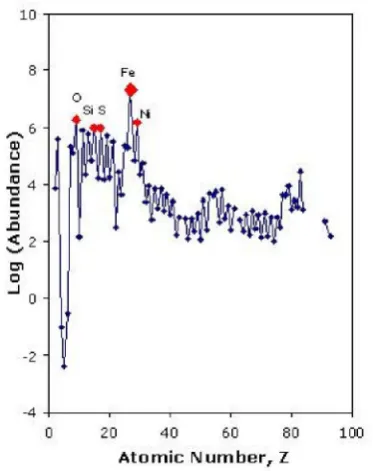
There are over 100 naturally occurring elements in the Universe and their classification makes up the periodic table. According to liquid drop model, the maximum nucleon binding energy occurs at mass A ≈ 56, i.e. around iron, which we may consider to be the most thermodynamically stable element in the universe (Wong, 1990). At lower values of A, fusion of lighter elements releases energy while the exothermic reactions to form heavier elements (A > 60) involve neutron captures. The elemental composition of our sun is about 73% hydrogen, 25% helium and 2% carbon, nitrogen and other elements distributed as shown in figure 1. In all, approximately 70 elements have been detected in the solar spectrum and there are reasons to believe that all the elements up to uranium are present in our sun. The present understanding of processes in the interior of stars is the result of combined efforts from many scientific disciplines such as hydrodynamics, plasma. Physics, nuclear physics, nuclear chemistry and not least astrophysics. To understand what is going on in the inaccessible interior of a star, we must make a
*Corresponding author: Mohammadi, S., Department of Physics, Payame Noor University, PO BOX 19395-3697 Tehran, Iran
model of the star which explains the known data such as mass, diameter, luminosity, surface temperature and composition. The development of such a model normally starts with an assumption of how elemental composition varies with distance from the center. By solving the differential equations for pressure, mass, temperature, luminosity and nuclear reactions from the surface (where these parameters are known) to the star’s center and adjusting the elemental composition model until zero mass and zero luminosity is obtained at the center, one arrives at a model for the star’s interior. The model developed then allows us to extrapolate the star’s evolution backwards and forwards in time with some confidence (Carroll, 1996). Gamma rays in a stellar core are capable of disrupting nuclei, emitting free protons and neutrons. If the reaction rates are high, then a net flux of energy is produced. Fusion of elements with mass numbers greater than 60 uses up more energy than is produced by the reaction. Thus, elements heavier than iron cannot be produced in stars, so what is their origin? The construction of elements heavier than iron involves neutron capture. A nucleus can capture or fuse with a neutron because the neutron is electrically neutral. In everyday life, free neutrons are rare because they have short half-life and undergo radioactive decay. Each neutron capture produces an isotope, some are stable, and some are unstable. Unstable isotopes will decay by emitting a positron and a neutrino to
ISSN:
2230-9926
International Journal of Development Research
Vol. 4, Issue, 2, pp. 294-299, February,2014
International Journal of
DEVELOPMENT RESEARCH
Article History:
Received 14th November, 2013
Received in revised form 09th December, 2013
Accepted 18th January, 2014
Published online 21st February, 2014
Available online at http://www.journalijdr.com
Key words:
make a new element. Neutron captures can happen by two methods, the s and r-processes, where s and r stand for slow and rapid. The s-process happens in the inert carbon core of a star, the slow capture of neutrons. The s-process works as long as the decay time for unstable isotopes is longer than the capture time. Up to the element bismuth (atomic number 83), the s-process works, but above this point the more massive nuclei that can be built from bismuth are unstable. The second process, the r-process, is what is used to produce very heavy, neutron rich nuclei. Here the capture of neutrons happens in such a dense environment that the unstable isotopes do not have time to decay. The high density of neutrons needed is only found during a supernova explosion and, thus, all the heavy elements in the universe (radium, uranium and plutonium) are produced in this way. The properties and reactions of unstable nuclei are important elements in the initiation and the explosion of supernovae. The supernova explosion also has the side benefit of propelling the new created elements into space to seed molecular clouds, which will form new stars and solar systems.
In the beginning of time
The era immediately after the Big Bang was a time with densely packed matter and very high temperatures (ten's of millions of degrees). Around “time zero” the universe consisted of an immensely dense, hot sphere of photons, quarks, leptons and their antiparticles in thermal equilibrium. Particles being created by photons and photons created by annihilation of particles. The temperature must have been
≥1013 K, but no light was emitted because of the enormous
gravitational force pulled the photons back (Carroll, 1996). The system was supposed to be in a unique state with no repulsion forces. However, just as a bottle of supercritical (overheated) water can explode by a phase transition, so did the universe, and time began. The universe expanded violently in all directions, and as age and size grew, density and temperature fell. A one hundreds of a second later all the quarks were gone, and the universe consisted of an approximately equal number of electrons, positrons, neutrinos and photons, and a small amount of protons and neutrons.
The creation of a proton or a neutron (rest mass 940 MeV) out
of radiation requires a temperature of 1.1x 10¹³ K,
corresponding to a photon wavelength of about 10-15 m, that is
the size of a nucleon. At these temperatures nucleons are formed out of radiation, but are also disrupted by photons, leading to equilibrium with about an equal number of protons, electrons and photons. This state of matter, called plasma, is opaque, just like the glowing gases inside a discharge tube. The background photons had energies great enough to prevent electrons and protons from binding to form hydrogen atoms (Carroll, 1996). The epoch when atoms first formed at t = 380000 years after the big bang is called the “era of recombination”. This refers to electrons recombining to form atoms. The photons no longer had enough energy to keep the protons and electrons apart. As soon as the temperature of the radiation field fell below about 3000 K, protons and electrons began combining to form hydrogen atoms. These atoms do not absorb low-energy photons, and so space became transparent. All the photons that heretofore had been vigorously colliding with charged particles could now stream unimpeded across space. Today, these same photons constitute the microwave background.
Fusion Processes in Stars
Stars produce energy by fusion. Hydrogen is the most abundant element and also has the smallest nuclear charge (one proton). Fusion in the early universe produced Hydrogen, helium, lithium, beryllium and boron, the first 5 elements in the periodic table. Other elements, from carbon to iron, were formed by fusion reactions in the cores of stars. The fusion process produces energy, which keeps the temperature of a stellar core high to keep the reaction rates high. The fusing of new elements is balanced by the destruction of nuclei by high-energy gamma rays.
Hydrogen burning to Helium
Helium can be formed from hydrogen in several ways, the
least likely one is the reaction 4 1H→ 4He + | 2β+ + 2e- | + 2υe,
which would require that 4 protons come together
simultaneously. For stars with m≤1.5 M๏ and T≥ 2x 10⁷ K, the
main reaction sequence is referred to as the proton-proton chain, which constitutes about90% of the solar energy production. The pp-chain is summarized in the following reactions (Prialnik, 2000) (not showing gammas):
1
H + 1H → 2H
2
H + 1H → 3He
3
He + 3He → 4He + 2 1H
In 9% of the pp-chain, the above last equation is replaced by:
3
He + 4He → 7Be
7
Be + e- → 7Li + υe (4%)
7
Li + 1H → 2 4He
The neutrino takes 4% of the decay energy. To a very small amount (< 1%) also the reaction sequence
7
Be + 1H → 8B
8
B + e- → 8Be → 2 4He
Occurs (Prialnik, 2000). Thus isotopes of Li, B and Be are
formed as intermediates. 7Be decays by electron capture while
7
Li is stable. 8B is very short-lived, decaying to 8Be, which
immediately decays into 2 He. The amount of pp- fusion
reactions in our sun amounts to 1.8 x 1038 S -. For stars with
m≥1.4 M๏, the so-called CNO or carbon cycle dominates. In
such stars temperature and pressure reach higher values, and
the consumption of hydrogen is faster. A star of 20 M๏ burns
its hydrogen through the CNO-cycle in some 10 My, compared to the sun’s pp-cycle, which burns hydrogen at a lower rate for about 10000 My. The CNO-cycle requires the
presence of some 12C, which acts as a catalyst. In hydrogen
burning star some small amounts of 12C is always produced
through reaction. The CNO-cycle for helium production, which constitutes about 10% of the solar energy, is listed as (again not showing gammas):
12
C + 1H → 13N
13
N → 13C + e+ + υe
13
C + 1H → 14N
14
N + 1H → 15O
15
O → 15N + e+ + υe
15
Helium burning to Iron
In stars with 3 M๏< m < 15 M๏, helium burning becomes the
important energy source. Even though 8Be has an extremely
short lifetime, there is always a small equilibrium amount present. This amount is sufficient to allow some capture of a
third helium nucleus to form 12C. The reaction is
8
Be + 4He → 12C
sometimes referred to as the “ 3 α-process” as 3 He atoms
form a C atom. Once 12C has been formed, further reactions
with helium can explain the formation of oxygen, neon and higher elements according to the following reactions:
12
C + 4He → 16O
16
O + 4He → 20Ne
20
Ne + 4He → 24Mg
24
Mg + 4He → 28Si
These reactions occur with increasing yields in stars of increasing mass. Carbon fusion can occur in stars with m > 7.5
M๏ and at core temperatures ≥ 8x 10⁸ K:
12
C + 12C → 24Mg
→ 23Na + 1H
→ 20Ne + 4He
This occurs suddenly and is observed as a carbon flash. The star either continues to burn carbon or explodes (as supernova) with destruction of most of the star.
In very heavy stars, m > 15 M๏, the He-burning only lasts for
a few My. The carbon core formed remains convective, and carbon burns to oxygen and magnetism. Further fusion synthesis occurs in several zones, leading to the production of
elements up to 40Ca, 44Ti, 48Cr, 52Fe and 56Ni, partly by
He-capture and partly by direct fusion of heavier nuclides. The heaviest elements may be formed in reactions like:
28
Si + 28Si → 56Ni
56
Ni → 56Co + e+ + υe
56
Co → 56Fe + e+ + υe
56
Fe is a stable nucleus. The formations of elements higher than those of A around 60 through fusion processes are exoergic, that is requires energy. Table 1 briefly shows nuclear
burning stages for a star with m ~ 20 M๏. The last steps of
production of heavy elements (up to Fe/Ni) occur rather rapidly in a few thousand years. When the nuclear fuel for fusion is exhausted, the star collapses and results in a supernova.
From Iron to Uranium
According to liquid drop model, the maximum nucleon binding energy occurs at mass A ≈ 56, i.e. around iron, which we may consider to be the most thermodynamically stable element in the universe. At lower values of A, fusion of lighter elements releases energy while the exothermic reactions to form heavier elements (A > 60) involve neutron (s- and r-processes) or proton (rp-process) captures.
Slow neutron captures (s-process)
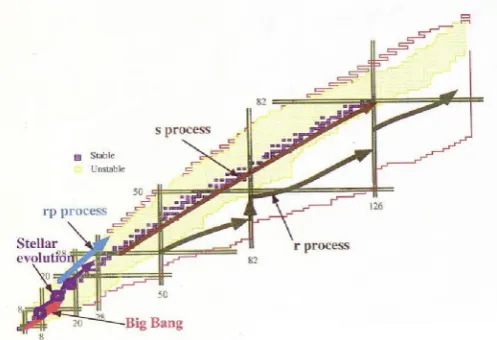
The s-process is responsible for the production of nearly 50% of the heavy elements by slow consecutive neutron capture reactions along the line of stability (figure 2). The main process produces heavy elements up to Pb-Bi region. The s-process provides one of the most pronounced signatures for testing stellar model simulations. The comparison between observed and predicted abundance distributions provides the opportunity to test the predicted density, temperature and neutron flux conditions for modeling the s-process site.
Through hydrogen and helium burning, neutrons are formed. The most important reaction is believed to be
22
Ne + 4He → 25Mg + n
As the heavier elements form in the star, the neutron production increases considerably since such reactions become more prevalent as heavier elements are involved in the reactions. The mode of production of the elements changes from that of helium captures to that of neutron captures, so that the elements from iron to bismuth (Bi) can be formed by a slow process of neutron captures, or (n, γ) reactions (see figure 2). This process can be interrupted by β-decay whenever it is faster than the next capture step.
[image:3.595.340.527.456.692.2]Such a process is known as the s-process. While the reaction probability for the capture of neutrons increases with the atomic number of the element, the relative amount of the elements in the star will decrease with increasing atomic number, because of the successive higher order of reaction. The result is the observed flattening of the abundance curve for A>100 in figure 1.
Figure 1. Relative abundance of the elements in the sunv
The formation of 104Pd from 100Ru can serve as an example of
the steps in the s-process of elements formation:
100
Ru (n, γ) 101Ru(n, γ) 102Ru(n, γ) 103Ru
β ↓ 39d
103
Rh (n, γ) 104Rh
(Stable) β ↓ 42s
104
Pd (stable)
The discovery of the element Promethium (Pm) for which the longest-lived isotope has a half-life of 18 year in a star (HR 465) in the Andromeda constellation shows that an s-process must be occurring. A possible reaction path is:
146
Nd (n, γ) 147Nd (β-, 11d) 147Pm(β-, 2.6y)
The s-process is believed to be extensive in Red Giant stars of
mass 3-8 M๏ and to last for about 1o My, a short period in the
total lifetime of a star (Prialnik, 2000).
Supernova explosions
The s-process cannot explain the formation of the elements heavier than bismuth, as the trans-bismuth elements have a number of short-lived isotopes, which prevent the formation of thorium and uranium in the amounts observed in nature. The heaviest elements are believed to be formed in supernova
explosions. For stars of an original mass > 7.5 M๏ the energy
loss through photon and especially through neutrino emission is very large. Under the development of these conditions, the elements in the core disintegrate (especially iron) releasing helium and neutrons; for example:
56
Fe + γ → 13 4He + 4n
Rapid neutron and proton captures (r- and rp-processes)
[image:4.595.40.289.567.737.2]The time-scale of stellar explosions is often significantly shorter than the lifetimes of the associated radioactive isotopes. Under these conditions capture reactions on radioactive isotopes play a significant role for nucleosynthesis and energy generation during the explosive event. The two most important nucleosynthesis processes involving short-lived radioactive isotopes are the r-process (rapid neutron capture) with the reaction path along the neutron rich side of
Figure 2. Path of nucleosynthesis at various sites. The decay properties and the capture reaction rates of unstable nuclei are
essential for understanding these pathways and thus the elemental abundances
the line of stability and the rp-process (rapid proton capture) with the reaction path along the proton-drip line at the neutron deficient side of stability (see figure 2). The experimental study of the associated capture and decay processes represents one of main motivations for the design and construction of radioactive beam facilities (see next section). The supernova stage is very short-lived with extremely intense neutron production. It provides a method whereby the barrier of the short-lived isotopes between polonium and francium is overcome and the heaviest elements synthesized. The n-capture in the r-process has been suggested to go up to Z ~100 and N ≤ 184. In the intense neutron field a considerable amount (mainly fast) of fission of the newly synthesized heavy elements probably also occurs. This partly explains the peaks at N = 50 and 82 in figure 2. Some stars are unique in that they have an unusually high abundance of fission products. Spectral lines from heavy actinides, like americium and curium have also been observed in such stars. The neutron fluxes and exposures in the s- and r-processes as compared to those in a nuclear explosion and a reactor are given in table 2.
The intensity of the neutron flux as well as the very short time preclude β-decay as a competitor to neutron capture in the r-process. This results in a different isotopic distribution of the elements for the r-process compared to that formed in the s-process. The following reaction sequence illustrates the r-process in which β-decay can occur only after the explosion has terminated and the intense neutron fluxes decreased:
100
Ru (n, γ) 101Ru(n, γ) 102Ru(n, γ) 103Ru(n, γ)104Ru(n,
γ))105Ru(n, γ)106Ru
β ↓ 39dβ ↓ 4.4 hβ ↓ 368d
103
Ru 105Rh 106Rh
(Stable) β ↓ 36 hβ ↓ 30 s
105
Pd 106Pd
(Stable) (Stable)
After completion of the r-process, 103Ru, 105Ru and 106Ru
undergo β-decay to isotopes of Rh and Pd. In this r-process,
104
Ru - 106Ru are formed; but in the s-process beginning with
100
Ru, the heaviest ruthenium isotope has A = 103. In the supernova explosion a large mass of material is ejected into interstellar space. This contributes to the higher abundance of heavy elements in cosmic rays as compared with the cosmic abundance. In fact, even uranium has been observed in cosmic rays and in our sun. Since our sun in undergoing the simplest type of hydrogen-burning cycle, it is not possible for the heavier elements (~2%) to have been synthesized by the sun. Consequently, their presence indicates that the sun has been formed as a second (or later) generation star from material that included matter ejected by an earlier supernova, or has accumulated matter from such a star. The carbon cycle stars
are likely to be second-generation stars because 12C is needed
Table 2. Comparison of conditions for n-capture processes
Radioactive Ion Beams
The production, acceleration and use of Radioactive Ion Beams (RIB) are a topic of great current interest. Possible applications for such beams can be found in nuclear astrophysics, nuclear structure physics, solid state physics, biomedical research and cancer therapy.
A few key-reactions of astrophysical interest are listed below:
1) Big Bang:
8
Li(α, n) 11B,8Li (d, n) 9Be, 6He (α, n) 9Be
2) Hot pp-chain:
7
Be (p, γ) 8B, 7Be (α, γ)11C, 8B (p, γ)9C, 8B (α, γ) 12N,
11
C(p, γ) 12N
3) Hot CNO-Cycle:
13
N (p, γ )14O, 14O (α, p)17F, 15O (α, γ) 19Ne, 19Ne (p, γ) 20Na
4) Hot NeNa-MgAl-Cycles:
20
Na (p, γ) 21Mg, 21Na (p, γ) 22Mg, 26Al (p, γ) 27Si
5) rp-Process: Reactions on the proton-rich side of the valley of stability up to Fe
region (see figure 2).
In these processes, unstable nuclei played a very important role. It can be said that if there were only stable nuclei and unstable nuclei do not exist, most elements would have not been synthesized due to the lack of reaction routes. The RIB factory will reproduce these synthesis reaction paths in the laboratory and study the origin of the elements abundance on earth and in the rest of the universe (RIKEN, 1994). The properties and reactions of unstable nuclei are important elements in the initiation and the explosion of supernovae. The generation process and internal structures of neutron stars produced after a supernova explosion will be determined from the studies of the neutron rich nuclei. Specific examples of
nuclear reactions of astrophysical interest involving
radioactive nuclei are the 15O (α, γ) 19Ne and 19Ne (p, γ) 20Na
reactions in which 19Ne plays a significant role in the hot
pp-chain and hot CNO-cycle as outlined above (NuPECC, 1993). Currently, there are two main ways to produce intense beams of radioactive, heavy ions at energies useful for nuclear astrophysics studies (Mueller, 1993). These are the Projectile Fragmentation (PF) method and the Isotope Separator On-Line (ISOL) method. In the PF method, an energetic (>50 MeV/u), stable heavy ion beam bombards a thin target. Those projectiles, which are involved in peripheral reactions with the target nuclei, can lead to fragmentation of the projectile nucleus. The fragmentation products of interest can then be selected on-line from the wide range of reaction products using electromagnetic devices. This leads to a wide range of very energetic and reasonably intense beams of short-lived and neutron rich radioactive species. The major PF laboratories in operation are GANIL in France, GSI in Germany, NSCL in USA and RIKEN in Japan.
The second approach (ISOL) involves the coupling of a primary radioisotope production accelerator to an isotope separator that is itself coupled to a post-acceleration system. In this method, typically a high-energy light ion beam is directed onto a thick, high temperature target, which allows the neutron-deficient reaction products to diffuse into an ion source. The radioactive ions are extracted and mass separated before being injected into a second accelerator. The major ISOL laboratories currently in operation are at Louvain-la-Neuve Laboratory in Belgium and ISOLDE at CERN in Switzerland. The Radioactive Ion Beam project at Louvain-la-Neuve Laboratory, Belgium, aims at the production and acceleration of radioactive nuclei in the low and medium energy range (<4.0 MeV per nucleon), which is of interest for cross section measurements of important reactions in nuclear astrophysics (Rolfs, 1989). The general layout of the facility has been described in detail elsewhere (Darquennes, 1990).
The 19Ne + 40Ca Experiment
This experiment was the first world nuclear high-resolution gamma spectroscopy of a Radioactive Ion Beam, which was performed by several European countries in April 1994 in Belgiumin order to answer some questions on the origin of some medium mass nuclei in stars (Mohammadi, 2003). Some results of this experiment were published before (Catford, 1996 and 1997). The experiment used the ISOL method to
produce a neutron-deficient 19Ne beam with the aim of
investigating the consequences of nuclear reactions with a
radioactive beam. The 19Ne decays via β+ emission to 19F with
a lifetime of 17 seconds. Using this method, beams of up to
150 ppA (9.4x 10⁸ particles per second) of 19Ne4+ were
accelerated to final beam bombarding of 70 MeV. The beam
was incident on a 1.6 mg/cm2 thick 40Ca target. A huge 511
[image:5.595.38.290.195.244.2]keV gamma energy due to annihilation of an electron-positron pair had dominated the experiment. Fortunately, the beam
Table 1. Nuclear burning stages for a star with mass m ~ 20 M๏.
Fuel Main Product Secondary Product T (109 K) Time (Yr) Main Reaction
H He 14N 0.02 107 4H→ 4He
He O, C 18O, 22Ne
S-process
0.2 106 3 4He→ 12C
12C(α, γ) 16O
C Ne, Mg Na 0.8 103 12C + 12C
Ne O, Mg Al, P 1.5 3 20Ne(γ, α) 16O
20
Ne(α, γ)24Mg
O Si, S Cl, Ar, K, Ca 2.0 0.8 16O + 16O
Si Fe Ti, V, Cr, Mn, Co, Ni 3.5 0.02 28Si(γ, α)…
pulsing of the cyclotrons, the detection system, and software programs made it possible to subtract these unwanted from the experiment off-line (Catford, 1996 and 1997). In order to compare the residual yields with a stable beam, an experiment was also performed using the isobaric stable beam on the same target with the same energy. A lot of new information was obtained from this experiment. Some interested results from astrophysical point of view is presented in figure 3, which shows a comparison of production cross
sections for products of the reactions 19Ne +
40
[image:6.595.48.286.250.425.2]Ca at beam energies of 70 MeV (Mohammadi, 2003). measured cross-sections for some medium mass nuclei Cr, Mn, Fe and Co that had been reported before that there are some anomalies for their productions in stars if we consider just stable nuclei. It indicates a clear enhancement of u radioactive beams to access nuclei far from stability.
Figure 3. Comparison of fusion-evaporation production cross sections of the reactions 19Ne + 40Ca and 19F +
energies of 70 MeV
Conclusions
Experimental nuclear astrophysics is concerned with the study and measurement of nuclear processes driving the evolution and explosion of stellar systems. The measurement of these processes by simulating stellar conditions in the laboratory are the crucial link for interpreting the wealth of observational elemental and isotopic abundance data from satellite based observatories and analysis of meteoritic inclusions through complex computer simulation of stellar evolution and stellar explosion. Two major goals have crystallized over the last decade. The first centers on the understanding of nuclear processes far off stability in the rp- and r
characterize nucleosynthesis in novae, X supernovae. The second goal focuses on understan burning through the different phases of stellar evolution, pulsing of the cyclotrons, the detection system, and software programs made it possible to subtract these unwanted events (Catford, 1996 and 1997). In order to compare the residual yields with a stable beam, an
experiment was also performed using the isobaric stable 19F
beam on the same target with the same energy. A lot of new was obtained from this experiment. Some interested results from astrophysical point of view is presented in figure 3, which shows a comparison of production
cross-Ne + 40Ca and 19F +
(Mohammadi, 2003). We sections for some medium mass nuclei Cr, Mn, Fe and Co that had been reported before that there are some anomalies for their productions in stars if we consider just stable nuclei. It indicates a clear enhancement of using radioactive beams to access nuclei far from stability.
evaporation production cross-F + 40Ca at beam
Experimental nuclear astrophysics is concerned with the study and measurement of nuclear processes driving the evolution and explosion of stellar systems. The measurement of these processes by simulating stellar conditions in the laboratory are link for interpreting the wealth of observational elemental and isotopic abundance data from satellite based observatories and analysis of meteoritic inclusions through complex computer simulation of stellar evolution and stellar s have crystallized over the last decade. The first centers on the understanding of nuclear and r-process, which characterize nucleosynthesis in novae, X-ray bursts and supernovae. The second goal focuses on understanding nuclear burning through the different phases of stellar evolution,
determining the lifespan of the stars and the onset conditions of stellar explosions. The laboratory measurement of nuclear processes in stellar explosion
radioactive beam facilities to simulate the conditions for rapid nuclear reaction processes within the split
of a stellar explosion. Radioactive beam facilities provide opportunities to probe by direct or indir
capture and decay processes of nuclei far away from stability line, which are expected to determine energy production and nucleosysnthesis in novae X-ray bursts and supernovae. These new facilities are complemented with new and rapid developments in detector technology and data acquisition techniques. The combination of new facilities and detector techniques for using Radioactive Ion Beams (RIB) has opened a new era of opportunities in experimental nuclear astrophysics to answer some questio
elements in stars.
REFERENCES
Carroll B.W., Ostlie D.A., 1996. An Introduction to Modern
Astrophysics, 1st edition, Addison
0201547309.
Catford W.N., et al, 1996. High Resolution Gamma Spectroscopy with a Radioactive Beam, Nucl. Inst. And Meth. A371,Issue 3, pp: 449
9002(95)00857-8
Catford W.N., et al, 1997. High Resolution Gamma Spectroscopy with a Radioactive Beam, Nuclear Physics
A, A616, pp: 303
9474(97)00101-2
Darquennes D., et al, 1990. Production of intense radioactive ion beams using two accelera
R804-R806.; DOI: 10.1103/PhysRevC.42.R804 http://link.aps.org/doi/10.1103/
Mohammadi S., 2003. Symmetry breaking in mirror nuclei
55
Co and 55Ni, Iranian Jo. of Phy. Research (IJPR), V3,
No. 3, pp: 71-76; URL nefullv3n3y2003p71-76.pdf
Mueller A.C. and Sherill B.M., 1993, Nucli at the Limits of Particle Stability, Ann. Rev. Nucl. Part. Sci. 43
583;
NuPECC, 1993, European Radioactive Beam Facilities. Prialnik D., 2000. An Introduction to the theory of Stellar
Structure and Evolution, 1st
Press, ISBN 052165937x
RIKEN, 1994, Radioactive Ion Beam Factory, Japan. Rolfs C., et al, 1989. “A concept f
radioactive ions for measurements in astrophysics”, CERN Report.
Wong S.S.M., 1990, Introductory Nuclear Physics Prentice- Hall Press, ISBN 0134715667
*******
determining the lifespan of the stars and the onset conditions The laboratory measurement of nuclear processes in stellar explosion requires the development of radioactive beam facilities to simulate the conditions for rapid nuclear reaction processes within the split-second time-scale of a stellar explosion. Radioactive beam facilities provide opportunities to probe by direct or indirect measurement capture and decay processes of nuclei far away from stability line, which are expected to determine energy production and ray bursts and supernovae. These new facilities are complemented with new and rapid pments in detector technology and data acquisition techniques. The combination of new facilities and detector techniques for using Radioactive Ion Beams (RIB) has opened a new era of opportunities in experimental nuclear astrophysics to answer some questions on the synthesis of the
Carroll B.W., Ostlie D.A., 1996. An Introduction to Modern edition, Addison-Wesley Press, ISBN
, 1996. High Resolution Gamma-ray Radioactive Beam, Nucl. Inst. And pp: 449-459;
DOI:10.1016/0168-, 1997. High Resolution Gamma-ray Radioactive Beam, Nuclear Physics
pp: 303-310;
DOI:10.1016/S0375-, 1990. Production of intense radioactive ion beams using two accelerators, Phys. Rev. C42, pp: 10.1103/PhysRevC.42.R804; URL: http://link.aps.org/doi/10.1103/PhysRevC.42.R804
Mohammadi S., 2003. Symmetry breaking in mirror nuclei Ni, Iranian Jo. of Phy. Research (IJPR), V3, URL: http://journals.iut.ac.ir/ijpr/ 76.pdf
Mueller A.C. and Sherill B.M., 1993, Nucli at the Limits of Ann. Rev. Nucl. Part. Sci. 43,
pp:529-Radioactive Beam Facilities. Prialnik D., 2000. An Introduction to the theory of Stellar
st
edition, Cambridge University
RIKEN, 1994, Radioactive Ion Beam Factory, Japan.
, 1989. “A concept for post-acceleration of radioactive ions for measurements in astrophysics”, CERN
Wong S.S.M., 1990, Introductory Nuclear Physics, 1st edition,