IJPSR (2014), Volume 5, Issue 9 (Research Article)
Received on 05 March 2014; received in revised form, 21 April 2014; accepted, 20 June 2014; published 01 September 2014
COMPARATIVE CNS ACTIVITIES OF CLINICALLY EMPLOYED ANTIHISTAMINES (H1
ANTAGONIST)
Bhavesh M. Vyas * 1, Adarsh J. Singh 1, Abdulkadir S. Dhattiwala 2, Sabera M. Mansuri 3 and Varsha J.
Patel 2
Department of Pharmacology 1, AMC-MET Medical College, Ahmedabad - 380008, Gujarat, India.
Department of Pharmacology 2, Smt. NHL Municipal Medical College, Ahmedabad - 380006, Gujarat,
India.
Department of Pharmacology 3, Karnavati Dental College, Ahmedabad - 382422, Gujarat, India.
ABSTRACT: Aim: H1 Antihistamines are classified into the first generation and second generation agents. The main differences between the first and second generations of drugs are their propensity to cause central nervous system (CNS) side effects. Therefore, the present study was aimed to analyze the effects of different H1 antihistamines (first and second generation) on CNS using different animal experimental models. Materials and Methods: H1 antihistamines such as pheniramine maleate (3 mg/kg, 6 mg/kg), cetirizine (0.6 mg/kg, 1.2 mg/kg), levocetirizine (0.6 mg/kg, 1.2 mg/kg), loratadine (1 mg/kg, 2 mg/kg) and desloratadine (0.6 mg/kg, 1.2 mg/kg) are evaluated and compared for their effects on CNS using experimental animal model (Pentobarbitone sleeping time, spontaneous motor activity, motor coordination) in Swiss albino mice. Results and Discussion: Desloratadine (0.6 mg/kg, 1.2 mg/kg) and loratadine (1 mg/kg, 2 mg/kg) did not produce significant (P<0.05) effect on sleeping time when compared to control. At 120 min time interval after treatment with cetirizine (1.2 mg/kg) and levocetirizine (1.2 mg/kg) was shown a reduction in locomotor activity and remaining three drugs such as pheniramine (6 mg/kg), loratadine (2 mg/kg) and desloratadine did produce any effect on locomotor activity. Treatment with a higher dose of pheniramine (6 mg/kg) and cetirizine (1.2 mg/kg) was shown significant (P<0.05) motor coordination while other drugs did not induce any motor in-coordination. First generation antihistamines were shown a significant effect on CNS activity at low and high dose while only some second-generation antihistamines showed a significant effect on CNS at the high dose. Conclusion: Numerous well-performed, sensitive measures of psychomotor and cognitive performances are needed to study to compare the effect of the first generation and second generation antihistamines on CNS to avoid serious impairment of CNS function.
INTRODUCTION: Antihistamines are broadly
divided into first and second generation drugs
based on their structural characteristics,
pharmacokinetic, and adverse effects.
QUICK RESPONSE CODE
DOI:
10.13040/IJPSR.0975-8232.5(9).3790-95
This article can be accessed online on www.ijpsr.com
DOI link: http://dx.doi.org/10.13040/IJPSR.0975-8232.5(9).3790-95
The effects of antihistamines on the central nervous system are determined by their capability to cross the blood-brain barrier and capacity to bind with
the H1 receptor. The capability of drugs to cross
blood-brain barrier depends on the lipophilic nature of the drug entity and its affinity towards P
glycoprotein 1.
First generation drugs penetrate blood-brain barrier readily due to their lipophilicity/solubility ratios, relatively low molecular weight, and for some, lack of recognition by the P-glycoprotein reflux pump
Keywords:
Antihistamines, CNS (Central nervous system),
Pentobarbitone sleeping time, Spontaneous motor activity,
Motor co-ordination Correspondence to Author: Bhavesh M. Vyas
M.D., Pharmacology, Assistant Professor,
Department of Pharmacology, AMC-MET Medical College, Ahmedabad - 380008, Gujarat, India.
expressed on the luminal surfaces of endothelial
cells in the cerebral vasculature 2.
Second generation drugs are highly specific for histamine receptors. They penetrate poorly into the CNS due to their lipophilic nature, relatively high molecular weight, or recognition by the P-glycoprotein efflux pump expressed on the luminal surfaces of endothelial cells in the cerebral vasculature. Though second-generation drugs penetrate blood brain barrier to lesser extent but many of them have been found to produce dose
related impairment of CNS functions 3, 4.
Epidemiologic studies have been done to establish the relationship between increased incidence of automobile accidents and the administration of antihistamines. The adverse effects of
first-generation H1 antihistamines are mainly on the
CNS, including impaired driving performance, drowsiness, lassitude, fatigue, and dizziness. Although the new-generation antihistamines, do not exert serious CNS effects, a small number of individuals may experience sedation with these drugs 5, 6.
Therefore, the present study was aimed to analyze the effects of different antihistamines (first and second generation) on the central nervous system using different animal experimental models.
MATERIALS AND METHODS:
Animal: Swiss albino mice weighing 25-30 gm of either sex were procured from the departmental animal house for experimentation. Animals were divided into groups (n=8) and housed in poly-acrylic cages under standard laboratory conditions (temperature 25 ± 2 ºC and dark-light cycle 14-10 hrs) with an allowance of free access to standard dry pellet diet (Hindustan Lever, Kolkata, India) and water ad libitum. The animals were transferred to the laboratory at least one hour before experimentation. The experiments were performed during day time (08.00–16.00 h). The animals were cared for and maintained by CPCSEA guidelines.
Drugs and Other Chemicals: The pure form of
powdered pheniramine maleate, cetirizine,
levocetirizine, loratadine, and desloratadine were obtained from Cadila Pharmaceutical Ltd., India. Pentobarbitone Sodium (standard drug) was obtained from Ind-Swift Pvt. Ltd., India. A tween
80 (used as solvent and vehicle) was obtained from ACS Chemical Ltd, Ahmedabad, India. All other chemicals used in the experiments were of analytical grade.
Preparation of Drug and Mode of Treatment:
The treatment drugs such as loratadine and desloratadine were suspended 1% Tween 80, and all other drugs were suspended in Sterile Physiological Saline (SPS) containing 0.5% Carboxy Methyl Cellulose (CMC). All animals
were treated via the intraperitoneal route of
administration. In the present study, we have taken one control group as tween 80 is impermeable so it cannot alter the activity of the central nerves
system (CNS) 7.
Treatment Schedule: The animals were divided into the following groups (n=8)
Group I: The animals of this group received 0.5 ml/kg, 1% Tween 80 suspended in SPS i.p.
Group II: The animals of this group received Pheniramine (3 mg/kg).
Group III: The animals of this group received Pheniramine (6 mg/kg).
Group IV: The animals of this group received Cetirizine (0.6 mg/kg).
Group V: The animals of this group received Cetirizine (1.2 mg/kg).
Group VI: The animals of this group received Levocetirizine (0.6 mg/kg).
Group VII: The animals of this group received Levocetirizine (1.2 mg/kg).
Group VIII: The animals of this group received Loratadine (1 mg/kg).
Group IX: The animals of this group received Loratadine (2 mg/kg).
Group X: The animals of this group received Desloratadine (0.6 mg/kg).
Group XI: The animals of this group received Desloratadine (1.2 mg/kg).
Pentobarbitone Sleeping Time: Pentobarbitone Sodium (30 mg/kg, i.p.) was injected 30 minutes after administration of test drug and vehicle in all groups for the screening of centrally acting
recovery of the righting reflex was noted and taken as sleeping time. This reflex was considered positive when the animal placed on its side recovers from this position within one minute. It was considered lost when the recovery requires a longer period. This time has been expressed in min. Sleeping time was expressed as Mean ± SEM.
Spontaneous Motor Activity: Spontaneous motor activity was measured by Actophotometer (Techno lab. Lucknow). The actophotometer is an instrument designed for registering walking and running movement of mice by recording the
number of times; they interrupt a beam of light 10.
The instrument consists of a chamber of 30 × 30 × 24 cm in size with a soundproof lid on its top. The floor of the chamber is covered by six photo cell beams, and each time the animal crosses the beam, it is counted and shown on the LCD unit. Thirty minutes after administration of test drug and vehicle i.p., the activity was measured for each group by placing them in actophotometer for 10 minutes at 30 min interval for 120 min (2 h).
Motor Co-Ordination: Skeletal muscle relaxation was induced by a test compound could be evaluated by testing the ability of mice or rats to remain on a
rotating rod 11. For this purpose, a group of mice
was trained to remain on the rotarod for 3 min at 25 r.p.m. The animals were discarded and replaced if they failed to do so. Ninety animals were considered and trained on rotarod in eleven groups (n=8). On next day both vehicle or test compound was introduced, and the ability of animals to remain on the rotarod was assessed before and 30 minutes after i.p. administration. The falloff time from the rotarod was noted for each animal during the scheduled time (3 min) and was compared with the control group.
Statistical Analysis: All the values were expressed as mean ± SEM or mean ± SD. Statistical analysis was carried out using SAS 9.1 version. Statistical significance of the difference between two means was assessed by one-way ANOVA followed by
Dunnets’ Test. A probability level of P<0.05 was
considered significant.
RESULT:
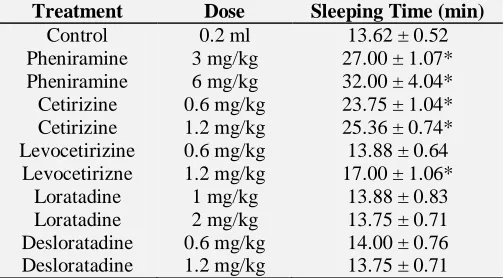
Pentobarbitone Induced Sleeping Time: Results of present study showed lower dose treatment with
pheniramine maleate (3 mg/kg) and cetirizine (0.6
mg/kg) significantly (P<0.05) potentiated sleeping
time while lower dose treatments with
levocetirizine (0.6 mg/kg), loratadine (1 mg/kg) and desloratadine (0.6 mg/kg) had no significant
effect on sleeping time Table 1. Higher dose
treatment with pheniramine maleate (6 mg/kg), levocetirizine (1.2 mg/kg) and cetirizine (1.2 mg/kg
) were significantly (P<0.05) potentiated sleeping
time whereas higher dose of loratadine (2 mg/kg) and desloratadine (1.2 mg /kg) had not shown significant effect on sleeping time when compared
to control Table 1.
TABLE 1: EFFECT OF ANTIHISTAMINES ON PENTOBARBITONE SLEEPING TIME IN MICE (N=8)
Treatment Dose Sleeping Time (min)
Control 0.2 ml 13.62 ± 0.52 Pheniramine 3 mg/kg 27.00 ± 1.07* Pheniramine 6 mg/kg 32.00 ± 4.04* Cetirizine 0.6 mg/kg 23.75 ± 1.04* Cetirizine 1.2 mg/kg 25.36 ± 0.74* Levocetirizine 0.6 mg/kg 13.88 ± 0.64
Levocetirizne 1.2 mg/kg 17.00 ± 1.06* Loratadine 1 mg/kg 13.88 ± 0.83 Loratadine 2 mg/kg 13.75 ± 0.71 Desloratadine 0.6 mg/kg 14.00 ± 0.76 Desloratadine 1.2 mg/kg 13.75 ± 0.71 Data are expressed in minutes as the Mean ± SD, n=8; *p < 0.05 & p < 0.01 when compared to control group
Spontaneous Motor Activity: Spontaneous motor activity assessment was done at different time
intervals, i.e. at 30, 60, 90, and 120 min after
administration of drug using rotarod actophoto-meter for ten minutes. At first 30 min assessment
showed no significant (P<0.05) reduction in
locomotors activity with treatment of lower dose of pheniramine maleate (3 mg/kg), cetirizine (0.6 mg/kg), levocetirizine (0.6 mg/kg), loratadine (1 mg/kg) and desloratadine (0.6 mg/kg). At 60 min three out of five drugs such as pheniramine (3 mg/kg), cetirizine (0.6 mg/kg) and levocetirizine
(0.6 mg/kg) were shown significant (P<0.05)
reduction in locomotor activity when compared to
control Table 2. At 90 minutes loratadine (1
mg/kg), pheniramine (3 mg/kg), cetirizine (0.6 mg/kg) and levocetirizine (0.6 mg/kg) also showed
significant (P<0.05) reduction in locomotors count
[image:3.612.314.566.268.407.2]Locomotor count assessed at 30 min was shown no significant effect on counts with any of the drugs at a higher dose. At 60 min interval pheniramine (6 mg/kg), cetirizine (0.6 mg/kg) and levocetirizine
(0.6 mg/kg) were shown significant (P<0.05)
reduction in locomotor count when compared to control. Loratadine (2 mg/kg) was shown a significant reduction in the count at 90 min and a similar trend was noted for three drugs such as
pheniramine (6 mg/kg), cetirizine (1.2 mg/kg) and levocetirizine (1.2 mg/kg). At 120 min time interval cetirizine (1.2 mg/kg) and levocetirizine (1.2 mg/kg) showed a reduction in locomotor activity and remaining three drugs such as pheniramine (6 mg/kg), loratadine (2 mg/kg) and desloratadine did not produce any effect on
[image:4.612.47.569.190.341.2]locomotor activity Table 2.
TABLE 2: EFFECT OF ANTIHISTAMINES ON SPONTANEOUS LOCOMOTOR ACTIVITY IN MICE
Treatment Dose 30 min 60 min 90 min 120 min
Control 0.2 ml 216.25 ± 139.39 153.50 ± 60.85 149.50 ± 53.94 144.75 ± 55.36 Pheniramine 3 mg/kg 108.50 ± 5.32 71.00 ± 6.68* 73.50 ± 6.03* 74.50 ± 3.56 Pheniramine 6 mg/kg 195.00 ± 7.39 94.25 ± 5.74* 149.50 ± 53.94* 100.00 ± 5.72
Cetirizine 0.6 mg/kg 110.75 ± 9.22 73.25 ± 4.03* 81.00 ± 4.76* 77.00 ± 3.56 Cetirizine 1.2 mg/kg 131.00 ± 28.40 76.50 ± 9.33* 75.75 ± 7.37* 73.75 ± 8.22* Levocetirizine 0.6 mg/kg 111.50 ± 9.47 77.50 ± 7.42* 74.25 ± 7.09* 244.25 ± 342.61 Levocetirizine 1.2 mg/kg 113.75 ± 5.74 68.25 ±5.12* 62.25 ± 2.87* 54.50 ± 15.67*
Loratadine 1 mg/kg 114.00 ± 35.24 111.00 ± 40.78 90.75 ± 33.09* 101.25 ± 32.94 Loratadine 2 mg/kg 111.00 ± 26.44 103.75 ± 26.09 98.25 ± 24.76* 102.75 ± 23.47 Desloratadine 0.6 mg/kg 124.25 ± 20.11 114.00 ± 20.54 118.75 ± 21.61 112.50 ± 19.21 Desloratadine 1.2 mg/kg 122.50 ± 10.47 119.75 ± 10.69 118.75 ± 4.35 114.75 ± 5.91 Data are expressed as activity counts for 10 minutes (Mean ± SEM; n=8) at different time intervals (minutes) after administration of the drug. One way ANOVA followed by Dunnet’s test was used for statistical analysis and *p < 0.05 & p < 0.01 when compared to the control group.
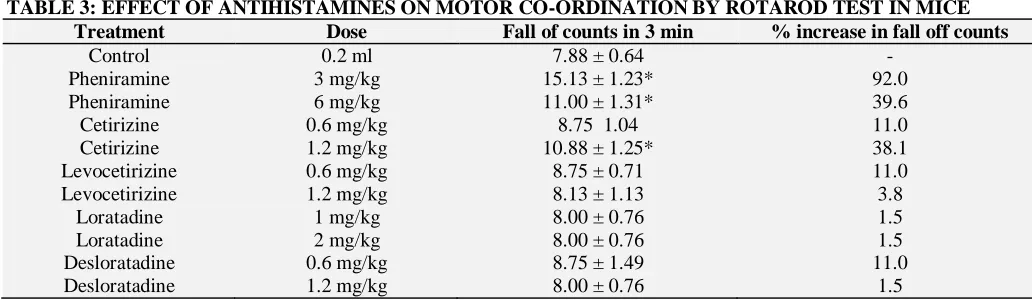
Motor Coordination: The animals treated with different antihistamines (lower and higher dose) were tested on a rotating rod for 3 min at 25 r.p.m to evaluate motor coordination. Only pheniramine at a lower dose (3 mg/kg) was shown significant
(P<0.05) effect on motor coordination while the
remaining drug did not affect motor coordination
when compared to control Table 3. On treatment
with higher dose only pheniramine (6 mg/kg) and
cetirizine (1.2 mg/kg) shown significant (P<0.05)
effect on motor coordination while other drugs did not induce any motor in-coordination when
compared to control Table 3.
TABLE 3: EFFECT OF ANTIHISTAMINES ON MOTOR CO-ORDINATION BY ROTAROD TEST IN MICE
Treatment Dose Fall of counts in 3 min % increase in fall off counts
Control 0.2 ml 7.88 ± 0.64 -
Pheniramine 3 mg/kg 15.13 ± 1.23* 92.0
Pheniramine 6 mg/kg 11.00 ± 1.31* 39.6
Cetirizine 0.6 mg/kg 8.75 1.04 11.0
Cetirizine 1.2 mg/kg 10.88 ± 1.25* 38.1
Levocetirizine 0.6 mg/kg 8.75 ± 0.71 11.0
Levocetirizine 1.2 mg/kg 8.13 ± 1.13 3.8
Loratadine 1 mg/kg 8.00 ± 0.76 1.5
Loratadine 2 mg/kg 8.00 ± 0.76 1.5
Desloratadine 0.6 mg/kg 8.75 ± 1.49 11.0
Desloratadine 1.2 mg/kg 8.00 ± 0.76 1.5
Data are expressed in minutes as the Mean ± SD and percentage, n=8; *p < 0.05 when compared to the control group DISCUSSION: Antihistamines are among the
most widely used medication in the world for the symptomatic treatment of allergic disorder such as chronic urticaria, various skin allergy, and perennial allergic rhinitis. The histamine exerts some effect on CNS, which includes a cycle of
sleep and waking, thermal regulation, food intake, aggressive and emotion behavior, memory,
learning, and locomotion 12. First generation
[image:4.612.45.561.494.644.2]action on CNS. The second generation of antihistamine penetrate poorly in CNS and thus does not produce sedating effects. In previous studies, it’s reported that the cetirizine may be slightly more sedating then placebo even at recommended doses. Major therapeutic effects of antihistamines are seen in the suppression of the early response to allergen challenge in the
conjunctiva, nose, skin, and lower airway 13.
The results of our study are congruent with Patel et
al., (2000) who reported that the cetirizine (2
mg/kg & 4 mg/kg dose) treated (i.p) rats showed significant dose dependent increase in sleeping time. Cetirizine (0.6 mg/kg & 1.2 mg/kg) potentiated sleeping time in this paradigm. McLeod RL in 1998 has reported sedating activity of
cetrazine at 30 mg/kg p.o in mice 14. I.C.V.
treatment of cetirizine (0.03-0.3 microg/mouse)
dose-dependently increased the duration of
pentobarbitone induced loss of righting reflex in
both nondiabetic and diabetic mice 15.
It has been reviewed in experimental as well as in clinical studies the first generation antihistamines are associated with CNS side effects like sedation and the secondary effects like psychomotor
impairment. Although second-generation H1
antihistamine claim to be “non-sedating,” some agents still cause CNS side effects, though findings are conflicting with one and another.
The present experimental study was undertaken in mice to evaluate the CNS effects of first and
second generation H1 antihistamine by subjecting
animals to i.p. administration of Pheniramine maleate, Cetirizine, Levocetirizine, Loratadine, and Desloratadine (at the low and the high doses, the ratio being 1:2). The CNS effects were evaluated by evaluating CNS parameter like Pentobarbitone induced sleeping time, spontaneous motor activity,
and motor coordination, using appropriate
statistical methods. Only Pheniramine and Cetirizine potentiated sleeping time at both lower and higher dose while levocetirizine at higher dose potentiated sleeping time. Pheniramine at higher and lower dose induced motor incoordination and
cetirizine at higher dose induced motor
incoordination significantly. Desloratadine was free from CNS effect in all three CNS parameters in both at lower and at a higher dose. No correlation
between the lower and higher dose of any antihistamine drugs was found, and the intensity to produce CNS effect could be established following statistical analysis 16, 17.
Some results correlate with the findings of the earlier research work as reviewed herein. Further species difference is likely to influence the results as the study has been carried out in experimental animals. Therefore these observations cannot be made directly applicable to clinical cases. With the
introduction of more and more novel
antihistamines, the need for practical guidelines on switching medications is likely to become more acute. Switching between drugs with a different mode of action, which in turn are associated with different dosing requirements, side effect profiles and requires careful handling. The principle of individualization should be illuminated.
CONCLUSION: In the light of the reported
serious CNS side effects of H1 antihistamines drug
usage and the results obtained herein, it is concluded that, initial choice should be made based on particular basis such as patient’s medical and socioeconomic status, and the clinicians should be proactive about warning their patients about the potential CNS side effects such as sedation,
psychomotor impairment, and motor
incoordination, etc.
ACKNOWLEDGEMENT: The authors would
like to thanks Mr. Prafulkumar Talaviya (Medical writer, DiaCare, Ahmedabad, India) for assistance in the statistical analysis and preparation of this manuscript.
CONFLICT OF INTEREST: Nil
REFERENCES:
1. Simons FE: Advances in H1-Antihistamines. The New England Journal of Medicine 2004; 351: 2203-17.
2. Timmerman H: Factors involved in the absence of sedative effects by second-generation antihistamines. Allergy 2000; 55(60): 5-10.
3. Hindmarch I and Shamsi Z: Antihistamines. Models to assess sedative properties, assessment of sedation, safety and other side-effects. Clinical & Experimental Allergy 1999; 29(3): 1333-142.
4. Simons FER: H1 receptor antagonists: safety issues. Annals of Allergy, Asthma & Immunology 1999; 83: 481-88. 5. Cookson J, Katona C and Taylor J: Use of Drugs in
6. Starmer G: Antihistamines and highway safety. Accident Analysis & Prevention 1985; 17: 311-17.
7. Sun W: Specific role of polysorbate 80 coating on the targeting of nanoparticles to the brain. Biomaterials 2004; 25: 3065-71.
8. Sethy VH and Sheth UK: Potentiation of barbital sodium hypnosis as a screening method for central nervous system depressants. Indian Journal of Medical Sciences 1967; 21: 32-37.
9. Kopera J and Armitage AK: Comparison of some pharmacological properties of chlorpromazine, promethazine and pethidine. British Journal of Pharmacology 1954; 9: 392-95.
10. Dews PB: The measurement of the influence of the drug on voluntary activity in mice. British Journal of Pharmacology 1953; 8: 46-48.
11. Dunham NW and Miya TS: A note on a simple apparatus for detecting neurological deficits in rats and mice. Journal of American Pharmacists Association 1957; 46: 208-09. 12. Montoro J: Effect of H1 antihistamines upon the central
nervous system. J. Investig. Journal of Investigational Allergology and Clinical Immunology 2006; 1(16): 24-28.
13. Chishty M, Reichel A and Siva J: Affinity for the P-glycoprotein efflux pump at the blood-brain barrier may explain the lack of CNS side-effects of modern antihistamines. Journal of Drug Targeting. 2001; 9: 223-28. 14. McLeod RL, Mingo G, O’Reilly S, Ruck LA, Bolser DC and
Hey JA: Antitussive action of antihistamines in independent of sedative and ventilation activity in the guinea pig. Pharmacology 1998; 57(2): 57-64.
15. Kamei J, Hirano S, Miyata S, Saitoh A and Onodera K: Effects of first and second generation histamine H1 receptor antagonists on the pentobarbital-induced loss of the righting reflex in streptozotocin-induced diabetic mice. Journal of Pharmacological Sciences 2005; 97(2): 266-72.
16. Devillier P, Roche N and Faisy C: Clinical pharmacokinetics and pharmacodynamics of desloratadine, fexofenadine and levocetirizine: a comparative review. Clinical Pharmacokinetics 2008; 47: 217-30.
17. Van Cauwenberge P and Juniper EF: Comparison of the efficacy, safety and quality of life provided by fexofenadine hydrochloride 120 mg, loratadine 10mg, and placebo administered once daily for the treatment of seasonal allergic rhinitis. Clinical & Experimental Allergy 2000; 30: 891-99.
All © 2013 are reserved by International Journal of Pharmaceutical Sciences and Research. This Journal licensed under a Creative Commons Attribution-NonCommercial-ShareAlike 3.0 Unported License.
This article can be downloaded to ANDROID OS based mobile. Scan QR Code using Code/Bar Scanner from your mobile. (Scanners are available on Google Playstore)
How to cite this article: