ScholarWorks @ Georgia State University
ScholarWorks @ Georgia State University
Philosophy Theses Department of Philosophy
Summer 4-26-2010
Autism, Social Comprehension, and Cognitive Impenetrability
Autism, Social Comprehension, and Cognitive Impenetrability
Matthew E. Hudgens-HaneyGeorgia State University
Follow this and additional works at: https://scholarworks.gsu.edu/philosophy_theses
Part of the Philosophy Commons
Recommended Citation Recommended Citation
Hudgens-Haney, Matthew E., "Autism, Social Comprehension, and Cognitive Impenetrability." Thesis, Georgia State University, 2010.
https://scholarworks.gsu.edu/philosophy_theses/75
by
MATTHEW ELDRIDGE HUDGENS-HANEY
Under the Direction of George Graham
ABSTRACT
Autism is a neurodevelopmental disorder featuring severe social and communicative deficits. Cognitive impenetrability is the inability of systems to be affected by an individual’s beliefs and desires. Individuals with autism have delayed performance on “mindreading” tasks. Mindreading is the interpretation of others which enables successful social interactions. This task performance is not correlated with “everyday” social function in autism. These deficits are in contrast with general intelligence and reasoning abilities within the normal range, resistant to cognitive behavioral training, and partially attributable to atypical social predispositions. This suggests individuals with autism perform social tasks differently than typicals. I argue that this mindreading deficit is cognitively impenetrable, then position this deficit within a theoretical framework, enactivism, emphasizing cognitive embodiment and inseparability of social
comprehension and action. This framework helps explain the cognitive impenetrability of these social deficits by “locating” failure to penetrate in individuals’ failure to properly interact with the environment.
AUTISM, SOCIAL COMPREHENSION, AND COGNITIVE IMPENETRABILITY
by
MATTHEW ELDRIDGE HUDGENS-HANEY
A Thesis Submitted in Partial Fulfillment of the Requirements for the Degree of
Master of Arts
in the College of Arts and Sciences
Georgia State University
Copyright by
by
MATTHEW ELDRIDGE HUDGENS-HANEY
Committee Chair: George Graham
Committee: Eddy Nahmias
Şeyda Özçalışkan
Electronic Version Approved:
Office of Graduate Studies
College of Arts and Sciences
Georgia State University
Here is my secret. It is very simple. It is only with the heart that one can see rightly; What is
essential is invisible to the eye.
ACKNOWLEDGEMENTS
I would like to thank George Graham for all his help over the past two years, for
challenging notions of what a philosopher should be, and, perhaps most importantly, for always
asking questions I could neither expect nor answer. Working with him has been both a pleasure
and an honor. I would also like to thank my other committee members, Şeyda Özçalışkan and
Eddy Nahmias, for their helpful comments and discussion on this and other topics.
My thesis would not be what it is without the help of my classmates. I would especially
like to thank Paul Pfeilshiefter, whose generous advice throughout this project has been
indispensible. Conversations with (and unrelenting questions from) Ryan Born, Ryan DeChant,
Dylan Murray, and Leroy Lamar have contributed to my thinking in this project, as well as my
enjoyment at Georgia State. Thank you.
I would also like to thank Colleen Kelley and Mike Kaschak. Although our conversations
were brief, they came at a pivotal point in my writing.
Thanks are due to the Philosophy Department at Georgia State University, which
provided resources to make this project possible.
Finally, I would like to thank my wonderful wife Julie, for endless patience, unceasing
TABLE OF CONTENTS
ACKNOWLEDGEMENTS ... v
LIST OF FIGURES ... vii
1 Introduction ... 1
2 Cognitive (Im)Penetrability ... 5
3 Autism ... 11
3.1 Mindreading and Deficits in Autism ... 14
3.2 Topologies of Salience: What Are We Looking For? ... 19
3.3 Topologies of Salience: What Are We Looking At? ... 21
3.3.1 “Seeing” Versus “Recognizing” ... 23
4 This is a substantive claim: Not all cognitive deficits are impenetrable ... 28
5 Enactive Social Cognition and Autism ... 33
5.1 Enactive Social Cognition ... 36
5.2 Enactive Social Cognition: Clarifying the Mindreading Deficits in Autism ... 41
6 Conclusions ... 46
LIST OF FIGURES
1 Introduction
Victims of autism suffer from a variety of cognitive, social, and sensory deficits. One of
the core deficit areas is social communication, in which individuals with autism seem to exhibit
an absence of basic comprehension of other people. Individuals with autism appear to be
disconnected from the social world such that, often, we do not understand their behavior and
they do not understand ours. The disconnect goes further than this misunderstanding, however.
Autism researchers and advocates often have a difficult time working with their students and/or
patients with autism, saying, for example, “They just don’t see me.” One researcher tells a (not
unfamiliar) story of a young girl with autism climbing up his body, no different than she would a
bookshelf, to reach something too high for her (Bloom, 2004). It is in this sense that individuals
with autism are sometimes said to be “mindblind,” exhibiting a failure in the typical capacity for
“mindreading”. Intervention programs, and studies of them, indicate that it is very difficult to
develop social skills in individuals with autism. This is true despite these individuals showing
proficiency in non-social tasks and skills that are seemingly quite similar. Even for those
individuals who can complete specific social tasks, e.g. interpreting the intentions of others or
labeling facial emotions, it is not clear that they are doing the task in the same way. Perhaps
autism deficits in the capacity for mindreading are not “cognitively penetrable,” in that they
appear to be unresponsive to the thoughts and beliefs of the individuals plagued by these deficits.
In this thesis, I will look at deficits in social understanding in autism. For much of what
follows, I will focus on problems related specifically to deficits in mindreading, the
interpretation of the thoughts and behavior of others. Mindreading, in some variation or another,
thousands of books and articles in such diverse fields as developmental, cognitive, and social
psychology, philosophy, both basic and applied neuroscience, artificial intelligence and robotics,
game theory, and beyond. Mindreading,1 as it has traditionally been defined, is the capacity to
attribute mental states to oneself and others and to understand that others have mental states that
are not the same as one’s own. The traditional view says, roughly, that we describe people by
reference to their beliefs, desires, and intentions and that the primary purpose of this rests in the
attempt to explain and predict their actions. This view, painted for now in very broad strokes,
will be kept in the background for the first part of this thesis. The view should not be allowed to
completely fade away, however, as much will be done in reference to it in the end.
For now, I mean to use the term ‘mindreading’ in a very broad sense, as whatever it is
that we are doing when we “read the minds” of others, the general types of capacities discussed
by theorists of various persuasions. Most of the time, people know and understand what those
around them are doing. If I were to walk into a classroom, for example, and one of my students
was upset, I would likely not have to ask her whether she was upset. I can figure that out on my
own. With minimal probing, I could, at the least, learn whether she was upset with me or with
something else; and if she was upset with me, then I would likely be able to quickly decipher,
based on our shared experiences, the reason for her distress and be able to predict, with some
level of accuracy, her future behaviors (e.g. whether she will politely approach me after class, or
if the situation warrants, at least in her mind, a heated discussion involving her classmates).
Likely, the student would also “read my mind”, herself knowing that I would know roughly what
she was thinking. All this before a single word is spoken. Köhler has a particularly illustrative
example about following other’s gaze:
1
If my attention is attracted by a strange object, a snake for instance, I feel directed toward it and at the same time a feeling of tension is experienced. A friend, even if he has not recognized the snake, will see me and especially my face and eyes directed toward it; in the tension of my face he will have a visual picture of my inner tension, as in its direction he has a direct picture of the direction which I experience. (Köhler, 1929, p. 250f)
These examples are meant to illustrate the special sense in which the term ‘mindreading’ will be
used. It is the ability to interpret (or understand or grasp) other people in such a manner that
facilitates successful social interactions with them. Individuals with autism have problems with
this. The mindreading deficits in individuals with autism represent a significant breakdown in
social comprehension. Through the study of these deficits, the understanding of autism is
increased and would ideally provide a path to treatment. Certainly, many a scientific talk begins
with a defense of seemingly abstract research by explaining the implications for treatment. In
addition, the study of these deficits can contribute to an understanding of social interactions more
generally. Discovering exactly what it is that individuals with autism cannot do aids in
understanding just what it is that typically developing individuals are doing, which, in turn, can
contribute back to a better understanding of autism.
I will use a particular model of social understanding to help explain the sort of failure in
mindreading exhibited in autism. Roughly, it could be said that our dealings with the social
world has two parts. The first part involves interpretation of the actions and behavior of others,
i.e. knowing what it is that other people are thinking, doing, or feeling. The second part is about
what role this interpretation plays, or should play, in appropriate social actions. The model
considered below, enactivism, emphasizes the inseparability of these two aspects of our dealings
with others and the world. On this view, the very idea of comprehension is action-oriented.
Likewise, social comprehension is (social) action-oriented, interaction-oriented. I hope to show
deficits in autism. Many aspects of autism are brought together, and made sense of, through
conceiving of proper social comprehension as action oriented. If proper mindreading capacities
entail, in some sense, proper action, then a wide variety of the characteristics of autism are
explained. If social cognition is essentially action-oriented, then this provides insight into the
cognitive impenetrability of mindreading deficits in autism.
In sum, I will argue for three main claims in this thesis. I look at a variety of data in
autism to argue that (1) the mindreading deficit cannot be properly understood outside of the
entire array of social deficits in autism.It is often said that individuals with autism live “in their
own world.” I argue that this metaphor is quite literal. Individuals with autism do not search out
the same objects in the environment, so, as infants, they do not attend to the same things. For
example, they do not look at faces as much as typical developing infants. They do not orient to
the motion or sounds of other humans. By not attending to social cues, these infants are not
exposed to the relevant social information. They are, in a sense, not exposed to the social world.
The result is a cascading effect, in which their brains don’t develop typical methods of
processing social stimuli. Mindreading is just one of a wide range of social deficits to be
explained these early processing problems. I use claim (1) to support two points: (2) The
mindreading deficit in autism is not cognitively penetrable. Here, the basic idea is that there is
massive developmental damage done so that the deficit becomes cognitively impenetrable before
the subject is able to penetrate it cognitively. I will also argue that (3) positioning the deficit
within an enactivist framework helps explain the cognitive impenetrability of these social deficits
by “locating” the failure to penetrate in a failure to properly interact with the environment.2
2
2 Cognitive (Im)Penetrability
Ever since Fodor popularized the use of the term module in cognitive science (1983),
much philosophical discussion has taken place on whether, and to what extent, processes of the
human brain may be cognitively impenetrable (see e.g. Prinz, 2006; Pylyshyn, 1984). Cognitive
impenetrability is a special case, a subtype, of what Fodor calls informational encapsulation,
where encapsulation is a restriction on the type of input available to a system. A system is
informationally encapsulated when it only has access to a specific subset of the information
potentially relevant to the task at hand; the system is unable to reference information stored
outside of itself (2009).3 For example, consider the following:
A parser for [a language] L contains a grammar of L. What it does when it does its thing is: it infers from certain acoustic properties of a token to a characterization of certain of the distal causes of the token (e.g., to the speaker's intention that the utterance should be a token of a certain linguistic type). Premises of this inference can include whatever
information about the acoustics of the token the mechanisms of sensory transduction provide, whatever information about the linguistic types in L the internally represented grammar provides, and nothing else. (Fodor, 1990, pp. 245-246)
In other words, a language parser may only have access to the language lexicon but not to
expectations about topics of conversation. In this case, words would be distinguished from
non-words and ambiguities settled based on the meanings of individual non-words and their relations to
one another. The parser may not be as helpful, however, in making sense of metaphorical
language or stream of consciousness writing (e.g. Morrison, 1987). In this sense, cognitive
impenetrability is the encapsulation of a cognitive faculty “relative to information stored in
central memory, paradigmatically in the form of beliefs and utilities” (Robbins, 2009). Fodor
3
Cognitive penetrability, flow of information into a system, should be understood as distinct from either
says that a system is cognitively penetrable if it is “importantly affected by the subject’s belief
about context, or his background information, or his utilities” (Fodor, 1983, p. 73).4 He also says
that “[t]he penetrability of a system is, by definition, its susceptibility to top-down effects at
stages prior to its production of output” (Fodor, 1983, p. 74).
So, a cognitive system or faculty is cognitively impenetrable when the faculty cannot be
importantly affected by the subject’s attitudes: beliefs, background knowledge, or utilities. If a
particular system is cognitively impenetrable, then the information available to that system may
be, as Fodor says: “considerably less than the organism may know” (Fodor, 1983, p. 69). To be
clear, attitudes penetrate faculties. Cognitive faculties are (potentially) penetrated by attitudes. It
is the faculties, capacities, or deficits that are cognitively (im)penetrable with respect to attitudes.
The examples most effective at illustrating the concept of cognitive impenetrability are likely
visual illusions. In these cases, an illusion persists despite viewers’ knowledge regarding the
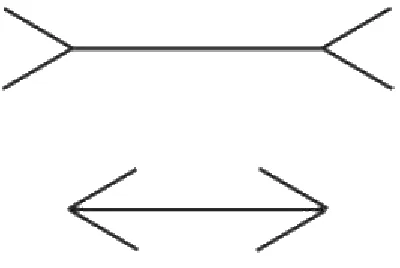
nature of the image. In the Müller-Lyer illusion, e.g., the two horizontal lines appear to be of
[image:15.612.116.316.460.594.2]unequal length (see Figure 2.1, below).
Figure 2.1: The Müller-Lyer Illusion (image from Robins, 2009)
4
The illusions persists even after viewers have been told, or even measures for themselves, that
the two lines are equally long. Although it may affect the way one thinks about the image,
knowing that what is seen is, in some sense, “not real”, does not affect the way that it is seen. In
other words, being aware of a conflict between the subjective experience of the image and
objective facts about it does not change the subjective experience.5
It was said above that cognitive faculties, capacities, or, importantly, deficits are
cognitively (im)penetrable with respect to attitudes. Although the cognitive (im)penetrability of
deficits has not been discussed, this would function in an analogous way. A deficit could be
understood as cognitively penetrable if the mechanism(s) contributing to the deficit are not
cognitively penetrable such that the deficit can be affected. So, to say that a deficit is cognitively
impenetrable is to say it is not importantly affected by the person’s beliefs, background
knowledge, or utilities.6 For example, suppose I visit the home of a friend. Suppose further that
this friend, who is significantly taller than I, has furnished his home relative to his stature, such
that I cannot reach items on the top shelf of a bookcase. It might be said that I have a deficit with
respect to reaching items on the top shelf. Seemingly, there is nothing that I could think or
believe that would affect this deficit, i.e. make me taller. Knowledge about the deficit could
assist me, e.g. if I know the problem is that I am not tall enough, then I might use a stepladder. It
should be noted that this does not affect the deficit itself, but only the effects of the deficit. This
is the same as in the Müller-Lyer illusion. Knowledge of the illusion could be useful (e.g.
5
Other illustrative examples include the McGurk effect, in which auditory speech processing appears to be
encapsulated relative to beliefs but not encapsulated relative to visual processing, (McGurk & MacDonald, 1976) or Shepard’s “Turning the Tables”, a visual illusion in which two figures of the same shape and size appear to be very
different in both shape and size (Shepard, 1981). Turning the Tables is a particularly striking illusion, which, unfortunately for present purposes, requires movement to be most effective.
6
knowing the nature of the illusion, one would be more inclined to use a ruler); but that
knowledge does not remove the illusion.
The cognitive penetrability of attitudes has important potential implications for
individuals with cognitive deficits. An understanding of the deficit, combined with research on
the (im)penetrability of the deficit, often reveals much about individuals both with the deficit and
without. The first half of this paper explores the (im)penetrability of the mindreading deficit
present in individuals with autism. What does it mean to ask whether this deficit in autism is
cognitively penetrable? It might mean that this particular deficit in autism can be affected simply
by the way in which individuals with autism think about their deficit. Can a reframing of these
individuals’ understanding of their deficits cause a change in their cognitive deficits? There are
three basic possible answers to the question of whether any given cognitive deficit is penetrable.
It could be that, in all cases, the given deficit is cognitively penetrable. This seems unlikely for
most, if not all, interesting deficits. It could be that the deficit is not cognitively penetrable in any
case. In other words, there is nothing that the individual can think, believe, or feel that will affect
the deficit in any important way. In this case, the nature of the deficit is such that it is not the
kind of thing capable of reacting to a change in belief structure.
The third possibility is that the deficit is cognitively penetrable in some cases, but not
others. The potential situations in which this is the case seem innumerable; but for example, the
cognitive penetrability of the deficit might be relative to the severity of the deficit. So, the more
severe the case, the less cognitively penetrable the deficit is in that individual. On the other hand,
the cognitive penetrability might depend on other factors, such as an individual’s stage of
development. The deficit might be penetrable at some point along the developmental trajectory,
cognitive penetrability makes sense with reference to the well-known developmental “critical
periods,” sometimes called “sensitive periods,” in which an organism has a time window,
relative to e.g. a particular information processing system, during which certain types of learning
can occur. After a particular critical period has come to a close, learning, with respect to that
domain, is much slower or sometimes even impossible. For example, in a classic series of
studies, Hubel and Wiesel demonstrated that proper maturation of the developing visual cortex is
dependent on visual experience within a certain developmental timeframe (Hubel & Wiesel,
1963, 1965; Wiesel & Hubel, 1963, 1965a, 1965b). Deprived of visual input in one eye, cortical
areas typically devoted to binocular vision failed to develop and the cortical space normally used
by the blind eye was taken over by the seeing eye. After a certain point, removing the eye covers
made no difference. The animals would be blind for life.7 For present purposes, one of the most
important aspects of this research is that this cortical reorganization could be reversed, provided
that the closed eye was opened, and allowed input, within a specific time window (Wiesel &
Hubel, 1965a).
It might also be possible for a deficit to be penetrable for a certain amount of
developmental time, after which it is relatively impenetrable. In other words, after the critical
period in development, the deficit remains penetrable but the penetrability is lessened in some
way. Consider an analogy. Children typically learn to walk very quickly. Within a matter of
weeks (and after a significant number of cute, then loud, falls), this skill is mastered and the child
goes on to learning other things. If, however, a child were to be immobilized, e.g. due to broken
bones, such that the learning of this skill is delayed, then the time it takes for the child to acquire
the skill, the learning curve, can be increased significantly (Sparks, Ortman, & Aubuchon, 2005).
7
For instance, a child immobilized in a body cast until the age of 4 years can learn to walk, but
likely will never walk smoothly. This is, of course, similar to the developmental trajectory of
language learning. Children acquire languages in a seemingly effortless fashion. After the age of
9-12 years, the ability of children to learn languages through passive experience is significantly
lessened and the learning of languages becomes increasingly difficult.8
8
3 Autism
Autism is a neurodevelopmental disorder in which the brain function of individuals with
the disorder, especially children, is often markedly different than those of typically developing
individuals. Although the existence of structural atypicalities in the brain development of
individuals with autism, specifically increased early brain growth and decreased later brain
growth, is supported by much evidence (Schumann & Amaral, 2006), data must usually be
averaged over dozens of patients before these differences can be found reliably (e.g., Corbett et
al., 2009). It is also notable that the atypicality in brain structure associated with autism is
significantly less than that of other neurodevelopmental disorders and that these differences, with
respect to typically developing individuals, often disappear when data analysis includes
statistically controlling for intelligence (Belmonte et al., 2008).
Genetics has considerable influence on an individual’s susceptibility to autism, with
autism being one of the most, if not the most, heritable psychiatric disorders. Ironically, the
nature of the genetic basis of autism seriously impedes autism research. The etiology, as well as
symptoms and behavior, of the disorder are heterogeneous across individuals. No specific
biological markers have been identified for autism, meaning that there are no known biological
indicators or characteristic traits that appear reliably enough to allow for diagnosis of autism.
The symptoms and behavior can even vary widely in one individual over time. Individuals with
autism have a high rate of co-morbidity, commonly exhibiting other psychiatric symptoms, such
as anxiety and depression, as well as genetic disorders, such as fragile X syndrome.9 The criteria
currently used both to characterize and diagnose autism are strictly behavioral, and, because of
9
the features stated above, these criteria are quite varied (American Psychiatric Association,
2000). Even so, there seem to be certain core features that tie together individuals with autism,
including deficits in social communication and reciprocal social interaction, as well as repetitive
activities and narrow interests (Frith, 2008).
These features are present to varying degrees across individuals and may not all be
present in any one individual. Although the complete absence of any of these features is rare in
individuals diagnosed with autism, autistic symptoms not sufficient for a diagnosis are common
in family members of those diagnosed (Frith & Hill, 2003). For example, Baron-Cohen has
hypothesized two distinct types of cognitive activity displayed by normal humans, systemizing
and empathizing (2002, 2003; Baron-Cohen & Hammer, 1997). He has shown that individuals
with autism are extreme systemizers. Engineers and scientists, also predominantly systemizers,
are over-represented in the families of individuals with autism (Baron-Cohen, Wheelwright,
Stott, Bolton, & Goodyer, 1997).10 It has even been speculated that autism forms such a
continuum with the general population that without autism genes there would be no scientists or
engineers (Grandin, 2008).
The characterization of autism as a disorder itself serves as a major obstacle for studies
on the prevalence, as well as the cognitive, neurological, or genetic phenotype of autism. As
Frith and Hill explain: “In line with the clinical recognition of the variability, there is now
general agreement that there is a spectrum of autistic disorders, which includes individuals at all
levels of intelligence and language ability and spanning all degrees of severity” (2003, 1-2).
“Classic” autism, Asperger syndrome, and PDD-NOS (pervasive developmental disorder – not
10
otherwise specified) constitute the autism spectrum (American Psychiatric Association, 2000).11
There is some disagreement among both clinicians and theorists as to exactly how these
disorders should be classified. For example, current criteria require that individuals diagnosed
with Asperger syndrome not exhibit any delay in language or cognitive development,
differentiating it from high functioning autism. However, as Frith and Hill state: “This
requirement seems somewhat arbitrary, as it is not clear that there are significant differences in
the core features of autism between such cases and those who showed significant language delay
early on, but later acquired fluent language and a social interest (Prior et al., 1998; Gilchrist et
al., 2001)” (Frith & Hill, 2003).12
It would be difficult to overstate how central the words ‘heterogeneous’ and
‘heterogeneity’ are to the autism literature. Tager-Flusberg and Joseph explain this: “Autism is a
complex disorder that is heterogeneous both in its phenotypic expression and its etiology. The
search for genes associated with autism and the neurobiological mechanisms that underlie its
behavioural symptoms has been hampered by this heterogeneity” (2003). Genetics plays a large
role in an individual’s susceptibility to autism. Autism, broadly defined, affects roughly 1% of
the general population (Frith, 2008). The rate of shared affectedness of autism is 2-6% among
singleton siblings, 10% for dizygotic (fraternal) twins, and 90% for monozygotic (identical)
twins (Bailey et al., 1995). Frith points out that: “Hardly any other mental disorder is so highly
genetic” (2008). However, the severity of symptoms can vary widely even between twins.
Evidence suggests that 2 to 10 genes, possibly interacting, are involved in autism (Pickles et al.,
1995; Santangelo & Folstein, 1999), with locations on several chromosomes (International
11
The exact diagnostic criteria distinguishing these are not important for the purposes of this paper. 12
Molecular Genetic Study of Autism Consortium, 1998). Individuals with autism exhibit both
genetic and phenotypic heterogeneity, whether the term ‘autism’ is used strictly or loosely.
Tager-Flusberg and Joseph explain: “The current view is that each locus identified in these
studies [on autism susceptibility genes] contains genes with only small or moderate effects on the
etiology of autism. These small effect sizes make the identification of specific genes significantly
more difficult” (2003, 44). Various classifications of subgroups have been proposed on the basis
of covariance in behavior, genetics, and neuroanatomy (e.g., Tager-Flusberg & Joseph, 2003).
3.1 Mindreading and Deficits in Autism
“Humans are exceptionally social primates, and increasing evidence suggests that human
social cognition is not simply the application of general cognitive abilities to social perception
and behavior, but may reflect the operation of distinct specialized processes (Adolphs, 2006;
Saxe, Moran, Scholz, & Gabrieli, 2006)” (New et al., 2009). Typically developing children
exhibit a wide variety of social predispositions which have been found to be deficient or absent
in children with autism, including preferential orienting of attention to social stimuli (Klin, Lin,
Gorrindo, Ramsay, & Jones, 2009). For example, although human voices are one of the earliest
and most effective stimuli involved in the social engagement of typically developing individuals
(Eimas, Siqueland, Jusczyk, & Vigorito, 1971; Mills & Melhuish, 1974), this is not found in
individuals with autism (Klin, 1991, 1992). For two year olds, lack of spontaneous orientation to
human sounds (e.g. voices) is one of the best known predictors of a later diagnosis of ASD
(Lord, 1995). From the first hours of life, typically developing humans preferentially attend to
social stimuli (Gallagher & Meltzoff, 1996), preferring the sound of a person’s voice over silence
and the sound of their mother’s voice over that of unknown woman (DeCasper & Fifer, 2004).
age (Bushnell et al. 1989). Infants typically begin to preferentially attend to biological motion
within 2 days of birth (Simion, Regolin, & Bulf, 2008), distinguish between faces directed at
them and faces directed away by four days old (Farroni, Csibra, Simion, & Johnson, 2002), and,
by 3 months, look more at emotionally relevant areas, i.e. eyes more than other parts of faces and
faces more than other body parts (Haith, Bergman, & Moore, 1977).
Very young infants have the ability to distinguish a human from surrounding objects with
enough detail to imitate gestures and facial expressions. The findings of these studies include the
imitation of mouth-opening and tongue protrusion gestures in newborns less than an hour to 71
hours old (Meltzoff & Moore, 1983) and imitation of smiling, frowning, or surprised expressions
(Field, Woodson, Greenberg, & Cohen, 1982). Even the youngest infant in Meltzoff and Moore’s
(1983) study, only 42 minutes old, showed a statistically significant level of imitative behavior.
Although 2-3 weeks old infants imitate facial gestures and certain hand gestures
(Meltzoff & Moore, 1983), they do not imitate similar movements by mechanical devices
(Meltzoff, 1995). There is evidence to suggest that the imitation in newborns is interactive, using
facial expression and gesture to provoke a response from others (Nagy & Molnar, 2004). Infants
learn to detect a correspondence between visual and auditory information indicating the
expression of emotion at 5-7 months (Hobson, 1993, 2004; Walker-Andrews, 1986) and develop
social evaluation processes as early as 6 months (Hamlin, Wynn, & Bloom, 2007).
Typically developing children gain various aspects of mindreading between the ages of
3-5 years (Wimmer & Perner, 1983). There is reason to believe that two particular capacities, joint
attention and language, are particularly important in the development of mindreading (Murray et
al., 2008). Joint attention is a triadic attention relationship between two individuals and an object.
him and then looks at her. After a few glances back and forth between the bear and the other
person, both individuals are paying attention both to each other and to the bear. Children and
adults with autism do not engage in joint attention, often showing an aversion to looking at faces,
especially eyes (Klin et al., 2007). In addition, they are often late to develop language (Frith,
2008).
Typically developing children pass first-order false belief tasks,13 on average, at a mental
age of 4 years (Wimmer & Perner, 1983). Although there is a large variability across studies in
the number of children with autism who pass these tests (Happé, 1995 reports that this ranges
from 15-60% respectively; Reed & Paterson, 1990; Prior, Dahlstrom, & Squires, 1990),
individuals with autism do not pass first-order false-belief tasks until average mental age of 9
years (Happé et al., 1996). There is a discrepancy between the social and non-social reasoning
skills in individuals with autism. Although 75% of individuals with autism have IQ scores below
70, those with higher IQ scores (labeled ‘high-functioning’) exhibit performance within the
normal range on reasoning tasks that do not involve the mental tasks of others. For example,
children with autism do not have difficulty representing counterfactuals per se, but do have a
problem with counterfactuals as beliefs. This can be seen through experiments such as that by
Zaitchik (1990): Suppose a researcher and a child are sitting are sitting at a table. The researcher
takes a Polaroid picture of a pencil on the table, and then places the picture face down on the
table to develop. While it develops, the researcher moves the pencil away from the table then
asks the child: “In the picture, where is the pencil?” Age-matched children with or without
autism answer this question equally well (Peterson & Siegal, 1998). However, if the situation is
slightly altered (such that it involves mental, rather than physical, representations) and the child
is asked: “Where does Timmy [present only when the pencil was on the table] think the pencil
13
is?” or “Where will Timmy look for the pencil?” then children with autism will fail this task far
beyond the age at which typically developing children pass it (Peterson & Siegal, 1998). There is
something special about social information to which individuals with autism do not, in some
sense, have access.
There is also a discrepancy in high-functioning individuals with autism between “what
they can do on explicit tasks of social reasoning (when all of the elements of a problem are
verbally given to them), and what they fail to do in more naturalistic situations (when they need
to spontaneously apply their social reasoning abilities to meet the moment-to-moment demands
of their daily social life) (Klin et al., 2000)” (Klin, Jones, Schultz, & Volkmar, 2003, p. 345).
This extends to their level of social responsiveness, i.e. their ability to cope with typical social
situations (Klin et al., 2003; 2007).
Although some individuals with autism do exhibit proficient, though developmentally
delayed, performance on “theory of mind” tasks, there is evidence that, once individuals with
autism can perform mental state reasoning tasks, they are doing so in a way that is functionally
and neurologically different from typicals (Happé et al., 1996). They can solve these tasks, but
reports from researchers and individuals with autism indicate that they solve mental state tasks in
an explicit manner, not automatically as typicals do it. Although some researchers have
suggested that individuals with autism who show proficient performance on various mentalistic
tasks may be using cognitive processes which differ from that of typically developing individuals
(e.g. Frith & Happé, 1999), throughout much of the literature these distinctions are still very
unclear. Individuals with autism are still sometimes said to develop mindreading capacities late.
Their development in this area is said to be “delayed,” not “deviant.” Persons with autism said to
typically developing individuals at all, in that they do not ever develop the capacity to mindread
in the same way that typicals do it.
Individuals with autism are performing this explicit task in a way that seems even more
explicit than typicals. Stop. Reread the first sentence of this paragraph. It equivocates over the
word ‘explicit.’ This is representative of equivocations between researchers in much of the
literature on social cognition, with autism research included. With regard to the first sentence of
this paragraph, the task is explicit in that all the elements of the task are explicitly given to the
participant (Bloom & German, 2000). The manner in which the task is completed is explicit in
that explicit calculations are performed in the solving of the problem. In contrast, typically
developing individuals solve these explicit mindreading tasks implicitly. Victoria McGeer points
out an implication of this:
Indeed, the most striking fact about these autistic subjects is that their way of knowing others seems more theory-like than does our method of normal psychological knowing. That is, they seem to explain and predict others’ behaviour in much the same way they would explain and predict the behaviour of other complex things in their environment, slowly and with effortful calculation based on a vast repertoire of (third-person)
observations. Consequently, from the autistic point of view, there is a sense in which other people do not become easier to understand at all: they do not become ‘familiar’. Rather, the strange behaviour of so-called ‘normals’ simply becomes easier to negotiate as a consequence of acquiring better tools for seeing predictable patterns in it. (McGeer, 2001, p. 115)
In context, this quotation is being used as part of an argument against a particular model of
understanding mindreading capacities. Aside from that, it is useful in considering the
phenomenology of mindreading experiences. From self-reports, among other things, it would
appear that the process of “reading someone else’s mind” is phenomenologically different
between typicals and individuals with autism. To solve mentalistic reasoning tasks, e.g.,
individuals with autism must consciously entertain hypotheses regarding the sources of the
minds. In contrast, typically developing individuals seem to just know the solution to these
problems. The deficit in the capacity for mindreading is not properly understood outside of the
entire array of social deficits present in autism. In what follows, I will consider new social
cognition research in autism. These data indicate that the social and communicative deficits
observed in the behavior of individuals with autism are a result of a deficit in perceptual
processing, in which social stimuli are neither given preference over other types of stimuli nor
even recognized as a distinct type of stimuli at all.
3.2 Topologies of Salience: What Are We Looking For?
Recent work has attempted to access the magnitude of the discrepancy between
performances on structured versus more naturalistic tasks in individuals with autism. In one
series of experiments (Klin, Jones, Schultz, Volkmar, & Cohen, 2002a, 2002b), eye-tracking
techniques allow researchers to record what participants are looking at when viewing various
complex social scenes. As Klin and colleagues write: “This paradigm allows for an appreciation
of a person’s spontaneous reactions to naturalistic demands inherent in seeking meaning in what
is viewed. In real-life social situations, many crucial social cues may lead to a general failure in
assessing the meaning of entire situations, thus precluding adaptive reactions to them” (2003).
These studies found that individuals with autism, as compared to typical controls, viewing social
situations spent twice as much time looking at the mouth regions and 2.5 times less looking at
the eye regions (Klin et al., 2002b). This lack of preferentially attending to eyes has been
replicated in studies by Jones, Carr, and Klin (2008). It was also found that individuals with
autism did not spontaneously respond to social gestures, such as pointing (Klin et al., 2002a).
It has also been found, with patients as young as 2 years, that individuals with autism fail
fundamental mechanism facilitating adaptive interaction with other living beings” (Klin et al.
2009, p. 257). Preferential attention to biological motion is found in a wide range of species (e.g.
in humans, Fox & McDaniel, 1982; Johansson, 1973; in monkeys, Oram & Perrett, 1996; and in
birds, Omori & Watanabe, 1996). It appears very early in development, within 2 days of birth in
humans, as mentioned above, and in newly hatched chicks (Vallortigara, Regolin, & Marconato,
2005). The detection and recognition of biological motion remains intact despite altering the
amount of information available, e.g. through occlusion or the use of point-light displays (Neri,
Morrone, & Burr, 1988; Thompson, Clarke, Stewart, & Puce, 2005), as well as in individuals
with other motion perception problems, such as individuals with Williams syndrome (Jordan,
Reiss, Hoffman, & Landau, 2002) or with circumscribed brain lesions (Jokisch, Troje, Koch,
Schwarz, & Daum, 2005). “Furthermore,” as Klin and colleagues remark, “biological motion
perceived through other sensory modalities – such as when listening to sounds of human motion
(Bidet-Caulet, Voisin, Bertrand, & Folumpt, 2005) – evokes activity in the same areas of the
brain that are typically responsive to visual presentations” (Klin et al., 2009). Importantly,
preferential attention to biological motion has been considered to be a precursor to attributing
intentions to others (Frith & Frith, 1999).
These results suggest that individuals with autism have an atypical topology of salience.
A person’s topology of salience represents the relative import given to the variety of stimuli
experienced in one’s environment. Typically developing individuals process social stimuli with a
high level of salience. For example, if a typically developing child sees a face and a hammer,
greater emphasis is put on the face. Typically developing children automatically fixate on the
eyes, whereas children with autism spend much more time looking at the mouth. Individuals with
are drawn to fixate on the mouth because they are drawn to audio-visual synchrony (AVS) (Klin
et al., 2009). AVS is the synchronization of auditory and visual stimuli. Typically developing
children completely ignore AVS and are drawn to social cues. This means that, while typically
developing individuals preferentially attend to social stimuli, for individuals with autism, social
stimuli are neither given preference over other types of stimuli nor even recognized as a distinct
kind of stimuli at all. For typically developing infants, “the social dimension is behaviorally
salient and appears to command the greatest portion of the typically developing child’s attention”
(Jones et al., 2008).
3.3 Topologies of Salience: What Are We Looking At?
It might be thought that if individuals with autism were only taught to look at eyes, then
they might internalize more of the social information available. It seems unlikely that the
solution will be this simple, however. Many individuals with autism actually are taught to look at
eyes. They can hold perfect (inappropriate/awkward and often timed) eye contact while they’re
talking to you. Piggot and colleagues conducted a study in which they had individuals with
autism and typically developing controls fixate on a particular point on a blank screen (Piggot et
al., 2004). An angry face then appeared on the fixation point and was replaced by an emotionally
neutral face before the participant has any conscious awareness of the angry face. Brain activity,
measured using fMRI, showed significant differences in multiple areas between individuals with
autism and typicals. Typicals show significant spontaneous amygdala activity, reacting to the
angry face. Individuals with autism show little to none. Subjects are then asked whether the face
is angry (i.e. asked to explicitly process the emotion). Typicals identify the correct emotion,
while amygdala activity dies down and frontal cortical activity appears. Generally, this cortical
with autism are explicitly asked to identify the emotion, they correctly identify it, but show brain
activity similar to typicals in the first case. They show increased amygdala activity, although the
absolute amount of activity is much smaller, and do not show the cortical activity that typicals
show in the explicit labeling of emotional expressions.
In a “Directed v. Averted Gaze” paradigm, Bookheimer compares data within the autism
group (Feusner, Townsend, Bystritsky, & Bookheimer, 2007): their responsiveness to emotional
faces (as indicated on fMRI) to their scores on the Social Responsiveness Scale. Better social
responsiveness correlated with increased activity in the medial prefrontal cortex, the inferior
frontal gyrus, and some temporal and cerebellar regions. This means that these regions are not
only different between typically developing controls and individuals with autism. They are also
associated with the magnitude of the social deficits between individuals with autism. Children
with autism attend to or process gaze-directed information differently. Children with autism
perceive the faces, see the emotions and can label them, and see the eye direction. The meaning
or significance of the emotion or gaze within a social context is not properly processed in the
brain. Individuals with autism do not exhibit a spontaneous response to emotions. Once their
attention is explicitly brought to the stimulus, however, they do show behavior and neural
processes that are closer to that of typically developing individuals.
Adults with autism learn the meaning of various social cues, although they do not use
them in ways that are seemingly obvious. They learn these skills cognitively, but do not
internalize them. Adolescents with autism are better at facial processing than younger children
with autism. They are processing the face cognitively, unlike typicals. Their brains do not
differentiate social stimuli as a distinct kind of stimuli. Faces are processed just like any other
processing. They become experts in “faces.” They automatically differentiate social stimuli as a
distinct kind of stimuli, a kind given a very high level of salience.
Adults with autism (at least) learn the meaning of various social cues, although they do
not use them in ways that are seemingly obvious. For example, adults with autism often
understand the meaning of a social gesture, say pointing at an object. When this gesture is made
in their presence, however, these adults often do not use the information encoded in this gesture.
So, when someone points across the room, typically developing individuals fixate on the object
indicated in the gesture. Individuals with autism, however, do not follow the gesture, and so, do
not look at the object. This is despite the fact that they can explain what the gesture means.
3.3.1 “Seeing” Versus “Recognizing”
Fred Dretske makes a distinction that will be useful here (1993). He distinguishes
between what he calls “seeing a state of affairs” and “seeing a fact”. For instance, there is a
difference between seeing a mouth and seeing it as a source of communication, seeing a
rectangular object on the wall and seeing it as a painting. There is a difference between “seeing a
state of affairs” – e.g. see that someone is smiling at you – and “seeing a fact” – seeing the fact
that they are happy with you. This, of course, comes in degrees or levels. For example, one could
see a painting, see a painting of Winston Churchill, see a painting of Winston Churchill at
Buckingham Palace, see a painting of Winston Churchill at Buckingham Palace in the midst of a
WWII bombing raid, etc.
To apply this distinction to the problem of autistic deficits: Individuals with autism see
social stimuli, but that there is something that they cannot understand about them. There is some
sense in which they cannot access the meaning. This is not straightforwardly analogous to the
purposes as well. Individuals with autism do seem to see, e.g. gestures as a form of social
communication with a particular meaning. They see the gesture, e.g. my pointing at a painting,
and, if asked, can explain what the gesture is and what was meant by it, me attempting to direct
the attention of another person to the painting. Although they seem to have a firm cognitive
grasp of the requisite concepts for social interactions, individuals with autism do not act on them
spontaneously. They do not spontaneously process the emotional or social significance of these
interactions.
Consider the following, there is a difference between “seeing a Rembrandt” and “seeing a
Rembrandt plus experiencing a Rembrandt.” A person doing the former may be able to, e.g.,
explain many things about the Rembrandt such that that person seems to have a cognitive
understanding of the work of art. This person is, however, missing something important,
essential even, about the Rembrandt. If they do not experience the Rembrandt in the right way,
e.g. if it does not evoke in them the typical emotional states, we might be inclined to as that there
is a sense in which they do not see the Rembrandt at all. This is analogous to what is happening
with the individuals with autism. They can see gestures and can identify the associated social
meanings. They do not, however, experience the gestures in the right kind of way. Similarly,
individuals with autism can see and identify faces, but do not see them “as” emotional faces until
explicitly asked to evaluate them (until their attention is explicitly directed). Implicitly, they do
not process faces “as” emotional.
For individuals with autism, cognitive level social concepts do not seem to connect to the
same inner states as those of typically developing individuals. There are (at least) two possible
the same concepts,14 but not have them “hooked up” in the right way. On the other hand,
individuals with autism could have different, “substitute concepts” that only appear on the
surface to be somewhat similar. As will be discussed below, theory-theorists and simulation
theorists have, to varying degrees, taken the first possibility to be the case. In contrast, the views
of some proponents of enactive theories of mind are much more in line with the second
possibility.
Individuals with autism do not process the relevant input during development, so that
their brain does not develop to process that sort of stimuli. In other words, they do not attend to
social stimuli as infants. As a result, their brains do not develop typical methods and brain
regions for processing social stimuli. Irreversible developmental damage is done long before the
individual might have the opportunity to penetrate the deficit cognitively.
Above, I have focused more on discussion of why mindreading deficits in autism might
be cognitively impenetrable and less on discussion that these deficits are cognitively
impenetrable. This is not meant to imply that there is not evidence that the mindreading deficits
in individuals with autism are cognitively impenetrable. In fact, understanding why the deficit
may be cognitively impenetrable provides additional evidence that the deficit is cognitively
impenetrable. In this case, there are a variety of aspects of autism that give strong reason to
believe that individuals with this disorder will not be able to cognitively penetrate their social
deficits. For example, typicals and individuals with autism do not complete social tasks in the
same manner. Individuals in these groups react differently, both behaviorally and neurally, to
social cues. Individuals with autism, both infants and adults, do not preferentially search out
14
social stimuli in the environment. Adults with autism appear to have a different sort of
understanding of social information, a different connection to it.
In addition, there is more direct evidence that the mindreading deficits in individuals with
autism are cognitively impenetrable. There is evidence from adults, such as Temple Grandin,
who are highly motivated to develop typical, implicit mindreading capacities. Despite learning
much about the deficit, however, these individuals do not succeed in penetrating it. They must
continue to actively interpret others, just as they would solve any other reasoning problem. There
is also a variety of evidence from work with children. For example, children involved in Applied
Behavioral Analysis (ABA), a particularly intense therapy for autistics emphasizing behavior and
social interactions, receive full-time training in social interactions and behavior, including a
substantial increase in the amount and variety of social interactions over the average child with
autism. These children appear to be the best candidates for learning to relate to others in a typical
ways and for developing intuitive mindreading capacities. Children in this therapy seem to be
making vast improvements in behavioral and social skills, including performance on mental state
tasks. There is evidence, however, that they develop the same explicit capacity as other
individual with autism studied, not the implicit mindreading capacity of typicals. This holds, not
just for children in ABA, but in many intervention and social training programs. Howlin,
Baron-Cohen, and Hadwin (1999) describe a wide variety of methods that have been used to teach
children with autism how to complete social reasoning tasks. An important aspect of this training
is to make the children motivated to learn. Reward systems (e.g., receiving candy for correct
answers) are put in place for the children such that they are often highly motivated to learn to
complete these tasks, but the skills acquired do not generalize into general improvement in social
4 This is a substantive claim: Not all cognitive deficits are impenetrable
Above I have outlined what we have good reason to believe is the typical manner in
which, or capacity through which, typically developing individuals ‘read’ the minds of others
and understand the social significance of their gestures and facial expressions. When a person
with typical mindreading capacities experiences sees a face they interpret as angry, they “just
know” the face is angry. Phenomenologically, there is (in the usual, “bedrock”15 cases) no
explicit interpretation or problem-solving. The “interpretive” aspect is, one might say, implicit.
This is in contrast to individuals with autism, who often must explicitly interpret the behaviors
and facial expressions of others. The phenomenology of their social experiences, which is
strikingly different from that of typicals, provides a window into the cognitive processes
involved in their social interactions and evaluations.
I have argued that the social, and specifically mindreading, deficits in individuals with
autism are not cognitively penetrable. There is nothing that individuals with autism can believe,
think about, or focus their attention upon that will affect the way in which social stimuli are
processed such that those individuals develop, or even experience, typical mindreading
capacities. Even if these deficits are not cognitively penetrable, however, this does not mean that
the lives of individuals with autism cannot be positively affected with respect to the effects of
these deficits. Although the mindreading deficits in individuals with autism are not cognitively
penetrable, the effects of autistic deficits are, in some sense, cognitively penetrable. The effects
of the deficits on the lives of individuals with autism can be affected by the beliefs and desires
they hold. For example, complex social environments can be particularly confusing and
15
frightening for individuals with autism, especially children. Social situations are commonly
described by writers with autism as “intense” (e.g. Grandin, 2006). This can be decreased
through gradual desensitization and the determination to gain the ability to withstand these sorts
of situations.
A clear distinction needs to be drawn between affecting a deficit, on the one hand, and
affecting the effects of a deficit, on the other: between curing an illness and relieving the
symptoms. As stated above, only the effects of the mindreading deficits in individuals with
autism, not the deficits themselves, are cognitively penetrable. To make this clearer, consider
that I have the following deficit: One of my legs is shorter than the other.16 I could manage my
deficit by putting a lift in my shoe, such that the distance between my hip and the bottom of my
shoe is the same for each leg. I have not affected the deficit itself, but I have affected the effects
of the deficit: I have not cured myself of the short leg, but I have relieved the symptoms of it.
The deficit no longer affects my life in the same way as before (i.e. I no longer walk with a
limp). On the other hand, I could treat my deficit. I could, for example, have my leg lengthened
surgically. In this case, there is no longer any effect of the deficit, because the deficit itself has
been eliminated. Treating and managing deficits both come in degrees, of course. To use the
previous example, suppose that I put a lift in my shoe that is not tall enough. I am made better off
by managing the effects of my deficit in this way. The lengths of my legs are closer than before;
and my limp is lessened. The effects of my deficit, however, have not been completely
compensated for. Similarly, my surgery could be less than successful, leaving one leg (now only
slightly) shorter than the other.
Similar to putting a lift in one’s shoe, relieving the symptoms, so to speak, of
mindreading deficits in autism represents the management, not treatment, of the deficits.
16
It could be claimed that this lack of cognitive penetrability in autistic deficits is merely
an uninteresting implication of the fact that it is a deficit. A person could not have, in other
words, a genuine deficit and yet that deficit be penetrable (affectible, changeable) by their beliefs
or attitudes. In this case, arguing for the cognitive impenetrability of autistic deficits would be
trivial. Cognitive impenetrability is part of what it means to have a deficit, so the argument might
go. This is not the case. The claim that the cognitive deficits associated with autism are
cognitively impenetrable is not an empty claim. I will argue, using the cognitive rehabilitation of
deficits associated with focal seizures as an example, that cognitive impenetrability is not
entailed in the very idea of a deficit. Only the effects of the mindreading deficits in individuals
with autism are cognitively penetrable. For individuals with focal seizures, however, cognitive
deficits associated with the condition are themselves cognitively penetrable. Individuals with
focal seizures can, through holding and acting on particular beliefs, affect not only their
symptoms, but the cognitive deficits themselves.
To be clear, this example is not meant to act as a comparison between autism and focal
seizures. These afflictions are very different. For example, although both are neurological
disorders, autism is a neurodevelopmental disorder, with widespread, pervasive affects on the
development of the system. This sort of effect may be possible in a case of focal seizures (e.g. if
the onset was during infancy) but is not the case in most patients with focal seizures. Likewise,
the individuals with these afflictions are very different. On the other hand, individuals with
autism are prone to epilepsy (Frith, 2008). It is possible that a more systematic comparison
between these two populations would prove fruitful. That is not, however, the purpose of the
merely by the beliefs and attitudes of the person with the deficit: So, some deficits are
cognitively penetrable.
Focal seizures, common to patients with temporal lobe epilepsy, are seizures which, on
outset, affect only a part of the brain. Patients with these seizures often exhibit deficits in
memory and attention (Corcoran & Thompson, 1993; Giovagnoli, Mascheroni, & Avanzini,
1997; Kälviäinen, Aikiä, Helkala, Mervaala, & Riekkinen, 1992; Perrine & Kiolbasa, 1999).
Cognitive rehabilitation therapy can take one of two common routes, retraining or compensation
(or some combination). After neurocognitive functioning has been diminished or impaired by
injury or disease, the retraining method attempts either to retrain neural pathways to regain or
improve neurocognitive functioning. The compensation method, taking the neurological damage
for granted, attempts to teach strategies which the patient can use to compensate for the effects of
the deficit (Halligan & Wade, 2005). In the discussion beginning this section, these methods are
represented by “treating a deficit” and “managing a deficit,” respectively.
With respect to the problem at hand, only deficits affected through retraining methods
will show that the deficit is cognitively penetrable. Cognitive rehabilitation therapies featuring
retraining methods have been shown to be effective in patients with epilepsy (Aldenkamp &
Vermeulen, 1991; Johanson, Chaplin, & Wedlund, 2001), schizophrenia (Hayes & McGrath,
2000), traumatic brain injury (Carney et al., 1999; Lincoln, Majid, & Weyman, 2000), and
multiple sclerosis (Plohmann, Kappos, & Brunnschweiler, 1994), among others. One study on
patients with epilepsy, although finding compensation and retraining equally effective on
average, found greater improvement in cognitive functioning, in terms of generalizability of
function, in individuals who underwent retraining than individuals undergoing compensatory
entailed by cognitive or neurological deficits. To say, as I have, that the mindreading deficits in
individuals with autism are cognitively impenetrable is a substantive claim. It is to say that the
deficits present in individuals with autism are a special kind of deficit. It is to say that, unlike
other cognitive or neurological deficits, the deficits in autism are not the right kind of thing to be
5 Enactive Social Cognition and Autism
I have argued above that the mindreading deficit in autism is cognitively impenetrable.
That is, the deficit itself is not, and cannot be, importantly affected by the beliefs, desires,
background knowledge, or utilities of the individual. It has also been argued that the cognitive
impenetrability of this deficit is not, as it were, “to be expected” in a trivial way. Cognitive
impenetrability is a substantive feature of a deficit, both in terms of the person’s relationship
with the deficit and with respect to cognitive deficits in general. Whether cognitive
impenetrability is part of the very idea of these mindreading deficits or not, however, the larger
project remains: We need to understand just what this deficit is. In learning the conditions under
which the deficit is impenetrable, we learn about the deficit, we learn about autism, and
(hopefully) we discover paths to intervention.
The path to intervention may not be a direct route. Barring the possibility that the next
brain scan in an autism study were to find an instruction manual on how to cure autism,
interpretation of the data is going to be required. The data will need to be put into context, into a
framework for understanding the deficit. Above, it was said that the sorts of things that “count”
as well-working in a person’s psychological or biological economy may be dependent on her
stage of development. Similarly, what “counts” as well-working is also likely to be dependent on
the people around her, the sorts of capacities the person, in some sense, “should” have. This
means that a proper understanding of mindreading deficits requires a proper understanding of
mindreading capacities. Fortunately, as mentioned above, the study of these deficits can
contribute to an understanding of social interactions more generally. Discovering things about
individuals with autism cannot do, aids in understanding the capacity, just what it is that
typically developing individuals are doing, which, in turn, can contribute back to a better
understanding of the deficit, and, thereby, autism.
There are various ways of understanding social cognition. There are models that appear
very different, while sharing fundamental suppositions. There are also models that can appear
very similar, yet have suppositions which explicitly contradict one another. Debates about social
understanding have been dominated for the past three decades by discussion regarding two main
models, one growing out of so-called “theory-theory” and the other growing from “simulation
theory.” Briefly, according to theory-theory and simulation theory, what I have referred to as
‘mindreading’ is the capacity to attribute mental states to oneself and others and to understand
that others have mental states that are not the same as one’s own. I have attempted to use the
term ‘mindreading’ in a very broad sense, as whatever it is that we are doing when we “read the
minds” of others, the general types of capacities discussed by theorists of each persuasion. As
theory-theory and simulation theory have dominated the folk psychology debate over the past
three decades, little will be said about them in this paper. For present purposes, the most
important feature of theory-theory and simulation theory is that they both assume a
“representationalist” or “cognitivist” framework. Under this sort of paradigm, social cognition is
viewed as a passive, third-person activity in which the observer constructs a “model” of sorts
which represents the observed person. Internal theorizing or simulation is conducted to
understand and predict the behaviors of others. This description is obviously simplified, although
not to the point of caricature. Gallagher and Hutto succinctly describe relevant aspects the two
main theories: “Theory theory (TT) and simulation theory (ST), the standard and dominant