ScholarWorks @ Georgia State University
ScholarWorks @ Georgia State University
Counseling and Psychological Services
Dissertations Department of Counseling and Psychological Services
Summer 8-7-2012
The Relationships between Perfectionism, Stress, Coping
The Relationships between Perfectionism, Stress, Coping
Resources, and Burnout among Sign Language Interpreters
Resources, and Burnout among Sign Language Interpreters
Tomina J. Schwenke Georgia State University
Follow this and additional works at: https://scholarworks.gsu.edu/cps_diss
Recommended Citation Recommended Citation
Schwenke, Tomina J., "The Relationships between Perfectionism, Stress, Coping Resources, and Burnout among Sign Language Interpreters." Dissertation, Georgia State University, 2012.
https://scholarworks.gsu.edu/cps_diss/80
This dissertation, THE RELATIONSHIPS BETWEEN PERFECTIONISM, STRESS, COPING RESOURCES, AND BURNOUT AMONG SIGN LANGUAGE
INTERPRETERS, by TOMINA J. SCHWENKE, was prepared under the direction of the candidate’s Dissertation Advisory Committee. It is accepted by the committee members in partial fulfillment of the requirements of the degree Doctor of Philosophy in the College of Education, Georgia State University.
The Dissertation Advisory Committee and the student’s Department Chair, as representatives of the faculty, certify that this dissertation has met all standards of excellence and scholarship as determined by the faculty. The Dean of the College of Education concurs.
____________________________ ____________________________
Jeffrey S. Ashby, Ph.D. Gregory Brack, Ph.D.
Committee Chair Committee Member
____________________________ ____________________________
Lawrence Pick, Ph.D. Roger O. Weed, Ph.D.
Committee Member Committee Member
____________________________ Date
____________________________ Brian Dew, Ph.D.
Chair, Department of Counseling and Psychological Services
____________________________ R. W. Kamphaus, Ph.D.
By preparing this dissertation as a partial fulfillment of the requirements of the advanced degree Georgia State University, I agree that the library of Georgia State University shall make it available for inspection and circulation in accordance with its regulations
governing materials of this type. I agree that permission to quote, to copy from, or to publish this dissertation may be granted by the Professor under whose direction it was written, by the College of Education’s director of graduate studies and research, or by me. Such quoting, copying, or publishing must be solely for scholarly purposes and will not involve potential financial gain. It is understood that any copying from or publication of this dissertation which involves potential financial gain will not be allowed without my written permission.
All dissertations deposited in the Georgia State University library must be used in
accordance with the stipulations prescribed by the author in the preceding statement. The author of this dissertation is:
Tomina J. Schwenke 748 Livingston Place Decatur, GA 30030
The director of this dissertation is:
Dr. Jeffrey S. Ashby
Department of Counseling and Psychological Services College of Education
Tomina J. Schwenke
ADDRESS: 748 Livingston Place
Decatur, GA 30030 EDUCATION:
Ph.D. 2012 Georgia State University
Counseling Psychology
M.A. 1997 New York University
Deafness Rehabilitation
M.A. 1995 New York University
Counselor Education
B.A. 1992 Linfield College
Psychology
PROFESSIONAL EXPERIENCE:
2011-2012 Psychology Intern
Emory University School of Medicine, GA
1998-present Nationally Certified Sign Language Interpreter (CI/CT) Independent Contractor, GA
2010- 2011 Psychometrist
Center for Behavioral Change, P.C., GA
1999-2004 Certified School Counselor
The Lexington School for the Deaf, NY
1997-1999 Employment Specialist
The Lexington Center for the Deaf, NY
1995-1997 Counselor
NY Foundling-Services for Deaf Children & Adults, NY
PRESENTATIONS AND PUBLICATIONS
Schwenke, T. (2011) Leadership and interdisciplinary collaboration improve psychiatric services and patient care for at-risk deaf women. A symposium presentation at the 2011 Inequity to Equity: Promoting Health and Wellness of Women with Disabilities, Washington D.C.
Schwenke, T. (2011). Childhood trauma: Considering diagnostic and culturally sensitive treatment approaches for deaf children, JADARA: A Journal for Professionals Networking for Excellence in Service Delivery with Individuals who are Deaf or Hard of Hearing, 158-173, Myersville, MD: American Deafness and
Rehabilitation Association.
Zhang, H., Rhodes, M., Neelarambam, K., Schwenke, T., & Kaslow, N. (2011).
Brack, G., Brack, C., J., Blood, R. C., Dispenza, F., & Schwenke, T. (2011). Abuse histories in non-traditional age college females. Poster accepted for presentation at the 2011 annual meeting of the American Psychological Association,
Washington D.C.
Schwenke, T. & O’Toole, K. (2011). Using an Ecological Lens to Examine the
Neurocognitive Outcomes of Infantile Myoclonic Encephalopathy: A Case Study.
Poster accepted for presentation at the 9th Annual Conference of the American Academy of Clinical Neuropsychology, Washington D.C.
Schwenke, T. & Pope, R. (2011). Interpreting in emergency situations: This is not business as usual, Registry of Interpreters for the Deaf (RID) Views, Alexandria, VA: RID Publications.
Schwenke, T. (2010). Sign language interpreters: Occupational risks and burnout,
Journal of Interpretation, 31-54, Alexandria, VA: Registry of Interpreters for the Deaf, Inc.
Blood, R. C., Schwenke, T., & Orr, J. (2010). Experiential groups’ effect on students’ personal and professional development. Poster session presented at the 2010 annual meeting of the American Psychological Association, San Diego, CA.
Schwenke, T. (2010). Play as the Universal Language of Children. Presentation given at the American Deafness and Rehabilitation Association in cooperation with Gallaudet University’s 2010 Breakout Conference, Mental Health Services for Deaf and Hard of Hearing Persons, Atlanta, GA.
Schwenke, T. (2010). Different Voices: A Multicultural Approach to conceptualizing deaf clients. Poster presented at the 2010 annual Cultural Competency
Conference, Georgia State University, Atlanta, GA.
Schwenke, T. (2010). Female Interpreters: Experiences of Occupational Risks and Burnout. Poster presented at the 2010 annual meeting of the Association for Women in Psychology, Portland, OR.
Rottenstein, A. & Schwenke, T. (2010). Bringing Disability into the Psychology & Women’s Studies Classroom. Structured discussion presented at the 2010 annual meeting of the Association for Women in Psychology, Portland, OR.
PROFESSIONAL SOCIETIES AND ORGANIZATIONS
1995-present American Psychological Association
THE RELATIONSHIPS BETWEEN PERFECTIONISM, STRESS, COPING RESOURCES, AND BURNOUT
AMONG SIGN LANGUAGE INTERPRETERS by
Tomina J. Schwenke
The multidimensional construct of perfectionism is well studied as it relates to
coping with stress and burnout (Flett & Hewitt, 2002). Bontempo and Napier (2011)
identify the personality trait of conscientiousness, which includes perfectionistic traits, as
beneficial to an interpreter’s job performance. In contrast, several studies suggest that
constructs related to maladaptive perfectionistic traits play a role in the development of
burnout among interpreters, although perfectionism has not been explicitly identified or
used as a research variable (Qin, Marshall, Mozrall, & Marschark, 2008). These studies
identify key components of both adaptive and maladaptive perfectionism in the
assessment of stress-related outcomes, thereby laying the groundwork for a more focused
study on the particular role of perfectionism among interpreters who experience burnout.
The current study evaluated the relationship between perfectionism, stress, coping
resources and burnout in a sample of sign language interpreters. The results provided
support for the mediating role of stress in the association of maladaptive perfectionism
and burnout within a sign language interpreting sample. Coping resources did not serve
as a moderator between perfectionism variables and burnout or a moderated mediator
between perfectionism variables and perceived stress. The implications of these findings
for sign language interpreters are discussed.
AMONG SIGN LANGUAGE INTERPRETERS by
Tomina J. Schwenke
A Dissertation
Presented in Partial Fulfillment of Requirements for the Degree of
Doctor of Philosophy in
Counseling Psychology in
the Department of Counseling and Psychological Services in
the College of Education Georgia State University
Copyright by Tomina J. Schwenke
ii
ACKNOWLEDGEMENTS
This dissertation would not be possible without the personal and academic support that I received from many individuals.
Thank you to my chair, Dr. Jeff Ashby and to my committee members, Dr. Greg Brack, Dr. Lawrence Pick, and Dr. Roger Weed.
Thank you to my colleagues, friends, and neighbors including Angelika, Erin, Ethan, Kara, Kathryn, Philip, Rebecca, and Susie.
Thank you to my family including Cayse, Coltrane, Eero, Jill, Richard, and Erica.
iii
TABLE OF CONTENTS
Page
List of Tables ... iv
List of Figures ...v
Abbreviations ... vi
Chapter 1 BURNOUT IN THE SIGN LANGUAGE INTERPRETING PROFESSION: THE RELATIONSHIP BETWEEN PERFECTIONISM, STRESS, AND COPING RESOURCES ...1
References ...31
2 SIGN LANGUAGE INTERPRETERS AND BURNOUT: THE EFFECTS OF PERFECTIONISM, PERCEIVED STRESS, AND COPING RESOURCES...43
Introduction ...43
Method ...52
Results ...60
Discussion ...70
References ...81
iv
LIST OF TABLES
Table Page
1 Intervention Summary for Sign Language Interpreters ...29
2 Means and Standard Deviations for Perfectionism, Stress, Coping Resources and Burnout ...61
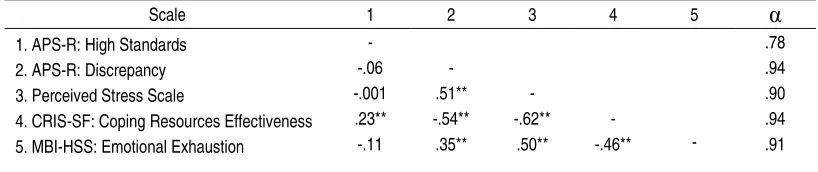
3 Correlations and Reliability Estimations for Perfectionism, Stress, Coping
Resources and Burnout. ...62
v
LIST OF FIGURES
Figure Page
1 Illustration of a direct effect; Illustration of a mediation design ...65
2 Path model of the relations between maladaptive perfectionism, burnout, and perceived stress ...66
3 Path model of the relations between adaptive perfectionism, burnout, and
vi
ABBREVIATIONS
APS-R Almost Perfect Scale – Revised
CRIS Coping Resource Inventory for Stress
DC-S Demand Control Schema for Interpreting Work
DISC Discrepancy
EE Emotional Exhaustion
MBI Maslach Burnout Inventory
PSS Perceived Stress Scale
RID Registry of Interpreters for the Deaf
CHAPTER 1
SIGN LANGUAGE INTERPRETERS AND BURNOUT: THE RELATIONSHIP BETWEEN PERFECTIONISM, STRESS AND COPING RESOURCES
Burnout is a syndrome characterized by increased emotional exhaustion and
depersonalization and reduced feelings of personal accomplishment (Maslach & Jackson,
1981; Maslach & Leiter, 1997; Maslach, Schaufeli, & Leiter, 2001). Maslach, Schaufeli,
and Leiter (2001) conceptualize burnout as a response to the ongoing emotional pressure
of managing complex people-related interactions and as a form of work stress that
develops from socially interacting and intervening between individuals. Across a variety
of occupations job burnout is positively correlated with chronic job stress (Maslach &
Jackson, 1981). Specific to sign language interpreters, job stress is positively associated
with fatigue, injury, and burnout (Delisle, Lariviere, Imbeau, & Durand, 2005;
Feuerstein, Carosella, Burrell, Marshal, & DeCaro, 1997; Heller, Stransfield, Stark, &
Langholz, 1986; Shealy, Feuerstein, & Latko, 1991). The stress-induced syndrome of
burnout is a threat to the profession of sign language interpreting because it is linked to
distress among workers and early departure from the profession (Dean & Pollard, 2001;
Delisle et al., 2005; Heller et al., 1986). Although researchers studying stress and burnout
raise concerns about the prevalence of the phenomenon amongst interpreters, they have
yet to identify the primary organizational and personal factors that contribute to the
problem (Heller et al., 1986; Schwenke, 2010; Swartz, 1999; & Watson, 1987).
Researchers Timarovà and Salaets (2011) highlight that training and working as
an interpreter as an interpreter are inherently stressful, in part because it is quick-paced,
complex, and challenging. Students and interpreters typically work in a simultaneous
moment (Frishberg, 1990; Solow, 1996). Additionally, the assessment process to attain
and maintain professional credentials stipulates that interpreters demonstrate numerous
technical skills and the personal strength to cope with dynamic and stressful situations
efficiently. Comprehensive professional standards established by the credentialing bodies
of the National Association for the Deaf (NAD) and the Registry of Interpreters for the
Deaf (RID) require that interpreters possess the necessary linguistic, cognitive and
technical skills, as well as, physical stamina, emotional stability, endurance and a
willingness to adhere to an ethical code of confidentiality (RID, 2012).
Scholars in the field of stress and coping consistently highlight the significant role
of personality traits in how individuals appraise and manage stressors (Flett & Hewitt,
2002; Lazarus & Folkman, 1984; Stoeber & Otto, 2006). The construct of perfectionism
is one particular personality trait consistently associated with the development of stress in
clinical (Flett & Hewitt) and non-clinical populations (Chang, Watkins, & Banks, 2004).
Perfectionism is also positively associated with the development of burnout amongst
athletes (Chen, Kee, Chen, & Tsaim, 2008; Stoeber & Rennert, 2008) and within various
professions (D’Souza, Egan, & Rees, 2011; Mitchelson & Burns, 1998).
Investigators focusing on sign language interpreters identify a wide range of
cognitive and personality factors that contribute to career success, positive job
performance, and effective stress management (Bontempo & Napier, 2011). Personality
traits both influence how an interpreter perceives of and copes with stress and are
precipitating factor to the development of burnout (Heller et al., 1986; Qin, Marshall,
Mozrall, & Marschark, 2008). Several studies suggest that constructs related to
been explicitly identified or used as a research variable. For instance, one recent study
investigating completion rates for sign language interpreting programs identified
conscientiousness, which includes perfectionistic traits, as critical for the successful
management of stress. Conscientious interpreters typically are adaptively perfectionistic
and strive for high professional standards and are willing to reflect upon their personal
performance in ways that facilitate learning (Bontempo & Napier). In another study, Qin,
Marshall, Mozrall, and Marschark (2008) found an association between interpreters’
concerns about job performance, the use of ineffective coping strategies, and the
development of stress-related physical injury on the job. In addition, Dean and Pollard
(2001) examine the central role of intrapersonal factors within their model for stress
appraisal among sign language interpreters, highlighting the effects of positive and
negative self-appraisal, which are also constructs consistently related to perfectionism.
These studies identify key components of perfectionism in their assessments of
stress-related outcomes, laying the groundwork for a more focused study on the particular role
of perfectionism among interpreters who experience chronic stress and develop burnout.
In the pages that follow, the problem of job burnout is described by introducing
the literature related to the constructs of perfectionism, stress and coping. Psychological
theories related to burnout and the role of emotional exhaustion, adaptive and
maladaptive types of perfectionism, and prominent models of stress coping (e.g., the
transactional model of stress) will inform the current conceptualization of the problem
and relevant interventions. The presented clinical and academic interventions aim at
coping strategies to reduce the prevalence of burnout in the field of sign language
interpreting.
Interpreting Profession and Stress
The Registry of Interpreters for the Deaf’s (RID) (2012) website states that there
is a need for qualified interpreters to meet the growing demand for the service. Chronic
job stress is high among sign language interpreters, a factor associated with burnout and
early professional departure (Dean & Pollard, 2001; Delisle et al., 2005; Heller et al.,
1986). There are both recruitment and retention issues that contribute to the insufficient
supply of interpreters (Dean & Pollard). Attaining the requisite skills and completing all
educational and credentialing requirements to become an interpreter requires a time
commitment as well as the ability to cope with stressors inherent to the training process.
Researchers studying the process of interpreting identify an association between
chronic stress and illness, injury and burnout amongst interpreters (Feuerstein, Carosella,
Burrell, Marshal, & DeCaro, 1997; Qin et al., 2008). Their findings (Feuerstein et al.; Qin
et al.) highlight a positive association between high levels of job stress and reports of
fatigue, physical disorders, and burnout. Researchers identify that physical stressors and
psychological distress significantly impair the interpreter’s linguistic and cognitive
capacity and reduce physical stamina and emotional stability. In one study (Qin et al.,
2008), interpreters with increased physical pain in the wrist and back also reported higher
levels of perceived stress. Within the sample, those interpreters who identified as
“stressed,” used an emphasized sign style (e.g., signs are produced faster and sharper and
the non-dominant hand is used with greater frequency) and reported higher levels of
that interpreters experience several occupational health problems associated with high
levels of stress, such as upper extremity cumulative trauma disorder and carpal tunnel
syndrome (Feuerstein et al., 1997; Qin et al., 2008; Shealy et al., 1991). Overall, stress
can tax the body and mind and increase one’s susceptibility to emotional and physical
exhaustion, symptoms consistent with the construct of burnout.
Stress is frequently identified as a precursor to negative outcomes such as anxiety,
depression, immune deficiency, and strokes (Matheny & McCarthy, 2000). However,
chronic job stress is not necessarily associated with physical illness and emotional
disturbances. For instance, in one study of differences in learning preferences and
motivation among student interpreters, Timarovà and Salaets (2011) identify that
successful interpreting students performed well with medium to high levels of reported
anxiety and were skilled at coping effectively with stress. In this example, anxiety
facilitated a helpful level of excitement and arousal, and was associated with a perceived
challenge related to the interpreting task. Overall, student interpreters with efficient
coping strategies for working in stressful work conditions demonstrated advantages with
regard to their capacity to learn and perform (Timarovà & Salaets).
Timarovà and Salaets (2011) observe that interpreters must have the capacity to
cope with a variety of challenging and potentially stressful situations. To assist
interpreters in coping with daily challenges effectively, Dean and Pollard (2001)
developed a stress-management model, the Demand Control Schema for Interpreting
Work (DC-S). Drawing from the occupational research conducted by Robert Karasek
(1979), Dean and Pollard (2001) developed this model to assist sign language interpreters
and environmental factors that comprise working conditions and assess personal reactions
to stress in order to increase competency and maintain professional standards. First, the
model assesses for contextual factors, specifically job challenges (demands) and
resources (controls) that influence an interpreter’s work. Second, the model emphasizes
interpersonal (e.g., unique perceptions) and intrapersonal variables (e.g., doubts or
questions about performance) that influence an interpreter’s stress reactions. Third, the
model views coping resources as essential buffers for interpreters when managing
multiple work demands. In sum, the Demand Control Schema posits that an increased
awareness of the various interpreting dynamics, both environmental and personal, will
aid the interpreter in effectively navigating situations, particularly stressful ones (Dean &
Pollard).
Dean and Pollard’s model is consistent with Karasek’s research, in which stressful
experiences and job strains are not judged as inherently bad. Karasek (1979)
hypothesized that high-stress jobs can optimally challenge workers, resulting in job
satisfaction. Specifically, Karasek (1979) found that individuals who experience high
levels of both demands and controls were typically satisfied with their work. In contrast,
Karasek (1979) identified that individuals with high levels of job demands and low levels
of controls (e.g., job decision latitude) were predictably less satisfied with their working
conditions. In general, when workers appraised themselves as having insufficient
resources to manage excessive job challenges they were at increased risk of feeling
overwhelmed, overtaxed and dissatisfied (Karasek, 1979). Thus, for Karasek, while stress
in and of itself is not the problem, a variety of individual and contextual variables
Robert Karasek’s (1979) demand-control theory, his job analysis method, and his
developed research instruments were used extensively to study stress-related health
outcomes. Karasek (1979) studied specific work environments, comparing those
professions that yielded high levels of emotional and physical distress with those that
yielded low levels of emotional and physical distress. Assessing the physical,
psychological, social, and organizational aspects of a job he and was then able to
categorize specific occupations in which workers consistently expressed higher rates of
job dissatisfaction and stress-related illnesses. Utilizing Karasek and colleagues’
instrument, the Job Content Questionnaire, (JQQ; Karasek, Brisson, Kawakami,
Houtman, Bongers, & Amick, 1998), Dean and Pollard (2010) surveyed sign language
interpreters to assess which contextual factors significantly contribute to distress. Dean
and Pollard (2010) identified that higher job demands and distress were reported by
interpreters working in Video Relay Service (VRS) call centers and school (K-12
education) settings compared to interpreters in free-lance interpreting settings. These data
support Karasek’s theory that environmental factors influence a worker’s assessed level
of job strain.
While the studies above focus on the organizational factors that contribute to
stress, Karasek’s (1979) job demand theory posits that personal and environmental
factors work together. The theory posits that an individual who is optimally challenged at
work and has sufficient resources will perceive work as satisfying and stressors as
manageable. In contrast, an individual who perceives the availability of resources as
insufficient to meet job demands will experience work as a source of chronic stress, a
personality features, such as interpersonal and intrapersonal characteristics and resources
are highlighted as influential on how the interpreter perceives his/her preparedness,
ability, and success on an assignment. Overall, occupational health researchers
acknowledge that stress reactions are contextually based and are dependent on several
interrelated factors unique to the organizational setting and the individual’s personality
and capacity to cope with stressors (Dean & Pollard; Karasek).
Defining Burnout
Psychiatrist Herbert Freudenberger first coined the term burnout in 1974. He
observed that some clinicians who were once highly motivated and idealistic suffered
from a gradual loss of commitment, motivation, and energy. Maslach and colleagues
made similar observations, conceptualizing burnout as a syndrome of fatigue, cynicism,
and inefficacy, and naming emotional exhaustion, depersonalization, and personal
accomplishment as its three key dimensions (Maslach & Jackson, 1981; Maslach &
Leiter, 1997; Maslach et al., 2001). Chronic symptoms of burnout erode an individual’s
engagement with work that was formerly viewed as important and meaningful, causing
cynical and emotional fatigue (Maslach et al., 2001). Distinct from a clinical diagnosis,
burnout develops from exposure to chronic work stress rather than traumatic natural
events or stressors related to major life events (Etzion & Pines, 1986). Burnout is
primarily discussed in relationship to work; however, there are a growing number of
studies that have associated symptoms of burnout in settings that were not occupational,
including marriage, school performance, and athletic competition (Chen, et al., 2008; Hill
Maslach et al. (2001) identify emotional exhaustion as the core element of
burnout and the construct most frequently described by individuals who refer to
themselves as burned out. Kristensen, Borritz, Villadsen, and Christensen (2005) argue
that burnout involves only emotional exhaustion. Shirom (1989) identifies emotional
exhaustion as the hallmark of burnout and conceptualizes that it results from high levels
of work demands that render an individual feeling overextended and depleted of coping
resources. Emotional exhaustion closely resembles other stress reactions explored in the
occupational stress literature, including fatigue, psychosomatic complaints, and anxiety
(Demerouti, Bakker, Nachreiner, & Schaufeli, 2001) and shares overlapping
characteristics with clinical depression (Etzion & Pines, 1986).
Maslach and colleagues conceptualize that in addition to the role of emotional
exhaustion, high levels of depersonalization and low levels of personal accomplishment
contribute to burnout (Maslach & Jackson, 1981; Maslach & Leiter, 1997; Maslach et al.,
2001). The aspect of burnout called depersonalization is similar to cynicism and is
defined by a sense of callousness and dehumanizing feelings towards others. Personal
accomplishment, another aspect of burnout, relates to the individual’s feelings of success,
competence, and ability to perform on the job. Maslach and Jackson (1981) identify that
reduced feelings of personal accomplishment result in habitual and negative
self-assessments and overall dissatisfaction with one’s professional performance.
Demerouti, Bakker, Nachreiner, and Schaufeli (2001) found that the pathways to
developing burnout altered the presentation of the symptoms. In a study of burnout,
Demerouti, et al. (2001) utilized the job demands-resources model of burnout (JD-R) to
emotional exhaustion or disengagement. Their research findings indicate that there are
distinct cluster response patterns that are dependent on situational stress factors. For
instance, high job demands were positively related to Maslach’s (1982) characterization
of emotional exhaustion, with increased symptoms of fatigue, psychosomatic complaints,
and anxiety (Demerouti et al., 2001). By comparison, a unique pattern emerged in which
insufficient or low levels of job resources correlated with the depersonalization or
disengagement component of burnout (Demerouti et al.). The above research suggests
that sign language interpreters may be particularly at risk for experiencing emotional
exhaustion given the demanding nature of their work.
Burnout theory posits that the problem of increased emotional exhaustion and
depersonalization arises from a mismatch between people and their jobs (Maslach &
Lieter, 1997). Specific factors that contribute to the development of burnout are
person-environment conflicts related to work overload, lack of control, insufficient reward,
breakdown in community, absence of fairness, and conflicting values (Maslach & Lieter).
Maslach and colleagues (Maslach & Lieter; Maslach & Jackson, 1981) identify several
negative outcomes associated with burnout, including the deterioration in the quality of
care and service to recipients, increased job turnover, absenteeism, low morale, and
psychological and medical problems, including insomnia, substance abuse issues, marital
problems, and fatigue (Maslach & Jackson, 1981). In total, the consequences of burnout
are far-reaching and have intrusive ramifications for the individual and society.
Maslach and Leiter (2008) describe burnout and work engagement as
conditionally related to the person-environment match. Whereas burnout is associated
outcomes, including improved psychological well-being, work satisfaction and
contentment with job performance (Maslach et al., 2001; Schaufeli & Bakker, 2004). The
interrelated theoretical dimensions that characterize the dichotomous relationship
between burnout and work engagement include: exhaustion-energy,
cynicism-involvement, and inefficacy-efficacy (Leiter & Maslach, 2005; Schaufeli & Bakker).
The person-environment match influences where an individual falls on the
theoretical burnout-work engagement continuum. In general, workers that are on the
burnout end of the continuum feel disengaged and dissatisfied with work, while those that
are on the engaged end of the continuum feel fulfilled and satisfied (Maslach & Leiter,
2008; Schaufeli & Bakker, 2004). Individual factors such as personality traits act upon
environmental factors, influencing whether a person feels engaged in work or burned out
by particular work conditions. Personality differences explain why some individuals
thrive in challenging work environments when others find the same situation
overwhelming. Overall, personality plays a critical role in how an individual experiences
his/her work setting, which influences whether that individual views the situation as
stressful or not.
Theories of burnout (Demerouti et al., 2001; Maslach & Leiter, 2008; Schaufeli &
Bakker, 2004) and occupational health (Dean & Pollard, 2001; Karasek, 1979) provide a
framework for understanding the dynamics between a worker and his/her work
environment. Working conditions, primarily the relationship between job demands and
controls, are predictive of an individual’s pattern of responses to stress (Dean & Pollard;
Karasek). Whereas high job demands are positively associated with emotional
al., 2001). Burnout theory underscores the importance of the fit between the person and
the environment, specifically noting that personality characteristics, as much as
contextual variables, are predictive of where the individual falls on the job
engagement-burnout continuum (Maslach & Leiter, 2008).
While burnout in interpreters is a well-recognized phenomenon, the precipitating
factors are not well understood. However, among the few published studies related to
burnout within the profession there are incidental findings which suggest that personality
traits contributes to increased levels of burnout. For instance, several studies of burnout
identify high personal expectations, concerns over mistakes, and impairments in stress
coping - all perfectionistic traits - as possible contributors to distress (Dean & Pollard,
2001; Heller et al., 1986; Qin et al., 2008; Roziner & Shlesinger, 2010). Specifically, in a
study of stress and burnout among interpreters Heller et al. (1986) observed that
interpreters’ perceptions of high performance expectations, limited support outlets, and
perceived skill inadequacies were contributing factors to burnout. In another study of
conference interpreters, a majority of the sample reported both low levels of satisfaction
with the quality of their job performance and high levels of burnout (Roziner &
Shlesinger, 2010). Also, in a study by Branam (1991) related to burnout and sign
language interpreters, stress was most commonly associated with unattainably high
performance expectations and perceived skill inadequacies. These findings highlight the
distressing relationship between a desire to produce quality work and a critical
self-assessment of work performance as inadequate. Although the above-mentioned studies of
burnout do not explicitly identify a specific personality characteristic, there is conceptual
Relationship between Perfectionism and Burnout
Freundenberger (1974) observed that those who were conscientious and
enthusiastic experienced burnout and he hypothesized that personality characteristics,
specifically perfectionistic tendencies, played a critical role in the development of fatigue
and cynicism. In addition to identifying a type of worker that he thought was more
vulnerable to burnout, Freundenberger suggested that burnout develops from a series of
sequential events that worsen the symptoms for individuals with particular personalities
and stress response styles. He observed that an idealistic worker attempts to maintain
high performance standards, but then begins to lack the commitment and energy required
to maintain their high standards. Over time, the discrepancy grows between perceived
performance and personal standards and the worker becomes increasingly distressed.
Chronic feelings of distress contribute to increased fatigue, which make it difficult to
sustain the motivation and energy needed to work. Empirical findings support
Freundenberger’s early observations. A positive correlation between perfectionistic
tendencies and the development of burnout is observed across numerous occupations
including clinical psychologists (D’Souza, Egan & Rees, 2011), schoolteachers (Stoeber
& Rennert, 2008), career mothers (Mitchelson & Burns, 1998), clergy (Grosch & Olsen,
1998), physicians (Houkes, Winants, & dTwellaar, 2008), and coaches (Tashman,
Tenenbaum, & Eklund, 2010).
While some researchers conceptualize perfectionism as a negative and
problematic personality trait other researchers acknowledge the potential advantages of
perfectionism. Burns (1980) defines the construct of perfectionism as unidimensional and
who possesses this characteristic. According to Burns (1980), individuals with a
perfectionistic drive are generally unrealistic and directed towards maintaining
abnormally high standards in personal performance or occupational endeavors. A
balanced view of the construct positions positive or normal perfectionism as distinct from
negative or neurotic perfectionism (Hamachek, 1978). Specifically, the normal
perfectionist pursues high standards, tolerates mistakes, and derives satisfaction
following task completion. In contrast, the neurotic perfectionist fears failure, does not
easily tolerate mistakes, and derives little self-satisfaction from task accomplishment.
Various researchers have elaborated upon the construct of perfectionism. Frost,
Marten, Lahart, and Rosen (1991) incorporate intrapersonal issues into their
conceptualization of perfectionism and emphasize more neurotic aspects of
perfectionism, such as concerns about meeting social expectations, tendencies towards
critical self-evaluations, and doubts about the effectiveness of one’s actions.
Additionally, Hewitt and Flett (1991) include interpersonal issues into their
conceptualization and identify three types of perfectionism, including self-oriented,
other-oriented, and socially prescribed. As the categorical names suggest, self-oriented
perfectionists set high standards for themselves; other-oriented perfectionism maintain
high standards on behalf of significant others; and socially prescribed perfectionism
believe that significant others are maintaining high standards for them (Flett & Hewitt,
1991). Especially applicable to the work of sign language interpreters is Hewitt and
Flett’s (1991) notion of the self-oriented perfectionists who demands high personal
standards for him or herself but is not easily satisfied with his/her resulting performance.
interpreting profession, in which interpreters set high personal standards and are
self-critical of their perceived job performance (Dean & Pollard, 2001; Heller et al., 1986;
Qin et al., 2008; Roziner & Shlesinger, 2010).
While some academic debate remains regarding perfectionism, contemporary
scholars generally define it as a multidimensional construct characterized by the setting
of high personal standards and that can be experienced as either maladaptive or adaptive
(Stoeber & Otto, 2006). The maladaptive perfectionist experiences distress from the
discrepancy experienced between personal standards and his/her negative appraisals of
performance (Rice & Slaney, 2002). In contrast, the adaptive perfectionist experiences
less distress when goals are not met and experiences less of a disparity between personal
standards and his/her assessed performance (Rice & Slaney). Thus, the distress
experienced by a perfectionist does not arise from the establishment of high performance
standards in and of itself, but rather from the discrepancy experienced between one’s
established standards and the negative appraisal of one’s performance (Stoeber & Otto,
2006).
Research findings provide evidence that maladaptive perfectionists experience
greater negative psychological outcomes, including elevated levels of depression (Frost,
Benton, & Dowrick, 1990), elevated levels of anxiety (Flett, Hewitt, & Dyck, 1989),
decreased self-esteem (Ashby, Rice, & Martin, 2006), elevated self-criticism (Flett,
Hewitt, Blankstein, & Mosher, 1991), lower satisfaction with life (Ashby, et al., 2006),
increased fear of intimacy (Martin & Ashby, 2004) and elevated levels of burnout
(Grosch & Olsen, 1998; Houkes et al., 2008; Mitchelson & Burns, 1998; Stoeber &
with greater levels of personal distress and clinical diagnoses, including eating disorders,
anxiety disorders and depression (Egan, Wade, & Shafran, 2011). In contrast, adaptive
perfectionists’ appraisals of their performance are less likely to induce stress (Stoltz &
Ashby, 2007) and are more likely to facilitate the learning of challenging new skill or
sport (Gould, Dieffenbach, & Moffett, 2002). Adaptive perfectionistic traits are also
associated with positive and beneficial outcomes such as psychological wellbeing (Slaney
et al., 2001), higher levels of self-esteem (Ashby & Rice, 2002), greater life satisfaction
and lower levels of depression (Wang, Yuen, & Slaney, 2009).
Generally, perfectionistic traits aid in the achievement of personal goals (Burns,
1980; Slaney & Ashby, 1996). Several empirical studies of high achieving students
(Bieling, Israeli, Smith, & Antony, 2003), professionals (Houkes et al., 2008) and
Olympic athletes (Gould et al., 2002) highlight the potential benefits of having
perfectionistic traits, specifically with regard to establishing high personal standards.
Therefore, perfectionists - adaptive or maladaptive - often do not wish to concede their
perfectionistic traits (Burns, 1980) or lower their performance standards (Slaney &
Ashby, 1996). Although the adherence to high personal standards is distressing for the
maladaptive perfectionist, lightening up or lowering personal standards does not seem a
desirable option.
Maladaptive perfectionists are more prone to negatively appraise performance
resulting in feelings of discouragement and distress (Rice & Slaney, 2002; Ashby & Rice,
2002). Research suggests that perfectionistic tendencies, specifically negative appraisals
of personal performance are predictive of burnout (Chen et al., 2008; Hill et al., 2008;
Lemyre, Hall & Roberts, 2008) have identified that amongst athletes, those with
perfectionistic traits who repeatedly engage in maladaptive appraisals and
self-criticism reported high levels of burnout (Appleton, Hall & Hill, 2009; Gould et al.;
Lemyre et al.). Tashman et al. (2010) found that athletic coaches that reported high
perfectionistic standards and chronic feelings of inadequacy related to their job
performance also reported high levels of burnout. In the few studies that address stress
and burnout within the interpreting profession it is observed that stress and burnout are
more prevalent when interpreters engage in patterns of thinking dominated by negative
self-talk, concerns about performance, and critical assessments of skill competency (Dean
& Pollard, 2001; Heller et al., 1968; Roziner & Shlesinger, 2010).
Bontempo and Napier (2011) and Dean and Pollard (2001) identify that the
personality characteristics of sign language interpreters influence their capacity to
manage stress and perform on the job. Furthermore, environmental stressors influence
interpreters’ personal stress reactions, which in turn influence behaviors, cognitive
functioning, mood, and psychological wellbeing (Dean & Pollard, 2001). Dean and
Pollard (2001) recognize that work demands, stressors and coping resources are
experienced through the filter of the individual personalities of interpreters and influence
how interpreters judge their capacity to successfully convey a message.
Personality characteristics such as perfectionistic traits play a part in determining
how successful interpreters are throughout training and at work (Bontempo & Napier,
2011). In research looking at the “soft skills,” or personality traits that are helpful for the
development of interpreting skills, conscientiousness, which includes the constructs of
significant predictor of occupational performance (Bontempo & Napier). These findings
highlight the adaptive potential of conscientiousness and perfectionistic traits for sign
language interpreters throughout their careers.
Researchers have identified numerous conceptual links between perfectionism
and the personality traits of conscientiousness. Rice, Ashby, and Slaney (2007) have
empirically studied whether adaptive perfectionism as measured by the Almost Perfect
Scale-Revised (APS-R; Slaney et al., 1996, 2001) could be differentiated from seemingly
related personality factors, such as the personality domain of Conscientiousness as
measured on the NEO Five-Factor Inventory Form S (NEO-FFI-S; Costa & McCrae,
1992). When the scales related to the multidimensional construct of perfectionism where
compared to the Five-Factor model of personality, a positive correlation was identified
between the Conscientiousness scale of the NEO-FFI-S and adaptive perfectionistic traits
as measured by the High Standards scale of the APS-R. These findings suggest that while
there are distinct conceptual differences between perfectionistic traits and the personality
traits of conscientiousness there are significant conceptual points of overlap.
Perfectionistic traits, adaptive or maladaptive, have bearing on interpreters’ work,
positively or negatively. Research findings emphasize that perfectionistic traits and
striving for achievement assist interpreters in developing skills and achieving educational
and professional goals (Bontempo & Napier, 2011). Additionally, adaptive perfectionistic
traits appear advantageous with regard to work satisfaction and engagement. In contrast,
hallmarks of maladaptive perfectionism disadvantage the interpreter. For instance, a
primary stressor reported in samples of sign language and spoken language conference
professional standards (Heller et al., 1986; Roziner & Shlesinger, 2010). Dean and
Pollard (2001) also recognize the detrimental effects of doubts about performance. While
these studies do not name the personality trait of maladaptive perfectionism, there is
overlap with the construct, specifically with regard to interpreters reporting both high
personal standards and self-criticism regarding perceived job performance. Given that
interpreting can be stressful and is likely more challenging for the maladaptive
perfectionist, coping resources are an essential protective factor for professionals in the
field.
Relationship between Perfectionism and Coping Resources
According to the transactional model of stress (Lazarus, 1966) personality factors
shape an individual’s appraisal of demands and the capacity to effectively cope with
stress. Within Lazarus’s (1966) theoretical framework a stressor occurs within an
environment and the response to the stressor is dependent on individual perceptions and
contextual factors. The perceived demands of a situation are personal requirements that
are either internal, such as perfectionistic standards or expectations regarding the
completion of a task, or external, such as being asked by a supervisor to complete a work
task (Matheny & McCarthy, 2000). Within this framework stress is experienced by the
individual when the perceived demands appear to exceed perceived resources (Lazarus &
Folkman, 1984).
The stress and coping framework of Lazarus and Folkman (1984) distinguishes
two phases of the stress appraisal process - the primary appraisal and the secondary
appraisal. First, an individual is confronted with a demand. A primary appraisal occurs as
subjective level of threat to his/her physical and psychological wellbeing. Second, the
individual determines through a secondary appraisal how to respond to or cope with the
assessed danger or challenge.
Lazarus’s (2007) transactional model of stress and coping accounts for various
factors influencing how an individual copes with stressors, such as issues of time (e.g.,
age of the individual, current circumstances) and type of stressful situations (e.g., life
events or daily hassles). Lazarus (2001) distinguished between patterns of coping that
incorporate healthy behaviors (e.g., diet and exercise; meditation) and those that
incorporate non-healthy behaviors (e.g., dependence on drugs or alcohol) to manage
stress. Lazarus (2001) also differentiates between coping strategies that are
problem-focused, in which the individual attempts to confront or alter a stressor, and those
strategies that are emotion-focused, in which the individual attempts to accept and live
with a particular stressor. More active coping approaches include problem solving,
resolving interpersonal conflicts, time management, use of humor and seeking out social
support. In contrast, emotion-focused coping strategies include accepting the inevitable,
reframing, suppressing distressing thoughts, self-disclosure, and discharging painful
emotions, as well as avoidant approaches, such as the use of substances and self-blame to
reduce stress (Lazarus, 2007; Matheny & McCarthy, 2000).
Matheny and McCarthy (2000) describe coping resources as established traits,
abilities and assets that are utilized as strategies for coping with stress. Coping resources
serve to buffer individuals from stressful daily hassles and life events and minimize the
potentially detrimental effects of stressors as they occur (Matheny, Aycock, Curlette, &
individual experiences heightened self-confidence in their ability to manage situations -
an awareness that serves as a protective factor against maladaptive outcomes (Matheny &
McCarthy). Those individuals who are highly resourced with robust coping skills derive
relief or protection from stressful events and are more willing to take risks and challenge
themselves (Lazarus).
Hewitt and Flett (2002) use the diathesis-stress model to discuss the dysfunctional
patterns and approaches that maladaptive perfectionists employ to appraise stressors. For
instance, individuals with maladaptive perfectionistic traits develop patterns of judging
their performance as inadequate and generally reflect self critically on their job
performance, which produces, exaggerates, or prolongs stress responses. Maladaptive
perfectionists engage in behaviors that result in stressful circumstances, such as a
tendency to self-handicap (stress generation); anticipate future failure or maintain a
pessimistic future orientation (stress anticipation); cope poorly with stressors and
therefore prolong stressful episodes through negative automatic thinking, self-blame,
preservation, and rumination (stress perpetuation); and intensify the negative impact of
stressful conditions by associating self-worth with job performance (stress enhancement).
The primary problem with maladaptive perfectionists’ pessimistic patterns of thinking is
that stressors are viewed as threatening while the availability of personal resources is
judged as insufficient. Overall, the negative ego impact of maladaptive perfectionistic
thinking seems to magnify stress by perpetuating and reinforcing negative patterns of
reacting to stress (Rice & Slaney, 2002).
Flett and Hewitt (2005) observe that while strong coping resources and effective
coping resources are often impaired and applied less effectively by the maladaptive
perfectionist. Hewitt and Flett (2002) found that maladaptive perfectionists assess their
coping resources as insufficient and are less successful at using effective coping
strategies for the purpose of stress reduction. Maladaptive perfectionists are also prone to
negatively appraise their problem-solving capabilities and engage in more maladaptive
strategies of coping (e.g., emotion-focused).
For maladaptive perfectionists negative patterns of thinking and impaired coping
skills result in increased psychological symptomatology. Maladaptive perfectionists with
impaired coping resources are at greater risk for feelings of hopelessness and
psychologically distress (O’Connor & O’Connor, 2003). For instance, in one study Wei,
Heppner, Russell, and Young (2006) identified that perfectionistic college students with
low levels of coping resources were at greater risk for depression, anxiety, and emotional
maladjustment. In another study, Rice and van Arsdale (2010) identified that
maladaptive perfectionists had higher perceived stress scores and were more likely to
utilize non-healthy coping strategies (e.g., alcohol use). Additionally, maladaptive
perfectionists generally report lower perceptions of social support and utilize less
effective strategies (e.g., avoidant coping) during times of stress (Rice & Slaney, 2002).
In combination the research indicates that maladaptive perfectionists typically perpetuate
distress through ongoing disabling self-criticism and lower levels of self-confidence
(Rice & Slaney).
Interventions
The purpose of reviewing the literature related to perfectionism, stress coping,
interpreters. To summarize the literature, burnout theory posits that job satisfaction (or
dissatisfaction) is dependent on a complex relationship between the person and the
environment (Maslach & Leiter, 1997). Emotional exhaustion is a defining characteristic
of the individual who is burned out, while energy and engagement are characteristic of
the satisfied worker (Maslach & Jackson, 1981). Across various professions, high job
demands are primarily associated with emotional exhaustion, which is defined by
symptoms of fatigue, anxiety and various psychosomatic complaints (Demerouti et al.,
2001). Within interpreting samples, burnout is associated with high job demands and
chronic stress (Dean & Pollard, 2001; Heller et al., 1986). Personality characteristics,
which influence the stress appraisal process (Folkman & Lazarus, 1984) are known to
uniquely impact the way perfectionists assess and cope with stressors (Flett & Hewitt,
2002). For instance, maladaptive perfectionists are prone to exacerbate stress and to use
ineffective strategies for coping with stress (Flett & Hewitt, 2002). Amongst interpreters,
it is known that adaptive perfectionistic traits are beneficial when coping with stressors
(Bontempo & Napier, 2011) and chronic self-criticism, a hallmark of maladaptive
perfectionism, can place interpreters at risk for stress-related conditions (Qin et al., 2008).
The recommendations that follow are geared towards assisting interpreting
students in training programs and interpreters working in the field to improve
self-awareness, consider ways to facilitate systemic and environmental change, improve
coping responses to job stress and ultimately reduce burnout in the profession. The
interventions are summarized in Table 1 following the discussion.
First, it is known that beyond the linguistic skills and talents that are required of
development, linguistic competence and job performance of interpreters during training
and beyond (Bontempo & Napier, 2011; Timarovà & Salaets, 2011). Therefore,
interpreters may benefit from acquiring psycho-educational information about career
interests, personality type and coping strategies. Psychological assessments such as the
Strong Campbell Interest Inventory-Fourth Edition (SCII-4; Campbell, 1987), Personality
Assessment Inventory (PAI; Morey, 2007), the Minnesota Multiphasic Personality
Inventory-2 (MMPI-2; Butcher, Dahlstrom, Graham, Tellegen, & Kaemmer, 1989), and
the Coping Resources Inventory for Stress-Short Form (CRIS-SF; Matheny & Curlette,
2010) would provide detailed information related to vocational interest and job skills,
individual personality traits and the perceived availability of coping resources. In addition
to personality measures administered by psychologists, another recommendation is
participation in therapist-led “growth groups.” Members of interpersonal process oriented
psychotherapy groups learn through sharing thoughts, perceptions and feelings, testing
out new behaviors and giving and receiving feedback. Evaluation and participation in
psychologically oriented activities will assist interpreters to appraise their strengths,
abilities and capacity to cope with stressors.
Second, it is recommended that interpreters familiarize themselves with the work
of Dean and Pollard (2001) who have developed the Demand Control Schema for sign
language interpreters. DC-S is a widely understood model that assists interpreters to
identify and analyze work stressors. To explore the framework in-depth interpreters can
read primary texts by Dean and Pollard or attend workshops related to DC-S.
Third, while individual efforts directed at reducing stress, injury and burnout, are
interpreters are also recommended. Dean and Pollard (2001) suggest systematic changes
such as modifications to the interpreting code of professional conduct (e.g. with regard to
confidentiality), improvements in the availability of mentoring and confidential
supervision. Interpreters wishing to make systematic changes will likely need to advocate
for change collectively, as activists, through national or local organization (e.g., NAD,
RID, ADARA) channels. It is thought that efforts directed at reducing personal and
environmental stress will help to thwart, to some degree, the development of burnout.
Fourth, given that stress is a part of life (e.g. daily hassles, stressful life events) and
stressors are inherent in the interpreting profession, learning to cope or reduce stress is
critical. It is recommended that individuals consider self-care strategies for managing
stressors. Two suggested reads are Why Zebra’s Don’t Get Ulcers, which is a 1994 (2ed
1998, 3ed 2004) book by Stanford University neuroscientist Robert Sapolsky and Write
Your Own Prescription for Stress, published in 2000 by counseling psychologists
Kenneth Matheny and Christopher McCarthy. For the interpreter who is experiencing
burnout, Michael Leiter and Christina Maslach (2005) have authored a book titled,
Banishing Burnout: Six Strategies for Improving Your Relationship with Work. Within
this text, the authors provide the reader with a resource, the Work Life Self-Assessment.
This is a tool interpreters can use to assess areas of work that are particularly stressful
such as workload, control, reward, community, fairness, values.
Stress reduction interventions may be helpful for those suffering from chronic
stress and burnout. Cognitive behavioral mindfulness based psychotherapy approaches
are well researched and linked to beneficial mental health outcomes (Williams, Teasdale,
interventions are prevalent in local communities. Jon Kabat-Zinn’s (1994) book titled
Wherever you go there you are: Mindfulness meditation in everyday life may be a place
to start for those interested in mindfulness-based relaxation approaches. Furthermore,
downloadable apps, audible relaxation files, CD or DVD are easily made available for
use while traveling or at home. Biofeedback techniques and portable equipment for stress
reduction (e.g., HeartMath) are additional resources. Interpreters may wish to attend
weekend retreat, meditation or spiritual practice, or therapeutic massage to relieve stress.
Therapeutic adventure therapy (e.g. ropes courses) is an option for interpreters interested
in learning more about their own intrapersonal and interpersonal strengths and their
ability to cope with stress.
Lazarus’s (1966) transactional model of stress assesses for patterns of thoughts
and behaviors that influence stress responses. According to this model, individuals should
identify their stressors, assess the effectiveness of their current coping strategies (e.g.,
healthy or non-healthy behaviors), and consider the consequences of habitually using the
same coping strategies during stressful situations. According to Lazarus and Folkman
(1984) individuals should work to expand their repertoire of active coping strategies, and
include in their repertoire strategies such consistently scheduled exercise, getting
sufficient sleep, and eating healthy.
Fifth, individuals with maladaptive perfectionists burnout in a variety of situations
(Hill et al., 2008; Hill et al., 2010; Mitchelson & Burns, 1998; Stoeber & Rennert, 2008;
Tashman, et al., 2010). Additionally, researchers who study burnout identify that those
with limited coping resources are at increased risk for developing symptoms of emotional
Hewitt and Flett (2002) identify that maladaptive perfectionists are uniquely vulnerable
to stressors and experience limited coping abilities as a result of their personality
structure. Maladaptive perfectionists routinely engage in stress generation, stress
anticipation, stress perpetuation and stress enhancement, which actually exacerbate
feelings of distress (Flett & Hewitt, 2002). Additionally, maladaptive perfectionists
negatively appraise their problem-solving capabilities, are limited in their use of varied
coping strategies and routinely chose emotion-focused and avoidant approaches (Flett &
Hewitt, 2005).Thus, maladaptive perfectionists often need assistance to bolster active,
problem-focused coping (Flett et al., 1994).
For the portion of the interpreters that identify as perfectionistic, understanding
the adaptive and maladaptive potentialities of this personality trait has advantages
regarding seeking appropriate interventions. For maladaptive perfectionistic interpreters,
interventions during trainings, workshops, or continuing education workshops can be
directed at working with the distress caused by chronic negative appraisals and
dissatisfaction with job performance.
Blatt and colleagues (Blatt, 1995; Blatt, Quinlan, Pilkonis, & Shea, 1995; Blatt,
Zuroff, Bondi, Sanislow, & Pilkonis,1998) have explored the mechanisms by which
individuals with maladaptive perfectionistic personality traits are at increased risk for the
development of depression. Additionally, Blatt and colleagues have explored specific
treatments for perfectionists diagnosed with depression. Egan and Hine (2008) write
about the treatments proven efficacious for maladaptive perfectionists with clinical
conditions, such as anxiety or depression, most of which incorporate cognitive behavioral
positive thoughts, while helping the client become aware of perfectionistic patterns of
thinking (Egan & Hine). Therapeutic interventions attempt to interrupt the stress
generation, anticipation, perpetuation and enhancement process to reduce acute distress.
As was previously discussed, several mindfulness-based interventions are proven
effective in reducing the relapse rates of depression through the use of techniques that
shift attention from negative content of thought to an intentional practice of observing
and attending in a non-judgmental manner (Segal, Williams, & Teasdale, 2002).
Mindfulness/acceptance-based stress reduction programs have also proven effective for
the treatment of stress (Kabat-Zinn, 2003) and generalized anxiety disorder (Roemer &
Orsillo, 2002). While these techniques are not empirically validated as effective for
treating maladaptive perfectionists, Argus and Thompson (2008) observed that amongst
maladaptive perfectionism a lack of mindful awareness is associated with increased
depression severity. This lends support for using mindfulness techniques with
maladaptive perfectionists experiencing the symptoms of distress associated with job
stress and burnout.
Finally, maladaptive perfectionists report lower self-perceived social skills and
higher frequencies of negative social interactions (Flett et al., 1997). Therefore,
maladaptive perfectionists are encouraged to explore their personality structure in
individual therapy settings. For instance, Time Limited Dynamic Psychotherapy
approaches (see Binder & Strupp, 19991) focus on the relationship between personality
Conclusion
Concerns about chronic job stress in the profession of sign language interpreting
are well documented. A national shortage of interpreters is blamed on the prevalence of
physical disorders and burnout within the profession (Dean & Pollard, 2001; Qin et al.,
[image:44.612.101.550.71.571.2]2008). Maladaptive perfectionism is a personality characteristic consistently associated
Table 1. Intervention Summary for Sign Language Interpreters
Focus Recommendation Intervention Examples
Self-Awareness
Learn about interests, strengths, and personality through psychological assessments
Complete an assessment of career, personality, and/or coping resources
Complete the Strong Campbell Interest Inventory-Fourth Edition (SCII-4; Campbell, 1987), Personality
Assessment Inventory (PAI; Morey, 2007), Minnesota Multiphasic Personality Inventory-2 (MMPI-2; Butcher, Dahlstrom, Graham, Tellegen, & Kaemmer, 1989), and/or Coping Resources Inventory for Stress-Short Form (CRIS-SF; Matheny & Curlette, 2010).
Self-Awareness
Learn about intrapersonal and interpersonal strengths and patterns of coping
Attend interpersonal process group, adventure therapy course and/or individual psychotherapy
Attend local therapeutic groups or individual psychotherapy. Resources will vary, check with insurance provider and local therapists (e.g., licensed psychologists, social workers, and counselors). Job Analysis Learn how to analyze
job assignments
Become familiar with Dean and Pollard’s Demand Control Schema (DC-S) for sign language interpreters
Attend a workshop or training related to DC-S (Dean & Pollard, 2001).
Systemic Analysis
Make systemic changes Participate in local and national organizations
Join organizations, such as national and regional NAD, RID, ADARA, etc.
Stress Reduction
Learn about Stress Responses
Read stress related book(s) ReadRobert Sapolsky’s Why Zebra’s Don’t Get Ulcers
(2ed 1998, 3ed 2004).
Stress Reduction
Learn relaxation techniques
Participate in mindfulness meditation, through resources such as readings, CDs, audible files, portable equipment
Read Jon Kabat-Zinn’s (1994) book titled Wherever you go there you are: Mindfulness meditation in everyday life. Download related apps or audible relaxation files. Use biofeedback techniques and portable equipment for stress reduction (e.g., HeartMath). Attend weekend retreat, meditation or spiritual practice, or therapeutic massage to relieve stress (and get CEUs).
Coping Resources
Learn about Coping Resources
Read coping related book(s) Read Kenneth Matheny and Christopher McCarthy’s (2000) book titled Write Your Own Prescription for Stress.
Coping Resources
Learn about Coping Resources
Become familiar with Lazarus’s (1966) transactional model of stress. Strive for a balanced and healthy lifestyle.
Lazarus and Folkman (1984) suggest to expand repertoire of active coping strategies, such as consistently scheduled exercise, getting sufficient sleep, and eating healthy.
Burnout Learn about Burnout Read burnout related book(s)
Read Michael Leiter and Christina Maslach’s (2005) book titled Banishing Burnout: Six Strategies for Improving Your Relationship with Work and complete the
Work Life Self-Assessment. Perfectionism Learn about
Perfectionism (Adaptive vs. Maladaptive)
Attend specific workshops, trainings and curriculum lessons related to perfectionism
Increase awareness of the concept of perfectionism, enhancing stress management and bolster active, problem-focused coping (Flett et al., 1994).
Perfectionism Learn about Maladaptive Perfectionism
Engage in psychodynamic or cognitive behavioral therapy to learn about personality structure and ways of managing and coping with stress.
with burnout across a variety of professions (D’Souza et al., 2011; Freundenberger, 1974;
Houkes et al., 2008; Stoeber & Rennert, 2008; Tashman, et al., 2010).
Personality plays an essential role in informing the stress and coping appraisal
process (Lazarus & Folkman, 1984) and intrapersonal and interpersonal factors influence
interpreters as they cope with stress (Dean & Pollard, 2001). Interpreters striving for high
standards may see their performance enhanced by adaptive perfectionistic traits
(Bontempo & Napier, 2011) or hindered by pessimism and the negative appraisals of
performance (Dean & Pollard, 2001; Qin et al., 2008). Furthermore, maladaptive
perfectionists utilize coping strategies known to exacerbate and perpetuate the stress
response (Flett &Hewitt, 2005).
Job stress and burnout in the interpreting profession are issues of great concern to
educators, administrators, students, interpreters, and consumers. The above review of
extant literature indicates that personality, perfectionism in particular, plays a more
significant role in the phenomena of stress and burnout among interpreters than has been
previously acknowledged. Additional research is needed in order to understand with
greater precision the relationships between personality, stress, and burnout. Research
findings will enable the sign language profession to develop more effective stress-related
interventions in the areas of psychotherapy, didactics (e.g., trainings, workshops, and