ScholarWorks @ Georgia State University
ScholarWorks @ Georgia State University
Counseling and Psychological Services
Dissertations Department of Counseling and Psychological Services
Spring 5-11-2012
Perceptions of Collaborative Process in a Professional Learning
Perceptions of Collaborative Process in a Professional Learning
Focused University-Community-School Collaboration
Focused University-Community-School Collaboration
Lynnae L. Psimas Georgia State University
Follow this and additional works at: https://scholarworks.gsu.edu/cps_diss
Recommended Citation Recommended Citation
Psimas, Lynnae L., "Perceptions of Collaborative Process in a Professional Learning Focused University-Community-School Collaboration." Dissertation, Georgia State University, 2012.
https://scholarworks.gsu.edu/cps_diss/71
This dissertation, PERCEPTIONS OF COLLABORATIVE PROCESS IN A
PROFESSIONAL LEARNING FOCUSED UNIVERSITY-COMMUNITY-SCHOOL COLLABORATION, by LYNNAE L. PSIMAS, was prepared under the direction of the candidate’s Dissertation Advisory Committee. It is accepted by the committee members in partial fulfillment of the requirements for the degree Doctor of Philosophy in the College of Education, Georgia State University.
The Dissertation Advisory Committee and the student’s Department Chair, as representatives of the faculty, certify that this dissertation has met all standards of excellence and scholarship as determined by the faculty. The Dean of the College of Education concurs.
Stephen D. Truscott, Psy.D. Diane Truscott, Ph.D. Committee Chair Committee Member
Joel Meyers, Ph.D. Catherine Cadenhead, Ph.D. Committee Member Committee Member
Date
Brian Dew, Ph.D.
Chair, Department of Counseling and Psychological Services
R. W. Kamphaus, Ph.D.
By presenting this dissertation as partial fulfillment of the requirements for the advanced degree from Georgia State University, I agree that the library of Georgia State University shall make it available for inspection and circulation in accordance with its regulations governing materials of this type. I agree that permission to quote, to copy from, or to publish this dissertation may be granted by the professor under whose direction it was written, by the College of Education’s director of graduate studies and research, or by me. Such quoting, copying, or publishing must be solely for scholarly purposes and will not involve potential financial gain. It is understood that any copying form or publication of this dissertation which involves potential financial gain will not be allowed without written permission.
All dissertations deposited in the Georgia State University library must be used in
accordance with the stipulations prescribed by the author in the preceding statement. The author of this dissertation is:
Lynnae L. Psimas 730 Alstonefield Dr.
Milton, GA 30004
The director of this dissertation is:
Dr. Stephen D. Truscott
Department of Counseling and Psychological Services College of Education
Lynnae Lillian Psimas, née Bellmoff
ADDRESS: 730 Alstonefield Drive Milton, GA 30004
EDUCATION:
Ph.D. 2012 Georgia State University School Psychology M.Ed. 2007 Georgia State University
School Psychology B.A. 2003 Georgia State University
Psychology
PROFESSIONAL EXPERIENCE:
2011 – 2012 School Psychologist, Supply Position Cobb County School District, Georgia 2007 – 2010 Consultant
Georgia Learning Resource System 2004 – 2005 Assistant Project Coordinator
The Marcus Institute, Atlanta, GA
PRESENTATIONS AND PUBLICATIONS:
Bolling, M. A., & Psimas, L. (2010, March). Standards-based professional learning: Increasing capacity to intervene with problem behavior. Paper presented at the National Association of School Psychologists 2010 Annual Convention, Chicago, IL.
Psimas, L. (2010, February). Addressing challenging behaviors. Invited. Presented at a meeting of school psychologists in Henry County, GA.
Psimas, L., Bolling, M. A., Graybill, E., Schwartz, A., Albritton, K., Kreskey, D., Truscott, S. D., & Stringer, D. (2009, February). Designing and conducting exceptional professional learning to create lasting change. Mini-skills presented at the National Association of School Psychologists 2009 Annual Convention, Boston, MA.
bullying. Journal of School Violence, 4, 97 – 118.
Kreskey, D., Graybill, E., Psimas, L., Bolling, M. (2008, April). Developing a theory-based model of professional learning. Paper presented at the Georgia Association of School Psychologists Spring 2008 Convention, St. Simons Island, GA.
Stringer, D., Bolling, M., Kreskey, D., Graybill, E., Psimas, L., & Truscott, S. D. (2008, March). Professional development as an intervention. Paper presented at the Consortium for School Improvement, Atlanta, GA.
Graybill, E., Kreskey, D., Boney, T., Psimas, L., Bolling, M., Freer, P., & Truscott, S. D. (2008, February). Professional development that builds capacity for behavioral interventions. Paper presented at the National Association of School
Psychologists 2008 Annual Convention, New Orleans, LA.
Lopp, E., Bellmoff, L., Meyers, J., Varjas, K., Birckbichler, L., Marshall, M., &
Williamson, Z. (2007, March). Bullying in an urban school district: Perceptions of 4th through 8th grade students. Paper presented in symposium *Utilizing mixed methods to investigate bullying: Urban youths’ perspectives* at the National Association of School Psychologists 2007 Annual Convention, New York, NY.
Coles, C.D., Strickland, D. C., Padgett, L., & Bellmoff, L. (2007). Games that "work": Using computer games to teach alcohol-affected children about fire and street safety. Research in Developmental Disabilities: A Multidisciplinary Journal, 28, 518 – 130.
PERCEPTIONS OF COLLABORATIVE PROCESS IN A PROFESSIONAL LEARNING FOCUSED UNIVERSITY-COMMUNITY-SCHOOL
COLLABORATION by
Lynnae L. Psimas
The current study explored the collaborative processes present in a collaboration
between an urban university in the Southeast United States, a state-funded educational
support agency, and several urban and suburban school districts served by the state
agency. To obtain a comprehensive understanding of the collaboration and relevant
practices, perceptions were obtained from university, community agency, and K-12
school representatives through 12 individual and 2 group interviews. Data were collected
and analyzed using Moustakas’s (1994) transcendental phenomenology methodology.
Findings indicated that participants perceived collaborative processes in the areas of
collaborative structure, communication practices, characteristics of collaborators and
organizations, and group dynamics. Participants also described outcomes of the
collaboration in the areas of general impact on professional learning participants,
learning, evolution of behaviors and beliefs, relationship development, emotional impact,
sustainability, and generalizability. Comparison of the current results to Hord’s (1986)
model of inter-organizational collaboration and the literature on inter-organizational
collaboration revealed strong support for a synthesis model of inter-organizational
collaboration. Furthermore, the findings suggest implications for practice in the areas of
goal alignment, communication, perceptions of collaborative involvement, system entry
COLLABORATION by
Lynnae L. Psimas
A Dissertation
Presented in Partial Fulfillment of Requirements for the Degree of
Doctor of Philosophy in
School Psychology in
the Department of Counseling and Psychological Services in
the College of Education Georgia State University
Copyright by Lynnae L. Psimas
ii
To my committee chair, Dr. Steve Truscott: Thank you for all of the opportunities you’ve given me. You’ve been an inspiration, a teacher, and a friend. I have treasured our work together and hope it doesn’t end here! To my committee members, Dr. Diane Truscott, Dr. Joel Meyers, and Dr. Catherine Cadenhead: I have learned so much from each of you, both through this process and before it even began. Your insights and contributions have been invaluable. Thank you!
To my participants: Thank you for your honesty, your trust, and your insight. Each of you showed such courage in your willingness to examine your personal impact on a
professional experience that was a challenge as much as it was a reward. To my peer research team, Allie and Robin: Allie, you know I love you! Thanks for not throwing anything at me when I drove you crazy. Robin, thank you for your help and support with tasks that no one enjoys. You truly are a good friend. To my ladies in the trenches, Michelle, Emily, Donna, Kizzy, Allie, Robin, and Ray: Thank you for helping me turn frustration and exhaustion into laughter. You made it fun when I was thought it would be just another job.
To my family: Thank you all so much for your love and support! I marvel every day at the amazing family I was born into and the loved ones that have joined us. To the loved ones we’ve lost, I’ll never forget you. Aunt Bea, Uncle Dean, Alexis, and Philip: My sports day victories will only increase now that I have the time to get buff. I figure along with a thanks for everything, you should get fair warning. Kelly, thank you for
understanding about all the cancelled plans and busy weekends. Now it’s my turn! Brian, thanks for preventing the bear attacks. Rachel, thank you for always making the effort to close the distance. Chris, thanks for the bagels. You have now set a precedent. Harper and Kinley, thanks for making bragging so easy. Grandma, thank you for everything. I love you! Rosie, thank you for being so wonderful! Jim and Barbara, words cannot express how grateful I am for everything you have done to support me. You have always made me feel like one of yours, and I love you both so much.
To my mother: You are one of the most generous people I know, but the greatest gift you have always given me is your belief that I could do anything. Thank you.
To my father: You taught me about color correction, terrible puns, and the importance of a good cheesecake. But most importantly, you taught me to never give up. Thank you.
iii
Page
List of Tables ...v
List of Figures ... viii
Abbreviations ... ix
Chapter 1 INTRODUCTION ...1
Overview of Inter-Organizational Collaboration with a Professional Learning Focus...1
Significance of Inter-Organizational Collaboration with a Professional Learning Focus...2
Significance of the Current Study ...4
Purpose of the Current Study ...11
Current Research Methodology ...12
Research Question ...15
Glossary of Terms ...16
2 LITERATURE REVIEW ...21
Introduction ...21
Inter-Organizational Collaboration in Education...21
Collaborating to Design and Facilitate Professional Learning in Education ...74
General Inter-Organizational Collaboration Conclusions ...108
Research-Based Model of Inter-Organizational Collaboration ...110
Appropriate Qualitative Methodology ...129
Literature Review Conclusions ...136
3 METHODOLOGY ...138
Methodology Overview ...138
Research Question ...138
Settings and Participants ...138
Data Collection and Procedures ...160
Data Analysis ...161
4 RESULTS ...173
Presentation of the Data ...173
Preferred Descriptive Terminology ...174
Themes and Subthemes...175
iv
Contributions to the Literature ...263
Features of Successful Inter-Organizational Collaborations ...271
Strengths and Limitations ...300
Implications for Practice ...302
Implications for Research ...307
References ...309
v
Table Page
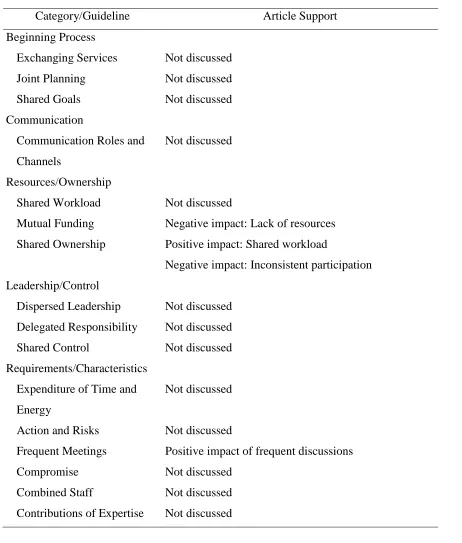
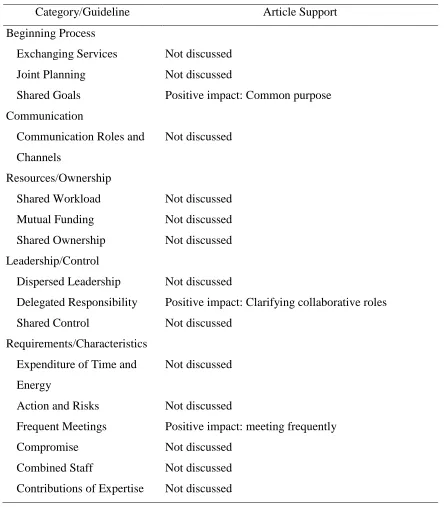
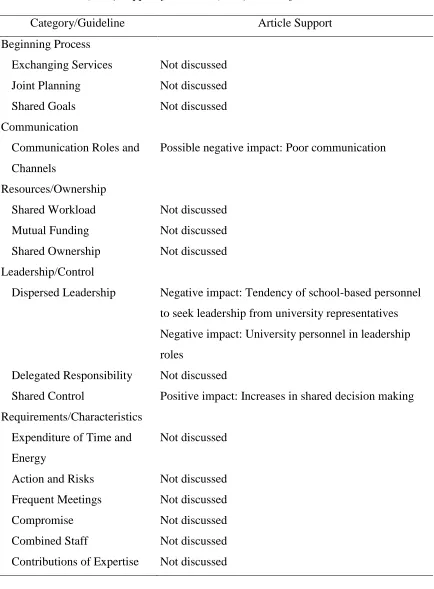
1 Hord’s (1986) Model of Inter-Organizational Collaboration ...25
2 Support of Hord’s (1986) Model of Collaboration ...27
3 Additional Factors Identified in Literature Review that were not Included by Hord (1986) ...38
4 Deslandes’ (2006) Support for Hord’s (1986) Model of Collaboration ....42
5 Baker and Martin’s (2008) Support for Hord’s (1986) Model of
Collaboration...46
6 Buys and Bursnall’s (2007) Support for Hord’s (1986) Model of
Collaboration...50
7 Weinstein et al.’s (1991) Support for Hord’s (1986) Model of
Collaboration...55
8 Frankham and Howes’ (2006) Support for Hord’s (1986) Model of
Collaboration...57
9 Brandon et al.’s (2008) Support for Hord’s (1986) Model of
Collaboration...60
10 Plateel et al.’s (2010) Support for Hord’s (1986) Model of
Collaboration...63
11 Robertson’s (2007) Support for Hord’s (1986) Model of Collaboration ...67
12 Miller and Hafner’s (2008) Support for Hord’s (1986) Model of
Collaboration...70
13 Rice’s (2002) Support for Hord’s (1986) Model of Collaboration ...84
14 Marlow et al.’s (2002) Support for Hord’s (1986) Model of
Collaboration...87
15 Coronel et al.’s (2003) Support for Hord’s (1986) Model of
Collaboration...91
16 Grundy et al.’s (2005) Support for Hord’s (1986) Model of
vi
18 Jaipal and Figg’s (2011) Support for Hord’s (1986) Model of
Collaboration...104
19 Synthesis of Hord’s (1986) Model of Inter-Organizational Collaboration and Additional Factors Found in Literature ...111
20 Support for Synthesis of Hord’s (1986) Model of Inter-Organizational Collaboration and Additional Factors Found in Literature ...118
21 Additional Factors not Addressed in Research-Based Model of Inter-Organizational Collaboration ...130
22 Collaboration Projects ...146
23 Stratification Sampling Grid ...150
24 Participant Involvement in the Collaboration and the Current Study ...153
25 Participant Demographics ...155
26 Invariant Constituent Samples ...164
27 Meaning Cluster Samples ...165
28 Sample Textural Statements ...168
29 Sample Structural Statements ...170
30 Participant Support for Collaborative Structure and Corresponding Subthemes ...177
31 Participant Support for Communication and Corresponding Subthemes ...184
32 Participant Support for Characteristics and Corresponding Subthemes ..191
33 Participant Support for Group Dynamics and Corresponding Subthemes ...208
34 Participant Support for Outcomes and Corresponding Subthemes...223
vii
viii
Figure Page
1 Methodology Presentation Overview ...139
2 Group Composition, Intangible Contributions, and Relevant Factors ...234
3 Goals, Focus, and Relevant Factors ...235
4 Assimilation, System Entry, and Relevant Factors ...238
5 Perceptions of Involvement and Relevant Factors ...242
6 Collaborative Roles and Relevant Factors ...252
7 Personality and Relevant Factors ...255
ix
BIP Behavior Intervention Plan
ELL English Language Learner
FBA Functional Behavioral Assessment
ICA Inter-Coder Agreement
ISPL In-Service Professional Learning
NCES National Center for Educational Statistics
NSDC National Staff Development Council
PSPL Pre-Service Professional Learning
RTI Response to Intervention
SC School-Community
UC University-Community
UCS University-Community-School
CHAPTER 1
INTRODUCTION
The current study explored the collaborative processes involved in a professional
learning focused university-community-school collaboration through the qualitative
methodology of transcendental phenomenology. The first chapter of this study provides a
brief overview of the purpose of the study, the literature on inter-organizational
collaboration in education, and the methodology used in the current study. In the second
chapter, the literature on inter-organizational collaboration with and without a
professional learning focus is explored in depth and compared to a model of
inter-organizational collaboration. The third chapter provides a detailed explanation of the
methodology used in the current study, as well as a description of the setting and
participant demographics. In chapter four, the data are presented according to
transcendental phenomenology recommendations. The fifth chapter includes a discussion
of the current contributions to the literature as well as a comparison of current findings to
a model of inter-organizational collaboration.
Overview of Inter-Organizational Collaboration with a Professional Learning Focus
Inter-organizational collaboration, or collaboration that involves two or more
organizations such as K-12 schools, universities, and community agencies, occurs in
various areas in education. For example, inter-organizational collaborations have been
developed to streamline service delivery to students and families (Baker & Martin, 2008),
develop embedded assessments for K-12 teachers (Brandon, Young, Shavelson, Jones,
Ayala, Ruiz-Primo, Yin, Tomita, & Furtak, 2008), and increase educational and
the collaboration includes building the capacity of educators to meet student needs, the
inter-organizational collaboration contains a professional learning, or high-quality
training, component. In a review of the literature on collaboration in education, no study
was identified that discussed the collaborative process involved in a professional learning
focused university-community-school collaboration.
Significance of Inter-Organizational Collaboration with a Professional Learning
Focus
There is a high demand for an inter-organizational approach to service delivery in
the field of education. Factors that have prompted this demand include issues such as
increasing student diversity (Hobbs & Stoops, 2002) and escalating social emotional and
behavioral struggles (Youth Risk Behavior Surveillance, 2010). Inter-organizational
collaboration has been called for in the areas of school-based delivery of mental health
services (Atkins, Graczyk, Frazier, & Abdul-Adil, 2003; Bierman, 2003; Nastasi, 2004),
conducting research (Adelman & Taylor, 2003; Karlsson, 2007), program planning for
students (Crockett, 2003), implementing systems-wide change (Shapiro, 2000;
Ysseldyke, 2000), and providing in-service professional learning to school psychologists
(Crocket, 2003).
The demand for increased inter-organizational collaboration in education is
supported by the research on benefits to students and educators. Correlations have been
observed between student achievement and inter- and intra-organizational collaborations
within educational settings (Goddard, Goddard, & Tschannen-Moran, 2007; McCoach,
Goldstein, Behuniak, Reis, Black, Sullivan, & Rambo, 2010). For example, an
students as measured by national and statewide assessments revealed that
over-performing schools tended to report higher levels of parent-teacher collaboration
(McCoach et al., 2010), suggesting the importance of the collaboration between home
and school. In within-school collaborations, increased teacher collaboration has been
correlated with higher student achievement in math and reading (Goddard et al., 2007).
It is possible that these benefits stem from more efficient resource allocation when
compared to traditional practices (Ehrhardt-Padgett et al., 2003; Goulet et al., 2003;
Hord, 1986; Mattesich & Monsey, 1992). Inter-organizational collaboration has the
potential to increase resources by combining personnel, funding, and knowledge
(Mattesich & Monsey, 1992). Combining personnel from multiple organizations for the
purpose of achieving a common goal might increase the amount of work that can be
accomplished (Hord, 1986; Mattesich & Monsey, 1992). Furthermore, the diversified
knowledge base available could allow for a more holistic approach to problem solving,
which can benefit students by addressing a wider range of variables which might
negatively impact academic, behavioral, or social-emotional functioning
(Ehrhardt-Padgett et al., 2003).
When focused on the development and delivery of high-quality professional
learning, inter-organizational collaboration may not only increase resources but has the
potential to leverage them in a way that produces more widespread outcomes.
Professional learning follows an indirect service delivery model intended to build the
capacity of educators to address student needs. When inter-organizational collaboration is
undertaken to develop and deliver professional learning, the multi-disciplinary, holistic
to the client. If the practitioners who receive the training work with a multitude of clients,
the number of clients who might benefit from the collaborative efforts is substantially
higher than might otherwise occur. Therefore, inter-organizational collaboration with a
professional learning focus represents a potentially beneficial approach to holistic,
widespread service delivery.
Significance of the Current Study
A review of the literature on inter-organizational collaboration in education
identified few articles that described the interpersonal processes and factors that
contributed to collaborative success. Within the identified articles, the focus of
collaborative efforts included practices such as school reform, the integration of school
and community service delivery in the areas of education and mental health, and the
pre-service preparation of future educators. No articles were identified that addressed the
collaborative processes involved in a professional learning focused inter-organizational
collaboration. Furthermore, the articles reviewed often exhibited poor methodological
rigor, limiting the reliability and generalizability of reported results.
Methodological limitations of the current literature base.
The most common methodological limitations identified in the articles reviewed
involved vague or limited sampling procedures. For example, in a study of a
university-community collaboration, Buys and Bursnall (2007) only obtained perceptions of the
collaboration from university representatives, excluding community contributions. In a
study describing a university-school collaboration, Frankham and Howes (2006) only
provided their own perceptions of the collaboration in which they were involved, failing
Westhuizen (2006) drew conclusions regarding the collaborative processes involved in
three intra-organizational professional learning communities from observations of
collaborative interactions. They did not obtain participant perceptions regarding those
interactions. Similar sampling limitations and vague sampling procedures were also
observed in studies by Deslandes (2006); Baker and Martin (2008); Weinstein, Soule,
Collins, Cone, Mehlhorn, and Simontacchi (1991); Brandon, Young, Shavelson, Jones,
Ayala, Ruiz-Primo, Yin, Tomita, and Furtak (2008); and Marlow, Kyed, and Connors
(2005).
Some studies reviewed also exhibited limitations with regard to their data analysis
methods. Specifically, Deslandes (2006), Marlow et al. (2005), and Coronel, Carrasco,
Fernéndez, and González (2003) each failed to specify the data analysis methodologies
employed in their studies. Miller and Hafner (2008) constricted their analysis of
interview data to the components of their theoretical framework of collaboration,
potentially limiting interpretations of participants’ perceptions. Grundy, Robison, and
Tomazos (2001) limited interpretation of school collaborators’ perceptions by only
asking questions about specific strengths and weaknesses perceived by the authors,
reducing the school collaborators’ opportunities to provide additional or opposing
viewpoints.
Possible features of successful inter-organizational collaborations.
Given the lack of rigorous research in the area, it is not surprising that little is
known regarding the factors that contribute to making collaborations successful
(Adelman & Taylor, 2003; Bierman, 2003). Many possible characteristics of successful
not research-based (Adelman & Taylor, 2003; Bierman, 2003). Authors have asserted
that merely expressing the desire to collaborate is insufficient (Adelman & Taylor, 2003).
Dividing labor between two or more organizations is also insufficient to guarantee
successful collaborative efforts (Goulet et al., 2003). A framework of practice such as
Hord’s (1986) model of inter-organizational collaboration might provide a starting point
for developing characteristics associated with successful collaborations; however, this
possibility has not yet been researched.
Hord (1986) proposed a model of inter-organizational collaboration that
organized 16 guidelines into 5 categories: beginning process, communication,
resources/ownership, leadership/control, and requirements/characteristics. Within the
category of beginning process, Hord proposed guidelines that were designed to assist
collaborators in engaging in new inter-organizational work. These included the guidelines
of exchanging services, joining forces, and agreeing upon goals. Exchanging services was
defined as follows: organizations should agree upon an exchange of products or services,
and each organization should offer the other a product or service. The joint planning
guideline stated that organizations should join forces to plan and execute the design of a
shared project. Furthermore, personnel from each organization should be involved in
developing the nature of the collaboration. The guideline of shared goals stated that
collaborators should develop shared goals for the collaboration. Organizations should
also agree on projected results, outcomes, products, and services.
Within the category of communication, Hord (1986) proposed the guideline of
establish defined roles and channels for communication to facilitate clear and accurate
conveyance of information.
The category of resources/ownership contains the guidelines of shared workload,
mutual funding, and shared ownership. Under the guideline of shared workload, Hord
stressed the importance that each organization contributes staff time, resources, and
capabilities. Contributions from each organization should be defined during the planning
process, according to this guideline. The guideline of mutual funding stated that
organizations should work together to obtain funding, possibly from an outside source,
for the express purpose of supporting the collaboration. The guideline of shared
ownership stated that shared ownership of the collaboration should develop over time.
The category of leadership/control contains the guidelines of dispersed leadership,
delegated responsibility, and shared control. According to the guideline of dispersed
leadership, collaborative leadership should be dispersed among the organizations. The
guideline of delegated responsibility stated that responsibility for collaborative tasks
should be delegated among the collaborators, and individuals should take initiative in
assuming responsibility. The guideline for shared control stated that collaborators should
assume shared, mutual control of the collaboration to facilitate congruent effort in
accomplishing collaborative tasks.
Within the category of requirements/characteristics, Hord (1986) proposed the
guidelines of expenditure of time and energy, action and risks, frequent meetings,
compromise, combined staff, and contributions of expertise. The guideline of expenditure
of time and energy stated that each organization should devote time and energy to the
take action and risks within the collaboration. The guideline of frequent meetings stated
that frequent large and small meetings between collaborators should be arranged. The
guideline of compromise stated that compromise is a necessity and that various trade-offs
must be made by each organization. The guideline of combined staff stated that a
combined staff, in which representatives from each organization are present, should be
developed. According to Hord, a staff trade or loan may be made to accomplish this goal.
Finally, the guideline of contributions of expertise stated that each organization should
contribute different kinds of expertise, as this is a primary motivator for collaborating.
Hord’s (1986) model of collaboration is not research-based; however, it is the
only identified model that addressed considerations unique to inter-organizational
collaborations. Furthermore, several of the guidelines proposed by Hord are corroborated
in other sources suggesting intra-organizational collaboration techniques.
Challenges associated with inter-organizational collaboration.
The limited research on the topic is concerning in the face of the unique
challenges associated with inter-organizational collaboration. Inter-organizational
collaboration in education is rare and often poor in quality (Farmakopoulou, 2002).
Members of different organizations might approach collaborations with dissimilar
priorities (Adelman & Taylor, 2003; Stokols, 2006). For example, in collaborations
between universities and schools or communities, university representatives are often
most concerned with research specific practices such as controlling environmental
variables and establishing comparison groups (Stokols, 2006). In contrast, school or
implementing effective practices across settings in ways that are feasible and fit within
existing environmental conditions.
Competing priorities between organizations can lead to collaborator frustration
and disillusionment, as occurred in Davies, Edwards, Gannon, and Laws’ (2007) attempt
to develop a theoretical approach to behavioral intervention through a university-school
collaboration. This “project gone awry” was characterized by poor communication and
“ongoing resistance and withdrawal” (Davies et al., 2007, p. 30). Participating teachers
expressed frustration with the university’s emphasis on theory as opposed to practical
intervention, and the university representatives experienced “irritation at the school-based
practitioners for not being open to the work required to develop new knowledge” (Davies
et al., 2007, p. 31). In short, the conflict between the university’s need for a
research-based partnership and the school’s need for practical professional development was too
divisive to overcome.
Stokols (2006) offers an explanation for such challenges. He asserts that the
increased complexity of inter-organizational collaboration when compared to
intra-organizational endeavors adds another dimension of difficulty to the task of establishing
and maintaining an effective collaborative relationship. As the number of stakeholders
increases, collaborators encounter progressively more diverse perceptions, needs, and
goals (Adelman & Taylor, 2003). Furthermore, political, economic, and personal interests
and concerns become more varied and multifaceted, presenting further challenges to
successful goal-oriented, interpersonal interactions.
An inter-organizational collaboration with a professional learning focus might be
other foci. High quality professional learning requires the provision of choice and
self-direction for professional learning participants (National Staff Development Council
[NSDC], 2001; Ryan & Deci, 2000; Lewis & Hayward, 2003). Therefore, some degree of
collaboration between trainers and participants is necessary in any standards-based
professional learning endeavor (NSDC, 2001). In a professional learning program
designed and developed through inter-organizational collaboration, the collaborators
must then negotiate the collaborative demands associated with inter-organizational
collaborations along with the collaborative demands placed upon them within the training
process.
Need for further research.
In conclusion, more information is needed regarding the process of establishing
and maintaining effective inter-organizational collaborations with a professional learning
focus (Stokols, 2006). Goddard, Goddard, & Tschannen-Moran (2007) asserted that
while correlational studies have shown the link between the practice of collaboration and
higher student achievement, more research is needed regarding the different types of
collaborative practices employed in effective collaborations. As Adelman and Taylor
(2003) and Beirman (2003) have noted, such research should focus on the specific
practices or individual behaviors that contribute to the development of successful
collaborative process. The dearth of methodologically rigorous studies assessing
inter-organizational collaborations, as well as the lack of studies on inter-inter-organizational
collaborations with a professional learning focus, suggest that a methodologically sound
Furthermore, the increased complexity of collaborating with multiple
organizations suggests the need for a holistic approach to the study of inter-organizational
collaboration. Specifically, the phenomenon of participating in an inter-organizational
collaboration would likely be best understood when examined from multiple
perspectives. Obtaining representatives from each organization as study participants
would facilitate the development of a more comprehensive view of the experience.
Moreover, studies of collaborations spanning multiple years or endeavors would produce
more trustworthy results when including participants who are representative of such
ranges in time and task. In summary, the credibility of the conclusions drawn by studies
of inter-organizational collaborations might be improved by holistic sampling techniques
and a comprehensive examination of collaborator perceptions.
Purpose of the Current Study
The current study addressed this gap in the literature by using a philosophically
grounded and systematic qualitative methodology to assess the collaborative process
involved in a professional learning focused university-community-school collaboration.
The collaboration under study was an on-going collaboration between an urban university
in the Southeast United States, a state-funded educational support agency (ESA), and
several urban and suburban school districts served by the ESA. The collaboration was
created to design and facilitate standards-based professional learning programs to K-12
educators. The collaboration, spanning five years, has involved collaborators with a
variety of educational backgrounds, years of experience in education and with
collaboration, and roles within the current collaboration. The collaborators involved have
initiation to current practice. Furthermore, the collaboration itself has resulted in the
development and facilitation of 13 professional learning programs designed to meet the
needs of personnel from 6 local school districts. These qualities make the collaboration
well suited for the intensive study of professional learning-focused inter-organizational
collaboration. As such, that the study of this collaboration provided valuable insight into
the practices necessary to establish and maintain an effective professional
learning-focused inter-organizational collaboration.
Current Research Methodology
Data were analyzed using Moustakas’s (1994) transcendental phenomenology
methodology, a qualitative methodology well-suited to study the proposed topic.
Transcendental phenomenology is grounded in transcendental philosophy, a philosophy
that asserts that while an objective reality exists, we can only know about that reality
through our perceptions. The transcendental philosopher learns about reality by
understanding noema, or what is perceived, and noesis, or how interpretation and
meaning of perceptions occur. According to this philosophy, the interaction between
noema and noesis results in an individual’s understanding of reality. Transcendental
phenomenology seeks to identify the essence or meaning of an experience, event, or thing
by obtaining perceptions of individuals who have been involved in that experience, event,
or thing. However, as individuals, our understanding of phenomenon is limited by our
own narrow experience with that phenomenon. Therefore, the transcendental
phenomenologist utilizes data collection methods designed to elicit descriptions of the
phenomenon under study from people who have a variety of experiences with that
one another to produce a well-rounded and comprehensive description of the
phenomenon.
To obtain a comprehensive understanding of the collaborative process involved in
the collaboration under study, perceptions were obtained from six university
representatives, three community agency representatives, one urban school district
representative, and six peri-urban school district representatives. Stratified random
sampling procedures for qualitative methodologies were utilized to obtain a
representative sample of participants for 12 individual and 2 group interviews (Creswell,
1998; Trost, 1986). Interviews were conducted by the primary researcher to ensure
consistency in data collection.
Interviews were analyzed by the primary researcher and a peer coder, who were
both participant observers within the collaboration under study. Data analysis was
accomplished using the systematic transcendental phenomenology data analysis process
proposed by Moustakas (1994). Within transcendental phenomenology, data analysis
consists of four broad phases: epoche, horizonalization, imaginative variation, and
synthesis. Epoche represents the beginning of an ongoing process of bias reduction.
During this phase, the primary and secondary researchers identified and documented their
preconceived biases regarding collaborative process as it occurs within collaborations in
general as well as the professional learning focused university-community-school
collaboration in particular. These biases were discussed and compared to research
conclusions periodically throughout the data analysis process.
The second phase of data analysis within this methodology involves the process
each interview transcript to identify statements that answered the research question.
These statements were compiled into a single document and examined for repeating and
overlapping statements. As per Moustakas’s (1994) recommendations, repeating
statements were removed from the data set. The remaining statements were grouped
according to meaning, resulting in meaning clusters. The meaning clusters provided a
coding manual, which was compared to each researcher’s epoche to determine the
presence of possible biases in coding and reduce the impact of those biases.
In imaginative variation, each transcript was re-coded for meaning using the
coding manual. Each coded transcript was then examined for statements that represented
the participants’ noema and noesis regarding the collaborative process involved in the
collaboration under study. The experiences of noema and noesis associated with the
collaboration were summarized into individual textural and structural descriptions for
each transcript.
The final phase of data analysis, synthesis, included both a summary of the
experience of collaborative process and a process of member checking to determine the
reliability of the results. First, the textural and structural descriptions for each transcript
were combined into individual textural-structural descriptions. According to Moustakas
(1994), these individual textural-structural descriptions represent the experience of
phenomenon under study as it was perceived by each individual collaborator. Each
participant reviewed their individual textural-structural description and was asked to look
for errors and omissions in interpretation. This process of member checking was
conducted in person whenever possible. When errors were observed, corrections were
description of the phenomenon of collaborative process as it occurs within a professional
learning-focused university-community-school collaboration, the corrected individual
textural-structural descriptions were then combined into one global descriptive summary
of the phenomenon. This global textural-structural description provides a comprehensive
explanation of the experience of collaborative process as it occurred within the
collaboration under study.
Presentation of these results included a description of each meaning code
employed during data coding as well as the frequency with which each meaning code was
applied. As each individual’s perceptions of the phenomenon under study are highly
valued within transcendental phenomenology, low frequency codes were not eliminated
or subsumed under other codes (Moustakas, 1994). The global descriptive summary of
the phenomenon under study was also included to convey the essence of the phenomenon
of collaborative process involved in a professional learning focused
university-community-school collaboration.
Research Question
The following research question guided the inquiry:
What are the university, community, and school representatives’ perceptions of
the collaborative process involved in a professional learning focused
Glossary of Terms
Collaboration – a mutually beneficial partnership between one or more parties entered
into for the purpose of achieving a common goal
Composite Textural-Structural Description (also referred to as Synthesis) – the
combination of the textural-structural descriptions developed for each participant
into one composite textural-structural description intended to describe the
phenomenon under study with intersubjective validity
Consultation – within the context of the collaboration under study, consultation activities
included discussions with district representatives regarding the type and extent of
PL services needed, appropriate PL content areas, and possible PL participants
Data Analysis – within the context of the collaboration under study, data analysis
consisted of analyzing student data to assist school personnel in data-based
decision-making practices
Didactic Training – within the context of the collaboration under study, didactic trainings
involved large group trainings consisting of lecture, interactive activities, and
discussion regarding PL content and application of PL content
Educational Support Agency – the community agency affiliated with the collaboration
under study; a state-funded agency developed to support local school systems
Epoche – the process researchers engage in within the methodology of transcendental
phenomenology to identify and eradicate their biases regarding the phenomenon
under study
Horizons – individual statements identified through the process of horizonalization within
Horizonalization – the transcendental phenomenology process of identifying every
statement made by participants that is relevant to the research questions under
study
Imaginative Variation – the transcendental phenomenology process of determining how
each participant in the study experienced the phenomenon under study and the
ways in which the participant described the phenomenon in relation to
themselves, their prior experiences, and other important variables such as time
and relationships with others
Implementation Support – within the context of the collaboration under study,
implementation support consisted of assistance from ESA representatives
provided to school personnel to utilize content and materials in the school setting
In-Service – the state of being engaged in professional practice in a particular field
Intra-Organizational Collaboration – a collaboration as defined above involving members
from a single organization such as a K-12 school, a university, or a community
agency
Inter-Organizational Collaboration – a collaboration as defined above involving members
from two or more organizations including, but not limited to, a kindergarten
through twelfth grade school, a university, or a community agency
Intentionality of Consciousness – a concept of transcendental philosophy referring to the
interaction between perception and interpretation of that perception which allows
us to know about the world
Intersubjective Validity – credibility of a description of a phenomenon which is derived
Invariant Constituents – those horizons which represent significant, non-repeating, and
non-overlapping statements relevant to the research questions in transcendental
phenomenology
Noema – a concept of transcendental philosophy referring to an individual’s perception
of a phenomenon
Noesis – a concept of transcendental philosophy referring to an individual’s interpretation
of their perception of a phenomenon
Observations – within the context of the collaboration under study, observations
consisted of PL facilitators observing teaching practices within the classroom
setting to determine the actual application of PL content with students; used to
assist in program planning and to measure the efficacy of the ESA
Phenomenological Reduction – the transcendental phenomenology process of
determining what each participant in the study experienced regarding the
phenomenon under study
Pre-Service – the state of being prior to practice within the field of education during
which preparatory training takes place
Professional Development School – a K-12 in which pre-service teachers and other
educators obtain applied practice with materials and concepts learned in the
pre-service training institution; usually involves collaboration between a training
university and a K-12 school
Professional Learning – the process of learning concepts and skills associated with one’s
professional area of practice
the purpose of exploring a topic or skill related to their profession; usually
involves individuals from within a single organization
Redeliver – the process of facilitating a previously attended training to additional
personnel; usually includes some degree of revision of the training by the
redeliverers who were participants in the initial training
School Reform – the process of changing systemic, or school-wide, practices in K-12
schools through changes in policy, data analysis, and/or teacher and administrator
practices; sometimes involves a formal PL component
Support Visits – small group, site-based visits conducted by PL providers for the purpose
of determining the learning status of PL participants and individualizing PL
content according to setting and participant needs
Structural Description – individual summary developed in the methodology of
transcendental phenomenology which describes how each participant experienced
the phenomenon under study, including consideration of variables which might
have impacted interpretation of the experience; a structural description is created
for each individual participant
Textural Description – individual summary developed in the methodology of
transcendental phenomenology which describes what each participant
experienced with regard to a specific phenomenon; a textural description is
created for each individual participant
Textural-Structural Description (also referred to as Synthesis) – the combination of the
textural and structural descriptions derived from each participant’s description of
for each individual participant
Training Revisions – within the context of the collaboration under study, training
revisions consisted of the examination of the acceptability and efficacy of PL
content and activities by previous PL participants for the purpose of modifying
said content and activities for future use within a specific school system; includes
the modification of content and activities
Transcendental Phenomenology – a qualitative methodology derived from the principles
of transcendental philosophy in which the essence or nature of a phenomenon is
understood through the analysis and synthesis of the descriptions of that
phenomenon as provided by individuals who have experienced the phenomenon
Transcendental Philosophy – a philosophy derived from the work of René Descartes and
Edmund Husserl, who sought to ascertain the relationship between reality and
perception
Universal Screening – an assessment process used to determine which student within a
school setting score in the lowest pre-determined percentile in a content area
when compared to all students within that setting; used to identify students who
CHAPTER 2
LITERATURE REVIEW
Introduction
This chapter provides a comprehensive review of the literature on collaboration in
education with a professional learning focus. The discussion begins with an assessment
of the need for organizational collaboration in education. A model of
inter-organizational collaboration is compared to literature on collaboration in education.
Several studies examining the strengths, weaknesses, and contributing factors within
inter-organizational collaborations are reviewed. Next, the focus turns to an argument for
standards-based professional learning delivered through inter-organizational
collaboration. Studies examining the strengths, weaknesses, and contributing factors in
professional learning focused collaboration are reviewed. Finally, a description is
provided regarding an appropriate methodology for examining perceptions of
collaborative processes involved an inter-organizational collaboration that was developed
to design and implement evidence-based professional learning to in-service educators.
Inter-Organizational Collaboration in Education
Significance of educational collaboration.
Several factors have influenced educators across disciplines to call for increased
collaboration. According to the U.S. Census Bureau, student diversity is increasing across
a range of demographic variables (Hobbs & Stoops, 2002). The No Child Left Behind
Act (NCLB) has increased instructional demands on educators in the form of higher
expectations for standards-based student achievement and educator accountability. In
behavioral struggles, increasing the demand on educators to address a range of
developmental needs (Youth Risk Behavior Surveillance, 2010). The scope of expertise
needed to successfully address this range of challenges may be best obtained through
collaboration with professionals with diverse and applicable areas of expertise (Crocket,
2003; Sheridan & D’Amato, 2003).
The call for collaboration has occurred not only across disciplines but across
applications. For example, authors called for greater collaboration in research, asserting
that universities should involve stakeholders in research processes (Adelman & Taylor,
2003; Karlsson, 2007). Greater collaboration has been called for in school-based delivery
of mental health services (Atkins, Graczyk, Frazier, & Abdul-Adil, 2003; Bierman, 2003;
Nastasi, 2004), program planning for students (Crockett, 2003), addressing child abuse at
the school and community levels (Crockett, 2003), providing services to English
language learners (ELL) in the mainstream setting (Arkoudis, 2006), implementing
systems-wide change (Shapiro, 2000; Ysseldyke, 2000), and establishing school-based
learning communities (Watkins, 2005). Finally, there has been a call for greater
collaboration with training institutions to provide in-service professional learning to
school psychologists (Crockett, 2003).
Need for inter-organizational collaboration.
Inter-organizational collaboration in education might allow K12 schools to access
the informational, personnel, and financial resources available within local universities
and community agencies, and vice versa. Intra-organizational collaboration, or
collaboration between members of a single organization, is often insufficient to address
need for increased inter-organizational involvement. This perspective is supported by
Hord (1986), who asserted that school improvement is best accomplished through
collaboration between schools and other stakeholder groups. Erhardt-Padgett,
Hatzichristou, Kitson, and Meyers (2003) suggested that collaboration between schools
and other organizations can improve and streamline service delivery. Baker and Martin
(2008) proposed that inter-organizational collaboration is an essential component of
integrated service delivery in schools. In conclusion, a turn toward inter-organizational
collaboration in educational settings is encouraged for effective service delivery.
Definition of inter-organizational collaboration.
Inter-organizational collaboration has been defined as a mutually beneficial
relationship between two or more organizations (Adelman & Taylor, 2003; Mattesich &
Monsey, 1992; Miller & Hafner, 2008) entered into for the purpose of achieving a
common goal (Adelman & Taylor, 2003; Goulet et al., 2003; James et al., 2007;
Mattesich & Monsey, 1992; Nelson & Slavit, 2008). In the field of education,
organizations involved might include, but are not limited to, K-12 schools or school
districts, universities, parents of K-12 students, and community agencies in the fields of
mental or physical health, social work, and educational support.
Model of collaboration.
There is a dearth of research-based suggestions regarding effective approaches to
collaborative process in the literature; however, several collaborative guidelines have
been proposed in non-empirical sources. Only one model was identified which
specifically addressed collaborative processes unique to inter-organizational
research-based, provides a framework for organizing 16 proposed guidelines into 5
categories: beginning process, communication, resources/ownership, leadership/control,
and requirements/characteristics. A summary of the categories and guidelines proposed
by Hord is displayed in Table 1. These guidelines are compared here to the findings of a
literature review on collaboration in the fields of health, social sciences, education, and
public affairs (Mattesich & Monsey, 1992), as well as several non-empirical sources
discussing collaborative process, in order to provide support for Hord’s model of
inter-organizational collaboration. Guidelines lacking support from other sources are noted in
this review. Table 2 depicts which guidelines of Hord’s model received support from
other sources.
Beginning process.
Three guidelines were proposed within the category of beginning process:
exchanging services, joining forces, and agreeing upon goals (Hord, 1986).
Exchanging services.
Hord (1986) suggested that collaborating organizations should agree on an
exchange of services or products. Each organization should offer the other a product or
service according to this guideline. This suggestion is reflected in proposed definitions of
collaboration, which state that collaborations should be founded on mutual benefit to
each participating organization (Adelman & Taylor, 2003; Mattesich & Monsey, 1992;
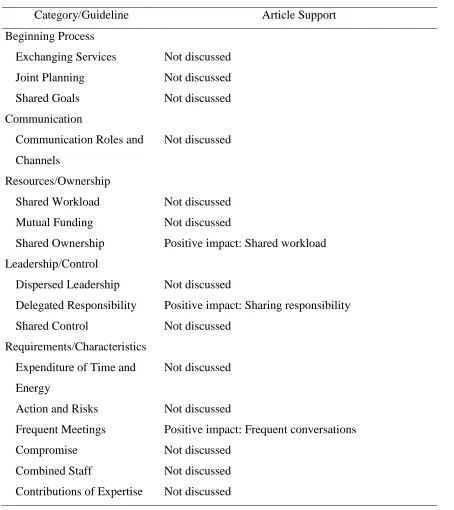
Table 1
Hord’s (1986) Model of Inter-Organizational Collaboration
Category/Guideline Definition Beginning Process
Exchanging services Organizations should agree upon an exchange of products or services. Each organization should offer the other a product or service.
Joint planning Organizations should join forces to plan and execute the design of a shared project. Personnel from each organization should be involved in developing the nature of the collaboration.
Shared goals Collaborators should develop shared goals for the collaboration. Organizations should agree on projected results, outcomes, products, and services. Communication
Communication roles and channels
Collaborators should establish defined roles and channels for communication to facilitate clear and accurate conveyance of information.
Resources/Ownership
Shared workload Each organization should contribute staff time, resources, and capabilities. Contributions from each organization should be defined during the planning process.
Mutual funding Organizations should work together to obtain funding, possibly from an outside source, for the express purpose of supporting the collaboration. Shared ownership Shared ownership of the collaboration should
develop over time. Leadership/Control
the organizations.
Delegated responsibility Responsibility for collaborative tasks should be delegated among the collaborators. Individuals should take initiative in assuming responsibility.
Shared control Collaborators should assume shared, mutual control of the collaboration to facilitate congruent effort in accomplishing collaborative tasks.
Requirements/Characteristics
Expenditure of time & energy Each organization should devote time and energy to the collaboration.
Action and risks Each organization should take action and risks within the collaboration.
Frequent meetings Frequent large and small meetings between collaborators should be arranged.
Compromise Compromise is a necessity. Various trade-offs must be made by each organization.
Combined staff A combined staff, in which representatives from each organization are present, should be developed. A staff trade or loan may be made to accomplish this goal. Contributions of
expertise
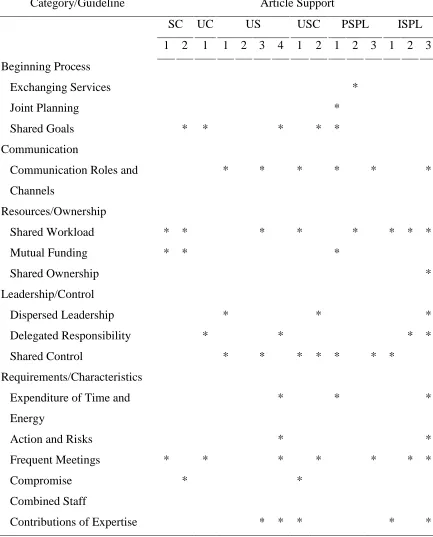
Each organization should contribute different kinds of expertise, as this is a primary motivator for
Table 2
Support of Hord’s (1986) Model of Collaboration
Category/Guideline Article Support
SC UC US USC PSPL ISPL 1 2 1 1 2 3 4 1 2 1 2 3 1 2 3 Beginning Process
Exchanging Services *
Joint Planning *
Shared Goals * * * * *
Communication
Communication Roles and Channels
* * * * * *
Resources/Ownership
Shared Workload * * * * * * * *
Mutual Funding * * *
Shared Ownership *
Leadership/Control
Dispersed Leadership * * *
Delegated Responsibility * * * *
Shared Control * * * * * * * Requirements/Characteristics
Expenditure of Time and Energy
* * *
Action and Risks * *
Frequent Meetings * * * * * * *
Compromise * *
Combined Staff
Contributions of Expertise * * * * *
Note: School-Community (SC) – 1= Deslandes (2006), 2= Baker & Martin (2008);
1=Weinstein et al. (1991), 2=Frankham & Howes (2006), 3=Brandon et al. (2008),
4=Platteel et al. (2010); University-School-Community (USC) – 1=Robertson (2007), 2=
Miller & Hafner (2008); Pre-Service PL-Focused Collaborations (PSPL) – 1=Rice
(2002), 2= Marlow et al. (2005), 3=Coronel et al. (2003); In-Service PL-Focused
Collaborations 1=Grundy et al. (2001), 2=Clark et al. (1996), 3=Jaipal & Figg (2011).
Joint planning.
Hord (1986) also suggested that organizations join forces to plan and execute the
design of a shared project. In other words, personnel from each organization should be
involved in developing the nature of the collaboration. The guideline of joint planning
does not appear to have been suggested explicitly in other sources. However, the
suggestions of shared decision making (Adelman & Taylor, 2003; Goulet et al., 2003;
Miller & Hafner, 2008) and shared workload (Adelman & Taylor, 2003; Mattesich &
Monsey, 1992) lend some support to this guideline.
Shared goals.
Hord’s (1986) final guideline within the category of beginning process was for
collaborators to develop shared goals for the collaboration. Hord suggested that
organizations should agree on projected results, outcomes, products, and services. The
importance of shared goals has been agreed upon by several authors (Adelman & Taylor,
2003; Goulet et al., 2003; James et al., 2007; Mattesich & Monsey, 1992; Miller &
Communication.
Hord (1986) proposed one guideline in the area of communication: defined roles
and channels of communication.
Communication roles and channels.
Specifically, Hord (1986) promoted the establishment of defined roles and
channels for communication across organizations. Hord suggested that multiple levels of
communication be developed to facilitate clear and accurate conveyance of information.
This category is supported by Mattessich and Monsey (1992), who determined that
formal and informal communication links between collaborators were characteristics of
successful collaborations.
Resources/ownership.
Hord (1986) proposed three guidelines in the area of resources/ownership: shared
workload, mutual funding, and shared ownership.
Shared workload.
First, Hord (1986) proposed the need for each organization to contribute staff
time, resources, and capabilities. Hord suggested that contributions be defined during the
planning process. The concept of shared workload has been recommended in the
literature on collaboration (Adelman & Taylor, 2003; Mattesich & Monsey, 1992).
Specifically, Mattesich and Monsey (1992) indicated that successful collaborations tend
to share the workload associated with collaborative goals
Mutual funding.
The second guideline stresses the importance of mutual funding. Hord (1986)
outside source, for the express purpose of supporting the collaboration. The importance
of funding has also been supported by the literature (Adelman & Taylor, 2003; Mattesich
& Monsey, 1992). According to Mattesich and Monsey (1992), collaborations that were
characterized as less successful cited a lack of funding as a contributing factor.
Shared ownership.
Hord’s (1986) final guideline within the category of resources/ownership
involved the development of shared ownership of the collaboration. This guideline was
not well-defined by Hord, presented only as a process that develops over time. While not
clearly defined, the concept of shared ownership has also received some support in
non-empirical literature (Goulet et al., 2003).
Leadership/control.
Within the category of leadership/control, Hord (1986) proposed three guidelines:
dispersed leadership, delegated responsibility, and shared control.
Dispersed leadership.
Hord (1986) asserted that collaborative leadership should be dispersed among the
organizations. Explicit support for this guideline was not identified in other sources. It is
possible, however, that dispersed leadership has not been mentioned in other sources
because it is a characteristic unique to inter-organizational collaborations. As noted
previously, Hord’s model of inter-organizational collaboration was the only model
identified that addressed the distinctive needs associated with collaboration between
Delegated responsibility.
According to Hord (1986), responsibility for collaborative tasks should be
delegated among the collaborators. Furthermore, individuals should take initiative in
assuming responsibility. This suggestion has been supported by other authors who have
asserted that collaborators should take joint responsibility for collaborative efforts and
outcomes (Adelman & Taylor, 2003; Mattesich & Monsey, 1992).
Shared control.
The third guideline under leadership/control involved the importance of shared,
mutual control. According to Hord (1986), shared control facilitates congruent effort on
the part of the collaborators. The literature in the area of educational collaboration has
supported the suggestion that collaborators should share in the decision making process
(Adelman & Taylor, 2003; Goulet et al., 2003; Miller & Hafner, 2008).
Requirements/characteristics.
Finally, Hord (1986) posited six requirements and characteristics of
inter-organizational collaboration which have not been mentioned explicitly in other
non-empirical studies: expenditure of time and energy, action and risks, frequent meetings,
compromise, combined staff, and contributions of expertise.
Expenditure of time and energy.
With the first requirement/characteristic, Hord (1986) asserted that each
organization should devote time and energy to the collaboration. No further definition or
Action and risks.
With the second requirement/characteristic, Hord (1986) proposed that each
organization should take action and risks within the collaboration. No further definition
or recommendation was given for this guideline.
Frequent meetings.
Hord (1986) suggested that frequent meetings be arranged between collaborators.
Both large and small meetings were recommended.
Compromise.
Hord (1986) also stressed the importance of compromise, citing it as a necessity.
According to Hord, various trade-offs made by each organization are required for
successful inter-organizational collaboration.
Combined staff.
The fifth requirement/characteristic involved the staffing arrangements within the
collaboration. Specifically, Hord (1986) asserted that a combined staff, in which
representatives from each organization are present, is important. Hord suggested the
possibility of a staff trade or loan as a means for developing a combined collaborative
staff.
Contributions of expertise.
Finally, Hord (1986) suggested that each organization contribute different kinds
of expertise. According to Hord, this characteristic is among the primary motivations for
Benefits of collaboration.
An examination of the potential benefits of collaboration provides insight into the
increased demand for the practice. Authors propose that collaboration can reduce the cost
of service delivery for each collaborating party (Ehrhardt-Padgett et al., 2003; Mattesich
& Monsey, 1992) while making services more accessible (Atkins et al., 2003; Bierman,
2003; Ehrhardt-Padgett et al., 2003; Hord 1986; Mattesich & Monsey, 1992), increasing
efficiency (Hord, 1986; Mattesich & Monsey, 1992), and improving results (Bierman,
2003; Hord, 1986; Ehrhardt-Padgett et al., 2003; Mattesich & Monsey, 1992). The
combined efforts of organizations can result in products or services that might not have
been possible if carried out by either organization alone (Hord, 1986). Furthermore,
collaboration can provide assistance to the professionals involved through the addition of
personnel, access to resources, and the provision of social support and encouragement
(Ehrhardt-Padgett et al., 2003; Goulet et al., 2003; Hord, 1986).
Challenges in implementation.
Despite the considerable demand for collaborative process, inter-organizational
collaboration in education is rare and often poor in quality (Farmakopoulou, 2002). We
still do not know exactly what factors contribute to making collaborations successful
(Adelman & Taylor, 2003; Bierman, 2003). Specifically, while many characteristics of
the collaborative process have been proposed, insufficient research has been conducted to
determine how to establish these characteristics as prescribed features of actual
collaborations. Adelman and Taylor (2003) assert that merely expressing the desire to
collaborate is insufficient. Goulet et al. (2003) add that simple division of the labor is also