Improvement of WiMAX Capacity of a Cell through
deploying Relay Stations and Adaptive Antennas
Manju Sharma1 Preeti Sharma2
M-Tech Student1, HOD 2 & Department of CSE & Delhi College of Technology & Management Palwal, Haryana, India
Abstract— Worldwide interoperability for Microwave Access
(WiMAX) is a wireless technology depending on IEEE 802.16 standard . A WiMAX cell which is to be taken into account in this study employs multicast mode of operation, the primary restriction of increasing the system capacity is the signal to noise ratio (subscribers near the base station employ ¾ Reed Solomon code and 64 QAM, while those which are close the border of the cell employs ½ Reed Solomon code and PSK to pay for the S/N impact). Results show that better capacity is obtained by presenting Adaptive Antenna System (AAS) and Relay Stations (RSs) to the cell with TDD mode of operation, other elements i.e. PHY and MAC layers overheads are analysed and considered in the computation of the capacity of system.
Keywords: WiMAX, Capacity, Overhead, Relay Stations, AAS.
I. INTRODUCTION
WiMAX systems depend on the IEEE802.16e-2005 standards for mobile services and IEEE 802.16d-2004 for static services and they describe a medium access control (MAC) layers and a physical (PHY) for broadband wireless access systems working at frequencies below 11 GHz. Relay stations are presented to improve the system capacity and range, they permit multi hop communication, which happens when data routes from the source node to the destination node through intermediary nodes. Thus, range of the network can be importantly increased without establishments of other expensive Base Stations. The traffic always leads from or to Base Station; therefore direct interaction between Subscriber Stations (SSs) is not taken into account. Adaptive antenna system (AAS) is an extra characteristic; it improves the capacity and coverage area as well as spectral efficiency. It has the benefit of employing only one antenna at subscriber station (SS) side, and as a result it makes easy the SS implementation process. This paper covers static WiMAX system which depends on IEEE 802.16d-2004 standard, it examines the overhead during system configuration particularly those concerned to the layers (MAC and PHY layers), also the throughput and capacity of the system are computed without and with Adaptive Antenna System (AAS).
II. PHY LAYER
The overhead concerned to the physical layer should be found to measure the WiMAX system capacity. According to [1], the channel bandwidth may change from 1.75 MHz to 28 MHz. The larger channel size can offer more radio resources and therefore the system capacity is larger. Due to errors occurred by imperfectness of the channel, Reed Solomon is utilized, it offers duplicates bits which must be conveyed with useful information for the objective of error detection and correction at the receiver side. The ratio of information to information plus duplicate bits is known as coding rate and may change from ½ to 3/4. WiMAX parameters are explained in Table (1).
Table 1: WiMAX (802.16d) Parameters
PARAMETERS VALUE
BANDWIDTH BW ( MHz) 20
symbol useful time ( μs) 11.64
CP time (μs) 2.91
overall symbol time ( μs) 14.55
OFDM Subcarriers 256
Data Subcarriers 192
At coding rate1/2, PHYOVERHEAD (%) 71.88 At coding rate3/4, PHYOVERHEAD (%) 57.81
DUPLEX TYPE TDD
Access FIXED
III. MAC LAYER
FDD (for licensed band only) and TDD (for licensed and licensed-exempt band) duplexing mechanisms are served by the MAC layer protocol in IEEE 802.16 standard. According to TDD duplex mechanism, each frame is classified into UL and DL sub frames. Each TDD frame has to begin with long preamble by which SSs may synchronize to the network. After DL long preamble, the Frame Control Header (FCH) adopts. It consists DL_Frame_Prefix (DLFP) which details up to 4 DL bursts (location and utilized burst profile type) [4]. The first DL burst involves MAC management flooded message, for example Dl-MAP, UL-MAP, DCD (Downlink Channel Descriptor), UCD (Uplink Channel Descriptor). In case that DL sub-frame contains of less than five bursts, DL-MAP message can be excluded but must be routed in a periodic manner to manage synchronization [2][4].
IV. PERFORMANCE OF RELAY STATIONS WiMAX similar to other wireless systems endures from radio propagation features. The accomplishable signal-to-noise ratio (SNR) reduces with an enhancing link distance. This shows low SNR at the cell border. Shadowing, which causes to non line of-sight (NLOS) interaction, further decreases the signal quality. The presentation of relay stations may importantly improve the link quality causing to throughput improvement and coverage increment. Therefore, relays permit offering broadband access to subscribers in remote locations. Moreover, a network can be flexibly accommodated to changing environmental conditions or user’s behavior. Two ideas to combine multi hop interaction into IEEE 802.16 standard are possible. The first one adopts a centralized mechanism, whereas the Base Station has complete control over the relay-improved cell. The second idea adopts a semi-disseminated mechanism, where RS coordinates the connected SSs performance. In the second situation, the MAC protocol complication of Relay Station is comparable to Base Station.
V. ADAPTIVE ANTENNA SYSTEMS
A smart antenna system integrates an antenna array with digital signal processing ability to obtain and transmit in a already described or adaptive, spatially sensitive way. This enables this system to change its radiation patterns directionality in response to a special signal environment. This result impressively enhances the performance features of a wireless system.
VI. SIMULATION MODEL DESCRIPTION AND ANALYSIS
Coding rate, cyclic prefix and 64 subcarriers (null and pilot subcarriers) from 256 subcarriers show the PHY layer overhead .The explanations are described in Table 1.
Parameter Value
Bandwidth( MHz) 20
OFDM subcarriers 256
Data subcarriers 192
null and pilot subcarriers 64
Symbol useful time (μs) 11.64
cyclic prefix time (μs) 2.91
Symbol time (μs) 14.55
Coding rate 1/2 3/4
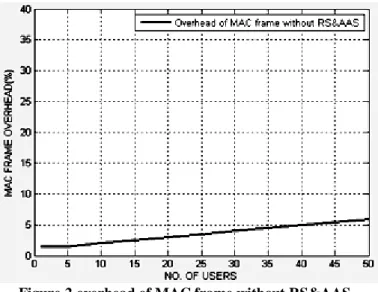
PHY overhead (%) 71.88 57.81 Table 1 the parameters of PHY layer overhead VII. SIMULATION AND RESULT ANALYSIS Figure 2 shows the MAC layer overhead percentage (without AAS & RS) as a function of the number of users.
Figure 2 overhead of MAC frame without RS&AAS. After involving AAS and RSs to the normal WiMAX cell, the overhead percentage of MAC layer is shown in Figure 3. It is apparent that the MAC layer overhead will be enhanced by almost a factor of two because of the presence of AAS and RSs.
Figure 3 overhead of MAC frame with AAS & RS. With AAS and RS there is extra of about 30% of users that can use the services of system without congestion.
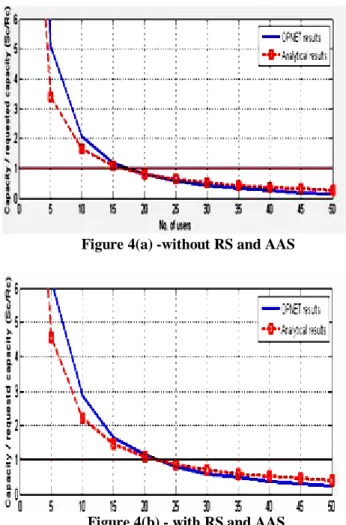
Figure 4(a) -without RS and AAS
Figure 4(b) - with RS and AAS.
Figure 5 shows the relationship between the number of users and Sc/Rc for the cases without and with RS and AAS utilizing analytical equations and for BR=1 Mbps and BR=4 Mbps.
Figure 5 Sc/Rc versus the number of users for bit rates 1 and 4 Mbps respectively
Figure 6 illustrates the relationship between the nominal bit rate and Sc/Rc for specified values of the number of users.
Figure 6 Shows Sc/Rc versus nominal bit rates. Again the number of users to be supported is reduced as the number of users grows, this is concerned to the enhancement of requested capacity. Figure 7 shows the relationship between length of frames and Sc/Rc without and with RS and AAS and for two values of number of users (10 and 50) .
Figure 7 Shows Sc/Rc versus length of frames for two values of number of users.
Throughput per user is illustrated in Figure 8 without and with AAS and RS . The curves indicate that at a number of users equal to 15, there is a benefit of 1Mbps in the throughput performance with RS and AAS in comparison of with the throughput without AAS and RS.
Figure 8 Throughput per user with and without AAS and RS
CONCLUSION
This paper as defined before covers the examiner and computation of PHY and MAC layers overheads without and with relay stations (RS) and Adaptive Antenna System (AAS), it concentrating on the impact of the number of users, length of frames and nominal bit rates on the system capacity to requested capacity and the throughput per user .The results indicate that the portion of the frame which is taken by the overheads is important, thus in the case of 50 users for example small length frames are not preferred ( LOF < 12ms ) because the small portion which is remained for data transmission .The system capacity performance is enhanced by utilizing the RS and AAS where nominal bit rate is equal to 1Mbps, 22 users can use the system resources against 17 users for the system without AAS and RSs, before congestion happens. The results indicate that the system capacity is reduced as the nominal bit rates and number of users is increased, which can be concerned to the requested capacity increment. It is worth to describe that some results are validated utilizing OPNET version (14), best agreement between analytical and OPNET results are achieved particularly when the number of users is greater than or equal to (10).
REFERENCES
[1] K.M Gharaibeh, K.G Gard, M.B Steer, "Accurate estimation of digital communication system metrics - SNR, EVM and ρ in a nonlinear amplifier environment," 64th ARFTG Microwave Measurements Conference, Fall 2004. , vol., no., pp. 41- 44, 2-3 Dec. 2004.
[2] F E Ismael - K. Syed Yusof and N Fisal “An efficient Bandwidth Demand Estimation for Delay Reduction in IEEE 802.16j MMR WiMAX Networks” International Journal of Engineering (IJE), Volume (3): Issue (6)
[3] D S Kumar and Dr. N.Nagarajan “Performance Analysis of IEEE 802.16j non Transparent mode Networks” Int. J. on Recent Trends in Engineering & Technology, Vol. 05, No. 01, Mar 2011
[4] N Poudyal, H C LEE, Y Jin KWON and B Seub LEE. “Delay-bound Admission Control for Real-time Traffic in Fourth Generation IMT-Advanced Networks based on 802.16m”. (2011), pages 31-37. [5] B. Bhattacharyya, I.S. Misra, S.K Sanyal, "The Effect of Varying Cyclic Prefix on Residual Constellation Error in OFDM technology using a novel Simulink-VSA based WiMAX Transceiver," 5th European Conference on Circuits and Systems for Communications (ECCSC) 2010, vol., no., pp.268-271, Serbia and Montenegro, 23-25 Nov. 2010.
[6] Michele Morelli and Umberto Mengali, Fellow, IEEE “A Comparison of Pilot-Aided Channel Estimation Methods for OFDM Systems”, IEEE Transactions On Signal Processing, VOL. 49, NO. 12, december 2001.
[7] Rebecca Morrison, Leonard J. Cimini, Jr., Sarah Kate Wilson “On the Use of a Cyclic Extension in OFDM”,
[8] Z. Zhao-yang and L. Li-feng, "A Novel OFDM Transmission Scheme with Length-Adaptive Cyclic Prefix," Journal of Zhejiang University SCIENCE, vol. 2004, pp. 1336-1342, 2004.
[9] Andrea Goldsmith, “Wireless Communication” Stanford University, Cambridge University Press
[10] T. S. Rappaport, “Wireless Communications: Principles & Practice”, Prentice Hall, 1995
[11] OPNET Documentation. http://www.opnet.com
[12] Xinjie Chang. “Network simulations with OPNET”. Winter Simulation Conference (WSC'99), pages 307-314, Phoenix, AZ, USA December 05- 08, 1999
[13] R.A Shafik; S. Rahman, AHM R.lslam , "On the Extended Relationships Among EVM, BER and SNR as Performance Metrics," International Conference on Electrical and Computer Engineering, 2006. ICECE '06., vol., no., pp.408-411, Dhaka, Bangladesh, 19-21 Dec. 2006.
[14] S Bhunia, I.S. Misra, S. K. Sanyal and A Kundu, "Performance study of Mobile WiMAX Network with Changing Scenarios under Different Modulation and Coding", Wiley Int. Journal of Communication System, DOl: 10.1002/dac.1217,201l.
[15] Iwan Adhicandra, Rosario G. Garroppo, Stefano Giordano, “Optimizing System Capacity and Application Delays in WiMAX Networks”, in Proc. ISWCS 2009.
[16] Abdul Qadir Ansari, Dr. Abdul Qadeer .K Rajput, Dr. Manzoor Hashmani, “WiMAX Network Optimization -Analyzing Effects of Adaptive Modulation and Coding Schemes Used in Conjunction with ARQ and HARQ”in Proc. Seventh Annual Communications Networks and Services Research Conference, 2009.
[17] L Garber, "Mobile WiMax: The Next Wireless Battle Ground," computer, vo1.41, no.6, pp.16-18, June 2008
[18] C. Tarhini, T. Chahed. "On capacity of OFDMA-based IEEE802.16 WiMAX including Adaptive Modulation and Coding (AMC) and intercell interference". Proceedings of 15th IEEE Workshop on Local and Metropolitan Area Networks, Princeton, NJ, U.S.A., pp. 139-144, 10-13
June 2007.
[19] S D'Alessandro, AM Tonello, L. Lampe, "On power allocation in adaptive cyclic prefix OFDM," IEEE International Symposium on Power Line Communications and Its Applications (ISPLC), 2010, vol., no., pp.183-188, 28-31 March 2010.
[20] B. Dusza, K. Daniel and e. Wietfield, "Error Vector Magnitude Measurement Accuracy and Impact on Spectrum Flatness Behavior for OFDM Based WiMAX and LTE systems", Wireless Communications, Networking and Mobile Computing(WiCOM'09), Beijing, China, pp. 1114-1117, Sept 2009.
[21] Aphira ksatyakul D., Boon-Chong Seet, Chiew-Tong Lau, “Evaluation of Terrain Effects on Mobile WiMax in a Vehicular Environment”, ITS Telecommunications 2008, pp.379-383, October 2008.
[22] Loutfi Nuaymi, ENST Bretagne, WiMAX-Technology for Broadband Wireless Access, Chapter 6, John Wiley & Sons Ltd, France, 2007.
[23] LaSorte, N.; Barnes, W.J.; Refai, H.H.; , "The History of Orthogonal Frequency Division Multiplexing," Global
Telecommunications Conference, 2008. IEEE GLOBECOM 2008. IEEE , vol., no., pp.1-5, Nov. 30 2008-Dec. 4 2008.
[24] James, L.B.; Moore, A.W.; Wonfor, A.; Plumb, R.; White, I.H.; Penty, R.V.; Glick, M.; McAuley, D. , "Packet error rate and bit error rate nondeterministic relationship in optical network applications, "Optical Fiber Communication Conference, 2005. Technical Digest, vol.4, no., pp. 3 pp. Vol. 4, 6-11 March 2005.
[25] Bottomley, G.E.; Wilhelmsson, L.R.; , "Recovering Signal Energy From the Cyclic Prefix in OFDM," Vehicular Technology, IEEE Transactions on , vol.57, no.5, pp.3205-3211, Sept. 2008 doi: 10.1109/TVT.2007.914057