Munich Personal RePEc Archive
The Economic Application Approach of
Fuzzy Logic Controller Type I and II for
Second Order Linear Systems
Tavakoli, Amir and Khazaei, Ehsan
Department of Mechanical Engineering, Islamic Azad University of
Shiraz, Shiraz, Iran
22 October 2016
1
The Economic Application Approach of Fuzzy Logic Controller Type I and II for Second
Order Linear Systems
Amir Tavakoli 1, Ehsan Khazaei 1
1 Department of Mechanical Engineering, Islamic Azad University of Shiraz, Shiraz, Iran
Abstract
During the last decades, Fuzzy Logic Controller (FLC) has been studied in many researchers. In this paper,
the applications of FLC for second order linear systems are reviewed. However, FLC has a good
performance for nonlinear systems as well. The main focus of this research is evaluating the FLC
performance for linear case study. Also a comparison between FLC and PI controller has been studied.
Moreover, both fuzzy type I and II are applied for evaluating the system performance. All the systems are
reviews from the economic perspective. It means that these methods tried to decrease the cost function of
the system. All the simulation and results are done in MATLAB environment.
Introduction
FLC is studied in many researches for both linear and nonlinear systems. For instance, fuzzy controller as
an adaptive controller for nonlinear systems have been reported [1], [2], and [3]. Also, the theorem of
fuzzy logic for linear Functions is defined in [4], [5]. However, fuzzy logic controller are studied for a
linear system in this paper. The applications of fuzzy logic controllers are a lot [6]. For instance in
electrical engineering, fuzzy logic is applied in the main structure of the DC/DC converter problem in [7].
Also, in [8] and [9], the fuzzy has been considered in many optimization power systems problems. In
[10] and [11], fuzzy has been applied to clustering data for wind renewable energies for the first time. On
the other hand, fuzzy logic controller type II has been considered in the main structure of the problems as
low voltage power systems. In this study, the Takagi Sugeno fuzzy controller is developed for fuzzy type
1 and type 2 [13].
Mathematical modelling of second order transfer function
A transfer function is a form of mathematical model between input and output of a system. “Transfer
functions are commonly used in the analysis of systems such as single-input single-output filters,
typically within the fields of signal processing, communication theory, and control theory. The term is
often used exclusively to refer to linear, time-invariant systems (LTI), as covered in this article.” [14].
The standard equation of a second order transfer function is:
G(s) =𝑆2+2𝜉𝑤𝑛𝑆+𝑤𝑛𝑤𝑛2 2
Where 𝑤𝑑 = 𝑤𝑛√1 − 𝜉2 . 𝑤𝑑 is called the damp natural frequency.
To obtain the poles of system we have:
𝑆2+ 2𝜉𝑤𝑛𝑆 + 𝑤𝑛2= 𝑜 → 𝑆 =−𝑏 ± √𝑏2− 4𝑎𝑐
2𝑎 =
−2𝜉𝑤𝑛 ± √(2𝜉𝑤𝑛)2− 4(𝑤𝑛2)
2
= 𝜉𝑤𝑛 ± √𝜉2𝑤𝑛2− 𝑤𝑛2 = (𝜉 ± √𝜉2− 1) 𝑤𝑛
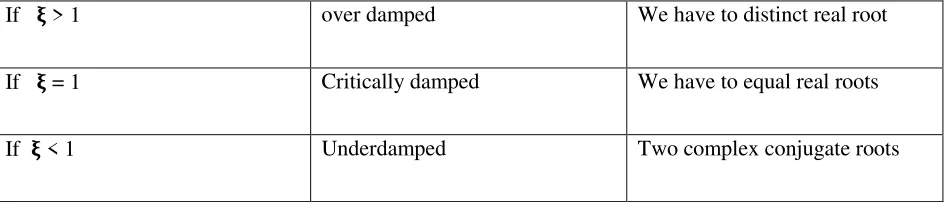
The damping of the second order transfer function can be found in the following table:
If 𝛏 > 1 over damped We have to distinct real root
If 𝛏 = 1 Critically damped We have to equal real roots
[image:3.612.75.548.554.655.2]If 𝛏 < 1 Underdamped Two complex conjugate roots
Figure 1: Step response for Under-damped, critically damped and over-damped systems
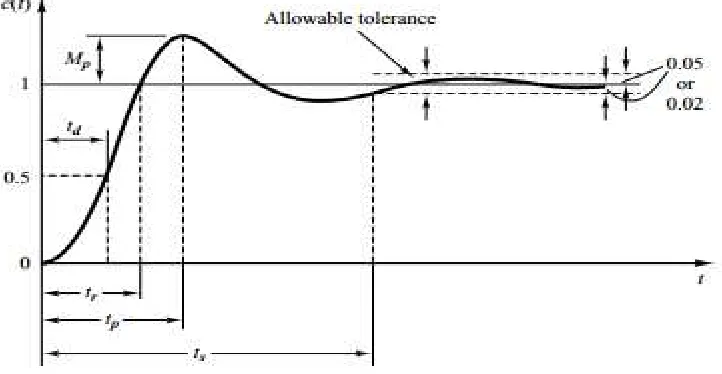
The final curve of a second order transfer function with a step unit source as an input is:
[image:4.612.126.487.424.611.2]Where
1. Delay time, 𝑡𝑑
2. Rise time, 𝑡𝑟
3. Peak time, 𝑡𝑝
4. Maximum overshoot, 𝑀𝑝
5. Settling time, 𝑡𝑠
According to [15]:
𝑀𝑝= 𝑒−(𝜉/√1−𝜉2) 𝜋
𝑡𝑠 = 𝜉𝑤4𝑛 (2% criterion)
𝑡𝑠 = 𝜉𝑤3
𝑛 (5% criterion)
𝑡𝑝= 𝑤𝑑𝜋
Fuzzy Logic
Fuzzy logic is a type of controller created by Lotfi A.Zadeh in 1956 and continued by Mamadani and
Sugeno theory. Todays, it has been applied to other sciences such as artificial intelligence, robotic, and
control theory. In practice, fuzzy logic controller has many applications such as:
• Nissan – fuzzy automatic transmission, fuzzy anti-skid braking system
• CSK, Hitachi – Hand-writing Recognition
• Sony - Hand-printed character recognition
• Canon developed an auto-focusing camera by fuzzy controller
“Compared to traditional binary sets (where variables may take on true or false values true), fuzzy logic
variables may have a truth value that ranges in degree between 0 and 1.
Fuzzy logic has been extended to handle the concept of partial truth, where the truth value may range
between completely true and completely false”.[16-22]
There are two types of Fuzzy controller in Matlab Simulink:
1- Mamadani: has a membership function in the output of the controller. No mathematical calculation
is needed.
2- Sugeno: has a real number in the output but requires a mathematical model to achieve the output
number.
In this project, Sugeno Fuzzy controller had been used.
Results
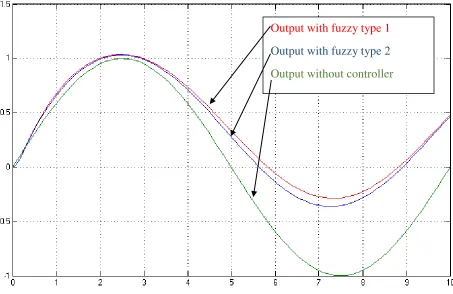
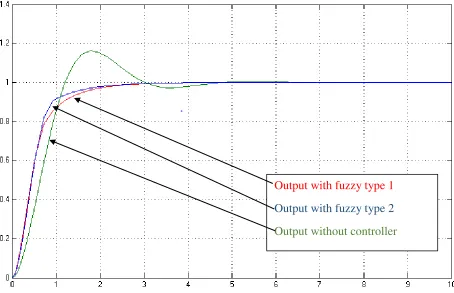
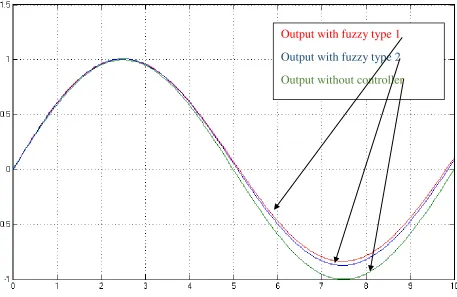
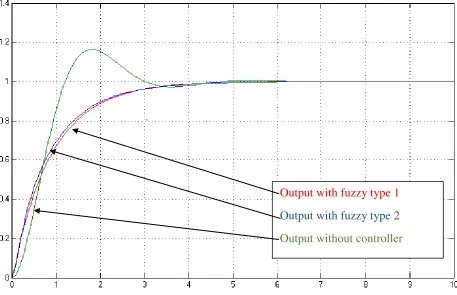
The final simulation and results of the fuzzy controller for both step and sine wave response are:
Figure 3: Sine wave frequency is 0.1 (Hz). The output of fuzzy is (-3 2 3)
Output with fuzzy type 1
Output with fuzzy type 2
Figure 4: Step response when fuzzy output is (-3, 2, 3)
Results of (-20 2 20) as the output of fuzzy controller is:
Output with fuzzy type 1
Output with fuzzy type 2
Figure 5:Sine wave frequency is 0.1 (Hz). The output of fuzzy controller is (-20, 2, 20).
Output with fuzzy type 1
Output with fuzzy type 2
Figure 6: Step response when fuzzy output is (-20, 2, 20)
Output with fuzzy type 1
Output with fuzzy type 2
Conclusion
In this project, analysis of fuzzy controller type 1 and type 2 has been studied for second order
linear systems. The performance of the control system has been studied for two different inputs:
step response and sine wave response. Base on the finding, the operation of the fuzzy controller
type 2 is better than type 1. Root square error and mean square error has been analyzed too. Base
on the finding root mean square error and mean square error of fuzzy controller type 2 is lower than
fuzzy controller type 1. Also, for the step input, rising time and steady state of the fuzzy type 2 is
faster than type 1.
References
[1] Martin Kratmüller, “The Adaptive Control of Nonlinear Systems Using the T-S-K Fuzzy Logic”, SIEMENS PSE sro Slovakia Dúbravská cesta 4, 845 37 Bratislava, Slovak Republic, Vol. 6, No. 2, 2009.
[2] Xin Wang, Edwin E. Yaz, James Long and Tim Miller,” Fuzzy Control of Nonlinear Systems
with General Performance Criteria” ©2012 Wang et al., licensee InTech.
[3]David F. Jenkins, Kevin M. Passino, “An introduction to nonlinear analysis of fuzzy control systems”. Journal of intelligence and fuzzy systems.
[4] Fernando di Sciascio, Ricardo Carelli,” Fuzzy Representation Theorem of Linear Functions Automatic
Control Applications”, INSTITUTO DE AUTOMATICA, UNIV. NAC. DE SAN JUAN, Av. San Martin
1109(O), 5400 San Juan, ARGENTINA
[5] Şahin Emrah Amrahov, Iman N. Askerzade, “Strong Solutions of the Fuzzy Linear Systems” Ankara University, Computer Engineering Department.
[6] Nilesh N. Karnik, Jerry M. Mendel, Fellow, IEEE, and Qilian Liang, “Type-2 Fuzzy Logic Systems”, IEEE TRANSACTIONS ON FUZZY SYSTEMS, VOL. 7, NO. 6, DECEMBER 1999
[7] Khazaei, P., S. M. Modares, M. Dabbaghjamanesh, M. Almousa, and A. Moeini. "A High Efficiency DC/DC Boost Converter for Photovoltaic Applications." International Journal of Soft Computing and Engineering (IJSCE) ISSN (2016): 2231-2307.
[8] Mehrtash, Mahdi, Masoud Jokar Kouhanjani, and Mohammad Mohammadi. "A new nonparametric density estimation for probabilistic security-constrained economic dispatch." Journal of Intelligent & Fuzzy Systems Preprint: 1-12.
[9] Mehrtash, Mahdi, Mahdi Raoofat, Mohammad Mohammadi, and Hamidreza Zareipour. "Fast
stochastic security‐constrained unit commitment using point estimation method." International
[10] Ashkaboosi, Maryam, Seyed Mehdi Nourani, Peyman Khazaei, Morteza Dabbaghjamanesh, and Amirhossein Moeini. "An Optimization Technique Based on Profit of Investment and Market Clearing in Wind Power Systems." American Journal of Electrical and Electronic Engineering 4, no. 3 (2016): 85-91.
[11] Mehrtash, Mahdi, Masoud Jokar Kouhanjani, Amir Pourjafar, and Seyedbehnam Beladi. "An Interior Point Optimization Method for Stochastic Security-constrained Unit Commitment in the Presence of Plug-in Electric Vehicles." Journal of Applied Sciences 16, no. 5 (2016): 189.
[12] Dabbaghjamanesh, M., A. Moeini, M. Ashkaboosi, P. Khazaei, and K. Mirzapalangi. "High performance control of grid connected cascaded H-Bridge active rectifier based on type II-fuzzy logic controller with low frequency modulation technique." International Journal of Electrical and Computer Engineering (IJECE) 6, no. 2 (2016): 484-494.
[13] “Fuzzy logic”, http://en.wikipedia.org/wiki/Fuzzy_logic, Nov. 2014
[14] L. A. Zadeh, Fuzzy sets, Informat Control. 1965, pp 338-353
[15] Li-Xin Wang, A course in Fuzzy Systems and Control, Prentice-Hall
[16] Mohammad Reza Rajati, Jerry M. Mendel, Modeling Linguistic Probabilities and Linguistic Quantifiers Using Interval Type-2 Fuzzy Sets. Proceedings of 2013 Joint IFSA World. 2013.
[17]Khazaei, Peyman, Morteza Dabbaghjamanesh, Ali Kalantarzadeh, and Hasan Mousavi. "Applying the modified TLBO algorithm to solve the unit commitment problem." In World Automation Congress (WAC), 2016, pp. 1-6. TSI Enterprise Inc (TSI Press), 2016.
[18] Mei-Hui Wang, A Type-2 FML-Based Fuzzy Ontology For Dietary Assessment, Fuzziness and Soft Computing. 2013, Volume 296, pp 149-168
[19] N. N. Karnik, J. M. Mendel, and Q. Liang, Type-2 fuzzy logic systems, IEEE Trans Fuzzy System. 1999, pp 643-65
[20] Shing-Chung Ngan, A type-2 linguistic set theory and its application to multi-criteria decision making, Computers and Industrial Engineering. 2013, Volume 64 Issue 2, pp. 721-730
[21] Danling Wang and Yanfei Wang, Disease-Related Gene Identification by an Improved Type-2 Fuzzy Method on Microarrays, Journal of Engineering Science and Technology. 2013, Review 6 (2), pp 78-84