The Effects of NdF
2on Current Efficiency of Nd Extraction
from NdF
3-LiF-Nd
2O
3Melts
Xiaolong Liu, Chao Huang and Bing Li
*East China University of Science and Technology, 130Meilong Road, Shanghai 200237, P.R. China
In this paper, the cyclic voltammetry was applied to investigate the electrochemical reduction processes of Nd(III) ions in NdF3-LiF melts
with or without excessive metal Nd. Equilibrium experiments were carried out in NdF3-LiF melts with excessive spheric metal Nd to investigate
the relationship between the NdF3:LiF mass ratio and NdF2 concentration. Electrolysis experiments were performed in NdF3-LiF-Nd2O3 melts
with different NdF3:LiF mass ratios to explore the relationship between the NdF2 concentration and the current efficiency.
The results indicated that Nd(III) ions in the melts were reduced in two steps, i.e., Nd(III)→Nd(II) and Nd(II)→Nd(0). NdF2 could be
formed by the comproportionation reaction between Nd(III) and Nd(0) and could stably exist in NdF3-LiF melts containing metal Nd(0). NdF2
mass concentration in the melts decreased from 45.5% to 36.4% with the increase of NdF3-LiF mass ratio from 7:3 to 9:1 in NdF3-LiF melts
containing excessive spheric metal Nd, which resulted in a higher current efficiency during the electrolysis. And the highest current efficiency of about 50% for Nd extraction has been obtained by electrolysis in NdF3-LiF (9:1 mass ratio) melts with Nd2O3 (2%, mass concentration) at
1423 K. [doi:10.2320/matertrans.MK201611]
(Received August 31, 2016; Accepted November 28, 2016; Published February 10, 2017)
Keywords: NdF2, current efficiency, NdF3-LiF, comproportionation reaction
1. Introduction
Currently, NdF3-LiF-Nd2O3 melts are mainly used to
ex-tract neodymium (Nd) by molten salts electrolysis due to their higher current efficiency than that of chloride melts, such as NdCl3-KCl melts. However, the current efficiency for
Nd extraction from the NdF3-LiF-Nd2O3 melts is about 70%–
80%, lower than that of aluminium electrolysis (about 92%). According to professor Zhu s research1), the lower current
ef-ficiency for Nd extraction from NdCl3-KCl melts is partly
caused by Nd consumption and corresponding to Nd(II) for-mation by the comproportionation reaction between the Nd(0) and Nd(III). A. Novoselova et al.2), S.Vandarkuzhali et
al.3) and Hajimu Yamana et al.4) have confirmed that the
Nd(III) ions in the NdCl3-KCl melts are reduced to Nd(0)
through two consecutive steps, i.e., Nd(III)→Nd(II) and
Nd(II)→Nd(0). Therefore, they have concluded that the
Nd(II) ions can stably exist in molten LiCl-KCl-NdCl3 at
773 K4) and LiCl-KCl-CsCl-NdCl
3 melts after electrolysis at
810–840 K2). But so far the existence of stable Nd(II) ions in
fluoride melts is ambiguous. The cathodic processes of Nd(III) in fluoride melts revealed by C. Hamel et al.5) showed
that Nd(III) ions are reduced to Nd(0) in a one-step process in LiF-CaF2 melts. E. Stefanidaki et al.6) have also shown that
Nd(III) ions are reduced to Nd(0) via a three-electron reaction in NdF3-LiF-Nd2O3 melts. But in our previous researches7,8),
we have found that the Nd(III) ions in the NdF3-LiF melts are
reduced through two consecutive steps, similar to the reduc-tion process in the chloride melts. So in this paper, we further investigated the existence of Nd(II) ions in NdF3-LiF melts
with excessive spheric metal Nd. The effect of the NdF3/LiF
mass ratio on the concentration of Nd(II) in NdF3-LiF melts
with excessive spheric metal Nd and on the current efficiency for Nd extraction from the NdF3-LiF-Nd2O3 melts by
elec-trolysis has also been researched.
2. Experiments
All the experiments were carried out in a graphite crucible or a Mo crucible, which was placed in an airtight stainless steel reactor with cooling water. The reactor was heated in an electric furnace to the designated temperature. A K-type ther-mocouple with an accuracy of ±1 K was used to measure the experiments temperature. Before the experiments, the chemi-cals including LiF (aladdin, 99.9% purity), NdF3 (aladdin,
99.9% purity) and Nd2O3 (aladdin, 99.9% purity) were
pre-treated under argon gas (99.99% purity) according to the fol-lowing steps: First, each chemical was placed in a graphite crucible (spectrographic purity) and then heated to 673 K and remained for 8 h to remove traces of moisture in the airtight stainless steel reactor under the pressure of 0.016 MPa. Then the chemical was further heated to 1073 K and maintained for 2 h at 1073 K under argon gas atmosphere with a flow rate of 1.2 L/h. At last, the chemical was taken out from the reactor after cooling to room temperature (about 298 K) and stored in
a glove box under argon gas with both O2 and H2O levels
below 1 ppm before using.
During the electrochemical measurements, the three-elec-trode system was used, in which the working electhree-elec-trode and reference electrode were W wires (99.9%, dia.1 mm), the auxiliary electrode was graphite rod (spectrographic purity, dia.7 mm). And the electrochemical experiments were per-formed by using a PAR-STAT2273 (PAR-Ametek Co, Ltd.) with a PowerSuite software package. For all the electrochem-ical experiments, the potentials were transferred to Li+/Li
according to literatures7). In the electrolysis experiments, a
two-electrode system was used, in which the anode was graphite plate (6 mm × 25 mm × 50 mm spectrographic puri-ty) and the cathode was W plate (2 mm × 8 mm × 55 mm). Before the experiments, all the electrodes and graphite cruci-bles were polished by SiC emery papers to the mirror finish, washed with distilled water, then dried under argon atmo-sphere.
During the experiments, the salt mixtures (NdF3-LiF,
*
Corresponding author, E-mail: [email protected]
mixtures were further heated to the designated temperature in 5 h under argon gas atmosphere with a flow rate of 1.2 L/h.
3. Results and Discussion
3.1 Nd(III) ions electrochemical reduction processes
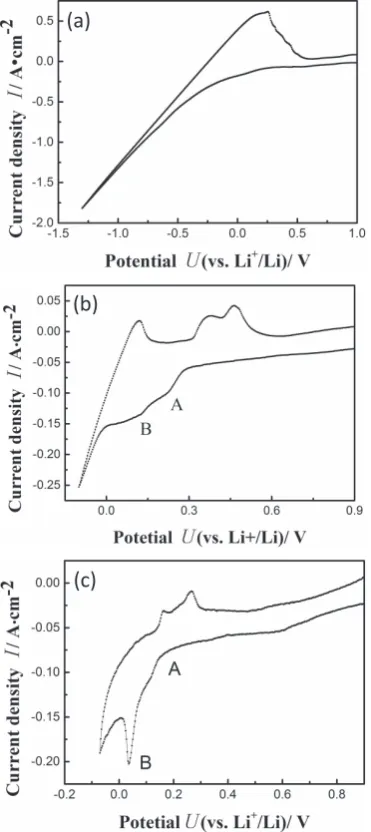
In Fig. 1, the cyclic voltammograms (CVs) on the W elec-trode were measured to investigate the reduction processes of Nd(III) ions in the NdF3-LiF melts. Compared with the
back-ground CV in LiF melts in Fig. 1(a), the CVs in the NdF3-LiF
(50:1 mass ratio) melts in Fig. 1(b) and NdF3-LiF (50:3 mass
ratio) melts with excessive spheric metal Nd(0) in Fig. 1(c) have shown two reduction peaks and two corresponding oxi-dation peaks. As we reported in the previous work7,8), the
Nd(III) ions in fluoride melts were reduced in two steps, i.e.,
2 3
spheric metal Nd
Equilibrium experiments were carried out in NdF3-LiF
melts with excessive spheric metal Nd (compared with Nd(III) ions amount in the melts) in Mo crucible at 1323 K to investigate NdF2 concentration in the melts. The Mo crucible
[image:2.595.77.263.325.742.2]with the above mixture was situated in an airtight stainless steel reactor and heated to 1323 K for 2 h under argon gas atmosphere. Then the mixture was cooled to room tempera-ture (about 298 K) naturally and taken out from the crucible under argon gas atmosphere. The surface morphology of the spheric metal Nd was compared before and after experiments. The mass loss of the spheric metal Nd was calculated. The phase composition of the melts at different positions shown in
Fig. 2 was analyzed by XRD to investigate NdF2
concentra-tion caused by the comproporconcentra-tionaconcentra-tion reacconcentra-tion between Nd(III) and Nd(0).
For the mixture of NdF3-LiF (7:3 mass ratio, total mass of
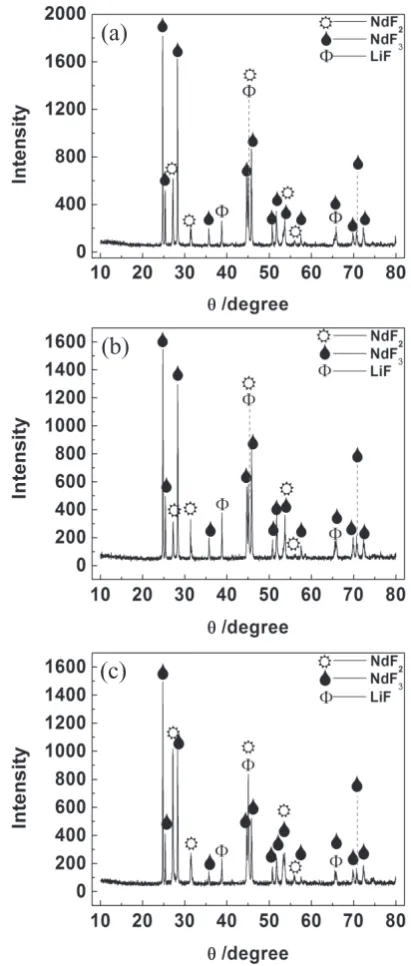
12.86 g) with excessive spheric metal Nd (5.8 g), the geomet-ric shape of metal Nd has changed from its initial sphere to semiellipse after the equilibrium experiments shown in Fig. 3. And the mass of metal Nd decreased by 35 mass% (2.03 g). The melts phase composition at different positions including on the metal Nd surface and far away from the metallic Nd surface has presented NdF2 phase according to Fig. 4. The
average NdF2 concentration in the melts was about 45.5%
(mass concentration) by calculation according to 2Nd(III) +
Fig. 1 The cyclic voltammograms recorded on W electrode (a) in LiF melts (b) in NdF3-LiF (50:1 mass ratio) melts (c) in NdF3-LiF (50:3 mass
ra-tio)-Nd (excess) melts with 100 mV/s and an immersion area of 0.53 cm−2
at 1323 K.
Fig. 2 Schematic of equilibrium experiments including the different melts positions for XRD analysis: 1--melts away from the spheric metal Nd; 2--the melts between the spheric metal Nd and Mo crucible; 3--melts on the spheric metal Nd surface; 4--Mo crucible; 5--NdF3-LiF melts; and 6-
spheric metal Nd.
Fig. 3 (a) Initial spheric metal Nd surface morphology before the equilibri-um experiments, (b) metal Nd surface morphology and (c) metal Nd side morphology after the equilibrium experiments in the NdF3-LiF (7:3 mass
[image:2.595.339.513.469.567.2] [image:2.595.324.527.657.745.2]Nd(0) = 3Nd(II) reaction.
For the mixture of NdF3-LiF (9:1 mass ratio, total mass of
10 g) with excessive spheric metal Nd (6 g), the geometric shape of metal Nd has changed from its initial sphere to semiellipse after the equilibrium experiments shown in Fig. 5, and the mass of metal Nd decreased by 23 mass% (1.38 g). The melts phase composition at different positions as shown in Fig. 2 has presented NdF2 phase according to Fig. 6. The
average NdF2 concentration in the melts was about 36.4%
(mass concentration) by calculation according to 2Nd(III) + Nd(0) = 3Nd(II) reaction.
The above results revealed that NdF2 could form and stably
exist because of the comproportionation reaction between
Nd(III) and metal Nd(0). As NdF3-LiF melts composition
changed from 7:3 mass ratio to 9:1 mass ratio, the metal Nd
Fig. 4 XRD patterns of the melts (a) at position 1 of Fig. 2; (b) at position 2 of Fig. 2; (c) at position 3 of Fig. 2 after the equilibrium experiments in the NdF3-LiF (7:3 mass ratio, total mass of 12.86 g) melts with Nd (5.8 g)
at 1323 K.
Fig. 5 (a) Initial spheric metal Nd surface morphology before the equilibri-um experiments, (b) metal Nd surface morphology and (c) metal Nd side morphology after the equilibrium experiments in NdF3-LiF (9:1 mass
ra-tio, total mass of 10 g) melts with Nd (6 g) at 1323 K.
Fig. 6 XRD patterns of the melts (a) at position 1 of Fig. 2; (b) at position 2 of Fig. 2; (c) at position 3 of Fig. 2 after the equilibrium experiments in NdF3-LiF (9:1 mass ratio, total mass of 10 g) melts with Nd (6 g) at
[image:3.595.66.274.66.542.2] [image:3.595.323.526.72.157.2] [image:3.595.322.528.236.720.2]36.4%.
According to the Ref. 9), as NdF3-LiF mass ratio increased
from 7:3 to 9:1, Li+ ions concentration in NdF
3-LiF melts
de-creased and less free Nd(III) ions were released from more stable NdF63− ions. So the comproportionation reaction of
2Nd(III) + Nd(0) = 3Nd(II) was shifted to the left hand side. Therefore less NdF2 was formed and higher current efficiency
could be obtained.
3.3 Current efficiency for Nd extraction from NdF3-LiF-Nd2O3 melts
In order to explore the relationship between the NdF2
con-centration and the current efficiency for Nd extraction, elec-trolysis experiments were performed in the NdF3-LiF melts
(500 g) with various NdF3:LiF mass ratio of 9:1, 8.5:1.5, 8:2
and 7:3 with Nd2O3 (2% mass concentration) at 1323 K,
1373 K and 1423 K, respectively. The current density was se-lected as Ianode = 3700 A·m−2 and Icathode = 18500 A·m−2, and
the polar distance was 0.056 m during the electrolysis exper-iments. After the electrolysis experiments, the current effi-ciency was calculated in term of eq. (1) and shown in Fig. 7.
η= W
CIt×100% (1)
η: current efficiency; W: the amount of Nd, g; I: the average current, A; t: time, h; C: electrochemical equivalent, g·(A·h)−1.
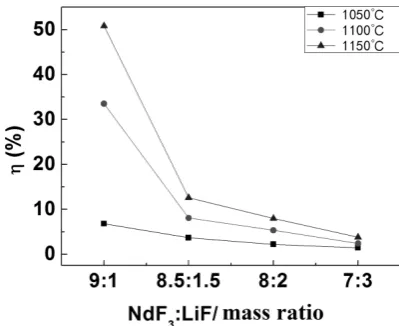
According to Fig. 7, the current efficiency increased in dif-ferent NdF3:LiF mass ratio conditions as the temperature
in-creased from 1323 K to 1423 K. This was because the metal Nd obtained in the cathode was subject to aggregate to a big-ger sphere from lots of smaller particles, as shown in Fig. 8. Therefore the smaller specific surface area of the Nd at 1423 K greatly reduced both of the consumption of metal Nd
and NdF2 concentration in the melts by the
comproportion-ation reaction.
As NdF3-LiF mass ratio increased from 7:3 to 9:1, the
cur-rent efficiency for Nd extraction increased from about 3% to 7% at 1323 K, from 5% to 35% at 1373 K and from 5% to 50% at 1423 K, respectively. At the same temperature, the NdF3:LiF mass ratio had a significant effect on the current
efficiency, especially at 1423 K. This was because the con-centration of NdF2 decreased in the melts as the NdF3:LiF
mass ratio changed from 7:3 to 9:1, which was in good agree-ment with our previous results. And the electrolyte composed of NdF3-LiF (9:1 mass ratio) with Nd2O3 (2%, mass
concen-tration) at 1423 K has presented the highest current efficiency of about 50%. Currently, the industrial current efficiency for Nd extraction by electrolysis was about 70% 80%, higher than our experiment value. This was because that the elec-trode distance, current density and temperature in our experi-ments were different from the industrial conditions.
4. Conclusions
The electrochemical reduction processes of Neodymium
ions in NdF3-LiF melts with or without excessive spheric
metal Nd were measured. The results indicated that neodym-ium ions in the fluoride melts were reduced in two steps, i.e.,
Nd(III)→Nd(II) and Nd(II)→Nd(0). NdF2 could be formed
by the comproportionation reaction between Nd(III) and Nd(0) and stably exist in NdF3-LiF melts containing metal
Nd(0). NdF2 mass concentration in the melts decreased from
45.5% to 36.4% with the increase of NdF3-LiF mass ratio
from 7:3 to 9:1 in NdF3-LiF melts containing excessive
spheric metal Nd, which resulted in a higher current efficien-cy during the electrolysis. And the highest current efficienefficien-cy of about 50% for Nd extraction has been obtained by electrol-ysis in NdF3-LiF (9:1 mass ratio) melts with Nd2O3 (2%,
mass concentration) at 1423 K.
Acknowledgements
This work was financially supported by National Natural Science Foundation of China (No. 51274102).
REFERENCES
1) H.M. Zhu: Encyclopedia of Applied Electrochemistry (Springer., Berlin, Fig. 7 Plots of current efficiency for Nd extraction from NdF3-LiF melts
with Nd2O3 (2%, mass concentration) versus electrolyte composition and
temperature. The experiments condition: current densities for anode and cathode are Ianode = 3700 A·m−2 and Icathode = 18500 A·m−2, respectively,
the polar distance is 0.056 m.
Fig. 8 Cathode products (metal Nd) obtained from electrolysis experiments in the NdF3-LiF melts (9:1 mass ratio, the mass of 500 g) with Nd2O3 (2%
[image:4.595.325.525.68.231.2] [image:4.595.323.529.321.459.2]2011) pp. 1765–1772.
2) A. Novoselova and V. Smolenski: Electrochim. Acta 87 (2013) 657–662.
3) S. Vandarkuzhali, M. Chandra, S. Ghosh, N. Samanta, S. Nedumaran, B. Prabhakara Reddy and K. Nagarajan: Electrochim. Acta 145 (2014) 86–98.
4) H. Yamana, B.G. Park, O. Shirai, T. Fujii, A. Uehara and H. Moriyama:
J. Alloy. Compd. 408–412 (2006) 66–70.
5) C. Hamel, P. Chamelot and P. Taxil: Electrochim. Acta 49 (2004) 4467–
4476.
6) E. Stefanidaki, C. Hasiotis and C. Kontoyannis: Electrochim. Acta 46 (2001) 2665–2670.
7) S.Z. Liu, L.Y. Chen and B. Li: Electrochim. Acta 147 (2014) 82–86.
8) C. Huang, X.L. Liu, Y. Gao, S.Z. Liu and B. Li: Faraday Discuss. 190 (2016) 339–349.