A Study on Automatically Extracted Keywords in Text Categorization
Anette Hulth and Be´ata B. Megyesi Department of Linguistics and Philology
Uppsala University, Sweden
[email protected] [email protected]
Abstract
This paper presents a study on if and how automatically extracted keywords can be
used to improve text categorization. In
summary we show that a higher perfor-mance — as measured by micro-averaged F-measure on a standard text categoriza-tion colleccategoriza-tion — is achieved when the full-text representation is combined with the automatically extracted keywords. The combination is obtained by giving higher weights to words in the full-texts that are also extracted as keywords. We also present results for experiments in which the keywords are the only input to the cat-egorizer, either represented as unigrams or intact. Of these two experiments, the unigrams have the best performance, al-though neither performs as well as head-lines only.
1 Introduction
Automatic text categorization is the task of assign-ing any of a set of predefined categories to a doc-ument. The prevailing approach is that of
super-vised machine learning, in which an algorithm is
trained on documents with known categories. Be-fore any learning can take place, the documents must be represented in a form that is understand-able to the learning algorithm. A trained
predic-tion model is subsequently applied to previously
unseen documents, to assign the categories. In order to perform a text categorization task, there are two major decisions to make: how to repre-sent the text, and what learning algorithm to use to create the prediction model. The decision about the representation is in turn divided into two
sub-questions: what features to select as input and which type of value to assign to these features.
In most studies, the best performing representa-tion consists of the full length text, keeping the tokens in the document separate, that is as uni-grams. In recent years, however, a number of ex-periments have been performed in which richer representations have been evaluated. For exam-ple, Caropreso et al. (2001) compare unigrams and bigrams; Moschitti et al. (2004) add com-plex nominals to their bag-of-words representa-tion, while Kotcz et al. (2001), and Mihalcea and Hassan (2005) present experiments where auto-matically extracted sentences constitute the input to the representation. Of these three examples, only the sentence extraction seems to have had any positive impact on the performance of the auto-matic text categorization.
In this paper, we present experiments in which keywords, that have been automatically extracted, are used as input to the learning, both on their own and in combination with a full-text representation. That the keywords are extracted means that the se-lected terms are present verbatim in the document. A keyword may consist of one or several tokens. In addition, a keyword may well be a whole ex-pression or phrase, such as snakes and ladders. The main goal of the study presented in this pa-per is to investigate if automatically extracted key-words can improve automatic text categorization. We investigate what impact keywords have on the task by predicting text categories on the basis of keywords only, and by combining full-text repre-sentations with automatically extracted keywords. We also experiment with different ways of rep-resenting keywords, either as unigrams or intact. In addition, we investigate the effect of using the headlines — represented as unigrams — as input,
to compare their performance to that of the key-words.
The outline of the paper is as follows: in Section 2, we present the algorithm used to automatically extract the keywords. In Section 3, we present the corpus, the learning algorithm, and the experimen-tal setup for the performed text categorization ex-periments. In Section 4, the results are described. An overview of related studies is given in Section 5, and Section 6 concludes the paper.
2 Selecting the Keywords
This section describes the method that was used to extract the keywords for the text categorization ex-periments discussed in this paper. One reason why this method, developed by Hulth (2003; 2004), was chosen is because it is tuned for short texts (more specifically for scientific journal abstracts). It was thus suitable for the corpus used in the de-scribed text categorization experiments.
The approach taken to the automatic keyword extraction is that of supervised machine learning, and the prediction models were trained on man-ually annotated data. No new training was done on the text categorization documents, but models trained on other data were used. As a first step to extract keywords from a document, candidate terms are selected from the document in three dif-ferent manners. One term selection approach is statistically oriented. This approach extracts all uni-, bi-, and trigrams from a document. The two other approaches are of a more linguistic charac-ter, utilizing the words’ parts-of-speech (PoS), that is, the word class assigned to a word. One ap-proach extracts all noun phrase (NP) chunks, and the other all terms matching any of a set of empir-ically defined PoS patterns (frequently occurring patterns of manual keywords). All candidate terms are stemmed.
Four features are calculated for each candi-date term: term frequency; inverse document fre-quency; relative position of the first occurrence; and the PoS tag or tags assigned to the candidate term. To make the final selection of keywords, the three predictions models are combined. Terms that are subsumed by another keyword selected for the document are removed. For each selected stem, the most frequently occurring unstemmed form in the document is presented as a keyword. Each document is assigned at the most twelve key-words, provided that the added regression value
Assign. Corr.
mean mean P R F
[image:2.595.328.509.64.105.2]8.6 3.6 41.5 46.9 44.0
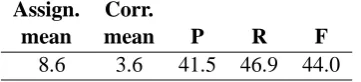
Table 1: The number of assigned (Assign.) key-words in mean per document; the number of cor-rect (Corr.) keywords in mean per document; pre-cision (P); recall (R); and F-measure (F), when 3– 12 keywords are extracted per document.
(given by the prediction models) is higher than an empirically defined threshold value. To avoid that a document gets no keywords, at least three key-words are assigned although the added regression value is below the threshold (provided that there are at least three candidate terms).
In Hulth (2004) an evaluation on 500 abstracts in English is presented. For the evaluation, key-words assigned to the test documents by profes-sional indexers are used as a gold standard, that is, the manual keywords are treated as the one and only truth. The evaluation measures are
preci-sion (how many of the automatically assigned
key-words that are also manually assigned keykey-words) and recall (how many of the manually assigned keywords that are found by the automatic indexer). The third measure used for the evaluations is the
F-measure (the harmonic mean of precision and
recall). Table 1 shows the result on that particu-lar test set. This result may be considered to be state-of-the-art.
3 Text Categorization Experiments
This section describes in detail the four experi-mental settings for the text categorization exper-iments.
3.1 Corpus
For the text categorization experiments we used the Reuters-21578 corpus, which contains 20 000 newswire articles in English with multiple cate-gories (Lewis, 1997). More specifically, we used the ModApte split, containing 9 603 documents for training and 3 299 documents in the fixed test set, and the 90 categories that are present in both train-ing and test sets.
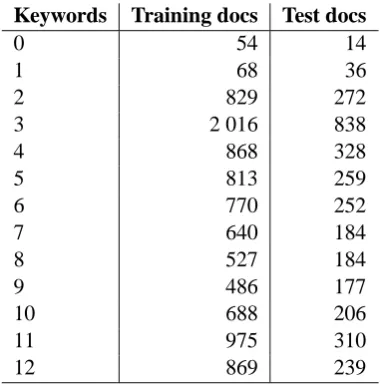
doc-uments in the training set and the test set are dis-played. As can be seen in this table, three is the number of keywords that is most often extracted. In the training data set, 9 549 documents are as-signed keywords, while 54 are empty, as they have no text in the TITLE or BODY tags. Of the 3 299 documents in the test set, 3 285 are assigned key-words, and the remaining fourteen are those that are empty. The empty documents are included in the result calculations for the fixed test set, in or-der to enable comparisons with other experiments. The mean number of keyword extracted per docu-ment in the training set is 6.4 and in the test set 6.1 (not counting the empty documents).
Keywords Training docs Test docs
0 54 14
1 68 36
2 829 272
3 2 016 838
4 868 328
5 813 259
6 770 252
7 640 184
8 527 184
9 486 177
10 688 206
11 975 310
[image:3.595.86.277.263.456.2]12 869 239
Table 2: Number of automatically extracted key-words per document in training set and test set re-spectively.
3.2 Learning Method
The focus of the experiments described in this pa-per was the text representation. For this reason, we used only one learning algorithm, namely an im-plementation of Linear Support Vector Machines (Joachims, 1999). This is the learning method that has obtained the best results in text categorization experiments (Dumais et al., 1998; Yang and Liu, 1999).
3.3 Representations
This section describes in detail the input repre-sentations that we experimented with. An impor-tant step for the feature selection is the dimen-sionality reduction, that is reducing the number of features. This can be done by removing words that are rare (that occur in too few documents or
have too low term frequency), or very common (by applying a stop-word list). Also, terms may be stemmed, meaning that they are merged into a common form. In addition, any of a number of feature selection metrics may be applied to further reduce the space, for example chi-square, or infor-mation gain (see for example Forman (2003) for a survey).
Once that the features have been set, the final decision to make is what feature value to assign. There are to this end three common possibilities: a boolean representation (that is, the term exists in the document or not), term frequency, or tf*idf.
Two sets of experiments were run in which the automatically extracted keywords were the only input to the representation. In the first set, key-words that contained several tokens were kept in-tact. For example a keyword such as paradise fruit
was represented as paradise fruit and was
— from the point of view of the classifier — just as distinct from the single token fruit as from
meat-packers. No stemming was performed in this set
of experiments.
In the second set of keywords-only experiments, the keywords were split up into unigrams, and also stemmed. For this purpose, we used Porter’s stem-mer (Porter, 1980). Thereafter the experiments were performed identically for the two keyword representations.
In a third set of experiments, we extracted only the content in the TITLE tags, that is, the head-lines. The tokens in the headlines were stemmed and represented as unigrams. The main motiva-tion for the title experiments was to compare their performance to that of the keywords.
For all of these three feature inputs, we first evaluated which one of the three possible feature values to use (boolean, tf, or tf*idf). Thereafter, we reduced the space by varying the minimum number of occurrences in the training data, for a feature to be kept.
frequency of an identical keyword unigram. Note that this does not mean that the term frequency value was necessarily doubled, as a keyword often contains more than one token, and it was the term frequency of the whole keyword that was added.
3.4 Training and Validation
This section describes the parameter tuning, for
which we used the training data set. This set
was divided into five equally sized folds, to de-cide which setting of the following two parameters that resulted in the best performing classifier: what feature value to use, and the threshold for the min-imum number of occurrence in the training data (in this particular order).
To obtain a baseline, we made a full-text uni-gram run with boolean as well as with tf*idf fea-ture values, setting the occurrence threshold to three.
As stated previously, in this study, we were concerned only with the representation, and more specifically with the feature input. As we did not tune any other parameters than the two mentioned above, the results can be expected to be lower than the state-of-the art, even for the full-text run with unigrams.
The number of input features for the full-text unigram representation for the whole training set was 10 676, after stemming and removing all to-kens that contained only digits, as well as those tokens that occurred less than three times. The total number of keywords assigned to the 9 603 documents in the training data was 61 034. Of these were 29 393 unique. When splitting up the keywords into unigrams, the number of unique stemmed tokens was 11 273.
3.5 Test
As a last step, we tested the best performing rep-resentations in the four different experimental set-tings on the independent test set.
The number of input features for the full-text
unigram representation was 10 676. The total
number of features for the intact keyword repre-sentation was 4 450 with the occurrence thresh-old set to three, while the number of stemmed keyword unigrams was 6 478, with an occurrence threshold of two. The total number of keywords extracted from the 3 299 documents in the test set was 19 904.
Next, we present the results for the validation and test procedures.
4 Results
To evaluate the performance, we used precision,
recall, and micro-averaged F-measure, and we let
the F-measure be decisive. The results for the 5-fold cross validation runs are shown in Table 3, where the values given are the average of the five runs made for each experiment. As can be seen in this table, the full-text run with a boolean fea-ture value gave 92.3% precision, 69.4% recall, and 79.2% F-measure. The full-text run with tf*idf gave a better result as it yielded 92.9% precision, 71.3% recall, and 80.7% F-measure. Therefore we defined the latter as baseline.
In the first type of the experiment where each keyword was treated as a feature independently of the number of tokens contained, the recall rates were considerably lower (between 32.0% and 42.3%) and the precision rates were somewhat lower (between 85.8% and 90.5%) compared to the baseline. The best performance was obtained when using a boolean feature value, and setting the minimum number of occurrence in training data to three (giving an F-measure of 56.9%).
In the second type of experiments, where the keywords were split up into unigrams and stemmed, recall was higher but still low (between 60.2% and 64.8%) and precision was somewhat lower (88.9–90.2%) when compared to the base-line. The best results were achieved with a boolean representation (similar to the first experiment) and the minimum number of occurrence in the training data set to two (giving an F-measure of 75.0%)
In the third type of experiments, where only the text in the TITLE tags was used and was repre-sented as unigrams and stemmed, precision rates increased above the baseline to 93.3–94.5%. Here, the best representation was tf*idf with a token oc-curring at least four times in the training data (with an F-measure of 79.9%).
In the fourth and last set of experiments, we gave higher weights to full-text tokens if the same token was present in an automatically extracted keyword. Here we obtained the best results. In these experiments, the term frequency of a key-word unigram was added to the term frequency for the full-text features, whenever the stems were
identical. For this representation, we
Input feature Feature value Min. occurrence Precision Recall F-measure
full-text unigram bool 3 92.31 69.40 79.22
full-text unigram tf*idf 3 92.89 71.30 80.67
keywords-only intact bool 1 90.54 36.64 52.16
keywords-only intact tf 1 88.68 33.74 48.86
keywords-only intact tf*idf 1 89.41 32.05 47.18
keywords-only intact bool 2 89.27 40.43 55.64
keywords-only intact bool 3 87.11 42.28 56.90
keywords-only intact bool 4 85.81 41.97 56.35
keywords-only unigram bool 1 89.12 64.61 74.91
keywords-only unigram tf 1 89.89 60.23 72.13
keywords-only unigram tf*idf 1 90.17 60.36 72.31
keywords-only unigram bool 2 89.02 64.83 75.02
keywords-only unigram bool 3 88.90 64.82 74.97
title bool 1 94.17 68.17 79.08
title tf 1 94.37 67.89 78.96
title tf*idf 1 94.46 68.49 79.40
title tf*idf 2 93.92 69.19 79.67
title tf*idf 3 93.75 69.65 79.91
title tf*idf 4 93.60 69.74 79.92
title tf*idf 5 93.31 69.40 79.59
keywords+full tf*idf 3 (before adding) 92.73 72.02 81.07
[image:5.595.79.518.60.388.2]keywords+full tf*idf 3 (after adding) 92.75 71.94 81.02
Table 3: The average results from 5-fold cross validations for the baseline candidates and the four types of experiments, with various parameter settings.
highest recall (72.0%) and F-measure (81.1%) for all validation runs were achieved when the occur-rence threshold was set before the addition of the keywords.
Next, the results on the fixed test data set for the four experimental settings with the best per-formance on the validation runs are presented.
Table 4 shows the results obtained on the fixed test data set for the baseline and for those experi-ments that obtained the highest F-measure for each one of the four experiment types.
We can see that the baseline — where the full-text is represented as unigrams with tf*idf as fea-ture value — yields 93.0% precision, 71.7% re-call, and 81.0% F-measure. When the intact key-words are used as feature input with a boolean fea-ture value and at least three occurrences in train-ing data, the performance decreases greatly both considering the correctness of predicted categories and the number of categories that are found.
When the keywords are represented as uni-grams, a better performance is achieved than when they are kept intact. This is in line with the
find-ings on n-grams by Caropreso et al. (2001). How-ever, the results are still not satisfactory since both the precision and recall rates are lower than the baseline.
Titles, on the other hand, represented as uni-grams and stemmed, are shown to be a useful in-formation source when it comes to correctly pre-dicting the text categories. Here, we achieve the highest precision rate of 94.2% although the recall rate and the F-measure are lower than the baseline. Full-texts combined with keywords result in the highest recall value, 72.9%, as well as the highest F-measure, 81.7%, both above the baseline.
[image:5.595.78.520.63.389.2]Input feature Feature value Min. occurrence Precision Recall F-measure
full-text unigram tf*idf 3 93.03 71.69 80.98
keywords-only intact bool 3 89.56 41.48 56.70
keywords-only unigram bool 2 90.23 64.16 74.99
title tf*idf 4 94.23 68.43 79.28
keywords+full tf*idf 3 92.89 72.94 81.72
Table 4: Results on the fixed test set.
with tf*idf values.
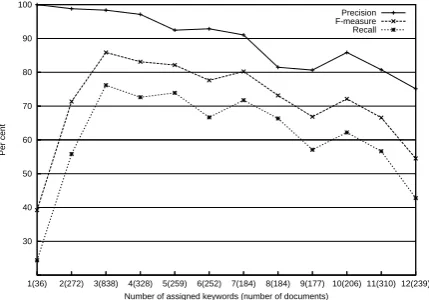
[image:6.595.75.290.321.471.2]As discussed in Section 2 and also presented in Table 2, the number of keywords assigned per doc-ument varies from zero to twelve. In Figure 1, we have plotted how the precision, the recall, and the F-measure for the test set vary with the number of assigned keywords for the keywords-only unigram representation.
100
90
80
70
60
50
40
30
12(239) 11(310) 10(206) 9(177) 8(184) 7(184) 6(252) 5(259) 4(328) 3(838) 2(272) 1(36)
Per cent
Number of assigned keywords (number of documents) Precision F-measure Recall
Figure 1: Precision, recall, and F-measure for each number of assigned keywords. The values in brackets denote the number of documents.
We can see that the F-measure and the recall reach their highest points when three keywords are ex-tracted. The highest precision (100%) is obtained when the classification is performed on a single extracted keyword, but then there are only 36 doc-uments present in this group, and the recall is low. Further experiments are needed in order to estab-lish the optimal number of keywords to extract.
5 Related Work
For the work presented in this paper, there are two aspects that are of interest in previous work. These are in how the alternative input features (that is, al-ternative from unigrams) are selected and in how this alternative representation is used in combina-tion with a bag-of-words representacombina-tion (if it is).
An early work on linguistic phrases is done by F ¨urnkranz et al. (1998), where all noun phrases matching any of a number of syntactic heuristics
are used as features. This approach leads to a
higher precision at the low recall end, when eval-uated on a corpus of Web pages. Aizawa (2001) extracts PoS-tagged compounds, matching pre-defined PoS patterns. The representation contains both the compounds and their constituents, and a small improvement is shown in the results on Reuters-21578. Moschitti and Basili (2004) add complex nominals as input features to their bag-of-words representation. The phrases are extracted
by a system for terminology extraction1. The more
complex representation leads to a small decrease on the Reuters corpus. In these studies, it is un-clear how many phrases that are extracted and added to the representations.
Li et al. (2003) map documents (e-mail mes-sages) that are to be classified into a vector space
of keywords with associated probabilities. The
mapping is based on a training phase requiring both texts and their corresponding summaries.
Another approach to combine different repre-sentations is taken by Sahlgren and C ¨oster (2004), where the full-text representation is combined with a concept-based representation by selecting one or the other for each category. They show that concept-based representations can outperform traditional word-based representations, and that a combination of the two different types of represen-tations improves the performance of the classifier over all categories.
Keywords assigned to a particular text can be
seen as a dense summary of the same. Some
reports on how automatic summarization can be used to improve text categorization exist. For
ex-1In terminology extraction all terms describing a domain
ample, Ko et al. (2004) use methods from text summarization to find the sentences containing the important words. The words in these sentences are then given a higher weight in the feature vectors, by modifying the term frequency value with the sentence’s score. The F-measure increases from 85.8 to 86.3 on the Newsgroups data set using Sup-port vector machines.
Mihalcea and Hassan (2004) use an
unsuper-vised method2to extract summaries, which in turn
are used to categorize the documents. In their ex-periments on a sub-set of Reuters-21578 (among others), Mihalcea and Hassan show that the preci-sion is increased when using the summaries rather
than the full length documents. ¨Ozg¨ur et al. (2005)
have shown that limiting the representation to 2 000 features leads to a better performance, as evaluated on Reuters-21578. There is thus evi-dence that using only a sub-set of a document can give a more accurate classification. The question, though, is which sub-set to use.
In summary, the work presented in this paper has the most resemblance with the work by Ko et al. (2004), who also use a more dense version of a document to alter the feature values of a bag-of-words representation of a full-length document.
6 Concluding Remarks
In the experiments described in this paper, we investigated if automatically extracted keywords can improve automatic text categorization. More specifically, we investigated what impact key-words have on the task of text categorization by making predictions on the basis of keywords only, represented either as unigrams or intact, and by combining the full-text representation with auto-matically extracted keywords. The combination was obtained by giving higher weights to words in the full-texts that were also extracted as keywords. Throughout the study, we were concerned with the data representation and feature selection pro-cedure. We investigated what feature value should be used (boolean, tf, or tf*idf) and the minimum number of occurrence of the tokens in the training data.
We showed that keywords can improve the per-formance of the text categorization. When key-words were used as a complement to the full-text representation an F-measure of 81.7% was
ob-2This method has also been used to extract keywords
(Mi-halcea and Tarau, 2004).
tained, higher than without the keywords (81.0%). Our results also clearly indicate that keywords alone can be used for the text categorization task when treated as unigrams, obtaining an F-measure of 75.0%. Lastly, for higher precision (94.2%) in text classification, we can use the stemmed tokens in the headlines.
The results presented in this study are lower than the state-of-the-art, even for the full-text run with unigrams, as we did not tune any other pa-rameters than the feature values (boolean, term frequency, or tf*idf) and the threshold for the min-imum number of occurrence in the training data.
There are, of course, possibilities for further improvements. One possibility could be to com-bine the tokens in the headlines and keywords in the same way as the full-text representation was combined with the keywords. Another possible improvement concerns the automatic keyword ex-traction process. The keywords are presented in order of their estimated “keywordness”, based on the added regression value given by the three pre-diction models. This means that one alternative experiment would be to give different weights de-pending on which rank the keyword has achieved from the keyword extraction system. Another al-ternative would be to use the actual regression value.
We would like to emphasize that the automati-cally extracted keywords used in our experiments are not statistical phrases, such as bigrams or tri-grams, but meaningful phrases selected by includ-ing linclud-inguistic analysis in the extraction procedure.
In this study, we showed that automatic text categorization can benefit from automatically ex-tracted keywords, although the bag-of-words rep-resentation is competitive with the best perfor-mance. Automatic keyword extraction as well as automatic text categorization are research areas where further improvements are needed in order to be useful for more efficient information retrieval.
Acknowledgments
The authors are grateful to the anonymous review-ers for their valuable suggestions on how to im-prove the paper.
References
Akiko Aizawa. 2001. Linguistic techniques to im-prove the performance of automatic text
categoriza-tion. In Proceedings of NLPRS-01, 6th Natural
Language Processing Pacific Rim Symposium, pages
307–314.
Maria Fernanda Caropreso, Stan Matwin, and Fabrizio Sebastiani. 2001. A learner-independent evaluation of the usefulness of statistical phrases for automated text categorization. In Text Databases and
Docu-ment ManageDocu-ment: Theory and Practice, pages 78–
102.
Susan Dumais, John Platt, David Heckerman, and
Mehran Sahami. 1998. Inductive learning
algo-rithms and representations for text categorization. In Proceedings of the Seventh International
Confer-ence on Information and Knowledge Management (CIKM’98), pages 148–155.
George Forman. 2003. An extensive empirical study of feature selection metrics for text classification.
Journal of Machine Learning Research, 3:1289–
1305, March.
Johannes F¨urnkranz, Tom Mitchell, and Ellen Riloff. 1998. A case study using linguistic phrases for text categorization on the WWW. In AAAI-98 Workshop
on Learning for Text Categorization.
Anette Hulth. 2003. Improved automatic keyword ex-traction given more linguistic knowledge. In
Pro-ceedings of the Conference on Empirical Methods in Natural Language Processing (EMNLP 2003),
pages 216–223.
Anette Hulth. 2004. Combining Machine
Learn-ing and Natural Language ProcessLearn-ing for Automatic Keyword Extraction. Ph.D. thesis, Department of
Computer and Systems Sciences, Stockholm Uni-versity.
Thorsten Joachims. 1999. Making large-scale SVM learning practical. In B. Sch ¨olkopf, C. Burges, and A. Smola, editors, Advances in Kernel Methods:
Support Vector Learning. MIT-Press.
Youngjoong Ko, Jinwoo Park, and Jungyun Seo. 2004. Improving text categorization using the importance of sentences. Information Processing and
Manage-ment, 40(1):65–79.
Aleksander Kolcz, Vidya Prabakarmurthi, and Jugal
Kalita. 2001. Summarization as feature
selec-tion for text categorizaselec-tion. In Proceedings of the
Tenth International Conference on Information and Knowledge Management (CIKM’01), pages 365–
370.
David D. Lewis. 1997. Reuters-21578 text categoriza-tion test colleccategoriza-tion, Distribucategoriza-tion 1.0. AT&T Labs Re-search.
Cong Li, Ji-Rong Wen, and Hang Li. 2003. Text clas-sification using stochastic keyword generation. In
Proceedings of the 20th International Conference on Machine Learning (ICML-2003).
Rada Mihalcea and Samer Hassan. 2005. Using the essence of texts to improve document classifica-tion. In Proceedings of the Conference on Recent
Advances in Natural Language Processing (RANLP 2005).
Rada Mihalcea and Paul Tarau. 2004. TextRank:
bringing order into texts. In Proceedings of the
Con-ference on Empirical Methods in Natural Language Processing (EMNLP 2004).
Alessandro Moschitti and Roberto Basili. 2004. Com-plex linguistic features for text classification: A
comprehensive study. In Sharon McDonald and
John Tait, editors, Proceedings of ECIR-04, 26th
European Conference on Information Retrieval Re-search, pages 181–196. Springer-Verlag.
Arzucan ¨Ozg ¨ur, Levent ¨Ozg ¨ur, and Tunga G¨ung ¨or.
2005. Text categorization with class-based and
corpus-based keyword selection. In Proceedings
of the 20th International Symposium on Computer and Information Sciences, volume 3733 of Lec-ture Notes in Computer Science, pages 607–616.
Springer-Verlag.
Martin Porter. 1980. An algorithm for suffix stripping.
Program, 14(3):130–137.
Magnus Sahlgren and Rickard C¨oster. 2004. Using bag-of-concepts to improve the performance of sup-port vector machines in text categorization. In
Pro-ceedings of the 20th International Conference on Computational Linguistics (COLING 2004), pages
487–493.
Yiming Yang and Xin Liu. 1999. A re-examination of text categorization methods. In Proceedings of