Proceedings of the 49th Annual Meeting of the Association for Computational Linguistics:shortpapers, pages 598–602,
Hierarchical Text Classification with Latent Concepts
Xipeng Qiu, Xuanjing Huang, Zhao Liu and Jinlong Zhou School of Computer Science, Fudan University
{xpqiu,xjhuang}@fudan.edu.cn, {zliu.fd,abc9703}@gmail.com
Abstract
Recently, hierarchical text classification has become an active research topic. The essential idea is that the descendant classes can share the information of the ancestor classes in a predefined taxonomy. In this paper, we claim that each class has several latent concepts and its subclasses share information with these d-ifferent concepts respectively. Then, we pro-pose a variant Passive-Aggressive (PA) algo-rithm for hierarchical text classification with latent concepts. Experimental results show that the performance of our algorithm is com-petitive with the recently proposed hierarchi-cal classification algorithms.
1 Introduction
Text classification is a crucial and well-proven method for organizing the collection of large scale documents. The predefined categories are formed by different criterions, e.g. “Entertainment”, “Sport-s” and “Education” in news classification, “Junk E-mail” and “Ordinary EE-mail” in email classification. In the literature, many algorithms (Sebastiani, 2002; Yang and Liu, 1999; Yang and Pedersen, 1997) have been proposed, such as Support Vector Machines (SVM), k-Nearest Neighbor (kNN), Na¨ıve Bayes (NB) and so on. Empirical evaluations have shown that most of these methods are quite effective in tra-ditional text classification applications.
In past serval years, hierarchical text classification has become an active research topic in database area (Koller and Sahami, 1997; Weigend et al., 1999) and machine learning area (Rousu et al., 2006; Cai and Hofmann, 2007). Different with traditional clas-sification, the document collections are organized
as hierarchical class structure in many application fields: web taxonomies (i.e. the Yahoo! Directory
http://dir.yahoo.com/and the Open
Direc-tory Project (ODP)http://dmoz.org/), email
folders and product catalogs.
The approaches of hierarchical text classification
can be divided in three ways: flat,localandglobal
approaches.
Theflatapproach is traditional multi-class
classi-fication in flat fashion without hierarchical class in-formation, which only uses the classes in leaf nodes in taxonomy(Yang and Liu, 1999; Yang and Peder-sen, 1997; Qiu et al., 2011).
Thelocalapproach proceeds in a top-down fash-ion, which firstly picks the most relevant categories of the top level and then recursively making the choice among the low-level categories(Sun and Lim, 2001; Liu et al., 2005).
Theglobalapproach builds only one classifier to discriminate all categories in a hierarchy(Cai and Hofmann, 2004; Rousu et al., 2006; Miao and Qiu, 2009; Qiu et al., 2009). The essential idea of global approach is that the close classes have some com-mon underlying factors. Especially, the descendan-t classes can share descendan-the characdescendan-terisdescendan-tics of descendan-the ances-tor classes, which is similar with multi-task learn-ing(Caruana, 1997; Xue et al., 2007).
Because the global hierarchical categorization can avoid the drawbacks about those high-level irrecov-erable error, it is more popular in the machine learn-ing domain.
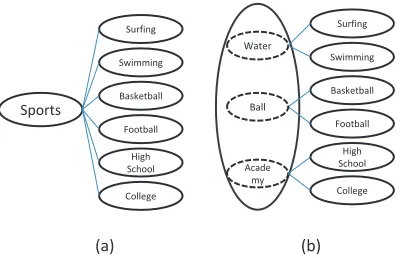
Sports
Football Basketball Swimming Surfing
Sports Water
Football Basketball Swimming Surfing
Ball
(a) (b)
College High School
College High School Acade
[image:2.612.87.287.73.202.2]my
Figure 1: Example of latent nodes in taxonomy
cal classification. For example, the “Sports” node in a taxonomy have six subclasses (Fig. 1a), but these subclass can be grouped into three unobserv-able concepts (Fig. 1b). These concepts can show the underlying factors more clearly.
In this paper, we claim that each class may have several latent concepts and its subclasses share in-formation with these different concepts respectively. Then we propose a variant Passive-Aggressive (PA) algorithm to maximizes the margins between latent paths.
The rest of the paper is organized as follows. Sec-tion 2 describes the basic model of hierarchical clas-sification. Then we propose our algorithm in section 3. Section 4 gives experimental analysis. Section 5 concludes the paper.
2 Hierarchical Text Classification
In text classification, the documents are often rep-resented with vector space model (VSM) (Salton et al., 1975). Following (Cai and Hofmann, 2007), we incorporate the hierarchical information in fea-ture representation. The basic idea is that the notion of class attributes will allow generalization to take place across (similar) categories and not just across training examples belonging to the same category.
Assuming that the categories is Ω =
[ω1,· · · , ωm], where m is the number of the
categories, which are organized in hierarchical structure, such as tree or DAG.
Give a samplexwith its class path in the
taxono-myy, we define the feature is
Φ(x,y) = Λ(y)⊗x, (1)
whereΛ(y) = (λ1(y),· · ·, λm(y))T ∈ Rm and⊗
is the Kronecker product. We can define
λi(y) =
{
ti if ωi∈y
0 otherwise , (2)
whereti >= 0is the attribute value for nodev. In
the simplest case,tican be set to a constant, like1.
Thus, we can classifyxwith a score function,
ˆ
y= arg max
y F(w,Φ(x,y)), (3)
wherewis the parameter ofF(·).
3 Hierarchical Text Classification with Latent Concepts
In this section, we first extent the
Passive-Aggressive (PA) algorithm to the hierarchical clas-sification (HPA), then we modify it to incorporate latent concepts (LHPA).
3.1 Hierarchical Passive-Aggressive Algorithm
The PA algorithm is an online learning algorithm,
which aims to find the new weight vectorwt+1to be
the solution to the following constrained
optimiza-tion problem in roundt.
wt+1= arg min
w∈Rn
1
2||w−wt|| 2+Cξ
s.t.ℓ(w; (xt, yt))<=ξandξ >= 0. (4)
whereℓ(w; (xt, yt))is the hinge-loss function andξ
is slack variable.
Since the hierarchical text classification is loss-sensitive based on the hierarchical structure. We need discriminate the misclassification from
“near-ly correct” to “clear“near-ly incorrect”. Here we usetree
induced error∆(y,y′), which is the shortest path
connecting the nodesyleaf andy′leaf. yleaf
repre-sents the leaf node in pathy.
Given a example (x,y), we look for the w to
maximize the separation margin γ(w; (x,y))
be-tween the score of the correct pathyand the closest
error pathyˆ.
whereyˆ = arg maxz̸=ywTΦ(x,z)andΦis a
fea-ture function.
Unlike the standard PA algorithm, which achieve a margin of at least 1 as often as possible, we wish
the margin is related to tree induced error∆(y,yˆ).
This loss is defined by the following function,
ℓ(w; (x,y)) =
{
0, γ(w; (x,y))>∆(y,yˆ)
∆(y,yˆ)−γ(w; (x,y)), otherwise (6)
We abbreviateℓ(w; (x,y))toℓ. Ifℓ= 0thenwt
itself satisfies the constraint in Eq. (4) and is clearly the optimal solution. We therefore concentrate on
the case whereℓ >0.
First, we define the Lagrangian of the optimiza-tion problem in Eq. (4) to be,
L(w, ξ, α, β) = 1
2||w−wt||
2+Cξ+α(ℓ−ξ)−βξ
s.t.α, β >= 0. (7)
whereα, βis a Lagrange multiplier.
We set the gradient of Eq. (7) respect toξto zero.
α+β =C. (8)
The gradient ofwshould be zero.
w−wt−α(Φ(x,y)−Φ(x,yˆ)) = 0 (9)
Then we get,
w=wt+α(Φ(x,y)−Φ(x,yˆ)). (10)
Substitute Eq. (8) and Eq. (10) to objective func-tion Eq. (7), we get
L(α) =−1 2α
2||Φ(x,y)−Φ(x,yˆ)||2
+αwt(Φ(x,y)−Φ(x,yˆ)))−α∆(y,yˆ) (11)
Differentiate Eq. (11 withα, and set it to zero, we
get
α∗= ∆(y,yˆ)−wt(Φ(x,y)−Φ(x,yˆ)))
||Φ(x,y)−Φ(x,yˆ)||2 (12)
Fromα+β =C, we know thatα <C, so
α∗= min(C,∆(y,yˆ)−wt(Φ(x,y)−Φ(x,ˆy)))
||Φ(x,y)−Φ(x,yˆ)||2 ).
(13)
3.2 Hierarchical Passive-Aggressive Algorithm with Latent Concepts
For the hierarchical taxonomy Ω = (ω1,· · · , ωc),
we define that each class ωi has a set Hωi =
h1ωi,· · ·, hmωi withmlatent concepts, which are un-observable.
Given a label pathy, it has a set of severallatent
paths Hy. For a latent path z ∈ Hy, a function
P roj(z) =. yis the projection from a latent pathz
to its corresponding pathy.
Then we can define the predict latent pathh∗and
the most correct latent pathhˆ:
ˆ
h= arg max
proj(z)̸=yw
TΦ(x,z), (14)
h∗= arg max
proj(z)=yw
TΦ(x,z). (15)
Similar to the above analysis of HPA, we re-define the margin
γ(w; (x,y) =wTΦ(x,h∗)−wTΦ(x,hˆ), (16)
then we get the optimal update step
α∗L= min(C, ℓ(wt; (x,y))
||Φ(x,h∗)−Φ(x,hˆ)||2). (17)
Finally, we get update strategy,
w=wt+α∗L(Φ(x,h∗)−Φ(x,hˆ)). (18)
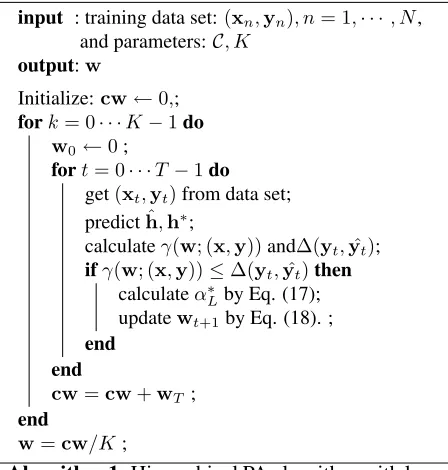
Our hierarchical passive-aggressive algorithm with latent concepts (LHPA) is shown in Algorith-m 1. In this paper, we use two latent concepts for each class.
4 Experiment
4.1 Datasets
We evaluate our proposed algorithm on two datasets with hierarchical category structure.
WIPO-alpha dataset The dataset1consisted of the
1372training and 358testing document
com-prising the D section of the hierarchy. The
number of nodes in the hierarchy was188, with
maximum depth3. The dataset was processed
into bag-of-words representation with TF·IDF
1World Intellectual Property Organization,http://www.
input : training data set:(xn,yn), n= 1,· · · , N,
and parameters:C, K
output:w
Initialize:cw←0,; fork= 0· · ·K−1do
w0←0;
fort= 0· · ·T−1do get(xt,yt)from data set;
predicthˆ,h∗;
calculateγ(w; (x,y))and∆(yt,yˆt);
ifγ(w; (x,y))≤∆(yt,yˆt)then
calculateα∗Lby Eq. (17); updatewt+1by Eq. (18). ;
end end
cw=cw+wT ;
end
w=cw/K;
Algorithm 1:Hierarchical PA algorithm with la-tent concepts
weighting. No word stemming or stop-word removal was performed. This dataset is used in (Rousu et al., 2006).
LSHTC dataset The dataset2has been constructed by crawling web pages that are found in the Open Directory Project (ODP) and translating them into feature vectors (content vectors) and splitting the set of Web pages into a training, a validation and a test set, per ODP category. Here, we use the dry-run dataset(task 1).
4.2 Performance Measurement
Macro Precision,Macro RecallandMacroF1are the most widely used performance measurements
for text classification problems nowadays. The
macro strategy computes macro precision and re-call scores by averaging the precision/rere-call of each category, which is preferred because the categories are usually unbalanced and give more challenges to
classifiers. The MacroF1score is computed using
the standard formula applied to the macro-level pre-cision and recall scores.
M acroF1 = P ×R
P +R, (19)
[image:4.612.74.298.74.309.2]2Large Scale Hierarchical Text classification Pascal Chal-lenge,http://lshtc.iit.demokritos.gr
Table 1: Results on WIPO-alpha Dataset.“-” means that the result is not available in the author’s paper.
Accuracy F1 Precision Recall TIE
PA 49.16 40.71 43.27 38.44 2.06 HPA 50.84 40.26 43.23 37.67 1.92 LHPA 51.96 41.84 45.56 38.69 1.87
HSVM 23.8 - - -
-HM3 35.0 - - -
-Table 2: Results on LSHTC dry-run Dataset
Accuracy F1 Precision Recall TIE
PA 47.36 44.63 52.64 38.73 3.68 HPA 46.88 43.78 51.26 38.2 3.73 LHPA 48.39 46.26 53.82 40.56 3.43
whereP is the Macro Precision andRis the Macro
Recall. We also usetree induced error(TIE) in the
experiments.
4.3 Results
We implement three algorithms3: PA(Flat PA),
H-PA(Hierarchical PA) and LHPA(Hierarchical PA
with latent concepts). The results are shown in Table 1 and 2. For WIPO-alpha dataset, we also compared
LHPA with two algorithms used in (Rousu et al.,
2006):HSVMandHM3.
We can see that LHPA has better performances than the other methods. From Table 2, we can see that it is not always useful to incorporate the hierar-chical information. Though the subclasses can share information with their parent class, the shared infor-mation may be different for each subclass. So we should decompose the underlying factors into dif-ferent latent concepts.
5 Conclusion
In this paper, we propose a variant Passive-Aggressive algorithm for hierarchical text classifi-cation with latent concepts. In the future, we will investigate our method in the larger and more noisy data.
Acknowledgments
This work was (partially) funded by NSFC (No. 61003091 and No. 61073069), 973 Program (No.
3Source codes are available in FudanNLP toolkit, http:
[image:4.612.316.536.98.250.2]2010CB327906) and Shanghai Committee of Sci-ence and Technology(No. 10511500703).
References
L. Cai and T. Hofmann. 2004. Hierarchical document categorization with support vector machines. In Pro-ceedings of CIKM.
L. Cai and T. Hofmann. 2007. Exploiting known tax-onomies in learning overlapping concepts. In Pro-ceedings of International Joint Conferences on Arti-ficial Intelligence.
R. Caruana. 1997. Multi-task learning. Machine Learn-ing, 28(1):41–75.
D. Koller and M Sahami. 1997. Hierarchically classify-ing documents usclassify-ing very few words. InProceedings of the International Conference on Machine Learning (ICML).
T.Y. Liu, Y. Yang, H. Wan, H.J. Zeng, Z. Chen, and W.Y. Ma. 2005. Support vector machines classification with a very large-scale taxonomy. ACM SIGKDD Ex-plorations Newsletter, 7(1):43.
Youdong Miao and Xipeng Qiu. 2009. Hierarchical centroid-based classifier for large scale text classifica-tion. In Large Scale Hierarchical Text classification (LSHTC) Pascal Challenge.
Xipeng Qiu, Wenjun Gao, and Xuanjing Huang. 2009. Hierarchical multi-class text categorization with glob-al margin maximization. InProceedings of the ACL-IJCNLP 2009 Conference, pages 165–168, Suntec, Singapore, August. Association for Computational Linguistics.
Xipeng Qiu, Jinlong Zhou, and Xuanjing Huang. 2011. An effective feature selection method for text catego-rization. InProceedings of the 15th Pacific-Asia Con-ference on Knowledge Discovery and Data Mining. Juho Rousu, Craig Saunders, Sandor Szedmak, and John
Shawe-Taylor. 2006. Kernel-based learning of hierar-chical multilabel classification models. InJournal of Machine Learning Research.
G. Salton, A. Wong, and CS Yang. 1975. A vector space model for automatic indexing. Communications of the ACM, 18(11):613–620.
F. Sebastiani. 2002. Machine learning in automated text categorization. ACM computing surveys, 34(1):1–47.
A. Sun and E.-P Lim. 2001. Hierarchical text classi-fication and evaluation. In Proceedings of the IEEE International Conference on Data Mining.
A. Weigend, E. Wiener, and J Pedersen. 1999. Exploit-ing hierarchy in text categorization. In Information Retrieval.
Y. Xue, X. Liao, L. Carin, and B. Krishnapuram. 2007. Multi-task learning for classification with dirichlet process priors. The Journal of Machine Learning Re-search, 8:63.
Y. Yang and X. Liu. 1999. A re-examination of text categorization methods. InProc. of SIGIR. ACM Press New York, NY, USA.