A n Interactive Translation S u p p o r t Facility
for N o n - P r o f e s s i o n a l Users
Y A M A B A N A K i y o s h i , M U R A K I K a z u n o r i , K A M E I S h i n - i c h i r o , S A T O H K e n j i , D O I S h i n i c h i , T A M U R A S h i n k o
I n f o r m a t i o n T e c h n o l o g y R e s e a r c h L a b o r a t o r i e s N E C C o r p o r a t i o n
M i y a z a k i 4-1-1, M i y a m a e - k u , K a w a s a k i 216, J A P A N {yamabana, k-muraki, kamei, satoh, doi, shinko}~hum.cl.nec.co.jp
A b s t r a c t
We present an interactive translation method to support non-professional users to write an original document. The method, combining dictionary lookup func- tion and user-guided stepwise interactive machine translation, allows the user to ob- tain clear result with an easy operation. We implemented the method as an English writing support facility that serves as a translation support front-end to an arbi- trary application.
1
I n t r o d u c t i o n
With the steady decrease of network communica- tion cost and equipment prices, world-wide com- puter networks and the number of its users are growing very rapidly. However, there is a large obstacle against global communication over net- works, namely the language barrier, especially for non English-speaking people. This is a major reason personal EJ (English to Japanese) machine transla- tion systems are gaining popularity in Japan. They help the user to quickly grasp the content of web pages, by providing rough translation. Since speed and lexical coverage are most important require- ments, conventional automatic machine translation systems developed so far are useful for this purpose. Contrary to the EJ direction, the major task in JE (Japanese to English) direction will be writing short original documents, such as e-mail. The most impor- tant requirement will be translation quality, because the reader is usually different from the MT user. To control quality, some kind of human interaction will be inevitable. However, interactive support for conventional MT systems doesn't seem suitable for these users, since they are primarily intended for professional translators. Their post-editing function often requires working in a special environment that requires special training. An interactive, easy-to-
use translation support facility, targeted for non- professional translators, is desirable.
We may expect that these users have basic knowl- edge and ability to read and understand English. This expectation is natural and realistic in a coun- try like Japan, where all high-school graduates are supposed to have completed six year course in En- glish. Their reading skill and grammar knowledge is usually enough to judge the quality of current MT systems, but they may need help from MT systems when browsing the Internet. For the JE direction, they will not be satisfied with the raw output of con- ventional MT systems, but it will be too laborious to write down English sentence from scratch. For these users, online dictionaries have been used be- cause of the reliability of the result. However, in spite of abundant information within the dictionary such as inflection, verbal case frame, idioms and so on, the only electronically available part is spelling of translation equivalents (through copy & paste). Other information is only presented to be read as in the case of a paper dictionary, with all further work left to the user.
In this article, we present an interactive trans- lation method and its implementation, which has advantages of both a dictionary look-up tool and a machine translation system. The system has an in- teractive interface similar to Kana-Kanji conversion method, and initially serves as a dictionary look- up tool. After dictionary lookup, the user can in- voke syntactic transformation in terms of grammat- ical information in the dictionary. Syntactic trans- formation proceeds step by step in a bottom-up manner, combining smaller translation components into larger ones. This "dictionary-based interactive translation" approach allows the user to fully utilize syntactic information in the dictionary while main- taining clarity of the result.
In the next section, we give a simple example of translation steps and provide a general idea of the method. In section 3, we describe the basic model and associated operations. Section 4 gives further
explanation a b o u t disambiguation capability of the interactive operations. Section 5 discusses exten- sions to the basic model to treat linguistic phenom- ena such as idiomatic expressions. Section 6 de- scribes the current implementation as a front-end to an arbitrary application. In section 7, the m e t h o d is compared with former approaches. The final section is the conclusion.
2 A n E x a m p l e
In this section we show the basic steps of simple sentence translation, in order to give a general idea about how the m e t h o d works.
Consider a situation where the user is writing a message in English, using an editor of a mail pro- gram. Our system is running as a daemon. While the user is typing English characters, the system does nothing special and let them through to the editor window. T h e system wakes up when the user toggles on Japanese input. The moment the first Japanese character is t y p e d in, the main translation window is opened, and all subsequent characters are typed in to t h a t window instead of the editor win- dow.
Suppose the input sentence is one shown in fig- ure 1 (a). As soon as (a) is entered, the dictionary look-up function is invoked automatically. A mor- phological analyzer recognizes word boundaries in the sentence, looks up corresponding word entries in the system dictionary, and shows the result in the main window (b). 1 Content words are replaced by a translation equivalent assumed most plausible, while functional words are left unchanged.
This representation step, in which English words (content words) and Japanese words (functional words) are mixed, separates steps for word trans- lation .and later syntactic transformation, making translation steps clearer. Since word order and func- tional words carrying grammatical functions are un- changed, the user can easily recognize the skeleton of the sentence, and clearly grasp the correspondence between the original word and its translation equiv- alent. This representation is not only to show the re- sults of dictionary look-up like (Canisius, 1977), but also carries all interactive operations of the m e t h o d with it, and has a double role of showing information and being objects of interactive manipulation.
Translation equivalent alternatives for the cursor position word (focus word) are displayed in an alter- natives window, appearing nearby that word. Fig- ure 2 is a snapshot of the alternatives window for ronbun (paper). T h e second line is highlighted to show that it is the current selection. T h e user can
1Slanted words show romaji transcription of respec- tive Japanese words. They don't appear on a real window.
(a) ~£ t~ ~ tc ~ ~¢ ~ b tc w a t a s h i - w a k a r e - n i r o n b u n - o w a t a s h i - t a
I T O P he D A T p a p e r O B J g i v e P A S T
(b) I ~: he i:- paper ~ give ~v. - w a - h i - o - t a (c) I gave him a paper
Figure 1: Translation of a simple sentence
ronbun
paper
[noun] [ t y p i c a l w o r dthesis [noun] [for degree] essay [noun] [general] dissertation [noun] [for degree]
Figure 2: Alternatives Window for ronbun
change the selection simply by a cursor movement or mouse click on this window, then the corresponding translation equivalent on the main window changes synchronously. To see alternatives for another word, the user has only to move the cursor to t h a t word on the main window. There is also a CD-ROM dictio- nary access function, making translation equivalent selection easier. In addition, the user can change an inflection in a similar m a n n e r on an inflection selec- tion window, opened by the user's request.
If the user needs only the result of dictionary lookup, s / h e can signal the end of translation at this point, just after choosing the translation equivalent. If a translation is necessary, the user needs to go one more step. At the same time as initial translation equivalent selection, the system predicts an appro- priate area for translation, as shown by an underline (b). Just as the translation equivalent selection can be freely changed, the area can be changed by drag- ging the left or right edge of the underline. After the user confirms selections of translation equiva- lents and translation area on (b), the user invokes translation. T h e system performs syntactic trans- formation using syntactic information in the dictio- nary such as the verbal case frame of the main verb in the area, shows the result on the main window, and replaces the original sentence with the result (c). When there is more t h a n one possible transla- tion, the different possibilities are shown in an al- ternatives window similar to figure 2, allowing the user to change the choice. When the user triggers translation end, the result is sent to the original ed- itor window. T h e user can continue to work in the editor after turning off Japanese input.
3
D e s c r i p t i o n o f t h e M e t h o d
[image:2.612.333.539.79.240.2]of t a r g e t language expression and source language expression are shown to give the current status of the interactive translation. Translation proceeds from a smaller unit as word to a larger unit as sentence, step by step in a b o t t o m - u p manner. T h e result can be checked and corrected at each step, making it easier to obtain a desired result. Interactive operations are similar to those of Kana-Kanji conversion, although they are further extended to be capable of control- ling syntactic transformations. We first describe the basic model t h a t determines the scope and timing of interaction, t h e n the set of interactive operations.
3.1 B a s i c M o d e l
T h e basic model of our m e t h o d is the syntax- directed translation scheme with b o t t o m - u p at- t r i b u t e evaluation (see chapter 5 of (Aho et al., 1986)). In this scheme, an a t t r i b u t e of a syntax tree node is calculated from t h a t of the children nodes by a semantic rule, associated with the syntax rule used to build the node from children. Attributes represent partial translation result for the structure below the node, and a t t r i b u t e calculation proceeds from the lexical nodes to the root node in a b o t t o m - up manner.
Interactivity is integrated with this model by al- lowing interactive operation when a t t r i b u t e is cal- culated at each node. Before each calculation, the system pauses to show an interpretation of the un- derlying structure, and allows the user to examine and change it if necessary. W h e n interaction is fin- ished, the system chooses a next node and pauses there. This process repeats until the system reaches the root node. Any translation m e t h o d can be used as long as it is compatible with this general scheme. Although basic model is as described, it is appar- ently t o o bothersome to give an operation at every node. In addition, some nodes only have a formal role in t h e grammar, and are not meaningful to the user. For this reason, the nodes at which the system automatically pauses for interaction are restricted to the node marked as a sentence, and the node t h a t dominates a relative clause and its antecedent: in short, just restricted to contain one predicate. We remark t h a t this restriction is effective only on de- fault decision of which node to pause at, and does not restrict operations by the user. T h e system looks for a minimal node marked as above, then pauses for user operation. At this time, attributes of the focus node and lower nodes are still undetermined except for lexical nodes. When the user triggers translation, u n d e t e r m i n e d attributes are calculated, then the re- sult replaces the tree under the focus node. T h a t node serves as a kind of lexical node in subsequent translation.
3.2 Interactive Operations
T h e basic interaction model of the m e t h o d is t h a t the system shows current interpretation in the form of translation equivalents and translation area, while the user responds to it by changing these initial se- lections. This set of operations is essentially the same as the Kana-Kanji conversion method, and its obvious advantage is t h a t e v e r y b o d y who can use Kana-Kanji conversion is expected to be well accus- t o m e d to these operations.
When the system pauses for interaction, it shows initial selection of translation equivalents and trans- lation area, as in figure 1 (b). Translation equivalent selection for all content words, and the designated region to be translated next, is shown in a compact manner, allowing the user to examine and change t h e m before translation. This mixed representation level of the source and target language expression serves as a playground for all subsequent interac- tions.
After confirming all selections, the user triggers translation. T h e n the original area is replaced with resulting English expression. If there are more t h a n one possible translation, the system presents t h e m in a similar window as alternatives window as in fig- ure 2, and the user is allowed to change the system's selection by the same interface as translation equiv- alent selection.
Translation equivalent selection enables the user to directly manipulate t a r g e t language expression. Selecting before translation is much easier t h a n after translation, because the word order and u n d e r s t o o d syntactic structure is t h a t of the user's native lan- guage. T h e meaning of translation area selection is also clear. T h e user should choose t h e area so t h a t it contains necessary and sufficient words to be one meaningful expression. Technically, it is bracketing by the user. If the user changes the area, the system changes the analysis according to the new constraint. Further disambiguation capability of this operation will be discussed in section 4.
Other possible interactive operations include edit- ing and undoing the translation. T h e user can freely modify the displayed characters at any time, and the system responds by invoking an appropriate proce- dure, such as morphological analysis. Also, the user can go back to any former steps by canceling former translations.
All these operations are optional, except for trans- lation triggers to invoke next translation. T h e a m o u n t of interaction and timing of translation trig- ger is completely up to the user, and s / h e can even proceed without any modification to the system's initial choice.
Steps of interactive translation can be summarized as below.
1. Type in the sentence.
2. Repeat until whole sentence is translated. (a) Translation equivalent selection
and translation area are shown. (b) Confirm all the selections are
right. Change them if necessary. (c) Trigger translation.
3. Signal the end of translation.
3.3 E x a m p l e s
Next we turn to more complex examples, and show how more than one translation units are combined.
3.3.1 A Relative Clause
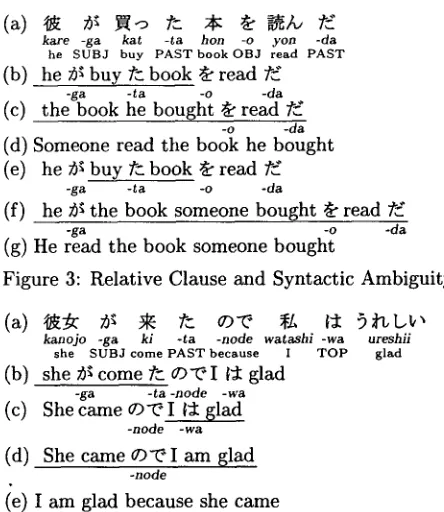
Figure 3 shows translation steps for a sentence with a relative clause. This sentence has a depen- dency ambiguity, so we also show how to resolve it through interaction. The original sentence (a) contains a relative clause with verb kau (buy) with an antecedent hen (book). Since Japanese is head- final, the sentence-initial case element kare-ga (he- SUB J) can be the subject of either kau (buy) or
y o m u (read), causing syntactic ambiguity.
First, let's suppose kare-ga is assumed to be the subject of the relative clause by the system. Then the system pauses showing (b), as soon as (a) is in- put. In (b), the translation region is assumed to be "he-ga buy-ta book". After translation trigger, the system pauses showing (c). Please note t h a t the underlined part in (b) is replaced by its equiva- lent English expression "the book he bought", and the whole sentence is underlined now. After another translation trigger, (d) is obtained, with missing sub- ject filled by some default word.
Suppose after obtaining (d) the user noticed t h a t this interpretation is not what s/he wants, and the case element kare-ga should be the subject of the verb of the matrix sentence. Then the user triggers undo of translation twice, returning to (b). Then s/he notice t h a t "he -ga buy -ta book" is treated as one phrase, against his/her interpretation. Then s/he changes the underlined area to "buy -ta book", excluding "he -ga" from the region (e), because this is the "correct meaningful phrase" in the user's in- terpretation. After translation trigger, (f) follows. Note t h a t the subject of the relative clause is supple- mented by a default element. Then (g), the desired result, follows.
Generally, if two syntax tree nodes share a child leaf node, one is an ancestor of the other. This property guarantees t h a t two overlapping transla- tion units can always be combined in our stepwise bottom-up translation method.
3.3.2 A Conjunction
Figure 4 shows translation steps for two sentences joined by a subordinate conjunct n o d e (because).
k a t e -ga k a t - t a h e n -o y o n - d a
he S U B J b u y P A S T b o o k O B J r e a d P A S T
(b) he 75~ buy fz book ,~ read fg
- g a - t a -o - d a
(c) the book he bought ~ read 7b:
-o - d a
• (d) Someone read the book he bought (e) he ~ buy ft. book ~ read fc:
- g a - t a -o - d a
(f) he ;0; the book someone bought ~ read Fd"
- g a -o - d a
(g) He read the book someone bought
Figure 3: Relative Clause and Syntactic Ambiguity
k a n o j o - g a ki - t a - n o d e w a t a s h i - w a
s he S U B J c o m e P A S T b e c a u s e I T O P
(b) she ~ come f~. ¢ ) ' ~ I ~$ glad -ga - t a - n o d e - w a (c) Shecame © ' ~ I ~ glad
-node - w a
(d) She came ¢)'~ I am glad
-node
ie) I am glad because she came
ureshH
g l a d
Figure 4: Treatment of Conjunction
Component sentences are translated first (c, d), then they are combined to produce a complex sentence. Here "because" is assumed to be the first alternative as translation equivalent for node.
4 M o r e o n I n t e r a c t i v e O p e r a t i o n s
The selection of an equivalent translation is more than simply choosing among synonyms, as shown in (Yamabana et al., 1995). First, part-of-speech of translation equivalent m a y be specified through this operation, since translation equivalents with differ- ent part-of-speech appear distinctly in the alterna- tives window. Second, the translation equivalent for functional words can be specified, which can affect the syntactic structure of the result. Although func- tional words remain unchanged in the intermediate representation, some words provide an alternatives window when the cursor is placed on them. Third, a whole unit with more t h a n one word can be de- tected and selected in the same interface as transla- tion equivalent for a single word.
[image:4.612.331.553.77.333.2]rareru be -ed
C a n
possibly
it is possible t h a t be able to
[image:5.612.91.299.80.181.2][auxiliary] [adverb] [adjective] [adjective]
[passive] [honorific] [capable] [capable] [capable] [capable]
Figure 5: Alternatives Window for rareru
(a) SL I~ ~ ~ ~g ~ ~ 2 © ~: l~:~z~ w a t a s h i - w a k a r e -ga h o n -o y o m u - n o - o t a s u k e r u
I T O P he S U B J b o o k O B J r e a d C O M P O B J h e l p
(b) I I~ he ;0~ book ~ read © ~ help
- w & - g a - w o - n o - w o
(c) I ~:~ he reads a book ~ help
- W a - 0
(d) I help him to read a book
Figure 6: Change of Generation Style
Figure 5 shows the content of the translation equivalent alternatives window for rareru. It ap- pears when the cursor is placed on t h a t word. If "be -ed" is chosen, the auxiliary is interpreted as a pas- sive morpheme and t r e a t e d as such in translation. If the second alternative is chosen, it is interpreted as honorific. In this case, as the translation equivalent is shown as a blank, no m o r p h e m e appears in the translation. By choosing the t h i r d alternative, it is translated to an auxiliary "can", showing capability. T h e fourth morpheme translates it to "possibly", an adverb. By choosing the fifth alternative, the user can specify the result to be a complement of an ad- jective "possible". A tree for the structure "it is pos- sible t h a t " , coded in the dictionary, is synthesized in the generation module.
T h e third point will be discussed in section 5.2.
5
E x t e n s i o n f r o m B a s i c
M o d e lAs explained in section 3.1, the m e t h o d basically as- sumes simple compositionaiity of translation. How- ever, this assumption a p p a r e n t l y needs modification to be applied to broader phenomena. T h e r e are two m a j o r sources of violation. One is inherited attributes, corresponding to constraints posed by higher nodes to lower ones. A n o t h e r is idiosyncratic violation of compositionality assumption, such as id- iomatic expressions. In this section we describe how t h e basic model is extended to t r e a t p h e n o m e n a t h a t violates this assumption.
5.1
Constraints from Higher Nodes
One obvious example of this t y p e of violation is in- flection. It is not an intrinsic p r o p e r t y of a word, but a constraint by dominating or governing element. For this reason, its calculation is delayed until the last phase of generation, when all information are gathered at the lexical node. In addition, inflec- tion are re-calculated in every translation, even if the translation of t h a t word has been already fixed by a former translation.
Another example is constraint posed by a verb subcategorization frame to s u b o r d i n a t e elements. Although syntactic cases can be processed by inflec- tion mechanism, constraint of sentence styles, such
as to-infinitive or gerund, can not be t r e a t e d in a similar manner. Since the sentence is a default paus- ing node, subcategorized sentence usually is already fixed as a finite form before the constraint is ap- plied. To cope with this problem, we provide a bookkeeping mechanism t h a t preserves all partial s y n t a x trees generated during translation. W h e n some grammatical constraint is newly introduced on an already translated expression, and if it requires structural deformation, the system looks for the reg- istered structure and generates it again so t h a t it meets the new constraint.
Figure 6 shows steps to obtain a sentence with an embedded clause "I help him to read a book". As soon as the original sentence (a) is entered, transla- tion equivalent selection and translation region se- lection is presented (b). T h e first region is the com- plement sentence "he ga book wo read n d ' , where
n o is a complement marker. After translation, (c) is obtained. T h e n whole sentence is assumed t o be the translation region, and (d) is obtained finally. Please note the change in the embedded sentence from a fi- nite form "he read a book" in (c) to an to-infinitive form "him t o read a book" in (d), in accordance with the grammatical constraint posed by t h e verb
"help".
5.2
Idiomatic Expression
T h e r e are some sets of words t h a t acquire special s y n t a c t i c / s e m a n t i c behavior when appearing simul- taneously. These idiomatic expressions are a n o t h e r m a j o r source t h a t violates the compositionaiity as- sumption of the method. Hereafter, the word "id- iomatic expression" is used in a r a t h e r broad sense: if translation of a combination of words is not pre- dictable from their individual behavior, we call it an idiomatic expression.
In one case, cooccurring words determines trans- lations of one another, even though their mean- ing can be u n d e r s t o o d compositionally. For exam- ple, r e n r a k u - w o toru (contact-OBJ take) should be translated to "make a contact", not "take a con- tact" nor "get a contact". In another case, the whole expression can t u r n into completely a n o t h e r mean- ing. For example, ashi-wo arau (foot-OBJ wash)
can be interpreted as either "wash (one's) foot" o r "wash one's hands", the latter case losing the orig- inal meaning of respective words. Although these idiomatic expressions must be recognized and trans- lated as one thing, t h e y cannot be registered as one word in the dictionary, since their elements can ap- pear in a distant position, or they can also have a purely compositional interpretation.
To cope with this problem, we extended the trans- lation equivalent selection interface so that transla- tion equivalents can be specified as a set for these expressions. Translation equivalent for the compo- nent words of an idiomatic expression changes syn- chronously when one of them is altered. Also, we expanded the dictionary and morphological analyzer to allow such multi-word translation unit correspon- dence.
We give an example with denwa-wo kakeru, an equivalent expression for "make a phone call". This is idiomatic because the correspondence between kakeru and "make" is peculiar to this interpreta- tion. When the expression denwa-wo kakeru is en- tered, the morphological analyzer recognizes it as an idiomatic expression and retrieves information from the idiom dictionary. Figure 7 is a snapshot of al- ternatives window for "kakeru", in the idiomatic in- terpretation. T h e second line is highlighted as the current selection. T h e leftmost word "make" shows that the current translation equivalent for "kakeru", and the third column shows the current translation equivalent for the whole expression is "make a phone call", an idiomatic interpretation. The alternatives window for "denwa" is shown in Figure 8. Here, the word "phone call" is highlighted corresponding to the interpretation as "make a phone call". When the user triggers translation, denwa becomes "a phone call", kakeru becomes "make", producing "make a phone call" in whole.
If the user changes the selection to another alter- native, say "telephone" at the third line in the al- ternatives window kakeru, then the selection in the alternatives window denwa also changes to the third line synchronously. Translation of denwa as denwa shows this word will simply vanish after translation. Then the translation of whole expression becomes an one word verb phrase "telephone".
At the first line of both alternatives window, the whole original Japanese expression is shown, with a slash at the boundaries of words, like d e n w a / w o / k a k e r u . This alternative allows the user to switch from idiomatic interpretation to non- idiomatic interpretation. If the user chooses this al- ternative, a new alternatives window containing lit- eral translation appears as in figure 9. At the same time the alternatives window for denwa changes and shows literal translations for denwa. T h e user can
denwa/wo/kakeru
make [verb] [make a phone call] telephone [verb] [telephone]
call [verb] [call up]
Figure 7: Alternatives for kakeru as an Idiom
denwa/wo/kakeru
phone call [countable] [make a phone call]
denwa [telephone]
denwa [call up]
Figure 8: Alternatives for denwa as an Idiom
go back to the idiomatic interpretation by choosing the alternative denwa+wo+kakeru, at the last line of these alternatives windows.
We remark t h a t this mechanism provides a general means to treat translation unit with more t h a n one component word.
6
I m p l e m e n t a t i o n
T h e m e t h o d is realized as an English writing support software on personal computers. T h e main function is divided into two modules, the interface module and the translation module. T h e interface module is in charge of user interaction, morphological analy- sis and predicting translation equivalent and region, as well as function as a front-end. T h e translation module performs translation of the specified region, obeying user specification passed by the interface module. The most i m p o r t a n t requirement for the translation module is robustness, in the sense t h a t it doesn't drop a word even when specifications are contradictory. In that case, the system should serve as a simple online dictionary.
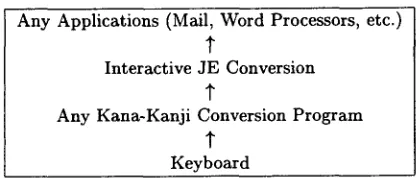
A prominent feature is added in this implementa- tion: it works as a language conversion front-end to an arbitrary application. T h e system is placed be- tween the keyboard and an application in the d a t a flow. It captures Japanese input before they are en- tered to an application, converts it into English, and then sends the result to the application (figure 10).
kakeru
hang [verb] put [verb]
denwa+wo+kakeru
Figure 9: Alternatives for kakeru in literal interpre- tation
[image:6.612.328.555.84.250.2] [image:6.612.401.488.632.693.2]Any Applications (Mail, Word Processors, etc.)
t
Interactive JE Conversion
t
Any Kana-Kanji Conversion Program
t
Keyboard
Figure 10: Relation to Other Programs
This function is realized using a standard hook and IME API of the operating system, Microsoft Win- dows 95. This feature allows this system used as an add-on function of any application, enabling the user to work in a familiar document writing environment. The system dictionary contains about 100,000 Japanese entries and 15,000 idiomatic expressions. Since there was no source available to build an id- iom dictionary of this size, they were collected man- ually from scratch following a method described in (Tamura et al., 1996). The essence of this method is limiting search space utilizing distinguished word classes characteristic to idiomatic expressions, re- vealed by an intensive analysis of these expressions. A CD-ROM online dictionary accessing function is also provided to help user's translation equivalent selection.
This software is currently available either as a package software or a pre-installed software on per- sonal computers.
7
D i s c u s s i o n
Interactive method in machine translation have been pursued by many people (Kay, 1973; Melby et al., 1980; Tomita, 1984; Huang, 1990; S o m e r s e t al., 1990a; Boitet et al., 1995). In these approaches, the system asks a set of questions to the user to resolve ambiguities not solvable by itself. Among problems of this approach are, as Melby pointed out, exces- sive interaction and necessity for special training for interactive operations.
In our method, interactive operations are initi- ated and guided by the user and all interactive op- erations are optional, except for a small number of translation triggers needed for translating compo- nent sentences. The system provides its prediction as a default selection, and other possibilities as sec- ond or third choices, but the user is free to obey or ignore them. If the selection is wrong, the transla- tion result becomes wrong, which is a feedback to the user. Then the user can undo the translation, correct selections, and try again (for example, see figure 3). On the other hand, the user has only to repeat "next" i~struction to obtain a result of au- tomatic translation quality. Frequency and content
of interaction are determined by the user. In this manner, the user and the system are essentially co- operative, avoiding the problem of excessive ques- tioning by the system. The problem of difficulty in learning interactive operations is also avoided since our interactions are essentially those of simple Kana- Kanji conversion operations. We believe an average user can easily learn operations of our system.
An interactive dependency parser reported in (Maruyama et al., 1990), is based on an interface like Kana-Kanji conversion, and shares character- istics described above 2. However, their method is limited to syntactic dependency disambiguation by explicitly specifying the words in the dependency re- lation, and it is difficult to expand the method to handle the types of ambiguity discussed in this pa- per.
A user-driven approach to interactive translation, proposed by (Somerset al., 1990b), is based on cut and paste operations, where the content of copy buffer is translated when it is pasted. This method seems to leave too much burden to the user, since the user must explicitly specify which portions of the text Should be translated, and in what order. Also it is not clear how to combine partial translations of two overlapping expressions, except for direct edit- ing.
Our stepwise conversion scheme, in which conver- sion proceeds from smaller structures to larger ones, is a natural conclusion of our try-and-error-based conversion approach. As Melby says, a post-editor will only improve by a certain increment: if the re- sult is completely wrong, s/he will simply abandon the whole result. Since it is easier to obtain an ap- propriate result for a shorter and simpler structure, a result obtained by stepwise conversion tends to be of better quality than a result obtained by translat- ing the whole structure at one step. In other words, our system divides the translation step into smaller pieces, and allows post-editing at every step.
As described before, target users of our method are those who have basic knowledge to read and un- derstand the target language. According to the tar- get language skill of the user, useful support func- tion will be different. For example, for a user who is competent in English, our system will be useful as an online dictionary. While writing in English, the user can look up the system dictionary only by entering a Japanese word. Then s/he can enjoy easy- to-use interactive operations for translation equiva- lent selection, inflection selection and CD-ROM die- tionary access. When the user find an appropriate word, s/he only has to push the return key to enter the word into the original application. These users
2These characteristics are inherited essentially from a Kana-Kanji conversion interface.
[image:7.612.108.317.85.174.2]will also find it useful to obtain a translation equiv- alent expression for an idiomatic expression. These idiomatic expressions, either of source language or target language, are hard to t r a n s l a t e since they do not allow literal translation and difficult to find in other dictionaries. By combining this idiom dictio- n a r y and translation function, the user can obtain a useful skeleton for target language expression. For m a n y users, however, the translation function will be considered helpful to produce a result of the quality level t h a t m a t c h e s their English reading skill. Suit- able usage will be balanced between the user's skill and the capability of the system.
T h e function as an add-on function to an a r b i t r a r y software will be an a d v a n t a g e equally for all users, enabling t h e m to work in their familiar environment, c o m p a r e d to conventional machine-aided translation systems t h a t force t h e m to work in an independent unfamiliar environment.
Finally we discuss some remaining problems and direction of further work.
Translation quality needs continuous effort for im- provement, in b o t h linguistic coverage and preci- sion. Precision of initial prediction of translation equivalent and translation area is crucial to the per- formance of the system, since t h e y determine the quality of default translation. In our experience, the users are willing to use interactive operation to im- prove translation quality, b u t never to recover from incomprehensible o u t p u t .
We also have to mention some ambiguities difficult to resolve though basic operations of the method. An e x a m p l e is g r a m m a t i c a l relation a m b i g u i t y be- tween a case element a n d a verb, when the case m a r k e r is hidden. Generally, the s y s t e m t r e a t s these cases by producing all possibilities in the order of pri- ority and allowing the user to choose one. However, when such ambiguities are multiplied, the n u m b e r of possibilities easily grows large, m a k i n g selection difficult. One possible solution would be to pro- vide more disambiguation information, possibly a sequence of dialogues, to help the user to make de- cision. An i m p o r t a n t requirement here is t h a t these dialogues m u s t not force a response. T h e user should be able to ignore t h e m unless t h e y want to.
A n o t h e r further work is e x p a n d i n g the dictionary, especially idiomatic expressions. We are also plan- ning to add translation examples to t h e knowledge base, so t h a t translation can be p e r f o r m e d either using g r a m m a r s or examples in the knowledge base. These examples are effective to guarantee correct- ness of the result, hence will be useful even for users not very familiar in the target language. In this di- rection, our system would be e x p a n d e d as a kind of interactive example-based translation s u p p o r t sys- tem.
8
C o n c l u s i o n
We presented an interactive machine-aided trans- lation m e t h o d to s u p p o r t writing in a foreign lan- guage, which is a combination of dictionary lookup and interactive machine translation. T h e transla- t i o n proceeds as a cooperative process between t h e system and the user, t h r o u g h interactive operations similar to K a n a - K a n j i conversion m e t h o d . We im- plemented the m e t h o d as a front-end language con- version software to an a r b i t r a r y application.
R e f e r e n c e s
Aho, A. et al. 1986. Compilers. Principles, Techniques, and Tools. Addison-Wesley Publishing.
Boitet, C. et al. 1995. Multilingual Dialogue-Based MT for Monolingual Authors: the LIDIA Project and a First Mockup. In Machine Translation, vol.9(2), pages 99-132.
Canisius, P. 1977. Automatic Partial Translation in a Multilingual Information System. In Overcoming the Language Barrier (Third European Congress on Information Systems and Networks), vol.1, pages 259- 269.
Huang, X. 1990. A Machine Translation System for the Target Language Inexpert. In Proceedings of
COLING-90, pages 364-367.
Kay, M. 1973. The MIND System. In Natural Language Processing, Algorithmic Press.
Maruyama, H. et al. 1990. An Interactive Japanese Parser for Machine Translation. In Proceedings of COLING-90, pages 257-262.
Melby, A. et al. 1980. ITS: Interactive Translation Sys- tem. In Proceedings of COLING-80, pages 424-429.
Muraki, K. et al. 1994. TWP: How to assist English pro- duction on Japanese word processor. In Proceedings of COLING-94, pages 283-298.
Somers, H. et al. 1990a. Machine Translation without a source text. In Proceedings of COLING-90, pages 271-276.
Somers, H. et al. 1990b. A user-driven interac- tive machine translation system. In Proceedings of SICONLP-90, pages 140-143.
Tamura, S. et al. 1996. Collecting of Verbal Id- iomatic Expressions and Development of a Large Dic- tionary for Japanese-to-English Machine Translation. (In Japanese) In Proceedings o] 2nd Annual Conven- tion of Association for NLP, pages 45-48.
Tomita, M. 1984. Disambiguating grammatically ambiguous sentences by asking. In Proceedings of COLING-84, pages 476-480.