
Performance of SDMA Multi-User Detection
Techniques for Walsh-Hadamard-Spread OFDM
Schemes
Matthias M ¨unster and Lajos Hanzo1
Dept. of Electronics and Computer Science, University of Southampton, SO17 1BJ, UK. Tel: +44-1703-593 125, Fax: +44-1703-594 508
Email:[email protected] http://www-mobile.ecs.soton.ac.uk
Abstract—Multiple reception antenna assisted Space Divi-sion Multiple Access (SDMA) techniques designed for wire-less OFDM systems have recently drawn wide interests. These techniques facilitate the implementation of effective multi-user detection algorithms at the receiver, such as Mini-mum Mean-Square Error (MMSE) detection, Successive In-terference Cancellation (SIC), Parallel InIn-terference Cancel-lation (PIC) or Maximum Likelihood (ML) detection. In this contribution we will investigate the performance of the MMSE and PIC detection techniques in the context of a Walsh-Hadamard spreading assisted SDMA OFDM system.
I. INTRODUCTION
Space Division Multiple Access (SDMA) concepts in-corporating effective multi-user OFDM detection tech-niques have recently been addressed in a variety of pub-lications. More specifically, detection techniques typically employed in CDMA systems, such as Minimum Mean-Square Error (MMSE) combining [1–3], Successive In-terference Cancellation (SIC) [3–5], Parallel InIn-terference Cancellation (PIC) [5], Maximum Likelihood (ML) de-tection [3, 6] and Maximum Likelihood Sequence Esti-mation (MLSE) [5, 7] have recently been tailored to sup-port the operation of SDMA systems. A further tech-nique, which can be used by both single- and multi-carrier CDMA systems [8], potentially supporting multiple si-multaneous users at the cost of a reduced throughput for each individual user, is spreading of the transmitted sig-nal by means of orthogosig-nal codes, such as for example Walsh-Hadamard sequences. In the context of single user OFDM systems, spreading has been recognized as an
ef-VCT2001 Fall Conference, October7-11, 2001, Atlantic City, NJ
The financial support of the European Union under the auspices of the Pan-European TRUST project and that of the EPSRC, Swindon UK is gratefully acknowledged
Receiver
User 1
User 2
User L
Channel
H (L) P
H (2) 2 s
(1)
s (2)
s (L)
n2
nP H
(L) 2 H
(L) 1
H (1) 1
H (2) P
H (2) 1
n 1
H (1) P
[image:1.612.309.558.224.337.2]H (1) 2
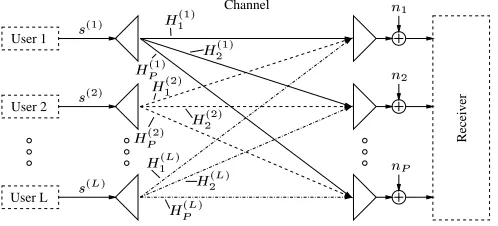
Fig. 1. Schematic of an SDMA uplink scenario, where each of theLusers is equipped with a single transmit antenna and
the receiver is assisted by aP-element antenna front-end.
fective technique for exploiting the multipath diversity of-fered by a wideband channel. Hence, in this contribution we combine multiple reception antenna assisted SDMA concepts, where each user accesses the entire available fre-quency band, with subcarrier spreading [8]. Our investiga-tions will assess the impact of spreading on the MMSE and PIC detection techniques. The outline of the paper is as follows. In Section II we introduce the SDMA signal model, while in Section III the principles of spreading are explained. In Section IV simulation results are presented for various system configurations in terms of the number of users supported. Our conclusions are offered in Sec-tion V.
II. THESDMA SIGNAL MODEL
In Figure 1 we have portrayed an SDMA uplink trans-mission scenario, where each of theLsimultaneous users is equipped with a single transmission antenna, while the receiver capitalizes on aP-element antenna front-end. The
superposition of the independently faded signals associ-ated with the L users sharing the same space-frequency resource. The received signal was corrupted by the Gaus-sian noise at the array elements. The indices [n;k]have been omitted for notational convenience during our forth-coming discourse, yielding:
x = Hs+n; (1)
where the (P 1)-dimensional vector xof received sig-nals, the vectorsof transmitted signals and the array noise vectorn, respectively, are given by:
x = (x
1 ;x
2 ;:::;x
P )
T
; (2)
s = (s
(1) ;s
(2) ;:::;s
(L) )
T
; (3)
n = (n
1 ;n
2 ;:::;n
P )
T
: (4)
The frequency domain channel transfer factor matrix H of dimension LP is constituted by the set of channel vectors of theLusers:
H = (H
(1) ;H
(2)
;:::;H (L)
); (5)
each of which hosts the frequency domain channel transfer factors between the single transmitter antenna associated with a particular user l and the reception array elements
p2f1;:::;Pg:
H (l) = (H (l ) 1 ;H (l ) 2
;:::;H (l ) P
) T
; (6)
with l 2 f1;:::;Lg. Regarding the statistical properties of the components associated with the vectors in Equation 1, we assume that the complex data signal s
(l )
transmit-ted by thel-th user has zero-mean and unit variance. The AWGN noise process n
p at any antenna array element p exhibits also zero-mean and a variance of
2
. The fre-quency domain channel transfer factors H
(l )
p of the differ-ent array elemdiffer-entsp2f1;:::;Pgor usersl2f1;:::;Lg are independent, stationary, complex Gaussian distributed processes with zero-mean and a different variance of
2 l [1].
III. WALSH-HADAMARD TRANSFORMSPREADING
During then-th OFDM symbol period prior to transmis-sion the set ofK data symbolss
(l ) i [n; k];0
k K 1
of the l-th user, which are associated with individual sub-carriers in a scenario using no spreading, is subjected to the Walsh-Hadamard Transform (WHT) [8] in the spread scenario. As a result, each subcarrier-related symbol at the output of the transform block contains a contribution of all the original subcarrier data symbols that are to be transmit-ted. At the receiver after subcarrier-by-subcarrier based
00 00 11 11 00 00 11 110011
00 00 11 11 00 00 11 11 00 00 11 110011
00 00 11 11 00 00 11 11 00 00 11 110011
00 00 11 11 00 00 11 11 00 00 11 11 00 00 11 11 00 11 00 00 11 11 00 00 11 11 00 11 00 00 11 11 00 00 11 11 00 11 00 00 11 11 00 00 11 11
17 18 19 16
0 1 2 3 32 33 34 35
[image:2.612.305.558.12.108.2]subcarrier index B 0 B 1 B 2 B 3 B 0 B 1 B 2 B 3 B 0 B 1 B 2 B 3 B0 B1 B2 B3
Fig. 2. Illustration of WHT subcarrier spreading using a limited WHT blocksize, which is a fraction of the total number of subcarriers hosted by the OFDM symbol.
channel equalization in the single-user single-reception antenna scenario or after array combining in the multi-user multi-reception antenna assisted SDMA scenario de-spreading is performed. Dede-spreading is invoked separately for the different users in the SDMA scenario. Due to the operations of spreading and despreading combined with MMSE based frequency-domain equalization the adverse effects of low SNR subcarriers on the average BER per-formance is potentially improved. This is a direct conse-quence of spreading, since even if the signal corresponding to a specific chip is obliterated by a deep channel fade, af-ter despreading its effects are spread over the WHT-length. Hence there is a high chance of still recovering all the par-tially affected subcarrier symbols without errors.
Since the employment of WHTs having a high trans-form length, such as for example512, as required in case of the indoor WATM system model employed in our in-vestigations in Section IV would impose a high compu-tational complexity, we partition the OFDM symbol into several WHTs. This is also justified by the observation that most of the channel’s diversity can be exploited with the aid of a relatively short spreading length, as illustrated in Figure 3. Furthermore, depending on the particular de-lay spread profile of the channel, the OFDM symbol band-width of K subcarriers can be divided into K =M inter-leaved blocks of size M each, which are separately sub-jected to the WHT. More specifically, thei-th WHT block contains subcarriers having indicesjgiven by:
j=i+r K M
; 0r M 1 ; (7)
s c path
225MHz 60GHz 3 16:9ns
FFT length cycl. prefix f d;max
f 0 d;max
512 64 2778Hz 1:23510
[image:3.612.318.524.19.272.2]5
TABLE I
PARAMETERS OF THE INDOORWATMENVIRONMENT[9].
0 5 10 15 20 25 30 35 40 Average SNR at the antenna element [dB] 10-5
2 5
10-4
2 5
10-3
2 5
10-2
2 5
10-1
2 5
100
BER
Fr.-Inv. Fad. SWATM, Spread, 4QAM
blk. 64 blk. 32 blk. 16 blk. 8 blk. 4 blk. 2 Spread:
AWGN
SWATM, Spread
Fig. 3. BER performance of a Walsh-Hadamard spreading as-sisted, 4QAM modulated single reception antenna,
sin-gle user OFDM system parameterised with the spreading
blocksize in the context of the ’frame-invariant’ fading in-door WATM channel model of Table I [9]; ideal channel transfer function knowledge was assumed; the BER per-formance of 4QAM signalling over an AWGN channel has been plotted as a reference.
from each other belong to the same WHT block.
The WHT spreading assisted OFDM system can be viewed in terms of the average BER achieved as a ’fully loaded’ downlink Multi-Carrier Code Divison Multiple Access (MC-CDMA) scheme. As a result of the or-thogonality of the WHT, the operations of MMSE based frequency-domain equalization and despreading are de-coupled both in the single-user single reception antenna as well as in the multi-user multi-reception antenna scenario.
IV. SIMULATION RESULTS
Simulation results have been obtained for the indoor
WATM system- and channel model of [9, 10]. The associ-ated parameters are listed in Table I. We commenced our
0 5 10 15 20 25 30 35 40 Average SNR at the antenna element [dB] 10-5
2 5
10-4
2 5
10-3
2 5
10-2
2 5
10-1
2 5
100
BER
Fr.-Inv. Fad. SWATM, Adapt./Spread, 4QAM
Spread, blk. 64 (AWGN only) Adaptive, 512 Subb. Adaptive, 32 Subb. Adaptive, 16 Subb. Non-Adaptive
AWGN
[image:3.612.54.257.128.388.2]SWATM
Fig. 4. BER performance comparison between a 4QAM
mod-ulated single reception antenna, single user standard OFDM system, an OFDM system employing four-mode
(’no transmission’, BPSK, 4QAM, 16QAM), constant-throughput, zero-delay signalling based adaptive
modula-tion using16 or 512 subbands, and a Walsh-Hadamard spreading assisted OFDM system employing a spreading
blocksize of 64 subcarriers in the context of the
’frame-invariant’ fading indoor WATM channel model of Table I [9]; ideal channel transfer function knowledge was assumed; the BER performance of 4QAM signalling over an AWGN channel has been plotted as a reference.
0 5 10 15 20 25 30 35 40 Average SNR at the array elements [dB] 10-5
2 5
10-4
2 5
10-3
2 5
10-2
2 5
10-1
2 5
100
BER
Fr.-Inv. Fad. SWATM, 2 Rec. Antennas, 2 Users, 4QAM
SIC PIC MMSE Detector:
spread
non-spread
[image:4.612.54.259.25.272.2]SIC, non-spread
Fig. 5. BER performance comparison between MMSE, PIC
or SIC multi-user detection assisted, 4QAM modulated, two reception antenna, two user OFDM systems, in the
context of an SDMA channel environment as portrayed in Figure 1, where each independently fading channel is char-acterized by the parameters of the ’frame-invariant’ fad-ing indoor WATM channel model given in Table I [9]; the systems employing MMSE and PIC multi-user detection were further assisted by Walsh-Hadamard spreading using a blocksize of16subcarriers; ideal channel transfer function
knowledge was assumed.
frequency-domain fading effects as possible.
In our next investigations we compared the BER per-formance of the WHT assisted OFDM system to a non-spread OFDM system and to an OFDM system employ-ing adaptive modulation [9], under the constraint of hav-ing a target throughput equivalent to that of the fixed mode 4QAM modulated OFDM system. The modulation mode adaptation regime employed a total of four modes, namely ’no transmission’, BPSK, 4QAM and 16QAM transmis-sion. In order to reduce the signalling overhead required, the modulation modes were assigned on a subband basis, where each subband hosted either one or a number of sub-carriers. Specifically, using one subcarrier per subband allowed us to determine the upperbound performance of the system. Furthermore, the best case scenario of per-fect channel transfer function knowledge was invoked in the process of determining the optimum modulation mode assignment. The corresponding simulation results are il-lustrated in Figure 4. We observe that in the specific in-door WATM channel environment, assuming the
separa-0 5 10 15 20 25 30 35 40 Average SNR at the array elements [dB] 10-5
2 5
10-4
2 5
10-3
2 5
10-2
2 5
10-1
2 5
100
BER
Fr.-Inv. Fad. SWATM, 4 Rec. Antennas, 4 Users, 4QAM
SIC PIC MMSE Detector:
spread
non-spread
[image:4.612.321.522.25.273.2]SIC, non-spread
Fig. 6. BER performance comparison between MMSE, PIC
or SIC multi-user detection assisted, 4QAM modulated, four reception antenna, four user OFDM systems, in the
context of an SDMA channel environment as portrayed in Figure 1, where each independently fading channel is char-acterized by the parameters of the ’frame-invariant’ fad-ing indoor WATM channel model given in Table I [9]; the systems employing MMSE and PIC multi-user detection were further assisted by Walsh-Hadamard spreading using a blocksize of16subcarriers; ideal channel transfer function
knowledge was assumed.
tion of the total bandwidth into 32equal-sized subbands, each hosting16subcarriers, the OFDM system employing adaptive modulation exhibits the same performance as the spread OFDM system, for a WHT blocksize of64 subcar-riers. By contrast, a hypothetic system assigning an indi-vidual modulation mode to each subcarrier outperformed the WHT OFDM scheme by about2dB. Hence, taking also into account the signalling overhead required by the adap-tive modulation scheme, as well as its limited applicabil-ity to relatively slowly varying channels in the absence of channel transfer function prediction techniques, we con-clude that subcarrier spreading is a more convenient ap-proach to exploiting the wideband channel’s diversity po-tential.
we invoked the MMSE [1–3] and the PIC [5] based multi-user detection approaches, while SIC [3–5] was not di-rectly applicable to a spread OFDM system. This is be-cause in a specific subcarrier or subband in each iteration the highest-power user is detected first, followed by sub-traction of its sliced and remodulated signal from the resid-ual composite multi-user signal received by each antenna. Since the WHT based spreading is performed across sub-carriers spaced apart from each other as far as possible, for the sake of maximising the achievable diversity ef-fect, these subcarriers would potentially require a differ-ent SIC detection order. Hence not all the symbols of a specific user contained in a WHT block are available at the same time for demodulation. Initial simulation re-sults have been obtained for a two reception antenna, two user SDMA scenario. The results are portrayed in Fig-ure 5. We observe that the PIC detector using WHT based spreading outperforms the SIC detector in the non-spread case, which, following the philosophy of the M-algorithm, tracked two possible symbol states from each node. By contrast, the least complex multi-user receiver, namely the MMSE detector performed about 2:5dB worse, than PIC, which was also observed in the non-spread scenario. Again by contrast, in case of a four reception antenna, four user SDMA scenario characterized in Figure 6, the SIC de-tector applied in the non-spread scenario outperforms both spreading assisted arrangements, namely those employing MMSE and PIC based detection. Still, in comparison to an arrangement using no spreading, both the MMSE and PIC detection assisted SDMA scenarios exhibit a signifi-cant performance gain in the presence of spreading.
V. CONCLUSIONS
From the investigations conducted we conclude that WHT based subcarrier spreading can be effectively em-ployed in the context of SDMA/OFDM scenarios sup-porting a moderate number of users in conjunction with MMSE and PIC multi-user detection techniques, in order to exploit the diversity potential offered by the wideband channel. While spreading assisted PIC detection slightly outperformed the SIC detection assisted system using no spreading in the two-reception antenna, two-user scenario, in OFDM scenarios supporting a high number of users, SIC detection - which was not directly applicable to sce-narios using spreading - was demonstrated to be more ef-fective.
REFERENCES
[1] Y. Li and N. R. Sollenberger, “Adaptive Antenna Arrays for OFDM Systems with Cochannel Interference,” IEEE
Transac-tions on CommunicaTransac-tions, vol. 47, pp. 217–229, Feb 1999.
[2] M. M¨unster, T. Keller, and L. Hanzo, “Co–Channel Interfer-ence Suppression Assisted Adaptive OFDM in InterferInterfer-ence Lim-ited Environments,” in Proc. of Vehicular Technology Conference, vol. 1, (Amsterdam, Netherlands), pp. 284–288, IEEE, September 19-22 1999.
[3] P. Vandenameele, L. V. der Perre, M. Engels, and H. D. Man, “A Novel Class of Uplink OFDM/SDMA Algorithms for WLAN,” in
Proc. of Global Telecommunications Conference - Globecom’99,
vol. 1, (Rio de Janeiro, Brazil), pp. 6–10, IEEE, December 5-9 1999.
[4] G. D. Golden, G. J. Foschini, R. A. Valenzuela, and P. W. Wol-niansky, “Detection Algorithms and Initial Laboratory Results using V-BLAST Space-Time Communication Architecture,” IEE
Electronics Letters, vol. 35, pp. 14–16, Jan. 1999.
[5] M. M¨unster and L. Hanzo, “Co-Channel Interference Cancella-tion Techniques for Antenna Array Assisted Multiuser OFDM Systems,” in Proc. of 3G-’2000 Conference, vol. 1, (London, Great Britain), pp. 256–260, IEE, March 27-29 2000.
[6] G. Awater, A. v. Zelst, and R. v. Nee, “Reduced Complexity Space Division Multiplexing Receivers,” in Proc. of Vehicular
Technol-ogy Conference, vol. 1, (Tokyo, Japan), pp. 11–15, IEEE, May
15-18 2000.
[7] M. Speth, A. Senst, and H. Meyr, “Low Complexity Space-Frequency MLSE for Multi-User COFDM,” in Proc. of Global
Telecommunications Conference - Globecom’99, vol. 1, (Rio de
Janeiro, Brazil), pp. 2395–2399, IEEE, December 5-9 1999. [8] K. Fazel and G. Fettweis, Multi-carrier Spread Spectrum &
Re-lated Topics, ISBN 0-7923-7740-0. Kluwer, 2000.
[9] L. Hanzo, W. Webb, and T. Keller, Single- and Multi-carrier
Quadrature Amplitude Modulation. IEEE Press- John Wiley,
April 2000.
[10] T. Keller and L. Hanzo, “Adaptive multicarrier modulation: A convenient framework for time-frequency processing in wireless communications,” Proceedings of the IEEE, vol. 88, pp. 611–642, May 2000.
[11] K. Fazel and G. Fettweis, Multi-carrier Spread Spectrum, ISBN

![Fig. 4. BER performance comparison between a 4QAM mod-ulated single reception antenna, single user standardOFDM system, an OFDM system employing four-mode(’no transmission’, BPSK, 4QAM, 16QAM), constant-throughput, zero-delay signalling based adaptive modula-tion using16 or512 subbands, and a Walsh-Hadamardspreading assisted OFDM system employing a spreadingblocksize of64 subcarriers in the context of the ’frame-invariant’ fading indoor WATM channel model of Table I[9]; ideal channel transfer function knowledge was assumed;the BER performance of 4QAM signalling over an AWGNchannel has been plotted as a reference.](https://thumb-us.123doks.com/thumbv2/123dok_us/1035532.618998/3.612.54.257.128.388/performance-standardofdm-transmission-hadamardspreading-spreadingblocksize-subcarriers-performance-awgnchannel.webp)
![Fig. 5.BER performance comparison between MMSE, PICor SIC multi-user detection assisted, 4QAM modulated,two reception antenna, two user OFDM systems, in thecontext of an SDMA channel environment as portrayed inFigure 1, where each independently fading channel is char-acterized by the parameters of the ’frame-invariant’ fad-ing indoor WATM channel model given in Table I [9]; thesystems employing MMSE and PIC multi-user detectionwere further assisted by Walsh-Hadamard spreading using ablocksize of16 subcarriers; ideal channel transfer functionknowledge was assumed.](https://thumb-us.123doks.com/thumbv2/123dok_us/1035532.618998/4.612.54.259.25.272/performance-comparison-thecontext-environment-independently-detectionwere-subcarriers-functionknowledge.webp)
