Themed Section: Engineering and Technology
Improving Performance and Detection Schemes of Mimo-Ofdm Systems in the Presence of Phase
Noise and Doubly-Selective Fading Where Channel is Both Time and Frequency Selective
Offia Innocent.S, Udeh Ikemefuna James, Eke J
Department of Electrical Electronic Engineering
Enugu State University of Science and Technology, Enugu State Nigeria
ABSTRACT
MIMO-OFDM technology is a combination of multiple-input multiple-output (MIMO) wireless technology with orthogonal frequency division multiplexing (OFDM) that has been recognized as one of the most promising techniques to support high data rate and high performance in different channel conditions. In this paper we analyze the impacts of phase noise to multiple-input multiple-output (MIMO) orthogonal frequency division multiplexing (OFDM) systems over doubly selective Rayleigh fading. Where channel is both time and frequency selective. Similar to single-antenna OFDM, Orthogonal frequency division multiplexing (OFDM) techniques have been investigated extensively to combat the effect of multipath delay. MIMO-OFDM suffers from significant performance degradation due to phase noise and time-selective fading, which causes intercarrier interference (ICI). We derive the expressions of carrier to interference and signal to interference plus noise ratios. After characterizing the common phase error (CPE) caused by phase noise and ICI caused by phase noise, as well as time-selective fading, using a minimum mean-squared error-based scheme to mitigate the effect of both phase noise and time-selective fading. Equally we evaluated and compared various detection schemes and their performances combined with the proposed CPE mitigation scheme. With numerical results, we examined the relative performances and the potential error floors of these detection schemes which show a total reduction of noise to 5%.
Keywords: ICI, MIMO-OFDM, ZF, MMSE, phase noise, time-selective fading
I.
INTRODUCTION
Orthogonal Freguency Division Multiplexing is considered a promising transmission technique for wideband wireless communications. One of the disadvantages of Orthogonal Freguency Division Multiplexing is its sensitivity to phase noise, which is a random process caused by the fluctuation of the transmitter and receiver oscillators [Pollet, 1995]. It is widely accepted that phase noise in Orthogonal Freguency Division Multiplexing has two major effects [Tomba, 1998], [Armada, 2001] Common Phase error (CPE), a constant rotation to the signal constellation, and intercarrier interference (ICI) due to the loss of orthogonality among subcarriers caused by the fast changes of the oscillator phase.
The Common Phase error (CPE) term is the same for all subcarriers within one Orthogonal Freguency Division Multiplexing symbol interval and changes slowly from one symbol to another. If phase noise level is low, Common Phase error (CPE) approximately equals the
mean of the phase deviation of an oscillator within one Orthogonal Freguency Division Multiplexing symbol. The Intercarrier Interference (ICI) term is a random process. Schemes which compensate phase noise in Orthogonal Freguency Division Multiplexing systems have been proposed [S. Wu, 2002]. The signal–to-interference–plus–noise ratio (SINR) expression for single-antenna Orthogonal Freguency Division Multiplexing systems with various phase noise levels and different number of subcarriers was derived [Zheng, 2004].
systems was studied [Nikitopoulos, 2004]. Besides phase noise- time-selective fading also destroys the orthogonality among different subcarriers within one Orthogonal Freguency Division Multiplexing (OFDM) symbol and causes Intercarrier interference (ICI) [Russell, 1995]. Similar to single-antenna Orthogonal Freguency Division Multiplexing (OFDM), MIMO-OFDM is also vulnerable to channel time selectivity. Error performance of MIMO-OFDM systems in the presence of time-selective fading without considering phase noise was analysed [Stamoulis, 2002].
Although the issue caused by phase noise and time-selective fading in MIMO-OFDM has been recognized, the exact quantitative effect of the combination of the two has not been well addressed. Phase noise mitigation for MIMO-OFDM in fast time-varying fading environments has not been well studied either. In this chapter, It was analyzed, via mainly an analytical approach, the impact of phase noise to the performance of MIMO-OFDM systems over doubly-selective Rayleigh fading channels. After characterizing Common Phase error (CPE) caused by phase noise and Intercarrier Interference (ICI) caused by phase noise and time-selective fading, an MMSE-based mitigation scheme to effectively minimize the impact of phase noise was derieved. The author also compare four detection schemes, Zero forcing, ZF, MMSE, decorrelating division feeback (DF) and MMSE-DF schemes, and evaluate their SER performance.
II.
METHODS AND MATERIAL
A. System Model
Consider a MIMO-OFDM system with Nt transmit
antennas, Nr receive an-tennas, and Ns subcarriers in a
doubly-selective Rayleigh fading environment. Input data are assumed to be independent variables with zero mean and unit variance. The time domain data sequence is obtained by taking the inverse discrete Fourier transform (IDFT) of the data block for each transmit antenna. A cyclic prefix (CP) with a length longer than the channel length is inserted at the beginning of each of the data sequences. The data sequences with a cyclic prefix (CP) are then trans-mitted through Nt independent
antennas. At each receive antenna, the cyclic prefix (CP) is removed and a discrete fourier Transform (DFT) unit is applied. Let xk = [xk1,…,xkNt]
T
and yk = [yk1,…,ykNr] T
denote, respectively, the transmitted and received data for all antennas on subcarrier k, where 0 k
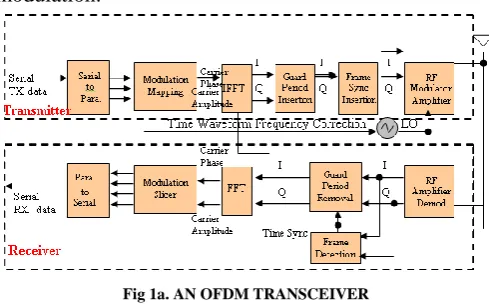
Ns – 1.The general form of the received signal in MIMO-OFDM over slowly fading channels (the channel is time-invariant over several Orthogonal Freguency Division Multiplexing (OFDM) symbol periods) (OFDM) signal are time and frequency synchronsed to each other, allowing the interference between subcarriers to be carefully controlled. These multiple subcarriers overlap in the frequency domain but do not cause inter-carrier interference (ICI) due to the orthogonal nature of the modulation.
Fig 1a. AN OFDM TRANSCEIVER
B. Space-Time Coded Orthogonal frequency division multiplexing (OFDM) Transmitter
Consider a Mult-Input Multi-Output- Orthogonal frequency division multiplexing (OFDM) system with Nt
transmit antennas, Nr receive an-tennas, and Ns
subcarriers. The channel is frequency-selective Rayleigh fading and is modeled as quasi-static, allowing it to be constant over an orthogonal frequency division multiplexing (OFDM) block and change independently from one block to another.
Input symbol sequence {a(0), a(1),…,a(NtNs – 1)} is
serial-to-parallel con-verted into Ntsequences, each of
length Ns, as
ap(k) = a(k + (p – 1) Ns); k = 0, …, Ns – 1, p = 1, …, Nt.
Each of the Ns sequences {a1(k), a2(k)…, aNt(k)}, k = 0, …, Ns – 1, is mapped to a matrix Ψk of size Nt x N (N is the number of time burst defined in STC) by using the orthogonal space- time block coding scheme given in [Tarokh ,1999]
For instance, if we apply the Alamouti code for a system with two transmit antennas, Ψk is obtained as
Then we take the inverse discrete Fourier transform (DFT) of {Ψ0, Ψ Ns
-1 } as
Where j = -1, to form the transmitted signals represented in a matrix form as
Where Sm is given by
It is easy to recognize that {Sp,n(m) }, p = 1, …, Nt, n
= 0, …, N – 1, m = 0, …, Ns – 1, are transmitted in
parallel using the Ns subcarriers and Nt antennas over N
time intervals. Thus, each transmitted symbol is coded onto the space, time, and frequency dimensions through the ST-OFDM process.
C. Multi-Input Multi-Output Wireless Channel In a frequency-selective fading channel with L
resolvable paths, there exists mutual interference between adjacent Orthogonal frequency division multiplexing (OFDM) blocks. This interblock interference (IBI) could be cancelled by adding a cyclic prefix (CP) of length Cp (Cp > L) to each trans-mitted
block. At the receiver, the Cyclic Prefix is discarded, leaving InterBlock Interference-free information-bearing signals. The channel matrix H is block-circulant with Ns
x Ns blocks expressed as
where 0 is a zero matrix of size Nr x Nt. Each nonzero
block of H represents the MIMO spatial channel matrix of size for a particular path l and is expressed as
where h
i,j(l), 1 < i < N
r, 1 < j < N
t, is zero-mean
complex Guassian with unit variance. In a practical
scenario, insufficient spacing among antennas will
cause spatial correlation
a) The Impact of Intercarrier Interference ICI Caused by Phase Noise and Time-Varying Fading
In the presence of phase noise and time-selective fading, the effective NsNr NsNt, spatiotemporal channel matrix Ht during the tth (OFDM) Orthogonal Freguency
Division Multiplexing symbol period with the effects of phase noise taken into consideration is expressed in APPENDIX C
b) Phase Noise Suppression and Data Detection
As mentioned in Section 4.5, do not hold for MIMO-OFDM systems in the presence of phase noise and time-selective fading. The term Pkkxk carries data symbols,
but the distortion Pkk is a function of the phase noise
process, which is costly to estimate. Additionally, when
Ns is large, this term is very small due to the scaling
factor 1/Ns. Therefore, the term Pkkxk will be treated as
noise for the derivation of minimum mean-squared error, MMSE-based phase noise mitigation and the third term on the right-hand side in the APPENDIX B, the intercarrier interference ICI term caused by both phase noise and time-selective fading.
III.
RESULTS AND DISCUSSION
Numerical Results
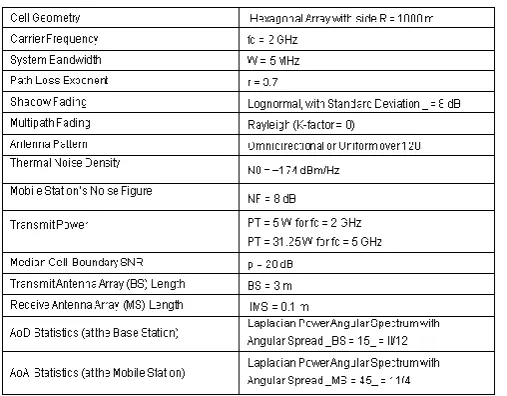
Simulations are carried out based on the “SUI-5” channel model [Falconer, 2002] , which is one of six channel models adopted by IEEE 802.16a for evaluating broadband wireless systems in the 2-11GHz band. The author considered a system with two transmits antennas and three receive antennas which employs QPSK modulation.
The doubly-selective Rayleigh fading channel is assumed to have three resolvable multipath components. These paths are modelled as independent complex Gaussian random variables and have relative delays of 0s, 5s, and 10s. The rms delay spread of the channel is 3.05s and the maximum Doppler shift of the channel is calculated based on a carrier frequency of fc = 2GHz.
Table 1 PARAMETER VALUES USED IN THE SYSTEM SIMULATIONS
TABLE .2: PARAMETER VALUES USED IN THE SYSTEM SIMULATIONS
TABLE 3, showing the improvement in terms of dB, by using the proposed STBC code structure for different Modulations and for
different Channels
Table 4 THROUGHPUTS IN BPS/HZ ACHIEVED (WITH ONLY SIGNALING INEFFICIENCY PRESENT) FOR VARIOUS VALUES OF CHANNEL RMS DELAY SPREAD (NANOSEC)
AND NUMBER OF CARRIERS/TONES (N).
Table 5 PERCENTAGE LOSS RELATIVE TO THE FLAT-CHANNEL (WITH ONLY SIGNALING INEFFICIENCY PRESENT), FOR VARIOUS VALUES OF CHANNEL RMS
DELAY SPREAD (NANOSEC), AND NUMBER OF CARRIERS/TONES (N).
MIMO-OFDM system more vulnerable to phase noise or time variations of the channel coefficients. The author has assumed perfect channel state information CSI for all numerical results so far. In practical systems, however, there exist channel estimation errors. It is beyond the scope of this chapter to discuss channel estimation schemes for time-selective fading channels. To access its impact, channel estimation error is emulated by introducing an error with a normalized average MSE defined as MSE = E [ H H 2F] /E
[H2F], where H has the same form, except that phase
The strongest signal refers to the signal with the highest signal-to-noise ration (SNR), and the weakest signal refers to the signal with the lowest SNR. As the number of subcarriers increases, however, system performance deteriorates rapidly.
Discussion
Fig. 2 shows the CIR values as a function of data symbol period Ts, the 3-dB phase noise linewidth
, and thenumber of subcarriers Ns within one OFDM symbol.
These curves are obtained by using the analytical expression given in Eq. (4.1) and simulations based on the maximum Doppler shift under a vehicle speed of vs
= 100Km/h. Simulation results match well with the theoretical results. CIR is found to be inversely proportional to Ts, Ns, and
; thus, increasing
or Tsmakes the MIMO-OFDM system more vulnerable to phase noise or time variations of the channel coefficients.
Figure 2: CIR comparisons with different number of subcarriers and phase noise linewidth (vs = 100Km/h).
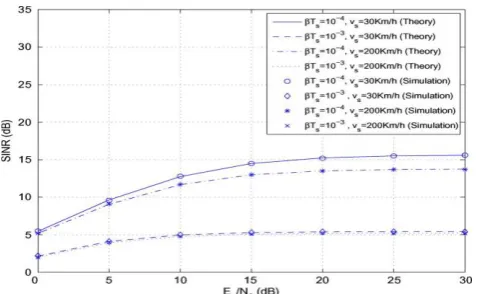
In Fig. 3, SINR versus Es/N0 curves under different
values of
Ts and vs are obtained by using computersimulations. The OFDM symbol is assumed to have Ns =
256 subcarriers, and data symbol period is Ts = 10
-6 seconds. It is observed that SINR is inversely proportional to
Ts. With a fixed but large value of
Ts(e.g., 10-3), however, the difference between SINR curves corresponding to different vehicle speeds diminishes. This is because when
Ts is large, ICI isdominated by phase noise. On the other hand, with a smaller
Ts value such as
Ts = 10-4
, increasing the Doppler shift (or vehicle speed) clearly lowers the SINR value.
Figure 3. SINR versus Es/N0 for MIMO-OFDM with different vehicle speed and phase noise variance (Ns = 256, Ts = 10-6s).
Fig. 4. shows the SER performance of the proposed MMSE-based phase noise suppression scheme together with those of a phase-noise-free system and a system without phase noise correction when the MMSE detection scheme is considered. System parameters chosen are: Ns = 128, Ts = 10
-7
s,
=10Hz, and vs =30Km/h. It is observed that without phase noise correction, even a very mild amount of phase noise (
Ts= 10-6) causes a high error floor. On the other hand, the proposed scheme significantly reduces the effect of phase noise. Note that performance of the proposed scheme does not approach that of the phase-noise-free system because this scheme mitigates only CPE, and it does not eliminate ICI, which is caused by both phase noise and time-selective fading.
Figure 4 CIR comparisons with different number of subcarriers and phase noise linewidth (vs = 100Km/h).
Shown in Fig. 4 are the simulated SER performances of the system when the proposed MMSE-based phase noise suppression scheme and the MMSE detection scheme described are employed. Other parameters chosen are:
Ns = 64, Ts = 10-7s, and vs = 100Km/h. Performances
with different values of the 3-dB phase noise variance (
Ts = 10-7
, 10-6, 3 x 10⁻⁶, and 10-5) are compared. The
that the scheme works effectively only when
Ts issmall.
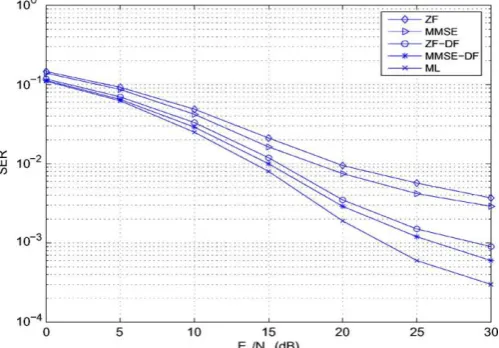
In Fig. 6.., we compare the performances of four different detection methods: the ZF, MMSE, decorrelating DF, and MMSE-DF schemes when the MMSE – based phase noise suppression scheme applied. Other than that
= 30Hz, all other parameters are the same as those applied for Fig. 4.. Performance of the ML scheme is used as the benchmark for other detection schemes. Since these schemes are not specifically optimized for MIMO-OFDM systems with phase noise over fast time-varying fading channels for which ICI should be dealt with, error floors are observed for all cases. Note that from Eqs. (4.1) and (4.2), the energy of ICI due to the phase noise and time-selective fading is found to spread over all subcarriers, which is different from the assumption that most of ICI on each subcarrier comes from several neighbouring subcarriers. Consequently, ICI suppression for the scenario studied in this chapter becomes more challenging than the case dealt with earlier.Figure 5. SER versus Es/N0 for MIMO-OFDM with different phase noise variance (Ns = 64, Ts = 10-7s, vs = 100Km/h).
Figure 6 : SER versus Es/N0 for MIMO-OFDM with different detection schemes (Ts = 3 x 10⁻⁶, Ns = 64, vs = 100Km/h).
We have assumed perfect CSI for all numerical results so far. In practical sys-tems, however, there exist channel estimation errors. It is beyond the scope of this chapter to discuss channel estimation schemes for
time-selective fading channels. To access its impact, channel estimation error is emulated by introducing an error with a normalized average MSE defined as MSE = E [ H H 2F] /E [H
2
F], where H has the same form as Eq.
(4 1), except that phase noise terms and OFDM symbol index are neglected. The performance results of MIMO-OFDM systems with various MSE values are shown in Fig. 4.2., where all parameters, except
= 10Hz, are the same as those applied in Fig. 8.. The proposed MMSE-based phase noise suppression scheme and the MMSE detection scheme are employed in this simulation. It is observed that the performance degradation is negligible only when the MSE value of channel estimation errors is small (e.g., 10-3).
Figure 7. SER versus Es/N0 for MIMO-OFDM with different MSE (Ts = 10-6, Ns = 64, vs = 100Km/h).
IV.
CONCLUSION
We have analyzed the impact of phase noise and channel time selectivity on the performance of MIMO-OFDM systems. Specifically, we have quantified ICI caused by phase noise and channel time variations. A phase noise suppression scheme based on the MMSE criterion is proposed, which is shown to effectively reduce the effect of phase noise. Performances of five detection schemes are compared, and it
V.
REFERENCES
[1] Foschini .G. J., Aug. 1996 “Layered space-time architecture for wireless communication in a fading environment when using multiple antennas,” Bell Labs Technical Journal,.
[2] Foschini G. J. , Shiu D., Gans .M. J., and J. M. Kahn, Mar. 2000 “Fading correlation and its effect on the capacity of multielement antenna systems”, IEEE Trans. Commun.
[3] Alamouti .S.M. . Oct. 1998, “A simple transmit diversity technique for wireless communica-tions”, IEEE J. Select. Areas Commun., vol 16,. [4] Tarokh .V, Seshadri .N., and A. R. Calderbank, Mar. 1998 “Space-time
codes for high data rate wireless communication: Performance criterion and code construction”, IEEE Trans. Inform. Theory, vol. 44,.
[5] Tarokh ., Jafarkhani H., and Calderbank A. R., July 1999 “Space-time block codes from orthogonal designs”, IEEE Trans. Inform. Theory, vol. 45,
[7] Tirkkonen O., Boariu A., and A. Hottinen, Sept. 2000 “Minimal non-orthogonality rate 1 space-time block code for 3+ tx antennas,” in Proc. IEEE ISSSTA
[8] W. Su and X. Xia, Nov. 2002 “Quasi-orthogonal space-time block codes with full diversity”, in Proc. GLOBECOM, ,
[9] Sharma N. and Papadias C., Mar. 2003 “Improved quasi-orthogonal codes through constella-tion rotation”, IEEE Trans. Commun., vol. 51, .
[10] Tran .T.A. and Sesay A. B., 2002 “A generalized simplified ML decoder of orthogo-nal space-time block code for wireless communications over time-selective fading channels”, in Proc. IEEE Vehicular Technology Conf., ,
[11] Zheng F.C. and A. G. Burr, Nov. 2003, Receiver design for orthogonal space-time block coding for four transmit antennas over time-selective fading channels”, in Proc. GLOBECOM, ,
[12] Zheng F.C. and Burr A.G., Aug. 2004 “Signal detection for non-orthogonal space-time block coding over time-selective fading channels”, IEEE Commun. Lett., vol. 8, .
[13] Falconer D., Ariyavisitakul S.L., A. Benyamin-Seeyar, and B. Eidson, Apr. 2002 “Frequency domain equalization for single-carrer broadband wireless systems”, IEEE Com-mun. Mag., vol. 40
[14] Stuber G.J., Barry J. R., Mclaughlin S. W., Y. Li, M. A. Ingram, and T. G. Pratt, Feb. 2004 “Broadband MIMO-OFDM wireless communications”, Proceedings of the IEEE, vol. 92,.
[15] Russell M. and Stuber G. J., 1995 “Interchannel interference analysis of OFDM in a mobile environment,” in Proc. IEEE Vehicular Technology Conf., ,
[16] Li .J. and Kavehrad M., Dec. 1999 “Effects of time selective multipath fading on OFDM systems for broadband mobile applications”, IEEE Commun. Lett., vol. 3, .
[17] Pollet T., Bladel M., and Moeneclaey .M., Feb. 1995 “BER sensitivity of OFDM systems to carrier frequency offset and Wiener phase noise”, IEEE Trans. Commun., vol. 43.
[18] Tomba .L., May 1998 effect of Wiener phase noise in OFDM systems”, IEEE Trans. Commun., vol. 46,.
[19] Armada .A. G., June 2001 “Undestanding the effects of phase noise in orthogonal frequency division multiplexing (OFDM)”, IEEE Trans. Broadcast, vol. 47,.
[20] S. Wu and Y. Bar-Ness, Dec. 2002 “A phase noise suppression algorithm for OFDM based WLANs”, IEEE Commun. Lett., vol. 6, . [21] Liu G. and W. Zhu, Dec. 2004. “Compensation of phase noise in OFDM
systems using an ICI reduction scheme”, IEEE Trans. Broadcast, vol. 50,.
[22] Wu S. and Y. Bar-Ness, Nov. 2004 “OFDM systems in the presence of phase noise: con-sequences and solutions”, IEEE Trans. Commun., vol. 52, .
[23] Uysal M., N. AL-Dhahir, and C. N. Georghiades, Oct. 2001 “A space-time block-coded OFDM scheme for unknown frequency-selective fading channels”, IEEE Com-mun., Lett., vol. 5,.
[24] Z. Liu, Y. Xin, and G. B. Giannakis, “Oct. 2002 Space-time-frequency coded OFDM over frequency-selective fading channels”, IEEE Trans. Signal Processing, vol. 50,.
[25] Stamoulis A., S. N. Diggavi, and N. AL-Dhahir, Oct. 2002 “Intercarrier interference in MIMO OFDM”, IEEE Trans. Signal Processing, vol. 50,. [26] Schnek T. C. W., X.-J. Tao, Smulders P.F.M., and E. R. Fledderus, Sept. 2004 “Influence and suppression of phase noise in multi-antenna OFDM”, in Proc. of IEEE VTC’04-Fall,
[27] Nikitopoulos K. and A. Polydoros, Sept. 2004 “Decision-directed compensation of phase noise and residual frequency offset in a space-time OFDM receiver”, IEEE Com-mun., Lett., vol. 8,.
[28] Zhang Y. and H. Liu, Feb. 2006 “Impact of time-selective fading on the performance of quasi-orthogonal space-time coded OFDM systems”, IEEE Trans. Commun., vol. 54,.
[29] Zhang Y. and H. Liu, May 2006 “Frequency-domain correlative coding for MIMO-OFDM systems over fast fading channels”, IEEE Commun., Lett., vol. 10,.
[30] Zhang Y. and H. Liu, Nov 2007 “Decision-feedback receiver for quasi-orthogonal space- time coded OFDM using correlative coding over fast fading channels”, IEEE Trans. Wireless Commun.
[31] Zhang Y. and H. Liu, Nov 2006 “MIMO-OFDM systems in the presence of phase noise and doubly-selective fading”, IEEE Trans. Veh. Technol.
[32] Zhang Y. and H. Liu, Sept. 2005. “Decision-feedback receiver for quasi-orthogonal space-time coded OFDM with correlative coding over fast fading channels”, in Proc. of IEEE VTC’05-Fall,
[33] Bolcskei H. and A. J. Paulraj, Sept. 2000 “Performance of space-time codes in the presence of spatial fading correlations”, in Proc. Asilomar Conf.,.
[34] Kermoal J. P., L. Schumacher, K. I. Pedersen, P.E. Mogensen, and F. Frederiksen, Aug. 2002. “A stochastic MIMO radio channel model with experimental validation”, IEEE J. Select. Areas Commun., vol. 20, [35] Proakis J. G., 2001 Digital Communications. New York, NY:
McGraw-Hill, 4th ed.,.
[36] Pollet T., M. Bladel, and M. Moeneclaey, Feb. 1995 “BER sensitivity of OFDM systems to carrier frequency offset and Wiener phase noise”, IEEE Trans. Commun., vol. 43,
[37] Armada A. G., June 2001 “Understanding the effects of phase noise in orthogonal frequency division multiplexing (OFDM)”, IEEE Trans. Broadcast, vol. 47,.
[38] Verdu S., Multiuser Detection. 1998. Cambridge, U.K.: Cambridge Univ. Press,
[39] Duel-Hallen A., Oct. 1995 “Decorrelating decision-feedback multiuser detector for syn-chronous code-division multiple-access channel”, IEEE Trans. Commun., vol. 43,.
[40] Cioffi J., G. Dudevoir, M. Eyuboglu, and G. D. Forney, Jr., Feb. 1993 “MMSE decision feedback equalization and coding-Parts I and II”, IEEE Trans. Commun., vol. 43,.
[41] Edfors O., M. Sandell, J. –J. v. d. Beek, S. K. Wilson, and P. O. Borjesson, July 1998 “OFDM channel estimation by singular value decomposition”, IEEE Trans. Com-mun., vol. 46,.
[42] Coleri S., M. Ergen, and A. Bahai, Sept. 2002 “Channel estimation techniques based on pilot arrangement in OFDM systems”, IEEE Trans. Broadcast., vol. 48,.
[43] Simeone O., Y. Bar-Ness, and U. Spagnolini, Jan. 2004 “Pilot-based channel estimation for OFDM systems by tracking the delay-subspace”, EEE Trans. Wireless Commun., vol. 3,.
[44] Moose H., Oct. 1994 “A technique for orthogonal frequency division multiplexing frequency offset correction”, IEEE Trans. Commun., vol. 42,.
[45] Klein A., G. K. Kaleh, and P. W. Baier, May 1996. “Zero forcing and minimum mean-square-error equalization for multiuser detection in code-dividion multiple-access chan-nels”, IEEE Trans. Veh. Technol., vol. 45,
[46] Duel-Hallen A., Apr. 1992 “Equalizers for multiple input/multiple output channels and PAM systems with cyclostationary input sequences”, IEEE J. Select. Areas Commun., vol. 10,.
[47] Zhao Y. and S. G. Haggman, Aug. 1998 “Intercarrier interference compression in OFDM communication systems by using correlative coding”, IEEE Commun. Lett., vol. 2,.
[48] Hassibi B., Oct. 2000 “A fast square-root implementation for BLAST”, in 34th Asilomar Conference on Signal, Systems, and Computers, (Pacific Grove, California), .
[49] Armstrong J., Mar. 1999 “Analysis of new and existing methods of reducing intercarrier interference due to carrier frequency offset in OFDM”, IEEE Trans. Commun., vol. 47,.
[50] Zhao Y. and S. G. Haggman, July 2001 “Intercarrier interference self-cancellation scheme for OFDM mobile communication systems”, IEEE Trans. Commun., vol. 49,.
[51] Zhang H. and Y. Li, , July 2003 “Optimum frequency-domain partial response encoding in OFDM system”, IEEE Trans. Commun., vol. 51. [52] Forney G.D., Jr., May 1972 “Maximum-likelihood sequence estimation
of digital sequences in the presence of intersymbol interference”, IEEE Trans. Inform. Theory, vol. IT-18,.
[53] Kim J., R. W. Heath, Jr., and E. J. Mar. 2005. Powers “Receiver designs for Alamouti coded OFDM systems in fast fading channels”, IEEE Trans. Wireless Commun., vol. 4,.
[54] Golden G. D., C. J. Foschini, R. A. Valenzuela, and P. W. Wolniansky, “Detection algorithm and initial laboratory results using V-BLAST space-time communica- tion architecture”, Electron. Lett., vol. 35. Jan. 1999.