An evaluation of a working memory training scheme in
older adults
Laura P. McAvinue*, Mara Golemme, Marco Castorina, Elisa Tatti , Francesca M. Pigni , Simona Salomone, Sabina Brennan and Ian H. Robertson
Institute of Neuroscience, School of Psychology, Trinity College Dublin, Dublin, Ireland
Edited by:
Hari S. Sharma, Uppsala University, Sweden
Reviewed by:
Ashok Kumar, University of Florida, USA
Jose-Vicente Lafuente, University of Basque Country, Spain
*Correspondence:
Laura P. McAvinue, Trinity College Institute of Neuroscience, Lloyd Building, Trinity College Dublin, Dublin 2, Ireland.
e-mail: [email protected]
Working memory is a cognitive process that is particularly vulnerable to decline with age. The current study sought to evaluate the efficacy of a working memory training scheme in improving memory in a group of older adults. A 5-week online training scheme was designed to provide training in the main components ofBaddeley’s (2000)working mem-ory model, namely auditmem-ory and visuospatial short-term and working memmem-ory. A group of older adults aged between 64 and 79 were randomly assigned to a trainee (n=19) or control (n=17) group, with trainees engaging in the adaptive training scheme and con-trols engaging in a non-adaptive version of the program. Before and after training and at 3- and 6-month follow-up sessions, trainees and controls were asked to complete mea-sures of short-term and working memory, long-term episodic memory, subjective ratings of memory, and attention and achievement of goals set at the beginning of training. The results provided evidence of an expansion of auditory short-term memory span, which was maintained 6 months later, and transfer to long-term episodic memory but no evidence of improvement in working memory capacityper se. A serendipitous and intriguing finding of a relationship between time spent training, psychological stress, and training gains provided further insight into individual differences in training gains in older adults.
Keywords: working memory, aging, cognitive training, stress, cognitive decline
INTRODUCTION
Baddeley (1992) defined working memory as a “brain system that provides temporary storage and manipulation of the infor-mation necessary for such complex cognitive tasks as language comprehension, learning, and reasoning” (p. 556). Working mem-ory has come to be recognized as having a central role to play in general cognition (Engle et al., 1999; Cowan et al., 2005). In youth, the importance of working memory in learning has been demonstrated in studies showing strong associations between chil-dren’s working memory capacity and their academic attainments (Gathercole and Pickering, 2000;Gathercole et al., 2003; Jarvis and Gathercole, 2003;Holmes and Adams, 2006). In older adult-hood, working memory has been identified as one of the cognitive processes that shows significant decline with age (Park, 2000;Park et al., 2001;Park and Reuter-Lorenz, 2009). The discovery of the importance of working memory in facilitating complex cogni-tion and its vulnerability to decline with age, has led to a recent surge in the development of training programs aimed at enhancing working memory capacity.
A number of reviewers in the area have concluded in favor of the efficacy of working memory training in improving working memory capacity and the extension of its effects to other cog-nitive processes such as fluid reasoning and attentional control (Klingberg, 2010;Morrison and Chein, 2011). However, a recent fine-grained analysis of the training literature has cast doubt on this conclusion. Having conducted a detailed review of working memory training in relation to children, young adults, and older
adults,Shipstead et al. (2012)criticized previous research on a number of grounds, including: inadequate measurement of work-ing memory, either in relation to the use of swork-ingle tasks as criterion measures or the conflation of working memory with short-term memory; the use of no-contact control groups, which create a host of confounds when used as a comparison groups; and the use, as outcome measures, of subjective reports, which are vulnerable to participant expectations. They concluded that the efficacy of train-ing schemes in improvtrain-ing worktrain-ing memory capacity has yet to be demonstrated.
training in a sample of participants with a mean age of 80. The trainee group showed significant improvements on the training tasks and near transfer to a similar visual short-term memory task but no improvements on several other transfer tasks of digit span, verbal recall, and visual recall. Li et al. (2008)found that updating training using ann-back task led to training gains and improvement on a near transfer n-back task but a lack of far transfer to complex span tasks in either young (aged 20–30) or older (aged 70–80) participants. In a group of older adults aged between 60 and 70, Brehmer et al. (2011) reported significant improvements on trained tasks and transfer to short-term mem-ory, working memmem-ory, and episodic memory tasks. Their training tasks were largely focused on short-term memory span tasks, how-ever. Examining the effects of complex span training,Richmond et al. (2011)reported significant training effects and near transfer to another complex span task, a far transfer effect to some but not all aspects of verbal learning tested, some evidence of a self-reported improvement in everyday attention but no significant transfer to measures of short-term memory, fluid intelligence, or attention.
In a systematic review of randomized controlled trials con-ducted to examine the efficacy of cognitive training in improving memory in people in the early stages of Alzheimer’s Disease or Dementia, Clare and Woods (2004) pointed to the lack of evidence for the efficacy of such training. They suggested that cognitive training, involving guided practice on a set of standard tasks, lacked immediate relevance or applicability to the every-day lives of older adults. They advocated the development of a more meaningful, individualized approach, termed Cognitive Rehabilitation, which would involve identifying personally rele-vant goals and developing strategies to achieve these goals. In a single case study and a randomized controlled trial,Clare et al. (2009, 2010)presented evidence for the efficacy of the approach in improving the activities of daily living in older adults with Mild Cognitive Impairment or in the Early Stages of Alzheimer’s Disease, through the identification and achievement of personal goals.
The purpose of the current study was to examine the effi-cacy of a working memory training scheme in improving the working memory capacity of a group of older adults (aged 64 to 79). The 5-week computerized training scheme was designed to provide practice in each of the main components of working memory represented inBaddeley’s (2000)model, namely, audi-tory short-term memory, audiaudi-tory working memory, visuospatial short-term memory, and visuospatial working memory. In an attempt to combine the Cognitive Training and Cognitive Reha-bilitation approaches, participants were also asked to set goals in relation to aspects of daily functioning that they would like to see improve following training. The goals were based on aspects of daily functioning which participants felt were impeded by slips of attention or memory. Trainees were compared to a control group that trained on a non-adaptive version of the program. The two groups were compared pre- and post-training and at 3- and 6-month follow-up sessions on a series of measures of short-term memory, working memory, episodic memory and subjective rat-ings of attention and memory slips, and goal performance and satisfaction.
MATERIALS AND METHODS PARTICIPANTS
Fifty-two participants were recruited and randomly allocated to the Trainee or Control Group using a minimization procedure (Altman and Bland, 2005) to balance the two groups in terms of gender and age. Sixteen participants dropped out during the 5-week training period, leaving 19 participants in the Trainee Group and 17 in the Control Group who completed the train-ing and pre and post-traintrain-ing assessments. There were no sig-nificant differences between these two groups in terms of age, t34= −0.75,p=0.46, gender,χ2(1)=0.36,p=0.55, or education level,χ2(3)=6.18,p=0.1. A further 10 participants dropped out
of the study before all four assessments were conducted. Details of the number, gender, age, and education level of trainees and control participants assessed at each time point are presented in Table 1. The two groups did not differ in terms of IQ, as estimated from performance on the National Adult Reading Test (Nelson, 1982), trainee mean of 120.47 (SD=4.44) vs. control mean of 118.24 (SD=8.11),t34=1.04,p=0.31. They did not differ sig-nificantly in terms of scores on the Mini-Mental State Examination (Folstein et al., 2010), trainee mean of 27.74 (SD=2.05) vs. con-trol mean of 28.41 (SD=1.46),t34= −1.13,p=0.27, or on the Hospital Anxiety and Depression Scale (Zigmond and Snaith, 1983), trainee mean of 7.74 (SD=3.46) vs. control mean of 8.94 (SD=4.1),t34= −0.96,p=0.35.
MATERIALS
Participant characteristics
Mini-mental state examination-2. This is a brief 30 item ques-tionnaire which taps areas such as orientation, memory, attention, and language in order to screen for cognitive impairment (Folstein et al., 2010).
The national adult reading test. An estimate of IQ was derived from performance on the NART, which comprises of 50 irregu-lar words, which are read aloud and scored for accuracy (Nelson, 1982).
The hospital anxiety and depression scale. The HADS was administered during each assessment session as a self-report measure of current psychological stress (Zigmond and Snaith, 1983).
Short-term and working memory
Table 1 | Number, gender, age, and education levels of trainees and controls participating in pre-training, post-training, 3-month follow-up, and
6-month follow-up assessments.
Pre and post-training 3-Month follow up 6-Month follow up
Trainee Control Trainee Control Trainee Control
n 19 17 16 14 15 11
Gender m, f 6, 13 7, 10 6, 10 7, 7 5, 10 5, 6
Age M(SD) 69.89 (4.5) 71.06 (4.8) 70.94 (4.11) 72.14 (4.54) 70.73 (4.17) 72.73 (4.2)
Education a, b, c, d 1, 2, 10, 6 1, 8, 5, 3 1, 2, 9, 4 1, 5, 5, 3 1, 2, 8, 4 1, 4, 3, 3
Education: a, Primary School; b, Leaving Certificate; c, Undergraduate; d, Postgraduate.
Episodic memory
Rey auditory verbal learning test. Word lists from the RAVLT were used to assess immediate and delayed memory for words. Different word lists were used for each testing session (i.e., forms AB, Cr-AB, Ge-AB, CD). Word lists consisted of 15 words which were read aloud by the research assistant and recalled verbally by the participant five times to facilitate verbal learning. A distrac-tor word list, also consisting of 15 words, was then read aloud by the research assistant and recalled by the participant. The partici-pant was then asked to recall once more the target word list. The participant’s score on this recall trial served as his/her score for immediate word recall. Delayed recall was tested by asking par-ticipants to recall the target word list 20 min later. Possible scores ranged from 0 to 15 (Schmidt, 2004).
Rivermead behavioral memory test. Short passages of prose from the first and third editions of the RBMT were used to assess imme-diate and delayed story recall. Different passages were used for each testing session. The research assistant read the passage aloud to the participant who was then asked to recall (verbally) as much as he/she could of the passage (immediate recall). Delayed story recall was assessed by asking participants to recall the passage once again 20 min later. Possible scores ranged from 0 to 21, with one point being given for each of 21 “ideas” recalled (Wilson et al., 1985; RBMT-3;Wilson et al., 2008).
Subjective attention and memory rating
Attention-related cognitive errors scale. The ARCES was used as a self-report measure of attention slips and absentmindedness in everyday life. It consists of 12 statements, each of which describes a particular instance of an attentional slip. Participants rate the fre-quency with which they experience such slips of attention along a scale ranging from 1 (never) to 5 (very often). Possible scores range from 12 to 60, with higher scores representing a higher degree of absentmindedness in everyday life (Carriere et al., 2008).
Memory failures scale. Fashioned in the same way as the ARCES, the MFS is a self-report measure of minor memory failures which occur in everyday life. Participants rate the frequency with which they experience memory failures described in a series of 12 state-ments, which are rated along a scale ranging from 1 (never) to 5 (very often). Possible scores range from 12 to 60, with higher scores representing a higher occurrence of memory failures in everyday life (Carriere et al., 2008).
Goals questionnaire
An instrument was developed to facilitate participants in choosing and rating goal activities. The Goals Questionnaire was modeled on the Canadian Occupational Performance Measure (Law et al., 2005), which is an individualized measure designed for use by occupational therapists to detect changes in a client’s self percep-tion of performance of daily living activities over time. During the pre-training assessment session, participants were, first of all, asked to identify from a prepared list, those attentional and memory slips which happen to them from time to time in their daily lives. The list was motivated by examples in the ARCES and MFS question-naires and participants were also prompted to supply personal examples, if missing from the list. In a second step, participants returned to the list and rated each chosen attentional or memory slip in terms of how troublesome it was in their daily lives, along a scale ranging from 1 (does not trouble me at all) to 10 (extremely troubling). In Step 3, participants were prompted to adopt the five slips which they had rated as being most troublesome in daily life as their goal activities, activities that they would most like to improve as a result of the working memory training. They then rated each of the five goal activities in terms of their current per-formance of the activity, along a scale ranging from 1 (not able to do it at all) to 10 (able to do it extremely well) and their satisfaction with this performance, along a scale ranging from 1 (not satisfied at all) to 10 (extremely satisfied). An average performance and satisfaction rating was calculated by adding ratings across goals and dividing by the number of goals. During each of the sub-sequent assessment sessions (post-training, 3-month follow-up, and 6-month follow-up), participants revisited their goal list and supplied current performance and satisfaction ratings. During the post-training assessment session only, participants also indicated the extent to which they felt they had achieved their goals follow-ing workfollow-ing memory trainfollow-ing, along a scale rangfollow-ing from 1 (fully achieved) to 10 (not achieved). A single achievement rating was calculated by averaging ratings across goals.
Working memory training scheme
consisted of a mixture of psycho-education on the nature of work-ing memory and strategies to support its function in everyday life and practice of nine training exercises, which were introduced gradually over the 5 weeks. Participants were asked to practice the training exercises for at least 30 min each day, for 5 days out of each week, for 5 weeks. The training exercises consisted of the following: Span taskswere fashioned after the classic digit span tasks (e.g., Wechsler, 1997).
Span Numbers – participants listened to a series of numbers played by the computer and at the end of the sequence, re-entered the numbers either in the same (Span Numbers Normal) or reverse (Span Numbers Reverse) order.
Span Colors– participants observed on a colored grid a sequence of flashing colors and reproduced the sequence either in the same (Span Colors Normal) or reverse (Span Colors Reverse) order.
Focus exercises were similar to the classic running span tasks (Pollack et al., 1959).
Focus Faces– participants observed a series of faces appearing one by one on screen and indicated the lastnfaces observed when the sequence ceased.
Focus Names– participants observed a series of names appearing one by one on screen and indicated the lastn names observed when the sequence ceased.
The Snap! exercises were modeled upon the classicn-back task (Kirchner, 1958). Participants viewed or listened to a series of stimuli and responded through a key press when two stimuli were repeated in sequence ornstimuli apart.
Faces Snap!– employed faces as stimuli.
Spaces Snap!– involved white squares or “spaces” moving around a black background or “parking lot.”
Names Snap!– involved a series of auditory names played by the computer.
Double Snap! – was a dual task requiring the participant to respond to visual stimuli (spaces) with one response and auditory stimuli (names) with another.
TheMathsMad taskwas modeled upon the classic Paced Auditory Serial Attention Task (PASAT;Crawford et al., 1998). Participants listened to a series of numbers (between 1 and 9) being played by the computer and added the current to the previous digit.
The program was designed to be adaptive, beginning with the easiest level for each participant and presenting levels of increasing difficulty as participants’ performance improved. Participants had access to a results graph for each exercise, which they were encour-aged to check regularly in order to follow their own progress on each task. The online arrangement also enabled the researchers to monitor each participant’s participation, performance, and time spent training.
At the end of each week, participants were given informa-tion on strategies that could be used to support working mem-ory function in everyday life situations, such as remembering phone numbers and checking change in shops and restaurants.
The recommended strategies included chunking, visualization, rounding and estimation, reading techniques, and thinking on one’s feet.
Control training
The control group engaged in a non-adaptive version of the train-ing program, which maintained all exercises at the easiest level. A number of exercises (Span Numbers Reverse, Span Colors Reverse, Double Snap!, and MathsMad) were removed from the program entirely as it was felt that even at the easiest level, these exer-cises taxed working memory. Information on strategies to support working memory function in daily life was also removed from the non-adaptive version of the training program.
RESULTS
EFFECTS OF WORKING MEMORY TRAINING Objective measures
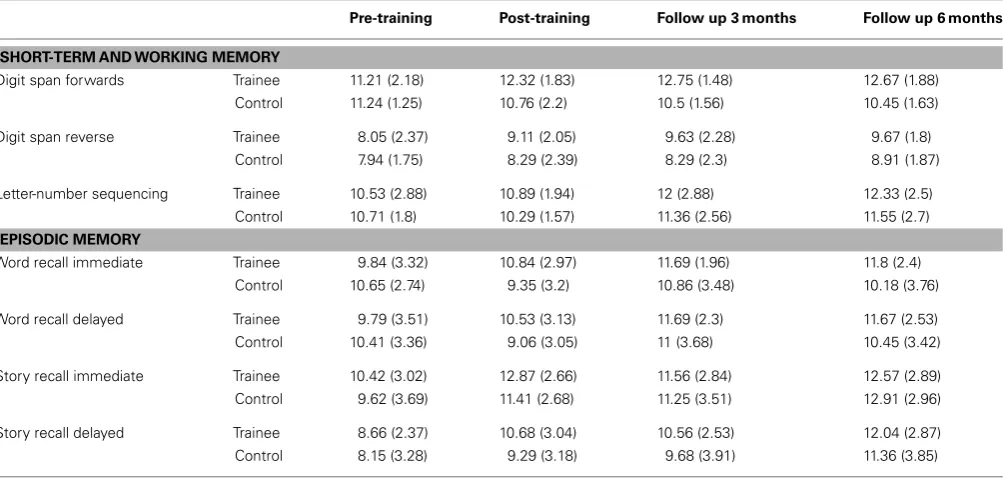
Table 2presents the mean values and standard deviations obtained
by the trainee and control groups on each objective memory mea-sure during each assessment session. A mixed analysis of covari-ance (ANCOVA), including one between subjects variable, Group (two levels: trainee, control), one within subjects variable, Ses-sion (three levels: post-training assessment, 3-month follow-up, 6-month follow-up) and one covariate, pre-training assessment, was run for each memory measure.Post hocone way ANCOVAs were run to examine the effects of Group on each assessment ses-sion separately.Table 3presents the results in relation to the effect of Group for each of these analyses.
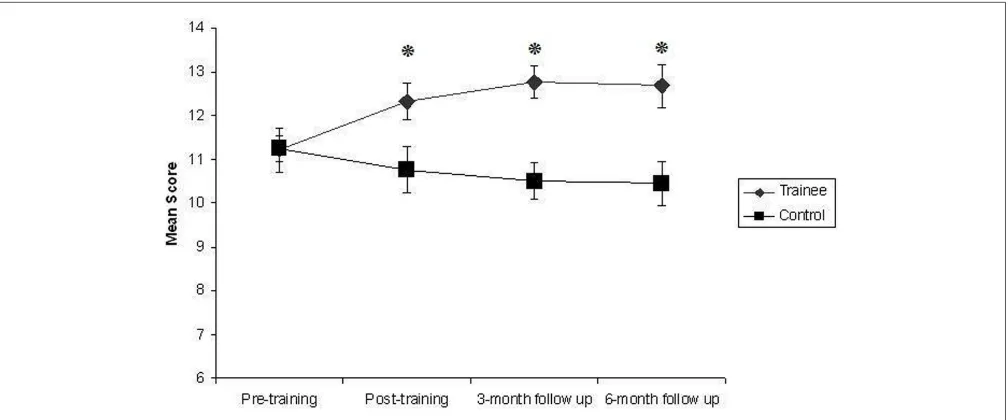
There was a statistically significant effect of training, with large effect size,η2=0.51, on Digit Span Forwards,F(1, 23)=23.65, p<0.001. Trainees improved significantly more than controls from the pre-training to the post-training assessment, F(1, 33)=10.35, p=0.003, η2=0.24, and this improvement was maintained at the 3-month follow-up,F(1, 27)=18.14,p<0.001,
η2=0.4, and at the 6-month follow-up, F(1, 23)=15.86, p=0.001, η2=0.41, assessments. This improvement is clearly illustrated in Figure 1. The effect of Group in the Mixed ANCOVA for Immediate Word Recall was approaching sig-nificance, F(1, 23)=3.37, p=0.079. The Post hoc One Way ANCOVAs revealed that trainees improved significantly more than controls from the pre to the post-training assessment,F(1, 33)=4.68, p=0.04, η2=0.12, but this improvement was not maintained at the 3-month,F(1, 27)=2.7,p=0.11,η2=0.09, or 6-month,F(1, 23)=2.55,p=0.12,η2=0.1, follow-up assess-ments. A similar pattern was evident for Delayed Word Recall. The Mixed ANCOVA was not statistically significant,F(1, 23)=2.73, p=0.11,η2=0.11, but thePost hocOne Way ANCOVAs revealed that trainees improved significantly more than controls from the pre to post-training assessment, F(1, 33)=4.37, p=0.04,
η2=0.12. This improvement was not maintained at the 3-month, F(1, 27)=1.18,p=0.29,η2=0.04, or 6-month,F(1, 23)=1.87, p=0.18,η2=0.08, follow-up assessments.Figure 2displays the pattern of performance of trainees and controls across all assess-ment sessions on Immediate and Delayed Word Recall. As is clear
fromTable 3, the effect of training was not statistically significant
Table 2 | Means (SDs) for trainees and controls on objective memory measures from pre-training to 6-month follow up.
Pre-training Post-training Follow up 3 months Follow up 6 months
SHORT-TERM AND WORKING MEMORY
Digit span forwards Trainee 11.21 (2.18) 12.32 (1.83) 12.75 (1.48) 12.67 (1.88)
Control 11.24 (1.25) 10.76 (2.2) 10.5 (1.56) 10.45 (1.63)
Digit span reverse Trainee 8.05 (2.37) 9.11 (2.05) 9.63 (2.28) 9.67 (1.8)
Control 7.94 (1.75) 8.29 (2.39) 8.29 (2.3) 8.91 (1.87)
Letter-number sequencing Trainee 10.53 (2.88) 10.89 (1.94) 12 (2.88) 12.33 (2.5)
Control 10.71 (1.8) 10.29 (1.57) 11.36 (2.56) 11.55 (2.7)
EPISODIC MEMORY
Word recall immediate Trainee 9.84 (3.32) 10.84 (2.97) 11.69 (1.96) 11.8 (2.4)
Control 10.65 (2.74) 9.35 (3.2) 10.86 (3.48) 10.18 (3.76)
Word recall delayed Trainee 9.79 (3.51) 10.53 (3.13) 11.69 (2.3) 11.67 (2.53)
Control 10.41 (3.36) 9.06 (3.05) 11 (3.68) 10.45 (3.42)
Story recall immediate Trainee 10.42 (3.02) 12.87 (2.66) 11.56 (2.84) 12.57 (2.89)
Control 9.62 (3.69) 11.41 (2.68) 11.25 (3.51) 12.91 (2.96)
Story recall delayed Trainee 8.66 (2.37) 10.68 (3.04) 10.56 (2.53) 12.04 (2.87)
[image:5.595.48.552.361.613.2]Control 8.15 (3.28) 9.29 (3.18) 9.68 (3.91) 11.36 (3.85)
Table 3 | Group effects for objective measures: main effect of Group in Mixed Analysis of Covariance (ANCOVA) examining effect of Group across
all three post-training assessments, withPost hocOne Way ANCOVAs examining effect of Group for each post-training assessment separately.
Mixed ANCOVA: effect of
group across all three
post-training assessments
One Way ANCOVA
Post-training assessment Follow up 3 months Follow up 6 months
SHORT-TERM AND WORKING MEMORY
Digit span forwards F(1, 23)=23.65,
p<0.001,η2=0.51
F(1, 33)=10.35,
p=0.003,η2=0.24
F(1, 27)=18.14,
p<0.001,η2=0.4
F(1, 23)=15.86,
p=0.001,η2=0.41
Digit span reverse F(1, 23)=2.15,
p=0.16,η2=0.09
F(1, 33)=1.75,
p=0.2,η2=0.05
F(1, 27)=3.18,
p=0.09,η2=0.11
F(1, 23)=1.1,
p=0.31,η2=0.05 Letter-number sequencing F(1, 23)=1.07,
p=0.31,η2=0.04
F(1, 33)=1.81,
p=0.19,η2=0.05
F(1, 27)<1,
η2=0.02
F(1, 23)<1,
η2=0.01 EPISODIC MEMORY
Word recall immediate F(1, 23)=3.37,
p=0.079,η2=0.13
F(1, 33)=4.68,
p=0.04,η2=0.12
F(1, 27)=2.7,
p=0.11,η2=0.09
F(1, 23)=2.55,
p=0.12,η2=0.1 Word recall delayed F(1, 23)=2.73,
p=0.11,η2=0.11
F(1, 33)=4.37,
p=0.04,η2=0.12
F(1, 27)=1.18,
p=0.29,η2=0.04
F(1, 23)=1.87,
p=0.18,η2=0.08 Story recall immediate F(1, 23)=1.08,
p=0.31,η2=0.05
F(1, 33)=2.09,
p=0.16,η2=0.06
F(1, 27)<1,
η2=0.002
F(1, 23)<1,
η2=0.007 Story recall delayed F(1, 22)=1.71,
p=0.2,η2=0.07
F(1, 33)=1.62,
p=0.21,η2=0.05
F(1, 27)<1,
η2=0.02
F(1, 22)<1,
η2=0.01
Subjective measures
Table 4presents the mean values and standard deviations obtained
by the trainee and control groups on each subjective memory mea-sure during each assessment session.Table 5presents the results in relation to the effect of Group for each of the ANCOVAs.
The tables clearly show that there was no significant dif-ference between trainees and controls during any post-training
FIGURE 1 | Mean score for trainees and controls on Digit Span Forwards during pre-training, post-training, 3-month follow-up, and 6-month follow-up assessment sessions. Error bars represent standard error of the mean. *Indicates statistically significant difference.
FIGURE 2 | Mean number of words recalled immediately and after a 20-min delay by trainees and controls during each assessment session. Error bars represent standard error of the mean.(A)Immediate recall.(B)Delayed recall.
presents a list of the top 10 goals selected by partici-pants.
Separate Mixed ANOVAs, with one between subjects vari-able, Group (two levels: trainee, control) and one within sub-jects variable, Session (four levels: pre-training, post-training, 3-month follow-up, 6-month follow-up), revealed a significant main effect of Session for ratings of Goal Performance, F(3, 72)=25.66, p<0.001 and Goal Satisfaction, F(3, 72)=31.79, p<0.001, but no Group×Session interaction in either case,F(3, 72)<1. Perusal of the mean values presented in Table 4and
Figure 3suggests that participants in both groups provided higher
Satisfaction and Performance Ratings for Goals in post-training assessments. Indeed, post hoc Paired Samples t-tests compar-ing the combined Performance Ratcompar-ings of both groups across
Table 4 | Means (SDs) for trainees and controls on subjective memory measures from pre-training to 6-month follow up.
Pre-training Post-training Follow up 3 months Follow up 6 months
ARCES Trainee 30.32 (6.6) 30.32 (6.42) 31.38 (5.99) 30.67 (5.98)
Control 29.76 (6.03) 28.76 (5.95) 29.07 (5.48) 30.18 (5.81)
MFS Trainee 30.95 (8.16) 29.26 (7) 30.88 (5.97) 30.47 (6.65)
Control 29.06 (5.11) 28.12 (4.41) 28.07 (4.34) 28.64 (3.85)
Goal performance Trainee 4.62 (1.35) 6.26 (1.15) 6.26 (1.37) 6.33 (1.34)
Control 4.14 (1.12) 5.89 (0.99) 5.99 (1.17) 6.03 (0.92)
Goal satisfaction Trainee 3.75 (1.63) 6.04 (1.3) 6.09 (1.74) 6.21 (1.42)
Control 3.70 (1.29) 5.60 (1.01) 6.29 (1.37) 6.26 (1.41)
Goal achievement Trainee / 5.24 (1.58) / /
Control / 5.67 (0.88) / /
Table 5 | Group effects for subjective measures: main effect of Group in Mixed Analysis of Covariance (ANCOVA) examining effect of Group
across all three post-training assessments, withPost hocOne Way ANCOVAs examining effect of Group for each post-training assessment
separately.
Mixed ANCOVA: effect of
group across all three
post-training assessments
One Way ANCOVA
Post-training assessment Follow up 3 months Follow up 6 months
ARCES F(1, 23)<1,η2=0.02 F(1, 33)<1,η2=0.02 F(1, 27)=1.87,p=0.18,η2=0.07 F(1, 23)<1,η2<0.001 MFS F(1, 23)<1,η2=0.04 F(1, 33)<1,η2<0.001 F(1, 27)=1.64,p=0.21,η2=0.06 F(1, 23)<1,η2=0.03 Goals performance F(1, 23)<1,η2=0.01 F(1, 33)<1,η2=0.01 F(1, 27)<1,η2<0.001 F(1, 23)<1,η2=0.008 Goals satisfaction F(1, 23)<1,η2=0.004 F(1, 33)=1.26,p=0.27,η2=0.04 F(1, 27)<1,η2=0.009 F(1, 23)<1,η2=0.002
INDIVIDUAL DIFFERENCES IN TIME SPENT TRAINING
Participants were advised to train for 30 min each day but given that the training was completed online in their own homes, they were, of course, masters of their own schedules. This meant that there were individual differences in the amount of time spent training. Overall, trainees spent an average of 14.75 h (SD=5.25) engaged in the working memory training program. They spent a minimum of 7.88 and a maximum of 26.25 h training. Trainees spent a significantly greater amount of time training than controls, who spent an average of 8.45 h (SD=3.89) training,t 34=4.05, p<0.001.
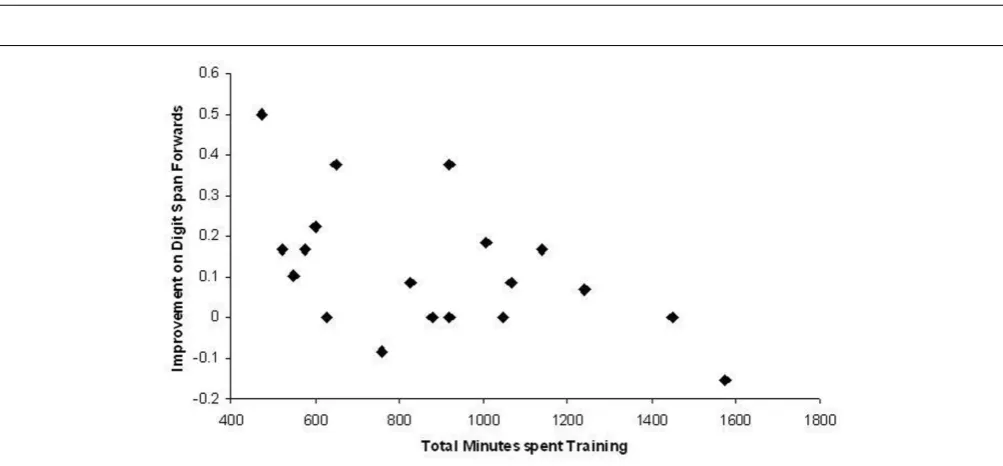
In order to examine whether there was a dose-response rela-tionship between time spent training and degree of improvement, correlations were computed between the amount of time spent training by trainees and the proportional improvement during the Post-Training Assessment Session on Digit Span Forwards, Word Recall Immediate, and Word Recall Delayed. Proportional improvement was calculated in the following manner: (Post-Training Assessment Score – Pre-(Post-Training Assessment Score)/Pre-Training Assessment Score. The correlations between time spent training and proportional improvement on Word Recall Imme-diate,r19=0.045,p=0.86, and Word Recall Delayed,r19=0.14, p=0.56, were not statistically significant. The correlation between time spent training and proportional improvement on Digit Span
Forwards was statistically significant,r19= −0.52,p=0.02, but as is clearly evident inFigure 4, this correlation was in an unexpected direction. It appears that the more time trainees spent training, the less they improved.
[image:7.595.54.552.298.411.2]FIGURE 3 | Mean ratings of performance and satisfaction of goals supplied by trainees and controls during each assessment session. Error bars represent standard error of the mean.(A)Mean performance rating.(B)Mean satisfaction rating.
FIGURE 4 | Scatter plot depicting the relationship between the total number of minutes spent training and proportional improvement on Digit Span Forwards for each trainee.
depressed during the post-training assessment and these feel-ings of psychological stress impeded their performance on the Digit Span Forwards Task during the post-training assessment session.
DISCUSSION
The current study sought to examine the efficacy of an online working memory training scheme in a group of adults aged between 64 and 79. In comparison to the control group, the trainees showed a significant improvement on a test of audi-tory short-term memory, Digit Span Forwards, which was main-tained at 3- and 6-month follow-up assessment sessions. They also showed a significant improvement in episodic memory on Immediate and Delayed Word Recall Tasks but this improve-ment was not maintained at follow-up. Trainees did not improve
significantly more than controls on auditory working memory (Digit Span Reverse and Letter-Number Sequencing) or in Story Recall episodic memory tasks. There were no significant changes in either group in relation to self-reported memory and atten-tion slips. Both groups gave significantly higher Performance and Satisfaction Ratings for their chosen goal activities during the Post-Training Assessments.
[image:8.595.47.549.258.491.2]Table 6 | Top 10 list of goals: the number of participants including the
following goals as part of their goal list.
Goal category Number of
participants
Specific examples
Improving
concentration
34 Improve concentration in general (12)
Concentrating on what people are
saying in conversation (11)
Concentrating during activities, such as
reading (3), games (1), watching
television (1)
Avoid/decrease distraction (6)
Remembering
people’s names
30 /
Speedy/quick/
immediate recall
20 /
Remembering
details
17 Remembering important details (3) Details of personal experiences such
as places visited (6)
Details of books read or movies/plays
seen (6), prices or names of products
in shops (2)
Remembering
where I put things
15 /
Task management 14 Improve concentration during multi or
dual-tasks (5)
Task completion (5)
Remembering for what purpose I
entered a room (4)
Planning &
remembering to
do things
13 Remembering important dates/coming
events (6) Planning (3)
Remembering to do tasks (4)
Improving
memory capacity
9 Improve retention of information (5)
Improve short-term memory (4)
Improve memory
during games
6 Bridge/cards (6) and Golf (1)
Verbal fluency 4 Recall words or word alternatives (3)
Express self clearly (1)
working memory capacity can be explained by other aspects of experimental design or measures used.
Previous studies of working memory training in older adults have identified a trend in which older adults show improvements on trained tasks or on tasks similar to those used in training but show limited transfer of gains to tasks dissimilar to the training tasks. Some researchers have speculated that reduced cognitive plasticity precludes the transfer of training gains in older adults (Dahlin et al., 2008a;Morrison and Chein, 2011;Shipstead et al., 2012). The improved short-term memory span found in this study is in keeping with this trend in so far as the Digit Span Forwards measure was very similar to the Span Numbers training task. The maintenance of the training effect is particularly impressive, how-ever, given that a rather small amount of training (around 15 h on average) served to expand span of auditory short-term memory on a rather prolonged basis (up to 6 months). Furthermore, the
significant improvement in Immediate and Delayed Word Recall identified during the Post-Training Assessment provides evidence of transfer to episodic memory. Links between short-term and long-term memory have been made (Nee and Jonides, 2008). The expansion of auditory short-term memory span may have facili-tated trainees in encoding or retrieval of words during the Word Recall Task (seeCantor and Engle, 1993;Burgess and Hitch, 2005). The serendipitous finding of the relationship between time spent training, psychological stress, and proportional improve-ment may also shed some light on lack of improveimprove-ments in older adults following training. The effect of individual differences on training outcomes has remained largely unexplored (Morrison and Chein, 2011). In this study, a significant negative correlation between time spent training and proportional improvement on the Digit Span Forwards task indicated that those trainees who spent more time training tended to improve less. Further exploration of this curious finding uncovered a significant positive correlation between time spent training and self-report scores on the HADS questionnaire supplied during the Post-Training Assessment, indi-cating that those who trained more had a tendency to report a higher degree of psychological stress during the Post-Training Assessment. Crucially, the correlation between time spent training and proportional improvement was reduced to a non-statistically significant level when the HADS score was partialed out, prompt-ing the possible explanation that those trainees who put more effort into the training were more anxious or depressed during the Post-Training Assessment and these feelings of psychological stress impeded their performance. The negative impact of stress on memory has been documented (Neupert et al., 2006). It is indeed possible that previous findings of limited training gains or transfer effects identified in older compared to young adults were due to performance-impeding levels of psychological stress rather than limited cognitive plasticity. Certainly, this finding deserves further exploration. At the very least, future research should be cognizant of the possibility of anxiety or depression impeding performance in older participants.
A significant limitation of this study is its lack of inclusion of a measure of visuospatial short-term or working memory. A considerable proportion of the training was devoted to the visu-ospatial modality but the inclusion of a corresponding memory measure was neglected. A second limitation relates to the use of a control group that engaged in a non-adaptive version of the training program. Although the use of a non-adaptive training control group has been hailed as the gold standard in this kind of research (Klingberg, 2010), limitations have also been identi-fied in relation to the training experiences received by the two groups. Inevitably, the training given to controls involves much less rigor and they also miss out on feedback on their perfor-mance (Shipstead et al., 2012). In this study, controls trained for an average of just under 8½ h while trainees spent just under 15 h training on average. This likely reflects a lower level of engagement in the control participants engendered by very simple and repet-itive training tasks. As an alternative to non-adaptive training, it has been suggested that controls engage in an adaptive training scheme that is focused on another cognitive process or activity (Shipstead et al., 2012). Another possibility would be to pro-vide control participants with training designed to expand short-term memory span only while trainees receive training designed to expand working memory capacity in addition to short-term memory span.
Shipstead et al. (2012)have claimed that a true enhancement of working memory capacity following cognitive training has yet to be demonstrated. The working memory training scheme employed in this study was designed to provide practice in the core elements of Baddeley’s (2000) model and training exer-cises were based upon classic tasks of short-term and working memory, such as span, updating, andn-back tasks. Despite this theoretically motivated and comprehensive training package, an increase in working memory capacity was not detected. There was, however, evidence of a rather durable expansion of short-term memory span coupled with transfer of training gains to a long-term episodic memory task, suggesting a degree of cogni-tive plasticity in this sample of older adults. The unexpected and intriguing relationships uncovered between time spent training, psychological stress, and training gains should stimulate ideas for further avenues of investigation into individual differences in the enhancement of cognition in older adults.
ACKNOWLEDGMENTS
We acknowledge the support of Atlantic Philanthropies for their generous support of the NEIL (Neuroenhancement for Inde-pendent Lives) programme. We would like to thank all of the volunteers for the time and effort they gave to participate in this study.
REFERENCES
Altman, D. G., and Bland, J. M. (2005). Treatment allocation by minimisa-tion.Br. Med. J.330, 843. Baddeley, A. (1992). Working memory.
Science255, 556–559.
Baddeley, A. (2000). The episodic buffer: a new component of working memory?Trends Cogn. Sci. (Regul. Ed.)4, 417–423.
Brehmer, Y., Rieckmann, A., Bellander, M., Westerberg, H., Fisher, H., and Backman, L. (2011). Neural cor-relates of training-related working-memory gains in old age. Neuroim-age58, 1110–1120.
Burgess, N., and Hitch, G. (2005). Com-putational models of working mem-ory: putting long-term memory into context. Trends Cogn. Sci. (Regul. Ed.)9, 535–541.
Buschkuehl, M., Jaeggi, S. M., Hutchi-son, S., Perrig-Chiello, P., Dapp, C., Muller, M., et al. (2008). Impact of working memory train-ing on memory performance in old-old adults. Psychol. Aging 23, 743–753.
Cantor, J., and Engle, R. W. (1993). Working-memory capacity as long-term memory activation: an individual-differences approach. J. Exp. Psychol. Learn. Mem. Cogn.19, 1101–1114.
Carriere, J. S. A., Cheyne, J. A., and Smilek, D. (2008). Everyday
attention lapses and memory fail-ures: the affective consequences of mindlessness.Conscious. Cogn.17, 835–847.
Clare, L., Linden, D. E. J., Woods, R. T., Whitaker, R., Evans, S. J., Parkin-son, C. H., et al. (2010). Goal-oriented cognitive rehabilitation for people with early-stage Alzheimer disease: a single-blind randomized controlled trial of clinical effi-cacy.Am. J. Geriat. Psychiatry 18, 928–939.
Clare, L., van Paasschen, J., Evans, S. J., Parkinson, C., Woods, R. T., and Linden, D. E. J. (2009). Goal-oriented cognitive rehabilitation for an individual with Mild Cognitive Impairment: behavioural and neu-roimaging outcomes.Neurocase15, 318–331.
Clare, L., and Woods, R. T. (2004). Cog-nitive training and cogCog-nitive reha-bilitation for people with early-stage Alzheimer’s disease: a review. Neu-ropsychol. Rehabil.14, 385–401. Cowan, N., Elliott, E. M., Saults, J. S.,
Morey, C. C., Mattox, S., Hismjatul-lina, A., et al. (2005). On the capacity of attention: its estimation and its role in working memory and cog-nitive aptitudes.Cogn. Psychol.51, 42–100.
Crawford, J. R., Obonsawin, M. C., and Allan, K. M. (1998). PASAT and components of WAIS-R
performance: convergent and dis-criminant validity. Neuropsychol. Rehabil.8, 255–272.
Dahlin, E., Nyberg, L., Backman, L., and Stigsdotter Neely, A. (2008a). Plasticity of executive functioning in young and older adults: immediate training gains, transfer, and long-term maintenance. Psychol. Aging 23, 720–730.
Dahlin, E., Stigsdotter Neely, A., Lars-son, A., Backman, L., and Nyberg, L. (2008b). Transfer of learn-ing after updatlearn-ing trainlearn-ing medi-ated by the striatum. Science 320, 1510–1512.
Engle, R. W., Tuholski, S. W., Laugh-lin, J. E., and Conway, A. R. (1999). Working memory, short-term memory, and general fluid intelligence: a latent-variable approach.J. Exp. Psychol. Gen.128, 309–331.
Folstein, M. F., Folstein, S. E., White, T., and Messer, M. A. (2010).Mini Men-tal State Examination, 2nd Edn. Lutz: Psychological Assessment Resources, Inc.
Gathercole, S. E., Brown, L., and Pick-ering, S. J. (2003). Working mem-ory assessments at school entry as longitudinal predictors of national curriculum attainment levels.Educ. Child Psychol.20, 109–122. Gathercole, S. E., and Pickering, S. J.
(2000). Working memory deficits in
children with low achievements in the national curriculum at 7 years of age. Br. J. Educ. Psychol. 70, 177–194.
Holmes, J., and Adams, J. W. (2006). Working memory and children’s mathematical skills: implications for mathematical development and mathematics curricula.Educ. Psy-chol.26, 339–366.
Jarvis, H. L., and Gathercole, S. E. (2003). Verbal and non-verbal work-ing memory and achievements on national curriculum tests at 11 and 14 years of age.Educ. Child Psychol. 20, 123–140.
Kirchner, W. K. (1958). Age differences in short-term retention of rapidly changing information.J. Exp. Psy-chol.55, 352–358.
Klingberg, T. (2010). Training and plasticity of working memory. Trends Cogn. Sci. (Regul. Ed.) 14, 317–324.
Law, M., Baptiste, S., Carswell, A., McColl, M. A., Polatajko, H., and Pollock, N. (2005).Canadian Occu-pational Performance Measure, 4th Edn. Toronto: CAOT Publications ACE.
Morrison, A. B., and Chein, J. M. (2011). Does working memory training work? The promise and challenges of enhancing cognition by training working memory.Psychon. Bull. Rev. 18, 46–60.
Nee, D. E., and Jonides, J. (2008). Neural correlates of access to short-term memory.Proc. Natl. Acad. Sci. U.S.A. 105, 14228–14233.
Nelson, H. (1982).National Adult Read-ing Test Manual. Windsor: NFER-Nelson.
Neupert, S. D., Almeida, D. M., Mroczek, D. K., and Spiro, A. III. (2006). Daily stressors and memory failures in a naturalistic setting: find-ings from the VA normative aging study.Psychol. Aging21, 424–429. Park, D. C. (2000). “The basic
mech-anisms accounting for age-related decline in cognitive function,” in Cognitive Aging: A Primer, eds D. C. Park and N. Schwarz (Hove: Psy-chology Press), 3–21.
Park, D. C., Polk, T. A., Mikels, J. A., Tay-lor, S. F., and Marshuetz, C. (2001). Cerebral aging: integration of brain and behavioral models of cognitive function.Dialogues Clin. Neurosci.3, 151–165.
Park, D. C., and Reuter-Lorenz, P. (2009). The adaptive brain: aging and neurocognitive scaffolding. Annu. Rev. Psychol.60, 173–196. Pollack, I., Johnson, L. B., and
Knaff, P. R. (1959). Running mem-ory span. J. Exp. Psychol. 57, 137–146.
Richmond, L. L., Morrison, A. B., Chein, J. M., and Olson, I. R. (2011). Work-ing memory trainWork-ing and transfer in older adults. Psychol. Aging 26, 813–822.
Schmidt, M. (2004).Rey Auditory Ver-bal Learning Test: A Handbook. Los Angeles: Western Psychological Ser-vices.
Shipstead, Z., Redick, T. S., and Engle, R. W. (2012). Is working memory
training effective?Psychol. Bull.138, 628–654.
Wechsler, D. (1997). Wechsler Adult Intelligence Scale, 3rd Edn. London: The Psychological Corporation. Wilson, B., Cockburn, J., and
Bad-deley, A. (1985). The Rivermead Behavioural Memory Test. Reading: Thames Valley Test Company. Wilson, B., Greenfield, E., Clare, L.,
Baddeley, A., Cockburn, J., Wat-son, P., et al. (2008). Rivermead Behavioural Memory Test – Third Edition (RBMT-3). San Antonio: Pearson.
Zigmond, A. S., and Snaith, R. P. (1983). The hospital anxiety and depres-sion scale.Acta Psychiatr. Scand.67, 361–370.
Conflict of Interest Statement: The authors declare that the research was conducted in the absence of any com-mercial or financial relationships that
could be construed as a potential con-flict of interest.
Received: 31 March 2013; paper pend-ing published: 19 April 2013; accepted: 01 May 2013; published online: 23 May 2013.
Citation: McAvinue LP, Golemme M, Castorina M, Tatti E, Pigni FM, Salomone S, Brennan S and Robertson IH (2013) An evaluation of a work-ing memory trainwork-ing scheme in older adults. Front. Aging Neurosci.5:20. doi: 10.3389/fnagi.2013.00020