&KZ&^
A
EEh>
ZWKZd
2011
To the Minister for Jobs, Enterprise and Innovation
Pursuant to the Industrial Development Act, 1993, Forfás herewith presents its report and accounts for the year ended 31 December 2011.
Eoin O’Driscoll Martin Shanahan
About Us
5
Board Members
12
Forfás Management Team
16
Chairman and Chief Executive
Overview 18
Policy Activities
27
Enterprise
3
1
Knowledge & Innovation
51
Competitiveness
73
People
8 7
Discover Science & Engineering
96
The Irish National Accreditation Board (INAB)
104
Corporate Governance
110
Financial Statements
1 1 7
Appendix 1
:
Advisory Councils
1
40
Appendix 2
:
Forfás Publications
14
5
About Us
Forfás is the national policy advisory board for enterprise, trade, science, technology and innovation.
In addition to its primary policy functions, Forfás activities in 2011 included awareness1, accreditation and shared corporate services.
Policy Analysis and Advice
Forfás is an agency of the Department of Jobs, Enterprise and Innovation (DJEI), and works closely with DJEI and Forfás’ sister agencies, Enterprise Ireland, IDA Ireland and Science Foundation Ireland to ensure the coherence of policies across the enterprise development agencies in support of enterprise growth and job creation.
Forfás provides the Minister, DJEI and Government with independent policy advice in a range of policy areas from an enterprise perspective. It links private sector enterprises and the public system and has individuals from both the private and public sectors represented on the Board. Many of the policy areas which impact on enterprise are within the Minister’s brief and responsibility for others reside with other ministers and departments, but have a direct or indirect impact on enterprise development. This requires Forfás to work across
government departments and agencies.
Forfás, its Sister Agencies and Advisory Councils
Focus 2011
Forfás policy advice in 2011 addressed four overarching policy areas of critical importance to the success of enterprise in Ireland and our work is detailed in the Activities Section of this report.
Enterprise Supporting the development of sustainable enterprises and jobs
Knowledge & Innovation Making research and technology work for business and Ireland
Competitiveness Ensuring Ireland is a good place to do business
Enterprise – Supporting the development of sustainable enterprises and jobs
Ireland has a strong base of enterprise, both indigenous and foreign owned, and a culture that encourages companies to develop and expand. Working with the enterprise development agencies and a broad range of stakeholders Forfás delivers policy advice across a broad range of enterprise issues to contribute to an environment conducive to successful, sustainable enterprises.
Knowledge and Innovation - Making research and technology work for business and Ireland Innovation has no boundaries. It can come from suppliers and customers, competitors and employees, in Ireland or internationally. It can apply to any aspect of a business – new or improved products, services, technology applications, processes, designs and organisation structures. Innovation is one of the essential factors which will define the future success of enterprises in Ireland.
Working with DJEI and other government departments, Forfás contributes to ensuring that science, technology and innovation policy delivers growth and jobs for Ireland by assembling and analysing a strong evidence base on which to provide policy advice on key national and international STI issues.
Competitiveness - Ensuring Ireland is a good place to do business
Our ability to compete in international markets and grow exports of high value added goods and services is perhaps the most critical condition for our future economic prosperity and standard of living. While recent improvements in our international competitiveness are welcome, we need to stay focused on reducing costs in the economy, increasing productivity, ensuring our trade policies are best suited to success in international markets and that public capital investment is directed to areas that will underpin future enterprise development. Forfás itself, and through its work with the National Competitiveness Council, delivers a range of research, analysis and advice on issues affecting our national competitiveness and focused on protecting our attractiveness as a location to do business.
People - Building a highly skilled, talented and flexible labour force
Continued strategic investment in the development of our people is an essential component in Ireland’s economic success. Forfás advises on policies that ensure Ireland provides education, training and upskilling that meets the needs of current and future enterprises and that
support labour market flexibility.
Forfás itself, and through its work with the Expert Group on Future Skills Needs, continues to support policies aimed at the development of Ireland’s people by providing a range of analysis and advice on the skills needs of Irish enterprises and on how Ireland can address the
Policy Support
As well as ongoing policy work, Forfás provides the Minister and DJEI with responsive, real-time policy advice on a broad range of emerging issues. Forfás also supports DJEI in the promotion and implementation of the outcomes of its advice.
Forfás manages the work of and provides research and analytical support to the Advisory Council for Science, Technology and Innovation, the Expert Group on Future Skills Needs and the National Competitiveness Council.
Forfás has a coordinating role in relation to the functions of its sister agencies, Enterprise Ireland, IDA Ireland and Science Foundation Ireland. Forfás also evaluates enterprise policy interventions.
Awareness, Accreditation and Corporate and Shared Services
AwarenessDuring 2011 Forfás managed the national awareness programme, Discover Science and Engineering (DSE). This programme delivers a focused, strategic and quantifiable awareness campaign which aims to:
Increase the number of students studying the physical sciences and mathematics - essential skills for the development of Ireland as a knowledge based economy;
Promoting a positive attitude to careers in science, technology, engineering and mathematics; and
Fostering a greater public understanding of the physical sciences, engineering and mathematics and their value to Irish society.
Accreditation
The Irish National Accreditation Board (INAB) is the designated national body with sole responsibility for accreditation in Ireland and is a sub-board and division of Forfás.
It has responsibility for the accreditation of laboratories, certification bodies and inspection bodies. It is Ireland’s only signatory to the multilateral agreements (MLAs) for Europe through the European cooperation for Accreditation (EA) and worldwide through the International Laboratory Accreditation Cooperation (ILAC) and the International Accreditation Forum (IAF).
It provides accreditation in accordance with the relevant International Organisation for Standardisation ISO 17000 series of standards and guides and the harmonised EN 45000 series of European standards.
In January 2010, INAB was appointed the sole national accreditation body for Ireland under Regulation 765/2008 which provides a legal framework for the provision of accreditation services across Europe.
Corporate and Shared Services
where Forfás can improve the efficiency and effectiveness of these services or where Forfás has obligations as the legal employer of staff in these agencies. These include aspects of financial and accounting services, human resources, pensions, facilities and property management, goods inwards, messengers, receptionist/telephonist services, coordination of corporate insurances and management of a Freedom of Information network for the
enterprise agencies and some other public bodies.
As legal employer of staff across the development agencies (Enterprise Ireland, IDA Ireland and Science Foundation Ireland), Forfás centrally manages the pension schemes of Forfás itself and its preceding organisations2, the associated pension compliance obligations and related staff benefits and insurance schemes. Forfás centrally handles certain pension queries from staff across the agencies, administers pension related matters for approximately 1,200 pensioners and their related records as well as records and queries from approximately 540 former employees with deferred pension benefits. All pension benefits arising for retiring and retired staff of IDA Ireland, Enterprise Ireland, Science Foundation Ireland and Forfás, as well as their preceding organisations, are paid on an ongoing basis by Forfás.
The Chief Scientific Adviser provides independent expert advice on any aspect of Science, Technology and Innovation (STI) that may be requested by Government. Forfás acts as the legal host for the Office of the Chief Scientific Adviser since the Office was established in September 2004. In the context of its activities and advice the office operates independently of the Forfás Board and management but, as host to the Office, Forfás acts as the legal entity for day to day contractual obligations associated with the work of the Office and provides the Chief Scientific Adviser with a full range of corporate service supports including legal, HR, facilities management, IT, procurement etc. The day to day administration of the Office is subject to Forfás governance and procedures.
Forfás holds the head leases of the former headquarter buildings of the Industrial
Development Authority, including Wilton Park House. In Wilton Park House, Forfás provides central procurement and management of facilities, cleaning, courier, travel, telecoms, catering, security, procurement and storage of stationary and related goods for IDA Ireland, SFI and SEAI. Forfás is also responsible for the property management of Wilton Park House including rent reviews, tenant liaison (public sector and a number of private sector tenants), landlord consents etc.
Forfás is responsible for the costs arising from lease obligations for Carrisbrook House and Knockmaun House, both of which had previously been leased by the former Industrial Development Authority.
Supporting Euroscience Open Forum (ESOF) 2012
ESOF 2012 is an interdisciplinary, pan-European general science meeting which has been held every two years since 2004. It comes to Dublin in July 2012. The five day event will bring together over 2,000 scientists, business leaders, government officials, policy makers and key international media to discuss the best of European research and to address the current major global scientific challenges, including energy, climate change, food and health. Across the five days there will be over 150 science, careers and science-to-business sessions, with 500
plus speakers, including 26 keynote speakers and five Nobel Laureates, an interactive exhibition and a business innovation marketplace. In recognition of hosting the prestigious ESOF conference this July, Dublin has been formally designated as the City of Science for 2012.
To complement ESOF 2012, a ten day Science in the City festival will take place in Dublin designed to maximise the engagement of the visiting delegates with the general public. The festival programme targets adults, families, children, teenagers, students, researchers, specialists and non-specialists, media and visitors to Dublin and Ireland.
The Office of the Chief Scientific Adviser to the Government is responsible for delivering the ESOF 2012 and Dublin City of Science 2012. Since Dublin won the open competition to host ESOF 2012 in November 2008 and in the run up to the event, Forfás has made a significant contribution to the organisation and planning of Dublin City of Science 2012 through the provision of support services and staff including legal, HR, recruitment, finance, facilities management, IT, procurement, governance policies and procedures.
Oireachtas Grant
Forfás’ detailed Financial Statements are on page 121 of this report.
Forfás Board
Eoin O’Driscoll Chairman, Forfás
Chairman, Southwestern
Martin D. Shanahan
Chief Executive, Forfás
Bob Brannock
President, European Operations, Genworth Financial
Timothy Dullea
Former Chief Executive Officer, Tipperary Co-op Mark Ferguson Director General, Science Foundation Ireland
Miriam Magner Flynn
Managing Director, Career Decisions
John Murphy
Secretary General, Department of Jobs, Enterprise and Innovation
William O’Brien
Chief Executive, Wm O’Brien Plant Hire Ltd
Barry O’Leary
Chief Executive Officer, IDA Ireland
Frank Ryan
Chief Executive Officer, Enterprise Ireland
Dr Don Thornhill
Business Adviser and Company Director
Michael O’Leary
Secretary to the Board
Sean Gorman resigned from the Board of Forfás on his retirement in October 2011 as Secretary General, Department of Jobs, Enterprise and Innovation.
Prof. Mark Ferguson joined the Board of Forfás in January 2012 following his appointment as Director General, Science Foundation Ireland.
John Murphy joined the Board of Forfás in January 2012 following his appointment as Secretary General of the Department of Jobs, Enterprise and Innovation.
Forfás Audit Committee
William O’Brien (Chairman)Eoin O’Driscoll
Tim Dullea
Sean Gorman*
John Murphy**
*Sean Gorman resigned from the Forfás Audit Committee on his retirement in October 2011 as Secretary General, Department of Jobs, Enterprise and Innovation.
**John Murphy joined the Forfás Audit Committee in May 2012.
Forfás Management Development Committee
Eoin O’Driscoll (Chairman)Dr Don Thornhill
Forfás
Chief Executive
Martin D. Shanahan Enterprise and Trade Division Innovation, Education and Science, Technology Skills Division
Vacant
Declan Hughes
Division Manager Division Manager Dept. Manager Secretary’s Office, Michael O’Leary HR, Pensions & Communications
Adrian Devitt
Dept. Manager, Economic Analysis, Competitiveness, Infrastructure, Tax & Finance
Eoin Gahan
Department Manager Trade, Environment & Survey
Analysis
Marie Bourke
Department Manager Education, Skills & Labour Market
Policy
Maria Ginnity
Department Manager Enterprise Policy & Evaluations
John Dooley
Department Manager Research & Development Policy
Adrienne Duff
Manager, Irish National Accreditation Board
Joe Heavey Department Manager
Finance
Karen Hynes
Department Manager Innovation Policy
Vacant
Department Manager, Systems & Cross Agency Facilities
Chairman and
Chief Executive
Overview
Chairman and Chief Executive Overview
Policy Context
While Forfás provides many important services to the Government, the enterprise
development agencies, and the business community through its constituent elements, Forfás’ primary role is the provision of evidence based policy advice. It is appropriate therefore to begin with the current policy context.
From an Irish perspective 2011 can be seen as a year of consolidation and progress. For the first time since 2007, the Irish economy grew, fuelled primarily by a relatively resilient export performance. Ireland’s current account balance has moved back into surplus, suggesting that perhaps the economy is now living more within its means, and setting us apart from many other heavily indebted economies such as Greece, Italy, Spain and Portugal. Progress
has also been made in stabilising the banking system, tackling the exchequer deficit and public finances – to date €16.2 billion of consolidation has been achieved through expenditure reductions and taxation increases. Further adjustments totalling €8.6 billion between now and 2015 are envisaged. While such measures are undoubtedly painful, they are necessary, and look like being effective; it is estimated that Ireland’s General Government Deficit will decline from 10.1 per cent in 2011 to 2.9 per cent by 2015.
Challenges remain, employment continued to fall while unemployment continued to increase, albeit at a slower rate than in recent years. As a result of extremely weak consumer demand, ongoing uncertainties about recovery and international markets, and limited supply of credit, businesses find themselves under significant pressure in their quest to survive and grow.
The various strands of government policy of importance to enterprise are increasingly being drawn together, ensuring that all departments and agencies are working together in an optimal and complementary manner that will deliver economic growth and ultimately employment growth. The Action Plan for Jobs 2012 confirms the Government’s objective of having two million people in work by 2020 and sets out a vision of Ireland becoming the best small country in which to do business.
All of this is to be achieved against a turbulent international economic backdrop. Most international observers believe that while a global recovery remains the most likely scenario (partly arising as a result of improved financial conditions and resurgent commodity prices), substantial downside risks persist and any recovery will remain fragile for the foreseeable future. Overall, advanced economies are expected to experience weak but positive growth over the coming years.
The real engine of growth, however, will be emerging markets, which are expected to enjoy more robust growth, presenting both challenges and opportunities for Ireland in terms of trade and investment.
Eoin O’Driscoll Chairman
Closer to home, the downside risks to an EU and more specifically euro area recovery remain very real. The re-emergence of serious concerns relating to the sovereign debt crisis and recovery in the euro area combined to push the European economy back into recession in the second half of 2011, and marginally negative growth is forecast for 2012.
On the plus side, and notwithstanding the risks alluded to above, the European Commission is forecasting a resumption of growth in 2013 for Ireland and the euro area. The Commission notes, however, that as a result of the scale of the recession and the interlinked complication resulting from the sovereign debt crisis, EU recovery will be a gradual process of continuing unemployment and below potential growth rates.
Achieving Growth and Jobs
Focus on ImplementationIn light of the domestic and international challenges which confront us, there is an understandable desire for solutions from the public and from policymakers. There is, however, no silver bullet that will deliver instant results and allow Ireland to achieve the objective of a quick return to employment growth. While it might be desirable and
comforting if we could focus on a small number of high impact action items to deliver growth and employment, such an outlook is unrealistic. It is enterprises that create jobs and the reality is that a wide range of actions is required to ensure that enterprises are appropriately positioned and equipped to take advantage of any global recovery. It is about taking decisive, concerted and timely action across the entire front of enterprise policy.
Forfás has long advocated a focus on implementation and action. The Action Plan for Jobs 2012 is focused on implementation and delivery of enterprise-relevant actions, and seeks to harness the collective strength of business, public services and policy makers. It sets out over 270 actions designed to improve competitiveness, grow enterprise (be it at the start-up, expansion or internationalisation phase), deepen the impact of FDI and ultimately deliver jobs and improved living standards. There are actions across each of these areas that can make a real difference for business and for jobs growth in Ireland. In each case, the actors
responsible for delivery, the milestones to be met and the resources required for implementation have been identified.
In 2011, working closely with Richard Bruton, T.D., Minster for Jobs, Enterprise and
Innovation and his department, Forfás dedicated significant resources, providing research and analytical support, to develop the Action Plan. In 2012, Forfás is responsible for delivering on a significant number of these actions. It is also providing expertise to the Department of the Taoiseach for monitoring implementation of the Plan and is part of the Monitoring Committee together with the Department of the Taoiseach, the Department of Jobs, Enterprise and Innovation (DJEI) and the Department of Public Expenditure and Reform.
More importantly, the Action Plan for Jobs 2012 is the beginning of a process of annual planning to ensure that Ireland sustains its drive toward achieving the best business
Exports
Employment, or rather unemployment, is the dominant economic and social issue now confronting policymakers and citizens alike. As of the last quarter of 2011, there were 302,000 people unemployed in Ireland, equating to 14.3 per cent of the labour force. Despite indications of stabilisation in the labour market, the fact that employment is not growing means that long term unemployment and youth unemployment are increasing and becoming ever more serious problems.
The challenge now is to identify sectors which we believe can generate sufficient employment opportunities to replace the jobs lost in sectors such as construction.
At present, exporting sectors are the only elements of the economy contributing to economic growth – and consumption, investment and government expenditure are expected to remain weak for the foreseeable future.
While exports have proven resilient in comparison with other sectors of the economy – in 2011 merchandise exports grew by 4.1 per cent and services exports grew by 7.1 per cent in 2011 – we cannot afford to be complacent. Despite increasing export values, Ireland is struggling to maintain its global market share, particularly in relation to merchandise exports and in emerging markets such as Brazil, China and India. This is a particular concern given that these are the primary drivers of global economic growth. Irish exports also tend to be concentrated in a relatively narrow range of sectors – pharmachem and computer services being the two dominant exporting sectors. While the performance of these two sectors, as well as the largely indigenous agri-food sector is to be lauded, there is also a need to diversify in terms of both sectors and markets. The impending loss of patent protection is likely to impact upon Ireland’s exports from the pharma sector in the immediate term. A continued focus on working with the sector to capture strategically important activities within their corporations and/or to transition to the next generation of production remains crucial to the future success of the overall lifesciences sector in Ireland.
During 2011, Forfás, working with the Export Trade Council, monitored progress on the Trade, Tourism and Investment Strategy. We are also working with the relevant Government
Departments and agencies to identify the potential for economic partnership opportunities with high growth economies. In this regard Forfás is focused in particular on the potential of the BRIC countries.
The Domestic Economy and Labour Market
Exports alone will not deliver economic growth and create sufficient employment
opportunities to resolve the unemployment crisis. Sustainable growth will require positive contributions from the domestic sectors also. In particular, there is a need to encourage investment in productive capital and create an environment that facilitates sustainable growth in consumption.
In terms of consumption, reduced incomes have combined with high levels of saving to depress consumer spending. Uncertainty about the future has also dented consumer
There is a range of other policy areas where the Government can take action to support the domestic economy. For example, to facilitate employment creation, it is important that the supply side of the labour market is structured appropriately to take advantage of any upturn in demand. The labour market is a complex entity, regulation of which falls within the remit of a number of different Government departments. Through coordinated and complementary action, we need to ensure that workers (both employed and unemployed) are equipped with enterprise-appropriate skills. This requires ongoing monitoring, evaluation and where necessary, reform of education and training programmes. We also need to ensure that the unemployed are supported appropriately while out of work, mindful of the interaction
between welfare supports and labour market wage rates, and kept close to the labour market through targeted activation.
Forfás has continually prioritised policies to ensure the continued strategic investment in our people with policy recommendations aimed at the provision of education, training and upskilling that meet the needs of current and future enterprises and which support labour market flexibility. Forfás has again been to the forefront in 2011 in pushing the need for alignment of education and training provision with enterprises’ skills needs. Most recently, there has been a specific focus on the demand and supply of ICT skills for the ICT, financial and other sectors. Forfás firmly advocates a bias towards promotion and supply of science, technology, engineering and maths related programmes. Forfás also advocates an escalation of efforts aimed at strengthening mathematical education at all levels. In 2008 Forfás and the EGFSN were to the forefront of advocating the introduction of bonus points for higher level mathematics at Leaving Certificate level. 2012, the first year of their introduction has seen a significant increase in the number of students applying to sit the higher level paper. In 2011, Forfás contributed to directing the new Labour Market Activation Funds towards the areas of skills demand; but more needs to be done in relation to existing provision by
universities, institutes of technology and training providers.
Competitiveness
To support our exporting sector and kick start growth in locally trading sectors we must maximise Ireland’s international competitiveness. International competitiveness refers to the ability of firms to compete successfully in international markets. There are three main, interlinked elements to competitiveness – cost competitiveness; productivity; and innovation.
Looking firstly at costs, it is clear that Ireland became progressively less competitive throughout the period of the construction and consumption bubble, as capacity constraints and excess credit combined to drive up wages and prices. Between 2002 and 2008, it is estimated that Ireland experienced a 30 per cent loss in cost competiveness. Since the onset of the recession we have recovered some lost ground as a result of falls in relative prices and favourable exchange rate movements. From April 2008 to April 2012, the nominal
Costs, as stated, however, are just one component of competitiveness. Productivity is a key driver of living standards and competitiveness. Productivity growth allows firms to compete successfully in international markets by enabling output to be produced in a more efficient and cost effective manner. Starting from a low base, Irish productivity levels now exceed those of many of our peers and key competitors. Ireland’s labour productivity levels have increased almost threefold in three decades. While traditionally a small number of exporting sectors have been significant drivers of Irish productivity – particularly the modern
manufacturing and tradable services sectors - the base of Irish productivity growth is broadening. This is a welcome development and reflects the increasing contribution of the indigenous sector to Ireland’s productivity growth. With the onset of recession, Ireland’s productivity performance remained relatively strong. However, up to a third of Ireland’s productivity growth since 2007 is a result of the reduction of hours worked brought on by the recession. We cannot afford to lose the momentum achieved to date. From a policy
perspective, the focus must now be on embedding structural productivity enhancements in all sectors of the economy.
Innovation is the third pillar of competitiveness. Ireland and Irish businesses have invested substantially in research and development as the cornerstone of innovation over the past decade and built up substantial research capability. We now need to ensure that we
maximise and accelerate the return from that investment. Gross expenditure on R&D (GERD) has more than doubled over the last decade. This investment has enhanced Ireland’s
attractiveness to foreign investors and has improved the competitiveness of our indigenous and foreign owned enterprises. At a firm level, we need to ensure that enterprise can access the skills and capital required to introduce new products and processes that enhance their competitiveness.
Forfás has advocated a focus on outputs and impacts as well as investment in research and development. During 2011, Forfás undertook extensive research and analysis to underpin the national exercise to identify those areas which should be prioritised for State investment in research and development and which will have the greatest potential to deliver enterprise growth and employment, as well as improvements in quality of life. This is probably one of the most important policy developments in research and development policy since the Technology Foresight exercise over a decade ago. The National Research Prioritisation Exercise looked at existing research strengths taking account of the outputs of the investment since 2000; assessed the connections between publicly funded research and development and the current and likely future enterprise base; and explored areas of opportunity that are likely to yield the best return for taxpayers’ investment in research and development and ultimately sustain high quality jobs in Ireland. The research identifies 14 areas of opportunity which will form the majority of Ireland’s State investment in research and development. The work recognises the social impact of research and indeed the need for policy research. The National Research Prioritisation Exercise was accepted by Government and published in March 2012 and Forfás is currently supporting the implementation group chaired by Minister Sean Sherlock T.D.
Growing Enterprise
The specific challenges relating to growing our enterprise base can be broadly split into two broad categories – enhancing the success of indigenous enterprise and maintaining and continuing to attract and develop foreign direct investment (FDI).
Forfás collects data annually on the performance of the enterprise development agency-supported cohort of companies in terms of economic impact and employment. Full-time employment among agency-assisted firms saw a return to positive growth (+1.5 per cent) in 2011 following three years of net job losses, with gross job gains (21,800) at their highest levels since 2008 and gross job losses (17,500) at their lowest level in over a decade. Net job losses in manufacturing have stabilised and services jobs are up 4 per cent. Total exports of agency-assisted companies in 2010 increased by 4 per cent over 2009. Indigenous exports increased by 14.7 per cent to €12.37 billion, and foreign-owned firms’ exports increased by 2.5 per cent from €112 billion to €114.62 billion between 2009 and 2010. Direct expenditure of all agency assisted firms in the Irish economy, however, fell in 2010 to €34.95 billion, which was a drop of 4.4 per cent over 2009 (4.8 per cent for Irish and 4 per cent for foreign- owned companies). Irish-owned firms account for almost half of direct expenditure in the Irish economy in 2010.
Many sectors exhibit potential to grow, including well developed sectors such as ICT, life sciences, financial services and agri-food and new sectors such as digital games, green technologies, private health and international education. The construction sector is an important sector in any economy and needs to be working at a sustainable level. In Ireland the sector has taken a significant knock. Forfás will in 2012 examine the potential of the sector and outline a new strategy for the sector, with a particular focus on its potential in terms of exports and outward direct investment.
Forfás believes that manufacturing is hugely important from an enterprise policy perspective. Manufacturing presents an opportunity to create significant numbers of jobs particularly when integrated with other parts of the value chain in high value sectors. As with all sectors, we must be internationally competitive to price ourselves back into the market for such jobs. One of the most important items for Forfás to deliver under the Action Plan for Jobs 2012 is a strategy in support of manufacturing in Ireland.
There is a range of business environment issues that impact on all businesses and Forfás has worked with key stakeholders throughout 2011 and provided policy advice on these issues including tax, access to finance, infrastructure quality, skills availability and reducing the administration burden imposed by the State on firms.
Forfás is also currently reviewing all of the supports provided by the enterprise development agencies to ensure that they are fit for purpose.
Forfás Resources and Performance
Internally within Forfás 2011 was a demanding year. There was an increased need and demand for our research, policy advice and other services, while resources continued to reduce.
result, we have re-structured, re-organised, and re-prioritised and we have delivered. That in large part is due to the expertise, commitment and professionalism of our management team and staff. The reduction in resources has put continuing strain on the organisation’s ability to deliver on its wide mandate, which includes both policy advice and operational services.
The output and impact of our policy advisory function is difficult to quantitatively measure, but we engage with our key stakeholders regularly and elicit their feedback on our
performance. Such feedback has been overwhelmingly positive and has also underlined the need for evidence based policy advice.
Non-Policy Services
While the primary function of Forfás is to deliver policy advice it also has other significant functions including accreditation, awareness, and corporate and shared services.
Accreditation
The single European market is of fundamental importance to Ireland and accreditation plays an important role in guaranteeing the access of Irish products and services to EU and
worldwide markets. It can provide competitive advantage and promotes improved standards and work practices.
The Irish National Accreditation Board (INAB) is a division of Forfás and INAB accreditation ensures that certificates and test results are acceptable worldwide. Accreditation eliminates the need for multiple assessments when goods cross frontiers, giving Irish industry the best competitive advantage possible in what is an ever-expanding and increasingly challenging marketplace. Demand for accreditation services from INAB continued to increase through 2011.
INAB, like the other divisions of Forfás, is committed to improvement and responding to client needs. It seeks feedback through its website, seeks input from its assessors to improve its processes and has also just recently conducted a client survey.
STEM Awareness
Throughout 2011 we continued to enhance students’ and the general public’s engagement with science, engineering and maths through a range of awareness activities. The national awareness programme, Discover Science and Engineering (DSE), which was transferred to Science Foundation Ireland earlier this year, started in Forfás in 2003 and grew into the significant and impactful programme that is today. The programme directly engages 200,000 primary students and 10,000 secondary school students across the country and has delivered a programme of activities which has brought a greater understanding of science, engineering and maths and its value to society to many. Over the years, Forfás has used a partnership model and the most up-to-date information technology and communication channels to reach its target audiences and has maximised the impact of the programme with reduced resources. This is a programme of which we are very proud and we would like to wish Science
Shared Services
Forfás shared corporate services staff continued to provide efficient and effective services to IDA Ireland, Enterprise Ireland, SFI, SEAI and the Office of the Chief Scientific Adviser to the Government throughout the year. In addition to the shared services activities in financial and accounting, HR, pensions, facilities and property management and others, Forfás’ shared services teams have provided significant additional support to the Office of the Chief Scientific Adviser which is responsible for the European City of Science in Dublin in 2012 the focal point of which is Europe’s largest science conference ESOF 2012 in July.
The Future
In 2011 Minister Bruton signalled his intention to integrate the policy advisory function of Forfás with his own Department. The aim of the integration being to leverage synergies and efficiencies in the development and delivery of enterprise policy and actions.
The Board and Executive Management team have engaged proactively, positively and constructively with the Minister and his Department in relation to exploring the potential of such an integration, mindful of the need to maintain the core principles which underpin the development of robust, evidence-based policy advice and continuity in service delivery during any resulting change process.
To provide certainty to our staff and stakeholders, the Board wishes to see progress made on this proposal quickly. In the meantime, the organisation is focused on delivering on all aspects of its mandate.
Acknowledgements
Forfás is committed to the delivery of evidence-based policy advice, which has greatest impact for enterprise and which delivers on our national goals of enterprise growth and job creation. We benefit from the guidance and knowledge of many organisations and
individuals. There are many that we would like to thank for their support in our work during 2011.
Forfás works in partnership with our parent department, the Department of Jobs, Enterprise and Innovation. We would like to acknowledge the support of the department. We would like to thank Richard Bruton T.D., Minister for Jobs, Enterprise and Innovation, and his colleagues John Perry, T.D., Minister for Small Business and Sean Sherlock, T.D., Minister for Research and Innovation at the Department of Jobs, Enterprise and Innovation for the contributions and support that they have provided to us. We would also like to acknowledge the inputs of the former Secretary General of DJEI, Sean Gorman who retired during 2011. We look forward to progressing a range of important and demanding projects with the new Secretary General, John Murphy, and wish him well in his new role.
Forfás activity requires that we work across Government departments and agencies as we bring an enterprise perspective to their areas of policy. Forfás is grateful for the level of engagement and commitment demonstrated by all departments and their agencies in Forfás’ policy work and that of the councils we support.
their cooperation and input during 2011. Forfás also receives support in its work from FÁS, Shannon Development and Údarás na Gaeltachta.
There is a wider community of stakeholders which also contributes significantly to our work including employer representative groups, trade unions, and third level institutions and training bodies and we would like to extend our appreciation to them.
Forfás manages and supports the work of three advisory councils. We would like to acknowledge the work of those groups and their chairpersons Dr Tom McCarthy (Advisory Council for Science, Technology and Innovation), Una Halligan (Expert Group on Future Skills Needs), and Dr Don Thornhill (National Competitiveness Council). We would also like to acknowledge the work of the Irish National Accreditation Board, chaired by Tom O’Neill. In 2011, we also worked closely with the Steering Group for the National Research Prioritisation Exercise and we would like to acknowledge the contribution of its Chairman Jim O’Hara.
We would also like to acknowledge the work of the Advisory Group for Small Business, chaired by Minister John Perry, on which Forfás is represented and to which Forfás provided research support during the year. We also work closely with the Central Statistics Office on surveys and data collection and we appreciate their ongoing collaboration.
We work closely with and provide significant support to Prof. Patrick Cunningham, the Chief Scientific Adviser to the Government and his team. We would like to thank them for their inputs and wish them the very best of luck in delivering on the ESOF 2012 conference in July.
With the increasing pressures on business people and entrepreneurs it is not easy for them to take time out of their businesses and work. We would particularly like to thank all of those who have given their time to engage with us directly or through their representative groups.
Forfás staff have worked hard and delivered an extensive and challenging work programme in 2011. We would like to thank them. Maintaining the focus, achieving the quality and
delivering on the flexibility that was needed required a significant extra effort on their part, particularly in light of the impacts of reducing resources and an uncertain operating
Policy
Enterprise 33
Enterprise Surveys
Annual Business Survey of Economic Impact (2010) Annual Employment Survey
34 34 36
Action Plan for Jobs 2012 40
Jobs Initiative 41
Agency Programme Evaluations 42
Advisory Group for Small Business 43
South East Employment Action Plan 45
Regional Aid Guidelines 46
Sector Development 46
The Games Sector in Ireland 47
Life Sciences Alliance 49
Inter-Agency Cleantech Strategy 49
Smart, Green Agri-Food 50
Trade
Trade and Investment Performance Report Key Countries for Economic Partnerships
Impacts for Ireland of Trade Liberalisation Proposals
51 51 51 52
Knowledge and Innovation
53
R&D Surveys
Eurostat and OECD Data Provision Science Budget 2010-2011
Strategy for Science, Technology and Innovation – Indicators 2011
Business Expenditure on Research and Development
54 54
54
59
62
Research Prioritisation 63
International Research and Innovation Policy
Representing Ireland on the European Research Area
67
Committee (ERAC)
International Co-operation Activities
Engagement on International Research Infrastructure and Global Science Forum
69
70
Advisory Council for Science, Technology and Innovation o Sustainability of Research Centres
o Developing the New Framework Programme for Research and Innovation, Horizon 2020
o Submission to the National Research Prioritisation Exercise
70 70 73
74
Competitiveness
75
Review of the Funding Environment 76 Partial Loan Guarantee Scheme 77 Pre-Budget Submission for an Enterprise-led Recovery 77 Review of Competitiveness of Imports to Ireland 78
Labour Costs 79
Infrastructure Priorities for Enterprise 79 Delivering Advanced Broadband Services 80 Energy Competitiveness Issues and Priorities for Enterprise 81 Intelligent Infrastructure 82 Reducing Infrastructure Costs 83 Review of the Economic Impact of the Retail Cap 83 National Competitiveness Council
o Statement on Competitiveness Priorities
o Cost of Doing Business in Ireland 2011
o Ireland’s Competitiveness Scorecard 2011
o Ireland’s Competitiveness Challenge 2011
People
89
Springboard Higher Education Labour Market Activation Call 90 Guidelines for the Alignment of Further Education Programmes with
Skills Needs of Enterprise 90 Joint Submission (EGFSN/Forfás/NCC) to NCCA Consultation on the
draft Leaving Certificate Enterprise Short Course 91 Submission on the National Strategy to Improve Literacy and Numeracy
among Children & Young People 2011-2020 92 Advice on Economic Migration Policy 92 EU 2020: Setting Ireland’s Employment Rate Target 92 Expert Group on Future Skills Needs
o Addressing ICT Skills Recruitment Difficulties of Foreign Owned and Indigenous Companies
o Developing Recognition of Prior Learning in the Context of the National Skills Strategy Upskilling Objectives
o Progress on Implementation of EGFSN Report Recommendations
o Collaboration with FÁS Skills and Labour Market Research Unit
93 94
95
96
Ireland has a strong base of enterprise, both indigenous and foreign owned
,
and a
culture that encourages companies to develop and expand.
Working with the enterprise development agencies and a broad range of
stakeholders, Forfás provides the Minister and DJEI with independent advice on a
range of policy areas from an enterprise perspective.
We advise on enterprise policy that recognises the critical role of sustainable,
competitive enterprises to Ireland’s economic recovery.
We develop clear action plans to enhance the business ecosystem so that all
enterprises can invest, grow and thrive in an intensely competitive global
environment.
We highlight sectoral areas of opportunities for enterprise, informed by global
trends and Ireland’s existing strengths and competences, and identify
sector-specific actions needed to accelerate growth in exports and employment.
We advise on trade strategies, building on Ireland’s existing trade relations, and
identifying the actions needed to expand into new and emerging markets.
We contribute to the development of regional policy and highlight the importance
of place, access and quality of life for enterprise investment and entrepreneurship.
We evaluate enterprise agency programmes in a comprehensive and systematic way
to measure the appropriateness, effectiveness and efficiency of their objectives
and delivery.
We gather data and robust, thorough analysis of that data is an essential basis
for good policy advice. We undertake a number of enterprise related surveys
which are used across all the policy areas and
are
also responsible for a number
of international surveys which are undertaken on behalf of the Central Statistics
Office and the EU Commission.
Enterprise
Enterprise Surveys
In 2011 Forfás collected and analysed a range of data on employment and expenditure by agency-supported firms.
Annual Business Survey of Economic Impact (2010)
Annual Employment Survey
Annual Business Survey of Economic Impact (2010)
The Annual Business Survey of Economic Impact (ABSEI) is a survey of the client base of Enterprise Ireland, IDA Ireland, Shannon Development and Údarás na Gaeltachta and tracks indicators of their performance and contribution to the Irish economy. The survey population comprises all manufacturing and internationally traded services client firms in Ireland with ten or more employees (approximately 3,600 enterprises). The response rate for this survey was 63 per cent for 2010.
[image:35.595.97.472.500.695.2]The questionnaire covers a wide range of indicators, e.g. sales and exports along with expenditure items such as purchases of materials and services and the percentage of that expenditure that is spent in Ireland, payroll and training investments. The results show an improvement for agency-assisted enterprises since 2009, with increased sales for foreign-owned companies (2 per cent), increased exports for both Irish and foreign foreign-owned companies (by 15 per cent and 2 per cent respectively) and value added increased by 3 per cent for foreign-owned firms. However, direct expenditure in the Irish economy declined for both Irish and foreign owned companies, by 5 per cent and 4 per cent respectively since 2009. Sales and value added for Irish-owned firms also declined by 3 per cent since 2009.
Figure 1: Contribution of Irish-Owned Agency-Assisted Companies in the Irish Economy, 2001 – 2010 (€billion, current prices)
The total economic impact of the agency client base on the Irish economy remains significant, with these companies contributing almost €35bn in 2010 between payroll costs and their purchase of Irish materials and services. Direct expenditure (payroll and purchases of Irish materials and services) by Irish firms fell by 5 per cent over 2009 levels to €16.9 billion reflecting the fall in sales, while the corresponding percentage for foreign-owned firms is 4 per cent (€17.9 billion). In 2010, the direct expenditure of foreign-owned firms in the Irish economy was equivalent to approximately 14 per cent of Ireland’s Gross National Product (GNP). In 2010, the direct expenditure of Irish-owned firms in the Irish economy also amounted to approximately 13 per cent of GNP. Value added in all Irish-owned firms was equivalent to over 9 per cent of GNP in 2010.
[image:36.595.104.482.378.561.2]As noted above, Irish owned companies reported decreased sales of 3 per cent in 2010 and foreign-owned firms reported a 2 per cent per cent increase; sales by Irish firms in 2010 stands at €27.2 billion, while the corresponding figure for foreign firms is €118.9 billion. Exports were €12.4 billion (Irish firms) and €114.6 billion (foreign). See Figures 1 above and 2 below.
Figure 2: Contribution of Foreign Owned Agency Assisted Companies in the Irish Economy, 2001 – 2010 (€billion, current prices)
Source: Forfás Annual Business Survey of Economic Impact 2010
Corporation Tax Payments
Annual Employment Survey
The Annual Employment Survey is an annual census of employment in all primary production, manufacturing and services companies supported by the enterprise development agencies, IDA Ireland, Enterprise Ireland, Shannon Development and Údarás na Gaeltachta. In response, firms give their count or best estimate of permanent full time employees and part time and other employees as of 31 October in the survey year. The survey has been carried out each year since 1973. Forfás, in line with its mandate to co-ordinate the activities of Enterprise Ireland and IDA Ireland, carries out the survey with the co-operation of Enterprise Ireland and IDA Ireland staff. Shannon Development and Údarás na Gaeltachta carry out the survey for companies falling within their remit and provide the results for inclusion in the Forfás database.
The population for the Annual Employment Survey 2011 was approximately 8,000 firms: roughly three quarters of which were Enterprise Ireland clients; one eighth were IDA clients; and one eighth were clients of Shannon Development or Údarás na Gaeltachta. Results from the survey are, and have been, important to the enterprise development agencies, as they help to establish the level of net job creation in each of the sectors in which its clients are involved, and to make overall comparisons between those changes in employment levels and changes in employment by sector across the wider economy.
Total permanent full time employment in agency-assisted companies operating in all sectors amounted to 284,471 in 2011. This is an increase of 4,333 jobs (1.5 per cent) on employment levels in 2010, representing a return to positive growth in employment following three consecutive years of employment losses between 2008 and 2010. Part-time employment increased by 10.3 per cent between 2010 and 2011. Total full-time employment among Irish-owned companies amounted to 141,392 in 2011, an increase of 0.4 per cent or 629 additional jobs over the previous year. Irish owned company employment is currently 9,450 jobs or 6.3 per cent lower than it was in 2002. Among foreign-owned companies, total full-time employment amounted to 143,079 in 2011, up from 139,375 (an increase of 2.7 per cent on the previous year). Employment in foreign-owned companies is 9 per cent (13,667 jobs) lower than 2002 employment levels.
In addition to permanent full-time employment, there were a further 38,434 jobs of a temporary or part-time nature recorded in agency assisted companies in 2011, of which 21,044 were in Irish firms, and the remaining 17,390 in foreign owned firms. The
temporary/part time employment level for 2011 is up 3,586 on 2010 levels (10.3 per cent). Among Irish-owned companies, there was an increase in temporary and part time employment of 1,868 (9.7 per cent) in 2011. In foreign owned firms, employment of a temporary or part-time nature increased by 1,718 jobs (11 per cent) on the previous year.
Taking the two categories of employment together (permanent/full time and temporary/part time), there are now 322,905 people employed in agency assisted companies, compared to 340,745 in 2002.
Figure 3: Job Gains, Losses & Net Change in Permanent Full-time Employment in All Agency Assisted Companies, 2002 – 2011
Source: Forfás Annual Employment Survey 2011
[image:38.595.91.484.507.744.2]Figure 4 presents a sectoral breakdown of permanent full-time employment in Irish-owned companies by broad sector. In 2011, employment increased by 0.4 per cent for all sectors over 2010. In the Information, communication and computer services sector employment increased by 3.2 per cent on 2010. The business, financial and other services sector saw a decline of 0.6 per cent in employment since 2010. However, over the 10 year period this sector has seen employment growth of 75.8 per cent or 11,915 jobs with the business services sector accounting for 6,305 jobs.
The manufacturing sector has seen a net gain of 147 jobs from 2010 to 2011, an increase of 0.2 per cent, and a loss of 26,072 jobs or 23.5 per cent since 2002. However, within
manufacturing, the food sector created 636 additional net jobs since 2010, a 2 per cent increase. The construction, utilities and primary production sector has seen an increase in employment of 0.54 per cent on 2010, following three years of declining employment in the sector with a loss of 3,570 jobs from 2008 to 2011.
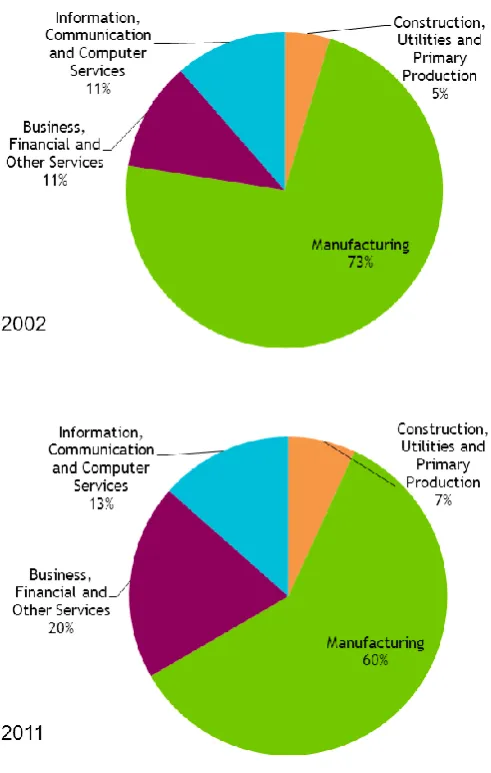
[image:39.595.150.396.347.734.2]As a share of total Irish-owned company employment, manufacturing has fallen 73 per cent in 2002 to 60 per cent in 2011. Alongside a 76 per cent absolute increase in employment between 2002 and 2011, business, financial and other services has seen its share increase from 11 to 20 per cent over the same period. The construction, utilities and primary production and information, communications and computer services sector groupings each saw small increases in shares of total employment between 2002 and 2011 (see Figure 5).
Figure 5: Sectoral Proportions of Permanent Full-Time Employment within Irish-Owned Agency Assisted Companies, 2002 and 2011
Figure 6 depicts the proportion of agency assisted foreign owned employment for each sector in the economy in 2002 and in 2011. Construction, utilities and primary production
[image:40.595.154.383.266.437.2]employment shares are not shown above due to their negligible proportions. Notable are the reduced share of manufacturing and the increases in the services sectors. Business, financial and other services have increased their proportion of employment from 6 to 12 per cent.
Figure 6: Sectoral Proportions in Permanent Full-time Employment within Foreign-owned Agency-Assisted Companies, 2002 and 2011
Action Plan for Jobs 2012
Forfás worked closely with the Minister for Jobs, Enterprise and Innovation and his
Department to develop the Action Plan for Jobs (APJ) 2012. The production of an Action Plan for Jobs 2012 marked the commencement of an annual process to produce an Action Plan focused on jobs and the enterprise economy.
The APJ 2012 aims to make Ireland the best small country in the world in which to do business and increase the number of people at work in Ireland by 100,000 by 2016. It provides a blueprint for action which aligns all Government departments and agencies around an enterprise growth and jobs objective.
The APJ 2012 focused on seven strands, the first six of which were:
Building Competitive Advantage;
Supporting Indigenous Start-ups;
Assisting Business to Grow;
Attracting Inward Entrepreneurial Start-ups;
Developing and Deepening the Impact of Foreign Direct Investment; and
Developing Employment Initiatives within the Community.
The APJ 2012 also included a section on Exploiting Sectoral Opportunities which highlighted the actions required to support existing and new sectors.
Launching the first Action Plan for Jobs 2012
Pictured are (l-r) Eamonn Gilmore TD, Tánaiste and Minister for Foreign Affairs, Enda Kenny, T.D., Taoiseach and Richard Bruton, T.D., Minister for Jobs, Enterprise and Innovation
There were 270 actions across 14 departments and 36 agencies which, while disparate, was recognition that making progress across a wide range of issues that were impinging on businesses could make a significant impact on job growth prospects.
Reporting requirements in relation to the Plan have also been put in place. The Action Plan for Jobs Monitoring Committee has been established and includes representatives from Forfás, the Department of Jobs, Enterprise and Innovation, the Department of Public Expenditure and Reform and the Department of the Taoiseach. The Monitoring Committee reports to the Cabinet Committee on Economic Recovery and Jobs to ensure that targets are achieved. A number of expert staff from Forfás are currently working with the Department of the Taoiseach on the monitoring process.
Quarterly reports on implementation will be prepared and published. The first
implementation report has been published and 96 per cent of all actions targeted for delivery in the first quarter of the Plan were achieved.
Forfás has lead responsibility for the delivery of a substantial number of actions in the Plan in 2012, including:
Developing a set of competitiveness targets that are amenable to domestic action;
Developing actions to systematically reduce excessive key business costs or delays;
Identifying changes in the operation of sectoral regulators that would enhance cost competitiveness;
Auditing and reviewing the multiplicity of licenses required by businesses to assess the potential for discontinuing some licenses and for amalgamating licenses;
Developing, in consultation with stakeholders, a national strategy for the construction sector; and
Developing a long term vision for the manufacturing sector and putting in place a strategic plan that will help to realise this vision.
Action Plan for Jobs 2012
Jobs Initiative
The Government committed to bringing forward, within its first one hundred days of office, a series of actions to foster employment growth and help sustain enterprise.
The Jobs Initiative was the first of these actions. Forfás provided advice on the Jobs Initiative based on research already conducted, the views of the enterprise agencies and undertook new focused analysis.
The budget neutral measures outlined in the Initiative were focused on assisting in employment generation, providing opportunities for those who have lost their jobs, and generating confidence in the economy.
Agency Programme Evaluations
Making it Happen – Growing Enterprise For Ireland called for the development and implementation of a framework that would inform a systematic approach to undertaking evaluations of agency programmes. A programme of evaluations was started by Forfás in 2011.
An evaluation framework has been developed, informed by international best practice, which sets out the methodologies and approach to ensure maximum coherence and comparability across evaluations.
This framework will assist policy makers and enterprise support programme designers to assess the value of policy interventions, achieve continued improvements in the design and implementation of programmes, and strengthen the evaluation culture in enterprise support provision.
The overall objective of the series of evaluations of agency programmes is to inform the optimum use of resources in a constrained environment to deliver on enterprise policy objectives. The agency programmes are categorised according to the following areas of intervention:
Start-up and Entrepreneurship;
Research, Development and Innovation; and
Business Development.
In early 2012, Forfás completed the evaluations for start-up and entrepreneurship supports and progressed those relating to RD&I, which are scheduled for completion by end 2012. Each programme is evaluated in terms of its appropriateness, efficiency and effectiveness:
In its own right;
As a constituent within the relevant thematic area; and
Within the overarching enterprise policy context.
The evaluation of the entrepreneurship and start up supports provided by Enterprise Ireland and the County Enterprise Boards (CEBs) included a range of programmes - supports for high potential start-ups (HPSUs), micro-firms and start-up firms (CEBs), start your own business programmes and a number of HPSU feeder programmes. The feeder programmes range from idea generation workshops, to short training sessions to longer term intensive programmes (incl IdeaGen, Propel, Enterprise Start 1, Enterprise Start 2 and CORD).
Over the period covered by the evaluation (2004-2010) enterprise policy strategies and related reports highlight the importance of stimulating entrepreneurship and start-ups. Start ups play a key role in driving economic growth, enhanced productivity and innovation are one of the means by which new sectors or sub sectors of existing industries take root in Ireland, thereby helping to deliver a strong enterprise mix. Most recently the Action Plan for Jobs 2012 reinforces the importance placed on start ups.
The economic context changed considerably over the period under evaluation, ranging from a time of high growth/low unemployment in 2004 to a period of high unemployment and increased challenges for start-ups in terms of access to finance.
The overarching finding of the analysis indicates that, in general, the each of the individual initiatives is:
Appropriate in the context of the policy environment at the time;
Effective in meeting its stated objectives; and
Efficient.
However, there is scope to minimise potential duplication, particularly with regard to the feeder interventions. Since the evaluations started some changes have been made to streamline programmes and increase efficiencies where appropriate.
The key recommendations include the need to:
Develop a national entrepreneurship policy for Ireland outlining objectives, targets and responsibilities;
Introduce a system of ex-ante evaluation across the enterprise agencies, informed by the Forfás evaluation framework, so that the most appropriate supports are being provided to address the market failures that pertain at a point in time. At design stage an ex-ante evaluation should set out the rationale, clear objectives, targets and metrics. At a system level consideration should also be given to what is already in existence to avoid duplication, and to inform the discontinuation of a no longer justifiable intervention.
Collect and collate data required for the purposes of programme evaluation informed by the identification of metrics at ex-ante evaluation stage. Within the CEBs in particular the supports directed toward start ups needs to be delineated from those provided to existing firms and other activities.
For individual programmes:
Assess the potential to increase cohort of HPSUs generated per annum with due regard to retaining the quality associated with HPSU status;
Streamline the feeder programmes for start-ups, and consider developing a modular approach to address the needs of different cohorts and target audiences;
Increase the efficiencies of the training programmes offered by the CEBs through further collaboration on design and delivery;
Ensure that any future Enterprise Ireland venture capital partner funds are aimed at addressing the prevailing market failures in the VC market and in sectors aligned with the investment strategies of commercial VC fund managers.
Advisory Group for Small Business
The range of issues raised by the AGSB's members was extensive and, facilitated by Forfás, the members agreed to focus on addressing barriers to growth in the first instance. Its report, The Voice of Small Business - A Plan for Action3, was published in November 2011. The main findings of the report set out that:
There are almost 200,000 small businesses in Ireland involving over 655,000 people4. A significant proportion of these firms employ less than 10 people.
Many trade on international markets, and there is potential for many more to
internationalise. Many will continue to focus exclusively on the domestic market and to remain small by choice.
Small firms are involved in a broad spectrum of sectors and activities, including software, medical technologies, food production, digital content, tourism, retail and wholesale, business, professional and personal services – many of which are high employment generators5.
Small firms are regionally spread and contribute to building a community, to developing a sense of place and to enhancing a location’s attractiveness as a place in which to live and to do business.
Small firms are facing unprecedented challenges in the current economic downturn. There were 8,000 fewer small businesses and 105,000 less people employed by small businesses in 2009 than there was in 2007.
Launch of the Report of the Advisory Group on Small Business
Launching the report in November 2011 are John Perry, TD and Minister for Small Business with AGSB members and secretariat to the AGSB
The AGSB members acknowledged that some actions set out in the report are already on the Government’s agenda, and reinforced the importance from the perspective of small
businesses. Actions were set out under a number of priority areas:
Access to Finance and Improving Cash Flow
Labour Costs
3 The recommendations contained in this report represent the views of the members of the Advisory Group for Small Business and not those of Forfás.
4 Small businesses are those with less than 50 people engaged
Other Costs of Doing Business
Access to Public Procurement for Small Business
Advice on Managing out of a Crisis
Management Development for Growth
The Hidden Economy
Other actions are focused on competitive practices, making it easier to access information for small firms and non-judicial debt resolution and insolvency.
The Voice of Small Business - A Plan for Action provided the small business perspective and a valuable input to the 2012 Action Plan for Jobs published by the Minister for, Jobs, Enterprise and Innovation in February 2012.
Report of the Advisory Group for Small Business
South East Employment Action Plan
In response to the high unemployment in the South East region and impact of the closure of the Talk Talk operation in Waterford City, Richard Bruton, T.D., Minister for Jobs, Enterprise and Innovation requested that Forfás develop an action plan for the South East.
Forfás worked closely with the development agencies and other stakeholders and, building on its previous research and analysis for the Regional Competitive Agendas (2009), provided a comprehensive overview of the strengths and potential for the region, together with a suite of actions required to address barriers and to enable future employment creation and growth.
The South East Region Employment Action Plan – Spotlight on the South East was published in December 2011. The key actions were focused on the following aspects:
Development of the regional gateway and effective promotion of the region, involving the elevation of key developmental priorities for Waterford City and a coordinated approach by the enterprise agencies, local authorities and other regional stakeholders.
Upgrading the regional enterprise mix, with a focused enterprise agency spotlight on the South East, involving concerted actions to:
Stimulate entrepreneurship and new business start-ups;
Promote sustainability and upgrading of the existing enterprise base through intense engagement by the agencies with established client companies;
Improve the attractiveness of the South East to realise potential for enterprise investment in sectors such as tourism, agri-food, cleantech, lifesciences and
internationally traded services, working in partne