Original Article
Association of MMP-2 polymorphisms with occurrence
risk of stroke
Li Zhang1, Runan Ren1, Shaoning Mu2
1Department of Neurology, Liaocheng People’s Hospital, Liaocheng 252002, Shandong, China; 2Department of
Emergency, Liaocheng Hospital of Traditional Chinese Medicine, Liaocheng 252003, Shandong, China
Received October 18, 2015; Accepted November 28, 2015; Epub February 1, 2016; Published February 15, 2016
Abstract: Aims: This study was designed to discuss the association between matrix metalloproteinase-2 (MMP-2) gene C-735T, C-1306T polymorphisms and stroke, meanwhile, to detect the interaction of MMP-2 polymorphisms in stroke. Methods: In 95 patients with stroke and 120 healthy controls, who were matched in age and gender, poly-merase chain reaction-restriction fragment length polymorphism (PCR-RFLP) was used to determine the genotypes of C-735T and C-1306T polymorphisms. The distribution differences of genotypes and alleles between the case and
control groups were tested by chi-square. Odds ratio (OR) and 95% confidence interval (CI) were applied to express
the relative risk of stroke. Crossover analysis was conducted to check the interaction of MMP-2 polymorphisms. Results: In MMP-2 C-735T polymorphism, both of TT genotype and T allele showed the significant frequency dif -ference between the case and control groups (P<0.05), which indicated the carriers easily suffered from stroke (OR=3.26, 95% CI=1.07-9.90; OR=1.68, 95% CI=1.06-2.68). Similarly, the CT genotype and T allele in C-1306T
polymorphism had statistically significant difference between two groups (P<0.05) and they might be associated
with the onset risk of stroke (OR=2.83, 95% CI=1.20-6.70; OR=3.89, 95% CI=1.77-8.55). In addition, these two polymorphisms of MMP-2 gene had the strong interaction. Conclusion: MMP-2 C-735T and C-1306T polymorphisms are related to the occurrence risk of stroke and both of two play a role in stroke synergistically.
Keywords:MMP-2, polymorphism, stroke, interaction
Introduction
Stroke is the second leading cause of death in the world with the characteristics of high mor-bidity, high disability rate, high mortality, high recurrence rate and various complications [1, 2]. About 1.5-2.0 million people are attacked by stroke every year in China [3]. Stroke is usually divided into hemorrhagic and ischemic stroke and the lifetime prevalence of the latter is high-er than that of the formhigh-er [4]. The symptoms and signs of stroke are sudden weakness, numbness of arms and legs, confusion, lan-guage disorder and loss of vision to one side [5]. So stroke brings on heavy economic and life burden for patients themselves and their family, but the effective methods to prevent and treat stroke are not found nowadays. In previous studies, hypertension, diabetes, hyperlipidemia, cigarette consumption were
proved to have influences on stroke [6]. What’s
more, the publications have reported that
stroke is caused by the interaction of genetic and environmental factors [7]. Therefore, researches on stroke pathogenesis, treatment and prognosis have always been the focuses of
medical field for years.
collapse of atheromatous plaque, and cerebral ischemia reperfusion, hemorrhagic transforma-tion, and neuron apoptosis through degrading ECM [12-14], which may be closely connected with the occurrence and development of stroke. However, so far, the research on the associa-tion of MMP-2 polymorphisms with stroke is rare.
Therefore, in this study, MMP-2 C-735T, C-1306T polymorphisms were selected to reveal the association with stroke susceptibility and explain the etiology of stroke. Meanwhile, the interaction between the two polymorphisms of MMP-2 was analyzed based on stroke to ensure the role of MMP-2 polymorphisms in stroke.
Materials and methods
Research objects
The case-control study was conducted and a total of 215 subjects were enrolled. All research objects in this study were Han population from northern China without blood relationship each other. This study was reviewed and approved by the Research Ethics Committee of Liaocheng
People’s Hospital. The process of sample col -lection was conducted in accordance with the national ethics criteria of human genome
research. What’s more, all subjects were
informed the study process and the written consents were also signed by patients and their family.
The case group consisted of 95 patients with stroke from outpatients and inpatients in
neu-rology department of Liaocheng People’s
Hospital, including 55 males and 40 females at the age of 32-83 with the mean age of 63.56±9.83. Certainly, the cases were diag-nosed by pathobiology and patients with undi-agnosed stroke or others relative diseases, such as tumors were excluded. 120 healthy people as the control group had been
conduct-ed the physical examination in the same hospi-tal during the same period with the case group, including 68 males and 52 females at the age of 36-78 with the mean age of 64.13±10.22. The healthy physical examinees were frequen-cy-matched with the cases by age and gender and they also had no the history of stroke or tumors. Clinical information of research objects, such as gender, age, and symptom, sign and so on were collected and recorded, and then were made into an Excel form. People who drunk more than once every week were as a drinker, and cigarette was consumed two or more for every day as a smoker. The others indexed was detected according to the conven-tional criteria.
DNA extraction
The research objects were informed the study purposes and processes in detail. 2 ml fasting venous blood of the objects was collected and stored in the anticoagulative tube with ethyl-enediamine tetraacetic acid (EDTA). According
to manufacturer’s instructions, peripheral
blood leucocyte genome DNA was extracted by Beijing TIANGEN biochemical blood genome DNA extraction kit, and then put in -20°C refrig-erator for standby application.
Genotyping of MMP-2 polymorphisms
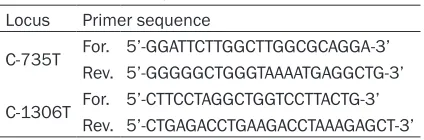
In present study, the method of polymerase chain reaction-restriction fragment length poly-morphism (PCR-RFLP) was used to determine the genotypes of MMP-2 polymorphisms. Firstly, primeval design: we referred to the Genebank database on NCBI website for the published sequence of MMP-2 C-735T, C-1306T polymorphisms. Primer Premier 5.0 software was adopted to design primer following general primer design principles and the primer sequences were showed in Table 1. Shanghai Sangon Biotech Co., Ltd took charge of synthe-sizing the primers.
And then, PCR reaction system: The total reac-tion system was a volume of 25 µl mixture, including 2.0 µl DNA template, 12.5 µl PCR Mix solution, each 1.0 µl of forward and reverse primers and 8.5 µl sterile ddH2O. PCR amplifi
-cation conditions: the amplifi-cation process
[image:2.612.90.302.94.164.2]started with 94°C initial denaturation for 5 min; followed by 30 cycles of 94°C degeneration for 30 s, 58°C annealing for 45 s, 72°C extension
Table 1. Primer sequences of MMP-2 gene C-735T, C-1306T polymorphisms
Locus Primer sequence
C-735T For. 5’-GGATTCTTGGCTTGGCGCAGGA-3’ Rev. 5’-GGGGGCTGGGTAAAATGAGGCTG-3’
for 45 s; and finally 72°C extension for 10 min.
The PCR products were checked and preserved at 4°C for standby application.
Finally, enzyme digestion reaction: the enzyme
digestion was finished in 20 µl reaction system,
including 2 µl restriction enzyme (HinfI for C-735T, XspI for C-1306T), 10 µl PCR products, 2 µl 10× Loading Buffer Solution and 6 µl ster-ile ddH2O. The reaction mixture was incubated in a water bath at 37°C for the overnight. 2% agarose gel electrophoresis (AGE) was per-formed to separate and determine the geno-types of MMP-2 polymorphisms.
Statistical analysis
PASW Statistics 18.0 was used to count data
and analyze the association between MMP-2
polymorphisms and stroke. χ2 test was applied to estimate if the genotype distributions of MMP-2 polymorphisms in the control group
conformed to Hardy-Weinberg equilibrium (HWE). The distribution differences of geno -types, alleles and the others indexes between the case and control groups were also tested
by χ2, and the influences of gene polymor -phisms on stroke were evaluated by odds ratio
(OR) and 95% confidence interval (95% CI) and
P<0.05 had statistical significance.
Further-more, crossover analysis was used to analyze the interaction intensity of MMP-2 C-735T, C-1306T polymorphisms in stroke. The interac-tion intensity was represented by the synergy index (S), attributable proportion of
in-interac-tion (AP) and relative excess risk of interacin-interac-tion (RERI).
Results
General situations of research objects
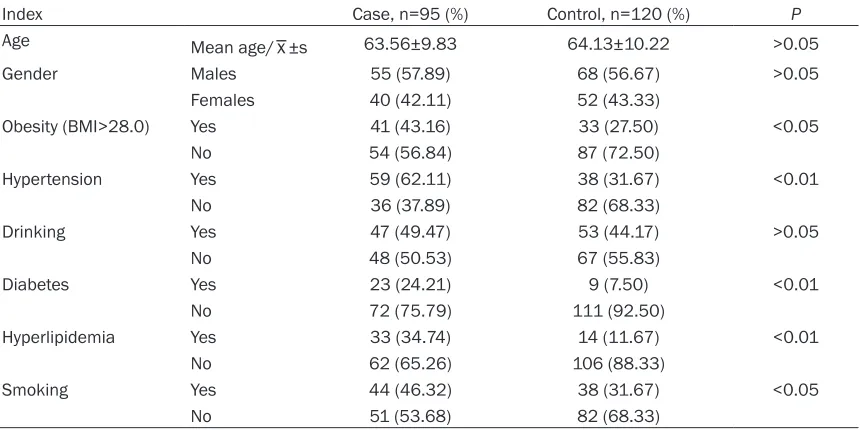
This study consisted of 215 objects, with 95 cases and 120 controls. The case group includ-ed 55 males and 40 females with the sex ratio of 1.38:1 and the mean age was 63.56±9.83. The control group included 68 males and 52 females, in which the sex ratio was 1.31:1 and the mean age was 64.13±10.22. The age and gender between two groups had no statistically
significant difference (P>0.05). As was the results in Table 2, the distributions of obesity, smoking, hypertension, diabetes,
hyperlipid-emia in case and control groups were signifi -cant differences (P<0.05). The hypertension patients even accounted for 62.11% in cases and hyperlipidemia patients also held 34.74%.
What’s more, the differences of hypertension,
diabetes, hyperlipidemia between two groups
reached to the significant level of 0.01. But drinking was not an independent influence fac -tor for stroke (P>0.05).
Distributions of MMP-2 polymorphisms in case and control groups
In Table 3, the genotype and allele distributions of MMP-2 C-735T, C-1306T polymorphisms
were showed. Tested by χ2, the genotype
distri-Table 2. Detailed characteristics of subjects in case and control groups
Index Case, n=95 (%) Control, n=120 (%) P
Age Mean age/_x±s 63.56±9.83 64.13±10.22 >0.05
Gender Males 55 (57.89) 68 (56.67) >0.05
Females 40 (42.11) 52 (43.33)
Obesity (BMI>28.0) Yes 41 (43.16) 33 (27.50) <0.05
No 54 (56.84) 87 (72.50)
Hypertension Yes 59 (62.11) 38 (31.67) <0.01
No 36 (37.89) 82 (68.33)
Drinking Yes 47 (49.47) 53 (44.17) >0.05
No 48 (50.53) 67 (55.83)
Diabetes Yes 23 (24.21) 9 (7.50) <0.01
No 72 (75.79) 111 (92.50)
Hyperlipidemia Yes 33 (34.74) 14 (11.67) <0.01
No 62 (65.26) 106 (88.33)
Smoking Yes 44 (46.32) 38 (31.67) <0.05
No 51 (53.68) 82 (68.33)
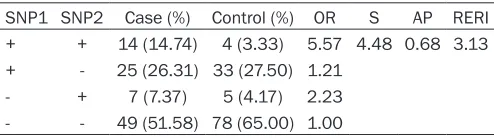
[image:3.612.92.522.85.300.2]The results of the interaction between MMP-2 C-735T and C-1306T polymorphisms were list-ed in Table 4. There was the positively additive
effect between two polymorphisms. When both
of two polymorphisms showed the genotypes of
the minor allele, the risk of strike significantly
increased (S=4.48) and 68% of the patients with stroke attributed to the interaction of MMP-2 C-735T and C-1306T polymorphisms (AP=0.68). Meanwhile, the interaction effect undertook 3.13 times risk in stroke, compared with the other risk factors (RERI=3.13).
Discussion
Stroke is not only a cerebral blood circulation disorder with sudden onset, but also one of the main diseases harming human health [15]. Among the people died of stroke, over two thirds concentrate in developing countries [16]. The onset of stroke derives from various possi-ble reasons, in which blood pressure, blood glu-cose, cholesterol level and smoking are the main risk factors. Besides, other reasons including advanced age, drinking, high-salt butions of MMP-2 two polymorphisms in the
control group conformed to HWE (P>0.05), which demonstrated that our study population was on behalf of a general Mendel population. At the same time, we can see that the genotype frequencies of CC, CT, TT in C-735T polymor-phism were 58.95%, 29.47%, 11.58% in case group and 69.17%, 26.67%, 4.16% in control group, respectively and The C, T allele frequen-cies were 47.37%, 52.63% in cases and 60.83%, 39.17% in controls. The distributions
had a significant difference between two
groups by TT genotype and T allele (P<0.05). Therefore, the carriage of TT genotype and T allele at C-735T polymorphism increased the probability suffering from stroke (TT vs. CC: OR=3.26, 95% CI=1.07-9.90; T vs. C: OR=1.68, 95% CI=1.06-2.68).
We only detected CC, CT genotypes of MMP-2 C-1306T polymorphism in the control group and the frequencies were respectively 92.50%, 7.50%, but CC, CT, TT genotype frequencies in cases were 77.89%, 17.89%, 4.22%,
respec-tively. CT genotype frequency was significantly
higher in cases than that of in controls, compared with CC genotype, so was T allele (P<0.05). So CT genotype and T allele were correlated to the increased the risk of stroke in our study popula-tion (TT vs. CC: OR=2.83, 95% CI=1.20-6.70; T vs. C: OR=3.89, 95% CI=1.77- 8.55).
[image:4.612.91.527.97.274.2]Interaction analysis of MMP-2 C-735T, C-1306T polymorphisms in stroke
Table 3. Genotype and allele distribution comparison of MMP-2 gene C-735T, C-1306T between case and control groups
Genotype/Allele Case n=95 (%) Control n=120 (%) Χ2 P OR (95% CI) P
HWE
C-735T 0.40
CC 56 (58.95) 83 (69.17) - - 1.00
CT 28 (29.47) 32 (26.67) 0.70 0.40 1.30 (0.71-2.39) TT 11 (11.58) 5 (4.16) 4.74 0.03 3.26 (1.07-9.90)
C 140 (73.68) 198 (82.50) - - 1.00
T 50 (26.32) 42 (17.50) 4.90 0.03 1.68 (1.06-2.68)
C-1306T 0.67
CC 74 (77.89) 111 (92.50) - - 1.00
CT 17 (17.89) 9 (7.50) 5.99 0.01 2.83 (1.20-6.70)
TT 4 (4.22) 0 (0) - -
C 165 (86.84) 231 (96.25) - - 1.00
T 25 (13.16) 9 (3.75) 12.89 0 3.89 (1.77-8.55)
Table 4. Interaction of MMP-2 C-735T, C-1306T polymor-phisms in stroke
SNP1 SNP2 Case (%) Control (%) OR S AP RERI + + 14 (14.74) 4 (3.33) 5.57 4.48 0.68 3.13 + - 25 (26.31) 33 (27.50) 1.21
- + 7 (7.37) 5 (4.17) 2.23 - - 49 (51.58) 78 (65.00) 1.00
[image:4.612.90.337.318.387.2]diet, obesity are considered as the influence
factors of stroke. Cerebral ischemic stroke is the main type and accounts for 80% of total stroke [17]. It has been widely considered that stroke is a complex polygenic disease affected by the interaction of environmental and genetic factors, but the detailed pathogenesis of stroke
is still not confirmed up to now.
Currently, some studies reveal that stroke is
related to inflammatory response [18, 19].
Ramallal et al. assess the role of the dietary
inflammatory index (DII) which is used to deter
-mine the inflammatory potential of the diet in stroke, the final results show that the risk of
stroke gradually increase with each improving quartile of DII [20]. Rajan et al. ensure that low
cognitive function significantly increases the
onset risk of stroke and the association between the two has racial difference, that is, negro with cognitive impairment are easier to suffer from stroke that that of Caucasian [21]. The effects gene and its genetic variant on stroke susceptibility have been researched and gained several positive results. In the study of Hanscombe et al., the increased risk of isch-emic stroke is found in people with genetic
bio-markers influencing the factor XIII subunit B (FXIIIB), a coagulation factor [22]. What’s more,
genetic polymorphisms of various genes involve in the process of stroke development, including MTHFR, AopE, angiotensin converting enzyme gene (ACE), eNOS, angiotensinogen gene (AGT), angiotensin II type 1 receptors gene (AT1R) [23-25].
MMPs, a zinc dependent proteolytic enzyme family, are the important media of degrading and reconstituting ECM. They can dissolve col-lagen ingredients, make the proportion of plaque elements obviously alter and relatively increase lipid contents, and further add insta-bility to plaque [26]. Gross and Lapiere earliest found MMPs when they studied metamorpho-sis of tadpole tail in 1962 and at least 25 mem-bers in MMPs have been found out until now. They participate in the processes of wound healing, bone resorption, pregnancy and deliv-ery, mammary gland instauration [27]. Lots of studies also discover that MMPs involves in multiple pathological processes, including
revascularization, tumor metastasis, inflamma
-tory response, etc. In recent years, people find
that MMPs widely affect nervous system, too. Among of the members in MMPs, MMP-2 and MMP-9 are studied widely in various diseases,
such as breast cancer, community-acquired pneumonia [28, 29].
In present study, the association between the genetic variants of MMP-2 and stroke suscepti-bility was discussed. Firstly, in the analysis of clinical information, patients with hyperten-sion, diabetes, hyperlipidemia accounted for large proportion in stroke patients than healthy persons, which ensured the conclusion that
these three index all had the important influ -ence on stroke development. In addition, per-manent cigarette consumption was also a risk factor for the onset of stroke, but the direct roles of obesity and drinking in stroke were not found in our study population. Secondly, the single polymorphism in MMP-2 was explored the association with stroke. Both of MMP-2 C-735T, C-1306T polymorphisms were reveal to be associated with the onset risk of stroke, not only genotype but allele. In the past, Nie et al. and Buraczynska et al. obtained the similar results [30, 31]. Finally, we analyzed the inter-action of MMP-2 C-735T, C-1306T polymor-phisms because of the complicacy of stroke which was regulated by various factors. These
two polymorphisms presented significantly
positive correlation under the additive effect model. It could explain near 70% of stroke occurrence when they showed the genotypes of minor allele.
Generally speaking, this study supported the viewpoint that there existed association between MMP-2 polymorphisms and stroke in the Han population from northern China. Nevertheless, in order to guarantee and improve the accuracy of results, more studies with larger and different sample populations should be performed for obtaining more sup-portive evidences and attaining the purpose of early discovery, diagnosis and treatment.
Disclosure of conflict of interest
None.
Address correspondence to: Runan Ren, Depart-
ment of Neurology, Liaocheng People’s
Hospi-tal, Liaocheng 252002, Shandong, China. E-mail: [email protected]
References
[2] Moskowitz MA, Lo EH and Iadecola C. The sci-ence of stroke: mechanisms in search of treat-ments. Neuron 2010; 67: 181-198.
[3] Wang YJ, Zhang SM, Zhang L, Wang CX, Dong Q, Gao S, Huang RX, Huang YN, Lv CZ, Liu M, Qin HQ, Rao ML, Xiao Y, Xu YM, Yang ZH, Wang JZ, Wang WZ, Wang J, Wang WJ, Wu J, Wu SP, Zeng JS, Zhao XQ and Zhong LY. Chinese guide -lines for the secondary prevention of ischemic stroke and transient ischemic attack 2010. CNS Neurosci Ther 2012; 18: 93-101.
[4] El Tallawy HN, Farghaly WM, Badry R, Hamdy
NA, Shehata GA, Rageh TA, Metwally NA, Hassan EM, Elsayed SS, Yehia MA and Soliman
WT. Epidemiology and clinical presentation of
stroke in Upper Egypt (desert area). Neuropsychiatr Dis Treat 2015; 11: 2177-2183.
[5] Donnan GA, Fisher M, Macleod M and Davis SM. Stroke. Lancet 2008; 371: 1612-1623. [6] Dries DJ and Hussein HM. Stroke: Part 1. Air
Med J 2015; 34: 236-239.
[7] Choi JC. Genetics of cerebral small vessel dis-ease. J Stroke 2015; 17: 7-16.
[8] Chambers AF and Matrisian LM. Changing views of the role of matrix metalloproteinases in metastasis. J Natl Cancer Inst 1997; 89: 1260-1270.
[9] Elkington PT, O’Kane CM and Friedland JS. The
paradox of matrix metalloproteinases in infec-tious disease. Clin Exp Immunol 2005; 142: 12-20.
[10] Machado GF, Melo GD, Souza MS, Machado AA, Migliolo DS, Moraes OC, Nunes CM and Ribeiro ES. Zymographic patterns of MMP-2 and MMP-9 in the CSF and cerebellum of dogs with subacute distemper leukoencephalitis. Vet Immunol Immunopathol 2013; 154: 68-74.
[11] Nakaji K, Ihara M, Takahashi C, Itohara S,
Noda M, Takahashi R and Tomimoto H. Matrix metalloproteinase-2 plays a critical role in the pathogenesis of white matter lesions after chronic cerebral hypoperfusion in rodents. Stroke 2006; 37: 2816-2823.
[12] Lu A, Suofu Y, Guan F, Broderick JP, Wagner KR
and Clark JF. Matrix metalloproteinase-2 dele-tions protect against hemorrhagic transforma-tion after 1 h of cerebral ischemia and 23 h of reperfusion. Neuroscience 2013; 253: 361-367.
[13] Hill JW, Poddar R, Thompson JF, Rosenberg GA
and Yang Y. Intranuclear matrix metalloproteases promote DNA damage and apoptosis in-duced by oxygen-glucose deprivation in neu-rons. Neuroscience 2012; 220: 277-290. [14] Lenti M, Falcinelli E, Pompili M, de Rango P,
Conti V, Guglielmini G, Momi S, Corazzi T, Giordano G and Gresele P. Matrix
metallopro-teinase-2 of human carotid atherosclerotic plaques promotes platelet activation. Corre- lation with ischaemic events. Thromb Haemost 2014; 111: 1089-1101.
[15] Stroke--1989. Recommendations on stroke prevention, diagnosis, and therapy. Report of
the WHO Task Force on Stroke and other
Cerebrovascular Disorders. Stroke 1989; 20: 1407-1431.
[16] Feigin VL. Stroke epidemiology in the develop-ing world. Lancet 2005; 365: 2160-2161. [17] Zhang LF, Yang J, Hong Z, Yuan GG, Zhou BF,
Zhao LC, Huang YN, Chen J and Wu YF.
Proportion of different subtypes of stroke in China. Stroke 2003; 34: 2091-2096.
[18] Singh S, Singh H, Loftus EV Jr and Pardi DS. Risk of cerebrovascular accidents and
isch-emic heart disease in patients with inflamma -tory bowel disease: a systematic review and meta-analysis. Clin Gastroenterol Hepatol 2014; 12: 382-393, e1: quiz e22.
[19] Xu T and Zhang YH. Association of psoriasis
with stroke and myocardial infarction: meta-analysis of cohort studies. Br J Dermatol 2012; 167: 1345-1350.
[20] Ramallal R, Toledo E, Martinez-Gonzalez MA, Hernandez-Hernandez A, Garcia-Arellano A, Shivappa N, Hebert JR and Ruiz-Canela M.
Dietary Inflammatory Index and Incidence of
Cardiovascular Disease in the SUN Cohort. PLoS One 2015; 10: e0135221.
[21] Rajan KB, Schneider JA, Aggarwal NT, Wilson
RS, Everson-Rose SA and Evans DA. Racial Differences in Cognitive Function and Risk of Incident Stroke. J Stroke Cerebrovasc Dis 2015; 24: 2854-9.
[22] Hanscombe KB, Traylor M, Hysi PG, Bevan S, Dichgans M, Rothwell PM, Worrall BB, Seshadri S, Sudlow C, Williams FM, Markus HS and Lewis CM. Genetic Factors Influencing Coagulation Factor XIII B-Subunit Contribute to
Risk of Ischemic Stroke. Stroke 2015; 46: 2069-2074.
[23] Lv QQ, Lu J, Sun H and Zhang JS. Association of methylenetetrahydrofolate reductase (MTHFR) gene polymorphism with ischemic stroke in the Eastern Chinese Han population. Genet Mol Res 2015; 14: 4161-4168.
[24] Das S, Roy S, Sharma V, Kaul S, Jyothy A and
Munshi A. Association of ACE gene I/D poly-morphism and ACE levels with hemorrhagic stroke: comparison with ischemic stroke. Neurol Sci 2015; 36: 137-142.
[25] Lopez Fernandez JC, Rodriguez Esparragon F and Buset Rios N. [Update on the genetics of stroke]. Med Clin (Barc) 2014; 143: 176-179. [26] Fatar M, Stroick M, Griebe M and Hennerici M.
[27] Takahara M, Naruse T, Takagi M, Orui H and Ogino T. Matrix metalloproteinase-9 expres-sion, tartrate-resistant acid phosphatase activ-ity, and DNA fragmentation in vascular and cel-lular invasion into cartilage preceding primary
endochondral ossification in long bones. J
Orthop Res 2004; 22: 1050-1057.
[28] Li C, Yang D, Zhao Y, Qiu Y, Cao X, Yu Y, Guo H, Gu X and Yin X. Inhibitory Effects of
Isorha-mnetin on the Invasion of Human Breast Carcinoma Cells by Downregulating the Expression and Activity of Matrix Metallo- proteinase-2/9. Nutr Cancer 2015; 67: 1191-1200.
[29] Bircan HA, Cakir M, Yilmazer Kapulu I, Sutcu R, Kaya S and Ozturk O. Elevated serum matrix
metalloproteinase-2 and -9 and their correla-tions with severity of disease in patients with community-acquired pneumonia. Turk J Med Sci 2015; 45: 593-599.
[30] Nie SW, Wang XF and Tang ZC. Correlations
between MMP-2/MMP-9 promoter polymor-phisms and ischemic stroke. Int J Clin Exp Med 2014; 7: 400-404.