Abstract—This article presents the solution of boundary
value problems using finite difference scheme and Laplace transform method. Some examples are solved to illustrate the methods; Laplace transforms gives a closed form solution while in finite difference scheme the extended interval enhances the convergence of the solution.
Index Terms— Finite difference method, Laplace transforms, boundary value problems
I. INTRODUCTION
wo-point boundary value problems have received a considerable attention due to its importance in many areas of sciences and engineering. These types of differential equations arise very frequently in fluid mechanics, quantum mechanics, optimal control, chemical-reactor theory, aerodynamics, reaction-diffusion process and geophysics. Various analytical and numerical techniques proposed for the solution of differential equations are available in literature; some of these are Differential Transform Method [1-6], Rung-Kutta 4th Order Method [7], Bernoulli Polynomials [8], Cubic Spline Method [9], Sinc Collocation Method [10], Modified Picard Technique [11], Block Method [12-14], Adomian Decomposition Method [15-20], Homotopy Perturbation Method [21-23].
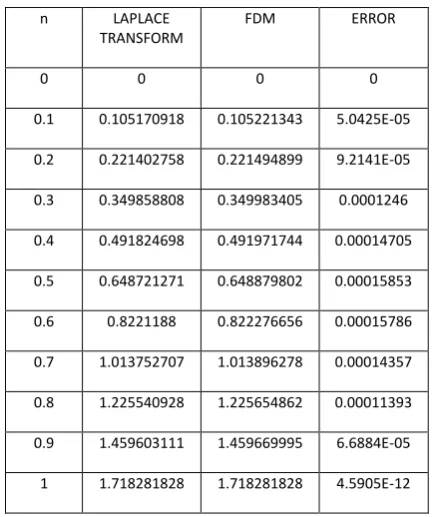
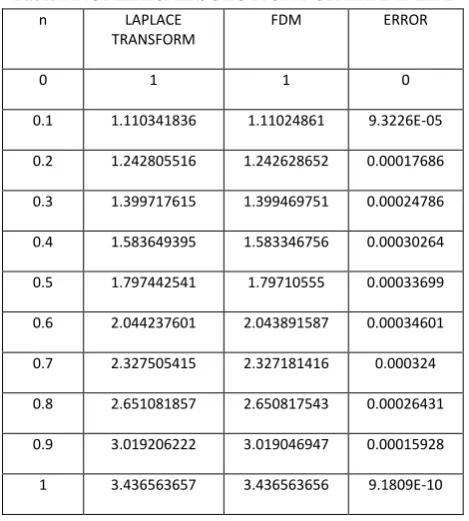
In this work, finite difference method proposed for the solution of two-point boundary value problems has been widely applied [24-26]. However, in this article the step length is extended and it is observed that the approach enhances the convergence of the result when compared with the exact from Laplace transforms (which gives a close form of solution), See Tables 1 and 2.
.
Manuscript received February 13, 2017; revised March 10, 2017. This work was supported by Centre for Research and Innovation, Covenant University, Ota, Nigeria.
A. A. Opanuga, E.A. Owoloko, H. I. Okagbue, O.O. Agboola are with the Department of Mathematics, Covenant University, Nigeria.
(e-mail:[email protected], [email protected], [email protected], [email protected]).
II. ANALYSIS OF FINITE DIFFERECE SCHEME Consider the second order boundary value problem below
( )
( )
( ),
,
p
q
r
(1)with the boundary conditions
( )
A
and
( )
B
(2)The intervals
a b
,
is subdivided inton
equal subintervals. The subintervals length is referred to ash
, given thath
n
(3)We consider the following points
0 1 0 2 0
0 0
,
,
2 ,
,
,
,
m
n
h
h
mh
nh
(4)The numerical solution at any point
m is denoted by
m and the theoretical solution is written as
(
m)
We shall consider the central difference approximation for the approximation of the differential equation. The approximation is shown below
1
1 1
2
1
;
2
1
2
m m m
m m m m
h
h
(5)
using (5) in (1),we obtain
1 1
1 1
(
)
1
2
2
2
(
)
m
m m m m m
m
p
h
q
(6)
simplifying gives
Finite Difference Method and Laplace
Transform for Boundary Value Problems
A. A. Opanuga*,
Member, IAENG,
E.A. Owoloko, H. I. Okagbue, O.O. Agboola
1 1
1 1
2
2
2
(
)
2
(
)
m m m m m m
m
hp
h q
(7)
Equation (7) can be written as
1 1
,
1, 2,3,
m m m m m m m
a
b
c
d m
(8) where2
2
2
(
),
4 2
(
),
2
(
),
2
(
)
m m
m m
m m
m m
a
hp
b
h q
c
hp
d
h r
(9)
The following equations are obtained from (8)
1 0 1 1 1 2 1
a
b
c
d
(10)2 0 2 1 2 2 2
a
b
c
d
,etc. (11) The equations above result to a system of equations of theform
A
d
for the unknowns
1,
2,
3,
,
n1 , where A is the coefficient matrix. Solving the system of equations above gives the solution of the boundary value problemsIII. NUMERICALEXAMPLES
Example 1: Consider the two-point boundary value problem below
( )
( ) 1, (0)
0, (1)
e
1
(12)The theoretical solution of (12) is
( )
e
t1
(13)Solution by Laplace Transform
The Laplace transform of equation (12) gives
1
L
L
L
(14)2
1
(0)
(0)
s
s
s
(15)Let
L
(0)
m
Equation (15) becomes2
1
(0)
s
s
m
s
(16)and simplifying, we obtain
2
2
1
1
1
m
s s
s
(17)Resolving into partial fraction, we get
1
1
1
1
2
1
2
1
2
1
m
s
s s
s
s
m
s
(18)
The inverse Laplace gives
1
1
1
2
2
2
2
m
m
e
e
e
e
(19)
Using
y
(1)
e
1
, we obtain1 1 1 1
1
1
1
1
2
2
2
2
m
m
e
e
e
e
e
(20)which gives m = 1, then
1
1
1
1
( )
1
2
e
2
e
2
e
2
e
(21)
Then
( )
e
1
(22)which is the exact solution
Solution by Finite Difference Method
Equation (12) is written with the following step lengths
1
1 0
,
10
1
10
10
h
n
h
(23)From the above we have
(0)
0, (0.1)
?, (0.2)
?,
(0.3),
, (1)
e
1
(24)Using the central difference approximations for equation (12), we have
1 1
100
m
2
m
m
m
1
(25)For
0 1 2
1,
1: 201
100
1
m
(26)1 2 3
2 : 100
201
100
1
2 3 4
3 : 100
201
100
1
m
(28)
10 8 9
9,
1: 100
201
100
100 1
m
e
e
(29) [image:3.595.60.278.215.474.2]Solving the system of equations (26-29) gives the solution of the boundary value problems; and the comparism with the close form solution of Laplace transform is presented in table1
.
Table I: NUMERICAL SOLUTION FOR EXAMPLE 1
n LAPLACE TRANSFORM
FDM ERROR
0 0 0 0
0.1 0.105170918 0.105221343 5.0425E-05 0.2 0.221402758 0.221494899 9.2141E-05 0.3 0.349858808 0.349983405 0.0001246 0.4 0.491824698 0.491971744 0.00014705 0.5 0.648721271 0.648879802 0.00015853 0.6 0.8221188 0.822276656 0.00015786 0.7 1.013752707 1.013896278 0.00014357 0.8 1.225540928 1.225654862 0.00011393 0.9 1.459603111 1.459669995 6.6884E-05 1 1.718281828 1.718281828 4.5905E-12
Example 2: Consider the boundary value problems below
1, (0)
2, (1)
2(
e
1)
(30)The theoretical solution is
( )
2
e
1
(31) Solution by Laplace TransformThe Laplace transform of equation (30) is
1
L
L
L
(32)
2
1
(0)
(0)
(0)
s
s
s
s
(33)Let
L
(0)
m
, equation (33) becomes2
1
1
s
s m s
s
(34)Simplifying, we obtain
2
2 21
1
1
1
m
s
s
s
s
s
s s
s
(35)Resolving into partial fraction, we obtain
2
1
1
1
1
1
1
1
m
m
s
s
s
s
s
s
(36)The inverse Laplace transform of (36) is given as
e
me
m
(37)Applying
(1)
2
e
2
2
e
2
e
me
m
(38)Simplifying, we obtain
m
1
. Then equation (37) becomes1
( )
2
1
y
e
e
e
(39)Equation (39) is the closed form solution of the boundary value problems (30)
Solution by Finite Difference Method
Equation (30) is written with the following step lengths
1, (0)
0, (1)
2
e
2
1
1 0
,
10
1
10
10
h
n
h
(40)With the nodal points above, we have
(0)
0, (0.1)
?, (0.2)
?,
(0.3),
, (1)
2
e
2
(41)Applying central difference approximations for equation (30), we obtain
1 1
1 1
100
2
5
1
m m m
m m
(42)For
0 1 2
1,
1: 200
95
104
m
(43)1 2 3
2 : 105
200
95
1
2 3 4
3 : 105
200
95
1
m
(45)
10 8 9
9,
2
2 : 105
200
190
190 1
m
e
e
(46) [image:4.595.52.287.198.459.2]The system of equations (43-46) are solved and compared with the closed form solution of the Laplace transforms in Table 2.
Table I NUMERICAL SOLUTION FOR EXAMPLE 2
n LAPLACE
TRANSFORM
FDM ERROR
0 1 1 0
0.1 1.110341836 1.11024861 9.3226E-05 0.2 1.242805516 1.242628652 0.00017686 0.3 1.399717615 1.399469751 0.00024786 0.4 1.583649395 1.583346756 0.00030264 0.5 1.797442541 1.79710555 0.00033699 0.6 2.044237601 2.043891587 0.00034601 0.7 2.327505415 2.327181416 0.000324 0.8 2.651081857 2.650817543 0.00026431 0.9 3.019206222 3.019046947 0.00015928 1 3.436563657 3.436563656 9.1809E-10
IV. CONCLUSION
In this article, Finite Difference Technique and Laplace transform are employed to solve two point boundary value problems. The step length is extended in finite difference method to enhance the convergence of the method; the results are compared with the close form solution of Laplace transform in Tables 1 and 2.
ACKNOWLEDGMENT
The authors are grateful to Covenant University for their financial support, and the anonymous reviewers for their comments.
REFERENCES
[1] A.A. Opanuga, J.A. Gbadeyan, S.A. Iyase and H.I. Okagbue, “Effect of Thermal Radiation on the Entropy Generation of Hydromagnetic Flow Through Porous Channel”, The Pacific Journal of Science and Technology, vol. 17, no 2, pp. 59-68, 2016.
[2] M. El-Shahed, “Application of differential transform method to non-linear oscillatory systems”, Communication in Nonliear Simulation, vol. 13, pp. 1714-1720, 2008.
[3] A. A. Opanuga, O. O. Agboola, H. I. Okagbue, “Approximate solution of multipoint boundary value problems”, Journal of Engineering and Applied Sciences, vol. 10, no 4, pp. 85-89,2015.
[4] J. Biazar and M. Eslami, “Analytic solution for Telegraph equation by differential transform method”, Physics Letters A, vol. 374, 2010, pp. 2904-2906. doi:10.0.16/jphysleta.2010.05.012
[5] N. Dogan, V. S. Erturk and O. Akin, “Numerical treatment of singularly perturbed two-point boundary value problems by using differential transformation method”, Discrete Dynamics in Nature and Society, 2012. http://dx.doi.org/10.1155/2012/579431
[6] A. A. Opanuga, H. I. Okagbue, S. O. Edeki and O. O. Agboola, “Differential Transform Technique for Higher Order Boundary Value Problems”, Modern Applied Science, vol. 9, no 13, pp. 224-230, 2015
[7] Anwar Ja'afar Mohamad-Jawad, “Second order nonlinear boundary value problems by four numerical methods”, Eng &Tech Journal, vol. 28, no 2, pp. 1-12, 2010.
[8] Md Shafiqul Islam and Afroza Shirin, “Numerical solution of a class of second order boundary value problems on using Bernoulli Polynomials”, Applied Mathematics, vol. 2, pp. 1059-1067, 2011. doi:10.4236/am.2011.29147.
[9] E. A. Al-Said, “Cubic spline method for solving two point boundary value problems”, Korean Journal of Computational and Applied Mathematics”, vol. 5, pp. 759-770, 1998.
[10] B. Bialecki, “Sinc-Collocation methods for two point boundary value problems”, The IMA Journal of Numerical Analysis, vol. 11, no 3, pp. 357-375, 1991. doi:10.1093/imanum/11.3.357
[11] H. A. El-Arabawy and I. K. Youssef, “A symbolic algorithm for solving linear two-point boundary value problems by modified Picard technique”, Mathematica and Computer Modelling, vol. 49, pp. 344-351, 2009. doi:10.1016/j.mcm.2008.07.030
[12] Z. Omar and J. O. Kuboye, “Derivation of Block Methods for Solving Second Order Ordinary Differential Equations Directly using Direct Integration and Collocation Approaches”, Indian Journal of Science and Technology, vol. 8, no 12, 2015. DOI: 10.17485/ijst/2015/v8i12/70646 |
[13] J. O. Kuboye and Z. Omar, “New Zero-stable Block Method for Direct Solution of Fourth Order Ordinary Differential Equations”, Indian Journal of Science and Technology, vol. 8, no 12, 2015. DOI: 10.17485/ijst/2015/v8i12/70647
[14] T. A. Anake, D. O. Awoyemi and A. O. Adesanya, “One-Step Implicit Hybrid Block Method for the Direct Solution of General Second Order Ordinary Differential Equations”, IAENG
International Journal of Applied Mathematics, vol. 42, no 4, pp. 224 -228, 2012.
[15] G. Adomian, “Solving Frontier Problems of Physics, The Decomposition method” , Boston, Kluwer Academic 1994. [16] G. Adomian, “Nonlinear Stochastic Systems and Application to
Physics”, Kluwer Academic. The Netherland, 1989.
[17] S. O. Adesanya, E. S. Babadipe and S. A. Arekete, A “New Result on Adomian Decomposition method for solving Bratu’s problem”, Mathematical Theory and Modeling, vol. 3, no 2, pp. 116-120, 2013.
[18] M. Tatari and M. Dehghan, “The use of the Adomian Decomposition Method for Solving Multipoint Boundary Value Problems”, Phys. Scr. vol. 73, pp. 672-676, 2006. doi:10.1088/0031-8949/73/6/023
[19] R. Jebari, I. Ghanmi and A. Boukricha, “Adomian decomposition method for solving nonlinear heat equation with exponential nonlinearity”, Int. Journal of Maths. Analysis, vol. 7, no 15, pp. 725-734, 2013
[20] M. Paripoura, E. Hajiloub, A. Hajiloub, H. Heidarib, “Application of Adomian decomposition method to solve hybrid fuzzy differential”, Journal of Taibah University for Science, vol. 9, pp. 95–103, 2015. [21] A. A. Opanuga, O. O. Agboola, H. I. Okagbue, G. J. Oghonyon,
“Solution of differential equations by three semi-analytical techniques”, International Journal of Applied Engineering Research, vol. 10, no 18, pp. 39168-39174, 2015.
[23] D. D. Ganji and A. Sadghi, “Application of homotopy-perturbation and variational iteration methods to nonlinear heat transfer and porous media equations”, Journal of Computational and Applied Mathematics, vol. 207, pp. 24-34, 2007.
[24] E.U. Agom and A.M. Badmus, “Correlation of Adomian decomposition and finite difference methods in solving nonhomogeneous boundary value problem”, The Pacific Journal of Science and Technology, vol. 16, no 1, pp. 104-109, 2015 [25] M. L. Dhumal1, S. B. Kiwne, “Finite Difference Method for Laplace
Equation”, International Journal of Statistika and Mathematika, vol. 9, no 1, pp. 11-13, 2014.