Abstract—Despite several researches in autonomous agents important theoretical aspects of multi-agent coordination has been largely untreatable. Multiple cooperating situated agents support the promise of improved performance and increase the task allocation problems in cooperative environments. We present a general structure for coordinating heterogeneous situated agents that allows both autonomy of each agent as well as explicit coordination of them. Such situated agents are embodied for taking into account their situation to solve any action. Indeed, organizational features have been used as metaphor to achieve highest levels of interactions in an agent system. Then, a decision algorithm has been developed to perform a match between the situated agent knowledge and the requirements of an action. Finally, this paper presents preliminary results in a simulated robot soccer scenario.
Index Terms—Multi-agent coordination, e-Institutions, Interactive Norms, Soccer Robotics.
I. INTRODUCTION
OORDINATION depends on how autonomous agents make collective decisions to work jointly in real cooperative environments [1]. Nowadays, several researchers have proposed that autonomous agent systems are computational systems in which two or more agents work together to perform some set of tasks or satisfy some set of goals. Research in multi-agent systems is then based on the assumption that multiples agents are able to solve problems more efficiently than a single agent does [2]. Special attention has been given to MAS developed to operate in dynamic environments, where uncertainty and unforeseen changes can happen due to presence of other physical representation (i.e., agents) and another environmental representations that directly affects the agents’ decisions. Such coordination allows agents to reach high levels of interaction and increase their successful decisions, improving the performance of complex tasks. Agents must therefore work in some way and under a wide-range of conditions or constraints. In fact, an agent system will have to be handled with a great level of awareness because the failure of a single agent may cause a total degradation of the system performance. For thus, this paper aims to introduce a decision algorithm based on the electronic Institution (e-I) features [3], which it represents the rules needed to support an agent society. Specifically, such algorithm uses knowledge of the agent situation regards to three perspectives: interaction with social
Manuscript received March 23, 2013.
I. González is a student of the Engineering Program at the Engineering School at the Autonomous University of Tamaulipas, Mexico ([email protected]).
S. Ibarra, J. A. Castán, J. Laria and J. Guzmán are professors in the Engineering School at the Autonomous University of Tamaulipas, Mexico.
information and other relevant details to entrust in other agents or humans; awareness representing the knowledge of the physical body reflecting in the body’s skills; and world
including information perceived directly from the environment. But each type of agent reacts to its perception of the environment in different ways, modifying the overall system performance. In particular, a match function has been formulated to reach a suitability rate based on the situated agents’ capabilities and the actions’ requirements. In fact, agents can select those actions for which they are the best qualified. The effectiveness of this work is illustrated by developing several examples that analyze cooperative agents’ behavior considering different situations in a real cooperative environment.
II. PROCEDURE FOR PAPER SUBMISSION
A group of situated agents are here presented as cooperative systems constituted by a group of autonomous agents who must cooperate among themselves in order to reach specific goals within real cooperative environments. When agent interaction exists, each element of the agent group must be able to be differentiated from the others. These agents require a sense of themselves as distinct and autonomous individuals obliged to interact with others within cooperative environments (i.e., they require an agent identification) [14]. This identification refers to the property of each agent to know who it is and what it does within the group. In this sense, this work proposes two agent classifications: Coach Agents(CA) and Situated Agents(SA)
A. Adopting e-Features
In order to imitate the ideology of the e-I (i.e., e-I uses a set of rules to manage the action performance in groups of agents), the paper describes how agents that work in temporal groups, are able to achieve collective behaviour. Such behaviour is possible by using communication among agents. Let us suppose a scene sα as a spatial region where a set of actions must be performed by a group of situated agents sα.
} s ,..., s , s , s { S where s
s | S s ,
si j∈ i ≠ j = 1 2 3 n
∃
S is the set of all possible Scenes.
Let us define a coach agent caαin charge of supervising the execution of the actions in a particular sα.
CA G
ca ca | G ca ,
cai j∈ CA i ≠ j∧ CA⊆ ∃
}
ca
,...,
ca
,
ca
,
ca
{
CA
where
=
1 2 3 nWhere CAis the set of all possible Supervisor Agents.
When saα has identified its sα, it must claim information in order to know which actions must be achieved in such sα. It is possible, then, to define a saα as sensitive to the events that happen in real cooperative environments based on the agent paradigm [15].
Coordination in Competitive Environments
I. González, S. Ibarra, J. A. Castán, J. Laria, J. Guzmán
Let us define a situated agent sai as an entity that has a physical representation on the environment and through which the systems can produce changes in the world.
SA G sa sa | G sa ,
sai j∈ SA i ≠ j∧ SA⊆
∃
}
sa
,...,
sa
,
sa
,
sa
{
SA
where
=
1 2 3 nSAis the set of all possible Situated Agents.
In this sense, sai could be represented in many ways, (i.e., one autonomous robot with arms, cameras, handles, etc) but for the scope of our proposal; sai is embodied for an entity that is characterized by the consideration of three parameters refer to: interaction, awareness and world.
[image:2.595.63.259.254.364.2]In fact, the paper argues coordination at two meta-levels (cognitive level - supervision of the intentions; physical level – execution of the action in the world), where the coach agents coordinates among them to allocate of a set of actions for a group of situated agents.
Fig. 1. Levels of Interaction.
Let us define a norm ni that is denoted as a rule that must be respected or must fix the behaviour that a sai must keep at trying to perform an action in a sα. We indicated the conception of a norm within a scene following a set of rules such that:
if (ni) do/dont {action}
N ) s ( N n n | ) s ( N n ,
ni j∈ i≠ j∧ ⊆
∃ α α
}
n
,...,
n
,
n
,
n
{
)
s
(
N
Where
α=
1 2 3 aLet us define an obligation obl as the imposition given to some sai to perform some action, which it is established following a set of rules. In order to denote the notion of obligation obl the predicate [3] is present as follows:
)
s
,
,
pa
(
obl
iψ
αWhere a sai is obligated to do ψ in sα.
1) Cooperative Actions
Studies about which actions are involved in determine scene are needed to perceive knowledge that make possible the organization of any determined scene. Once a coach
knows in which scene it will develop its function, it must identify the goals to be accomplished in such spatial region, indicate the tasks that must be performed to achieve these goals, and what roles are necessary for the task achievement. Then, a coach is defined in its knowledge base KB(caα) by the consideration of a set of goals G, a set of tasks T and a set of roles R.
)
s
(
R
)
s
(
T
)
s
(
G
)
ca
(
KB
α=
α∪
α∪
αWhere
KB
(
sa
α)
is the information of all the issues regarding to a specific scene sα,such that:G
(
s
α)
is the set of goals,)
s
(
T
α is a set of all tasks, andR
(
s
α)
is the set of all roles involved in determined scene sα.Indeed, it is necessary to propose a priority index pi that represents the importance of every action. A saα will know
performed and the order of the role allocation process regarding its supervised sα. Such priority index will be established according to system requirements (i.e., timeline) in order to achieve the saαaims.
Goals then embody the overall system purpose; however a caαcould achieve a particular goal without the necessity of performing another goal at the same sα.
G ) s ( G g g | ) s ( G g ,
gi j∈ i≠ j∧ ⊆
∃ α α
}
g
,...,
g
,
g
,
g
{
)
s
(
G
Where
α=
1 2 3 o 1 ) g ( p 0 | P ) g ( p ) s ( Ggi∈ ∃ i ∈ G(s ) ≤ i ≤
∀
α α
Where G is the set of all possible Goals and
G
(
s
α)
is gβ involved in sα.Let us to define a set of tasks T which represent the issues that must be performed to achieve a specific gβ. Goal then could be achieved without the implicit necessity of performing all its involved tasks. Therefore, the tasks selected are independent, but their development could affect in a positive or negative way the development of other tasks.
T ) s ( T ) g ( T t t | ) g ( T t ,
ti j∈ i≠ j∧ ⊆ ⊆
∃ β β α
} t ,..., t , t , t { ) g ( T
Where β = 1 2 3 p
1 ) t ( p 0 | P ) t ( p ) g ( T
ti∈ ∃ i ∈ T(g ) ≤ i ≤
∀ β β
Where T is the set of all possible Tasks.
Let us to define a set of roles R which represent the actions that a pai must fulfil to perform a tγ within a sα.
R ) s ( R ) t ( R r r | ) t ( R r ,
ri j∈ i≠ j∧ ⊆ ⊆
∃ γ γ α
} r ,..., r , r , r { ) t ( R
Where γ = 1 2 3 q
1 ) r ( p 0 | P ) r ( p ) t ( R
ri∈ ∃ i ∈ R(t ) ≤ i ≤
∀ γ γ
Where R is the set of all possible Roles.
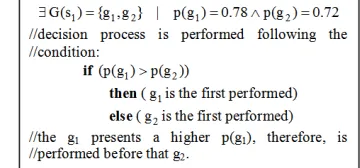
In order to illustrate how this process is performed, let us suppose a scene s1 which is supervised by the coach ca1 performing a decision process to define which goal must be attended firstly (Fig. 2).
Fig. 2. The coach ca1 defines which goal must be performed first.
2) Embodying Situated Agents
Suppose that a situated agent livesin a real environment, therefore, it has the ability to consider its physical representation in such world. Although these characteristics could supposedly take a lot of “things” regarding the environment our proposal takes three kinds of knowledge that seek to reference all the information that characterize the perception of particular sai.
a) Interaction
[image:2.595.332.512.512.596.2]useful in the interaction process of the agents because they can trust in other agents based on the result of their previous interactions. Obviously, if a sai has a positive performance of its actions, its interaction level increases; but if the outcome of the action is negative, its interaction level decreases. Such knowledge is obtained when a sai has a direct relationship with a caα.
) sa ( I ) sa ( I G
sai∈ SA ∃ r,s i ⊆ i
∀ γ α
WhereIr,s (sai)
α
γ is the interaction levelof a saito perform
rγ in the sα.
b) Awareness
Awareness A refers to the set of physical self-knowledge that a physical agent has represented about its skills and physical characteristics to execute any proposed action. Such physical representation is considered as the embodiment of the physical features that constitute all the information that physical agents can include in their decision-making
Physical agents could be any physical object “handled” by an intelligent agent (i.e., an autonomous robot, a machine or an electric device). Such pai has features that consider their physical body properties (i.e., their dynamic, their physical structure) usually when they commit to perform some task or to assume a specific behaviour within a cooperative environment. This fact represents the skill of the physical agents to know that actions will be performed based on the knowledge of the physical agents’ bodies, which is achieved through representation of them on a capabilities basis. ) pa ( A ) pa ( A PA
pai∈ ∃ t ,s i ⊆ i
∀ γ α
WhereAt,s (pai) α
γ is the Awareness of pai to perform tγ in the sα.
a) World
World W refers to the set of environmental knowledge that physical agents have to perform the proposed set of actions. Such domain representation is considered as the embodiment of the environment knowledge that represents all the physical information that has influence in the physical agents’ reasoning process
Let us to define a set of world conditions that represent information about empirical knowledge of the environmental state, such that:
) pa ( W ) pa ( W PA
pai∈ ∃ t,s i ⊆ i
∀ γ α
WhereWt ,s (pai)
α
γ is the environmental condition of pai to perform tγ in a sα; saα uses the above information to know the physical situation of each pai.
All knowledge of a particular pai
KB
(
pa
i)
is then constituted by the information provided for the three modules, such that:)]
pa
(
W
)
pa
(
A
)
pa
(
I
[
)
pa
(
KB
pa
i∃
i=
i i i∀
In particular, all knowledge related to a specific tγ in sα is given such that:
)] pa ( W ) pa ( A ) pa ( I [ ) pa (
KB i t ,s t ,s i t ,s i t ,s i
α γ α γ α γ α γ =
3) Communication Process
The humans have a communication process that allows transmit information or ideas in a common language to make sure and reliable commitments between us. Likewise, artificial intelligence has several approaches showing the same process [15], [17] to exploit the advantages of expressing communication. To accomplish an action, a group of agents must establish communication (to coordinate them). On such coordination agents must “converse” among them to agree who is who within the group. Then, a communication with three simple dialogues based on the KQML specification is presented as follows:
) s , , sa , sa ( quest
Re α β θ n
Where saα asks to saβ its θin the scene sα
) , sa , sa ( ply
Re β α φ
Where saβ responds to saα its decision φ based on the information dispatched. ) s , , sa , sa (
Inform α β δ α
Where saα informs saβ its state δin the scene sα.
This process helps to the saα to communicate among them and with a pai.
Fig. 3. Conversation between the sa1 and sa2.
Otherwise, some concepts have been explained throughout this research work, but none of them has clarified how a saαcould decide who is the pai (or group) that will take part in the action of its responsible sα. saα then considers an Influence Degree ID to all these actions involved in a sα by the tupla ID(sα) based on the consideration of the aforementioned parameters to generate an utility function that helps them in their decision making structure.
)]
s
(
id
)
s
(
id
)
s
(
id
[
)
s
(
ID
α=
EC α PK α TV αWhere
id
EC(
s
α)
,id
PK(
s
α)
andid
TV(
s
α)
are values that establish the relevance of each parameter related to a sα. These values are in the range [0,1]. In this sense, the saαresponsible in sα uses the
α γ,s
t i) pa (
KB and the
ID
(
s
α)
to perform a match function by means of (1).) 1 ( ) ) s ( ID 1 ( 3 ) pa ( KB ) s ( ID ) ) pa ( KB ), s ( ID ( match 3 1 j ) j ( 3 1
j (j)
s , t i ) j ( s , t i
∑
∑
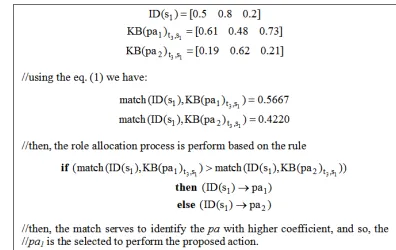
= α = α α − − × = α γ α γFig. 4. Empirical example of a match process.
B. Decision Algorithm
An important criterion for the development of collective actions within real cooperative environments is the traffic of the information available from the perception of the intentions to the execution of them. We have therefore determined a particular decision algorithm of four simple stages.
Stage 1. Refers to the property of a saα to perceive which
sα must manage, therefore, a saαthen knows its goals, tasks, roles (the priority of every item is also perceived) and ID involved in its sα. Hence, the knowledge base of each saα could be achieved.
Stage 2. All the sa (of the entire SA) must organize them to define which will be the order in that they could begin the recruitment of pa to perform the actions within its sα. For thus, the sa must converse among them using the developed dialog (see II.5)
Stage 3. Based on the order obtained above, a saα is approved to starts the communication with the entire PA to determine that pai will be the selected to perform every action. For thus, a saα must obtain the physical knowledge of each paiby means of directly communication with they; the environment conditions and trust value of each pai are obtained when the saα uses the modules aforementioned (respectively for each parameter).
Once a saα completes the
KB
(
pa
i)
of the entire PA, takes such information to perform the match using the equation (1), considering the priority index of all the roles. Then, saα has a list detailed (form higher to lowest coefficient) of the entire PA. After, saα knows that pai must perform that role; therefore, it is able to obligate a determine pai to perform a role which it represent that action must be performed.Hence, the best pai (of the entire PA) will chose to perform the most prior role and so successively until finish with all the roles in such sα. Such process guaranty us a suitable role allocation because the rq always will allocated to the best pai. Indeed, a saα knows how many PA needs because it needs the same amount of PA such as R(sα). Suppose that the system has enough amount of PA to take all the defined roles. To know, every saα is able to exclude a
pai that presents a lowest action capability.
Stage 4. Show-time. A pai knows the rq that must perform. This involves physical changes in the environment. Now, the environment has been modified. So, a new consensus among the SA could be performed to adjust it to the current changes in the environment.
III. IMPLEMENTATION
[image:4.595.365.489.128.220.2]In our implementation, each physical agent has a different movement controller which differentiates from others. Then, we have segmented the scenario into three spatial regions (Fig. 5) to represent each sα.
Fig. 5. Geographic segmentation of the experimental environment.
For sake of simplicity, we only have defined one goal per scene G(s1)=g1; G(s2)=g2 and G(s3)=g3. The consensus to define the execution order of the scenes is derived as follow (Fig. 6).
Fig. 6. Supervisor Agent Consensus.
Where cbp is the current ball position on the environment. So, the spatial regions are limited according to the simulator dimensions (axis x: [0 220]; axis y:[0 180]). Moreover, specific tasks are defined in order to accomplish each gi such that:
}
,t
{t
)
T(g
}
t
,
{t
)
T(g
}
t
,
{t
)
T(g
1=
1 2∧
2=
3 4∧
3=
5 6Where t1 is make-pass, t2 is shooting, t3 is player-on, t4 is kick-ball, t5 is protect-ball and t6 is covering a position.
Following the rule presented for the goals, the tasks also use the cbp as a reference to determine its execution order.
Then, using the ranges above, a saα may decide the task to perform at any time. But, to attempt to achieve such tasks a
saα must define which roles it must perform and the priority order of such roles. Therefore, by means of human analysis we have proposed four roles that could be used to perform any task such that:
} r , r , r , r )
R(tγ ={1 2 3 4
Where r1 is go to the ball, r2 is kick the ball, r3 is cover a zone and r4 is take a position to be used in each tγ.
[image:4.595.368.484.678.779.2]In addition, we have performed a combination with the information involved in the environment-based knowledge. Such combination is used by saα to perform the match process considering the aforementioned parameters. Then, a binary combination lets us generate eight influence degrees (Table I).
We present a review to show how we have implemented these parameters in the robot soccer testbed.
Interaction here called Trust TV represents the social relationship among agents taking into account the result of past interactions of a saα with a pai. Equation (2) shows the
trust calculation if the aim is reached. Otherwise, using (3) shows the trust calculation if the aim is not reached.
) 2 ( ) , s ( A ) pa ( tv ) pa (
tvtγ,sα i = tγ,sα i +Δ α σ ) 3 ( ) , s ( P ) pa ( tv ) pa (
tvtγ,sα i = tγ,sα i −Δ α ω
Where the tvtγ,sα(pai)∈[0,1] and higher )
pa ( tvt,s i
α
γ represent the best pai to perform tγ in sα,
)
,
s
(
A
σ
Δ
α andΔ
P
(
s
α,
ω
)
are the awards and punishmentsgiven in sα respectively and σ is from 1 to
Q
(
s
α)
and ω is from 1 toQ
'
(
s
α)
; that are the number of awards and punishments in sα.Awareness here called Physical Knowledge PK represents the knowledge of the agents about their physical capabilities to perform any proposed task. In particular, the introspection process is performed by using neural networks taking into account the knowledge that a pai has related to perform tγin
sα. Consider that a highPKtγ,sα(pai)∈[0,1]by representing a
suitable pai.
World here called Environmental Conditions EC is a value related to the distance between the current location of a pai and the location of the ball. Equation (4) shows the calculation:
) 4 ( ] 1 , 0 [ ) pa ( ec )) s max( d / )) s , t ( r , pa ( d 1 ( ) pa (
ectγ,sα i = − i γ α α tγ,sα i ∈
Where ect ,s (pai)
α
γ is the value of a pai to perform a tγ in sα;
)) s , t ( r , pa (
d i γ α is the distance between the pai with
) s , t (
r γ α and
d
max(
s
α)
is the maximal distance of all pa insα. Then, equation (5) shows the
d
max(
s
α)
calculation where m is the total number of pa in IAS.) 5 ( ] 1 , 0 [ max d )) s , m ( d ),..., s , 1 ( d max( ) s max(
d α = α α ∈
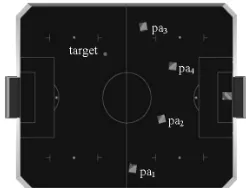
[image:5.595.311.543.138.326.2]In order to show how our approach performs the role allocation process we present a possible situation (Fig. 7 where the ball is within the s2 and we use all the influence degrees generated to perform the pa selection. Then, we only showed the allocation for one action (kick the ball).
Fig. 7. Possible situation for the PA in the environment.
In (Table II) we present the values of a pairegarding to the proposed action. In (Table III) we show the match values obtained by means of the equation (1). Then, is possible to see will be the pai selected by the sa2 to perform the proposed action. Additionally, the remained physical agents follow a fix strategy which was defined to consider actions to the entire PA.
TABLE II. PHYSICAL AGENTS’KNOWLEDGE BASES
TABLE III.SOME EXAMPLES OF PHYSICAL AGENT SELECTION
IV. RESULTS AND CONCLUSIONS
We ran two experimental evaluations to validate the proposed approach. In particular, in the experiments our IAS uses all the binary combination of the ID to perform the match process. In Exp. 1, our IAS competed against a blind opponent in 30 games. Here, the IAS performance is improved when all the parameters are considered. So, IAS(ID7) shows a better average (improvement rate: +81% better) than IAS(ID0) (any parameter considered). Then, in the Exp. 2, a league of 28 games was performed to confront the IAS among them. So, the IAS performance increases when uses jointly all the parameters. In fact, the IAS(ID7) shows a better average (improvement rate: +92%) than IAS(ID0).
As conclusions we argue the need of agent meta-coordination to exploit the advantages of abstract the environment knowledge (by the supervisor agents) and use it to influence the reasoning process of the physical agents. In addition, a combination (named Influence Degree) describes the consideration among these parameters giving to the saα the ability to determine a decision process to
perform a match between the scene requirements and the physical agent capabilities. In fact, the best performance is obtained when our team agent took into account all the parameters in its decision process.
[image:5.595.105.228.634.728.2]TABLE IV.OUR APPROACH VS OTHER APPROACHES
REFERENCES
[1] S. Ibarra, C. Quintero, J. A.Ramon, J. Ll de la Rosa and J. Castán, PAULA: Multi-agent Architecture for Coordination to Intelligent Agent Systems, Proc. In. European Control Conference (ECC’07), Kos, Greece 2-5 July, 2007. [2] D. Jung and A. Zelinsky, An Architecture for Distributed Cooperative-Planning
in a Behaviour-based Multi-robot System, Journal of Robotics & Autonomous Systems (RA&S), special issue on Field & Service Robotics, vol 26, 1999, pp. 149-174.
[3] M. Esteva, J.A. Rodríguez, C. Sierra, J.L. Arcos, On the Formal Specification of Electronic Institutions, In. Agent Mediated Electronic Commerce, The European AgentLink Perspective, Spring-Verlag, 2001, pp. 126-147
[4] A. Oller, DPA2: Architecture for Co-operative Dynamical Physical Agents, Dept. d’Enginyeria Electrica, Electronica i Automatica, Universitat Rovira I Virgil, Lecture Notes in Computer Science.
[5] C.G. Quintero, J.Ll. de la Rosa, J. Vehí, Physical Intelligent Agents’ Capabilities Management for Sure Commitments in a Collaborative World, Frontier in Artificial Intelligence and Applications, IOS Press, ISBN I 58603 466 9, ISSN 0922-6389, 2004, pp. 251-258.
[6] C.G. Quinero, J. Zubelzu, J.A. Ramon, J. Ll. de la Rosa, Improving the Decision Making Structure about Commitments among Physical Intelligent Agents in a Collaborative World, In. Proc. of V Workshop on Physical Agents, ISBN 84-933619-6-8, Girona, Spain, 2004, pp. 219-223.
[7] C.G. Quintero, J. Ll. de la Rosa, J. Vehí, Self-knowledge based on the Atomic Capabilities Concept. A Perspective to Achieve Sure Commitments among Physical Agents, 2nd International Conference on Informatics in Control Automation and Robotics, Barcelona, Spain, 2005.
[8] R. S. Aylett and D. P. Barnes, A Multi-robot Architecture for Planetary Rovers, Centre for Virtual Environments, Departament Electronic & Electrical Engineering, University of Salford.
[9] R. Simmons, T. Smith, M. Bernardine, D. Goldberg, D. Hershberger, A. Stentz, R. Zlot, A Layered Architecture for Coordination of Mobile Robots, Robotics Institute, Carnegie Mellon University, Multi-robot Systems: From Swarms to Intelligent Automata p. Kluwer, 2002.
[10] Langley Pat, An Adaptative Architecture for Physical Agents, IEEE /WIC/ACM International Conference on Intelligent Agent Technology, pp. 18-25, 2005. ISBN: 0-7695-2416-8
[11] Busquets D., López de Màntaras R., Sierra C., Dietterich T.G., A multi-agent architecture integrating learning and fuzzy techniques for landmark-based robot navigation, Lecture Notes In Comp. Science; vol. 2504., Proc. of 5th Catalonian Conference on AI. Topic in Artificial Intelligence. pp. 269-281. 2002 ISBN: 3-540-00011-9
[12] Ibarra S., Quintero C., Ramon J., De la Rosa J. LL. & Castan J., Studies about Multi-agent teamwork Coordination in the Robot Soccer Environment, Proc. In 11th Fira Robot World Congress 2006, pp. 63-67, ISBN:3-00-019061-9. [13] Federation of International Robosoccer Association (FIRA). SimuroSot
simulator available from the web:
http://www.fira.net/soccer/simurosot/overview.html.
[14] B. Duffy, Robots Social Embodiment in Autonomous Mobile Robotics, Int. J. of Advanced Robotic Systems, vol. 1, no. 3, pp. 155-170. ISSN 1729-8806. [15] Russell S. & Norving P., Artificial Intelligence: A Modern Approach, ISBN:
0130803022.
[16] Farinelli A., Iocchi L. and Nardi D., Multirobot Systems: A Classification Focused on Coordination, Int. IEEE Transaction on Systems, Man. And Cybernetics, part B: Cybernetics, vol. 34, no. 5, October 2004.