THEORETICAL STUDY OF THE PERFORMANCES OF AN ABSORPTION REFRIGERATING
MACHINE IN SUB
1, 2
GUIDI Tognon Clotilde,
1, 2ALIHONOU Agnimoan Constant,
2
SEMASSOU Guy Clarence,
4
AGASSOUNON DJIKPO TCHIBOZO Micheline
1Laboratory of Processes and Technological Innovations, National Institute of Industrial Technol
2Laboratory for Energy and Applied Mechanics ( 3Thermic and Energy Lab of Nantes (LTEN), UMR CNRS 6607
4Laboratory of Standards and Microbiological, Nutritional and Pharmacological Quality Control (LNCQMNP), Faculty of Science and Technology (FAST), University of Abomey
ARTICLE INFO ABSTRACT
The cooling for air conditioning or foodstuff refrigeration is ensured in most cases with compression refrigeration machines which are high electrical energy consumers. They are responsible of much greenhouse effects, e
(HCFCs), or certain hydro
warming capacities. A promising alternative to these systems is the use of absorption refrigeration
the use of refrigerants with quite low global warming potential as water, or ammonia which are natural refrigerants.
technology more competitive and eco absorption machine using the water Beninese climatic
device on the coefficient of performance (COP) were
performance have also been determined. The results showed that the efficiency recovery heat exchanger and the temperatures
impact on the COP. The numerical study also made it possible to determine the temperature ranges for which the absorption machine may pr
Copyright©2019, GUIDI Tognon Clotilde et al. This unrestricted use, distribution, and reproduction in any medium,
INTRODUCTION
Active cooling and comfort control in buildings have long been considered a luxury in certain regions of the world. The refrigerating machines used for this purpose are mainly mechanical compression which requires a significant expenditure of electrical energy. Moreover, these machines generally use refrigerants for their operation, a number of which contributes to the depletion of the ozone layer, and the majority participates to global warming (Fan
Rabah Touaibi et al., 2012; Srikhirin
Chégnimonhan et al., 2010). Considering the adverse effects
on environmental of mechanical compression moved air conditioning systems and their high consumption of electrical energy, research and adoption of more environmentally friendly and sustainable alternatives become a priority. This includes the use of refrigerants that are more
ISSN: 0975-833X
Article History: Received 28th April, 2019
Received in revised form 19th May, 2019
Accepted 07th June, 2019
Published online 31st July, 2019
Citation: GUIDI Tognon Clotilde, ALIHONOU Agnimoan Constant, CHEGNIMONHAN K. Victorin of an absorption refrigerating machine in sub-sahelian
Key Words:
Air conditioning, Refrigeration, Solar absorption,
Coefficient of performance, Energy analysis.
*Corresponding author:
CHEGNIMONHAN K. Victorin
RESEARCH ARTICLE
THEORETICAL STUDY OF THE PERFORMANCES OF AN ABSORPTION REFRIGERATING
MACHINE IN SUB-SAHELIAN CLIMATIC CONDITIONS
ALIHONOU Agnimoan Constant,
1, 3, *CHEGNIMONHAN K. Victorin,
SEMASSOU Guy Clarence,
2SANYA A. Emile,
2DEGAN Gérard
AGASSOUNON DJIKPO TCHIBOZO Micheline
Laboratory of Processes and Technological Innovations, National Institute of Industrial Technol Lokossa, BP: 133 RB, Lokossa, Benin
Laboratory for Energy and Applied Mechanics (LEMA/UAC), University of Abomey
Thermic and Energy Lab of Nantes (LTEN), UMR CNRS 6607 – rue Christian Pauc, 44300 Nantes, France d Microbiological, Nutritional and Pharmacological Quality Control (LNCQMNP), Faculty of Science and Technology (FAST), University of Abomey-Calavi (UAC), 01BP: 1636 RP, Cotonou, Benin
ABSTRACT
The cooling for air conditioning or foodstuff refrigeration is ensured in most cases with compression refrigeration machines which are high electrical energy consumers. They are responsible of much greenhouse effects, especially when chlorofluorocarbons (CFCs), hydro
(HCFCs), or certain hydro fluorocarbons (HFCs) are involved as refrigerants due to their high global warming capacities. A promising alternative to these systems is the use of absorption refrigeration machines. Indeed, these equipments provide a very low power consumption and allow the use of refrigerants with quite low global warming potential as water, or ammonia which are natural refrigerants. In tropical countries, solar energy can be associated for heat supply making the technology more competitive and eco-friendly. In this paper a focus was made in the modelling of an absorption machine using the water-lithium bromide (LiBr-H2O) binary mixture withinsouthern Beninese climatic conditions. The effect of the operating temperatures of the main elements of the device on the coefficient of performance (COP) were analysed. The
performance have also been determined. The results showed that the efficiency
recovery heat exchanger and the temperatures (at the heater and the evaporator) have a significant impact on the COP. The numerical study also made it possible to determine the temperature ranges for which the absorption machine may provide good performances in tropical environments.
This is an open access article distributed under the Creative Commons medium, provided the original work is properly cited.
Active cooling and comfort control in buildings have long regions of the world. The refrigerating machines used for this purpose are mainly mechanical compression which requires a significant expenditure of electrical energy. Moreover, these machines generally use refrigerants for their operation, a number of ch contributes to the depletion of the ozone layer, and the Fan et al., 2007;
Srikhirin et al., 2001;
. Considering the adverse effects nical compression moved air conditioning systems and their high consumption of electrical energy, research and adoption of more environmentally friendly and sustainable alternatives become a priority. This environmentally
friendly with noimpact on the ozone layer and that have a negligible greenhouse effect. Scientific and technological investigations are of increasing interest in the development of absorption refrigeration machines whose main advantages are
(Kherris et al., 2008):
Low power consumption;
The possibility of using "decarbonised" energies at the
heater by using solar energy or waste heat recovery;
The adaptation of these equipments in hostile or
isolated environments because of the diversity of energy sources allowing its operation (solar, wood, hydrocarbons, ...);
The simplicity of operation and the robustness of this
equipment;
Longevity, reliability and acoustic comfort related to
the rarefaction of moving parts.
International Journal of Current Research Vol. 11, Issue, 07, pp.5847-5853, July, 2019
DOI: https://doi.org/10.24941/ijcr.36096.07.2019
GUIDI Tognon Clotilde, ALIHONOU Agnimoan Constant, CHEGNIMONHAN K. Victorin et al., 2019. “Theoretical study of the performances sahelian climatic conditions”, International Journal of Current Research, 11, (0
THEORETICAL STUDY OF THE PERFORMANCES OF AN ABSORPTION REFRIGERATING
SAHELIAN CLIMATIC CONDITIONS
CHEGNIMONHAN K. Victorin,
DEGAN Gérard and
Laboratory of Processes and Technological Innovations, National Institute of Industrial Technology (INSTI) of
LEMA/UAC), University of Abomey
tian Pauc, 44300 Nantes, France d Microbiological, Nutritional and Pharmacological Quality Control (LNCQMNP), Faculty of
Calavi (UAC), 01BP: 1636 RP, Cotonou, Benin
The cooling for air conditioning or foodstuff refrigeration is ensured in most cases with compression refrigeration machines which are high electrical energy consumers. They are responsible of much specially when chlorofluorocarbons (CFCs), hydro chlorofluorocarbons fluorocarbons (HFCs) are involved as refrigerants due to their high global warming capacities. A promising alternative to these systems is the use of absorption type very low power consumption and allow the use of refrigerants with quite low global warming potential as water, or ammonia which are n be associated for heat supply making the In this paper a focus was made in the modelling of an H2O) binary mixture withinsouthern conditions. The effect of the operating temperatures of the main elements of the analysed. The parameters that ensure optimum performance have also been determined. The results showed that the efficiency of the internal heat (at the heater and the evaporator) have a significant impact on the COP. The numerical study also made it possible to determine the temperature ranges
ovide good performances in tropical environments.
Commons Attribution License, which permits
friendly with noimpact on the ozone layer and that have a negligible greenhouse effect. Scientific and technological investigations are of increasing interest in the development of absorption refrigeration machines whose main advantages are
power consumption;
possibility of using "decarbonised" energies at the heater by using solar energy or waste heat recovery;
adaptation of these equipments in hostile or isolated environments because of the diversity of the energy sources allowing its operation (solar, wood,
simplicity of operation and the robustness of this
Longevity, reliability and acoustic comfort related to the rarefaction of moving parts.
INTERNATIONAL JOURNAL OF CURRENT RESEARCH
In sunny areas, absorption refrigeration systems can use the sun energy at the heater to generate refrigerant vapour, which constitutes a very attractive sustainable solution. In addition, the demand for cooling is in line with the period when the solar radiation is the most intense, thus increasing the interest to move towards the use of absorption refrigeration systems.
Bibliographic studies
Romero et al. (2001) theoretically compared the performance
of a reversible absorption heat pump system for two mixtures
of fluid (LiBr-H2O) and (potassium, sodium and cesium
hydroxide). The results obtained showed that the coefficient of performance is similar for the two mixtures. However, the mixture of potassium hydroxide, sodium and cesium) allows the equipment to operate with a wide temperature range of the
condenser and absorber. Saravanan et al. (1998) achieved a
numerical simulation of a vapour absorption cycle that uses water as the refrigerant associated with 16 different
combinations of absorbent. The results revealed that the H2
O-LiCl mixture is preferable from the point of view of threshold
temperature and circulation rate, while the (H2O-LiBr + LiCl +
ZnCl2) mixture is better considering the coefficient of
performance of the system. Florides et al. (2002) constructed a
single-acting absorption machine operating with water-lithium
bromide (LiBr-H2O). They presented a method of evaluating
the performance of the machine. The calculated theoretical values were compared with the experimental results for a small absorption machine with a nominal capacity of 1 kW. The results showed that the heat recovery between rich and poor solutions significantly increases the efficiency of the machine.
Nizar et al. (2004) dynamically simulated two double-acting
absorption machines of different internal configurations (parallel and series generators) with a power of 17.5 kW. The results showed that the dual-effect absorption device with internal configuration of a parallel heat generator (heater) is more efficient than that with a generator in series. This paper deals with the parametric study of the performances of an absorption machine operating with the water-lithium bromide
pair (LiBr-H2O). The purpose is to determine the parameter
ranges for optimal operation in warm tropical areas.
MATERIALS AND METHODS
Description of the thermodynamic cycle of an absorption
machine: The solar absorption machine chosen for the
simulation is a single-acting one, operating with Lithium
Water-Bromide (LiBr-H2O). The schematic flow diagram is
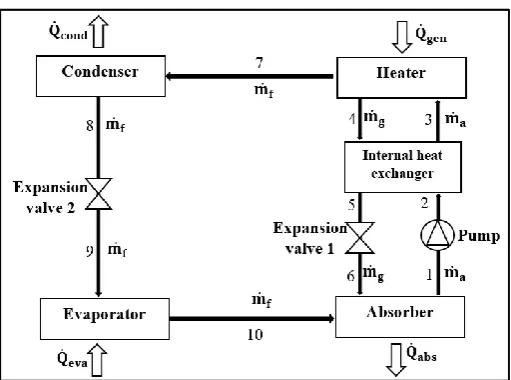
shown in Figure 1. The refrigerant (water) evaporates while removing heat from the medium to be cooled (air conditioned rooms). Water vapour is sprayed (10) on lithium bromide being absorbed this way. This phenomenon is exothermic. The fluid leaving the absorber is a ‘rich’ water-lithium bromide solution (1). This rich solution is then pumped (2) through a heat recovery unit (3) to the heater (vapour generator).In the
generator, the water-lithium bromide solution (LiBr-H2O) is
[image:2.595.307.563.50.240.2]heated and boiled by the means of an external heat source to release the refrigerant vapour (7). Thus, a concentrated bromide solution poor in refrigerant (water) is obtained (4). The poor solution returns to the absorber in the form of a spray (6), flowing through the heat exchanger and an expansion valve. The refrigerant vapour leaving the generator (heater) is liquefied in the condenser (8), then flows to the evaporator through the expansion valve (9).
Figure 1. Schematic flow diagram of an absorption machine
Method
To reach the goal of performing the parameter ranges for optimal operation, the mathematical model of the absorption machine was done and the different results were obtained from the equation resolution of the model developed under the Matlab / Simulink software. The result obtained made it possible to analyse and study the influence of various parameters on the efficiency of the system and on the performance of each component of the machine. To study the influence of a parameter, the latter was varied from a predefined reference state while keeping the other parameters constant. After establishing the energy balance of the system, the comparison of the results of the simulation with data collected in the literature was made. Then the influence of the temperatures of the various components of the absorption machine (generator, condenser, absorber, evaporator, heat exchanger) on the operation of the system was analysed.
Theoretical analysis
Simplifying hypotheses
In the study, the following assumptions were considered:
The pressure losses are negligible and the expansions
are isenthalpic;
Variations in kinetic energy and potential energy are not
considered;
The system is adiabatic (without loss or thermal gains)
and operates in a stationary dynamic regime;
The temperature (Te) at the evaporator varies
depending on the load conditions but remains above 0 ° C;
The temperature (Tg) at the generator depends on the
heat source available;
The vapour leaving the generator (7) and which
liquefies in the condenser exits in sub-cooled liquid (8). The liquid then undergoes a ‘rolling’ in the pressure reducing valve inducing a pressure drop (9) and reaches the evaporator where under the effect of the heat of the medium to cool, evaporates and leaves in (10) in the vapour state. From point (7) to point (10), the fluid is pure water. As a result, the concentration of lithium bromide in this segment is zero. Only the concentrations of lithium bromide in the solution
Mass balance
At the absorber, two mass balance equations can be written:
ṁ + ṁ + ṁ = 0 ( mass balance on the solution)
ṁ . x − ṁ . x = 0 (mass balance onLibr) (1)
Circulation rate of the solution (F): The circulation ratio (F)
can be defined as the ratio of the mass flow rate of the solution through the pump to the mass flow rate of the working fluid (Omer Kaynakli and Recep Yamankaradeniz, 2007). The ratio is expressed in terms of concentrations as follows:
F = ̇
̇ (2)
F = (3)
Where:
xc is the weight concentration of the Libr solution leaving the
generator toward the absorber and xd is weight concentration
of the rich binary mixture leaving the absorber to reach the heater.
An expression of ṁ and ṁ as a function of ṁ and the
different refrigerant mass fractions can be deduced as follows:
⎩ ⎪ ⎪ ⎨ ⎪ ⎪
⎧ ṁ = ̇
h − h
ṁ = ṁ . x
(x − x )
ṁ = ṁ . x
(x − x )
(4)
Saturated vapour pressure: The saturation vapour pressure of
the water at the inlet and outlet points of the machine components can be determined by the Rankine formula
(Richard Taillet et al., 2009):
P = exp( , ) (5)
With Psat: saturation vapour pressure of water, expressed in
atmosphere, T is the absolute temperature in K.
Enthalpy: The relation between enthalpy h, temperature T and
concentration x is given by (Lansing, 1976):
h(T, x) = a x + a x + a x + (b x + b x + b x )T (6)
ai and bi (i=0, 1, 2) coefficients are defined in table 1
Table 1. Values of ai, bi coefficients
i ai bi
0 42,81 1,01 1 -425,92 -1,23 2 404,67 0,48
Enthalpy balances: Applying the energy balance to each
component interacting with the external environment leads to:
Q̇ + Q̇ = Q̇ + Q̇ é +Ẇ (7)
Enthalpy balance at the condenser: At the outlet of the
condenser, the refrigerant becomes liquid and the energy balance gives:
Q̇ = ṁ (h − h ) (8)
Enthalpy balance at the evaporator: The energy balance at the
evaporator writes:
Q̇ = ṁ (h − h ) (9)
Heat balance at the heater: The refrigerant is separated from
the solution due to the energy supply at the heater by an external heat source. From Equations 3, 4 and 7, the heat balance at the heater (water vapour generator) is formulated:
Q̇ = Q̇ + Q̇ − Q̇ − Ẇ (10)
Q̇ = ṁ ( . + h − h + h − F. h ) (11)
Heat balance at the absorber: Through the absorber the
solution toward the generator becomes rich in refrigerant. The heat balance gives:
Q̇ = ṁ h + ṁ h − ṁ h (12)
Power of the solution pump: The pump transports the solution
concentrated in refrigerant (rich solution) to the high pressure heater. The pump is one the rare organ needing electrical power with absorption machines. The power consumed is obtained via the energy balance:
Ẇ = ṁ (h − h ) (13)
Coefficients of Performance (COP): From the previous
equations, the coefficient of performance COP can be deduced (Feidt, 1996; Gomri, 2010):
COP = ̇ ̇ ̇ (14)
COP = ̇ ̇ ̇ ( ̇ )̇ (
) (15)
Relative coefficient of performance (COPratio): The relative
coefficient of performance (or Carnot efficiency) is the ratio of the coefficient of performance COP on the maximum
coefficient of performance COP of the system obtained for
the reversible Carnot cycle (Lansing et al., 1976):
COP = ( )
( ) (17)
RESULTS AND DISCUSSION
In general, numerical simulation permit to model, analyse and predict the behaviour of systems with accurate precision. In order to simulate the behaviour of the lithium-bromide
(LiBr-H2O) single-effect absorption machine, the above formulated
equations are implemented using the Matlab software.
Validation of the results: Figures 2 and 3 show a comparison
solution (LiBr-H2O) with those presented by Romero et al.
(2001), Saravanan et al. (1998) and Boutina et al. (2012). The
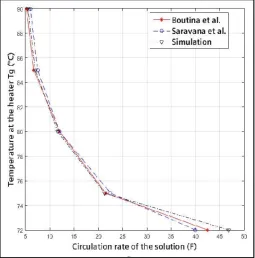
rate of circulation of the aqueous solution in the machine decreases with the increasing temperature at the heater. There is indeed a better degassing of the refrigerant contained in thesolution. The relative errors between the results of the
simulation and those of Saravana et al. (2001), and Boutina et
al. (2012) are respectively of 3% and 2%. The evolution of the
coefficient of performance (COP) as a function of the temperature of the heat generator Tg is presented in Figure 3. The coefficient of performance increases with the temperature Tg. The maximum coefficient of performance of the machine (0.7) is reached at the temperature Tg = 80 ° C and remains constant till Tg = 90 ° C. This makes it possible to choose an efficient operating temperature range between these two values. The relative errors between the simulation and the
results by Romero et al. (1996) and Boutina et al. are
respectively of 1% and 2% (Boutina et al., 2012). Figures 4
and 5 illustrate the influences of the efficiency of the heat exchanger (Eff) and the temperature of the generator (Tg) on the coefficient of performance of the machine. A high efficiency of the heat exchanger induces a high inlet temperature of the solution at the heater. Thus, an efficient heat exchanger provides better machine performance, as less energy input is needed to produce the necessary refrigerant vapour
flow ̇ . It can also be noted that for a temperature Tg higher
[image:4.595.306.563.50.262.2]than 80°C, a better COP is obtained (with a value higher than 0.7). Thus a clear improvement of the COP appears with the rise of the evaporation temperature Te, especially for the values of Te greater than 6°C.
Figure 2. Variation of the heater temperature (Tg) vs. the circulation rate F, (Ta=35°C, Tc=35°C, Te=5°C and Eff= 0%.)
Influence of condensation (Tc) and absorption (Ta) temperatures on the coefficient of performance (COP):
Figures 6 and 7 show the variation of the coefficient of performance COP as a function of the temperature of the condenser Tc and the absorber Ta for increasing values of the heating temperature Tg. There is an improvement (Figure 6) of the COP for all Tg values above 80°C.
Figure 3. Variation of the coefficient of performance COP in terms of the temperature at the heater Tg, comparison with literature results (Ta=35°C, Tc=35°C, Te=2°C and Eff= 0%)
Figure 4. Coefficient of performance COP vs. Temperature of heater Tg, for several values of Eff (Ta=38°C, Tc=42°C, Te=7°C)
[image:4.595.306.562.313.520.2] [image:4.595.38.294.413.672.2]Figure 6: Coefficient of performance COP vs. Temperature of condensation Tc, for several of several temperatures at the heater (Ta=38°C, Tc=42°C)
Figure 7. Coefficient of performance (COP) vs. temperature of absorption (Ta), for several values of Tg( Tc=38°C and Te=7°C)
Figure 8. Variationsof COP, COPratio, COPmax in terms of heater temperatureTg(for Ta=38°C,Tc=42°C, Te=7°C, Eff=0.8)
From theresults, an optimum condensing temperature range of between 38° and 42 ° C can be deduced. On Figure 7, the COP is greater than 0.7 when the temperature of the absorber is between 30 and 36°C, for all the values of Tg tested. Thus the suitable operating temperature of the absorber is located between 30° and 36 ° C.
Influence of the generator (Tg) and evaporator (Te)
temperature on the coefficients of performances: An
improvement of the coefficient of performance COP obtained with the increase of the generator temperature up to Tg = 90 ° C, in the same conditions, the coefficient of performance COP remains stable at the value of 0.79 (Figure 8).The increase of the relative coefficient of performance COP ratio with a generator temperature up to Tg = 82 ° C. For values of Tg> 82 ° C, the relative coefficient of performance COP ratio decreases. The maximum coefficient of performance COP max increases with the temperature of the generator Tg.
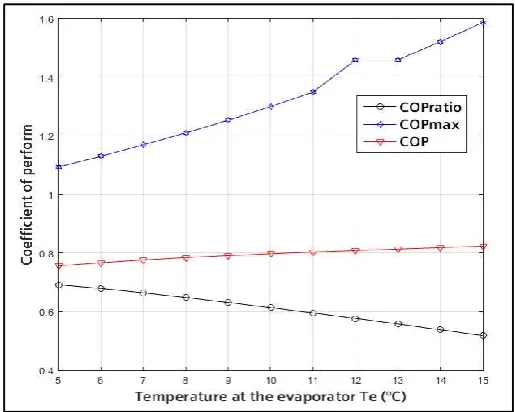
Figure 9 shows:
- A marked improvement of the coefficient of
performance COP and the maximum coefficient of performance COP max with the increase of the evaporation temperature Te;
- A decrease in the coefficient of relative performance
COP ratio with the increase of the evaporation temperature Te.
Influence of Absorber (Ta) and Condenser (Tc) Temperatur on the COP, the COP and the Maximum
Coefficient of Performance (COP max): Figures 10 and 11
show the variation of the coefficient of performance COP, the relative coefficient of performance COP ratio and the maximum coefficient of performance COP max of the machine as a function of the temperature at the absorber Ta and the condenser Tc. The coefficient of performance COP and the maximum coefficient of performance COP max decrease with the rise of temperature at the absorber (Figure 10). This is normal since the absorber device has to be cooled for the
proper absorption of water by lithium bromide;
the relative coefficient of performance COP ratio increases proportionally with the temperature at the absorber up to Ta=46°C.
[image:5.595.35.293.52.274.2] [image:5.595.37.293.322.530.2] [image:5.595.305.563.561.767.2] [image:5.595.38.293.569.776.2]Figure 10. Variations of COP, COP ratio, COP max in terms of the absorber temperature Ta (for Te=7°C,Tc=40°C, Tg=90°C, Eff=0.8)
Figure 11. Variations of COP, COPratio, COP max in terms of the condensation temperature Tc (for Te=7°C,Tc=40°C, Tg=90°C, Eff=0.8)
Figure 12. Heat capacities of the main elements of the absorption machine as a function of the temperatures at the heater Tg (for Eff = 0.8).
Figure 11 shows a decrease in the coefficient of performance COP and the maximum coefficient of performance COP max with the increase of the condensation temperature Tc. There is a quasi linear growth of the relative coefficient of performance COP ratio with the condensing temperature Tc up to 46 ° C.
Influence of the generator temperature (Tg) on the heat flux at the main elements of the machine (heater,
condenser, absorber, evaporator): Figure 12 shows the
variation of the heat capacity of the main components as a function of the heater temperature Tg. The increase of the temperature of the heater Tg produces a growth of the thermal
capacity of the heater Q̇ , the condenser Q̇ , the
absorber Q̇ , while thecooling capacity of the evaporatorQ̇
remains constant.
Conclusion
Through this work, the influences of generator, condenser and evaporator temperatures as well as the effect of heat exchanger efficiency on system performance were studied. The deduced operating temperature ranges for the lithium bromide-water single-acting absorption-type machine are (80 ° C <Tg<90 ° C, 38 ° C <Tc<42 ° C, 30 ° C <Ta <36 ° C and Te> 6 ° C). The efficiency of the heat exchanger, the temperatures at the generator and at the evaporator have an important impact on the operation of the machine. Increasing the efficiency of the heat exchanger significantly increases the coefficient of performance COP of the machine.
Conflict of interest statement: The Authors declare that there
is no conflict of interest.
Funding: The Authors declare that there were nofunding.
REFERENCES
Boutina Lyes, Abdelhamid. Boualit, Abdelaziz. Benkhelifaet Toufik. Chergui, 2012, Simulation numérique d'un cycle à
absorption solaire (LiBr/H2O), 2ème Séminaire
International sur les Energies Nouvelles et Renouvelables, Ghardaïa-Algérie.In French.
Chégnimonhan V., C. Josset, H. Peerhossaini, 2010, "Ice slurry crystallization based on kinetic phase-change modeling",
International Journal of Refrigeration, Volume 33, Issue 8, December 2010, Pages 1559-1568.
Fan Y., L. Luo, B. Souyri, 2007, Review of solar sorption refrigeration technologies: Development and applications,
Renewable and Sustainable Energy Reviews, 11 pp1758– 1775.
Feidt M., Thermodynamique et optimisation énergétique des systèmes et procédés, Tec & Doc, 2e Edition, 1996.In French.
Florides G.A., Kalogirou S.A., Tassou S.A., Wrobel L.C., 2002, Design and construction of a LiBr–water absorption machine.
Gomri R., 2010, Investigation of the potential of application of single effect and multiple effect absorption cooling systems, Energy Conversion and Management 51 1629– 1636.
[image:6.595.37.292.571.767.2]Lansing F.L., 1976, “Computer modeling of a single stage lithium bromide/water absorption refrigeration unit,” JetPropuls. Lab. Calif.Inst. Technol. Pasadena CA Deep Space Netw. Prog. Rep., no. 42-32, pp. 247–257.
Nizar Ben Ezzine, KhalifaMejbri, MessaoudBarhoumi, Ahmed Bellagi, 2004, Thermodynamic Simulation of Ammonia-Water Double Effect Absorption Chiller.
Omer Kaynakli and RecepYamankaradeniz, 2007,
Thermodynamic analysis of absorption refrigeration system
based on entropy generation, Current Science, vol. 92, n°.
4, pp 472-479.
Rabah Touaibi, Elena Eugenia Vasilescu, Michel Feidt, Abdelhamid Kheiri, Miloud Tahar Abbes, Benyoucef Khelidj, 2012, Etude paramétrique d’un système de réfrigération par absorption à simple effet utilisant le couple Eau –Bromure de lithium. In French.
Richard Taillet, Pascal Febre et Loïc Villain, 2009, Dictionnaire de physique, 754p. In French.
Romero R.J., Rivera W., Garacia J. and Best R., 2001. “Theoretical comparison of performance of an absorption heat pump system for cooling and heating operating with an aqueous ternary hydroxide and water/lithium bromide”,
Applied Thermal Engineering, Vol. 21, pp. 1137-1147. Saravanan R. and M.P. Maiya, 1998, “Thermodynamic
comparison of water – based working fluid combinations
for a vapour absorption refrigeration system”, Applied
Thermal Engineering, Vol.18, pp. 553-568.
Srikhirin P., S. Aphornratana, S. Chung Paibulpatana, 2001. A
review of absorption refrigeration technologies, Renewable
and Sustainable Energy Reviews, 5 pp 343–372.