ISSN Print: 2327-5952
DOI: 10.4236/jss.2019.77010 Jul. 19, 2019 99 Open Journal of Social Sciences
The Impact of Family Supportive Supervisor
Behavior on Employee’s Proactive Behavior:
A Study of a Moderated Mediating Effect
Panting Chen
School of Management, Jinan University, Guangzhou, China
Abstract
Based on the theory of social exchange, this study attempts to probe the me-chanism of the impact of the family supportive supervisor behavior on em-ployee’s proactive behavior, especially to explore the mediating role of the af-fective commitment and the moderating role of the power distance in Chi-nese organizational context. After analyzing the samples collected from 305 employees, we found that: family supportive supervisor behavior has a signif-icantly positive effect on employee’s proactive behavior; affective commit-ment plays a partial mediating role between family supportive supervisor be-havior and employee’s proactive bebe-havior; meanwhile, power distance mod-erates the relationship between family supported supervisory behavior and affective commitment, and further moderates the indirect relationship be-tween family supported supervisory behavior and employee’s proactive beha-vior through affective commitment. That is, the lower the employees’ power distance is, the stronger the mediating effect of affective commitment be-comes.
Keywords
Family Supportive Supervisor Behavior, Employee’s Proactive Behavior, Affective Commitment, Power Distance, Social Exchange Theory
1. Introduction
As the nature of work is continuously evolving, so too are work and family lives becoming increasingly intertwined, creating strain for employees trying to func-tion successfully in both domains. Most employees struggle between work and family responsibilities, and the resulting great pressure has some negative effects
How to cite this paper: Chen, P.T. (2019) The Impact of Family Supportive Supervi-sor Behavior on Employee’s Proactive Be-havior: A Study of a Moderated Mediating Effect. Open Journal of Social Sciences, 7, 99-113.
https://doi.org/10.4236/jss.2019.77010
Received: June 7, 2019 Accepted: July 16, 2019 Published: July 19, 2019
Copyright © 2019 by author(s) and Scientific Research Publishing Inc. This work is licensed under the Creative Commons Attribution International License (CC BY 4.0).
DOI: 10.4236/jss.2019.77010 100 Open Journal of Social Sciences
on their work, including decreased task performance, reduced spontaneity that is beneficial to the organization, and reduced job satisfaction [1] [2]. To solve this problem, organizations have gone to great lengths to assist employees in al-leviating the distress caused by work-family conflict, such as providing fami-ly-friendly benefits [3]. Yet, research shows that the effects of such benefits, al-beit well intended, tend to be quite marginal when they are not accompanied by informal family support from supervisors. In recent years, the key role of super-visors in helping employees cope with work and family demands has attracted more and more attention from scholars [4]. Family supportive supervisor beha-vior (FSSB), as an informal organizational support, is the supportive behabeha-vior of supervisors to employees’ families [5], which aims to help employees better ful-fill their responsibilities of work and family and improve the relationship be-tween work and family [6]. Previous studies have shown that FSSB has a positive impact on employees’ work attitude and behavior, and some scholars also call for strengthening the link between FSSB and work-related results in the future
[7].
beha-DOI: 10.4236/jss.2019.77010 101 Open Journal of Social Sciences
viors [11], affective commitment is likely to play an intermediary role in the re-lationship between FSSB and employees’ Proactive behaviors. However, the per-formance of leadership is often related to its situational characteristics. Different power distance may lead to different sensitivity of employees to FSSB. Therefore, this study will further examine its moderating effect between FSSB and em-ployees’ proactive behaviors in the workplace. The research model of this paper is shown in Figure 1.
2. Theoretical Development and Hypotheses
2.1. FSSB and Employee’s Proactive Behavior
Proactive behavior refers to the behavior of an employee who spontaneously changes the situation (introduces new working methods, influences organiza-tional strategies) and/or changes himself/herself (learns new skills to cope with future work demands), emphasizing future orientation and change orientation
[12]. For example, employees offer Suggestions to the organization, actively seek ways to improve their work, and solve problems with foresight are the main ma-nifestations of proactive behaviors. There are many factors that affect employees’ Proactive behaviors. Leadership behavior, as an important situational variable, plays an important role in predicting employees’ Proactive behaviors [13].
Firstly, family support supervisors take the initiative to care about employees’ family life, respect and understand employees, and provide supportive resources and services to help employees fulfill their work and family responsibilities when needed. This is an important and attractive resource for employees. According to social exchange theory, one party provides something of great value to the other party, which will prompt the other party to give back [14]. The supervi-sor’s enactment of family-supportive behaviors, a valued resource, acts as a ser-vice resource and leads to a response from the employee. However, resources are not exchanged randomly; a resource exchanged in one direction is likely to be reciprocated via a resource that is of the same resource type [15]. Based on Wil-son etal.’s resource categorization [16], FSSB is a service resource that will likely be exchanged for another service resource (e.g., task and non-task performance). Moreover, given family-supportive supervisors provide support beyond task performance (e.g., help managing competing priorities, flexible hours), FSSB is likely seen as an extra-role service resource such that it is beyond the normal job requirements of a leader. Therefore, when reciprocating, employees will likely (potentially unconsciously) choose a similar extra-role behavior beyond their day-to-day task performance. That is, employees respond to the “above and
Figure 1. Hypothesized model. Power distance
DOI: 10.4236/jss.2019.77010 102 Open Journal of Social Sciences
beyond” leader with “above and beyond” behavior [17]. Secondly, a study by Chalofsky found that there is a relationship between work-life fit and meaning-fulness, suggesting that the better work and life merge, the more employees ex-perience meaningfulness at work [18]. FSSB provides employees with sufficient time flexibility to manage their work and family needs, so that employees can ensure the completion of work tasks and the realization of organizational goals while fulfilling their family roles. Such a working environment will enhance em-ployees’ sense of work self-efficacy and make them realize the value and signi-ficance of work, so as to stimulate employees’ strong sense of identity to their own jobs and organizations and to stimulate their intrinsic motivation to work more actively. Thirdly, Ahmadi and Mirsepassi put forward the “performance transfer” effect in their study, that is, when subordinates perceive that the boss puts a lot of energy into their work, they will follow suit and increase their work input [19]. As an extra-role behavior beyond the supervisor’s job responsibilities, FSSB reflects the supervisor’s extra efforts in work. Employees will imitate the supervisor’s input in work to enhance their willingness to actively contribute to the organization. Ultimately, we hypothesize that:
Hypothesis 1: FSSB is positively related to employee’s proactive behavior.
2.2. Mediating Influence of Affective Commitment
com-DOI: 10.4236/jss.2019.77010 103 Open Journal of Social Sciences
mitted to the organization. Substantial research on positive management prac-tices has supported this contention (for a review, see [23]).
Employees with affective commitment will develop a sense of belonging and identity to the organization, which can increase employees’ involvement in or-ganizational activities and make them willing to pursue oror-ganizational goals and desire to stay in the organization and make their own contributions to the de-velopment of the organization. As a challenging active organizational behavior, employees’ affective commitment to the organization may be an important fac-tor to predict their Proactive behaviors. Employees with high affective commit-ment are more likely to recognize the organization’s strategies and goals. They will not be limited to completing their daily work, but will actively look for var-ious ways and means to improve the organization’s operation. Employees with low affective commitment are more likely to consider that engaging in Proactive behaviors will lead to pressure and risks, and are less willing to make extra ef-forts to actively change or improve their work. Similarly, Meyer, Paunonen, Gellatly, Goffin and Jackson (1989) likewise found that of the three types of or-ganizational commitment, affective commitment was most positively correlated with important organizational- and individual-level outcomes such as perfor-mance and work-family conflict. Similar results were more recently found by Kuvaas and Dysvik (2010), who found that perceived supervisor support was positively predictive of job performance, with Aryee, Chu, Kim and Rye (2013) specifically finding that it was predictive of contextual performance in particular. This stands in line with our discussion regarding the norm of reciprocity as ex-planatory of the proposed relationship. Therefore, we believe that the organiza-tion of the emoorganiza-tion of affective commitment is to promote voluntary behavior motivation, employees in FSSB positive experience, are more likely to have a positive emotions, director of increasing emotional loyalty to the organization, and we hope more emotional attachment to the form of returns, this enhance-ment of affective commitenhance-ment expectations and voluntary behavior were posi-tively correlated.
Hypothesis 2: Affective commitment mediates the relationship between FSSB and employee’s proactive behavior, FSSB improves employees’ level of affective commitment, and thus their level of proactive behavior.
2.3. Moderating Influence of Power Distance
DOI: 10.4236/jss.2019.77010 104 Open Journal of Social Sciences
behavior and employee behavior [26]. As a role norm, it clarifies the agreed be-haviors and obligations of both parties in the relationship and explains the in-fluence of leadership on the attitude and behavior of subordinates [27]. In this study, different power distance is expected to lead to different sensitivity of em-ployees to FSSB, which will lead to different effects of FSSB on emem-ployees’ affec-tive commitment.
High power distance employees highly revered authority, they expressed fear for leadership, believe that leadership is inaccessible, and leadership is the psy-chological distance, also won’t have too much work outside, so when in trouble, employees in the aspect of family responsibilities tend to suppress their true ideas rather than seeking leadership help. Even in the high FSSB situation, when supervisors provide supportive resources and help to subordinates, employees may not be grateful for such kind of goodwill behavior, so the positive effect of FSSB on employees with high power distance will be weakened. On the contrary, employees with low power distance are less sensitive to power differences be-tween superiors and subordinates and tend to define the exchange with leaders as an interpersonal communication. They believe that leaders are approachable and usually develop a personalized relationship with them [28]. When the family needs help, they will fully seek support and help from the supervisor. At the same time, when they get the resources and support from the supervisor, they will have higher gratitude and sense of obligation to return based on interper-sonal reciprocity norms. Such behavior of respecting and caring for employees’ families, as well as the organizational atmosphere formed on this basis to help employees achieve work-family balance, will undoubtedly enhance employees’ strong identification and dependence on the organization. Studies have also shown that organizational support has a stronger positive impact on the affective commitment, job satisfaction and OCB of individuals with lower power distance
[29]. Therefore, this study believes that the positive effect of FSSB on employees’ affective commitment will have different influences at different power distance levels. To sum up, we propose the following hypothesis:
Hypothesis 3: Power distance plays a moderating role between FSSB and em-ployee affective commitment. Compared with emem-ployees with high power dis-tance, FSSB has a stronger impact on the affective commitment of employees with low power distance.
Based on the above three assumptions, we further propose:
Hypothesis 4: Power distance moderates the indirect effect of FSSB on em-ployees’ proactive behaviors through affective commitment. For employees with low power distance, FSSB has a stronger effect on employees’ proactive beha-viors through affective commitment.
3.
Method
3.1. Sample and Procedure
DOI: 10.4236/jss.2019.77010 105 Open Journal of Social Sciences
assistance of human resources department and employees of enterprises. The respondents were mainly employees of enterprises in Guangdong and Hunan provinces, covering the Internet, medical service, machinery manufacturing and other industries. To reduce common method bias, data were collected at two time points. Time point 1 (October 2018), we mainly collected demographic va-riables, FSSB and power distance level of the subjects, issued a total of 400 ques-tionnaires, and actually recovered 367 valid questionnaires; Time point 2 (No-vember 2018) mainly collects employees’ evaluation of affective commitment and initiative behavior of the organization, and also issues 400 questionnaires, and actually collects 341 valid questionnaires. In the two surveys, the last four digits of the mobile phone number were used for matching. After eliminating invalid questionnaires, 305 valid questionnaires were obtained, and the effective recovery rate was 76.25%.
In terms of gender, male accounts for 48.20%; In terms of age, the average age was 35.59 years old (SD = 7.05); In terms of education level, 60.33% had a ba-chelor’s degree or above; In terms of job grade, grass-roots managers and ordi-nary employees accounted for 69.18%; In terms of tenure, the average tenure is 6.20 years (SD = 6.63); In terms of marriage and children, 84.92% were married and 75.41% had children; In terms of the nature of enterprises, 49.18 percent were private enterprises, and 36.39 percent were state-owned enterprises, public institutions, and government departments.
3.2. Measures
The measurement tools used in this study were developed mature scales, and all scales were scored by likert 5-point scale. “1” to “5” respectively represented “strongly disagree” to “strongly agree” or “never” to “frequently”. The Cronbach alpha coefficients of each scale in this study are shown in Table 2.
Family supportive supervisorbehavior (FSSB) was assessed with the 4-item measure by Hammer, Kossek, Bodner, and Crain (2013). A sample item is “My supervisor makes me feel comfortable talking to him/her about conflicts between work and non-work”.
Power distance was assessed with the 6-item measure by Dorfman et al.
(1988). A sample item is “I should not have doubts on the decision from super-visors”.
Affectivecommitment was assessed with the 8-item measure by Allen et al.
(1990). A sample item is “I would be very happy to spend the rest of my career with this organization”.
Proactive behavior was assessed with the 6-item measure by Fuller, Marler and Hester (2012). A sample item is “I would try to bring about improved pro-cedures for the work unit or department”.
DOI: 10.4236/jss.2019.77010 106 Open Journal of Social Sciences
4. Results
4.1. Confirmatory Factor Analyses
We used Lisrel to conduct confirmatory factor analyses (CFAs) using the maxi-mum likelihood estimation method so we could examine the independence of the study variables. As depicted in Table 1, the goodness of fit statistics of our baseline model (Model IV) shows that our measurement model was appropriate:
χ2/df = 2.26, root mean square error of approximation (RMSEA) = 0.06,
non-normed fit index (NNFI) = 0.97, and comparative fit index (CFI) = 0.97. This indicates that these five variables have good discriminant validity and represent five different constructs.
4.2. Descriptive Statistics and Correlations
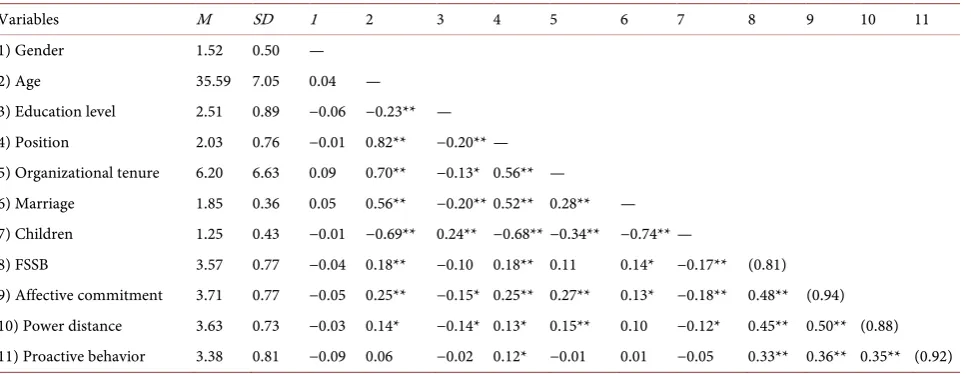
The means, standard deviations, and zero-order bivariate correlations reported
in Table 2 were in the expected directions and of the expected magnitudes.
[image:8.595.59.541.379.472.2]Among them, FSSB was significantly positively correlated with affective com-mitment (r = 0.48, p < 0.001) and Proactive behavior (r = 0.33, p < 0.001); Affec-tive commitment is also significantly posiAffec-tively correlated with employees’ proactive behaviors (r = 0.36, p < 0.001).
Table 1. CFA results.
Models χ2 df χ2/df CFI RMSEA NNFI
Model IV: FSSB; PD; AC; PB; 555.74 246 2.26 0.97 0.06 0.97
Model III: FSSB + AC; PD; PB; 1013.56 250 4.05 0.95 0.10 0.94
Model III: FSSB; PD + AC; PB; 1664.83 250 6.66 0.92 0.14 0.91
Model II: FSSB + PD + AC; PB; 2137.01 253 8.45 0.90 0.16 0.89
Model I: FSSB + PD + AC + PB; 3826.82 252 15.19 0.83 0.22 0.81
Notes: FSSB, family supportive supervisor behavior; PD, power distance; AC, affective commitment; PB, Proactive behavior.
Table 2. Descriptive statistics and correlations.
Variables M SD 1 2 3 4 5 6 7 8 9 10 11
1) Gender 1.52 0.50 —
2) Age 35.59 7.05 0.04 —
3) Education level 2.51 0.89 −0.06 −0.23** — 4) Position 2.03 0.76 −0.01 0.82** −0.20** — 5) Organizational tenure 6.20 6.63 0.09 0.70** −0.13* 0.56** —
6) Marriage 1.85 0.36 0.05 0.56** −0.20** 0.52** 0.28** — 7) Children 1.25 0.43 −0.01 −0.69** 0.24** −0.68** −0.34** −0.74** —
[image:8.595.58.544.515.702.2]DOI: 10.4236/jss.2019.77010 107 Open Journal of Social Sciences
4.3. Testing the Hypotheses
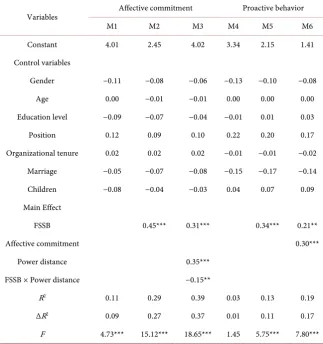
Model 5 in Table 3 showed that FSSB was positively related to proactive beha-vior (β = 0.34, p < 0.001), thus supporting Hypotheses 1. Model 2 showed that family supportive supervisor behavior was positively related to affective com-mitment (β = 0.45, p < 0.001) and Model 6 showed that affective commitment was positively related to proactive behavior (β = 0.30, p < 0.001). In addition, FSSB was still positively related to proactive behavior (β = 0.21, p < 0.01). Therefore, affective commitment plays the mediating role between FSSB and employees’ proactive behavior (Effect = 0.13, 95% Bootstrap CI = [0.06, 0.23]), thus supporting Hypotheses 2.
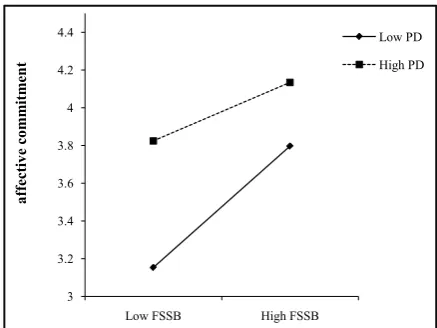
According to model 3, the interaction term (FSSB × Power distance) was posi-tively related to affective commitment (β = −0.15, p < 0.01), which indicates that power distance negatively regulates the relationship between FSSB and affective commitment, and hypothesis 3 is supported. We further conducted simple slopes analysis to better interpret the interaction effect. The interaction effect of FSSB and power distance on employees’ affective commitment is shown in
Fig-ure 2. When the employee power distance orientation is high, FSSB will trigger
the affective commitment of employees (β = 0.20, p < 0.01), while this positive relationship will be strengthened when the employee power distance orientation is low (β = 0.42, p < 0.001).
[image:9.595.262.481.528.692.2]Using the process modeling macro (Hayes, 2013), we tested the indirect ef-fects of FSSB contingent on specific values of power distance (e.g., 1 SD above and below the mean). As reported in Table 4, FSSB had a significant conditional indirect effect on proactive behavior through affective commitment at lower (B = 0.12, 95% confidence interval [CI] [0.21, 0.53]), mean (B = 0.09, 95% CI [0.16, 0.42]), and higher (B = 0.06, 95% CI [0.12, 0.23]) levels of power distance. The index of moderated mediation was significant because the 95% CI did not in-clude zero (B = −0.04, 95% CI [−0.09, −0.13]). Overall, Hypothesis 4 was sup-ported because lower levels of power distance strengthened the indirect effect of FSSB on proactive behavior through affective commitment.
Figure 2. Power distance moderating the relationship between FSSB and affective commitment.
3 3.2 3.4 3.6 3.8 4 4.2 4.4
Low FSSB High FSSB
af
fect
iv
e co
m
m
itm
en
t
DOI: 10.4236/jss.2019.77010 108 Open Journal of Social Sciences Table 3. Regression results.
Variables Affective commitment Proactive behavior
M1 M2 M3 M4 M5 M6
Constant 4.01 2.45 4.02 3.34 2.15 1.41
Control variables
Gender −0.11 −0.08 −0.06 −0.13 −0.10 −0.08
Age 0.00 −0.01 −0.01 0.00 0.00 0.00
Education level −0.09 −0.07 −0.04 −0.01 0.01 0.03
Position 0.12 0.09 0.10 0.22 0.20 0.17
Organizational tenure 0.02 0.02 0.02 −0.01 −0.01 −0.02
Marriage −0.05 −0.07 −0.08 −0.15 −0.17 −0.14
Children −0.08 −0.04 −0.03 0.04 0.07 0.09
Main Effect
FSSB 0.45*** 0.31*** 0.34*** 0.21**
Affective commitment 0.30***
Power distance 0.35***
FSSB × Power distance −0.15**
R2 0.11 0.29 0.39 0.03 0.13 0.19
ΔR2 0.09 0.27 0.37 0.01 0.11 0.17
F 4.73*** 15.12*** 18.65*** 1.45 5.75*** 7.80***
Note: N = 305; unstandardized coefficients are reported. *p < 0.05. **p < 0.01.***p < 0.001.
Table 4. Conditional indirect effects of FSSB on proactive behavior through affective commitment.
Moderator
(power distance) B SE Upper limit 95% CI Lower limit 95% CI
−1 SD 0.12 0.39 0.53 0.21
M 0.09 0.29 0.42 0.16
+1 SD 0.06 0.25 0.23 0.12
Note: N = 305. M = mean. SD = standard deviation. B = unstandardized conditional indirect effect. SE = standard error. CI = confidence interval.
5. Discussion
[image:10.595.209.538.492.576.2]man-DOI: 10.4236/jss.2019.77010 109 Open Journal of Social Sciences
agement style of the leader will inhibit the active behavior of the employees. This study confirms that FSSB, as a positive leadership behavior, also has a positive impact on employees’ proactive behavior. For employees, family support super-visors support employees to pursuit of work-family balance and provide a series of services to relieve their work and family pressure. In this kind of caring em-ployment relationship, employees will be more engaged in their work. Based on the principle of reciprocity, employees are more willing to take the initiative to make extra efforts for the long-term development of the organization.
Secondly, this study found that affective commitment plays a part of mediating role between FSSB and employees’ proactive behaviors. That is to say, FSSB can not only directly affect employees’ proactive behaviors, but also further lead to more proactive behaviors by enhancing employees’ affective commitment to the organization. Many studies show that emotional state plays an extremely important role in driving individual behaviors [31]. From the perspective of so-cial exchange, this study reveals the relationship between FSSB and employees’ proactive behaviors from the perspective of emotional state, which is also a sup-plement to existing studies. As the agent of the organization, the supervisor has the most frequent interaction with the supervisor, and the leadership behavior is the direct factor that affects the affective commitment of employees to the or-ganization. The care, support and understanding of the management for em-ployees directly reflect the respect, support and understanding of the organiza-tion for employees. Driven by the principle of reciprocity, especially in the Chi-nese society that attaches great importance to human feelings, it is easier to sti-mulate employees’ gratitude and return, increase their emotional return to su-pervisors and organizations, and thus increase their initiative in work.
DOI: 10.4236/jss.2019.77010 110 Open Journal of Social Sciences
response to the organization are less affected by the supervisor’s behavior.
5.1. Limitations and Directions for Future Research
This study also has some limitations, which can be improved in the future re-search. First of all, although the research design of multi-period data collection is adopted in this study to minimize common method bias, it is still not a longitu-dinal study in a strict sense. Meanwhile, employees’ self-assessment is adopted, and the causal relationship between variables is difficult to be completely deter-mined. In the future, we can further study the influence mechanism of FSSB on subordinates’ proactive behaviors dynamically through longitudinal follow-up research, or adopt the optimal design combining situational experiment and multi-source mutual assessment questionnaire survey, so as to make the research conclusion more reliable. Secondly, the subjects in this study come from a li-mited number of regions and enterprises, which limits the external validity of the research conclusions to some extent. In future research, the sample sources should be further expanded to enhance the universality of the research conclu-sions. Finally, this study takes FSSB as a whole construct to explore its influence mechanism on employees’ proactive behaviors. Whether there are significant differences in the influence effect of different dimensions of FSSB on employees’ proactive behaviors remains to be further studied in the future.
5.2. Implications for Practice
DOI: 10.4236/jss.2019.77010 111 Open Journal of Social Sciences
of their proactive behaviors.
6. Conclusion
Based on a questionnaire survey of 305 employees in enterprises, this study ex-plores whether FSSB can promote employees’ proactive behaviors in the workplace and its action mechanism. The results show that: 1) FSSB is positively related to employee’s proactive behavior; 2) Affective commitment plays a par-tial mediating role in the relationship between FSSB and employee’s proactive behaviors; 3) Power distance has a significant moderating effect on the relation-ship between FSSB and emotional commitment. When the power distance orientation is low, the relationship between FSSB and employee affective com-mitment is stronger.
Conflicts of Interest
The author declares no conflicts of interest regarding the publication of this pa-per.
References
[1] Eby, L.T., Casper, W.J., Lockwood, A., Bordeaux, C. and Brinley, A. (2003) Work and Family Research in io/ob: Content Analysis and Review of the Literature (1980-2002). JournalofVocationalBehavior, 66, 124-197.
https://doi.org/10.1016/j.jvb.2003.11.003
[2] Brinberg, D. and Castell, P. (1982) A Resource Exchange Theory Approach to In-terpersonal Interactions: A Test of Foa’s Theory. JournalofPersonalityandSocial Psychology, 43, 260-269.https://doi.org/10.1037/0022-3514.43.2.260
[3] Bagger, J., Li, A. and Gutek, B.A. (2008) How Much Do You Value Your Family and Does It Matter? The Joint Effects of Family Identity Salience, Fami-ly-Interference-with-Work, and Gender. HumanRelations, 61, 187-211.
https://doi.org/10.1177/0018726707087784
[4] Kossek, E.E., Pichler, S., Bodner, T. and Hammer, L.B. (2011) Workplace Social Support and Work-Family Conflict: A Meta-Analysis Clarifying the Influence of General and Work-Family-Specific Supervisor and Organizational Support. Per-sonnelPsychology, 64, 289-313.https://doi.org/10.1111/j.1744-6570.2011.01211.x
[5] Hammer, L.B., Kossek, E.E., Yragui, N.L., Bodner, T.E. and Hanson, G.C. (2009) Development and Validation of a Multidimensional Measure of Family Supportive Supervisor Behaviors (FSSB) JournalofManagement, 34, 837-856.
https://doi.org/10.1177/0149206308328510
[6] Odledusseau, H.N., Britt, T.W. and Greeneshortridge, T.M. (2012) Organizational Work-Family Resources as Predictors of Job Performance and Attitudes: The Process of Work-Family Conflict and Enrichment. JournalofOccupationalHealth Psychology, 17, 28-40.https://doi.org/10.1037/a0026428
[7] Odledusseau, H.N., Hammer, L.B., Crain, T.L. and Bodner, T.E. (2016) The Influ-ence of Family-Supportive Supervisor Training on Employee Job Performance and Attitudes: An Organizational Work-Family Intervention. Journalof Occupational HealthPsychology, 21, 296-308.https://doi.org/10.1037/a0039961
Re-DOI: 10.4236/jss.2019.77010 112 Open Journal of Social Sciences view and Recommendations for Research and Practice. Journal ofOrganizational Behavior, 39, 869-888.https://doi.org/10.1002/job.2320
[9] Rank, J., Carsten, J.M., Unger, J.M. and Spector, P.E. (2007) Proactive Customer Service Performance: Relationships with Individual, Task, and Leadership Va-riables. HumanPerformance, 20, 363-390.
[10] Janssen, O. and Van Yperen, N.W. (2004) Employees’ Goal Orientations, the Qual-ity of Leader-Member Exchange, and the Outcomes of Job Performance and Job Sa-tisfaction. AcademyofManagementJournal, 47, 368-384.
https://doi.org/10.5465/20159587
[11] Klein, H.J., Molloy, J.C. and Brinsfield, C.T. (2012) Reconceptualizing Workplace Commitment to Redress a Stretched Construct: Revisiting Assumptions and Re-moving Confounds. AcademyofManagementReview, 37, 130-151.
https://doi.org/10.5465/amr.2010.0018
[12] Parker, S.K., Williams, H.M. and Turner, N. (2006) Modeling the Antecedents of Proactive Behavior at Work. JournalofAppliedPsychology, 91, 636-652.
https://doi.org/10.1037/0021-9010.91.3.636
[13] Den Hartog, D.N. and Belschak, F.D. (2012) When Does Transformational Leader-ship Enhance Employee Proactive Behavior? The Role of Autonomy and Role Breadth Self-Efficacy. JournalofAppliedPsychology, 97, 194-202.
https://doi.org/10.1037/a0024903
[14] Cropanzano, R. and Mitchell, M.S. (2005) Social Exchange Theory: An Interdiscip-linary Review. JournalofManagement, 31, 874-900.
https://doi.org/10.1177/0149206305279602
[15] Foa, U.G. and Foa, E. (1974) Societal Structures of the Mind. Charles C Thomas, Springfield.
[16] Wilson, K.S., Sin, H. and Conlon, D.E. (2010) What about the Leader in Lead-er-Member Exchange? The Impact of Resource Exchanges and Substitutability on the Leader. AcademyofManagementReview, 35, 358-372.
https://doi.org/10.5465/AMR.2010.51141654
[17] Graen, G.B. and Scandura, T.A. (1987) Toward a Psychology of Dyadic Organizing.
ResearchinOrganizationalBehavior, 9, 175-208.
[18] Chalofsky, N.E. (2010) Meaningful Workplaces: Reframing How and Where We Work. John Wiley & Sons, New York.
[19] Ahmad, A. and Omar, Z. (2010) Perceived Family-Supportive Work Culture, Affec-tive Commitment and Turnover Intention of Employees. Journal of American Science, 6, 839-846.
[20] Meyer, J.P. and Allen, N.J. (1991) A Three-Component Conceptualization of Orga-nizational Commitment. HumanResourceManagementReview, 1, 61-98. https://doi.org/10.1016/1053-4822(91)90011-Z
[21] Pan, W., Sun, L.Y. and Chow, I.H.S. (2012) Leader-Member Exchange and Em-ployee Creativity: Test of a Multilevel Moderated Mediation Model. Human Per-formance, 25, 432-451.https://doi.org/10.1080/08959285.2012.721833
[22] Panaccio, A. and Vandenberghe, C. (2009) Perceived Organizational Support, Or-ganizational Commitment and Psychological Well-Being: A Longitudinal Study.
Journal of Vocational Behavior, 75, 224-236. https://doi.org/10.1016/j.jvb.2009.06.002
DOI: 10.4236/jss.2019.77010 113 Open Journal of Social Sciences
PositivePsychology, 8, 153-164. https://doi.org/10.1080/17439760.2013.776622
[24] Hofstede, G. (1980) Motivation, Leadership, and Organization: Do American Theo-ries Apply Abroad? OrganizationalDynamics, 9, 42-63.
https://doi.org/10.1016/0090-2616(80)90013-3
[25] Dorfman, P.W. and Howell, J.P. (1988) Dimensions of National Culture and Effec-tive Leadership Patterns: Hofstede Revisited. AdvancesinInternational Compara-tiveManagement, 3, 127-150.
[26] Eylon, D. and Au, K.Y. (1999) Exploring Empowerment Cross-Cultural Differences along the Power Distance Dimension. International JournalofIntercultural Rela-tions, 23, 373-385.https://doi.org/10.1016/S0147-1767(99)00002-4
[27] Kirkman, B.L., Chen, G., Farh, J.L., Chen, Z.X. and Lowe, K.B. (2009) Individual Power Distance Orientation and Follower Reactions to Transformational Leaders: A Cross-Level, Cross-Cultural Examination. Academy of Management Journal, 52, 744-764.https://doi.org/10.5465/amj.2009.43669971
[28] Tyler, T.R., Lind, E.A. and Huo, Y.J. (2000) Cultural Values and Authority Rela-tions: The Psychology of Conflict Resolution across Cultures. Psychology Public Policy&Law, 6, 1138-1163.https://doi.org/10.1037/1076-8971.6.4.1138
[29] Farh, J.L., Hackett, R.D. and Liang, J. (2007) Individual-Level Cultural Values as Moderators of Perceived Organizational Support-Employee Outcome Relationships in China: Comparing the Effects of Power Distance and Traditionality. Academyof ManagementJournal, 50, 715-729.https://doi.org/10.5465/amj.2007.25530866
[30] Paustian-Underdahl, S.C. and Halbesleben, J.R.B. (2014) Examining the Influence of Climate, Supervisor Guidance, and Behavioral Integrity on Work Family Con-flict: A Demands and Resources Approach. JournalofOrganizationalBehavior, 35, 447-463.https://doi.org/10.1002/job.1883
[31] Dong, Y., Seo, M.G. and Bartol, K.M. (2014) No Pain, No Gain: An Affect-Based Model of Developmental Job Experience and the Buffering Effects of Emotional In-telligence. AcademyofManagementJournal, 57, 1056-1077.
https://doi.org/10.5465/amj.2011.0687
[32] Markus, H.R. and Kitayama, S. (1991) Culture and the Self: Implications for Cogni-tion, EmoCogni-tion, and Motivation. PsychologicalReview, 98, 224-253.
https://doi.org/10.1037/0033-295X.98.2.224