ISSN Online: 2333-9721 ISSN Print: 2333-9705
DOI: 10.4236/oalib.1105280 Mar. 20, 2019 1 Open Access Library Journal
Practical Teaching of UG CAM Based on the Case
of Pattern Punch
Pingqing Fan
*, Bo Zhao
School of Mechanical and Automotive Engineering, Shanghai University of Engineering Science, Shanghai, China
Abstract
UG CAM is a very strong course in practical teaching. It is very important to strengthen the teaching of cases in the classroom. This paper takes the simu-lation processing of flower-type punch as an example, introduces the general process of case teaching in the process of UG CAM teaching, so that the theory connects with the reality, enhances the interest of students, fully re-flects the subject status of students, cultivates students’ ability that the theory connects with the reality and improves the teaching effect of UG CAM.
Subject Areas
Computer Engineering, Education
Keywords
Pattern Punch, Practice Teaching, UG CAM
1. Introduction
CAM (Computer Aided Manufacturing) is computer-aided manufacturing, which includes computer-aided production planning, computer-aided process design, computer numerical control programming, and computer-controlled processing. CNC machining programming is its main content. CNC machining mainly re-fers to the control of the machine tool with digital information recorded on the media, so that it automatically performs the specified machining tasks [1] [2] [3].
In the vehicle industry, the processing of various process equipments with complex profiles, for example, main models inside and outside the body, stamp-ing dies for sheet metal parts, bumper, instrument panel and other large injec-tion molds, engine intake, cylinder water set of casting sand core molds, con-necting rods, crankshafts, etc., is a field in which CNC machining has a special advantage [4] [5]. It plays a pivotal role in the production of modern mechanical
How to cite this paper: Fan, P.Q. and Zhao, B. (2019) Practical Teaching of UG CAM Based on the Case of Pattern Punch. Open Access Library Journal, 6: e5280.
https://doi.org/10.4236/oalib.1105280
Received: February 21, 2019 Accepted: March 17, 2019 Published: March 20, 2019
Copyright © 2019 by author(s) and Open Access Library Inc.
This work is licensed under the Creative Commons Attribution International License (CC BY 4.0).
DOI: 10.4236/oalib.1105280 2 Open Access Library Journal products and has been widely used.
UG CAM is a processing and manufacturing Momodu which is one of the important modules of UG and plays a pivotal role [6]. Its main function is to undertake the task of interactive graphic NC programming, it is based on the surface geometry information of the existing CAD 3D model, and it automati-cally calculates the tool path of NC machining, then completes the processing and manufacturing of the product, and realizes the product designer.
2. Features of UG CAM
2.1. General Operation Steps of UG CAM
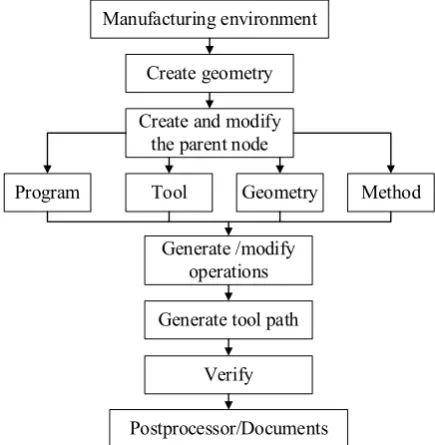
The specific operations of automatic turning programming, automatic milling programming and automatic cutting of wire cutting in UG CAM are different, but from the part design drawing to the final machining program, can be shown in Figure 1.
2.2. The Concept of CNC Process Tree
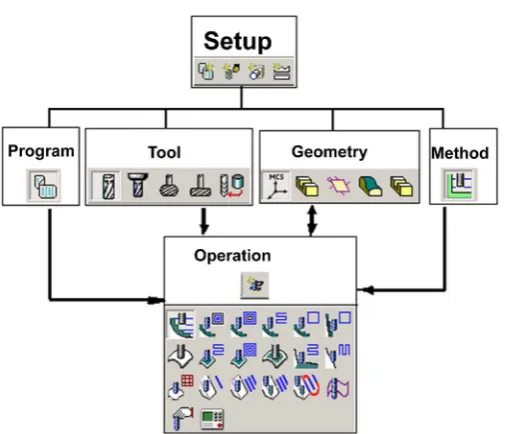
The multi-view performance of CNC process planning is fully reflected in the UG CAM process database. The different perspectives of the process planning are the different views of the database. UG/CAM divides the routing into four views, and they are PROGRAM tree, TOOL tree, GEOMETRY tree, and METHOD tree as shown in Figure 2.
[image:2.595.264.482.483.706.2]UG CAM course is a designated elective course for vehicle engineering. Its teaching goal is to master the principles and methods of computer-aided manu-facturing, so that students can master CAM basic knowledge and usage methods, and obtain application theory knowledge to solve practical problems. Not only that, they can also master the setting of UG CAM processing environment, the
Figure 1. General operational flow of UG CAM programming.
Manufacturing environment
Create geometry
Create and modify the parent node
Program Tool Geometry Method
Generate tool path Generate /modify
operations
Verify
DOI: 10.4236/oalib.1105280 3 Open Access Library Journal
Figure 2. UG CAM CNC process tree.
creation of cutting tools, methods and geometric parent node group, the setting of common options, then master the programming methods of plane milling, cavity milling, fixed axis surface contour milling, etc.
3. Pattern Punch Processing Case
Because UG CAM is very practical, it requires close contact with production practices in the teaching process. In the classroom teaching, the teaching of ac-tual cases must be strengthened. At present, although the acac-tual practice can meet the teaching requirements, it has less contact with the actual production case. Therefore, this paper introduces the system flow of UG CAM in the case teaching process through the body simulation processing.
3.1. Establishment of Rough Parts
Firstly, in the UG modeling module, the three-dimensional model is used to es-tablish the three-dimensional model of the pattern punch, and the blank model is added to the original model as shown in Figure 3.
3.2. Tool Path Generation
In the simulation process, two tool path operations are required that are one roughing and one finishing.
Firstly, setting the roughing simulation path. For the model material, a flat knife is selected as the roughing tool; the upper surface of the blank is offset by a certain distance to establish a safety plane; the part and the blank geometry are defined.
DOI: 10.4236/oalib.1105280 4 Open Access Library Journal
Figure 3. Parts and blank models of the flower punch.
Figure 4. The finished model.
stepping amount is set to 60% of the tool diameter; the input Depth Per Cut (Range) is 2.0, and in the cutting layer option, complete the processing after the relevant setting is made. Then, it can create a point machining operation and process six small holes. The entire roughing of the pattern punch can be com-pleted.
The finishing tool path setting is similar to the above steps. The design of pa-rameter: the tool will use a smaller size tool.
After the rough machining tool path is set, the tool path is generated and the tool path is simulated. Through simulation processing, the final model is shown in Figure 4.
3.3. CNC Programming Pre-Processing and Post-Progressing
The two paths of the roughing and finishing obtained by the simulation are output as a numerical control program, and are prepared for the subsequent transmission to the computer of the numerical control machining milling ma-chine through the network. If the processing device has a memory limit, the machining program can be divided into small sections.
4. Summary
[image:4.595.280.466.217.326.2]DOI: 10.4236/oalib.1105280 5 Open Access Library Journal learning through the explanation of the above-mentioned processing simulation processing cases, so that students can summarize the methods of knowledge ap-plication in practice and improve students’ ability to solve problems.
Acknowledgements
This work is supported by the Shanghai municipal education commission key curriculum construction project (Grant NO. A1-0601-18-01009).
Conflicts of Interest
The authors declare no conflicts of interest regarding the publication of this paper.
References
[1] Zhang, M.Y. (2012) Discussion on the Teaching Method of NC Programming Course Based on Numerical Control Machining Simulation Software. Curriculum Education Research, 11, 23-25.
[2] Su, H.Z. (2009) Numerical Control Machining Practice Based on UG NX and Ma-chining Simulation Software. Mechanical Engineering and Automation, 2, 52-53. [3] Hu, W.Y., Cao, H. and Zhou, Y.S. (2013) Research and Practice of Applied
Teach-ing Based on UG NX Software Platform in PrintTeach-ing Equipment Course. Journal of Anqing Teachers College, 19, 132-134.
[4] Lin, C.D. (2010) Characteristics of Creative Talents and Reconstruction of Educa-tional Models. Chinese Education Journal, No. 6, 1-4.
[5] Zhang, J.X. and Chen, G.T. (2010) Discussion on Talent Cultivation Model of En-gineering Universities under the Background of “Excellence Plan”. China Construc-tion EducaConstruc-tion, 5, 4-7.