https://www.scirp.org/journal/jwarp ISSN Online: 1945-3108 ISSN Print: 1945-3094
DOI: 10.4236/jwarp.2019.1110072 Oct. 11, 2019 1245 Journal of Water Resource and Protection
Overflow Controlled Declining Rate Filtration:
A Conceptual Design for Increased Flexibility
and Dynamism
Ababu T. Tiruneh
1, Tesfamariam Y. Debessai
2, Gabriel C. Bwembya
2, Stanley J. Nkambule
11Department of Environmental Health Science, University of Eswatini, Mbabane, Eswatini 2Department of Chemistry, University of Eswatini, Mbabane, Eswatini
Abstract
A declining rate filter operating through over flow control mode is proposed in this paper with a view to improving the overall performance of declining rate filters. Traditional declining rate filters have in-built self-adjustment of flow rates among the filters assisted with downstream orifice for flow control with limited flexibility for further adjustment. The proposed design allows the control of flow level and flow rates in individual filters, the water level in the over flow distributor tank and offers increased flexibility in responding to changes in filtration variables and optimising the overall performance of the filters. The design set up can also operate as constant rate filter through set-ting the water level in the distributor tank to the maximum.
Keywords
Water Treatment, Filtration, Declining Rate Filters, Variable Rate Filters, Constant Rate Filters, Filter Run
1. Introduction
Filtration is an important treatment process employed in modern water treat-ment plants and is traditionally considered as the last physical unit process in the chain of multiple barrier system existing in water treatment for solids re-moval. Carryover of coagulated solids from sedimentation is removed by filtra-tion [1]. Although not the last barrier for the removal of pathogenic organisms, filtration also assists in the removal of Giardia Lamblia and Cryptosporidium [2] [3]. The remaining pathogens are expected to be eliminated by the last barrier system for pathogens removal, namely, disinfection [4]. Filters do also have the How to cite this paper: Tiruneh, A.T.,
Debessai, T.Y., Bwembya, G.C. and Nkam-bule, S.J. (2019) Overflow Controlled clining Rate Filtration: A Conceptual De-sign for Increased Flexibility and Dynam-ism. Journal of Water Resource and Protec-tion, 11, 1245-1259.
https://doi.org/10.4236/jwarp.2019.1110072
Received: August 31, 2019 Accepted: October 8, 2019 Published: October 11, 2019
Copyright © 2019 by author(s) and Scientific Research Publishing Inc. This work is licensed under the Creative Commons Attribution International License (CC BY 4.0).
DOI: 10.4236/jwarp.2019.1110072 1246 Journal of Water Resource and Protection capability of removing iron and manganese as contact media facilitating co-adsorption [5]. Filters operating in rapid mode (rapid sand filters) are com-mon in conventional installations because of their low space requirements and provision for self-cleaning using the system of backwashing. They continue as component units of conventional water treatment installations despite the emergence of additional superior treatment technologies such as micro filters and ultra-filters [6].
There are two commonly adopted modes of operation of rapid sand filters, namely constant flow rate and declining flow rate modes. Constant flow rate fil-ters have uniform flow rate in all the filfil-ters throughout the stages of filter opera-tion and operate in three possible modes [7]. In the downstream valve control mode of operation, the downstream valve is gradually opened while the water level in the filter remains constant. In the constant filter water level mode of op-eration, a water level rise in the filter in response to increase in head loss triggers a sensor that automatically adjusts the flow rate by opening the downstream valve further. Lastly, in the rising filter water level mode of operation, uniform flow splitting devices such as weirs are provided in which the flows are equally distributed among the filters while constant flow conditions in individual filters are maintained through proportional rise in water level in the filters as more head loss is developed during operation.
In rapid sand filters operating in the declining mode, the water level in all the filters stays the same and the filters operate with varying filtration rates. The wa-ter normally flows from the common channel and enwa-ters through each filwa-ter at a level that is set below the minimum water level [8]. This distribution of water to the filter to a common water level does not require any special uniform flow dis-tribution device. The filter that is washed most recently carries higher flow rate whereas the dirtiest filter that has run the longest time carries the least flow [8]. This means that, the flow rate within each filter progressively decreases from the maximum (immediately following backwashing) to the minimum (when the fil-ter is dirty and needs to be taken off for backwashing). This mode of operation facilitates longer filter run as filters with clogged conditions are allowed to oper-ate at low flow roper-ates which will prevent the development of higher head loss. Operation at low flow rate with associated low head loss development enables filters to continue operating for a longer period before they are taken out for cleaning.
2. Declining Rate Filtration and Their Performance
DOI: 10.4236/jwarp.2019.1110072 1247 Journal of Water Resource and Protection achieve extended period of operation before a particular filter is taken out for back washing. As filters become lodged with deposits, their ability to accept flow and filter solids diminishes. Therefore, declining rate filter takes account of such limitation in performance and reduces flow rates in dirty filters so that they can continue operating with the same efficiency of filtration. The flow rejected by the dirty filters is distributed to the clean filters and because of this a minimum of four filters are required in order to run a filter system in declining mode enabl-ing only moderate increase in filtration rate as result of sharenabl-ing of the rejected excess flow during cleaning by the other three filters that are in operation. The minimum of four filters is also needed for another reason. It is possible to wash the dirtiest filter using the filtered water from the other filters. This arrangement of washing filters using effluent from the other filters avoids the need for more expensive backwash system [9]. The filtered water produced from the three fil-ters that are in operation will provide enough volume of water for washing when the dirtiest filter is taken out for backwashing.
One advantage of declining rate filters is the absence of the need for special inflow splitting device or uniform flow distribution device for inlets to the dif-ferent filters [10]. The filters are interconnected through a common inlet pipe that ensures that the water level is the same in each of the filters and flow to the filters enter below the minimum water level.
2.1. Mode of Operation of Declining Rate Filters
Declining rate filters operate with constant water level common to all the fil-ters whereas the flow rate in each of the filfil-ters varies depending on the amount of solids accumulated in the filters. The water level rises during operation commonly for all the filters, the rise in water level is in response to the head loss build up among the different filters that are in different stages of operation [11]. The initial high flow rate through the most recently washed filter is stricted by providing a downstream orifice that responds with high loss in re-sponse to high flow rate tendency. Meanwhile, this same orifice located in the dirtiest filter has low head loss and would not inhibit the flow in this particular filter. Alternatively, head loss control can be provided through downstream valve with the attendant problem of constant operational attention and flow disturbance.
DOI: 10.4236/jwarp.2019.1110072 1248 Journal of Water Resource and Protection Figure 1. Filtration rate and head loss during one filter run in declining rate filters [14].
2.2. Filter Flow Control in Declining Rate Filters
Declining rate filters have two modes of flow control. In the first mode of flow control, the water level rises from the minimum following backwash of the dir-tiest filter to the maximum when another filter need to be taken out for back-washing [13]. This mode of operation is easier as the flow rate is kept constant through rise in common water level in the filter. However, it requires additional wall to be built up to allow for rise in water level as the filter head loss increases. In the second mode of operation, the outlet weir level is lowered following in-crease in head loss whereas the water level in the filters remains more or less constant. This mode of operation is difficult requiring periodic adjustment in response to head loss build up.
Filter flow control through declining mode does not require any further ad-justment than the static provisions in the form of downstream flow restricting orifices. On the other hand, compared to filters operated by downstream flow regulators, there is an economic advantage to be gained while at the same time maintaining comparable quality of filtered water [15]. The flow-restricting de-vice is designed in such a way that the maximum hydraulic load (flow rate) in each of the filters does not exceed 1.5 times the average flow rate [8].
2.3. Head Loss Development in Declining Rate Filters
DOI: 10.4236/jwarp.2019.1110072 1249 Journal of Water Resource and Protection which is inherently a laminar head loss [11] [16] [17]. At this time, because of the low rate of filtration, the head loss in the flow-restricting orifice will be comparatively low. This mode of head loss transition from turbulent to laminar head loss has the advantage of lowering the hydraulic load as the filters become dirty as laminar flow vary only linearly with the flow rate.
When dual media filtration is used, such as a combination of coarse anthracite at the top and silica sand at the bottom, greater change in head loss occur in the anthracite media as a result of the proportionally greater amount of solids depo-sited on the coarser anthracite media. This observation may be similar to the ones observed in constant flow rate filters but can be a critical factor in the in-crease in turbidity at later stages of operation after the anthracite is clogged be-cause of the fact that the sand may have limited solids storage capacity [18].
2.4. Filtered Water Quality
In terms of water quality, declining mode of operation has been observed to re-sult in improved filtered water quality because of better distribution of solids achieved through reduced filtration rate. When the filtration rate is high, one part of the sand bed gets too much of the solids and gets clogged resulting in significant head loss before the remaining portion of the sand is able to deposit solids. This uneven distribution of solids results in loss of efficiency of perfor-mance and lowered filter runs [15] [19].
According to Marzec and Dobrowski [20], operation of rapid sand filters un-der different raw water turbidity did not materially alter the flow rates prevalent in the different filters as long as the water level following backwashing of one of the filters stays the same. This indicates that under stable operational conditions in terms of water level being the same following filter backwashes, variation of raw water quality does not seem to have significant effect on the distribution of flow rate among the different filters operating in declining mode. On the other hand, the same researchers indicated that the filtered water quality as well as the filter run times was significantly affected by variation in the raw water quality directed to the filters operating in declining mode. On the other hand, environ-mental variables such as seasonal changes in water temperature could not be re-gulated by the same self-controlled flow mechanism present in declining rate fil-ters necessitating different and potentially tedious adjustment procedure. This is one of the drawbacks of filters operating in declining mode [21].
2.5. Number of Filters Operating in Parallel
DOI: 10.4236/jwarp.2019.1110072 1250 Journal of Water Resource and Protection
2.6. Comparison of Performances of Constant and Declining Rate
Filters
Constant flow rate filters often require frequent backwashing due to the limited filter run time because of rapid head loss development and deterioration of fil-trate quality. Such frequent backwashing results in disruption of the filtration process as well as requiring increased volume of water required for backwashing. Declining rate filters reduce the frequency of disruption by allowing longer filter run while at the same time minimizing the amount of water needed for back-washing per a given time [23]. Past studies also demonstrated that, despite the initially high flow rate through backwashed filters, the filtered water turbidities were comparable with those of constant rate filters [19] [24].
There are, however, few—apparently contradictory—claims and counter claims cited in the literature regarding some of the advantages associated with the op-eration of declining rate filters. For example, it helps to look at the research conducted by the American Water Works Research Association [7]. The re-search study found little difference between the two modes of filtration in terms of flow disturbance, turbidity increase and overall cost. Both modes of operation were recommended with the only difference stated being ease of operation; the advantage lying with operation of declining rate filters.
On the other hand, Perera etal. [18] found out that declining rate operation produced, in general, better filter performance with improved filtered water tur-bidity and improved head loss conditions. The improved performance in terms of head loss is attributed to better redistribution of solid (solids penetration) that is achieved with declining mode of operation.
2.7. Optimisation of Filter Performance
In studies related to performance of declining rate filters, the total water flow flittered and the maximum allowable water level are considered constant (given). The variables considered in the optimisation process include: Filtration rate, medium size, inflow water quality, filter run, minimum water level, downstream head loss control, number of filters, etc. [13]
2.8. Why Choose Declining Rate Filters?
DOI: 10.4236/jwarp.2019.1110072 1251 Journal of Water Resource and Protection
2.9. Drawbacks with Design and Operation of Declining Rate
Filters
Declining rate filters have a number of disadvantages. Lack of operational flex-ibility is one disadvantage of declining rate filters although this too can be an advantage as operational intervention is minimised. When the flow rate changes, because of change in design conditions or when one of the filters has to be taken out of operation for maintenance purposes, the condition of operation changes and may be far from what is required to be optimum condition for satisfactory performance of the filters. There is no simple operational means to adjust to these new conditions without resorting to major modification in structural de-sign of the filters.
Another disadvantage of declining rate filters is the fluctuation in flow rates in the periods during back washing, after backwashing and as the filter progresses towards its end of filter run. The sudden change in filtration rate is observed in all the filters immediately after a filter has been backwashed and been put back into operation [23]. Such rapid change in filtration coupled with the existence of residual solids in the recently washed filter can result in upset of the conditions of solids storage on the filter bed in general and deterioration of filtrate quality in particular. Such flow rate fluctuations give rise to different filter performance affecting the quality of the filtered water [27]. There is also a sharp water level rise when one of the filters is isolated for backwashing resulting in sudden change in flow rates among the remaining filters that are in operation.
The lowering of the common water level following backwashing is as stated a condition that has an effect on the distribution of flow rates among the different filters. On the positive side, flow rates in the dirtier filters are reduced, and the recently washed filter carries the excess flow discarded by the dirty filters. Such redistribution of flow facilitates operation of filters with longer filter runs and better distribution of solids deposit on the filter bed. On the other hand, the proportion of flow distribution among the different filters cannot be con-trolled and may change when the flow rate changes (because of increased de-mand or when a filter is taken out for maintenance) or when the raw water qual-ity changes.
According to Murat et al. [28], a study of the impact of initial water quality and flow rate in declining rate filters revealed that the ratio between the maxi-mum and minimaxi-mum filtration rates among the different filters decreased when the flow rate in the system increases. Such reduction in filtration velocity ratio results in reduced efficiency of flow redistribution among the different filters, particularly reduction in the ability of the cleanest filter to share a larger propor-tion of the flow. The same ratio between maximum and minimum filtrapropor-tion rates increased when the coagulant dosage added to the raw water was reduced, indicating reduced efficiency of flow passage through the dirtier filters.
conve-DOI: 10.4236/jwarp.2019.1110072 1252 Journal of Water Resource and Protection nient operational mechanism to adjust to changing operational conditions is the inherent drawback of declining rate filters. Declining rate filters are, therefore, considered optimum in their performance only with respect to narrowly defined operational conditions. Development of self-controlled mechanisms to increase flexibility of operation of declining rate filters do not practically exist and are not reported in the literature.
2.10. Addressing the Problems of Operation of Declining Rate
Filtration
Declining rate filters have a number of problems related mainly to their lack of operational flexibility and sudden fluctuation of flow rate in response to back-washing of the filters. There will be deterioration of water quality at high initial flow rate of the filters following backwashing as well as during backwashing op-erations. The sudden change in flow rate also has an effect on solids deposition in filter media and can potentially upset filter performance through dislodging of deposited solids. Declining rate filters can require major structural readjust-ment whenever the flow rate changes or the raw water quality changes or in re-sponse to changes in environmental variables such as seasonal temperature vari-ation. This is not simple and routine task since structural adjustments such as changing the operating water level, surface area of filters and number of filters that are necessitated by change of environmental variables require major physi-cal alterations to the original filter design.
Because of the same water level commonly prevailing in all the filter beds, the distribution of flow rates among the filters can be less than optimum whenever the design variables change such as the overall flow rate or the coagulant dosage. This is apparently lack of flexibility that is inherent in declining rate filters. The self-control adjustment of flow rate in response to head loss development through orifices in declining rate filters does not work for changes in environ-mental variables such as temperature difference that are routinely observed be-tween different seasons since the orifice does not respond to changes in temper-ature [23]. There is, therefore, a need to consider an alternative setup such as this proposed overflow-controlled dynamic filter system to investigate the possi-bility of adaptation to changes in design variables without making major struc-tural adjustment to the filter.
3. The Concept of Overflow Controlled Declining Rate
Filtration
fluc-DOI: 10.4236/jwarp.2019.1110072 1253 Journal of Water Resource and Protection tuations are minimised or the influence of flow rate changes in other filters such as the recently back-washed one has less negative impact on the operation of the other matured filters. Additional flexibility of level changes and valve setup are also included in this new conceptual design to provide more flexibility in re-sponse to changes in design conditions, situations that are often difficult to han-dle in the existing declining rate filter setups. However, filtration performance studies of new systems or improvement of existing systems always require pilot testing since analytical models that enable full design of filters on theoretical as-sumptions alone do not exist [29].
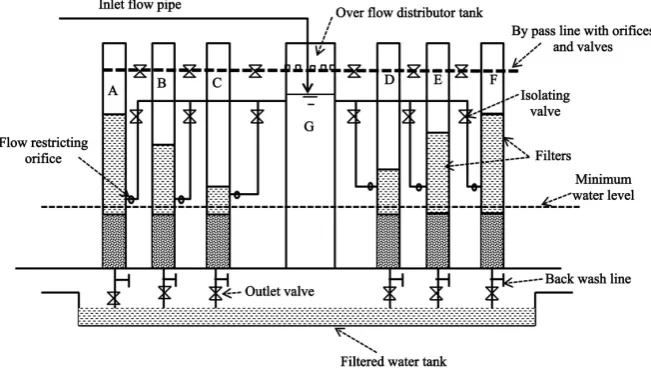
The concept of overflow-controlled declining rate filtration is here by pro-posed in this paper with the aim of addressing the operational setback of declin-ing rate filters through the provision of a more flexible control in the operation of the filters. Such added control involves mechanisms such as: The provision of variable water level in each filter participating in the filter, provision for adjust-ment of water level in the overflow distributer tank, and flow restricting me-chanisms such as orifices provided upstream of the filters to each of the individ-ual filters operating.
Figure 2 shows the schematic diagram of the set up overflow-controlled de-clining rate filtration. Raw water after coagulation and settlement or after coa-gulation alone (as in direct filtration alone) is directed towards the overflow dis-tributor tank. The overflow level in the disdis-tributor tank can be adjusted to pro-vide flexibility in response to changes in the overall rate of filtration or changes in raw water quality and seasonal changes in temperature, etc. Water flows to each filter through feeder pipe fitted with flow restricting orifice as well as an isolating valve. The major turbulent head loss occurs in the flow-restricting ori-fice whereas the isolating valve is fully opened during normal operation of the filter and hence has negligible head loss. The flow towards each filter varies in accordance with the water level difference between the over flow tank and water level in the individual filters. Accordingly, filter C in Figure 2, which is assumed most recently backwashed, has the lowest water level and hence highest filtration rate. On the other hand, filter A is the dirtiest filter and has the highest water level and lowest filtration rate. As filtration progresses, the water level in the dis-tributor tank rises as well as the levels in each filter in response to head loss de-velopment while maintaining the same overall flow rate through the system.
When water level in the dirtiest filter (filter A) reaches the maximum level, this particular filter is isolated using the isolating valve and backwashed while the remaining filters continue to operate. During this time, the water level in the distributor tank rises as expected as well as the levels in each of the remaining filters in operation.
DOI: 10.4236/jwarp.2019.1110072 1254 Journal of Water Resource and Protection Figure 2. Schematic layout of the overflow controlled declining rate filter model.
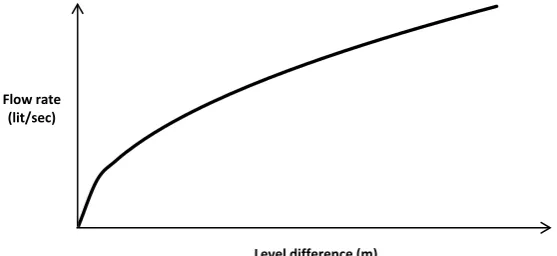
provision of separate water levels in each filter, the possibility of varying the overflow water level in the distributor tank and provision of the flow-restricting orifice in the inlet flow pipe to each of the filters. The variation of flow rate in each of the filters is entirely dependent on the water level difference between the individual filters and the distributor tank. This is modeled according to Equation (1):
i i D i
q =C H −H (1)
where
qi = the rate of filtration in filter i,
HD = is height of water level in the distributor tank,
Hi = the height of water level in the filter i and
Ci = orifice head loss parameter corresponding to filter i at a particular stage
of filtration.
Figure 3 shows a schematic diagram of the flow rate variation with the water level difference. the distribution of flow rates among the filters can be optimised by studying the changes in flow rates with respect to variables such as the water level in the distributor tank, the orifice head loss and head loss in the filters as filtration progresses. For example, by increasing the water level in the distributor tank, it is possible to increase the proportion of flow going to the dirtiest filter. This can be observed from the differential rate of change of flow rate with re-spect to change in water level in the distributor tank shown in Equation (2):
2
i i
D D i
dq C
dH = H −H (2)
DOI: 10.4236/jwarp.2019.1110072 1255 Journal of Water Resource and Protection
Figure 3. Variationof flow rate with level difference between filter and
over flow tank.
increase in plant flow rate in response to increase in demand, the resulting de-crease in the ratio of maximum to minimum flow rates can be counteracted by lowering the water level in the distributor tank, an action that will take flow away from the dirtiest filters and redistributes it to the cleaner filters.
In addition, the normal water level of operation in the distributor tank can be fixed in accordance with head loss characteristic of the orifice and laminar flow in the filter media. It is possible to study these characteristics in order to come up with optimal level of water in the distributor tank and optimum orifice size restricting flow in each of the filters.
As is normal with the operation of declining rate filters, the inlet flow distri-bution in this new filter system does not require special provision for uniform flow distribution, the same advantage achieved in the traditional declining mode of filtration. The settled water is directed towards the overflow tank from which water flow to the different tanks depending on the level difference that exists between the water level in the overflow tank and that of the water level in the in-dividual filters as explained above.
4. Benefits and Outcomes of the Proposed Design of
Overflow Controlled Declining Rate Filtration
The proposed design concept, which is based on overflow control of declining rate filtration, is expected to resolve some of the operational problems related to declining rate filter performance and add additional flexibility in terms of overall design and routine operation. By providing added control mechanisms in the proposed declining filter set up, it is possible to achieve increased filter perfor-mance measured in terms of filter water quality, filter run time, distribution of filtration rate and total filter water throughput. The proposed design, therefore, leads to a declining filter set up that has better efficiency of performance in terms of flow rate distribution, filter run time, filtrate water quality and overall cost. It also means a greater degree of freedom in optimization of the design of filter performance because of the added control variables of the proposed filter setup In addition; factors contributing to sudden changes in flow rate can be
Flow rate (lit/sec)
DOI: 10.4236/jwarp.2019.1110072 1256 Journal of Water Resource and Protection manipulated in order to control these changes so that the filter’s overall perfor-mance can be optimized. The result would be an improved filter setup that has stable performance in terms of flow rate changes and filter deposition through-out the cycle of operation of the filter. It also means better control of filter oper-ation and performance because of added flexibility in the filter setup. The pro-posed design setup offers significant solution alternatives to existing operational problems of declining rate filters, which are often difficult to change or adjust because of the inherent inflexibility present in their setup and operation. The proposed design concept also offers added operational flexibility to short-term as well as long-term changes in design variables. Through this proposed new se-tup, there will be more flexibility in filter operation and performance and better adaptability to changing conditions during the life of operation of a filtration plant.
The resultant benefit of the proposed filter technology to water treatment plant operating agencies would be stability of filter performance in response to changes in filtration variables, flexibility in adapting filter performance to satisfy desired water quality standard as well as flow rates and filter run lengths. In ad-dition, the overall economy and performance of filters can be improved through greater flow run, reduced filter washing frequency and reduced capital cost of the filter setups required of this technology.
5. Possibility of Running the Filters in Constant Filter Rate
Mode
DOI: 10.4236/jwarp.2019.1110072 1257 Journal of Water Resource and Protection
6. Conclusions
The proposed design concept of overflow controlled declining rate filtration ad-dresses the bottlenecks of existing declining rate filtration such as lack of flexi-bility to changes in filter variables with an in-built in self-operating mechanism, flow rate fluctuation and rise of water levels during washing.
Declining rate filters are only provided with downstream orifice as a means of restricting flow rate fluctuation. The lack of flexibility of operation of declining rate filters is evident as when the flow rate changes (due to increased demand, or changes in environmental variables such as temperature for example) the flow distribution among the filters will change. Higher flow rates typically reduce the difference between maximum and minimum rate of flow among the filters. On the other hand reduction of the coagulant dosage will decrease such difference. Such change in flow distribution may be far from the optimum required. De-clining rate filters are, therefore, considered optimum in their performance only with respect to narrowly defined operational conditions.
The need for an alternative set up is hereby proposed with the concept of an over flow controlled declining rate filtration with the aim of adaptation of the filter performance to changes in design variables without major structural ad-justment. In this proposed setup of over flow controlled declining rate filtration, the water levels in each filter are separate while the whole setup is connected through a common over flow tank. Such proposed set up allows flexibility in in-dividually controlling the flow rate in individual filters. The flow in individual filters would vary according to the level difference between the water level in the over flow tank and the level of water in the individual filters.
Additional flexibility is provided through valve set up and adjusting the maximum level of water in the over flow tank apart from the flow restricting ori-fice provided downstream. For example, increasing the water level in the over flow distributor tank increases the proportion of flow going to the dirtiest filter. On the other hand a decrease in coagulant dosage can be counteracted by de-creasing the water level in the overflow tank there by maintaining a greater dif-ference between the maximum and minimum flow rates among the different fil-ters. Similarly, lowering the water level in the overflow distributor tank assists in counteracting increased water flow rates due to increase water demand which tends to decrease the ration between the maximum and minimum flow rates among the different filters. The proposed setup can also run as constant rate fil-ters by setting the water level in the over flow distributor tank to the maximum and letting the flow pass through the bypass line that is provided with uniform flow distribution orifice holes at the tank walls and valves for isolating each fil-ter.
DOI: 10.4236/jwarp.2019.1110072 1258 Journal of Water Resource and Protection as well as optimal performance can be realized through greater filter run, duced filter washing frequency and reduced capital cost of the filter setups re-quired of this technology.
Conflicts of Interest
The authors declare no conflicts of interest regarding the publication of this pa-per.
References
[1] Gao, P., Xue, G., Song, X.S. and Liu, Z.H. (2012) Depth Filtration Using Novel Fi-ber-Ball Filter Media for the Treatment of High-Turbidity Surface Water. Journal of Separation and Purification Technology, 95, 32-38.
https://doi.org/10.1016/j.seppur.2012.04.010
[2] Cornwell, D., Macphee, M., Brown, R. and Via, S. (2003) Demonstrating Cryptos-poridium Removal Using Spore Monitoring at Lime-Softening Plants. Journal of the American Water Works Association, 95, 124-133.
https://doi.org/10.1002/j.1551-8833.2003.tb10367.x
[3] Spellman, F. (2009) Handbook of Water and Wastewater Treatment Plant Opera-tions. 2nd Edition, Taylor & Francis, Boca Raton, New York.
https://doi.org/10.1201/9781420075311
[4] Crittenden, J., Trussell, R.H., Howe, K. and Tchobanoglous, G. (2012) Water Treatment Principles and Design. John Wiley & Sons, New York.
https://doi.org/10.1002/9781118131473
[5] Valentukeviciene, M. (2009) Applying Backwash Water in Order to Enhance Re-moval of Iron and Ammonium from Spent Filters with Fresh Filter Media. Envi-ronment Protection Engineering, 35, 135-144.
[6] Bodzek, M. and Konieczny, K. (2008) Application of Membrane Processes in Water Treatment—State of Art. Instal, 4, 58-61. (In Polish)
[7] American Water Works Association, AWWA (1991) Full-Scale Valuation of De-clining and Constant Rate Filtration. American Water Works Association, Denver. [8] Sabogas, L.P. and DiBernardo, L. (2009) Seleção de tecnologias de tratamento de
água. LdiBe, São Paulo.
[9] Libhaber, M. and Jaramillo, A.O. (2012) Sustainable Treatment and Reuse of Mu-nicipal Wastewater: For Decision Makers and Practicing Engineers. IWA Publish-ing, London, 434-441.https://doi.org/10.2166/9781780400631
[10] Akgiray, O. and Saatci, M. (1998) A Critical Look at Declining Rate Filtration De-sign. Water Science and Technology, 38, 89-96.
https://doi.org/10.2166/wst.1998.0240
[11] Mackie, R.I., Dabrowski, W. and Zielina, M. (2003) Numerical Study of a Rational Rule for the Operation of Variable Declining Rate Filters in Response to Changes in Raw Water Quality. Environment Protection Engineering, 29, 45-52.
[12] Dibernardo, L. (1987) Designing Declining-Rate Filters. Filtration and Separation, 338-341.
[13] Dabrwoski, W. (2011) Rational Operation of Variable Declining Rate Filters. Envi-ronment Protection Engineering, 37, 35-53.
DOI: 10.4236/jwarp.2019.1110072 1259 Journal of Water Resource and Protection Civil Engineers, 106, 1023-1043.
[15] Dabrwoski, W. (2006) The Progression of Flow Rates in Variable Declining Rate Filter Systems. Acta Hydrochimica et Hydrobiológica, 34, 442-452.
https://doi.org/10.1002/aheh.200500647
[16] Cleasby, J.L. (1993) Status of Declining Rate Filtration Design. Water Science and Technology, 27, 151-164.https://doi.org/10.2166/wst.1993.0224
[17] Escobar, J. (1992) Influência da capacidade de armazenamento de água a montante dos filtros nofuncionamento de sistemas de filtração com taxa declinante. Dissertação para Obtenção dotitulo de Mestre em Hidráulica e Saneamento, Escola de Engenharia de São Carlos, Universidade de São Paulo, Brasil.
[18] Perera, T.L., Torres, L.P. and Cruz, V.C. (2014) Influence of the Flow Control (De-clining Rate—Constant Rate) on the Filtration Process in Drinking Water Treat-ment. Ingeniería y Universidad, 18, 217-234.
https://doi.org/10.11144/Javeriana.IYU18-2.ifcd
[19] Mackie, R.I., Zielina, M. And Dabrowski, W. (2003) Filtrate Quality from Different Filter Operations. Acta Hydrochimica et Hydrobiologica, 31, 25-35.
https://doi.org/10.1002/aheh.200390012
[20] Marzec, J. and Dabrowski, W. (1996) Operation of Rapid sand Filters under Fluc-tuable Water Turbidity. Ochrona, Srodowiska, 2, 19-21. (In Polish)
[21] Dabrwoski, W. and Mackie, R. (1997) Dynamics of Variable Declining Rate Filters during Backwash. Archives of Hydro-Engineering and Environmental Mechanics, 44, 69-83.
[22] Kawamura, S. (2000) Integrated Design of Water Treatment Facilities. 2nd Edition, John Wiley & Sons, New York.
[23] Ziellina, M. and Dabrowski, W. (2011) Impact of Raw Water Quality on Operation of Variable Declining Rate Filter Plants. Environment Protection Engineering, 37, 133-140.
[24] Baylis, J.R. (1959) Nature and Effects of Filter Backwashing. Journal of the American Water Works Association, 51, 126-137.
https://doi.org/10.1002/j.1551-8833.1959.tb21130.x
[25] Hilmoe, D.J. and Cleasby, J.L. (1986) Comparing Constant-Rate and Declining-Rate Direct Filtration of a Surface Water. Journal of the American Water Works Associ-ation, 78, 26-34.https://doi.org/10.1002/j.1551-8833.1986.tb02762.x
[26] Degremont, S. (2016) Declining Rate Filtration.
https://www.suezwaterhandbook.com/processes-and-technologies/filters/filter-cont
rol-and-regulation/declining-rate-filters
[27] Libhaber, M. and Jaramil, A.O. (2012) Sustainable Treatment and Reuse of Munici-pal Wastewater. IWA Publishing, London.
[28] Murat, E.O., Akgirayb, M. and Ebubekir, Y. (2013) An Experimental Investigation on the Hydraulic Behavior of Declining Rate Filtration. Desalination and Water Treatment, 51, 6137-6147.https://doi.org/10.1080/19443994.2013.763736
[29] Boller, M. and Kavanaugh, M. (1995) Particle Characteristics and Head Loss In-crease in Granular Media Filtration. Water Research, 29, 1139-1149.
![Figure 1. Filtration rate and head loss during one filter run in declining rate filters [14]](https://thumb-us.123doks.com/thumbv2/123dok_us/8933507.392602/4.595.208.537.76.293/figure-filtration-rate-head-loss-filter-declining-filters.webp)