Advances in Internet of Things, 2011, 1, 32-37
doi:10.4236/ait.2011.12005 Published Online July 2011 (http://www.SciRP.org/journal/ait)
WiFi/WiMAX Seamless Convergence with Adaptive
Vertical Handover for Continuity of Internet Access
Rashid Abdelhaleem Saeed1, 2Hafizal Mohamad, 2Mazlan Abbas, Borhanuddin Mohd Ali3
1
Engineering Faculty, Electerical and Computer Engineering Department, IIUM, Kuala Lumpur, Malaysia
2
Wireless Networks and Protocol Research Laboratory, MIMOS Berhad, Technology Park Malaysia, Kuala Lumpur,
Malaysia
3
Engineering Faculty, Computer and Communication System Engineering Department, UPM, Kuala Lumpur, Malaysia E-mail: [email protected]
Received March 1, 2011; revised March 28, 2011; accepted April 5, 2011
Abstract
The next generation of the wireless networks will consist of several overlapping tiers. Provision of undis-rupted communication to mobile users is a challenging task. Handover delay is one of the problematic issues that users are faced in the heterogeneous networks. However, in the case of both the WiMAX and the WiFi technologies which are located at the same base station (BS), the vertical handover (VHO) delay will be less as compared with the two conventional WiMAX/WiFi heterogeneous networks with two different wireless Internet service providers (WISP). Nevertheless, protocol conversion is still adding delay and jitter for data exchange between the needed two technologies. In this paper, in order to reduce the delay in the protocol conversion, a new industrial design for WiWi (WiMAX and WiFi) adaptation layer is proposed. The realiza-tion of the interworking between these two standards is discussed and evaluated. The results show that the proposed scheme-with the scenario under study- has better performance than other related works.
Keywords:WiFi, WiMAX, Convergence, Heterogeneous Network, Seamless Handover
1. Introduction
y distributing a high-speed Internet access from cable, Digital Subscriber Line (DSL), and other fixed broad-band connections within the wireless hotspots, WiFi has dramatically increased productivity and convenience. Today, there are nearly pervasive WiFi that delivers the high-speed Wireless Local Area Network (WLAN) con-nectivity to millions of offices, homes, and public loca-tions, such as hotels, cafés, and airports. The integration of WiFi into notebooks, handhelds and Consumer Elec-tronics (CE) devices has accelerated the adoption of WiFi to the point where it is nearly a default feature in these devices [1].
On the other hand, the WiMAX takes wireless Internet access to the next level, and over time, could achieve similar rates to devices as WiFi. WiMAX can deliver Internet access miles from the nearest WiFi hotspot and blanket large areas called wide area networks (WANs), be they metropolitan, suburban, or rural with multi- megabit per second mobile broadband Internet access [2]. Although the wide area Internet connectivity offered by
2.5 and 3G cellular data services are mobile, these ser-vices do not provide the broadband speeds to which users have become accustomed whereas WiMAX can deliver these services. In the last few years, WiMAX has estab-lished its relevance as an alternative to wired DSL and cable, providing a competitive broadband service that can be rapidly and cost effectively deployed.
speed Internet access to businesses, homes and hotspots. However, both techniques have their own sets of ad-vantages and disadad-vantages. On the one hand, WiFi may offer a high data rate (up to 500 Mb/s is envisaged), but its power is limited due to the use of unlicensed band and are therefore much more confined in coverage, while on the other hand, even though WiMAX is data rate limited (up to 70 Mb/s fixed), it can provide extensive coverage much like the cellular systems [4].
Among the differences between the WiFi and the WiMAX networks are the Media Access Control (MAC) and the spectrum determines the mechanisms of channel assignment. The allocated spectrum for the WiFi system is completely operated in the license-exempt (unlicensed) band, while most WiMAX systems use the licensed band. As a result, WiMAX and WiFi have different MAC de-signs [5]. The MAC in WiFi is the contention-based CSMA/CA, while the MAC defined in WiMAX is con-tention-free. WiMAX BSs schedule time slots to sub-scriber stations (SSs) (i.e., in the time domain). In addi-tion, with Orthogonal Frequency Division Multiple Ac-cess (OFDMA) physical layer (PHY), BSs can allocate a subset of subcarriers to each SS (i.e., in the frequency domain).
This paper explores the complementary nature of WiMAX and WiFi, as well as illustrates how service providers can leverage these technologies to offer wire-less broadband Internet connectivity and compelling new services at affordable prices and in more locations. The paper proposes a new industrial design for WiWi (Wi-MAX/WiFi) adaptation layer to reduce the delay in the protocol conversion. The realization of the inter-working between these two standards is discussed and evaluated. The results are compared with the other conventional methods from the other related works.
2. Related Works
Several technologies have been developed for handover purposes, for example, media independent handover 802.21 MIH [6] is an emerging IEEE standard that en-ables handover and interoperability between the hetero-geneous network types including both 802 and non 802 networks which allow handover between the cellular and the 802 based technologies, i.e., 802.11, 802.15 and 802.16 networks. Unlicensed Mobile Access (UMA) based on IMS (IP multimedia subsystem) is ETSI 3GPP standard which provides vertical handover and inter- working to extend mobile voice, data and Multimedia applications over the IP networks [7].
However these standards are designed for separate en-tities, i.e., gateway or server works as inter-working de-vice between the two networks which can be owned and
controlled by the operator. The needs for lightweight handover module that can work on the mobile or small access point open the door for many research proposals. In [8] the Fixed-Mobile Convergence (FMC) was studied, where the complete portability of the wireless and the wired services and applications over the networks using the portable devices is achieved by both the NGNs and the P2P, with the consideration of Mobile IP (MIP) and media independent handover (MIH) support. Chung et al. [9] proposed VoIP Multiplex-Multicast (M-M) scheme to double the capacity in WiMAX infrastructure to IEEE 802.11. Authors were shown that the voice capacity of a WLAN connected to WMAN is severely limited by the WLAN. The experimental results have confirmed that the M-M scheme sufficiently improved delay, capacity and coverage of VoIP over a Wireless Distribution Sys-tem (WDS).
A new method is proposed in [10] to allow 802.16 MCF (mesh coordination function) to be used for TDMA data transmissions in 802.11a mesh networks. The me- thod works by embedding the 802.16 packets into the 802.11a broadcast packets with padding so that all trans- missions can be aligned on the 802.16 frame boundaries. The simulation results show that the method significantly decreases the overhead inherent in RTS-CTS-ACK ex-changes. In [11], a new “WLAN to WLAN/WiMAX” handoff scenario was introduced, where a dynamic WLAN/WiMAX network selection scheme was pro-posed to maximize the delivered information bits. The numerical results showed that the numbers of delivered bits are improved by 10% as compared to the traditional schemes.
The two handoff management schemes between the IEEE 802.11g and the IEEE 802.16e are presented in [12]. Some network information such as bandwidth, blocking probability, dropping probability, and different types of traffics are considered as performance metrices. The handoff results are done for dual-mode and multi- interfaced devices.
R. A. SAEED ET AL. 34
not the case in many scenarios as will be discussed it later.
An inter-working architecture of wireless mesh back-bone and vertical handoff scheme between the 802.11 and the 802.16 is presented in [15]. The handoff signal-ing procedure in different scenarios has been discussed with the aim to reduce the signaling overhead on the backbone and to provide a lower handoff delay based on the call admission control (CAC). However, the pro-posed vertical handover is performed in two stages on both the MAC and the IP layers so as to avoid delay due to the upper layers message exchanges. In [16] the verti-cal handoff translation gateway architecture is proposed in order to improve the transmission QoS guarantees. The paper proposed the vertical handover scheme by encapsulating the WiFi transmitted packets with the WiMAX frames in the uplink and vice versa in the downlink.
3. System Model and Scenario Setup
In this section we discuss the interworking module that has been proposed to be built in the laptop/mobile for ubiquitous connection with high data rates. The new module is a combination of the WiMAX and the WiFi protocol stack. The WiWi module comprises WiMAX and WiFi layers located at the mobile WiMAX which will work as a relay node (here we call it mobile relay node). The purpose of the WiWi module is to convert the WiMAX signal received from the WiMAX network (i.e., BS) to the WiFi device (here we call it Laptop). Figure 1
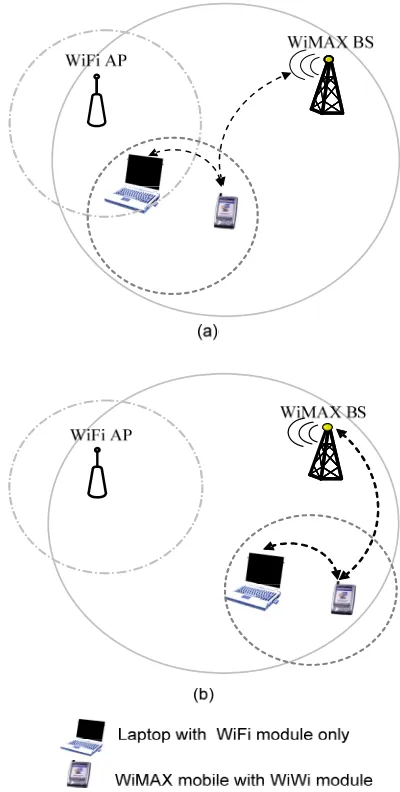
[image:3.595.321.521.79.475.2]shows the protocol stack of the proposed WiWi module. The scope of WiWi module is to increase the laptop range when the user moves out of the WiFi coverage by joining WiMAX network using the WiWi module in-stalled in the WiMAX mobile, as shown in Figure 2. The scope of this paper is to discuss adaptive handover decision for selecting either the WiFi or the WiMAX network.
Figure 2 shows the two possible scenarios for our study. (a) The Laptop within WiWi and WiFi networks coverage and (b) The Laptop out of WiFi network cov-erage. Scenario (b) is straightforward in which the laptop will see only one network connection provided by the WiWi module. The device will directly start the network
Figure 1. The interaction of WiWi protocol Stack with the WiMAX BS and WiFi device.
Figure 2. WiMAX and WiFi coverage in indoor and out-door (a) the laptop in the WiFi coverage (b) laptop is out of WiFi coverage.
entry process to join the WiMAX network using the WiWi module installed at the WiMAX mobile. There are two modes for the WiWi operation open access mode from which the user opens for everyone to access his/her WiMAX mobile (WiWi module), while in the close mode the WiFi device will only allow access to the WiMAX mobile to get the Internet access.
[image:3.595.59.286.630.687.2]) from the WiWi Module and the WiFi access point (AP). The difference between this scenario and the conven-tional scenario is that the decision criteria are not the same due to the difference in the technology in which the WiWi is a hybrid of the relay between the WiMAX and the WiFi as compared to the pure WiFi).
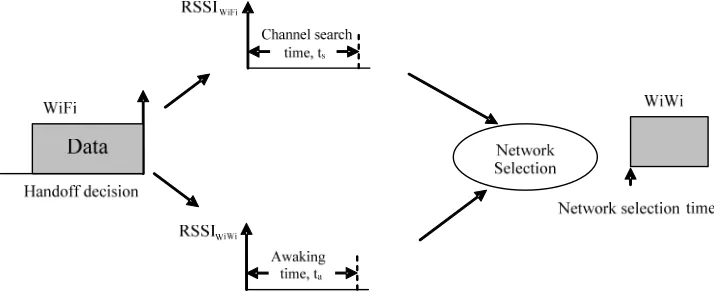
The RSSI value alone is not sufficient to be the deci-sion criteria for the handover, for example, in the closed mode the RSSI from the WiWi signal is usually greater than that of the AP (WiFi network) signal. Since the lap-top is close to the WiMAX mobile (owned by the same owner), the result will be to select the WiWi network. This is shown in Figure 3. Selecting the WiWi network is not always correct. Usually, the throughput of the WiWi network is lower than the WiFi throughput, due to the degradation results from the multihop (relay) in the WiWi network [14]. Consequently, it is not reasonable to initiate handover early if based on the conventional handover procedure. In this paper we propose a new al-gorithm for the network selection based not only on the RSSI but also on the total throughput. This is discussed in the next section.
4. Network Selection Scheme
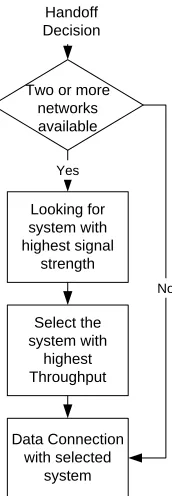
Figure 4 shows the handover decision based on the RSSI and the throughput. The total throughput ( WiWi for the WiWi network is calculated based on the WiMAX throughput ( WiMAX) and the effect of the vertical handover within the WiWi module:
( WiWi) ( WiMAX WiMAX
n
c n )
(1)where cWiMAX nis the degradation of throughput due
to the multihop relay [15]. WiMAX is the WiMAX ca-pacity and is the number of hops (i.e. in WiWi,
).
c
n
2
n l0 is the total throughput loss due to the protocol converter, where 0is the network selection time and l is the mean frame size. Figure 5 shows the
flow of the messages for connecting the WiFi devices with the WiWi network. Here we assume that the WiWi is in the closed mode so that there are no other nodes sharing the channel with the WiFi device. The ( WiMAX) throughput depends on the WiMAX channel bandwidth (i.e. 1.25 - 20 MHz) and the total number of tones (256 for fixed and 1024 for mobile) and the channel quality [16].
5. Simulation Results
A computer simulation is conducted for the network scenario in Figures 2 using the network simulation ns 2.34. A new software package is implemented to ns2 by using the scheme presented in Figures 3, 4 and 5. Other ns2 parameters setup is directly taken from [18] and [19]. From the related works, we found that mostly the two works are related to our work which are [15] and [16]. Both papers developed the schemes for the seamless ver-tical handover between the 802.16 and the 802.11. [15] The handover algorithm is implemented in the wireless mesh router where three air interfaces are built in the WMR, i.e., the 802.16 PMP, the 802.16 mesh, and the 802.11 access points with routing function for traffic coordination between the three air interfaces. In this sec-tion we compare our work with these two works in terms of time delay vs. packet size.
[image:4.595.119.476.554.700.2]Figure 6 shows the time delay of the WiMAX and the WiFi vertical handover schemes which show the delay time for the proposed method that outperforms the other two related works. The gateway delay in [16] has a higher delay due to the packets queue from different nodes.
Figure 7 shows the overall throughput which degrades with the network selection time. However, the degrada-tion is greater when using the ranging only (RSSI) than when the throughput is considered in the calculation. We need to take into consideration that the network selection
R. A. SAEED ET AL. 36
Data Connection with selected
system Select the system with
highest Throughput Looking for system with highest signal
strength Two or more
networks available
No Yes
[image:5.595.310.534.76.257.2]Handoff Decision
[image:5.595.124.210.78.326.2]Figure 4. Proposed network selection scheme in the WiFi to WiMAX handoff scenario.
Figure 5. Proposed signaling process in the WLAN to Wi-MAX handoff scenario.
time is less when only using the RSSI than when using both the RSSI and the network throughput, thus for the handover from the WLAN to the WiWi is better when using the RSSI only. This is due to the fixed network (WiFi) throughput which is normally larger than the mo-bile network (WiWi) throughput. In the open mode, where the WiWi module is open for all, the signal from the WiMAX base station can travel for the multi-hop Figure 8 shows that the overall throughput is dramatically degraded with the number of hops which is due to the delay to propagate for each hop. This prob-lem has been extensively discussed in the literature [12],
[image:5.595.311.537.297.474.2]
n2 .Figure 6. Vertical handover delay by using different proto-cols.
0 10 20 30 40 50 60
0 0.1 0.2 0.3 0.4 0.5 0.6 0.7 0.8 0.9 1
0(ms)
N
o
rm
a
liz
ed
O
v
er
a
ll
t
h
ro
ug
hpu
t
HO based on both RSSI and Throughput
HO based on both RSSI only
Figure 7. Normalized overall throughput for different type of network selections.
0 10 20 30 40 50 60
0 0.1 0.2 0.3 0.4 0.5 0.6 0.7 0.8 0.9 1
0(ms)
N
o
rm
al
iz
ed
O
v
er
a
ll t
hr
ou
gh
put
1-hop 2-hop 3-hop
[image:5.595.65.277.370.528.2] [image:5.595.312.534.512.686.2][14]. Our proposed WiWi module is working at hop 1. The figure shows acceptable performance can be achie- ved at 1-hop. Multiple hops are out of the scope of this paper.
6. Conclusions
While e WiMAX is getting mature, the need for in-ter-working with other technologies is becoming crucial especially with the local area networking, i.e., the WiFi. This paper presents an industrial design for a new verti-cal handover algorithm for the WiFi/WiMAX vertiverti-cal handover heterogeneous network. The proposed vertical handover is performed at the logical adaptation layer above the MAC layer. The results of the new algorithm shows less protocol converter time overhead which can guarantee thte QoS. The realization of the inter-working between these two standards is discussed and evaluated. Finally, ns2 results for the throughput and delay are given to show the performance of the vertical handoff implemented. The results are compared with the other conventional methods from the other related works.
7. References
[1] K. Pahlavan, P. Krishnamurthy, A. Hatami, M. Ylianttila, J. P. Makela, R. Pichna and J. Vallstron, “Handoff in Hybrid Mobile Data Networks,” Mobile and Wireless Communications Summit, Vol. 7, No. 2, April 2007, pp 34-47.
[2] J. Nie, J. C. Wen, Q. Dong, Z. Zhou, “A Seamless Hand-off in IEEE 802.16a and IEEE 802.11n Hybrid Net-works,” Communications, Circuits and Systems, 2005. Proceedings, 2005 International Conference on, Vol. 1, 27-30 May 2005, pp. 383-387.
[3] F. Behmann, “Impact of Wireless (Wi-Fi, WiMAX) on 3G and Next Generation: An Initial Assessment,” Electro Information Technology, 2005 IEEE International, Lin-coln, 12 May 2005, pp. 1-6.
[4] R. Inayat, R. Aibara and K. Nishimura, “A Seamless Handoff for Dual-Interfaced Mobile Devices in Hybrid Wireless Access Networks,” Advanced Information Net-working and Applications (AlNA2007), Vol. 1, 2007, pp. 373-378.
[5] O. S. Gaitan, P. Martins, S. Tohme and J. Demerjian, “SIP Embedded Attribute Certificates for Service Mobil-ity in Heterogeneous Multi-Operator Wireless Net-works,” Vehicular Technology Conference, (VTC2007), Dublin, 22-25 April 2007, pp. 2000-2004.
[6] G. Lampropoulos, K. Salkintzis and N. Passas, “Me-dia-Independent Handover for Seamless Service Provi-sion in Heterogeneous Networks,” IEEE Communica-tions Magazine, Vol. 46, No. 1, 2008, pp. 64-71. doi:10.1109/MCOM.2008.4427232
[7] Y. Zhang, L. T. Yang and J. H. Ma, “Unlicensed Mobile Access Technology: Protocols, Architecture, Security
Standards And Applications,” CRC Press, Boca Raton, 2008. doi:10.1201/9781420055382
[8] C. Tang, “Evolving to Wireless and Wireline Conver-gence—An Overview of IMS,” Wireless and Optical Communications, 2005 (WOCC2005), 22-23 April 2005, pp. 27-29.
[9] C. N. Ping, S. C. Liew and C. Lin, “Voice over Wireless LAN via IEEE 802.16 Wireless MAN and IEEE 802.11,” 2005 International Conference on Wireless Networks, Communications and Mobile Computing, Hong Kong, 13-16 June 2005, pp. 504-509.
doi:10.1109/WIRLES.2005.1549460
[10] P. Djukic and S. Valaee, “802.16 MCF for 802.11a Based Mesh Networks: A Case for Standards Re-Use,” 23rd Biennial Symposium on Communications, Kingston, 29 May-1 June 2006, pp. 186-189.
[11] L.-C. Wang, A. Chen and H.-H. Chen, “Network Selec-tion with Joint Vertical and Horizontal Handoff in Het-erogeneous WLAN and Mobile WiMAX Systems”, Ve-hicular Technology Conference (VTC2007), Hsinchu, 22-25 April 2007, pp. 794-798.
[12] D. Niyato and E. Hossain, “Wireless Broadband Access: WiMAX and Beyond—Integration of WiMAX and WiFi: Optimal Pricing for Bandwidth Sharing,” IEEE Communications Magazine, Vol. 45, No. 5, May 2007, pp: 140-146. doi:10.1109/MCOM.2007.358861
[13] J. Nie, l. Y. Zeng and J. C. Wen, “A Bandwidth Based Adaptive Fuzzy Logic Handoff in IEEE 802.16 and IEEE 802.11 Hybrid Networks,” 2007 International Confer-ence on ConvergConfer-ence Information Technology, Hyundai, 21-23 November 2007, pp. 24-29.
[14] S. N. Enrique and V. W. S. Wong, “Comparison between Vertical Handoff Decision Algorithms for Heterogeneous Wireless Networks,” 63rd IEEE Vehicular Technology Conference, Vol. 2, 2006, pp. 947-951.
doi:10.1109/VETECS.2006.1682964
[15] Y. Q. Zhang, W. H. Zhuang and A. Saleh, “Vertical Handoff between 802.11 and 802.16 Wireless Access Networks,” Global Telecommunications Conference, Waterloo, 30 November-4 December 2008, pp. 1-6.
[16] Y.-C. Chen, J.-H. Hsiaa and Y.-J. Liaoa, “Advanced Seamless Vertical Handoff Architecture for Wimax and Wifi Heterogeneous Networks with Qos Guarantees,”
Computer Communications, Vol. 32, No. 2, 2009, pp. 281-293. doi:10.1016/j.comcom.2008.10.014
[17] S. Xu and T. Saadawi, “Does the IEEE 802.11 MAC Protocol Work Well in Multihop Wireless Ad hoc Net-works,” IEEE Communications Magazine, Vol. 39, No. 6, June 2001, pp. 130-137. doi:10.1109/35.925681 [18] S. Wiethölter and C. Hoene, “IEEE 802.11e EDCA
Simulation Model for NS-2,” Telecommunication Net-works Group, 2007.
http://www.tkn.tu-berlin.de/research/802.11e_ns2/ [19] J. F. Borin, N. L. S.Fonseca, “A Standard-Compliant