ISSN Online: 2333-9721 ISSN Print: 2333-9705
DOI: 10.4236/oalib.1105586 Aug. 2, 2019 1 Open Access Library Journal
An Innovative GIS Method for Evaluating the
Visibility of the Road Using the ArcMap-Tools
Azad Abdulhafedh
Department of Civil Engineering, University of Missouri, Columbia, MO, USA
Abstract
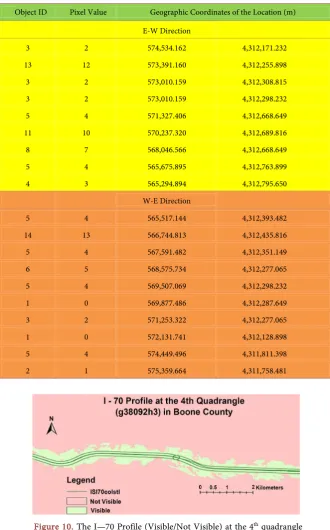
Road visibility is critical to motorists in making decisions such as stopping, slow downing, turning, entering a traffic stream from a driveway, or merging into traffic. Adequate visibility allows motorists the time they need to avoid vehicle crashes and conflicts and will help keep roadways operating safely and smoothly. Insufficient visibility is a significant factor in roadway crashes and near collisions. This paper utilizes the ArcMap-GIS viewshed tools, and the location analysis techniques to present an evaluation of the existing visibility on portions of the interstate highway I70 in the State of Missouri compared to AASHTO requirements. The evaluation of the existing visibility is conducted on the I70 segments at Boone, Callaway, and Cooper counties. This method is a useful tool for understanding location-based risks of limited visibility on the I70 or similar highways. The GIS techniques used show that the ArcMap-GIS tools can be used effectively in determining the road visibility and locating the hazardous locations without the need for field visits. Many highways were built years before tools like geographic information systems (GIS) and other computer aided designs were available. Therefore, this method can be consi-dered as a relevant aid for assessing geometric consistency of the I70 inter-state highway and similar roads, because it identifies different segments of the road layout that offer considerably different sight distances.
Subject Areas
Civil Engineering
Keywords
Road Visibility, Sight Distance, ArcMap, GIS, Viewsheds, AASHTO Green Book
1. Introduction
According to the American Association of State Highway and Transportation
How to cite this paper: Abdulhafedh, A. (2019) An Innovative GIS Method for Evaluating the Visibility of the Road Using the ArcMap-Tools. Open Access Library Journal, 6: e5586
https://doi.org/10.4236/oalib.1105586
Received: July 9, 2019 Accepted: July 29, 2019 Published: August 2, 2019
Copyright © 2019 by author(s) and Open Access Library Inc.
This work is licensed under the Creative Commons Attribution International License (CC BY 4.0).
DOI: 10.4236/oalib.1105586 2 Open Access Library Journal Officials (AASHTO), the ability of a driver to see ahead on the roadway is of pa-ramount importance for the safe and efficient operation of a vehicle. In general, sight distance refers to the driver’s line of sight. Insufficient sight distance is a significant factor in roadway crashes and many other near collisions [1]. Road-way sight distance is a measure of the road visibility, which can be categorized into four types: stopping sight distance; decision sight distance; passing sight distance; and intersection sight distance. Each of these sight distances accounts for the reaction time of the driver and the subsequent time required to complete the associated stopping task. Sight distance is the length of roadway ahead that is visible to the driver [1]-[8]. Moreover, the minimum sight distance at any point on the roadway should be long enough to enable a vehicle traveling at or near the design speed to stop before reaching a stationary object in its path. Although greater length is desirable, sight distance at every point along the highway should be at least that required for a below average driver or vehicle to stop in this distance. Stopping sight distances are calculated using basic principles of physics and the relationships between various design parameters. Providing adequate sight distance on a roadway is one of the central tasks of the designer. Adequate sight distance provides motorists the opportunity to avoid obstacles on the roadway, to merge smoothly with other traffic, and to traverse intersec-tions safely. Ramp, interchange, and intersection designs are typically completed in tightly constrained spaces with many structural, earthwork, and roadway ele-ments present that may obstruct sight distance. These eleele-ments are not easily moved; if consideration to sight distance constraints is not given early in the de-sign process, dede-signs may be compromised and may reduce the level of safety on the completed roadway. Therefore, sight distance criteria must be presented in a clear, comprehensive, and unambiguous manner to facilitate the completion of satisfactory roadway design [2][7]-[17].
For instance, the minimum length of the highway vertical curves is controlled by the required stopping sight distance, driver eye height, and object height. This required length of curve is such that, at a minimum, the stopping sight distance is available at all points along the curve. Sight distance criteria have impact on virtually all elements of highway design and many elements of the traffic opera-tion, and control. The roadway geometric design features, presence of obstacles to sight at the roadsides and the pavement surface condition are fixed by sight distance requirements. The nature of traffic controls, their placement and their effects on traffic stream conditions, such as traffic queues, must take account of sight distance requirements. Adequate stopping sight distance must be provided on 100% of the street and highway system so a driver with the standard eye height of 1080 mm may see an object of 600 mm with sufficient time to stop safely [1][2][13][14][15].
identi-DOI: 10.4236/oalib.1105586 3 Open Access Library Journal fies the cells in an input raster that can be seen from one or more observation points or lines. Each cell in the output raster receives a value that indicates how many observation points can see the location [3][14][15][16][17][18].
This paper utilizes the GIS tools, the Viewshed applications, and the location science and analysis techniques to present an evaluation of the existing stopping sight distances on portions of the interstate highway I70 in the State of Missouri. The evaluation of the sight distances is conducted on the I70 segments at Boone, Callaway, and Cooper counties. A design speed of 70 mph (110 km/h) was se-lected for the purpose of evaluation, and a corresponding standard AASHTO stopping sight distance of 730 ft (220 m) was compared against the existing sight distances at these portions of I70.
Many highways were built years before tools like geographic information sys-tems (GIS) and other computer aided design were available. Therefore, this me-thod can be considered as a relevant aid for assessing geometric consistency of the I70 interstate highway and/or similar roads, because it identifies different segments of the road layout that offer considerably different sight distances.
A stopping sight distance profile presented in this paper can also be a useful tool for understanding location-based risk of limited stopping sight distance. The profile shows the spots of insufficient stopping sight distance along the roadway, thereby illustrating the sight distance restrictions and where they oc-cur. This information can help designers understand the severity of a sight dis-tance restriction, how the restriction may interact with other roadway conditions or features, and how/where to implement mitigation strategies [9][12][15][18].
Data
The data used are obtained from the Missouri Spatial Data Information Service (MSDIS) website http://msdis.missouri.edu/. Six quadrangles are used for the analysis, as shown in Table 1.
2. Methodology
ArcGIS Desktop (ArcMap version 10.6.1) is used in the analysis. The data is up-loaded, and the main goal was to create Viewsheds, generate the I70 profiles and cartographic maps, and identify the points that do not meet the ASSHTO sight distance requirements. The profiles and the classified sections of the I70 were thoroughly inspected, and the existing sight distances of all points on the high-way interstate I—70 within Callahigh-way, Boone, and Cooper counties were com-pared against the recommended AASHTO stopping sight distance of 730 ft (220 m) that corresponds to the design speed of 70 mph (110 km/h) of the I70 inter-state highway.
The following steps are conducted throughout the analysis: • Importing the downloaded E00 interchange files in GIS • Densifying the I70 raster
DOI: 10.4236/oalib.1105586 4 Open Access Library Journal Table 1. Data files used in the analysis.
Quadrangle Code Type of the file County
g38092h2.e00.gz E00 Boone-Callaway
g38092h3.e00.gz E00 Boone
g38092h4.e00.gz E00 Boone
g38092h5.e00.gz E00 Boone-Cooper
g38092h10.e00.gz E00 Callaway
g38091h8.e00.gz E00 Callaway
• Adding new parameters to the attribute table of the point’s raster that control the visibility analysis in the viewsheds. These parameters are (OFFSET A = 1.08 m presenting the height of the driver’s eye recommended by AASHTO, OFFSET B = 0.6 m presenting the height of object above the road surface recommended by AASHTO, AZIMUTH 1 = 0, AZIMUTH 2 = 180 degrees, Vertical Angle 1 = +90 degrees, Vertical Angle 2 = −90 degrees, RADIUS 1 = 0, RADIUS 2 = 560 m presenting the radius of curvature recommended by AASHTO).
• Creating viewsheds for all points of the I70 raster • Buffering the DEMs by a distance of 200 m • Clipping the DEMs by the road buffers
• Connecting the buffered-clipped DEMs of all segments together by ArcMap Mosaic tools
• Generating the I70 profiles, and classified maps from the viewshed’s
• Identifying the IDs, and the geographic coordinates of all the points along the highway that did not meet the AASHTO recommended sight distance of 220 m
The main steps of the procedure are detailed below: 1) Import the E00 interchange files:
The E00 interchange files that are downloaded from the MSDIS website, were imported as follows:
(Arc Toolbox ≥ Conversion Tools ≥ To Coverage ≥ Import from E00). 2) Densify the I—70 rasters’:
Steps used are:
(Arc Toolbox ≥ Editing Tools ≥ Densify).
The Densification method was chosen to be (Distance), and the value of the Distance entered was (220 meter), which is the AASHTO recommended sight distance that corresponds to the design speed (70 mph).
3) Feature Vertices to Points:
The feature vertices of the I—70 are converted to points using,
(Arc Toolbox ≥ Data Management Tools ≥ Features ≥ Feature Vertices to Points).
DOI: 10.4236/oalib.1105586 5 Open Access Library Journal In order to control the visibility area, and creating the viewsheds accordingly, the following fields and parameters were added to the attribute table of the Ver-tices to Points layer:
• OFFSET A_1 = 1.08 meter, which presents the height of the driver’s eye above the road surface that is recommended by AASHTO Green Book, 2011. • OFFSETB = 0.6 meter, which presents the height of the visible object on the
road surface recommended by AASHTO Green Book, 2011.
• AZIMUTH_1 = 0 degree, which defines the start angle of the scan range • AZIMUTH 2 = 180 degree, which defines the end angle of the scan range • Vertical Angle 1 (VERT 1) = 90 degree, which defines the upper vertical
an-gle limit of the scan
• Vertical Angle 2 (VERT 2) = −90 degree, which defines the lower vertical an-gle limit of the scan
• RADIUS 1 = 0 meter, which defines the start distance from which visibility is determined
• RADIUS 2 = 560 meter, which defines the end distance from which visibility is determined, this value was chosen because it presents the recommended radius of curvature by AASHTO that corresponds to the design speed of (70 mph).
5) Creating Viewsheds
Viewsheds are created for all points at once, using the following steps: (Arc Toolbox ≥ 3D Analysis Tools ≥ Visibility ≥ Viewsheds),
The input raster: the quadrangle raster file, The input points feature: The Vertices To Points,
The output Raster: the Viewshed that corresponds to the quadrangle used, The Z factor was used as 1,
The earth curvature corrections is checked to be applied, and The Refractivity Coefficient is taken as the default value of 0.13 6) Modify the DEM by Buffering the Highway:
Each quadrangle raster layer of the I—70 interstate highway is buffered using an adequate distance around the I—70 for the purpose of evaluating the sight distances along the highway, and a distance of 200 meter is chosen as the buf-fering distance, as follows: (Customize ≥ Toolbar ≥ Editor ≥ Buffer).
7) Clipping the DEMs by the road buffer:
Each buffered quadrangle is clipped by the road buffer, as follows: (Customize ≥ Toolbar ≥ Editor ≥ Clip).
8) Mosaic the modified DEMs of all quadrangles together:
The modified DEMs from the different quadrangles are connected together using the Mosaic command, as follows:
(Arc Toolbox ≥ Data Management Tools ≥ Raster ≥ Raster Dataset ≥ Mosaic to New Raster), The input raster’s used were all created viewsheds of all the qu-adrangles.
The number of bands is =1,
DOI: 10.4236/oalib.1105586 6 Open Access Library Journal The mosaic Mode is the default (FIRST).
9) Identifying the locations that did not meet the recommended AASHTO Stopping Sight Distance of 220 m:
The profile of each quadrangle’s viewshed is inspected along the I—70 inter-state highways to highlight the locations or spots that did not meet the recom-mended AASHTO Stopping Sight Distance of (220 m). The points that fell short of the AASHTO standard sight distance were identified by inspection, and their IDs, and their geographic coordinates were determined by right-clicking on the location and using the “identify tools” that give the required information on that specific point or location.
3. Results and Findings
The map of the I70 profile at each quadrangle is generated from its correspond-ing viewshed and is classified into 5 classes to further show the locations that are visible and non-visible on the map. Since the points are separated originally by a distance of 220 m when converted from vertices to points, then obviously the non-visible locations are those points that did not meet the AASHTO recom-mended sight distance of 220 m along the highway profile. A thorough inspec-tion is conducted for the whole profile at each quadrangle, and the non-visible points are identified in term of their IDs and geographic coordinates and tabu-lated to present the locations of the insufficient sight distances along the I70 highway. The Object IDs, the Pixel Values, and the counts for each viewshed can be obtained from the attribute table of the viewshed and were tabulated for each viewshed/quadrangle. The overall profile of the I70 highway at each quadrangle, and the classified sections are shown below with the tables that contain the points that did not meet the AASHTO sight distance.
3.1. 1
stQuadrangle
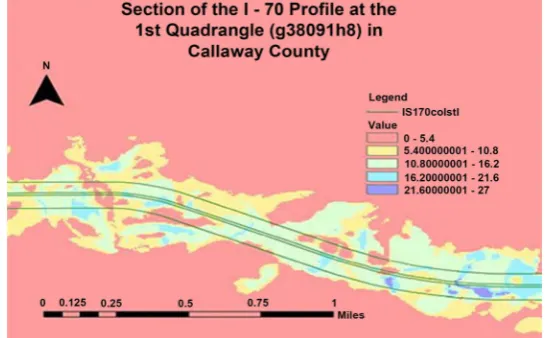
The I—70 Profile at the 1st quadrangle in Callaway County is shown in Figure 1 below:
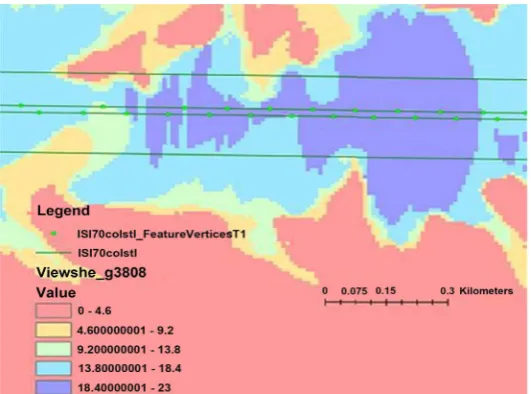
The classified section of the I—70 Interstate Highway at the 1st quadrangle in
the Callaway County is shown in Figure 2 and Figure 3.
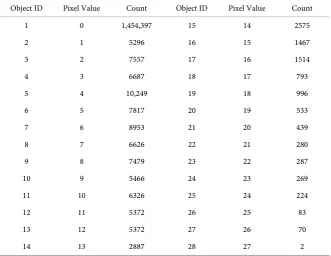
For the 1st quadrangle (g38091h8, located in Callaway County), the Object
IDs, the Pixel Values, and the counts are found from the attribute table of the viewshed, and as shown in Table 2.
The locations that did not meet the AASHTO standard stopping sight dis-tance of 220m at the 1st quadrangle, are shown in Table 3.
3.2. 2
ndQuadrangle
The I—70 Profile at the 2nd quadrangle in Callaway County is shown in Figure 4.
The classified section of the I—70 Interstate Highway at the 2nd quadrangle in
DOI: 10.4236/oalib.1105586 7 Open Access Library Journal Figure 1. The I—70 Profile (Visible/Not Visible) at the 1st quadrangle in Callaway County.
Figure 2. The I—70 Profile (Visible/Not Visible) at the 1st quadrangle in Callaway County.
[image:7.595.239.509.470.693.2]DOI: 10.4236/oalib.1105586 8 Open Access Library Journal Figure 4. The I—70 Profile (Visible/Not Visible) at the 2nd quadrangle in
[image:8.595.238.510.282.451.2]Callaway County.
Figure 5. The I—70 classified Profile at the 2nd quadrangle in Callaway
County.
Figure 6. The I—70 classified Profile (second image) at the 2nd
[image:8.595.241.507.494.691.2]DOI: 10.4236/oalib.1105586 9 Open Access Library Journal Table 2. Object IDs and counts in Callaway County.
Object ID Pixel Value Count Object ID Pixel Value Count
1 0 1,454,397 15 14 2575
2 1 5296 16 15 1467
3 2 7557 17 16 1514
4 3 6687 18 17 793
5 4 10,249 19 18 996
6 5 7817 20 19 533
7 6 8953 21 20 439
8 7 6626 22 21 280
9 8 7479 23 22 287
10 9 5466 24 23 269
11 10 6326 25 24 224
12 11 5372 26 25 83
13 12 5372 27 26 70
[image:9.595.209.540.379.538.2]14 13 2887 28 27 2
Table 3. Objects and locations of insufficient sight distance at 1st quadrangle.
Object ID Pixel Value Geographic Coordinates of the Location (m)
E-W Direction
5 4 594,070.439 4,311,304.627
10 9 592,567.603 4,311,304.627
9 8 590,605.714 4,311,563.919
7 6 587,562.999 4,312,132.774
W-E Direction
10 9 588,541.959 4,311,735.898
6 5 589,507.691 4,311,735.898
3 2 592,748.843 4,310,876.001
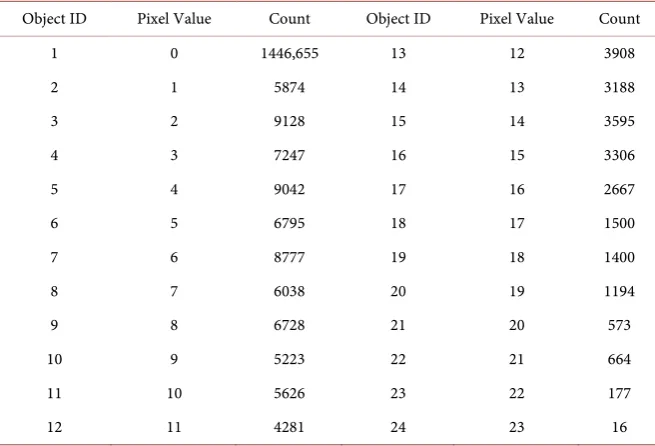
For the 2nd quadrangle (g38092h10, located in Callaway County), the Object
IDs, the Pixel Values, and the counts are found from the attribute table of its viewshed, and as shown in Table 4.
The locations that did not meet the AASHTO standard stopping sight dis-tance of 220m at the 2nd quadrangle, are shown in Table 5.
3.3. 3
rdQuadrangle
The I—70 Profile at the 3rd quadrangle in Boone-Callaway Counties is shown in Figure 7.
The classified section of the I—70 Interstate Highway at the 3rd quadrangle in
DOI: 10.4236/oalib.1105586 10 Open Access Library Journal Table 4. Object IDs and Counts at the 2nd quadrangle.
Object ID Pixel Value Count Object ID Pixel Value Count
1 0 1446,655 13 12 3908
2 1 5874 14 13 3188
3 2 9128 15 14 3595
4 3 7247 16 15 3306
5 4 9042 17 16 2667
6 5 6795 18 17 1500
7 6 8777 19 18 1400
8 7 6038 20 19 1194
9 8 6728 21 20 573
10 9 5223 22 21 664
11 10 5626 23 22 177
[image:10.595.207.540.344.667.2]12 11 4281 24 23 16
Table 5. Locations with insufficient sight distance at the 2nd quadrangle.
Object ID Pixel Value Geographic Coordinates of the Location (m)
E-W Direction
5 4 585,828.440 4,312,081.055
7 6 584,124.520 4,312,081.055
1 0 578,716.426 4,312,144.555
1 0 578,769.343 4,312,144.555
10 9 578,155.508 4,312,165.722
7 6 577,605.174 4,312,155.139
3 2 577,404.090 4,312,176.305
2 1 576,451.588 4,312,218.639
4 3 576,176.421 4,312,218.726
W-E Direction
6 5 576,620.922 4,311,901.138
7 6 576,747.922 4,311,954.055
7 6 576,949.006 4,311,774.138
5 4 577,531.090 4,311,784.721
4 3 578,536.509 4,311,795.305
3 2 579,086.843 4,311,763.555
For the 3rd quadrangle (g38092h2, located between Boone-Callaway Counties),
DOI: 10.4236/oalib.1105586 11 Open Access Library Journal Figure 7. The I—70 Profile (Visible/Not Visible) at the 3rd quadrangle in
[image:11.595.238.511.247.395.2]Boone-Callaway Counties.
Figure 8. The I—70 classified Profile at the 3rd quadrangle in
Boone-Callaway Counties.
Figure 9. The I—70 classified Profile (second image) at the 3rd
[image:11.595.238.510.437.694.2]DOI: 10.4236/oalib.1105586 12 Open Access Library Journal Table 6. Object IDs and Counts at the 3rd quadrangle.
Object ID Pixel Value Count Object ID Pixel Value Count
1 0 1,454,209 12 11 3765
2 1 6567 13 12 3177
3 2 9834 14 13 2272
4 3 7810 15 14 1999
5 4 10,174 16 15 1265
6 5 7095 17 16 834
7 6 7310 18 17 274
8 7 6295 19 18 146
9 8 7310 20 19 99
10 9 5550 21 20 55
11 10 5036 22 21 24
The locations that did not meet the AASHTO standard stopping sight dis-tance of 220 m at the 3rd quadrangle, are shown in Table 7.
3.4. 4
thQuadrangle
The I—70 Profile at the 4th quadrangle in Boone County is shown in Figure 10.
The classified section of the I—70 Interstate Highway at the 4th quadrangle in the Boone County is shown in Figure 11 and Figure 12.
For the 4th quadrangle (g38092h3, located in Boone County), the Object IDs, the Pixel Values, and the counts were found from the attribute table of its viewshed, and are shown in Table 8.
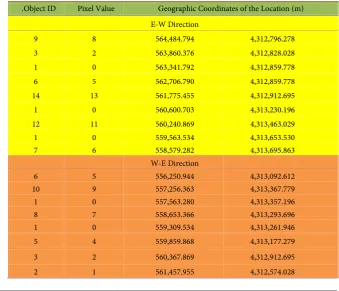
The locations that did not meet the AASHTO standard stopping sight dis-tance of 220 m at the 4th quadrangle are shown in Table 9.
3.5. 5
thQuadrangle
The I—70 Profile at the 5th quadrangle in Boone County is shown in Figure 13.
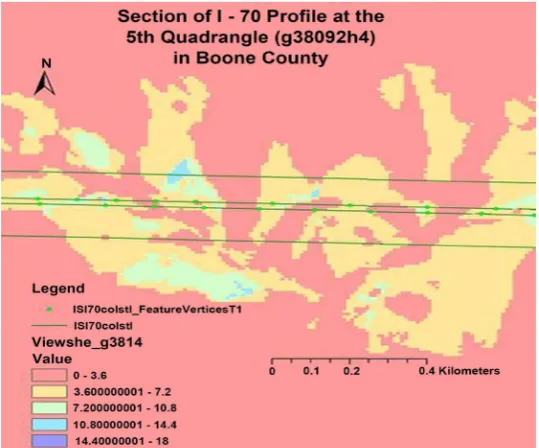
The classified section of the I—70 Interstate Highway at the 5th quadrangle in the Boone County is shown in Figure 14 and Figure 15.
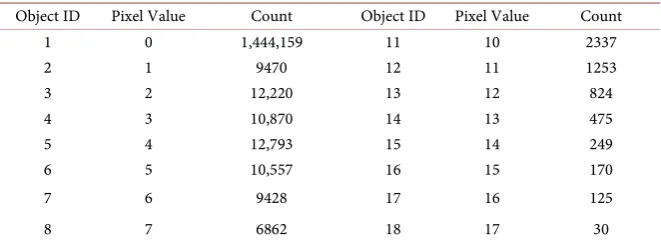
For the 5th quadrangle (g38092h4, located in Boone County), the Object IDs, the Pixel Values, and the counts were found from the attribute table of its viewshed are shown in Table 10.
The locations that did not meet the AASHTO standard stopping sight dis-tance of 220 m at the 5th quadrangle, are shown in Table 11.
3.6. 6
thQuadrangle
DOI: 10.4236/oalib.1105586 13 Open Access Library Journal Table 7. Locations with insufficient sight distance at the 3rd quadrangle.
Object ID Pixel Value Geographic Coordinates of the Location (m)
E-W Direction
3 2 574,534.162 4,312,171.232
13 12 573,391.160 4,312,255.898
3 2 573,010.159 4,312,308.815
3 2 573,010.159 4,312,298.232
5 4 571,327.406 4,312,668.649
11 10 570,237.320 4,312,689.816
8 7 568,046.566 4,312,668.649
5 4 565,675.895 4,312,763.899
4 3 565,294.894 4,312,795.650
W-E Direction
5 4 565,517.144 4,312,393.482
14 13 566,744.813 4,312,435.816
5 4 567,591.482 4,312,351.149
6 5 568,575.734 4,312,277.065
5 4 569,507.069 4,312,298.232
1 0 569,877.486 4,312,287.649
3 2 571,253.322 4,312,277.065
1 0 572,131.741 4,312,128.898
5 4 574,449.496 4,311,811.398
2 1 575,359.664 4,311,758.481
Figure 10. The I—70 Profile (Visible/Not Visible) at the 4th quadrangle
in Boone County.
The classified section of the I—70 Interstate Highway at the 6th quadrangle in the Boone-Cooper Counties is shown in Figure 17-19.
[image:13.595.208.537.97.604.2]DOI: 10.4236/oalib.1105586 14 Open Access Library Journal Figure 11. The I—70 classified Profile at the 4th quadrangle in Boone
[image:14.595.238.510.315.517.2]County.
Figure 12. The I—70 classified Profile (second image) at the 4th
qua-drangle in Boone County.
Figure 13. The I—70 Profile (Visible/Not Visible) at the 4th quadrangle
[image:14.595.240.506.559.694.2]DOI: 10.4236/oalib.1105586 15 Open Access Library Journal Figure 14. The I—70 classified Profileat the 5th quadrangle in Boone
[image:15.595.239.509.273.497.2]County.
Figure 15. The I—70 classified Profile (second image) at the 5th
qua-drangle in Boone County.
Figure 16. The I—70 Profile (Visible/Not Visible) at the 6th quadrangle
[image:15.595.239.510.541.696.2]DOI: 10.4236/oalib.1105586 16 Open Access Library Journal Table 8. Object IDs and Counts at the 4th quadrangle.
Object ID Pixel Value Count Object ID Pixel Value Count
1 0 1,455,300 23 22 747
2 1 5453 24 23 397
3 2 8129 25 24 249
4 3 7526 26 25 224
5 4 7179 27 26 171
6 5 7177 28 27 202
7 6 5648 29 28 117
8 7 5522 30 29 113
9 8 4985 31 30 97
10 9 4005 32 31 45
11 10 3136 33 32 52
12 11 3430 34 33 32
13 12 2625 35 34 29
14 13 2162 36 35 25
15 14 1667 37 36 15
16 15 1480 38 37 7
17 16 1574 39 38 9
18 17 1482 40 39 8
19 18 1573 41 40 18
20 19 1465 42 41 24
21 20 1312 43 42 33
22 21 650 44 43 8
Table 9. Locations with insufficient sight distance at the 4th quadrangle.
.Object ID Pixel Value Geographic Coordinates of the Location (m) E-W Direction
9 8 564,484.794 4,312,796.278
3 2 563,860.376 4,312,828.028
1 0 563,341.792 4,312,859.778
6 5 562,706.790 4,312,859.778
14 13 561,775.455 4,312,912.695
1 0 560,600.703 4,313,230.196
12 11 560,240.869 4,313,463.029
1 0 559,563.534 4,313,653.530
7 6 558,579.282 4,313,695.863
W-E Direction
6 5 556,250.944 4,313,092.612
10 9 557,256.363 4,313,367.779
1 0 557,563.280 4,313,357.196
8 7 558,653.366 4,313,293.696
1 0 559,309.534 4,313,261.946
5 4 559,859.868 4,313,177.279
3 2 560,367.869 4,312,912.695
[image:16.595.199.539.447.738.2]DOI: 10.4236/oalib.1105586 17 Open Access Library Journal Table 10. Object IDs and Counts at the 5th quadrangle.
Object ID Pixel Value Count Object ID Pixel Value Count
1 0 1,444,159 11 10 2337
2 1 9470 12 11 1253
3 2 12,220 13 12 824
4 3 10,870 14 13 475
5 4 12,793 15 14 249
6 5 10,557 16 15 170
7 6 9428 17 16 125
[image:17.595.206.540.239.555.2]8 7 6862 18 17 30
Table 11. Locations with insufficient sight distance at the 5th quadrangle.
Object ID Pixel Value Geographic Coordinates of the Location (m)
E-W Direction
3 2 553,098.683 4,313,800.369
2 1 552,103.848 4,313,885.036
1 0 552,082.681 4,313,874.453
1 0 549,786.093 4,313,990.870
2 1 548,558.424 4,314,012.036
1 0 548,209.173 4,314,012.036
2 1 547,743.506 4,314,033.203
2 1 545,838.502 4,314,086.120
10 9 545,108.250 4,314,075.536
8 7 543,446.664 4,314,160.203
W-E Direction
1 0 544,430.916 4,313,736.869
1 0 544,759.000 4,313,726.286
6 5 545,870.252 4,313,705.119
1 0 548,188.006 4,313,620.452
3 2 549,299.259 4,313,599.285
2 1 550,040.094 4,313,556.952
1 0 551,701.680 4,313,504.035
2 1 553,119.850 4,313,398.202
Table 12. Object IDs and Counts at the 6th quadrangle.
Object ID Pixel Value Count Object ID Pixel Value Count
1 0 1,428,067 11 10 7063
2 1 7641 12 11 4147
3 2 10,903 13 12 3441
4 3 8864 14 13 2200
5 4 10,727 15 14 2005
6 5 9442 16 15 767
7 6 9873 17 16 190
[image:17.595.205.539.584.735.2]DOI: 10.4236/oalib.1105586 18 Open Access Library Journal Figure 17. The I—70 classified Profileat the 6th quadrangle in
Boone-Cooper Counties.
Figure 18. The I—70 classified Profile (second image) at the 6th
qua-drangle in Boone-Cooper Counties.
The locations that did not meet the AASHTO standard stopping sight dis-tance of 220 m at the 6th quadrangle, are shown in Table 13.
4. Conclusions
[image:18.595.240.510.326.532.2]DOI: 10.4236/oalib.1105586 19 Open Access Library Journal Figure 19. The I—70 classified Profile (third image) at the 6th
quadran-gle in Boone-Cooper Counties.
Table 13. Locations with insufficient sight distance at the 6th quadrangle.
Object ID Pixel Value Geographic Coordinates of the Location (m)
E-W Direction
5 4 540,590.674 4,313,656.531
2 1 540,299.631 4,313,365.489
1 0 540,233.485 4,313,325.801
3 2 539,717.547 4,312,915.696
2 1 532,600.241 4,310,322.774
W-E Direction
1 0 532,798.679 4,309,859.753
2 1 533,830.556 4,309,846.524
3 2 535,920.769 4,309,965.586
5 4 536,754.208 4,309,965.586
1 0 539,915.985 4,312,465.904
1 0 540,352.548 4,312,862.780
1 0 540,431.923 4,312,902.467
3 2 540,696.507 4,313,167.051
5 4 542,971.928 4,313,749.136
[image:19.595.208.539.398.667.2]DOI: 10.4236/oalib.1105586 20 Open Access Library Journal Cooper counties. The method used hereby utilized the GIS capability of analyz-ing the visibility of a line or area through creatanalyz-ing viewsheds for six quadrangles along the I70 alignment. A standard AASHTO stopping sight distance of 730 ft (220 m) was compared to the existing sight distances, and the IDs and coordi-nates of the points that did not meet the AASHTO requirements were identified. The steps used to generate the viewsheds and profile maps of the I70 interstate highway were as follows:
Importing the E00 interchange files into GIS coverage files Densifying the I70 raster
Converting the Vertices of I70 Features to Points
Adding new parameters to the attribute table of the point’s raster that control the visibility analysis in the viewsheds. These parameters were (OFFSET A = 1.08 m presenting the height of the driver’s eye recommended by AASHTO, OFFSET B = 0.6 m presenting the height of object above the road surface recommended by AASHTO, AZIMUTH 1 = 0, AZIMUTH 2 = 180 degrees, Vertical Angle 1 = +90 degrees, Vertical Angle 2 = −90 degrees, RADIUS 1 = 0, RADIUS 2 = 560 m presenting the radius of curvature recommended by AASHTO).
Creating viewsheds for all points of the I70 point’s raster at once Buffering the DEMs by a distance of 200 m
Clipping the DEMs by the road buffers
Connecting the buffered-clipped DEMs of all segments together by Mosaic tools
Generating the I70 profiles, and classified maps from the viewshed’s raster’s Identifying the IDs, and the geographic coordinates of all the points along the
DOI: 10.4236/oalib.1105586 21 Open Access Library Journal
Conflicts of Interest
The author declares no conflicts of interest regarding the publication of this pa-per.
References
[1] American Association of State Highway and Transportation Officials (AASHTO) (2011) A Policy on Geometric Design of Highways and Streets. Washington DC. [2] Azimi, M. and Hawkins, H. (2013) Algorithm for Analyzing Horizontal Sight
Dis-tance from Lane Centerline Coordinates. Transportation Research Record: Journal of the Transportation Research Board, 2358, 12-19.https://doi.org/10.3141/2358-02
[3] Ben-Arieh, D., Chang, S., Rys, M. and Zhang, G. (2004) Geometric Modeling of Highways Using Global Positioning System Data and B-Spline Approximation.
Journal of Transportation Engineering, 130, 632-636.
https://doi.org/10.1061/(ASCE)0733-947X(2004)130:5(632)
[4] Cai, H. and Rasdorf, W. (2008) Modeling Road Centerlines and Predicting Lengths in 3-D Using LIDAR Point Cloud and Planimetric Road Centerline Data. Comput-er-Aided Civil and Infrastructure Engineering, 23, 157-173.
https://doi.org/10.1111/j.1467-8667.2008.00518.x
[5] Abdulhafedh, A. (2017) Identifying Vehicular Crash High Risk Locations along Highways via Spatial Autocorrelation Indices and Kernel Density Estimation.
WorldJournal of Engineering and Technology, 5, 198-215.
https://doi.org/10.4236/wjet.2017.52016
[6] Castro, M., Iglesias, L., Rodríguez-Solano, R. and Sánchez, J.A. (2006) Geometric Modelling of Highways Using Global Positioning System (GPS) Data and Spline Approximation. Transportation Research Part C—Emerging Technologies, 14, 233-243.https://doi.org/10.1016/j.trc.2006.06.004
[7] Fisher, P.F. (1996) Extending the Applicability of Viewsheds in Landscape Plan-ning. Photogrammetric Engineering and Remote Sensing, 62, 1297-1302.
[8] Imran, M., Hassan, Y. and Patterson, D. (2006) GPS-GIS-Based Procedure for Tracking Vehicle Path on Horizontal Alignments. Computer-Aided Civil and Infra-structure Engineering, 21, 383-394.
https://doi.org/10.1111/j.1467-8667.2006.00444.x
[9] Khattak, A.J. and Shamayleh, H. (2005) Highway Safety Assessment through Geo-graphic Information System-Based Data Visualization. Journal of Computing in Civil Engineering, 19, 407-411.
https://doi.org/10.1061/(ASCE)0887-3801(2005)19:4(407)
[10] Kitzpatrick, K., Fambro, D.B. and Stoddard, A.M. (2000) Safety Effects of Limited Stopping Sight Distance on Crest Vertical Curves. Transportation Research Record:
Journal of the Transportation Research Board, 1701, 17-24.
https://doi.org/10.3141/1701-03
[11] Abdulhafedh, A. (2017) A Novel Hybrid Method for Measuring the Spatial Auto-correlation of Vehicular Crashes: Combining Moran’s Index and Getis-OrdGi
Sta-tistic. Open Journal of Civil Engineering, 7, 208-221.
https://doi.org/10.4236/ojce.2017.72013
[12] Nehate, G. and Rys, M. (2006) 3D Calculation of Stopping-Sight Distance from GPS Data. Journal of Transportation Engineering, 132, 691-698.
DOI: 10.4236/oalib.1105586 22 Open Access Library Journal
[13] Polus A., Livneh, M. and Frischer B. (2000) Evaluation of the Passing Process on Two-Lane Rural Highways. Transportation Research Record: Journal of the Trans-portation Research Board, 1701, 53-60. https://doi.org/10.3141/1701-07
[14] Rose, E.R., Hawkins, H.G., Holick, A.J. and Bligh, R.P. (2004) Evaluation of Traffic Control Devices: First Year Activities. FHWA/TX-05-0-4701-1, Texas Transporta-tion Institute.
[15] Berbel, D.C., Castro, M., Medina. L.C. and Maria, S.P.G. (2014) Sight Distance Stu-dies on Roads: Influence of Digital Elevation Models and Roadside Elements. Pro-cedia—Social and Behavioral Sciences, 160, 449-458.
https://doi.org/10.1016/j.sbspro.2014.12.157
[16] Abdulhafedh, A. (2017) How to Detect and Remove Temporal Autocorrelation in Vehicular Crash Data. Journal of Transportation Technologies, 7, 133-147.
https://doi.org/10.4236/jtts.2017.72010
[17] Shaker, A., Yan, W.Y. and Easa, S. (2011) Construction of Digital 3D Highway Model Using Stereo IKONOS Satellite Imagery. GeocartoInternational, 26, 49-67.
https://doi.org/10.1080/10106049.2010.537785
[18] Tsai, Y., Hu, Z. and Wang, Z. (2010) Vision-Based Roadway Geometry Computa-tion. Journal of Transportation Engineering, 136, 223-233.