ISSN Online: 2327-6053 ISSN Print: 2327-6045
DOI: 10.4236/msce.2019.78001 Aug. 5, 2019 1 Journal of Materials Science and Chemical Engineering
Synthesis, Characterization and Anticancer
Activity Studies of New Schiff Base Pt (II)
Complex
Sama A. Al-Aghbari
1*, Omar M. Al-Shuja’a
2, Rowaida Al-Badani
1, Abd Al-Wali M. Japir
3,41Chemistry Department, Faculty of Pharmacy, University of Science & Technology, Sana’a, Yemen 2Chemistry Department, Faculty of Applied Science, Thamar University, Thamar, Yemen
3CAS Key Laboratory of Soft Matter Chemistry, Department of Polymer Science and Engineering, University of Science and
Technology of China, Hefei, China
4Department of Chemistry, Faculty of Education, Thamar University, Dhamar, Yemen
Abstract
A New Schiff base ligand and its Pt (II) complex were synthesized. The ligand was prepared by condensation of 2-(4-isobutylphenyl)propanehydrazide with 2,3,4-trihydroxy benzaldehyde this novel ligand and its functional group was carefully designed and selected from well-known biological drugs. The struc-ture of the ligand and its Pt-complex have been confirmed by spectroscopic data, i.e. elemental (CHN) analysis, FT-IR, electronic spectra, NMR spectra. The ligand and its Pt-complex were investigated for their in vitro anticancer potential using HeLa and PC3 cells. The Pt-complex showed a higher cyto-toxic activity than the ligand towards Hela cells and PC3 cells.
Keywords
Schiff Base, Complexes, Platinum, Anticancer Activity
1. Introduction
Schiff bases play an important role in development of coordination chemistry. Many coordination compounds of biologically active ligands have synthesized and received much attention [1][2][3].
Chelation causes drastic change in the biological properties or the ligands and also the metal moieties [4]. Azomethines exhibit a wide range of pharmacologi-cal activities like antimicrobial [5], anti-parasitic [6], anti-inflammatory [7] and anticancer [8]. Schiff base and its metal complexes possess several interesting bi-ological activities such as anti-microbial and antitumor [9]-[15].
How to cite this paper: Al-Aghbari, S.A., Al-Shuja’a, O.M., Al-Badani, R. and Japir, A.A.-W.M. (2019) Synthesis, Characteriza-tion and Anticancer Activity Studies of New Schiff Base Pt (II) Complex. Journal of Materials Science and Chemical Engineer-ing, 7, 1-8.
https://doi.org/10.4236/msce.2019.78001
Received: July 2, 2019 Accepted: August 2, 2019 Published: August 5, 2019
Copyright © 2019 by author(s) and Scientific Research Publishing Inc. This work is licensed under the Creative Commons Attribution International License (CC BY 4.0).
http://creativecommons.org/licenses/by/4.0/
DOI: 10.4236/msce.2019.78001 2 Journal of Materials Science and Chemical Engineering
In this work, Schiff base ligand was prepared and complexed with Potassium tetrarchloroplatinate (K2PtCl4). Characterization, electronic properties and
anti-cancer effect are reported.
2. Experimental
2.1. Chemicals
The drug, chemicals and solvents used in this study were of analytical grade and used as obtained from Aldrich without further purification: Ibuprofen drug, hy-drazine hydrate, Potassium tetrachloroplatinate (II) (K2PtCl4), Methanol (CH3OH),
deionized water.
2.2. Instrumental
The melting points were measured on an electro thermal melting point appara-tus and were not corrected. Fourier-transform infrared spectra were recorded using the KBr disc technique on a JASCO 410 FTIR spectrophotometer. Ele-mental (CHN) analysis was performed using an Exeter CE-440 eleEle-mental ana-lyzer. UV-visible absorption spectra were measured in DMF (≈ 10−5 mole−1)
us-ing a Pye-Unicam 8800a uv-visible automatic scannus-ing spectrophotometer.1
HNMR spectra of the ligand and its complex were recorded on a Varian Gemi-ni-200 spectrometer (300 MHZ) using DMSO-d6 as solvent and TMS as internal reference. 13C NMR spectra of the ligand in DMSO was obtained using a Bruker
500 MHZ instrument using TMS as internal reference. Anticancer activity was evaluated at the Regional Center for Mycology and Biotechnology, Al-Azhar University, Cairo, Egypt.
2.3. Synthesis of Schiff Base
Synthesis of Schiff base L
The Schiff base ligand was prepared by condensation of mixture (0.001 mol) of 2-(4-isobutylphenyl)propanehydrazide and the 2,3,4-trihydroxybenzaldehyde in (30 ml) methanol. The mixture was refluxing for 24 h, The precipitated was filtered, crystallized by methanol, then dried in air for 24 h. Compound 2-(4-isobutylphenyl)propanehydrazide was prepared according the literature
[16].
Synthesis of Schiff base Platinum Complex (L-Pt)
The Schiff base Platinum complex (L-Pt) was prepared by mixing (0.001 mol) of K2PtCl4 was dissolved in 10 ml of methanol with some amount of deionized
water and (0.001 mol) of Schiff base L in 20 ml of methanol. The mixture was refluxing for 24 h, The precipitated complex was filtered, washed twice with methanol, then dried in air for 24 h.
2.4. Cytotoxicity
Cell line Propagation
inacti-DOI: 10.4236/msce.2019.78001 3 Journal of Materials Science and Chemical Engineering
vated fetal calf serum and 50 µg/ml gentamycin. The cells were maintained at 37˚C in a humidified atmosphere with 5% CO2 and were subculture two to three
times a week.
Cytotoxicity evaluation using viability assay
For antitumor assays, the growth cell lines were suspended in medium at concentration 5 × 10⁴ cell/well in Corning® 96-well tissue culture plates, then
incubated for twenty-four hour. The tested compounds were then additional in-to 96-well plates (3 replicates) in-to attain 12 concentrations for further compound. 6 vehicle controls with media or ½% dimethyl sulfoxide were run for each 96 well plate as a control. After incubating for twenty-four hour, the numbers of viable cells were determined by the MTT check. Briefly, the media was far from the 96 well plate and replaced with 100 µl of fresh culture RPMI 1640 medium without phenol red then ten µl of the twelve mM MTT, stock solution (five mg of MTT in one mL of PBS) to each well including the untreated controls. The 96 well plates were then incubated at 37˚C and five % CO2 for four hours. An 85 µl
aliquot of the media was removed from the wells, and 50 µl of DMSO was added to each well and mixed thoroughly with the pipette and incubated at 37˚C for 10 min. Then, the optical density was measured at 590 nm with the microplate reader (SunRise, TECAN, Inc, USA)to see the quantity of viable cells and the percentage of viability was calculated as [(ODt/ODc)]× 100% where ODt is the mean optical density of wells treated with the tested sample and ODc is the mean optical density of untreated cells. The relation between living cells and drug concentration is plotted to get the survival curve of each tumor cell line af-ter treatment with the required compound. The 50% inhibitory concentration (IC50), the concentration needed to cause toxic effects in 50% of intact cells, was
calculable from graphic plots of the dose response curve for every concentration using Graph pad Prism software system (San Diego, CA. USA) [17][18].
3. Result and Discussion
3.1. Synthesis and Characterization
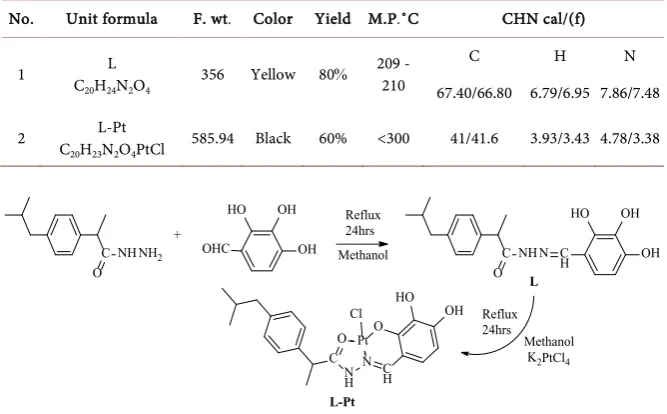
The Schiff base ligand was prepared by condensation of mixture (0.001 mol) of 2-(4-isobutylphenyl)propane hydrazide and the 2,3,4-trihydroxybenzaldehyde in (30 ml) methanol. The mixture was refluxing for 24 h, The precipitated was fil-tered, crystallized by methanol, then dried in air for 24 h. The Schiff base Plati-num complex (L-Pt) was prepared by mixing (0.001 mol) of K2PtCl4 was
dis-solved in 10 ml of methanol with some amount of deionized water and (0.001 mol) of Schiff base L in 20 ml of methanol. The mixture was refluxing for 24 h, The precipitated complex was filtered, washed twice with methanol, then dried in air for 24 h. Table 1 summarized the physical properties (melting point, color, percentage yield, and elements analysis) of the ligand and its Pt com-plex. The proposed structure of Schiff base and L-Pt Complex were shown in
DOI: 10.4236/msce.2019.78001 4 Journal of Materials Science and Chemical Engineering
Table 1. Physical properties of Schiff base and its complex.
No. Unit formula F. wt. Color Yield M.P.˚C CHN cal/(f)
1 C L
20H24N2O4 356 Yellow 80%
209 - 210
C H N
67.40/66.80 6.79/6.95 7.86/7.48
2 C L-Pt
20H23N2O4PtCl 585.94 Black 60% <300 41/41.6 3.93/3.43 4.78/3.38
Scheme 1. The proposed structure of Schiff base L and its Pt complex L-Pt.
3.2. IR Spectra
The main IR Spectra of ligand and its complex are summarized in Table 2, The absence of the aldehydic carbonyl stretch in the ligand and the appearance of the characteristic azomethine υ C=N at 1633 cm−1 confirmed formation of the Schiff
base. Comparison of infrared spectral data of Pt-complex and its corresponding ligand confirmed complexation as signification shifts in υ C=N was observed the strong band at 1633 cm−1 assigned to υ C=N in the free ligand shifted to higher
wave number in Pt-complex at 1652 cm−1, indicating participation of
azome-thine nitrogen coordination. More ever, the single band at 3447 cm−1 due to the
υ OH vibration was shifted upon complexation, which confirmed the involve-ment of the OH hydroxyl group in coordination to metal ions [19][20].
3.3. NMR Spectra
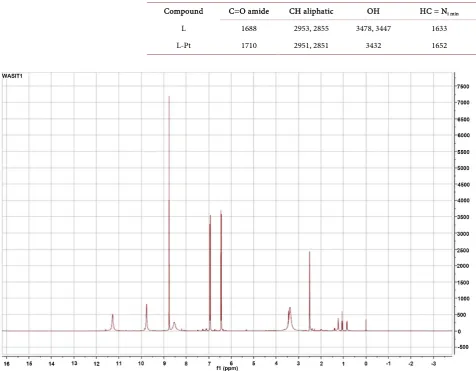
The main 1HNMR spectrum of the L, showed the azomethine proton at δ 8.6
ppm (s, 1H), while the multiples at δ (6.2 - 7.3) ppm (m, 6H) were ascribed to aromatic protons, the OH were observed at δ 8.8 ppm (s, 1H), 9.7 ppm (s, 1H) and 11.3 ppm (s, 1H).
For the 1HNMR spectrum of the Pt (II) complex an electron density shift was
observed from ligand to metal signal of azomethine proton appeared at δ 7.5 ppm (s, 1H) as compared to 8.6 ppm in the ligand confirming coordination through the nitrogen of azomethine.
The 13C NMR spectrum of the Schiff base had characteristic signals at δ149
ppm of the azomethine carbon, C=N spectra were further characterized by ab-sence of the aldehydic signal at δ 190 ppm from the corresponding aromatic al-dehyde (Figure 1).
C O
NH NH2
+ OHC HO OH OH Methanol Reflux 24hrs C O
NH N CH
HO OH
OH
K2PtCl4
Methanol L
C N H N CH
DOI: 10.4236/msce.2019.78001 5 Journal of Materials Science and Chemical Engineering
Table 2. Main IR absorption bands of Schiff base and its complex.
HC = Ni min
OH CH aliphatic
C=O amide Compound
1633 3478, 3447
2953, 2855 1688
L
1652 3432
2951, 2851 1710
L-Pt
Figure 1. 1HNMR spectrum of the ligand L.
3.4. Electronic Spectra
DOI: 10.4236/msce.2019.78001 6 Journal of Materials Science and Chemical Engineering
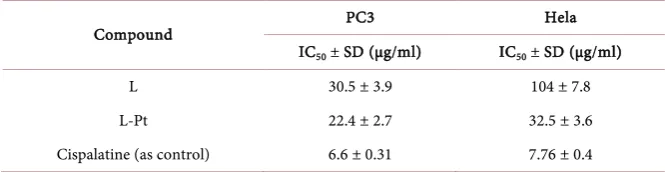
Table 3. IC50 values (μg/ml) for Schiff base and Pt (II) complex tested against Helacells
and PC3 cells.
Compound PC3 Hela
IC50±SD (μg/ml) IC50±SD (μg/ml)
L 30.5 ± 3.9 104 ± 7.8
L-Pt 22.4 ± 2.7 32.5 ± 3.6
Cispalatine (as control) 6.6 ± 0.31 7.76 ± 0.4
3.5. Anticancer Activity
The results of in vitro anticancer activity of the tested the ligand and its Ptcomp-lex were evaluated for cytotoxicity against PC3 cells and Hela cells of humans in comparison with Cis palatine as a positive control. The L-Pt complex showed a higher cytotoxic activity than free ligand towards Hela cells and PC3 cells. Table 3 represents the cytotoxic activity of the tested compounds.
4. Conclusion
The present work describes the synthesis and in vitro anticancer activity of Schiff base and its complex Pt (II). The L-Pt complex showed a higher cytotoxic activi-ty than Schiff base free ligand towards Hela cells and PC3 cells.
Conflicts of Interest
The authors declare no conflicts of interest regarding the publication of this pa-per.
References
[1] Naik, A., Annigeri, D., Gangardharmath, S.M.U., Ravankar, V.K., Mahale, V.B. and Reddv, V.K. (2002) Anchoring Mercapto-Triazoles on Dicarbonyl Backbone to As-semble Novel Binucleating, Acyclic SNONS Compartmental Ligands. Indian Jour-nal of Chemistry—Section A, 41, 2046.
[2] Sen, A.K., Singh, G., Singh, K., Handa, R.N., Dubey, R.N. and Squattirito, P. (1998) Synthesis and Characterization of Some Monofunctional Bidentate Schiff Bases De-rived from Cinnamaldehyde Ands-Triazoles, and Their Co(II), Ni(II), Cu(II) and Zn(II) Complexes. Proceedings of the Indian Academy of Sciences, 110, 75. [3] Sen, A.K., Singh, G., Singh, K., Handa, R.N. and Dubey, S.N. (1997) Synthesis and
Characterization of Some Monofunctional Bidentate Schiff Bases Derived from Furfuraldehyde and Their Cobalt(II), Nickel(II) and Copper(II) Complexes. Indian Journal of Chemistry A, 36, 891.
[4] El-Shekeil, A.G., Abdubakr, A.O., AlAghbari, S.A. and Nassar, M.Y. (2014) Anti-cancer 4: AntiAnti-cancer and DNA Cleavage Studies of Some New Schiff Base Titanium (IV) Complexes. European Journal of Chemistry, 5, 410-414.
https://doi.org/10.5155/eurjchem.5.3.410-414.996
DOI: 10.4236/msce.2019.78001 7 Journal of Materials Science and Chemical Engineering
Chemistry, 38, 89-100.
[6] Rathelot, P., Azas N., Elkashef, H. and Delmas, F. (2002) 1,3-Diphenylpyrazoles: Synthesis and Antiparasitic Activities of Azomethine Derivatives. European Journal of Medicinal Chemistry, 37, 671-679.
https://doi.org/10.1016/S0223-5234(02)01388-0
[7] Holla, B.S., Malini, K.V., Rao, B.S., Sarojini, B.K. and Kumari, N.S. (2003) Synthesis of Some New 2,4-Disubstituted Thiazoles as Possible Antibacterial and An-ti-Inflammatory Agents. European Journal of Medicinal Chemistry, 38, 313-318. [8] Holla, B.S., Veerendra, B., Shiramanda, M.K. and Poojary, B. (2003) Synthesis
Cha-racterization and Anticancer Activity Studies on Some Mannich Bases Derived from 1,2,4-Triazoles. European Journal of Medicine, 38, 759.
[9] Saleem, L.M.N. (1982) Trans-cis Isomerization of Schiff’s Bases (N-Benzylideneani- lines) on Addition of Lanthanide Shift Reagents. Organic Magnetic Resonance, 19, 176-180.https://doi.org/10.1002/mrc.1270190403
[10] Wang, M., Wang, L.F., Li, Y.Z., Li, Q.X., Xu, Z.D. and Qu, D.Q. (2002) Antitumour Activity of Transition Metal Complexes with the Thiosemicarbazone Derived from 3-Acetylumbelliferone. Transition Metal Chemistry, 26, 307-310.
https://doi.org/10.1023/A:1007159301849
[11] Gulerman, N.N., Rollas, S., Erdeniz, H. and Kiraj, M. (2001) Antibacterial, Anti-fungal and Antimycobacterial Activities of Some Substituted Thiosemicarbazides and 2,5-Disubstituted-1,3,4-Thiadiazoles. Journal of Pharmaceutical Sciences, 26, 1. [12] Tarasconi, P., Capacchi, S., Pelosi, G., Corina, M., Albertini, R., Bonati, A., Dall’Aglio,
P.P., Lunghi, P. and Pinelli, S. (2000) Synthesis, Spectroscopic Characterization and Biological Properties of New Natural Aldehydes Thiosemicarbazones. Bioorganic & Medicinal Chemistry, 8, 154-162.https://doi.org/10.1016/S0968-0896(99)00260-6
[13] Charo, J., Lindencrona, J.A., Carlson, L.M., Hinkula, J. and Kiessling, R. (2004) Protective Efficacy of a DNA Influenza Virus Vaccine Is Markedly Increased by the Coadministration of a Schiff Base-Forming Drug. Journal of Virology, 78, 11321- 11326.https://doi.org/10.1128/JVI.78.20.11321-11326.2004
[14] Mishra, V., Pandeya, S.N. and Anathan, S. (2000) Antitubercular Actnity of Thiose-niicarbazones and Semicarbazones. Acta Pharmaceutica Turcica, 42, 139.
[15] West, D.X., Carison, C.S., Liberta, A.E., Albert, J.N. and Daniel, C.R. (1990) Transi-tion Metal Ion Complexes of Thiosemicarbazones Derived from 2-Acetylpyridine. Part 8. The Chemical and Antifungal Properties of the Nickel (II) Complexes of 2-acetylpyridine 4N-Diethyl- and 4N-Dipropylthiosemicarbazones. Transition Metal Chemistry, 15, 341-344.https://doi.org/10.1007/BF01177458
[16] Yale, H.L., Losee, K., Martins, J., Holsing, M., Perry, F.M. and Berstein, J. (1953) Chemotherapy of Experimental Tuberculosis. VIII. The Synthesis of Acid Hydra-zides, Their Derivatives and Related Compounds1,2. Journal of the American Chem-ical Society, 75, 1933-1942.https://doi.org/10.1021/ja01104a046
[17] Mosmann, T. (1983) Rapid Colorimetric Assay for Cellular Growth and Survival: Application to Proliferation and Cytotoxicity Assays. Journal of Immunological Methods, 65, 55-63.https://doi.org/10.1016/0022-1759(83)90303-4
[18] Gomha, S.M., Riyadh, S.M., Mahmmoud, E.A. and Elaasser, M.M. (2015) Synthesis and Anticancer Activities of Thiazoles, 1,3-Thiazines, and Thiazolidine Using Chi-tosan-Grafted-Poly(vinylpyridine) as Basic Catalyst. Heterocycles, 91, 1227-1243.
https://doi.org/10.3987/COM-15-13210
Ti-DOI: 10.4236/msce.2019.78001 8 Journal of Materials Science and Chemical Engineering
tanium(IV) Complexes. Journal of Coordination Chemistry, 65, 2762-2770.
https://doi.org/10.1080/00958972.2012.703780
[20] Silverstein, M., Bassler, G. and Morril, C. (1981) Spectrometric Identification of Organic Compounds. 4th Edition, John Wiley & Sons, New York.
[21] Kandil, S.S., Katib, S.M.A. and Yarkandi, N.H.M. (2007) Nickel(II), Palladium(II) and Platinum(II) Complexes of N-allyl-N’-pyrimidin-2-ylthiourea. Transition Met-al Chemistry, 32, 791-798.https://doi.org/10.1007/s11243-006-0253-4
[22] El-Shekeil, A.G. and Al-Shuja’a O.M. (2007) Synthesis, Spectral Characterization, Thermal Studies and DC Electrical Conductivity of Poly[di(2,5-dimercapto-1,3,4- thiadiazole)-Platinum(IV)] Complex. Journal of Macromolecular Science, Part A, 44, 445-451.https://doi.org/10.1080/10601320601188414