MANAGING
PROJECT
MANAGING
PROJECT
STAKEHOLDERS
B U I L D I N G A F O U N D A T I O N
T O
A C H I E V E P R O J E C T G O A L S
Cover image: People Interacting © mediaphotos/iStockphoto Cover design: C. Wallace
Copyright © 2013 by Tres Roeder. All rights reserved.
Published by John Wiley & Sons, Inc., Hoboken, New Jersey. Published simultaneously in Canada.
Material fromPMBOK®Guide, 5th ed., has been adapted and reproduced with the permission of PMI. Project Management Institute, A Guide to the Project Management Body of Knowledge (PMBOK®Guide)–Fifth Edition, Project Management Institute, Inc., 2012.
No part of this publication may be reproduced, stored in a retrieval system, or transmitted in any form or by any means, electronic, mechanical, photocopying, recording, scanning, or otherwise, except as permitted under Section 107 or 108 of the 1976 United States Copyright Act, without either the prior written permission of the Publisher, or authorization through payment of the appropriate per-copy fee to the Copyright Clearance Center, Inc., 222 Rosewood Drive, Danvers, MA 01923, (978) 750-8400, fax (978) 646-8600, or on the Web at www.copyright.com. Requests to the Publisher for permission should be addressed to the Permissions Department, John Wiley & Sons, Inc., 111 River Street, Hoboken, NJ 07030, (201) 748-6011, fax (201) 748-6008, or online at http://www.wiley.com/go/permissions.
Limit of Liability/Disclaimer of Warranty: While the publisher and author have used their best efforts in preparing this book, they make no representations or warranties with respect to the accuracy or completeness of the contents of this book and specifically disclaim any implied warranties of merchantability orfitness for a particular purpose. No warranty may be created or extended by sales representatives or written sales materials. The advice and strategies contained herein may not be suitable for your situation. You should consult with a professional where appropriate. Neither the publisher nor author shall be liable for any loss of profit or any other commercial damages, including but not limited to special, incidental, consequential, or other damages.
For general information on our other products and services or for technical support, please contact our Customer Care Department within the United States at (800) 762-2974, outside the United States at (317) 572-3993 or fax (317) 572-4002.
Wiley publishes in a variety of print and electronic formats and by print-on-demand. Some material included with standard print versions of this book may not be included in e-books or in print-on-demand. If this book refers to media such as a CD or DVD that is not included in the version you purchased, you may download this material at http://booksupport.wiley.com. For more information about Wiley products, visit www.wiley.com.
Library of Congress Cataloging-in-Publication Data:
Roeder, Tres,
1968-Managing Project Stakeholders/Tres Roeder, MBA, PMP. pages cm
Includes bibliographical references and index.
ISBN 978-1-118-50427-7 (cloth); ISBN 978-1-118-50428-4 (ePDF); ISBN 978-1-118-50426-0 (ePub); ISBN 978-1-118-50425-3 (Mobi)
1. Project management. I. Title. HD69.P75.R64 2013
658.4'04—dc23
2013001466
The dogmas of the quiet past are inadequate to the stormy present. The occasion is piled high with difficulty, and we must rise with the occasion. As our case is new, so we must think anew and act anew.
Contents
Foreword xi
Preface xv
Acknowledgments xix
Section One: Stakeholder
Management Overview 1
Chapter One: What Is a Stakeholder? 3
Project Managers Must Be Nimble 3
The Balanced Approach 4
The Project Management Institute 7
Stakeholder Defined 11
Stakeholder Management Is Universal 16
Summary 16
Chapter Two: Categorizing Stakeholders 19
Benefits of Categorizing 20
Dimensions of Categorization 22
Stakeholder Engagement Assessment Matrix 25
Stakeholder Management Plan 27
Summary 28
Chapter Three: Prioritizing Stakeholders 31
Power and Interest 32
Power and Influence 35
Power and Knowledge 36
Custom Matrices 38
Stakeholder Register 38
Summary 48
Section Two: Stakeholder Groups 51
Chapter Four: Project Team Members 53
Who They Are 53
Tips for Managing Project
Team Stakeholders 55
The Extended Project Management Team 63
Watch-Outs 65
Summary 67
Chapter Five: Executive Stakeholders 69
Who They Are 69
Tips for Managing Executive Stakeholders 73
Watch-Outs 84
Summary 86
Chapter Six: Other Stakeholders 87
External Stakeholders 87
Stakeholders Subject to the Change 90
Phantom Stakeholders 97
Summary 101
Section Three: Stakeholder
Communication and Conflict 103
Chapter Seven: Stakeholder Communication 105
Stakeholder Communication Plan 106
Stakeholder Communication Channels 106 Holistic Approach to Communication 115
Summary 115
Chapter Eight: Managing Stakeholders
in a Virtual World 117
The Continuum of Robustness 118
Risks of Virtual Teams 123
Opportunities When Working Virtually 128
Summary 131
Chapter Nine: Managing Difficult Stakeholders 133
Projects Create Tough Issues 134
Categorizing Difficult Stakeholders 134 Proceeding without the Executive Sponsor 140
Positive Attitude 140
Summary 143
Section Four: General Stakeholder
Management Skills 145
Chapter Ten: Leadership 147
A Sixth Sense for Project Management® 148
Project Managers Are Leaders 149
Situational Leadership Model 155
Summary 180
Chapter Eleven: Buy-In 181
The Circle of Support Process 183
Include Stakeholders 183
Observe Stakeholders 189
Respond to Stakeholders 190
Summary 200
Chapter Twelve: Negotiation 203
Negotiation Is a Two-Way Street 204
Ten Tips for Negotiations in Projects 205
Summary 223
References 225
About the Author 227
Index 229
Foreword
P
rojects are done by people (the team) and for people (the stakeholders). While tools, techniques, and technologies are certainly important, the people’s participation and perception about the project and its deliverables is really what makes or breaks a project. As such, the project’s success is ultimately defined by stake-holders, and in particular by the beneficiaries of the project’s outcome(s); they can consider a project successful if the deliverables truly meet their needs, even if the project’s execution may not perfectly fit within the traditional triple constraint of “full scope, in time, within budget.”As this concept is embraced more and more by the project manage-ment community it has resulted in increased focus on stakeholder management as a critical component of project management, beyond the traditional Communications Management knowledge area. This trend was recently recognized in arguably the most widespread standard in the area,
A Guide to Project Management Body of Knowledge (PMBOK® Guide), 5th ed., published by Project Management Institute (PMI), by introducing a new knowledge area dedicated to project stakeholder management.
In terms of full disclosure, the author of this Foreword was part of the core team for thePMBOK®Guide–5th ed., and coordinated the teams
working in the “soft skills” areas of the standard—the knowledge areas for human resources, communication, and the newly introduced stake-holder management. Introducing the new knowledge area was confirmation that this is indeed a best practice “for most project man-agers, in most projects, most of the time.”
In the above capacity, I had the opportunity to interact with a group of dedicated, top-level professionals that participated in the editing teams, and discuss their experiences around the world in stakeholder management, as well as the results of various studies and research in the area. It demonstrated beyond any doubt the importance and extent of actively managing stakeholder participation in projects not only for a successful project execution, but also for the ultimate use of project’s deliverables to meet the organizational needs that triggered the project in the first place.
Tres Roeder, the author of this book, is a long-time champion of the stakeholder management domain and a public advocate of its importance for project managers. He is a globally recognized project management expert, invited to share his expertise not only as a consultant for many top-level organizations, but also as an applauded speaker at international con-ferences and other public events. Through his articles, seminars, webinars, courses, workshops, and blogs Mr. Roeder combines hands-on experience corralling high performing stakeholder teams with the latest research in the area to promote formal, sustained, and efficient stakeholder management as one of the main enablers of achieving project success.
In his first book, A Sixth Sense for Project Management, Mr. Roeder detailed how to achieve project success by deploying a balanced approach with a particular emphasis on people. His interest in the domain continues with the present book focused on stakeholder management. With a particular insight gained by acting as a reviewer of the draft project stakeholder management knowledge area introduced in PMBOK® Guide–5th ed., Tres Roeder brings in his extensive expertise in the area to complement, detail, and explain various components of this evolving domain.
domain that is variable, unique, and volatile by definition. It provides the reader with the necessary knowledge and practical examples to be able to understand, classify, and manage basically any stakeholders that may be encountered in real-life projects.
The book is structured in four sections, each including three chapters, which progressively build up the reader’s understanding of stakeholders’ management.
Section One discusses fundamental concepts for successful project stakeholder management. The introductory chapter defines project stakeholders as people who are subject to, part of, or have decision-making over a project, followed by two chapters dedicated to techniques to categorize project stakeholders and creating a prioritization strategy for project stakeholders.
Section Two discusses five stakeholder groups: project team stake-holders, executive stakestake-holders, external stakestake-holders, stakeholders subject to the changes, and phantom stakeholders. The chapters included in Section Two provide a detailed discussion of Project Team Stakeholders and Executive Stakeholders, and considerations about the remaining groups in the chapter Other Stakeholders.
Section Three focuses on managing stakeholder communication with special consideration being given to projects that take place in a virtual environment. The section concludes with practical advice on handling project conflicts that could occur with difficult stakeholders.
Section Four complements the specific project management skills with general management competencies that the project manager can deploy in all kinds of situations. The capabilities treated in the last section of the book are leadership, obtaining buy in, and negotiation.
This book contains not only a formal treatment of essential topics for successful stakeholder management, but also many high-impact tips project managers should know and be able to apply in order to effec-tively engage stakeholders in project execution, and secure their support to ensure a project’s success. It is an indispensable reading for every project manager that aspires to get beyond the technicalities of“percent complete” and move into leading projects that all stakeholders will consider successful.
George Jucan, MSc PMP
Preface
M
anaging Project Stakeholders is intended for anyone who works with people to accomplish project results. Historically, project management literature has focused on the technical skills required to document, track, and quantify projects. Although important, these technical skills correlate less to project success than the real world interpersonal skills addressed in this book. The successful project manager must know how to work with different types of people.This book can be read from beginning to end for an advanced understanding of working with project stakeholders. Alternatively, the busy professional can jump directly into the section or chapter most relevant to them. Each chapter is written as a free-standing module. Where there are connections to previous or subsequent chapters it will be noted in the text.
Section One creates the foundation for successful project stake-holder management. The section is divided into three chapters: What Is a Stakeholder, Categorizing Stakeholders, and Prioritizing Stakeholders. In Chapter 1, What Is a Stakeholder?, we define project stakeholders as people who are subject to, are part of, or have decision making over a project. We discuss how project stakeholder management is most
successful when it fits into a holistic and balanced approach to managing projects and managing change that includes technical project management skills, business acumen, and interpersonal skills.
In Chapter 2, Categorizing Stakeholders, we share techniques to categorize project stakeholders. We develop a common language to use when describing stakeholders. As a profession, a common language helps us work more efficiently and more seamlessly across organizations and industries.
In Chapter 3, Prioritizing Stakeholders, we use the categorization techniques from Chapter 2 to create a prioritization strategy for project stakeholders. Project managers must carefully deploy their time. Using thoughtful two-by-two matrices, Chapter 3 instructs us how to identify the most important stakeholders without losing focus on the other stakeholders. Section Two discusses five stakeholder groups: project team stake-holders, executive stakestake-holders, external stakestake-holders, stakeholders subject to the change, and phantom stakeholders. Stakeholders in each group may have much in common with one another. Section Two is divided into three chapters: Project Team Members, Executive Stake-holders, and Other Stakeholders.
Chapter 4, Project Team Members, discusses techniques to manage the project team. Project managers are likely to spend most of their time working with project team stakeholders. Chapter 4 discusses how to kick off the project team, build relationships within the team, and create an environment that is poised for success.
Chapter 5, Executive Stakeholders, focuses on working collabora-tively with the executives directing the project. In many cases the executive stakeholders are the single most powerful stakeholder group. In this chapter the project manager will learn techniques to harness the power of executive stakeholders to the benefit of the project team.
Chapter 6, Other Stakeholders, explains three additional stake-holder groups: external stakestake-holders, stakestake-holders subject to the change, and phantom stakeholders. The project manager will learn how to work with each of these groups to increase the probability of project success. Section Three focuses on project communication and conflict. The section is divided into three chapters: Stakeholder Communication, Managing Stakeholders in a Virtual World, and Managing Difficult Stakeholders.
In Chapter 7, Stakeholder Communication, we focus on different paths to communication success. The successful project manager com-municates messages that are clear, consistent, and frequently repeated through multiple communication channels.
In Chapter 8, Managing Stakeholders in a Virtual World, we discuss an area of growing importance, how to work with remotely located stakeholders. Stakeholder management in virtual environments has sim-ilarities to and important differences from the in-person environment.
In Chapter 9, Managing Difficult Stakeholders, we discuss techniques for working with stakeholders who present challenges to the project team. Despite the project manager’s best efforts, there may still be certain stakeholders who have a different perspective on the project. Chapter 9 presents real-world solutions to dealing with these individuals.
Section Four provides a portfolio of general management skills the project manager can deploy in all types of situations. The section is divided into three chapters: Leadership, Buy-In, and Negotiation.
Chapter 10, Leadership, begins with the premise that all project managers are leaders. Project stakeholders look to the project manager to provide guidance and direction. Chapter 10 provides a situational lead-ership framework based on A Sixth Sense for Project Management®.
Chapter 11, Buy-In, offers a three-step process for use to gain support. Project stakeholders have a variety of perspectives, attitudes, and beliefs. The Buy-In chapter contains a powerful framework that can be adapted to earn the support of each project stakeholder.
Chapter 12, Negotiation, provides 10 high-impact tips the project manager can deploy to succeed in project negotiations. Projects are a constant negotiation, whether about resources for the project, the time line, or the scope. In this chapter project managers will learn how to get what they need for project success.
Acknowledgments
I
offer deep gratitude to my family for providing ongoing encour-agement and support for this project. To my wife Elizabeth for her love and behind-the-scenes support; to my son Parker, who showed a keen interest for every step in the writing process; to my son Garrett for the late-night chats; and to our dog Batman, who spent many (not so) tough days lying at my side chewing on a bone while I typed.Thanks to George Jucan, PMP®, for his leadership overseeing the team that wrote Chapter 13 on project stakeholder management in the PMBOK®Guide, 5th ed., and to all those on the team who wrote this important work. I am honored and thankful to have George’s insight captured in the Foreword to this book.
I owe much to the dedicated team at Roeder Consulting who kept the lights on while I focused on writing. In particular, thanks to Keith Jenkins, Jim Kups, and Sarah Nicol.
Thanks to Rob Mansfield, firefighter with Squad 2 in the Chicago Fire Department, and Lt. Anthony Carusso, Pepper Pike Fire Depart-ment, for fact-checking the fire crew examples in Chapter 10 on
Leadership. Putting out a fire literally is a project that has many lessons for the figurative fires the rest of us put out every day.
I would like to thank Kelley Management Consulting for men-toring me and teaching me much about aligning people around a common goal in the fast-paced environment of organizational change. In particular, thanks to Patrick Kelley, Jim Schumann, and Erich Weber. I am thankful for the world-class team at John Wiley & Sons for supporting and executing this project. Thanks to Debra Englander for believing in the concept, Jennifer MacDonald and Donna Martone for overseeing editing and document creation, and Tula Batanchiev for expert marketing.
As always, thanks to all of you who attend Roeder Consulting’s courses, trust us with a consulting or training project, or are otherwise connected to the Roeder Consulting family. I learn from you every day and treasure your friendship and support.
Section One
STAKEHOLDER
MANAGEMENT
OVERVIEW
S
ection One creates the foundation for successful project stake-holder management. The section is divided into three chapters: What Is a Stakeholder?, Categorizing Stakeholders, and Priori-tizing Stakeholders.In Chapter 1, What Is a Stakeholder?, we define project stake-holders as people who are subject to, are part of, or have decision making over a project. We discuss how project stakeholder manage-ment is most successful when it fits into a holistic and balanced approach
to managing projects and managing change that includes technical project management skills, business acumen, and interpersonal skills.
In Chapter 2, Categorizing Stakeholders, we share techniques to categorize project stakeholders. We develop a common language to use when describing stakeholders. As a profession, a common language helps us work more efficiently and more seamlessly across organizations and industries.
In Chapter 3, Prioritizing Stakeholders, we use the categorization techniques from Chapter 2 to create a prioritization strategy for project stakeholders. Project managers must carefully deploy their time. Using simple two-by-two matrices, Chapter 3 instructs us how to identify the most important stakeholders without losing focus on the other stakeholders.
Chapter One
What Is a Stakeholder?
It is never too late to be what you might have been.
George Eliot
P
rojects require people. People are needed to conceive the idea for the project, design project plans, approve the plans, execute the plans, and close out the project. People are impacted by the outcome of the project. Whether the project is implementing a new software system, a new business unit, or a new bridge, there will be an impact on people. All of these people are stakeholders.Project Managers Must Be Nimble
This book discusses how to effectively identify, categorize, prioritize, manage, and lead project stakeholders. Projects are temporary endea-vors, so project managers must learn how to launch a team of stake-holders, manage the team for the duration of the project, then thank and disband the team when the project is complete. This stands in contrast to operational management, which is more permanent in nature.
Project management is a discipline focused on delivering results and then moving on to the next project. In contrast to operational man-agement, projects have a defined beginning point and a defined end point. Operational management is focused on the tasks and activities required to manage an organization on an ongoing basis.
The temporary nature of projects leads to transient stakeholders. Project stakeholders come and go as the project works through different phases. When the project ends, the stakeholder group is disbanded. Operational management, in contrast, may focus on the same stake-holders for years. An occasional stakeholder may come or go, but the overall stakeholder base is far less transient in operational management than in project management. As a result, project managers must be nimble, adaptable, and constantly vigilant to understand their stake-holder environment.
The Balanced Approach
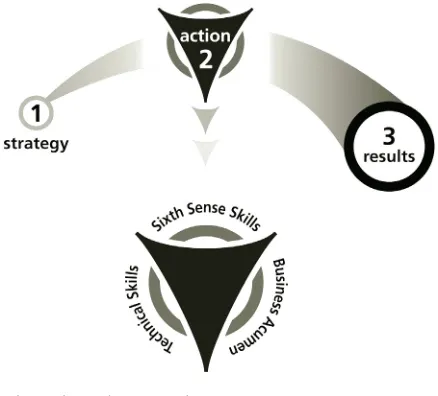
Project stakeholder management requires a robust skill set. Effective project managers must have expert knowledge of their project scope and plans. They must know what they are trying to do and the con-straints upon them to get it done. And they must be able to work with people. Successful project managers deploy a three-pronged approach to managing their projects: technical project management skills, business acumen, and “sixth sense” people skills. (See Figure 1.1.)
Technical Skills
managers understand these technical skills and know when to deploy them to facilitate project success. They also know when the standard technical skills are not appropriate and adapt accordingly.
Business Acumen
Business acumen is knowledge of the organization’s goals, strategies, and language. Business acumen is understanding how one’s project will help the organization achieve its goals and strategies. Effective project man-agers understand why the project is important. At any point in the project life cycle effective project managers can describe not only what they’re doing but also why they’re doing it and why it matters to the organization. This is business acumen.
[image:27.432.106.325.64.262.2]The successful project manager also understands the operational and strategic language of the organization. The project manager should know terms such as return on investment, net present value, and strategic alignment. Each organization has its own unique language to describe strategic goals and the tactics deployed to achieve the goals. It is important for the project manager to understand and use this language.
Figure 1.1 The Balanced Approach
“Sixth Sense” People Skills
Third, and most importantly, effective project managers know how to work with people to achieve results. They are strong communicators, good negotiators, effective leaders, and astute observers of human behavior. Decades of research proves that people skills are the most important driver of effective project management. The project man-ager’s ability to harness their expertise and intuition to lead people to successful outcomes is called“A Sixth Sense for Project Management®.” Together, the three core capabilities of technical skills, business acumen, and people skills comprise the Balanced Approach. Alone, each of these skills is not enough. Together, they form a powerful method for change. Successful project stakeholder management requires the Balanced Approach.
Importance of Business Acumen
Many organizations deploy a Project Management Office (PMO) to oversee major projects. Interestingly, the number of organiza-tions with PMOs is declining and many of those still having PMOs are reducing the staff in them. Recent research from The Hackett Group shows that there may be good reason for the decline. On average, PMOs increase the cost of an organization’s information technology (IT) function without delivering improvement to the on-time or on-budget performance of projects.
There’s an interesting twist, however. Top performing IT organizations continue to use PMOs and get results from them. Business acumen is one of the key factors correlated to successful PMOs in these top performers. Successful PMOs hold their project teams accountable for business results.
SOURCE:“Most Companies with Project Management Offices See Higher
IT Costs, No Performance Improvements,”The Hackett Group, November 1, 2012.
The Project Management Institute
The Project Management Institute (PMI) is a not-for-profit global project management association. Founded in 1969, PMI has grown from humble beginnings to a powerhouse with almost a half-million people globally holding its foundational professional designation, the Project Management Professional (PMP®).
The Project Management Body of Knowledge (PMBOK® Guide)
PMI correctly recognized that the profession of project management did not have a common knowledge base. In the past, when a group of
A Sixth Sense for Project Management®
Thefirst section in the book A Sixth Sense for Project Management
highlights the need for the project management profession to embrace people skills. Section One, comprised of three chapters, documents research showing that people skills are more highly correlated with project success than project management tech-nical skills.
At the conclusion of Section One project managers are asked to come together to broadcast the message that interpersonal skills are critically important. Others in the profession are champions of people skills, too. The message has been heard; the latest version of thePMBOK®Guideincludes a chapter devoted to stakeholder management, Chapter 13.
There’s still much work to do. Many project managers and project organizations continue to have an unhealthy overemphasis on the technical side of project and change management. Working together, we must continue to strive toward the more balanced approach that has proven to greatly increase the probability of project success.
project managers got together they did not have common terminology to describe what they were doing. They might take a large part of their meeting figuring out what the others were talking about. Recognizing this gap PMI commissioned a project to create a global standard. The goal was a standard that could be used in almost any project situation. After a number of years of effort the first standard was published in 1987. The standard was named A Guide to the Project Management Body of Knowledge. Today, in its fifth edition, we will call this document the
PMBOK®Guide.
PMBOK® Guide, Chapter 13
For the first time, the PMBOK® Guide includes a chapter on project stakeholder management. Chapter 13, Project Stakeholder Manage-ment, is one of the 10 knowledge areas. Each of the knowledge areas represents foundational information all project managers must know. Adding project stakeholder management to the knowledge areas is a major and game-changing development.
Increased Emphasis on People Skills Chapter 13 is game-changing for several reasons. First, it is the most attention authors of thePMBOK® Guide have devoted to project stakeholders. Stakeholders have always been critical to project success. Regrettably, these skills have not been a major part of a project manager’s professional development require-ments until recently. Many project managers and organizations incor-rectly view project management as a skill mainly focused on technical skills. People and organizations with this misguided understanding are more likely to suffer from failed projects.
categorize project stakeholders. Other knowledge areas of the
PMBOK® Guide have tools and techniques that are inputs into the stakeholder register. The stakeholder register itself is an input into knowledge areas such as project risk management and project human resources management. In simple language, this means that project stakeholder management is a technical project management skill in addition to an interpersonal skill. Project stakeholder management is integrated into the technical process of project management.
See Chapter 3, Prioritizing Stakeholders, for more detail on the stake-holder register.
Researching the Value of Project Management
“Researching the Value of Project Management” is a multiyear, multimillion-dollar project sponsored by the Project Management Institute. The goal is to answer the question“Does project man-agement deliver value?” and if it does,“What are the key drivers of value?”Not surprisingly, the study did indeed find that project management delivers value.
However, the study also found that project management does notalwaysdeliver value. In some cases, project management makes things worse. Project managers make things worse when they do not deploy awareness of the situation to adapt their project management approach and techniques. The study tracked a number of variables and determined which variables, if any, are correlated to project success. Many variables that were investi-gated, including a number of technical project management skills, did not correlate to project success. Leadership, interpersonal skills, and the project manager’s ability to read the project situation and adapt did correlate to project success.
SOURCE: Mark Mullaly and Janice Thompson,Researching the Value of Project Management(Newtown Square, PA: Project Management Institute, 2008).
Holistic Approach to Project Management A third reason why Chapter 13 is game-changing is that it highlights the concept of a holistic approach to project management. As discussed previously, this is called the Balanced Approach. Chapter 13 merges interpersonal skills, technical skills, and, to a more limited extent, business acumen into the required and standardized language of PMP®s. This is a major step toward improving project success rates. As a profession, we fail more often than we succeed. A primary reason for this failure is an overreliance on only one of the three types of skills required in the Balanced Approach— technical project management skills. The skills project managers most often use as a crutch are the technical skills. We must embrace the Balanced Approach if we are to improve project success rates. Chapter 13 in thePMBOK®Guideis a solid step in the right direction.
PMBOK® Guide, Appendix G
The prior version of the PMBOK Guide (the fourth edition) includes a brief appendix, Appendix G, which mentions interpersonal skills. Appendix G is about six pages long and served the purpose of putting project managers on notice that there is more to their craft than the
Disclosure
The author served as a subject matter expert reviewer of the
PMBOK® Guide’s new chapter on project stakeholder manage-ment, Chapter 13. One of several individuals selected globally to preview the chapter before final release, the author reviewed a draft version of Chapter 13 and provided feedback in 2011. A number of the author’s recommendations were integrated into the final text for Chapter 13.
technical skills they learned in the preceding 400+pages of the fourth edition. With Appendix G in the fourth edition and Chapter 13 and an appendix on interpersonal skills in the fifth edition, we are seeing the project management establishment move further toward embracing the importance of the human side of project management.
Stakeholder De
fi
ned
Project managers did not previously have a common definition for pro-ject stakeholders. With the introduction of Chapter 13 in thePMBOK® Guide, we now have a common definition to use. ThePMBOK®Guide
defines a project stakeholder as follows:
An individual, group, or organization who may affect, be affected by, or perceive itself to be affected by a decision, activity, or outcome of a project.
In the following section we discuss this definition in more detail.
A Stakeholder Is an Individual, Group, or Organization
Project stakeholders may represent themselves, a group, or an orga-nization. The project manager’s approach to managing each stake-holder varies according to which of these categories the stakestake-holder fits into.
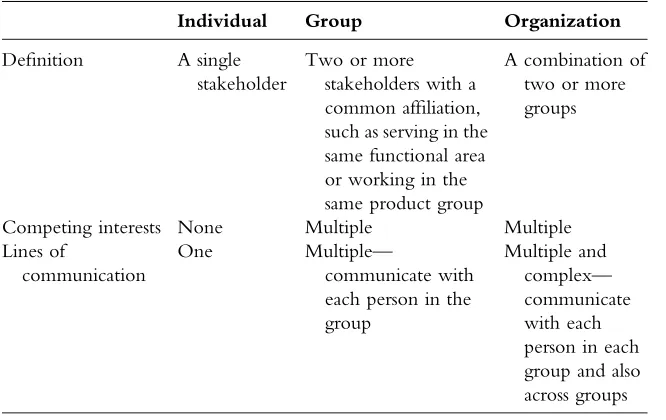
Individuals representing themselves do not need to communicate with others in their constituency to develop consensus. They are the constituency. Groups and organizations, however, may have one person who is the main stakeholder representing the group or a combination of stakeholders each of whom must be dealt with individually. The effective project manager understands the level of authority each stakeholder has and reacts accordingly. (See Table 1.1.)
See Section Two, Stakeholder Groups, for details on each stakeholder group.
A Stakeholder May Affect
Stakeholders have the option to make a difference. Anyone who can or does make a difference in a project is a stakeholder. There are numerous ways a stakeholder can affect a project. A few examples are:
• Conceive the idea for the project.
• Initiate the project.
• Set and/or approve the project budget.
• Provide input into project scope.
• Plan the project.
• Approve the project.
• Participate on the project team.
• Publicly support or resist the project.
• Rally a group to support or resist the project.
[image:34.432.53.386.76.286.2]This broad definition of project stakeholders is likely to result in a large group of people. Many project managers may be surprised at how large their list of stakeholders becomes when they adopt the definition of stakeholders used in thePMBOK®Guide. One of the implications of a larger list of stakeholders is that project managers will need to improve
Table 1.1 Individuals, Groups, and Organizations
Individual Group Organization
Definition A single stakeholder
Two or more stakeholders with a common affiliation, such as serving in the same functional area or working in the same product group
A combination of two or more groups Competing interests None Multiple Multiple Lines of
communication
One Multiple—
communicate with each person in the group
Multiple and complex— communicate with each person in each group and also across groups
their ability to strategically deploy their time across stakeholders and stakeholder groups.
See Chapter 3, Prioritizing Stakeholders, for details on how project managers can strategically deploy their time across stakeholders.
A Stakeholder May Be Affected By
Stakeholders in the previous section were either actively involved in the project or had the choice of becoming actively involved. These stake-holders could affect the project. In this next section of the definition we cast the net more broadly to anyone who might be affected by the project. These people may or may not be able to influence the project. Ideally, we want all stakeholders who are going to be affected by a project to have input into the process. Realistically, in many projects this is not feasible.
Stakeholders May Perceive Themselves to Be Affected By
The next group of stakeholders defined in thePMBOK®Guideare those who perceive themselves to be affected by the project. The concept is that perception is reality. If people think they are stakeholders then they are going to act in ways that they think a stakeholder might act. For example, they might attend project meetings. They might provide feedback on project documents. They might attempt to change the scope of the project. The definition of a stakeholder in the PMBOK® Guide’s Chapter 13 argues that this person, by definition, is a stakeholder. Indeed, the project manager will need to manage the situation when people think they are stakeholders. Whether it’s by diplomatically asking them not to attend team meetings or by deciding to incorporate them into the project, the project manager will use project stakeholder management tools and techniques to manage the situation.
A Decision, Activity, or Outcome of a Project
Stakeholders sometimes are decision makers. In other cases they do not have any decision-making authority. Stakeholders may have the ability to influence decisions others make. Influence can come in the form of
research, data, opinions, a persuasive argument, or other means such as bringing together a group of like-minded individuals and representing their cause.
Stakeholders might be involved with the entire project or just one aspect of the project. The activities they touch will vary. The
How Do You Manage Individuals Who Perceive Themselves to Be Stakeholders?
This topic has led to interesting conversation in public classes on advanced project stakeholder management. Some project man-agers argue that they should not be responsible for people who perceive themselves to be stakeholders but who are not actually stakeholders. These people are an annoyance, the argument goes, and just one more problem the project manager must deal with. Calling them a stakeholder indicates, they say, that anyone can force their way into the project. The project manager loses control. Other project managers think of stakeholders more broadly. They consider this group who perceives themselves to be stake-holders as an important faction that must be managed.
The answer comes down to how we define stakeholders. If stakeholders are defined as only the people we want to be on the project, then an individual who perceives himself or herself as a stakeholder is not one. However, if we think of stakeholders more broadly, as defined in the PMBOK® Guide, then these people become stakeholders.
Steps the project manager goes through to categorize and manage people who perceive themselves to be stakeholders are likely to be the same as the steps for those who are officially on the list. Therefore, individuals who perceive themselves to be stake-holders should be considered stakestake-holders for the purposes of tracking, categorizing, and managing them.
See Chapter 6, Other Stakeholders, for details on phantom stake-holders who act as stakestake-holders but are unrecognized as stakestake-holders by the project manager or the project team.
savvy project manager understands that the stakeholders are not a single homogeneous group of people with the same interests. Instead, stake-holders are unique individuals with their own sets of interests, fears, and aspirations.
Our Working Definition of a Stakeholder
For purposes of this book, we will simplify the definition of a stake-holder to the following: people who are subject to, are part of, or have decision making over a project.
This definition captures the essence of the PMBOK® Guide defi-nition but is simpler and uses fewer words. In general, anyone involved in the project in any manner is considered a stakeholder.
Stakeholder Management across Methodologies
ThePMBOK®Guide focuses on the waterfall method of project management. In the waterfall method the project flows in phases from initiating, to planning, to executing, to monitoring and controlling, and finally to closing. Each phase, in theory, flows into the next. Project managers using the waterfall method will
find that the concepts discussed in this book will apply directly to their projects.
The concepts in this book, however, are not exclusive to the waterfall method. The fundamentals of stakeholder management, as discussed in this book, are equally relevant to agile, lean, and other forms of project management.
Further, business analysts will find value in the pages of this book. As a business analyst goes through the work of capturing business requirements and gaining consensus, stakeholder man-agement will be a core skill for success.
See Section Three, Stakeholder Communication and Conflict, and Section Four, General Stakeholder Management Skills, for more detail on the general skills required to manage stakeholders in any situation.
Stakeholder Management Is Universal
Project stakeholder management is about people. People are involved in all projects. This is true regardless of the project management meth-odology used. There are many different technical project management methodologies, including waterfall, agile, extreme, and lean. The tools and techniques discussed in this book can be applied to any form of project management and change management.
Also, stakeholder management tools and techniques can be used in organizations of all sizes, across different industries, in organizations with different types of cultures, and so on. What is different, however, is the specific way the tools and techniques are deployed. No two project environments are the same so savvy project managers understand how to adapt their stakeholder management tools and techniques to the specific environment their project is operating in.
Summary
In summary, stakeholder management is required for all types of projects and change management processes. The tools and skills developed in the discipline of stakeholder management cut across all project
Stakeholder Management Is Like a Game of Golf
Golfers use almost exactly the same bag of clubs on all different types of golf courses. However, the details of each shot are dif-ferent depending on what type of material the ball is resting on, the wind conditions, whether the hole is above or below the golf ball, and so on.
Think of the bag of clubs as the project manager’s stakeholder management tools and techniques. Think of each project as a different golf course. The way the tools and techniques are applied will change based on a variety of conditions that will be discussed in this book.
management frameworks. The ability to identify, mobilize, motivate, and lead stakeholders will always be in demand for the individuals who lead change.
The discipline of stakeholder management is essential to project success. As part of the Balanced Approach, the successful project man-ager is an expert on managing the people in the project and harnessing their energy to achieve the desired project goals.
We defined stakeholders as“people who are subject to, are part of, or have decision making over a project.”Building on this definition, we will assign stakeholders into groups, categorize and prioritize stake-holders, and discuss how to communicate to and lead stakeholders.
A project may have many different stakeholders, all bringing their own unique needs and desires. Without proper management techni-ques, this can become overwhelming for the project manager. The first technique we will discuss is how to categorize stakeholders to bring clarity and understanding to the fog of project implementation. This is the topic of the next chapter, Categorizing Stakeholders.
Chapter Two
Categorizing
Stakeholders
All stakeholders are equal, but some are more equal than others.
Paraphrased from George Orwell,Animal Farm
I
t is self-evident that stakeholders are not all the same. The project manager must have a common language to use for categorizing the different stakeholders. In this chapter we discuss common termi-nology that can be used to describe and categorize project stakeholders. The project manager also requires documents to track stakeholders. In this chapter we introduce two documents to capture project stake-holder information: the stakestake-holder engagement assessment matrix and the stakeholder management plan. These documents will be integrated into the next chapter when we discuss the stakeholder register.We begin by discussing the importance of categorizing stakeholders. Categorizing stakeholders helps us develop our stakeholder manage-ment strategy related to three areas:
1.How much time to spend with each stakeholder.
2.The most important issues for each stakeholder.
3.The level of importance of each stakeholder’s concerns. Each is discussed in more detail in the following pages.
Bene
fi
ts of Categorizing
Categorizing enables the project manager to strategically manage stake-holders. Each stakeholder offers a unique mix of knowledge, experience, opinions, and behaviors. A one-size-fits-all approach does not work. The successful project manager must create a framework to simplify the wide array of stakeholders into understandable and actionable categories.
How Much Time to Invest
Project managers are pulled in many different directions. They typically manage project scope, time line, cost, and other attributes while simultaneously managing stakeholders. The project manager must decide how much time to invest in each of these activities. This chapter and the next chapter on prioritization offer tools that help project managers determine how to allocate their time across the myriad of project stakeholders.
What Issues Are Most Important?
It is common in a project for there to be a small number of key issues or changes that lead to the most debate and discussion. Catego-rizing stakeholders by their level of passion for each of these issues may be helpful to the project manager. Communications and stakeholder management strategies can be targeted by issue group.
When the project manager discovers a block of multiple stake-holders who believe that a particular issue is most important, then the project manager can target issue-specific communications to this group. In contrast to one-on-one communications with each stakeholder,
“issue group”focused communications are a more efficient way for the project manager to share information.
Relative Importance of Stakeholder Concerns
The project manager should prioritize stakeholders based on the potential impact of their concern on the project. Some concerns have more potential impact to the project than others. Stakeholders have a multitude of objections, concerns, and ideas about projects. The project manager must determine which objections carry real importance and which are frivolous.
In the absence of a strategy to prioritize stakeholder concerns the loudest voices are likely to get the most attention from the project manager and the project team. This is suboptimal, particularly in situations where the loudest voice is championing an issue that is relatively unimportant.
Relative Importance
Two stakeholders disagree about the plan for an office expansion project. In the project the current marketing department will be torn down and rebuilt into a more friendly work environment with open work spaces and environmentally friendly lighting.
Carlos, thefirst stakeholder, is concerned that the project will exceed the allocated budget. He cites similar projects that have been done in the past and all have gone over budget. He is arguing for a 10 percent contingency to be added to the project budget.
Carmen, the second stakeholder, has a different concern. She likes having a drinking fountain next to her desk. The construc-tion team’s current plans would move the drinking fountain into a shared lunchroom area that is 50 yards away from her.
Looking at the two concerns, the project manager can reason-ably conclude that thefirst issue is more serious than the second. The project manager should spend more time looking into the budget and Carlos’s argument. Carmen, in contrast, may be best managed with a single courtesy meeting to hear out her concerns. She may have valid reasons that should be incorporated into plans, or the conversation may show her concerns to be insignificant when compared to the concerns of other stakeholders.
Dimensions of Categorization
Let’s discuss the different dimensions used to categorize stakeholders based on definitions in thePMBOK®Guide, 5th ed. We use terms from the PMBOK®Guide to help create a common language for discussing project stakeholders. In the next chapter we will build on these terms as we deepen our understanding of how to categorize and prioritize stakeholders.
A Note on Standard Terminology
One of the primary benefits of thePMBOK®Guideis to create a common language for the project management profession. The Project Management Institute, as discussed in Chapter 1, published the first guidelines in 1987. It provided a standard language for project managers. Prior to thesefirst guidelines, project managers used different terms to describe the same concepts.
A document that one project manager called a charter another might call a kickoff document. This variation still exists today to a certain extent; each organization might have its own unique language. However, on the technical side of project management, thePMBOK®Guidehas been a useful tool to provide a common language and a common set of tools and techniques for project managers.
Thefifth edition of thePMBOK®Guide, published in January 2013, includes more detail than ever about the human side of project management. Thefifth edition includes a new chapter on project stakeholder management, Chapter 13.
of interest,” and we’ll know exactly what that means. Like any standard, it is not perfect. Each of us may define some of these words differently than the PMBOK® Guide does. The project management profession, however, will benefit from understanding and using standard terminology.
Not only will this help project managers communicate with other project managers in their organization, but it will also make the project manager’s skills more transferable across organizations. In an era when most people no longer enjoy so-called cradle-to-grave employment where they have the same job their entire career, it is in the best interest of both the employer and the project manager for the project manager to have transferable skills. The employer benefits because it can hire project managers and feel confident they will know the appropriate language. Employers may also see improved communication between ven-dors and their organization as the project stakeholders adopt a common terminology.
Employees benefit, too, from having transferable skills. If their current employer decides their particular skills are no longer needed, or they move to a new city or change organizations, then they can more easily integrate into a new organization if they have transferable skills, including a common language for project sta-keholders. Many organizations are unsure how to handle the project management function, and this creates some churn in project management roles and employment opportunities. Clearly, it is in the project managers’best interest to remain knowledgeable and relevant to their organization as well as to others should they
find themselves out of work.
Therefore, as we discuss project stakeholder management in this chapter, when possible we will use the definitions of words as defined in thePMBOK®Guide. This will give all of us a common language to describe stakeholders.
Power
Power is the measure of a stakeholder’s level of authority. Level of authority refers to the stakeholder’s overall organizational power. Senior executives, by this definition, are likely to have significant power. Power, however, is not a measure of the stakeholder’s ability to affect the particular project. There is a different word for this:impact.
Impact
Impact is a stakeholder’s ability to effect changes to the project’s plan-ning or execution. A stakeholder with high impact can direct the project in their desired direction. It is possible for a stakeholder to have low power but high impact, and vice versa. See the inset for more detail.
Power versus Impact
The PMBOK® Guide creates unique definitions for the words
powerandimpact. ThePMBOK®Guidedefines power as the“level of authority”of an individual. It defines impact as the stakeholder’s
“ability to effect changes to the project’s planning or execution.” Therefore, the wordspower and impactmean different things. For the benefit of standardization for our profession, when we use these words in this chapter we will use them consistently with how they are defined in the PMBOK® Guide.
It is important to note that power, as defined in thePMBOK® Guide, refers to overall organizational power. Therefore, power is the measure of a stakeholder’s overall level of authority in the organization. This does not necessarily translate into power to influence the project. Impact is the measure of the stakeholder’s ability to bring about changes specifically on the project. Said differently, power is the ability to impose one’s will across an organization, and impact is the ability to impose one’s will on the specific project.
Interest
Interest is a stakeholder’s level of concern regarding the project out-comes. A stakeholder with high interest is very concerned about the project. A stakeholder with low interest, however, has other priorities that are more important than the outcomes of this particular project.
Influence
Influence is the stakeholder’s level of active involvement in the pro-ject. A stakeholder with a high level of influence will participate more frequently in team discussions, meetings, and so on. A stakeholder with a low level of influence is not likely to participate in most team meetings.
Stakeholder Engagement Assessment Matrix
The stakeholder engagement assessment matrix helps the project man-ager categorize the current and desired attitudes of stakeholders. The matrix has five categories for attitudes: unsure, resistant, neutral, sup-portive, and leading. (See Table 2.1.)
Fields in the Stakeholder Engagement Assessment Matrix
The project manager should complete the fields in the matrix as follows:
• Stakeholder name. Enter the stakeholder’s name or initials (or other identifier if confidentiality is desired).
Table 2.1 Stakeholder Engagement Assessment Matrix
Stakeholder
Name Unaware Resistant Neutral Supportive Leading
Stakeholder C D
Stakeholder C D
Stakeholder D C
Source: Adapted fromPMBOK®Guide, 5th ed.
• Stakeholder’s level of support. Identify which of the following cate-gories best describes the stakeholder:
• Unsure—not knowledgeable on the project.
• Resistant—opposed to the project.
• Neutral—neither resistant nor supportive.
• Supportive—in agreement with the project.
• Leading—actively supporting the project.
• Time frame:
• C—current state of the stakeholder.
• D—desired state of the stakeholder.
See Chapter 11, Buy-In, for details on how to work with people who are unsure, resistant, neutral, supportive, and leading.
A brief glance at the stakeholder engagement assessment matrix shows project managers how much support they have. Also, it shows which stakeholders they need to work with. Any stakeholder with a desired state in a different column than the current state requires the project manager’s attention. A stakeholder with a current state in the desired category, however, should not be taken for granted. The project manager should continue to include this stakeholder in the process and ensure that the proper support is maintained.
Sensitivity of Stakeholder Information
Information included in the stakeholder engagement assessment matrix is sensitive. In some organizations the document could lead to bad feelings and anger. Stakeholders who believe they are supporting the project, for example, might be frustrated to learn they have been identified by the project team as resisters. The project manager and the project team should be careful to protect the confidentiality of the document.
Stakeholder Management Plan
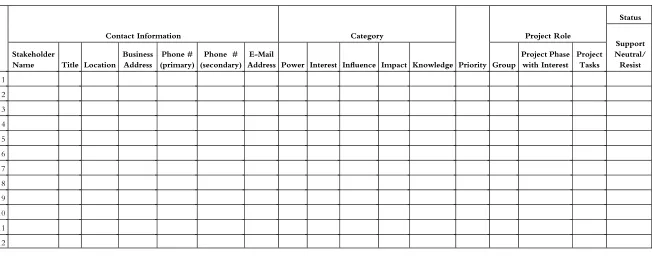
The stakeholder management plan is more detailed than the stakeholder engagement assessment matrix. Stakeholder management plans can be formatted many different ways and may include a variety of different pieces of information as necessary. For many organizations, the stake-holder management plan can include everything that is in the stakestake-holder register (a detailed stakeholder log discussed in Chapter 3), everything that is in the stakeholder’s engagement assessment matrix, and a variety of other information.
Potential Information in the Stakeholder Management Plan
The following is a list of the potential information in the stakeholder management plan:
• Consolidated information about communication strategies by group, issue, or other categorization.
See Section Two, Stakeholder Groups, for more details.
• Best channel for communicating with each stakeholder (for exam-ple, e-mail, phone, in person).
See Chapter 7, Stakeholder Communication, for more detail on stakeholder communication channels.
• Communication channels that will be used to engage groups of stakeholders (for example, in-person meetings, conference calls, virtual meetings).
See Chapter 7, Stakeholder Communication, for more detail.
• Identification of any topics that must be negotiated.
See Chapter 12, Negotiation, for more detail.
• Notes on which leadership style will be used for each stakeholder.
See Chapter 10, Leadership, for detail on leadership styles.
• Notes on what information was shared with each stakeholder on which dates.
• Hot spots that the stakeholders are particularly excited about or concerned about.
• Notes on any constraints the stakeholders may experience during the project (for example, vacations, business trips, standing meetings, other major projects that are demanding their time).
• Tips on how to integrate the stakeholder management plan into other project documents and processes.
• Organizational chart showing the reporting relationships between stakeholders.
• List of which project phases each stakeholder should be included in (initiating, planning, execution, monitoring and controlling, and closing for projects using a waterfall approach; different phases may be used for other approaches).
• List of what will be communicated during each phase.
The project manager should use awareness of project stakeholders and awareness of the project environment to structure the optimal template for the stakeholder management plan. Also, the savvy project manager will recognize that the template is likely to change for each project to make the plan relevant to the project details and environment. As always, project managers should use their expert judgment to determine the details of the stakeholder management plan.
Summary
In this chapter we discussed several categories the project manager can use to analyze stakeholders: power, impact, influence, and interest. These terms are defined in the PMBOK®Guide, 5th ed. and provide a common language project managers can use to discuss stakeholders. Common project management language is important as individuals and organizations seek to create common terms to explain concepts. Common language is also a goal of organizations seeking to improve their level of project management maturity.
We discussed a tool used to categorize stakeholders, the stake-holder’s engagement assessment matrix. The stakeholder’s engagement assessment matrix is a simple form that shows the current attitude of each stakeholder and the desired attitude of each stakeholder across five dif-ferent categories: unsure, resistant, neutral, supportive, and leading. We will use this tool as an input into other project management documents, including the stakeholder register.
together different aspects of project stakeholder management. Project managers should customize the stakeholder management plan to their organization and to their specific project.
In the next chapter, Prioritizing Stakeholders, we will introduce the stakeholder register. The stakeholder register is a single document used to capture all the information from the stakeholder engagement assess-ment matrix and combine it with many other key pieces of data. This single form creates the information backbone required to successfully manage project stakeholders.
Chapter Three
Prioritizing Stakeholders
The key is not to prioritize what’s on your schedule, but to schedule your priorities.
Stephen Covey
I
n the prior chapter we discussed specific attributes for categorizing project stakeholders. Four of the attributes discussed are:1.Power—the stakeholder’s level of authority.
2.Impact—the stakeholder’s ability to affect changes to the project’s planning or execution.
3.Interest—the stakeholder’s level of concern regarding the project outcomes.
4.Influence—the stakeholder’s level of active involvement in the project.
In this chapter, we discuss how to use these attributes, and others, to prioritize project stakeholders. Prioritizing project stakeholders is an important tool for the project manager. Project managers have limited time, and project teams have limited resources to deploy against project
stakeholder management. In order to work within these constraints, project managers must determine effective solutions to strategically deploy their time and skills, and the team’s time and skills, to work with project stakeholders.
Power and Interest
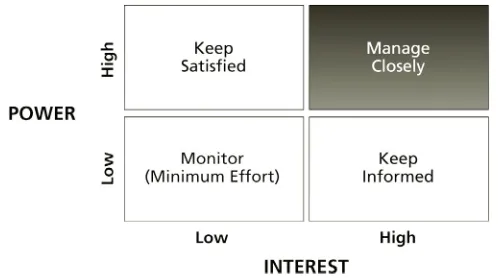
Without a prioritization plan the stakeholders who complain the most are likely to get the most attention. This is not a strategic way to allocate time. The project manager should not allow the stakeholders to dictate how much time is spent with them. Instead, the project manager must make crisp decisions on how much time to invest in each stakeholder. With a prioritization plan project managers will understand how to deploy their time. Let’s go back to two of the attributes discussed in the prior chapter, power and interest. If we take power and interest and put them into a simple two-by-two matrix, it might look something like the representation in Figure 3.1.
[image:54.432.91.340.409.548.2]We’ll discuss this chart starting with the top right quadrant. This quadrant shows the stakeholders who have a high degree of power and a high level of interest. In other words, stakeholders in this quadrant have a high level of authority and also a high level of concern about the project outcomes. As depicted in this two-by-two matrix, the project manager should manage these stakeholders very closely.
Figure 3.1 Power and Interest Matrix
Source:Adapted fromPMBOK®Guide, 5th ed.
Next, let’s move to the bottom right quadrant. Project stakeholders in this quadrant have a high level of interest but they also have less power. The project manager should keep these stakeholders informed because of their high level of interest in the project. The project manager, however, does not need to manage these project stakeholders as closely as those in the top right quadrant because they do not have as much power. Because project stakeholders in this quadrant have less authority, the strategic project manager understands that less time can be deployed with them.
Next, we look at the top left quadrant. In this quadrant we find project stakeholders with a high amount of power and a low level of interest. Said differently, these project stakeholders have a high level of authority; however, they are not as concerned about project out-comes. The project manager must handle the stakeholders in the top left quadrant carefully because they could easily shift over to the top right quadrant. All the stakeholders in this quadrant would need to do to shift from the top left quadrant to the top right quadrant is to decide that theywantedto be more involved. Therefore, the project manager should keep these stakeholders satisfied.
Finally, let’s look at the bottom left quadrant. Here we find the project stakeholders with low power and low interest. Project managers, as we discussed, must strategically deploy their time. If there’s one quad-rant in this chart that the project manager can invest the least amount of time on, it is this one. Stakeholders in the bottom left quadrant do not have much power to change the project outcomes and also don’t have much concern about the project, so the project manager should deploy minimal effort with this group of project stakeholders.
It is important to note that the project manager is still monitoring the stakeholders in the bottom left corner. The project manager is not deploying zero effort with these stakeholders. It is possible that some of these project stakeholders will gain more power as the project advances. It is also possible that some of these project stakeholders will become more interested as the project advances. Therefore, the savvy project manager will monitor this group and provide basic communication to them. Very rarely will the project manager encounter a group of pro-ject stakeholders who require no effort. Typically, the lowest level of commitment will be to monitor a group of stakeholders.
Panama Canal
The Panama Canal Authority is leading a major project to expand the number of locks. In this project, three new chambers will be added to the two chambers already in operation. This megaproject is also planned to widen and deepen the current navigational channels. Using the 2×2 matrix, let’s consider several stakeholders in this project.
Panamanian Government
The Panama Canal is a major economic engine for the country of Panama. Successful completion of the expansion project is very important to the government. Using the chart, the government is powerful and very interested in the outcome. The government is in the top right quadrant. The project managers should closely manage the government.
Unemployed Panamanians
The proposal to expand the canal estimated that 35,000 to 40,000 new jobs would be created by the construction. After completion, it is estimated the canal expansion will yield hundreds of thousands of jobs in its direct and indirect impact to the economy. Unem-ployed Panamanians are not likely to have as much power as the government. However, they are likely to have a high level of interest in the project’s outcome. This stakeholder group is in the bottom right quadrant of the matrix. The project team should keep these stakeholders informed about progress.
Celebrities
Power and In
fl
uence
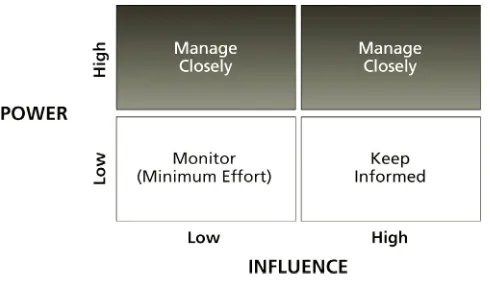
Next, let’s shift our attention to power and influence. Influence measures the active involvement of the project stakeholder. In other words, if stakeholders are very involved in the project, they will have high influ-ence. A project stakeholder who has minimal involvement will have low influence. For some, the wordspowerandinfluencemay sound very similar. However, as written in thePMBOK®Guide, power refers to the stake-holder’s level of authority, whereas influence, as stated in Chapter Two, refers to the stakeholder’s level of involvement. (See Figure 3.2.)
Involvement is another way to think about influence. In today’s hurried environment, many project stakeholders find themselves on numerous teams. In addition to their involvement on the teams, they may also have day-to-day management or operational responsibilities.
much power the celebrities have to sway public opinion the pro-ject manager will need to either keep them satisfied with current project progress (for celebrities with a lot of power) or monitor them (for celebrities with low power).
SOURCE: “Proposal for the Expansion of the Panama Canal Third Set of
[image:57.432.95.340.409.550.2]Locks Program,”Panama Canal Authority, April 24, 2006.
Figure 3.2 Power and Influence Matrix
Source:Adapted fromPMBOK®Guide, 5th ed.
The project manager can get a different perspective on this chart by replacing the word influence with the word involvement.
Figure 3.2 shows a power/influence grid. It is populated the same way as the power/impact grid with one exception—the top left corner. The top left quadrant shows stakeholders with a high degree of power and a low amount of influence. Unlike the power/impact grid that showed the stakeholders’ level of interest, in this case the stakeholders in the top left may be very interested but simply unable to attend meetings. These stakeholders should be managed as closely as those in the top right quadrant. Project stakeholders in the top left quadrant may make themselves available for key decision meetings at later points in the project. The project manager will want to keep them informed and make sure they are aware and supportive of the project.
This will be challenging for the project manager. As evidenced by these stakeholders’lack of involvement in the team they may be difficult to track down for meetings and phone calls. The project manager will need to be creative in how he or she communicates with project sta-keholders in the top left corner. Virtual technologies, such as virtual meetings and video phone calls, may be deployed to keep stakeholders in the top left quadrant informed.
See Chapter 8, Managing Stakeholders in a Virtual World, for more details on working with stakeholders who are remotely located or who travel extensively. Project stakeholders in the other three cells in this matrix are managed in a similar manner as the power/impact matrix. Stakeholders in the top right quadrant have significant power and are actively involved. The project manager should manage these stakeholders closely. Stakeholders in the bottom right quadrant do not have as much power in the organization but are active in the project. These stake-holders should be kept informed. Stakestake-holders in the bottom left quadrant are the best candidates for the least amount of effort. These stakeholders are not actively involved and have limited power.
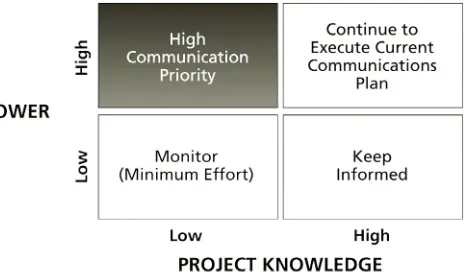
Power and Knowledge
deep knowledge of the project. Knowledgeable stakeholders are better able to contribute valuable th