FORMULATION AND EVALUATION OF MULTI-LAYER MATRIX
TABLETS OF ANTIHYPERTENSIVE DRUG CAPTOPRIL
Ghanshyam Yadav*, Mayank Bansal, Prem Shankar Mishra, Nishi Thakur, Pragati Khare
Department of Pharmaceutical Technology, Meerut Institute of Engineering and Technology, NH-58, Baghpat Crossing, Bypass Road, Meerut (U.P) India – 250005.
ABSTRACT
The present study is carried out to formulate and evaluate multi-layer matrix tablets using hydrophilic polymer, xanthan gum and chitosan as carrier and xanthan gum as retardant in multilayer tablets. Captopril was choosen as a model drug because of its higher water solubility. Matrix tablets were prepared by wet granulation technique using PVP as a binder. Multi-layer matrix tablets of captopril were prepared by compressing on both side of the core granules containing drug with 200mg of xanthan gum granules containing 65% of xanthan gum as release retardant layers. The multi-layer matrix tablets were evaluated for hardness, thickness, friability, drug content uniformity and were subjected to invitro drug release studies. The properties of the polymer used and the structure of each formulation appear to considerably affect drug release and its release rate. The multilayer matrix formulations exhibit lower drug release compared to matrix alone. This was due to the fact that the barrier-layers hindered the penetration of liquid into the core. The mean correlation co-efficients with all matrix formulations for first order release kinetics were found slightly higher when compared to those of zero order release kinetics indicating that the drug release from all the formulations followed first order kinetics. Layering with xanthan gum granules on the matrix core, provided linear drug release with zero order kinetics. FT-IR and DSC studies confirmed that there was no interaction between drug and excipients used in the formulation.
KEYWORDS: Xanthan gum, Chitosan, Captopril, Multi-layer matrix tablets, controlled drug delivery.
Volume 3, Issue 4, 2215-2228. Research Article ISSN 2277 – 7105
Article Received on 15 April 2014,
Revised on 08 May 2014, Accepted on 01 June 2014
*Author for Correspondence
Ghanshyam Yadav
Department of Pharmaceutical
Technology, Meerut Institute
of Engineering and
Technology, NH-58, Baghpat
Crossing, Bypass Road, Meerut
INTRODUCTION
Oral ingestion is most convenient and commonly employed route of drug delivery due to ease of administration, high patient compliance, least sterility constraint, and flexibility in the design of dosage forms. Developing oral controlled release tablets for highly water soluble drugs with a constant release rate is more challenging to the pharmaceutical technologists. Controlled release pharmaceutical systems have been developed and studied to improve the performance of drugs and in particular to increase their pharmacological effect and reduce any side effects. The basic characteristic of the systems is that the rate of drug absorption may be adjusted through a controlled rate of drug release from the dosage form. There are many ways to design modified release dosage forms for oral administration i.e. matrix systems, osmotic drug delivery systems, mucoadhesive systems and microcapsules and one of them is multilayered matrix tablet. In recent times, multilayer matrix tablets are gaining importance in the design of oral controlled drug delivery systems. A multilayer system consists of one or two layers of release retardant polymeric coatings (barrier-layer), which are applied on both side of hydrophilic matrix core containing the active ingredient during the tabletting process. [1,2]
The oral modified release drug product is designed to deliver the drug at a controlled and predetermined rate, thus maintaining their therapeutically effective concentrations in systemic circulation for prolonged period of time. The modulating layers serve to control the rate of hydration of the matrix layer there by restricting the surface area available for diffusion of drug and at the same time controlling solvent penetration rate.[3,4] In the device, the coat layers prevent the water penetration through the protected core for some duration. After this phase during the subsequent dissolution process, the swollen barriers erode and the surface available for drug release slowly increases. In this way the decrease of delivery rate due to the increase in diffusion path length (saturation effect) is counterbalanced by the simultaneous increase of the area available for drug release. [5,6] Thus by combining a time dependent control of the hydration rate of the device with reduction of tablet exposed to the dissolution medium, it is feasible to achieve a linear release profile. [7]
provision of constant rate input and maintenance of steady state blood levels. The pharmacokinetic studies have established that it has relatively short half life of 1.7 – 1.9 h and 70% of oral bioavilability.It is mainly prescribed for patients who are chronically ill and require long term therapeutic agents. The dose required is 37.5-75mg to be taken three times a day in divided doses. It is considered as an ideal drug candidate for the design of oral controlled release dosage form. [8,9] Formulation of an oral controlled delivery system for captopril would be advantageous especially in long term therapy to maintain relatively constant blood levels for a long period of time and reducing the dosing interval.
The widely used polymers for sustaining the drug delivery are HPMC, NaCMC, Chitosan, HPC, MC, Eudragits, natural gums etc. In the present investigation, it was planned to use xanthan gum and chitosan in combination for core, a naturally occurring and abundantly available polysaccharide. Xanthan gum was used as a release retardant carrier in the design of three-layer matrix tablets for highly water-soluble drugs such as captopril (model drug). A few reports appear in the literature on the use of xanthan gum and chitosan, as a carrier, for controlled delivery of drugs and it is potential hydrophilic matrix carrier for controlled delivery of drugs having varying solubility. Since captopril is a highly water-soluble drug, it was planned to develop a controlled release matrix formulation using xanthan gum and chitosan as a carrier.
MATERIALS AND METHODS Materials
Captopril was obtained as a gift sample from Akums Pharmaceutical Ltd., Haridwar, India. Chitosan, xanthan gum and MCC were purchased and of analytical or reagent grade.
Methods
Preparation of Captopril matrix tablets
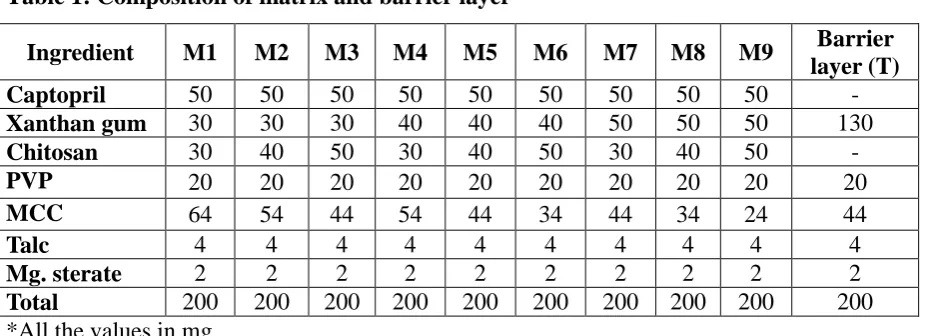
Matrix tablets of Captopril were prepared by the wet granulation method. A mixture of talc and magnesium stearate (2:1 ratio) was used as lubricant and MCC was used as diluent. Xanthan gum and chitosan were included in the formulation in various proportions. Nine matrix formulations were prepared with xanthan gum and chitosan and were coded as M1 to M9, respectively. The composition of formulations used in the study containing 50 mg of captopril in each case is shown in Table 1. In all the formulations, xanthan gum and chitosan was sieved (<250 µm) separately and mixed with captopril and MCC (<250 µm). The powder mix was granulated with 10% PVP solution in the same mixer. The wet mass was passed through a mesh number 18 and the granules were dried at 50 °C for 2 h in a tray drier. The dried granules were lubricated with a mixture of talc and magnesium stearate (2:1 ratio).
Preparation of Xanthan gum barrier layer granules
The barrier layer containing Xanthan gum, were prepared by wet granulation technique. The polymer Xanthan gum and 10% PVP solution were mixed well and the resulting wet mass was passed through sieve no 18 and dried at 30°C for an hour. To increase the flow property of the granules and to prevent its adhesion to die and punches the granules were lubricated with talc and magnesium stearate as shown in Table 1.
Preparation of matrix tablets and multi-layer matrix tablets
top and bottom layer consists of a release retardant barrier layer and middle layer consist of core along with captopril. The hardness of matrix tablet and multi-layer matrix tablets was adjusted to 5-8kg/cm2.
Table 1: Composition of matrix and barrier layer*
Ingredient M1 M2 M3 M4 M5 M6 M7 M8 M9 Barrier
layer (T)
Captopril 50 50 50 50 50 50 50 50 50 -
Xanthan gum 30 30 30 40 40 40 50 50 50 130
Chitosan 30 40 50 30 40 50 30 40 50 -
PVP 20 20 20 20 20 20 20 20 20 20
MCC 64 54 44 54 44 34 44 34 24 44
Talc 4 4 4 4 4 4 4 4 4 4
Mg. sterate 2 2 2 2 2 2 2 2 2 2
Total 200 200 200 200 200 200 200 200 200 200
*All the values in mg
Physical tests for the prepared multilayer matrix tablets
Hardness of the matrix tablets and multi-layer matrix tablets was evaluated by using hardness tester (Monsanto) and mass determination was performed for twenty tablets from each batch and average values were calculated. Ten tablets from each formulation were taken for measurement of diameter and crown thickness with vernier calipers and an average of ten determinations was carried out. Friability of the matrix tablets and multi-layer matrix tablets was determined by first weighing 10 tablets after the dusting and placing in a friability tester (Electrolab EF-2 friabilator USP), which was rotated for 4 min at 25rpm. After de dusting, the total remaining weight of the tablets was recorded and the percent friability was calculated. The drug content of the prepared tablets of each batch was determined in triplicate.
In vitro dissolution studies
tablets were observed for physical integrity. The experiments were repeated thrice and the results were taken as average of three test readings with standard deviations.
Characterization of release data
The description of dissolution profiles has been attempted using different release models. The data were evaluated according to the following equations.
Zero order: Mt = Mo+ Kot
First order: ln Mt = ln Mo+ K1t
Higuchi model: Mt = KH √t
Korsmeyer –Peppas model: Mt/Mo = Kktn
Where Mt is the amount of drug dissolved in time t, Mo is the initial amount of drug, K1is the
first order release constant, K0 is the zero order release constant, KH is the Higuchi release
constant, Kk the Korsmeyer - Peppas release constant and n is the diffusional release
exponent indicative of the operating release mechanism. The correlation coefficient (r2) was used as an indicator of the best fitting, for each of the models considered.[13,14]
.
FT-IR Studies (Fourier Transform Infrared)
The FT-IR spectrum of pure captopril, xanthan gum, chitosan, powdered sample of matrix tablets and multilayer matrix tablets. Infrared spectrum was taken (Shimadzu FT-IR system, Japan) by scanning the sample in Potassium bromide discs. The samples of pure drug and formulated tablets were scanned individually to detect drug-excipients interaction.
Differential scanning calorimetry
Stability Studies
Stability studies were conducted for the optimized formulations of captopril three-layer matrix tablets containing various proportions of xanthan gum and chitosan. To assess their stability with respect to their physical appearance, drug content and drug release characteristics after storing at 40°C/75% RH for 3 months [15] was seen.
RESULT AND DISCUSSION
The present study was carried out to develop oral controlled release tablet dosage form for highly water-soluble drug, captopril. The usual dose range is 25 to 150 mg b.i.d. or t.i.d. for management of hypertension. Matrix and multilayer matrix tablets of captopril were prepared, using xanthan gum and chitosan in different ratio as matrix forming agent. The multilayer matrix tablets of captopril were developed to retarded the drug release from the surfaces of matrix core by compressing xanthan gum on both the surfaces.
Physicochemical characterization of matrix and multilayered matrix tablets
The physical parameters such as hardness, thickness, friability, mass and drug content of the matrix and multilayer matrix tablets are shown in Table 2. All the values were found to be within the limits indicating that tablets were of sufficient standards. The hardness of multilayer matrix tablets was within the range 7.10 ±0.1 to 6.03 ± 0.23 kg/cm2. Drug content uniformity was within the range of 99.57 ± 1.29 to 97.74 ± 0.24 of drug indicating uniform mixing of the xanthan gum, chitosan, drug and other formulation excipients.
Table 2: Physico- chemical characterization of captopril multi-layer matrix tablets (Mean ± SD)
Formulation code
Weight
Variation Hardness Thickness Friability
In-vitro dissolution studies
Drug release studies were carried out in pH 1.2 (0.1N HCl) for 2 hrs and the pH of the media was raised to pH 6.8 for remaining 10 hrs. The percentage in vitro drug release from the formulations M1, M2 and M3 ranged from 96.03 ± 0.59%, 93.94 ± 0.72% and 81.45 ± 1.63% and as variation in the combination of xanthan gum and chitosan upto formulation M9 (72.44 ± 0.25%) the percentage drug release were decreased. Matrix tablets after 8 h of the dissolution study dissolved either completely or near to completion forming a very loose porous mass, sticking to the beaker. Similarly in case of formulations M1T, M2T and M3T, the drug release was upto 85.96 ± 0.48%, 70.71 ± 1.39% and 66.73 ± 0.81% and retardant layer was same upto M9T (60.10 ± 0.75%). The results described in Fig. 1. indicated that the rate and extent of drug release were decreased for the multilayer matrix tablets.
(A)
(C)
Fig. 1: In vitro dissolution profiles of matrix (A),multilayer matrix (B) and comparative studiesof matrix and multilayer matrix tablets (C) of captopril .
Characterization of release data
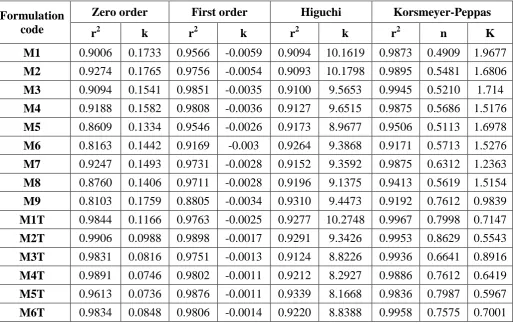
The dissolution mechanism was characterised by using different release models. The mean correlation co-efficient (r2) was used as an indicator of the best fitting for each of the models considered. The mean correlation co-efficient for zero order kinetics, first order kinetics and Higuchi model was shown in table 3. The mean correlation co-efficients with all matrix formulations for first order release kinetics were found slightly higher (r = 0.8805 – 0.9851) when compared to those of zero order release kinetics (r = 0.9285 – 0.9930 ) indicating that the drug release from all the formulations followed first order kinetics. A controlled drug release observed when release retardant layer xanthan gum was applied on both side of variation matrix core formulations, provided fit to zero order kinetics than first order and higuichi equation due to higher r2 value. When 200 mg of xanthan gum (65%) was layered on the variance matrix formulation, the first order release rate constant is reduced from 0.0059 h-1 to 0.0009 h-1. The release of captopril was slower from the formulations with matrix in combination of hydrophillic xanthan gum and chitosan. The controlled drug release is due to increased proportion of polymers. By using korsmeyer model, if n = less than 0.45 it is Fickian diffusion, if n = 0.45-0.89 it is non-Fickian transport.[16] The result of all the formulations showed ‘n’ values between 0.4909-0.7612. It showed that all the formulations
Multilayer matrix tablets are based on the idea that restriction of the matrix area exposed to the dissolution may lead to dual control in the system performance. This is possible for two reasons: (a) matrix hydration rate and consequent swelling and (b) the surface through which the drug can delivered is reduced. These effects, possibly more effective in the initial phase of the dissolution process and less pronounced as swelling proceeds, lead to a linearization of release profile. The drug release mechanism from multi-layer matrix tablets involves the following sequence In the initial phase, barriers applied to the core are able to obstruct the contact of the core tablet with the dissolution medium by limiting the solvent penetration rate and by reducing the surface available for drug release. Thus, in this system the burst effect can be controlled and the area available for drug release can be maintained at a relatively constant level. During dissolution, barrier layers are progressively eroded and the surface available for the drug release increases. Hence, the decrease on the release due to an increase in the diffusion path length is compensated by the concurrent increase in the available area for drug release. Eventually, the dissolution process can finally reach the core even under the layer, and the matrix can freely swell or erode.
Table 3: In-vitro dissolution kinetics of captopril released from multi-layer matrix tablets
Formulation code
Zero order First order Higuchi Korsmeyer-Peppas
r2 k r2 k r2 k r2 n K
[image:10.595.44.558.437.760.2]M7T 0.9877 0.0647 0.9691 -0.0009 0.9200 7.6140 0.9918 0.8626 0.4512 M8T 0.9285 0.0708 0.9672 -0.0011 0.9217 8.2213 0.9689 0.6624 0.898 M9T 0.9930 0.0807 0.9864 -0.0012 0.9225 8.5964 0.9942 0.7854 0.6176
FT-IR Study
FT-IR Spectroscopy was used as a means of studying drug excipients interaction. The FT-IR spectra of captopril exhibits principle absorption peak at 1747.39 cm-1 due to C=O (carboxylic), 1589.23 cm-1 due to C=O (amide) stretching, 1380.94 cm-1 due to CH3 bending,
1245.93 cm-1 due to C-N stretching and 2565.15 cm-1 due to S-H stretching of pure drug. The spectra of pure drug, xanthan gum, chitosan, powdered sample of matrix tablets and multilayer matrix tablets shown in the Fig. 3. The matrix tablets and multi-layer matrix tablets showed similar spectra nearer to drug indicating that no chemical interaction occurred between the captopril and the excipient used in the study.
Fig. 3: FT-IR spectra of pure Captopril (a), xanthan gum (b), chitosan (c), powdered sample of matrix tablets (d) and powdered sample of multilayer matrix tablets (e).
DSC Studies
of interaction between captopril and polymer/ other excipients used in the preparation of three- layer matrix tablets in the study.
(A)
[image:12.595.125.467.109.461.2](B)
Fig. 4: DSC of pure drug captopril (A) and drug-polymer/ other excipients (B)
Stability studies
The stability studies indicated that multi- layer matrix tablets, after storing at 40±2ºC/75±5% RH for three months showed no changes either in physical appearance, drug content and in vitro dissolution studies.
CONCLUSION
drug release compared to matrix tablets. FT-IR and DSC studies confirmed that there was no interaction between drug and excipients used in the formulation. It could be concluded that in oral controlled drug delivery system, hydrophilic polymer is a potent as carrier and barrier layer in the design of multilayer matrix tablets will provide linear release profile for highly water soluble drugs.
ACKNOWLEDGEMENTS
The authors are thankful to Akums Pharmaceutical Ltd, Haridwar, India for generously giving the samples of captopril and Department of Pharamaceutical Technology, M.I.E.T., Meerut, India for their valuable support to complete this work successfully.
REFERENCE
1. Colombo P, Conte U, Gazzaniga A, Maggi L, Sangalli ME, Peppas N. Drug release modulation by physical restrictions of matrix swelling. Int J Pharm, 1990; 63: 43-48. 2. Efentakis M, Peponaki C. Formulation Study and Evaluation of Matrix and Three-layer
Tablet Sustained Drug Delivery Systems Based on Carbopols with Isosorbite Mononitrate. AAPS PharmSciTech, 2008; 9(3): 917-923.
3. Conte U, Maggi L, Colombo P, La Manna A. Multi-layered hydrophilic matrices as constant release devices. J Control Rel., 1993; 26: 39-47.
4. Yihong Q, Chidambaram N, Kolette F. Design and evaluation of layered diffusional matrices for zero order sustained-release tablets. J Control Rel., 1998; 51: 123-130. 5. Conte U, Maggi L. Modulation from Geomatrix® multi-layer matrix tablets containing
drugs of different solubility. Biomaterials, 1996; 17 (9): 889-896.
6. Yihong Q, Kolette F. Design of sustained release matrix system for a highly water soluble compound ABT-089. Int J Pharm., 1997; 157: 46-52.
7. Krishnaiah YSR, Karthikeyan S, Gouri VS, Satyanarayana V. Three-layer guar gum matrix tablet formulations for oral controlled delivery of highly soluble trimetazidine dihydrochloride. J Control Rel., 2002; 81: 45-56.
8. Mohabe V, Akhand R, Pathak AK. Preparation and evaluation of captopril Transdermal patches. Bulletin of Pharmaceutical Research, 2011; 1(2): 47-52.
10. Vendruscolo CW, Andreazza IF, Ganter JLMS, Ferrero C, Bresolin TMB. Xanthan and galactomannan (from M. scabrella) matrix tablets for oral controlled delivery of theophylline. International Journal of Pharmaceutics, 2005; 296: 1–11.
11. Panos I, Acosta N, Heras A. New Drug Delivery Systems Based on Chitosan. Current Drug Discovery Technologies, 2008; 5: 333-341.
12. Bernkop-Schnürch A, Dünnhaupt S. Chitosan-based drug delivery systems. Eur J Pharm Biopharm, 2012; 1(3): 463-469.
13. Ummadi S, Shravani B, Rao NGR, Reddy MS, Nayak BS, Overview on Controlled Release Dosage Form, International Journal of Pharma Sciences, 3(4), 2013, 258-269. 14. Singhvi G, Singh M. Review: In-Vitro Drug Release Characterization Models.
International Journal of Pharmaceutical Studies and Research, 2011; II(I): 77-84.
15. Mathews BR. Regulatory aspects of stability testing in Europe. Drug Dev Ind Pharm., 1999; 25: 831-856.