DESIGN, DEVELOPMENT AND EVALUATION OF SUSTAINED
RELEASE TABLETS OF METOPROLOL SUCCINATE USING
EUDRAGIT POLYMERS.
William Arputha Sundar1* and Dharani Purohit2 1
A. S. William Arputha Sundar, Dean – Health and Sciences, Sunrise University, Alwar,
Rajasthan. 301026.
ABSTRACT
The objective of the study was to develop sustained release tablets of
Metoprolol Succinate (MS) using two different grades of EUDRAGIT
polymers called Drugcoat RLPO and Drugcoat RSPO and to evaluate
pharmacokinetic parameters of the optimized product. Sustained
release tablets of Metoprolol Succinate were prepared using
combination of different ratios of Drugcoat RLPO and Drugcoat
RSPO. Study of pre compression and post compression parameters
facilitated the screening of a formulation with best characteristics. The
granules were prepared by wet granulation method using non-aqueous
vehicles. The granules were coated with coating solution containing
EUDRAGIT polymers. In-vitro drug release studies were performed
using USP apparatus type II. It was found that 93% of the drug was
released at the end of 20hrs. In-vitro release studies was conducted based on the data that all
formulations follows zero order release kinetics and higuchi’s mechanism i.e. the drug was
released by diffusion. Among all the 7 formulations F7 was found to be best matched
formulation with respect to the marketed formulation.
KEYWORDS: Sustained release, Metoprolol Succinate, DRUGCOAT RLPO, DRUGCOAT RSPO, β-blockers.
INTRODUCTION
Cardio vascular disease has become the leading cause of morbidity and mortality in India
during the last three decades. On average, younger age are less likely to have cardiovascular
Volume 6, Issue 8, 553-562. Research Article ISSN 2277–7105
Article Received on 30 May 2017,
Revised on 19 June 2017, Accepted on 10 July 2017
DOI: 10.20959/wjpr20178-8995
*Corresponding Author
Dr. William Arputha
Sundar
A. S. William Arputha
Sundar, Dean – Health
and Sciences, Sunrise
University, Alwar,
diseases and commonly seen in past middle age.[1] The genetic predisposition and acquisition
of traditional risk factors at a rapid rate as a result of urbanization seems to be the major
cause. Also, hypertensive heart diseases in India occur 10 – 15 years earlier than in western
countries.[2] Similarly, there appears to be a steady increase in hypertension prevalence over
the last 50 years which was found to be more in urban than in rural areas. For most drugs,
conventional methods of drug administration are effective, but some drugs are unstable or
toxic and have narrow therapeutic ranges. Some drugs also possess solubility problems. In
such cases, a method of continuous administration of therapeutic agent is desirable to
maintain fixed plasma level. Oral route has been the most convenient and commonly
employed route of drug delivery. Indeed, for the sustained release systems received more
attention in the design and testing of products.[3]
In the recent years focus on the development of sustained release drug delivery system has
increased. The basic rationale of sustained release drug delivery system optimizes the
biopharmaceutical, pharmacokinetic and pharmacodynamic properties of a drug in such a
way that its utility is maximized, side effects are reduced and cure or control of the condition
is achieved in the shortest possible time by using smallest quantity of drug administered by
the most suitable route.[4] Sustained release (SR) products are designed to bring the blood
level of a drug immediately to therapeutic concentrations by means of an initial dose portion
and then sustained this level for a certain predetermined time with the maintenance portion.[5]
β- adrenergic blockers are one of the most frequently prescribed cardiovascular drugs.[6]
Metoprolol is the prototype of cardio selective β- blockers with intrinsic sympathomimetic
activity. It is one of the drugs which cross the BBB and it has been reported that in the
cerebrospinal fluid it achieves 78% of plasma concentration. Only a small portion of it (12%)
bound to human serum albumin. Metoprolol is most effective than other β- blockers. Metoprolol is approximately equipotent to propranolol in inhibiting β1 receptors in heart but
50 times less potent than propranolol in blocking β2 receptors.[7] Drugs that that blocks the β1
receptor have been developed to eliminate the unwanted bronchoconstrictor effects (β2) of propranolol seen among the asthmatic patients. Metoprolol antagonizes the β1 receptors at
doses 50-100 times lesser than that required to block β2 receptors. This cardio selectivity is
more at low doses and lost at high doses.
The drug is freely soluble at any pH, hence judicious selection of release retarding excipients
modulating the drug release is to include the drug in matrix systems. Matrix based SR tablet
formulations are the most popular and easy to formulate on a commercial scale in an industry.
Reservoir type when compared to Matrix type provides better result in retarding the drug
release but difficult to prepare on a commercial scale.[8]
In the present study combination of Reservoir and Matrix type system was formulated by wet
granulation method. Influence of different ratio of polymer concentration on drug release was
evaluated by keeping the drug substance concentration constant and altering the release
retardant polymer concentration. Pre compression and post compression parameters were
evaluated and optimized formulation was characterized.[9]
EUDRAGIT polymers are relatively new synthetic anionic and cationic release retarding
agents consisting of methacrylic acid dimethylaminoethyl methacrylate and methacrylic acid
esters in varying ratios. It is a white powder with slight amine like odor. It is suitable for
Matrix devices and it exhibits pH independent swelling which helps in retarding the drug
from the device.[10]
MATERIALS AND METHODS
Metoprolol Succinate was obtained from Paxmy chemicals, Mumbai. The EUDRAGIT
polymers were obtained from Vikram thermolabs, Calcutta; Talc & Magnesium stearate was
obtained from Loba chemie, Pvt. Ltd, Mumbai; MCC was obtained from Welming
pharmaceuticals, India. Solvents and all other chemical reagents used were of analytical
grade.
Preparation of SR tablets of Metoprolol Succinate.
Preparation of SR tablets of Metoprolol Succinate (F1 to F5)
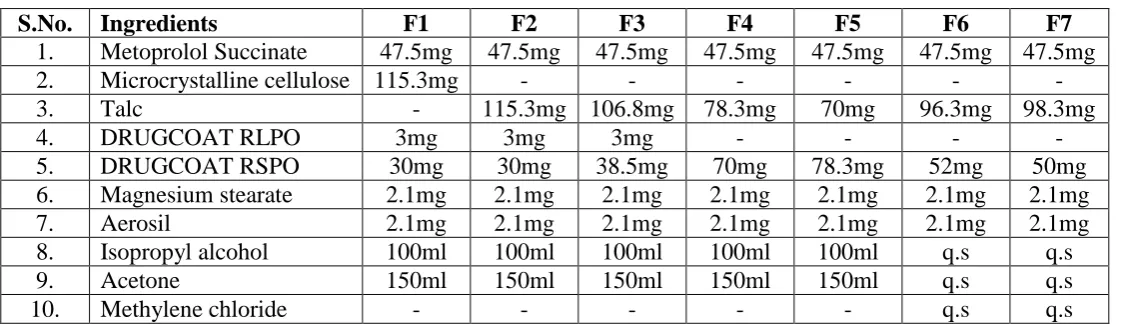
Tablets were prepared by wet granulation method using the ingredients given in table. F1 to
F5 trials were taken. The active ingredient Metoprolol Succinate and the following excipients
like Micro crystalline cellulose, Magnesium stearate etc. were sifted separately through
ASTM sieve no. 60. Aerosil was sifted through sieve no.24. Metoprolol Succinate and MCC
were mixed thoroughly for 5min. DRUGCOAT RLPO, RSPO were mixed together and
dissolved in mixture of IPA and Acetone. The above solution was used to form wet granules.
The wet granules were open air dried at room temperature for 30min. The granules were
passed through ASTM sieve no.12. The sifted granules were dried at 600C for 3hrs. To the
the lubricated granules were compressed into tablets weighing 200 mg die cavity using the
punch size of 10/32 SC’ in a Cadmach double rotary tablet punching machine using
appropriate size of standard concave punches to a hardness of 6 to 10 kg/cm3. The
compressed tablets were de dusted and evaluated for various tablet properties.
Preparation of SR tablets of Metoprolol Succinate (F6, F7)
Sustained release tablets of Metoprolol Succinate was prepared by wet granulation method
The active pharmaceutical ingredient Metoprolol Succinate and the following excipients like
talc, magnesium stearate were sifted separately through ASTM sieve no.60. Aerosil was
sifted through ASTM sieve no.24. Metoprolol Succinate and talc was dry mixed previously.
One third quantity of polymer DRUGCOAT RSPO was dissolved in the mixture of isopropyl
alcohol and acetone. The above polymer solution was slowly added to the mixture of
Metoprolol Succinate and talc to produce wet granules. The wet granules were kept for open
air dry for 30min.The granules were then passed through ASTM sieve no.12.The sifted
granules were then transferred to a pan and kept in an oven at 450C for 2 hours.
The remaining quantity of polymer DRUGCOAT RSPO was dissolved in a mixture of
isopropyl alcohol and methylene chloride. For uniform distribution of the polymer into the
solvent mixture the above mixture was homogenized. In the spray coating machine, the dried
granules were placed in the coating pan. The above polymer solution was sprayed on to the
dried granules at low pressure, in wide angle to overcome the flyover of particles. The coated
granules were dried in oven at 600C for about 1 hr. The dried coated granules were then
passed through ASTM sieve no. 18 and aerosil was added to the granules and lubricated.
Finally, the lubricated granules were compressed into tablets weighing 200 mg die cavity
using the punch size of 10/32 SC’ in a Cadmach double rotary tablet punching machine using
appropriate size of standard concave punches to a hardness of 6 to 10 kg/cm3. The
compressed tablets were dedusted and evaluated for various tablet properties.
Evaluation of Metoprolol Succinate S.R. tablets Pre compression parameters
Initially the lubricated powder blend was evaluated for density parameters like bulk density,
tapped density, compressibility index and Hausner’s ratio was calculated to estimate the flow
properties. The physical parameters of the lubricated powder blend from all the seven
polymer concentration decreases the flow property and increases the compressibility of the
lubricated powder blend.
Post compression parameters
The compressed tablets were characterized by their physical properties. The average tablet
weight was determined from 20 tablets (USP, 2007). Tablet hardness was tested using
Monsanto tablet hardness tester. Friability of the tablets was determined by Roche friabilator.
Tablet friability was calculated as the percentages of weight loss of 20 tablets after 100
rotations (USP, 2007). The post compression parameters of the compressed tablets from all
the seven trials were evaluated. Low hardness and little high friability were observed for
formulations with low concentration of polymer and high concentration of active ingredient
[image:5.595.20.581.344.509.2]and this is due to low bulk density and low compressibility nature of Metoprolol Succinate.
Table no.1 Formula for Metoprolol Succinate S.R. tablets.
S.No. Ingredients F1 F2 F3 F4 F5 F6 F7
1. Metoprolol Succinate 47.5mg 47.5mg 47.5mg 47.5mg 47.5mg 47.5mg 47.5mg
2. Microcrystalline cellulose 115.3mg - - - -
3. Talc - 115.3mg 106.8mg 78.3mg 70mg 96.3mg 98.3mg
4. DRUGCOAT RLPO 3mg 3mg 3mg - - - -
5. DRUGCOAT RSPO 30mg 30mg 38.5mg 70mg 78.3mg 52mg 50mg
6. Magnesium stearate 2.1mg 2.1mg 2.1mg 2.1mg 2.1mg 2.1mg 2.1mg
7. Aerosil 2.1mg 2.1mg 2.1mg 2.1mg 2.1mg 2.1mg 2.1mg
8. Isopropyl alcohol 100ml 100ml 100ml 100ml 100ml q.s q.s
9. Acetone 150ml 150ml 150ml 150ml 150ml q.s q.s
10. Methylene chloride - - - q.s q.s
Table no. 2: Evaluation of lubricated powder blend.
S. No. Parameters F1 F2 F3 F4 F5 F6 F7
1. Angle of repose 37
018’±
0.21
25079’± 0.34
27014’± 0.21
33051’± 0.03
36075’± 0.03
28016’± 0.06
31016’± 0.02
2. Bulk density
(g/ml) 0.642± 0.02 0.680± 0.01 0.652± 0.03 0.551± 0.01 0.529± 0.02 0.738± 0.01 0.742± 0.01
3. Tapped density
(g/ml) 0.741± 0.01 0.777± 0.03 0.744± 0.02 0.636± 0.02 0.640± 0.01 0.851± 0.04 0.829± 0.03 4. Compressibility index (%) 17.45± 0.47 12.48± 0.14 12.41± 0.11 13.36± 0.26 18.38± 0.20 13.27± 0.18 10.49± 0.15
5. Hausner’s ratio 1.20±
Table no. 3: Evaluation of finished product
S.No Test Specification F1 F2 F3 F4 F5 F6 F7
1. Description
White colour, slightly concaved tablets
Complies Complies Complies Complies Complies Complies Complies
2. Thickness 3.2 to 4mm 3.9±0.03 3.11±0.05 3.16±0.02 3.47±0.05 3.53±0.02 3.14±0.02 3.17±0.02
3. Hardness 6 to 10 (kg/cm2) 6.35±0.02 6.12±0.01 6.17±0.01 6.11±0.02 6.19±0.05 8.27±0.04 8.25±0.01
4. Friability NMT 1% 0.7 0.12 0.12 0.11 0.11 0.11 0.11
5. Weight
Variation (mg)
±7.5 from the
average weight 203 202 200 200 201 200 201
6. Assay 90-110% 98.86 98.21 99.64 98.75 99.34 98.71 98.78
Table No. 4. In-vitro dissolution data of formulations F1, F2, F3, F4, F5, F6 and F7: S. No. Time in
hours
Marketed
Seloken XL F1 F2 F3 F4 F5 F6 F7
1. 1 11.61±0.03 53.96±0.01 41.43±0.12 30.19±0.19 25.87±0.05 28.40±0.06 9.39±0.05 11.52±0.05
2. 4 24.77±0.06 88.29±0.05 62.34±0.16 61.76±0.23 52.58±0.09 59.31±0.1 25.11±0.08 27.39±0.03
3. 8 49.37±0.09 98.56±0.09 85.97±0.11 79.11±0.17 86.35±0.07 82.87±0.09 49.61±0.04 46.87±0.06
Table no 5: Kinetic data of release profile of metoprolol succinate Sustained release tablets of optimized formulation.
S.No Order of kinetics Optimized formulation ( F7)
R2 ‘n’
1. Zero order 0.985
-
2. First order 0.995
3. Higuchi plots 0.984
4. Korsmeyer Peppa’s plots 0.994 0.7011
In-vitro dissolution study
In-vitro drug release study from the prepared S.R. tablets of Metoprolol Succinate was
conducted for a period of 20 hours using six stations USP type II dissolution apparatus and
the temperature of the medium was maintained at 370 ±0.50C with paddle rotation at 50rpm
and 500ml of dissolution medium using pH 6.8 phosphate buffer. Samples of 2 ml were taken
from the dissolution medium at appropriate time intervals. After filtration and appropriate
dilution with the mobile phase (mixture of pH6.8 phosphate buffer and Acetonotrile in 85:15
ratio) the sample is injected into the HPLC column. Column used for reverse phase HPLC
was Cromasil C18(250×4.6). The flow rate was maintained at 1.0ml/min. the sample
injection volume was 20µl. The amounts of the drug present in the samples were calculated
with the help of appropriate calibration curves constructed from reference standards.
Similarly, dissolution study was conducted for the reference product (i.e Seloken XL, Batch
No: SWEJ001, Manufacturer: AstraZeneca) and compared with the test products. The
dissolution profiles for the trials were provided in table no.3.
For the uncoated granules the increased polymer concentration could not retard the release of
the drug in sufficient manner. Also the hardness and flow property was found to decrease in
considerable amount. Similarly for coated granules flow property and hardness was found to
be within the USP limits and there is evidence that the drug release was sufficiently retarded
with even low polymer concentration. The drug release protocol of formulated trials of
Metoprolol Succinate S.R. tablets from MS-1 to MS-7 is shown in (Table No.3). From these
formulations MS-7 was found to be best formulation because the release pattern of F7 batch
Figure no: 1 Comparative dissolution study of formulations F1 - F7 and marketed formulations.
Kinetic studies of Optimized formulation F7.
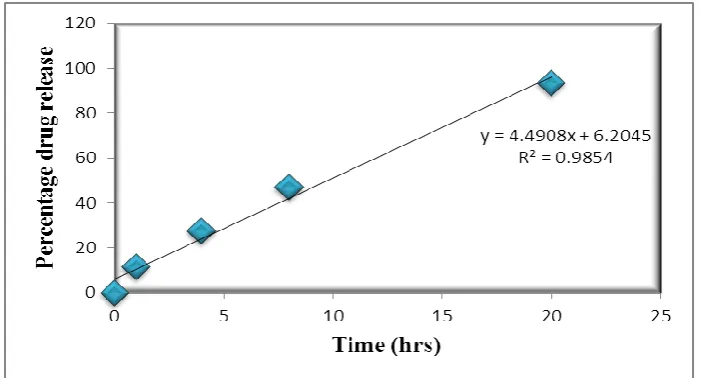
The drug release data were subjected to mathematical treatment to check the release order
kinetics. Plots of Percentage drug release Vs Time (Zero order Plot) Cumulative percentage
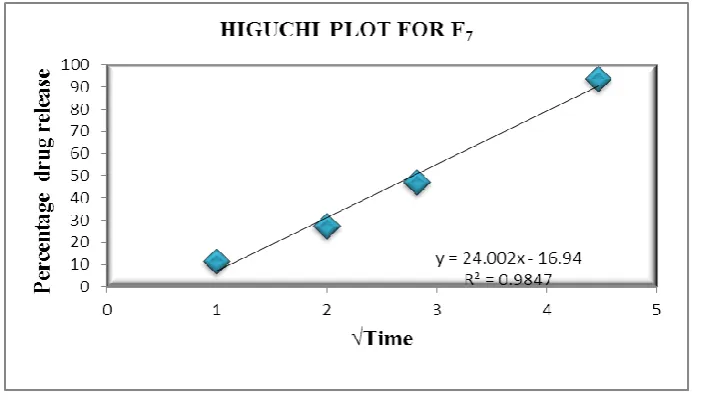
drug release Vs Square root of time (Higuchi plot) are shown in graphs respectively. The
kinetic data of dissolution studies of all formulations were presented in Table no 4. Plots of
percentage drug release Vs Time were found to be linear indicating that the mechanism of
drug release from these formulations was according to Zero order kinetics. To evaluate the
drug release pattern of these formulations Higuchi plots were constructed. These plots were
linear with formulations F3, F6, F7 indicating that the drug release mechanism was Diffusion
controlled but for the other formulations like F1, F2, F4, F5 non- linearity was observed
[image:8.595.125.477.66.250.2]indicating that the drug release was by Erosion.
[image:8.595.123.474.553.742.2]Figure No. 3 Higuchi’s plots of optimized formulation F7.
CONCLUSION
From the above observations it can be concluded that Metoprolol Succinate is an ideal
candidate for converting into the sustained release dosage forms. Also, it shows the evidence
that Eudragit polymers can be effectively utilized in the design of Metoprolol Succinate
sustained release tablets using an optimum concentration for desired release profile and with
good quality parameters.
REFERENCES
1. Haward B: Cardiovascular Pharmacology. 3rd edition, 1990; 15(2): S 24-28.
2. Padric J and Jessica T: Study of racial differences in tolerance to diseases. 1st Ed, 2012;
12-31.
3. Upendra K and Vineet B: Perspective of coronary interventions and cardiac surgeries in
India. Indian J Med Res, 2010; 132: 543-548.
4. Kanika and Sandeep.Design and evaluation of oral sustained drug delivery of Metoprolol
Succinate using hydrophilic gums and polymers and polymers such as Xanthan gum, guar
gum and HPMC as a release modifier. International Journal of Pharmacy and
Pharmaceutical Sciences, 2009; I: 60-69.
5. Bhavya M. Study the effect of formulation factor on the release rate of drug from the
dosage form of metoprolol succinate. International Journal of Drug Development &
Research, 2011; 3(1): 307-313.
6. M.J. Reiter. Cardiovascular drug class specificity: β-blockers. Progress in cardiovascular
7. Mohamed SK, Syed A and Merlin. Formulation and evaluation of porous controlled
release tablets of Metoprolol Succinate using sodium alginate as a matrix forming agent
and Ammonium bi carbonate as a pore forming agent. International Journal of Pharmacy
and Pharmaceutical Sciences, 2011; 3(2): 192-199.
8. Siddique S, Bose A, Khanam J. Modulation of drug (metoprolol succinate) release by
inclusion of hydrophobic polymer in hydrophilic matrix. Drug Dev Ind Pharm, 2011 Sep;
37(9): 1016-25.
9. Panchaxari MD, Navik VK, Anand PG and Sowjanya P. Fabrication and in vitro
Evaluation of Porous Osmotic pump based controlled drug delivery of Metoprolol
Succinate. Int J Pharm Pharm Sci, 2012; 4(3): 697-704.
10.Santosh KN, Nageswara R and Chandra SR. Formulation and Evaluation of Sustained
Release Metoprolol Succinate Matrix Tablets by Direct Compression Process using