755
Structural, Electrical and Optical Characterization Studies on Glycine Picrate
Single Crystal : A Third Order Nonlinear Optical Material
T. Uma Devi *a, N. Lawrenceb, R. Ramesh Babuc, K. Ramamurthic G. Bhagavannarayanad
a
Department of Physics, Government Arts College for Women, Pudukkottaii –622001, India.
b
Department of Physics, St. Joseph’s College (Autonomous), Tiruchirappalli –620002, India.
c
Crystal Growth and Thin Film Laboratory, School of Physics, Bharathidasan University, Tiruchirappalli –620024, India.
d
Materials Characterization Division, National Physical Laboratory, Dr. K. S. Krishnan Marg, New Delhi-110 012, India
*Corresponding author: [email protected] Phone: +91 9345123400; Fax: +91 431 2407045
ABSTRACT
Single crystal of an organic nonlinear optical (NLO) material, Glycine picrate (GP), was grown by slow cooling method. The structural perfection of the grown crystal was analyzed by high-resolution X-ray diffraction (rocking curve) measurements. UV-Visible-NIR spectral analysis was used to determine the optical constants and band gap of GP. The nature of variation of dielectric constant with frequency at different temperatures was investigated. Third-order optical nonlinearities of GP crystal were investigated. Etch patterns of the grown crystal quality were studied.
Keywords: X-ray diffraction, Growth from solutions, Single crystal growth, Nonlinear optic
materials
1. INTRODUCTION
study of amino acid crystallizes with other organic and inorganic molecules, which presents a high non-linear optical coefficient has gained much attention in the last few years because of the possibility of using them in technological devices [1,2]. Our laboratory is engaged in finding new materials for NLO applications and some of these were reported recently [3-6]. Glycine picrate (GP) is an organic nonlinear optical material that belongs to monoclinic crystal system and the lattice parameters are a = 14.968 Å, b = 6.722 Å, c = 15.165 Å and β= 93.65º. GP consists of two molecules of glycine and one picric acid molecule and is formed through hydrogen bonding and the carboxyl groups of two glycine molecules share a hydrogen atom [7]. Growth of GP and the results of FTIR, TG-DTA, UV-vis-NIR spectrum and Vicker’s microhardness studies of GP were discussed in our earlier report [4].
Third-order nonlinear optical (NLO) materials with weak nonlinear absorption (NLA) but strong nonlinear refraction (NLR) have attracted considerable attention because of their potential uses in the optical signal processing devices [8–13]. The Z-scan method has gained rapid acceptance by the nonlinear optics community as a standard technique for separately determining the nonlinear changes in index and changes in absorption. This acceptance is primarily due to the simplicity of the technique as well as the simplicity of the interpretation.
The dielectric behavior of a material is an important factor as it has direct influence on the NLO efficiency of the crystals. Further quality of the crystal is an important factor when the crystals are brought to the device applications. Hence, we present in this paper, the results of the third order nonlinear optical, dielectric, etching and high resolution X-ray diffraction studies on the nonlinear optical GP crystal.
2. CRYSTAL GROWTH
643
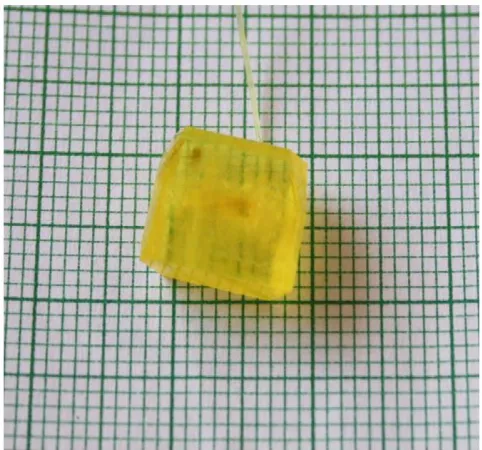
Fig. 1. As grown GP single crystal
3. EXPERIMENTAL
3.1High-Resolution X-ray Diffractometry Study on GP
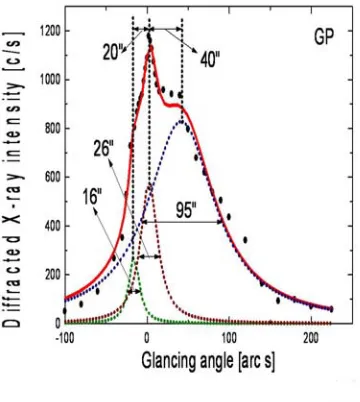
reasonably good. The affect of such low angle boundaries may not be very significant in many applications, but for the phase matching applications, it is better to know these minute details regarding crystalline perfection. It may be mentioned here such very low angle boundaries could be resolved only because of the high-resolution of the multicrystal X-ray diffractometer used in the present investigation.
Fig. 2 Diffraction curve recorded for a typical SEST-grown GP single crystal
3.2 Etching Studies
The patterns of etch pits depend on the etchant, etching time and crystal faces. Etch pits are associated with dislocations and dislocation bundles and hence bring out the crystal quality [15, 16]. The etch pits in GP crystals were examined using normal incident light type microscope. Etching experiments were performed using water as etchant at room temperature for 10 s on (0 0 1) face which was carefully oriented and polished before etching. Fig. 3a shows predominant straight striations on crystals. Some of them extend completely over the surface while others are partly extended. Fig. 3b shows the striations parallel to c-axis on its face for etching period of 20s.
3.3 Dielectric Studies
643
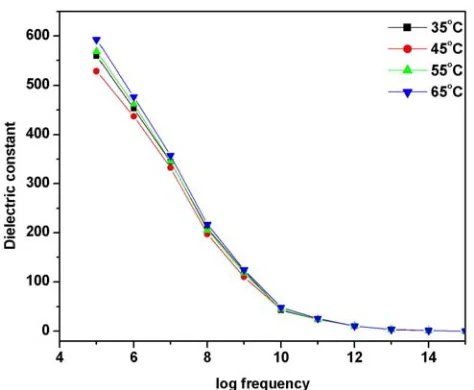
4. The dielectric constant (ε') obtained for GP is higher at the lower frequencies and then it decreases with the increasing frequencies and saturates for further increase in the frequency which can be attributed to space charge polarization mechanism of molecular dipoles [17]. It is important to note that temperature has not influenced much on the dielectric behaviour of the GP crystal. The electronic exchange of a number of ions in the crystals gives local displacement of electrons in the direction of the applied field, which in turn gives rise to polarization. Crystals with high dielectric constant lead to more power dissipation and hence at higher frequencies, the power dissipation in the crystal may have lower value [17].
Fig. 3. Etch patterns observed on ( 0 0 1) plane of GP single crystal with water as an etchant for
[image:5.612.76.490.230.379.2]a period (a) 10 s and (b) 20 s
[image:5.612.181.418.449.644.2]3.4 Optical Transmission Studies
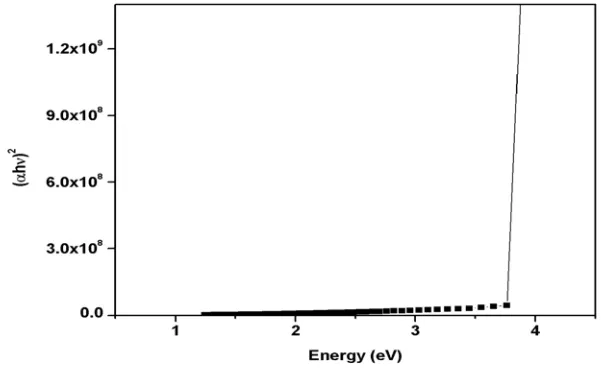
The dependence of optical absorption coefficient with the photon energy helps to study the band structure and the type of transition of electrons [18]. The optical transmittance spectrum of GP recorded using Shimadzu model 1601 in the range 200–1000 nm. Optically clear single crystal of thickness of about 1mm was used for this study. There is no appreciable absorption of light in the entire visible range, as is the case for all the amino acids [19]. Some absorption bands in the UV– Vis region may be attributed to the coloured nature of the material. The short wavelength cutoff occurs at 470 nm. The value of band gap energy was estimated from the graph between hν and (αhν)2 by extrapolating the linear portion of the curve to zero absorption (Fig. 5). Here α is the absorption coefficient and hν the photon energy. The band gap energy calculated is about 3.7 eV for the GP single crystal. As a consequence of wide band gap, the crystal under study has relatively larger in the visible region [20]. Values of the refractive index are within the range 2.45 to 2.64. The internal efficiency of the device also depends upon the absorption coefficient. Hence by tailoring the absorption coefficient and tuning the band gap of the material, one can achieve the desired material which is suitable for fabricating various layers of the optoelectronic devices as per the requirements.
Fig. 5 Graph of hν and (αhν)2
3.5 Z-Scan Measurements
[image:6.612.136.437.368.552.2]643
measuring the transmittance of a nonlinear medium through a finite aperture in the far field as a function of the sample position Z with respect to the focal plane. With this procedure the transmittance change between peak and valley ΔTpv can be extracted from them. Using the expression ΔTpv = 0.406 (1 - S) 0.25ΔφNL we can obtain the induced nonlinear phase, ΔφNL=(2π/λ)
n2LI0, where λ is the wavelength, L is the sample length, I0 is the intensity at focus and n2 is
nonlinear refractive index. Fig. 6 shows Z-scan measurements in the GP crystal. The transmittance change observed as a function of the sample position Z has a peak to valley shape that is characteristic of a self focusing. GP has a nonlinear refractive index n2 = 4.6x10⁻⁸ cm2/W
for the laser wavelength at 632 nm.
Fig.6. Closed aperture Z-scan measurements on GP crystal
4. CONCLUSION
fabrication of laser based spectral instruments and also good enough for the generation of higher harmonic light using IR lasers through NLO phenomena. The Z-scan measurements, performed with 632 nm laser pulses, revealed that GP possesses prominent third order nonlinearity. One can also use this material as third harmonic generator of Nd:YAG laser. Etching studies and the low values of dielectric constant with high frequency for the sample suggest that the sample possesses enhanced optical quality with lesser defects and is a promising material for designing optical device.
REFERENCE
[1] S. Moitra, T. Kar, J.Cryst. Growth 310(2008) 4539
[2] Z.H. Sun, G.H. Zhang, X.Q. Wang, X.F. Cheng, X.J. Liu, L.Y. Zhu, H.L. Fan, G. Yu, D. Xu, J.Cryst. Growth 310(2008) 2842
[3] T. Uma Devi , N. Lawrence, R. Ramesh Babu, K. Ramamurthi J. Cryst. Growth 310 (2008) 116
[4] T. Uma Devi , N. Lawrence, R. Ramesh Babu, K. Ramamurthi Spectrochim. Acta A 71( 2008) 340
[5] T. Uma Devi , N. Lawrence, R. Ramesh Babu, S. Selvanayagam, Helen Stoeckli-Evans, K. Ramamurthi Cryst. Growth Des. 9 (2009) 1370
[6] T. Uma Devi , N. Lawrence, R. Ramesh Babu, K. Ramamurthi Mat. Res. India, 5 (2008)397
[7] T. Kai, M. Goto, K. Furuhata, H. Takayanagi, Anal. Sci. 10 (1994)359.
[8] J.M. Hales, S.J. Zheng, S. Barlow, S.R. Mrder, J.W. Perry, J. Am.Chem. Soc. 128 (2006) 11362.
[9] S.R. Marder, B. Kippelen, A.K.-Y. Jen, N. Peyhambarian, Nature 388 (1997) 845. [10] Q. Wang, J. Han, H. Gong, D. Chen, X. Zhao, J. Feng, J. Ren, Adv. Funct. Mater. 16
(2006) 2405.
[11] Y. Zhu, Y.-Z. Zhu, H.-B. Song, J.-Y. Zheng, Z.-B. Liu, J.-G. Tian, Tetrahedron Lett. 48 (2007) 5687.
[12] X. Wang et al., J. Phys. Chem. B 110 (2006) 1566.
[13] M. Sheik-Bahae, A. A. Said, T-H Wei, D. J. Hagan and E. W. Van Stryland, IEEE J. Quantum Electron. 26 (1990) 760.
[14] G. Bhagavannarayana, R.V. Ananthamurthy, G.C. Budakoti, B. Kumar and K.S. Bartwal , J. Appl. Cryst. 38 (2005) 768
[15] J. Bohm, R.B. Heimann, M. Hengst, R. Roewer, J. Schindler, J. Cryst. Growth 204 (1999) 128.
[16] I.H. Jung, K.B. Shim, K.H. Auh, T. Fukuda, Mater. Lett. 46 (2000)354. [17] L.R. Dalton, J. Phys.: Cond. Matter 15 (2003) 897.
643
[19] J.J. Rodrigues Jr., L. Misoguti, F.D. Nunes, C.R. Mendonca, S.C. Zilio, Opt. Mater. 22 (2003) 235.