https://www.scirp.org/journal/ce ISSN Online: 2151-4771
ISSN Print: 2151-4755
DOI: 10.4236/ce.2019.1012246 Nov. 30, 2019 3223 Creative Education
The Relationship between Efficiency and Level
of Satisfaction on CPD among Teachers
Mohd Jasmy Abd Rahman, Low Weng Sheng, Md. Yusoff Daud, Nur Kamariah Ensimau
The National University of Malaysia, Bangi, Malaysia
Abstract
The aim of this study was to identify the level of efficiency among teachers in Bachang Zone and their satisfaction towards online CPD. The survey has been conducted among 181 respondents in Bachang Zone, Malacca in order to identify the relation between teachers level of knowledge on ICT and their satisfaction based on gender and ages. The study showed that teacher who has more knowledge in ICT has a highly satisfaction. However, the comparative analysis found that teachers’ efficiency on ICT was varied by gender, not by age. Meanwhile, the level of CPD satisfaction was significant by gender and ages. Therefore, this study suggested that various educational organizations should provide teachers with the assistance in ICT and improve the training website system to be more user-friendly and the similar conducted in rural areas also mostly welcomed.
Keywords
Technology and Information Skills, Service Satisfaction Training, Online, Teachers
1. Introduction
Information and Communication Technology skills were the goal of education because computer skills contribute to the success of learning (Kuhlemeier & Hemker (2007). Therefore, there was an important role to ensure the satisfaction of teachers in online training. It is also in line with the 7th Shift in PPPM 2013-2025 (Ministry of Education Malaysia, 2012), which utilizes ICT to en-hance the quality of learning in Malaysia. This may indicate that the ICT is a key element in 21st century learning (Mohd Jasmy & Norazani, (2017) as future education is digital. According to Goh et al. (2010), raising the level of employee skills at the basic level or providing continuous retraining is crucial to achieving How to cite this paper: Rahman, M. J. A.,
Sheng, L. W., Daud, Md. Y., & Ensimau, N. K. (2019). The Relationship between Effi-ciency and Level of Satisfaction on CPD among Teachers. Creative Education, 10, 3223-3234.
https://doi.org/10.4236/ce.2019.1012246
Received: October 21, 2019 Accepted: November 27, 2019 Published: November 30, 2019
Copyright © 2019 by author(s) and Scientific Research Publishing Inc. This work is licensed under the Creative Commons Attribution International License (CC BY 4.0).
http://creativecommons.org/licenses/by/4.0/
DOI: 10.4236/ce.2019.1012246 3224 Creative Education
the goals of an organization. This is because human resources are the most val-uable asset for an organization. Therefore, continous professionalism training programs are one of the important tools for expanding the human resource po-tential and thus enhancing the quality and quality of staff within the organiza-tion. In line with the 21st century, the use of advanced information and commu-nication technologies has made it easier for teachers to access online in-service training regardless of time and place such as through the Open Learning Web-site, OER, EPSA, eP-MABLS, the site education of the state of Malacca (Malacca Department of Education, (2017)) and so on. EPSA and eP-MABLS learning are considered as training and credit hours will be included in SPLKPM. This means that teachers can manage their own training online and learn new knowledge and skills on their own initiative anywhere and anytime. Teachers who have not completed the 7-day training can also take this initiative to meet the current year’s requirements. Numerous studies have also shown that continuous training can improve teacher work performance and is important in transforming a lag-ging practice. In short, our education system has changed dramatically in terms of widespread use of ICT. Studies have found that a teacher’s ICT skills level can influence the effectiveness of a program that requires the use of computers and IT (Sheiladevi & Rahman, (2016). High ICT skills play an important role in in-fluencing teachers’ job satisfaction in facing IT-related challenges(Mohd Jasmy & Md. Yusoff (2015). Therefore, teachers need to ensure that they enhanced their skills on ICT in order to raise their level of work satisfaction.
2. Problem Statement
DOI: 10.4236/ce.2019.1012246 3225 Creative Education
p0satisfaction in the context of Malaysia, I conducted this study to justify the re-lationship between ICT skills and online CPD satisfaction so that teachers can enhance their professionalism through CPD over online based on their needs. The training received will certainly enhance the quality of education as it will motivate teachers to continue to learn and improved their accountability as educators in schools.
3. Literature Review
DOI: 10.4236/ce.2019.1012246 3226 Creative Education
the information gap. This means that teachers can improve their knowledge through online in-service training. They will feel satisfied when they are able to improve their skills to achieve an educational objective. This will only happen when teachers have the ICT skills to access this information. Zawiyah & Zuhri, (2014) found that the use of Facebook Group is appropriate for the purpose of sharing knowledge rather than forging relationships between teachers and stu-dents. In addition, Aesaert et al. (2015) states that the lack of competency of teachers in the ICT will affect the achievement of students’ performance in school and may not develop their own knowledge.
4. Methodology
Survey and correlation studies using quantitative approaches were used as the design of this study. The study was conducted in Bachang zone, Melaka which involved 15 schools. Based on the Krejcie sampling method, R. V and Morgan D. W (1970) in the book Azizi et al. (2016), a total of 181 teachers were randomly selected to be sampled in this study. Table 1 shows the demographics of gender and age of the respondents
In this a quantitative study, an instrument is a questionnaire used only to col-lect the data of the variables from the study sample. The questionnaire consisted of three sections, Part A, 2 items collecting demographic information, Part B, 10 items collecting teachers ‘ICT skills level information and Part C, 25 items col-lecting teachers’ online CPD satisfaction data. This instrument has been certified by a lecturer in the field at UKM. The pilot results showed that the alpha and Part C items were alpha values of 0.93 and 0.97, respectively. The survey ques-tionnaire was distributed to 181 teachers in Bachang zone, Central Malacca, Malacca in the form of Google Form.
Data was collected from respondents using SPSS software version 20 by means of descriptive and inference analysis such as t-test, ANOVA test and correlation test. The interpretation scales for the mean data scores are as shown in Table 2. Adapted from Izani & Yahya (2014). While the range scores for the relationship strengths of the variables in this studied can refer to Table 3.
5. Research Findings
5.1. Level of Teacher Efficiency on ICT in Bachang Zone, Malacca
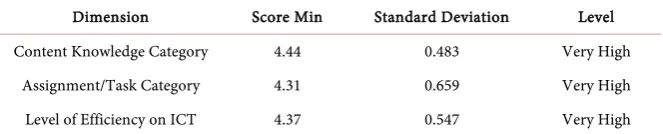
Part B items have been distributed and the questionnaire was analyzed descrip-tively. The table showed the level of ICT among teachers in Bachang Zone. Re-ferring to Table 4, it showed teacher level of efficiency on ICT in the Bachang zone, Malacca was very high with mean = 4.37; s.p. = 0.547.
DOI: 10.4236/ce.2019.1012246 3227 Creative Education Table 1. Respondent demographic.
Demography Frequency (n) Percentage (%)
Gender
Male 32 17.7
Female 149 82.3
Total 181 100.0
Ages
21 - 30 years old 35 19.3
31 - 40 years old 76 42.0
41 - 50 years old 49 27.1
51 - 60 years old 21 11.6
[image:5.595.204.541.308.395.2]Total 181 100.0
Table 2. Interpretation of min score.
Score Min Min
1.00 - 1.89 Extremely Low
1.90 - 2.69 Low
2.70 - 3.49 Moderate
3.50 - 4.29 High
4.30 - 5.00 Extremely High
Table 3. Range of relationship of variables.
Score Min Interpretation Score Min
0.00 Not relate
<0.19 Extremely Weak
0.20 - 0.39 Weak
0.40 - 0.69 Moderate
0.70 - 0.89 High
>0.90 Very High
Table 4. Level of teacher efficiency on ICT.
Dimension Score Min Standard Deviation Level
Content Knowledge Category 4.44 0.483 Very High
Assignment/Task Category 4.31 0.659 Very High
Level of Efficiency on ICT 4.37 0.547 Very High
5.2. Teachers Level of Satisfaction towards Training Online Services
[image:5.595.208.540.429.537.2] [image:5.595.208.540.570.637.2]DOI: 10.4236/ce.2019.1012246 3228 Creative Education Table 5. Teachers level of satisfaction towards training online services.
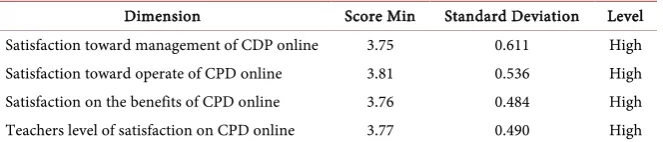
Dimension Score Min Standard Deviation Level Satisfaction toward management of CDP online 3.75 0.611 High Satisfaction toward operate of CPD online 3.81 0.536 High Satisfaction on the benefits of CPD online 3.76 0.484 High Teachers level of satisfaction on CPD online 3.77 0.490 High
The analyze shown that teachers in Bachang zone were most satisfied with the satisfaction towards management on CPD online score was (min = 3.81; sp = 0.536), followed by the satisfaction the benefits gained after attended CPD online score (min = 3.76; sp = 0.484) the lowest was the satisfaction with online CPD online management (min = 3.75; sp = 0.611). All of these dimensions scores were high and the mean difference between the highest and lowest dimensions was only 0.06.
5.3. Contribution of ICT Efficiency towards Level of Satisfaction on CPD Online among Teachers in Bachang Zone, Malacca
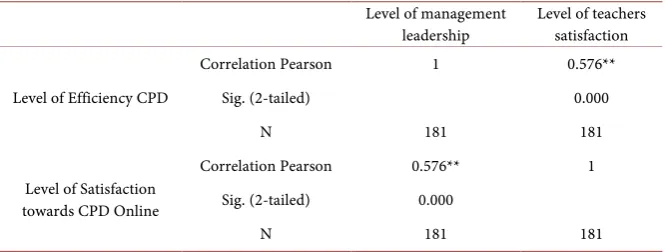
The level of ICT Efficiency and the online level of CPD satisfaction analyzed were performed in a statistical inference correlation test. A total of 181 ques-tionnaires were studied. Based on Table 6, it shows the correlation between the level of ICT efficiency and the level of online CPD satisfaction of teachers in Ba-chang zone, Malacca. The results analyzed using the Pearson correlation show that the correlation score was 0.576. It shows the correlation relationship at a simple positive stage. The results show that the value of sig. (2 tailed) displaying alpha values less than 0.05. Thus, it can be concluded that there was a significant relationship between the level of ICT efficiency and the level of CPD online sa-tisfaction of teachers in schools. Therefore, Ho1 was rejected. This means that the level of ICT Efficiency contributes to teacher satisfaction towards online CPD. Based on the findings of this study, one of the factors contributing to the teachers’ satisfaction in the online LDP implementation is due to their high level of ICT skills.
5.4. Teachers Efficiency on ICT Based on Genders and Ages
Table 7 showed the T-test analyze where there was a signification on teachers efficiency on ICT based on gender (t (4.00) = 0.000; p < 0.05 (95% CI = 0.156 until 0.465. Therefore, Ho2 was rejected. It showed that level on efficiency were different between men and women whereby the men teachers were more skills than women.
Table 8 indicated the one way ANOVA analysis that shows there were no sig-nificant value between ages and teachers efficiency, F(3,177) = 0.543; p > 0.05. Therefore, Ho3 was accepted.
5.5. Level of Satisfaction on CPD Based on Gender
DOI: 10.4236/ce.2019.1012246 3229 Creative Education Table 6. The correlation between level of management leadership and teachers satisfac-tion.
Level of management leadership
Level of teachers satisfaction
Level of Efficiency CPD
Correlation Pearson 1 0.576**
Sig. (2-tailed) 0.000
N 181 181
Level of Satisfaction towards CPD Online
Correlation Pearson 0.576** 1
Sig. (2-tailed) 0.000
[image:7.595.206.539.261.317.2]N 181 181
Table 7. T-test on teacher level of efficiency based on gender.
Variables N Min Standard Deviation T Significant Value
Men 32 4.63 0.352
4.00 0.000**
[image:7.595.207.540.352.446.2]Women 149 4.32 0.566
Table 8. One way Anova Test based on gender.
ANOVA Teachers Efficiency on ICT
Total Chi square df Min Chi Square F Value Sig.
In Group 0.646 3 0.215 0.717 0.543
Between Group 53.176 177 0.300
[image:7.595.207.540.481.527.2]Total 53.822 180
Table 9. T-test based between level of satisfaction and gender.
Variable N Min Standard Deviation T Significant Values
Men 32 3.95 0.655
1.78 0.087
Women 149 3.74 0.441
satisfaction and t (1.78) = 0.087; p > 0.05 (95% CI = −0.033 until 0.459). There-fore, Ho4 was rejected because the level of satisfaction between men and women were same.
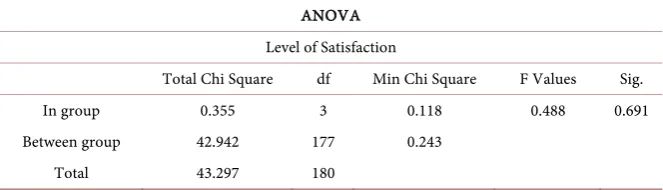
Table 10 showed the result of One Way ANOVA whereby there were no sig-nificant between levels of satisfaction and F(3,177) = 0.691; p > 0.05. Therefore, Ho5 was rejected.
6. Discussion
6.1. Teacher in Bachang Zone, Malacca Were High Level of Efficiency in ICT
DOI: 10.4236/ce.2019.1012246 3230 Creative Education Table 10. One way ANOVA test based on gender.
ANOVA Level of Satisfaction
Total Chi Square df Min Chi Square F Values Sig.
In group 0.355 3 0.118 0.488 0.691
Between group 42.942 177 0.243
Total 43.297 180
was at a high and medium level and teachers were less competent in using tech-nology especially computers. Based on study conducted by Luo & Bu, (2015), the high level of efficiency in ICT help to increase the productivity of emerging economies. As such, the use of ICT has been incorporated into the education system in our country. Many applications and administrative work have used ICTs whereby the teachers need to be skilled in using them to cope with their work routine as a teacher. The findings of this study also indicate that teachers were more proficient in content categories. Teachers were less skilled in prepar-ing document usprepar-ing computer because it involved more formulas and not fre-quently used. Therefore, MOE or JPN tend to prepare the form or templates and teachers just key in the data. Teachers also less skilled in drawing. This is be-cause teachers do not use these techniques and skills frequently plus most of graphics can be easily downloaded directly from the internet. However, more teachers prefer to use power point slides where graphics can be edited directly within the application.
6.2. Teacher Level of Satisfaction towards CPD Online
DOI: 10.4236/ce.2019.1012246 3231 Creative Education (2011) state that issues of accommodation and transportation can also be solved through online training. However, the most dissatisfying item is the duration of training in online services. Teachers do not know how much time should be spent preparing a course offered.
6.3. The Relationship between Teachers ICT Efficiency and Their Satisfaction on CPD Online
Studies show that there was a positive relationship between the level of ICT effi-ciency and the level of satisfaction on CPD online. The result of this study was in line with the findings ofSugunah (2014)who obtained similar findings. This in-dicates that the level of ICT skills will influence the level of CPD online satisfac-tion of teachers. Sharing knowledge among teachers not only enhances the pro-fessionalism of a teacher, but also develops the propro-fessionalism of all teachers in a school. Sukor et al. (2014). In addition, online training can enhance the know-ledge and skills of teachers at any time. This is because teachers do not have the time to hold discussion sessions to share ideas to improve their teaching me-thods Awang et al. (2011). Therefore, the highly skills in ICT definitely give the teacher satisfaction as they can overcome the problems. In addition, Kler (2014) also stated that the use of ICT in knowledge management such as CPD can help a teacher reduce the information gap. This is in line with Aesaert et al. (2015) opinion that the lack of competency of teachers in the ICT will affect the devel-opment of their own knowledge. Therefore, teachers’ ICT knowledge was a con-tributing factor to teachers satisfaction on online CPD. Schools and ministries should organize various ICT skills courses to ensure the online CPD can succeed and achieve their desired goals which were in line with Areej and Abdulrah-man’s (2011) study.
6.4. The Differences in the ICT Efficiency between Genders
This finding was contrast with the findings of Ahmad Hambali (2015) who found that there were no significant differences. In this study, male teachers had higher ICT skills compare to female teachers. This was in line with the findings of the study Nor Azan et al. (2000) which stated that men had higher ICT litera-cy than women. This is because the experience of using computers and comput-er purchases among men is highcomput-er than that of women. Moreovcomput-er, most male teachers were pointed being ICT teachers and Frog VLE teachers in school. These opportunity enhance their computer experience because they need to constantly solve other teachers’ computer problems in schools and indirectly in-crease their ICT skill among male teachers compared to female teachers. There-fore, female teachers should improve their computer experience in order to im-prove the level of proficiency on ICT.
6.5. There Was No Significant Differences in the Levels of the Teacher’s ICT Skills by Age
DOI: 10.4236/ce.2019.1012246 3232 Creative Education
Zainudin’s (2008) study which stated that young teachers have better ICT skills, Sheiladevi and Rahman (2016) who stated that ‘junior’ lecturers are better in various ICT dimensions and Ahmad Hambali (2015) found that there are dif-ferences which is significant based on the age and experience of teaching a teacher. This is because today’s educational administration is more concerned with the use of computers. Principals and senior assistant teachers need to use computers to complete routine administrative tasks. Not only that, all teachers without age should apply 21st century learning in the classroom. Many courses were also offered and conducted by all teachers. This indirectly enhances teach-ers’ ICT skills to meet current needs.
6.6. There Was No Significant Difference in CDP Online Satisfaction Level among Teachers
Male and female teachers have the same level of CDP online satisfaction. This is in line with Goh’s (2012)study which stated that gender does not influence the level of teacher satisfaction of the LDP. However, it contradicts John et al. (2005) state that job satisfaction varies by gender. This discrepancy arises due to the different working conditions in the United States and the older literature. Therefore, it can be said that all people regardless of gender will experience dif-ferent training depending on their circumstances and environment. Gender is not a factor contributing to a teacher’s training satisfaction. The satisfaction of the training experienced by the teachers depends largely on the training itself. Herzberg’s two-factor theory (in Sondang, 2002) also explains that satisfaction comes from the Motivators factor, which is the responsibility and progress of the teacher himself. Therefore, the training conducted should focus on its own qual-ity and be tailored to all male and female teachers.
6.7. There Was No Significant Difference in CPD Online Satisfaction Level among Teacher
Different age groups like novice teachers and experienced teachers have the same level of CPD online satisfaction. This contradicts Goh’s (2012) study which found that teaching experience shows differences between teachers’ satisfaction levels. This discrepancy may be due to the current situation. The KPM is now strongly emphasizing 21st century learning and Online based learning. It was a huge change and involves all ages of teachers as it differs from the past. Teachers of different ages need the same training. Their level of satisfaction is the same if the training provided a quality and helpful to all teachers. Therefore, the training should be focused on what to do and not worry about teachers of different ages. It is supported by the study of Maria and Theodosia (2016)who stated that the training provided can change perceptions and improve teachers’ knowledge and skills effectively.
7. Conclusion
DOI: 10.4236/ce.2019.1012246 3233 Creative Education
ICT skills and the level of online LDP satisfaction of teachers at Bachang zone school, Malacca. Teacher GPA proficiency levels are at a high level, while LDP online teacher satisfaction levels are high. Gender factors of teachers have an in-fluence on the level of ICT skills, but do not have an effect on LDP online teach-er satisfaction. In addition, age factors had no effect on both levels of ICT skills and online LDP satisfaction. Because the ICT skills contribute to the online LDP satisfaction of teachers, they need to provide regular support and stimulate the internal motivation of teachers to ensure LDP online teacher satisfaction. How-ever, this study involved only urban teachers from Bachang Zone, Malacca. Therefore, it is proposed that further studies be conducted in rural schools. This study can serve as a reference to the MOE, JPN, BTPN, PKG and schools on as-pects that need to be improved in terms of TMK skills and online LDP satisfac-tion to ensure continued use of e-learning websites. Ongoing training in online services can enhance teacher performance and achievement and further develop our nation’s education system as the technological age continues.
Acknowledgements
This research was partially supported by grant received from the Faculty of Education, Universiti Kebangsaan Malaysia code PP-FPEND-2019.
Conflicts of Interest
The authors declare no conflicts of interest regarding the publication of this paper.
References
Aesaert, K., Van Nijlen, D., Vanderlinde, R., Tondeur, J., Devlieger, I., & van Braak, J. (2015). The Contribution of Pupil, Classroom and School Level Characteristics to Pri-mary School Pupils ‘ICT Competences: A Performance-Based Approach. Computers &
Education, 87, 55-69.https://doi.org/10.1016/j.compedu.2015.03.014
Ahmad Hambali, M. D. (2015). Level on Efficiency on ICT (TMK) Islamic Teachers
MRSM: A Survey of MRSM Tun Ghafar Baba.http://www.academia.edu/6037190/
Areej, A. A., & Abdulrahman A. M. (2011). Implementing a Virtual Learning Environ-ment (VLE) in a Higher Education Institution: A Change ManageEnviron-ment Approach.
Journal of Theoretical and Applied Information Technology, 31, 42-52.
Awang, M., Ismail, R., Flett, P., & Curry, A. (2011). Knowledge Management in Malay-sian School Education: Do the Smart Schools Do It Better? Quality Assurance in
Edu-cation, 19, 263-282.https://doi.org/10.1108/09684881111158063
Azizi, Y., Shahrin, H., Jamaludin, R., Yusof, B., & Abdul Rahim, H. (2006). Mastering
Re-search in Education. Kuala Lumpur: PTS Professional Publishing Sdn. Bhd.
Goh, G. P. (2012). Knowledge Level and Level of Teacher Satisfaction in in-Service
Training at Segamat District Secondary School. Doctoral Dissertation, Malaysia:
Uni-versity of Technology Malaysia.
Izani, I., & Yahya, D. (2014). Servant Leadership and Its Influence on Change Manage-ment in Schools. Malaysian Journal of Education, 39, 19-26.
DOI: 10.4236/ce.2019.1012246 3234 Creative Education
Study of University Teachers in the United State. Women in Management Review, 20,
177-190.https://doi.org/10.1108/09649420510591852
Juan, E. J. A., & Isabel O’Shanahan, B. (2016). Effects of Web-Based Training on Spanish Pre-Service and in-Service Teacher Knowledge and Implicit Beliefs on Learning to Read. Teaching and Teacher Education, 55, 175-187.
https://doi.org/10.1016/j.tate.2016.01.006
Kler, S. (2014). ICT Integration in Teaching and Learning: Empowerment of Education with Technology. Issues and Ideas in Education, 2, 255-271.
Kokoc, M., Ozlu, A., Cimer, A., & Karal, H. (2011). Teachers’ Views on the Potential Use of Online in-Service Education and Training Activities. Turkish Online Journal of
Dis-tance Education, 12, 68-87.
Kuhlemeier, H., & Hemker, B. (2007). The Impact of Computer Use at Home on Stu-dents’ Internet Skill. Computers & Education, 49, 460-480.
https://doi.org/10.1016/j.compedu.2005.10.004
Luo, Y., & Bu, J. (2015). How Valuable Is Information and Communication Technology? A Study of Emerging Economy Enterprises. Journal of World Business, 51, 200-211. Maria, M. M., & Theodosia, P. (2016). Pre-Service Teacher Training on Game-Enhanced
Mathematics Teaching and Learning. Technology, Knowledge and Learning, 21, 379-399. https://doi.org/10.1007/s10758-016-9275-y
Ministry of Education Malaysia (2012). Malaysian Education Development Plan 2013-2025. Mohd Jasmy, A. R., & Mohd Yusoff, D. (2015). Information Technology Promotions and
Markets: The 21st Century Capability. Bangi: Faculty of Education SMEs.
Mohd Jasmy, A. R., & Norazani, M. Z. (2017). IT in 21st Century Education. Bangi: Fa-culty of Education SMEs.
Sharifah, N. P., & Kamarul Azman, A. S. (2011). The Level of Readiness of ICT in Teach-ing and Its Impact on Preschool Students’ Work and Behavior. Malaysian Journal of
Education, 36, 25-34.
Sheiladevi, S., & Rahman, A. (2016). An Investigation on the Impact of E-Learning Im-plementation on Change Management in Malaysian Private Higher Education Institu-tions. Pertanika Journal of Science & Technology, 24, 517-530.
Sugunah (2014). The Relationship of Teacher ICT Skills and Knowledge Management in
Primary Schools, Johor. Faculty of Education, Malasia: University of Technology
Mala-sia.
https://www.researchgate.net/publication/283243731_ICT_GURU_DAN_PRODUCTI
ON_IRECTORY_DI_SEKOLAH_RENDAH_JOHOR
Zawiyah, M. Y., & Zuhri, A. Z. (2014). Sharing Knowledge for Learning Purposes Using Social Media: A Model Need. Asia-Pacific Journal of Information Technology and