ISSN Online: 2328-4919 ISSN Print: 2328-4900
DOI: 10.4236/cus.2019.74029 Dec. 5, 2019 562 Current Urban Studies
Urban Morphology: Comparative Study of
Different Schools of Thought
Gelareh
Sadeghi, Baofeng
Li
SchoolofArchitectureandUrbanPlanning,HuazhongUniversityofScienceandTechnology,Wuhan,China
Abstract
Urban morphology can be described as methodical analyses of form, shape, map, origin, functions and structure of human-made urban fabric and its process of development over time. According to much research that has been conducted, urban morphology can be categorized as three main schools of British, Italian and French. This study will comparatively examine these ur-ban morphology schools of thought. In terms of forming processes and pro-cedures of urban form, British school is emphasized by scholars as it com-prehensively considers the historical procedures. Furthermore, it seems that the methodical studies of British school are more precise compared to others.
Keywords
Morphology, Urban Morphology, Urban Design, Urban Form
1. Introduction
Urban morphology is the mainstream in the study of urban form within urban geography (Madanipour, 2001: p. 77). Urban morphology is a study that ex-amines urban context and its different types in their current conditions. Study-ing of Urban morphology in different eras and via various perspectives led to diverse range of methodological outputs, which can be perceived in different schools of thoughts. According to many experts, one of the most comprehensive classifications of urban morphology analysis is done by Anne Vernez Moudon. She classifies urban morphology study as three major schools of British, Italian and French and analyzes them individually (Moudon, 1997).
The position of urban morphology study has been changing over time. Until the sixties, urban geographers with a special regard to urban morphology, main-ly focused on internal structure of a city, which identifies the historical elements How to cite this paper: Sadeghi, G., & Li,
B. F. (2019). Urban Morphology: Compara-tive Study of Different Schools of Thought. Current Urban Studies, 7, 562-572.
https://doi.org/10.4236/cus.2019.74029
Received: October 30, 2019 Accepted: December 2, 2019 Published: December 5, 2019
Copyright © 2019 by author(s) and Scientific Research Publishing Inc. This work is licensed under the Creative Commons Attribution International License (CC BY 4.0).
http://creativecommons.org/licenses/by/4.0/
DOI: 10.4236/cus.2019.74029 563 Current Urban Studies and characteristics of city maps and determines the typology of city buildings (Madanipour, 2001: p. 79). Hence, urban morphology was extremely criticized for being descriptive rather than practical, as it only concerns the evidences and soulless materials.
Accordingly, as a discourse had taken place among architects, geographers, historians and economists, urban morphology could be categorized as three main schools of British, Italian and French (Moudon, 1997). Therefore, the ur-ban structure became the subject of evaluation as consequences of historical de-velopments along various ages (Whitehand, 2007: pp. ii02-ii6). In order to do such evaluation, various approaches were provided by these schools each of which had its own patterns. Seemingly, British school is known by researchers as the most successful among others in terms of its urban morphology study patterns.
Consequently, after defining the associated terminologies and notions, urban morphology study will be classified as different schools of thought. Thus, the three main schools of urban morphology studies will be compared and their si-milarities and contrasts will be distinguished.
2. Research Methodology
Method of this research is analytical-comparative, which means, the research is based on contention and comparison of data and information that is driven from bibliographical studies and related evidences. Accordingly, urban mor-phology study will be categorized as different schools. Therefore, the schools of thought will be analyzed once the related terms and expressions are explained. Consequently, their similarities and contrasts will be detected with adaptive comparative technique.
3. Morphology & Urban Morphology
The origins of the term “morphology” are “morphe” (form) and “logie” (logic). The former indicates, morphology is the logic of understanding the form. These studies have been conducted in many fields, in order to highlight the characte-ristics, structure, proportions and alteration of materials and their contained elements (Cortes, 2004a: p. 3). The German poet Johan Wolfgang von Goethe was the first person who used this term, which it was later used in science such as Biology. Referring to Oxford dictionary (1970 edition), morphology is a field of science that study shape, form, external structure and its arrangement me-thod. The use of this term in Biology is not only about shape and structure of plants, animals and micro-organisms, but it is also about studying the size of shape, structure and correlation of their components. Although studying the function of organisms and their components, which is based on their types and known as physiology, is fairly the opposite of the former, their segregation is fa-bricated due to a close correlation of organisms functions and structures.
DOI: 10.4236/cus.2019.74029 564 Current Urban Studies Urban morphology is a study that focuses on tangible effects of social and
economic tensions, consequently, evaluate the procedure of intentions and assumptions that creation of cities form and outline is based on them. Build-ing, gardens, streets, parks and sculptures are considered as significant ele-ments of morphological analysis. Nevertheless, these eleele-ments gradually face modification and alteration during time (Moudon, 1997: p. 3).
Urban morphology is a systematic study of form, shape, map, structure and functions of cities’ artificial fabric, origin and evolution method of these fa-brics over time (Madanipour, 2001: p. 78).
Morphology is defined as “outlines, buildings, functions, streets, characters and urban perspectives” (Madanipour, 2001: p. 78).
Urban morphology is a term that stands for various types of research, which all of them concentrate on physical form of urban areas (Whitehand, 2001: p 103).
Urban morphology studies the idea of form and urban space combination that assists urban designers to be acquainted of local patterns of development and alteration procedures (Carmona et al., 2003: p. 61).
4. “Urban Morphology Study” Schools of Thought
There have been many studies on urban morphology. Anne Vernez Moudon has categorised them into three main schools of British, Italian and French (Mou-don, 1997: p. 3). This classification is important as it is not possible to write about different manners of urban morphology such as geography, architecture and urban design, without referring to these schools of thought, which indicate various types of studies (Bekkering, 2006: p. 100). The purpose of studying these schools of thought is to achieve the proper study pattern that is required for ur-ban morphologic study.
4.1. British School of Thought
“Bur-DOI: 10.4236/cus.2019.74029 565 Current Urban Studies gage Cycle”. The former means formation of restriction at the urban fringe throughout a period when the built-up region was not either developing or growing gradually. While, the latter indicates the progressive filling-in with buildings of the backland burgages and terminating in the clearing of buildings and period of urban follow prior to the initiation of a redevelopment cycle (Larkham, 1998: p. 163; Mirmoghtadaee, 2006: p. 132).
With historic study of urban development, Conzen also introduce “Plan Unit”, units that were shaped in different morphologic eras. As each era has its own specific circumstance, this segregation is both practical and logical (Bek-kering, 2006: p. 105).
Significant effects of Conzen on urban morphology study can be considered as following:
1) Considering the characteristic and alteration of urban landscape. 2) Estab-lishments that are involved with alteration process. 3) Management of the altera-tion (Larkham, 1998: p. 164). Conzen’s idea was developed by “Whithand” re-search. The boundaries of urban morphology from geography to urban econo-my, study of relation of a city and its occupants and dynamic methods of con-structing buildings were expanded by him. JWR Whitehand established the Bir-mingham research center in 1974 with the purpose of studying the medieval ci-ties. Furthermore, other figures such as Larkham and T.R. Slater, who were edu-cated in this research center, continued this school of thought (Moudon, 1997: p. 4).
The British approach represents an idea that claims current urban develop-ments are not completely new incidents; In fact, they are the continuation of previous alteration process (Bekkering, 2006: p. 106). Therefore, British school of thought analyse the urban morphology studies with the consideration of spe-cific study fields and a particular procedure. In the meantime, it also considers the current situation and alteration process.
4.2. Italian School of Thought
DOI: 10.4236/cus.2019.74029 566 Current Urban Studies Italian school of thought was firstly initiated in national institute of Assciura-zionei which is called INA the short form of “Istituo Nazionaledelle
Assicura-zioni”. Muratori was in the charge of Roman territory in that institute. However,
in the following years, many important universities from all around Italy were active as the academic basements of the mentioned school of thought. University of Rome was one the significant ones (Cataldi et al., 2002: p. 4). This school of thought can be considered as a respond to homogenization and standardization of modernism. Most of the research in this framework was on types of buildings that are considered as foundation of creation of urban tissue and the whole city.
Focusing on current situation without considering the historical evolution process of the fabric was the weakness point of this approach (Bekkering, 2006: p. 100). Nevertheless, studying on Caniggia made the research more efficient. His aim of studies was perception of artificial forms by analysing the historic procedure of creation. Although Caniggia considers the historic procedure of creation of the fabric, it distinguishes the spatial correlation of artificial elements and time correlation. Therefore, spatial correlation of artificial elements is based on divisions that create a hierarchy. Components are elements, creation of ele-ments, constructions’ system and organism of systems (Mirmoghtadaee, 2006: p. 133). From Caniggia’s point of view, who believe in an organic methodology, typology process is a connection between types of buildings and urban fabric that start with “elementary cell”. This process creates “pseudo-types” that func-tion differently. Consequently, it will lead to creafunc-tion of “a basic fabric” and “particular fabric” (Levy, 1999: p. 80). “The group Florentine” can be known as the second most active and academic source of this school of thought after Ca-niggia (Cataldi et al., 2002: p. 8). Thus, Italian school of thought is currently recognized as a school of thought that analyses the current situation by typology of urban tissue.
4.3. French School of Thought
After establishment of the mentioned schools of thought, the third school of thought appeared in France in late 1960’s. During that time, architects such as Philippe Panerai and Jean Caste with collaboration of Charls De Paule who was a French sociologist founded The Versailles National School of Landscape Archi-tecture as a segregated part of Beaux-art school. French morphology school of thought was a respond to modernism likewise Italian school of thought. Al-though it was benefited from enlighten discourse which was associated with ur-ban lifestyle that leaded to pioneer architecture, it also associated with strong critical ideas of sociologists such as “Henry Lefebvre” and architecture historians such as “Francoise Boudon” and “Andre Chastel” (Moudon, 1997: p. 5).
DOI: 10.4236/cus.2019.74029 567 Current Urban Studies Caniggia (Bekkering, 2006: p. 102). Some scholars believe that there is no such entity as French school of thought in urban morphology study. For example, Darin argues that studies, which are considered within French school’s frame, are very scattered and their researchers were not aware of each other in most cases. Therefore, no one can claim the existing of French school of thought (Da-rin, 1998: p. 71).
In addition, revising the existed literature of this field of study especially theoretical framework that was provided by Castex and Panerai, indicates a spe-cial form of unity. Contrary to Italians who achieved their approach towards ur-ban morphology within architecture, French school of thought believed that the accumulations of different fields were effected on urban morphology (Bekkering, 2006: p. 102). Dual interests of architecture school of Versailles in development of building a city and design theory of French school of thought lead to con-ducting several goals such as the following: strong interrelation with sociological sciences, analyzing the issues of dual connection between people and their sur-rounding and finally finding a way to narrate the design theory as a concept and design theory as a practical principle (Moudon, 1998: p. 145).
Panerai and Castex write in the book of “Urban Forms. The Death and Life of
The Urban Block” as following: In the 1970’s in France, architects were busy
with methodological-morphological games. Urban planners still used to believe that the magic of planning was based on large scales and also several groups who were engaged in politics were under influenced of sociologists who were looking for city’s citizens and were criticizing bulldozer renovation. They consider the consequences of this type of renovation equal to dismissal (Panerai et al., 2004: p. ix). Hence, it can be seen that collecting approaches of scholars with various fields of study with different perspectives of urban form topic were defined and cleared under influence of France renovations.
Although there are several similarities among French and Italian schools of thought, there some differences as well. These differences can be summarized as following. First, contrary to Italian school of thought, French school of thought does not believe in any distinction between “before” and “after”, due to exami-nation of various models and theories. Nonetheless, it considers the effects of an idea on patterns, types and forms along each other. Secondly, opposite to Italian school of thought, French school of thought tends to focus on either urban pat-terns or urban tissue (Bekkering, 2006: p. 104). The most significant characteris-tic of French school of thought can be defined as its consideration of urban form creation theories. As an instance, according to research they have done on dif-ferent European cities, several cases were analysed such as impacts of the garden city concept on the London city form, impacts of the Haussmann’s urban plan-ning on shape of Paris and the idea of Le Corbusier’s radial city (Panerai et al., 2004). Therefore, the main concentration of this school of thought is on applied modifications of Modernism.
DOI: 10.4236/cus.2019.74029 568 Current Urban Studies lead to creation of “Island”1 concept as an essential element which is needed in
order to analyzing the twenty-first century city. The definition of “Vertical Isl-and” is a respond to consequences of Modernism and is an alternative solution in order to filling the gaps of morphological studies in the manner of third di-mension. Thus, French school of thought has found its own framework in order to add observational and perceptive studies (Bekkering, 2006: p. 104). Therefore, it can be claimed that the goal of morphological studies in France is in fact, the evaluation of amount of realism in different theories, which is based on the evaluation of their impacts on urban forms and patterns and also definition of significant components that are needed to redefining the developments of new interventions.
5. Comparison of Different Urban Morphology Schools of
Thought
As it was mention, urban morphology studies have been divided into three schools of thought such as British, Italian and French. It is worth to note that beside Moudon, others such as Koster and Cortes also worked on this frame-work (Cortes, 2004b: p. 3). Moudon after revising these three schools of thought, sum them up as three main objectives of urban morphology study.
Research on urban forms with explanative-descriptive aims: Typically, the main goal is to improve the urban construction theory. These studies are more about how and why cities are created. It is the initial aim of geograph-ers, especially the “Birmingham school” followgeograph-ers, and French school sociol-ogist.
Research on urban forms with prescriptive aims: The main goal of this type of research is to improve urban designing. These studies concentrate on the method of construction of cities in the future. The contributions of Italian and French researchers, who analyse the traditions of construction of cities, are more than others.
Research on form of cities with the aim of evaluation of previous design theories of construction of cities: This research is field of critical designing that distinguish the complex difference between design as an idea and design theory as a proper method. This research also studies the differences and si-milarities between what should be constructed and what have constructed. Among these schools of thought as fields of morphological study, French school is more advanced (Moudon, 1997: p. 7).
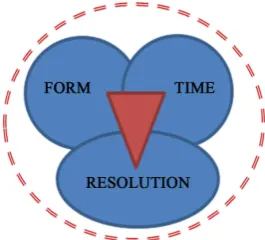
In order to study these schools of thought comparatively, it is required to note their contrasts and similarities. Referring to the above explanation, it can be said that all of these schools of thought support the below three main principles (Figure 1):
1The two concepts of Island and Vertical Island are defined as: responding to lack of occupants and
DOI: 10.4236/cus.2019.74029 569 Current Urban Studies
Figure 1. Main elements of morphological studies.
1) Urban forms are defined with the assist of created spaces, open spaces and activities that occur on them.
2) Urban form study includes various “resolutions” such as building, section, block, street, city and region.
3) Urban forms can only be examined via analysing of evolutions and transi-tions, which have taken place throughout history.
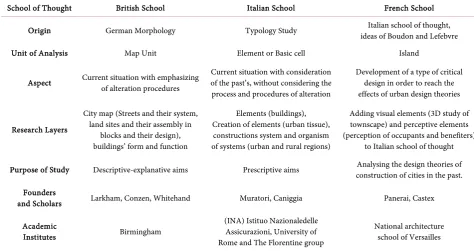
Therefore, each morphological study should include these three principles and use a proper analytical method to sanitize these layers of information according to the field of study2. Hence, Table 1 below is organized in order to establish the
best urban morphological study pattern with considering the contrast and simi-larities of these three schools of thought.
6. Concluding Remarks
Urban morphology is a study that examines urban context and its different types in their current conditions. Studying of Urban morphology in different eras and via various perspectives led to diverse range of methodological outputs, which can be perceived in different schools of thoughts. According to much research that has been conducted, urban morphology can be categorized as three main schools of British, Italian and French. This classification is important as it is not possible to write about different manners of urban morphology such as geogra-phy, architecture and urban design, without referring to these schools of thought, which indicate various types of studies. This study comparatively ex-amined these urban morphology schools of thought.
Based on the presented theoretical framework, in comparison, British school of thought is more complete than other urban morphology schools. The advan-tage of British school is its attention to historical events. Furthermore, it seems that the method of structural analysis of urban forms is more accurate in this school of thought. It can be claimed that the most significant weakness of this school study is its dependence on descriptive and explanative aims. However, as 2Cortes studies that were supervised by Bekkering, examine the urban morphology subject within
DOI: 10.4236/cus.2019.74029 570 Current Urban Studies
Table 1. Comparison of similarities and differences of different urban morphology schools of thought.
School of Thought British School Italian School French School
Origin German Morphology Typology Study ideas of Boudon and Lefebvre Italian school of thought,
Unit of Analysis Map Unit Element or Basic cell Island
Aspect Current situation with emphasizing of alteration procedures Current situation with consideration of the past’s, without considering the process and procedures of alteration
Development of a type of critical design in order to reach the effects of urban design theories
Research Layers
City map (Streets and their system, land sites and their assembly in
blocks and their design), buildings’ form and function
Elements (buildings), Creation of elements (urban tissue),
constructions system and organism of systems (urban and rural regions)
Adding visual elements (3D study of townscape) and perceptive elements (perception of occupants and benefiters)
to Italian school of thought
Purpose of Study Descriptive-explanative aims Prescriptive aims construction of cities in the past. Analysing the design theories of
Founders
and Scholars Larkham, Conzen, Whitehand Muratori, Caniggia Panerai, Castex
Academic
Institutes Birmingham
(INA) Istituo Nazionaledelle Assicurazioni, University of Rome and The Florentine group
National architecture school of Versailles
(Moudon, 1997;Larkham, 1998;Bekkering, 2006;Levy, 1999;Darin, 1998;Panerai et al., 2004).
French school of thought has the chance of examining the architectural, social, economy and political dimensions at the same time, the overall sufficiency of studies is high. Moreover, it not only provides a prescriptive framework, but it also reveals the effects of design theories on form. However, the major weakness of this approach can be found in analyzing the current formal condition and historical sequences that created it. In addition, when the urban fabrics were or-ganically created without any specific theory, the special concentration of French school on critical design, which is needed to achieve the effects of urban design theories, seems meaningless. Italian school of thought is also not useful enough, as it does not consider the past and different dimensions of fabric forms crea-tion.
Accordingly, it seems common criticism to all urban morphology schools of thought is the weakness of attention to social, economic and political dimen-sions and their process of development over time. As a direction for future re-search, this study was limited to comparative study of three different schools of thought. However, such kind of research can be followed by integrating British school of thought with analytical view of social, economic and political dimen-sions and their process of development over time.
Acknowledgements
DOI: 10.4236/cus.2019.74029 571 Current Urban Studies
Funded
Funded by NSFC 51538004.
Conflicts of Interest
The authors declare no conflicts of interest regarding the publication of this pa-per.
References
Bekkering, H. C. (2006). Morphological Analysis of the Contemporary Urban Territory: Is It Still a Relevant Approach? In F. Hoeven van der, & H. J. Rosemann (Eds.), Urban Transformations and Sustainability (pp. 96-113). Delft: IOS Press.
Carmona, M., Tiesdell, S., Heath, T., & Oc, T. (2003). Public Places Urban Spaces—The Dimension of Urban Design. UK, Oxford: Architectural Press.
https://www.amazon.com/Public-Places-Urban-Spaces-Second/dp/1856178277
Cataldi, G., Maffei, G. L., & Vaccaro, P. (2002). Saverio Muratori and the Italian School of Planning Typology. Urban Morphology, 6, 3-14.
https://www.researchgate.net/publication/242156734_Saverio_Muratori_and_the_Itali
an_school_of_planning_typology
Cortes, C. P. (2004a). Morphologies of Fragmentation and Continuity. Aix-en-Provence, France: Paper for the AESOP-APERAU PhD Workshop.
Cortes, C. P. (2004b). Morphologies of Fragmentation and Continuity. Newcastle: ISUF-Newcastle Symposium.
Darin, M. (1998). The Study of Urban Form in France. Urban Morphology, 2, 63-76. Larkham, P. J. (1998). Urban Morphology and Typology in the United Kingdom. In P.
Attilio (Ed.), Typological Process and Design Theory (pp. 159-170). Cambridge, MA: Aga Khan Program for Islamic Architecture. https://archnet.org/publications/4251 Levy, A. (1999). Urban Morphology and the Problem of the Modern Urban Fabric: Some
Questions for Research. Urban Morphology, 3, 79-85.
http://www.urbanform.org/online_unlimited/um199902_79-85.pdf
Madanipour, A. (2001). Design of Urban Space: An Inquiry into a Socio-Spatial Process
(Mortezaee, F. Trans.). Tehran: Publication of Pardazeshvabarnamerizi Shahri.
https://www.amazon.com/Design-Urban-Space-Inquiry-Socio-Spatial/dp/0471966738
Mirmoghtadaee, M. (2006). A Proposed Method for the Analysis of Urban Character.
Journal of Environmental Studies, 32, 129-140.
Moudon, A. V. (1997). Urban Morphology as an Emerging Interdisciplinary Field. Urban Morphology, 1, 3-10.
https://www.academia.edu/1914208/Urban_morphology_as_an_emerging_interdiscipli
nary_field
Moudon, A. V. (1998). The Changing Morphology of Suburban Neighborhoods. In Ty-pological Process and Design Theory (pp.141-157). Cambridge, MA: Agha khan Pro-gram for Islamic Architecture. https://archnet.org/publications/4249
Panerai, P., Castex, J., & Depaule, J. C. (2004). Urban Forms: The Death and Life of the Urban Block. Oxford: Architectural Press.
https://trove.nla.gov.au/work/16429423?selectedversion=NBD25113758
DOI: 10.4236/cus.2019.74029 572 Current Urban Studies https://www.researchgate.net/publication/237211880_British_urban_morphology_The
_Conzenian_tradition
Whitehand, J. W. R. (2007). Conzenian Urban Morphology and Urban Landscapes. Pro-ceedings of the 6th International Space Syntax Symposium (pp. ii01-ii09). Istanbul: Technical University Faculty of Architecture.