Heating and ionization of the primordial intergalactic medium
by high-mass X-ray binaries
G. Knevitt,
1‹G. A. Wynn,
1C. Power
2,3and J. S. Bolton
3,41Department of Physics and Astronomy, University of Leicester, Leicester LE1 7RH, UK
2International Centre for Radio Astronomy Research, University of Western Australia, 35 Stirling Highway, Crawley, WA 6009, Australia 3ARC Centre of Excellence for All-Sky Astrophysics (CAASTRO), University of Sydney, Sydney, NSW 2006, Australia
4School of Physics and Astronomy, University of Nottingham, University Park, Nottingham NG7 2RD, UK
Accepted 2014 September 2. Received 2014 July 24; in original form 2014 April 4
A B S T R A C T
We investigate the influence of high-mass X-ray binaries (HMXBs) on their high-redshift environments. Using a one-dimensional radiative transfer code, we predict the ionization and temperature profiles surrounding a coeval stellar population, composed of main-sequence stars and HMXBs, at various times after its formation. We consider both uniform density surround-ings, and a cluster embedded in a 108MNavarro–Frenk–White (NFW) halo. HMXBs in a constant density environment produce negligible enhanced ionization because of their high-energy spectral high-energy distributions and short lifetimes. In this case, HMXBs only marginally contribute to the local heating rate. For NFW profiles, radiation from main-sequence stars cannot prevent the initially ionized volume from recombining since it is unable to penetrate the high-density galactic core. However, HMXB photons stall recombinations behind the front, keeping it partially ionized for longer. The increased electron density in these partially ionized regions promotes further cooling, resulting in lower intergalactic medium (IGM) tempera-tures. In the context of this starburst model, we have shown that HMXBs do not make a major contribution to reionization or IGM heating. However, X-ray escape fractions are high in both density profile cases. Continuous star formation may result in the build up of X-rays over time, reducing the ionization time-scale and potentially leading to low level ionization of the distant IGM.
Key words: galaxies: formation – cosmology: theory – X-rays: binaries.
1 I N T R O D U C T I O N
X-ray radiation may have significantly influenced its surroundings in the distant past, shaping the universe we see today. For example, the presence of an X-ray background at high redshifts could have increased the fractional ionization of protogalactic gas, offsetting the effects of photodissociation from ultraviolet (UV) feedback and allowing gas haloes to cool at higher virial temperatures (Haiman, Abel & Rees2000; Oh2001; Machacek, Bryan & Abel2003). In addition, the cosmological reionization of neutral hydrogen, which completed approximately one billion years after the big bang (see reviews by e.g. Barkana & Loeb2001; Robertson et al.2010), may have been profoundly influenced by the presence of X-rays. Al-though UV radiation from massive stars is likely to have been the main contributor to reionization (Sokasian et al. 2004; Yoshida, Bromm & Hernquist2004; Wise & Abel2008), X-rays may have been able to ‘pre-ionize’ large volumes of the intergalactic medium (IGM), unreachable by UV sources (Oh2001; Venkatesan, Giroux
E-mail:[email protected]
& Shull2001; Madau et al.2004; Ricotti & Ostriker2004). Their penetrative power has lead some authors (e.g. Glover & Brand
2003; Madau et al.2004; Haiman2011) to propose a smoother global increase in ionized fraction with a more uniform morphol-ogy than the currently favoured ‘Swiss Cheese Paradigm’ (Gnedin
2000; Barkana & Loeb2001; McQuinn et al.2007), whereby ion-ized regions formed in isolated pockets that eventually expanded and joined. Heating from X-rays could also affect the progress of reionization, delaying its onset by increasing the Jeans mass (Ricotti & Ostriker2004; Kuhlen & Madau2005). Mesinger, Fer-rara & Spiegel (2013) show that the presence of X-rays may result in an extended epoch during which hydrogen is∼10 per cent ion-ized, before UV photons complete the process. Finally, X-ray radia-tion could further influence reionizaradia-tion by suppressing small-scale structure formation, thereby lowering recombinations (Jeon et al.
2014).
However, the exact effects of X-ray feedback in the early uni-verse are unclear, and depend on both the level of radiation pro-duced, and the sources responsible for it. Several observations can be used to constrain early X-ray emission. For example, the
Heating of the IGM by HMXBs
2035
high-redshift abundance of hard (>1 keV) X-ray photons is limited by the unresolved soft X-ray background (SXB), since they were optically thin to the IGM and remain unabsorbed to the present day (Dijkstra, Haiman & Loeb2004; Salvaterra, Haardt & Volonteri
2007; McQuinn2012). These high-energy X-rays would have also altered the ionization state of metal absorption lines inz∼3 quasar spectra (McQuinn2012). Upper limits on the kinetic Sunyaev– Zeldovich signal support homogenous ionization for which X-rays are an obvious candidate (Mesinger, McQuinn & Spergel2012; Reichardt et al.2012; Visbal & Loeb2012). Furthermore, the level of X-rays can determine whether the redshifted 21-cm spin-flip line appears in absorption or emission (Furlanetto, Oh & Briggs2006; Mesinger et al.2013). Feedback from X-rays must also conform to measurements of the thermal state of the IGM (Bolton et al.
2011; Raskutti et al.2012), and time-scales for He+ionization (Hui & Haiman2003; Dixon & Furlanetto2009; McQuinn et al.2009; Becker et al.2011; Worseck et al.2011).
Feedback from several X-ray emission mechanisms have been evaluated within these constraints, including accretion on to super-massive black holes (e.g. Ricotti & Ostriker2004; Ricotti, Ostriker & Gnedin2005; Volonteri & Gnedin2009), shocks in supernova remnants (Johnson & Khochfar2011), dark matter annihilations (Belikov & Hooper2009) and accretion of the interstellar medium (ISM) on to isolated stellar mass black holes (Wheeler & Johnson
2011).
A source of high-redshift X-ray radiation that has gained partic-ular attention in recent years is that of stellar-mass X-ray binaries. These sources are now believed to be proportionally more luminous at higher redshifts than the present day, due to an anticorrelation of high-mass X-ray binary (HMXB) mass with metallicity (Dray
2006; Crowther et al.2010; Mirabel et al.2011). In fact, Fragos et al. (2013a) have argued that these systems are likely to dominate X-ray luminosities over AGN atz6–8.
Several previous studies have highlighted the potential influence of X-ray binaries on their surroundings. For example, their feed-back effects have been addressed by Glover & Brand (2003) and Justham & Schawinski (2012), the latter of whom predict a signif-icant, stochastic effect on the evolution of dwarf galaxies, which could be responsible for the diversity we see today. HMXBs have been evaluated as a source of reionization in our previous work Power et al. (2009), and by Mirabel et al. (2011). Both studies sug-gest that the increased mean free path of X-rays and their potential for secondary ionizations lead to the ionizing potential of HMXBs equalling that of their progenitors. The X-ray energy emitted by HMXBs in the early universe, relative to stellar radiation alone, has been quantified in both Fragos et al. (2013b) and our most recent study, Power et al. (2013).
Qualitative reasoning and calculations of the energetics imply a significant (up to 10 per cent) contribution from HMXBs to reioniza-tion. However, McQuinn (2012) argues, based on assuming a hard power-law spectrum for HMXBs, that they cannot have contributed to reionization without the SXB constraint being violated. Kaaret (2014), on the other hand, predicts a much weaker constraint from the SXB, because HMXB shows spectral curvature above 2 keV. In another study, Jeon et al. (2014) computed the effects of the very first HMXBs on their environments using a zoomed hydrodynam-ical simulation, incorporating a fully integrated radiative transfer model. They found little or no direct ionization of the IGM from X-rays, although they predicted a net positive effect on reionization due to the suppression of small-scale structure. The discrepancy between these works, and among general HMXB ionization pre-dictions, highlights the need to move beyond energetics arguments
when assessing the feedback potential of HMXBs; full radiative transfer calculations, with accurate HMXB spectra, are required to predict the proportion of energy that directly contributes to heating and reionization, and the time-scales over which it acts.
Our Monte Carlo stellar population models, with observationally motivated HMXB abundances, lifetimes and, importantly, spectra, provide the ideal basis for an improved study of the influence of HMXBs within a population of stars. We have previously shown (Power et al.2013) that our models do not conflict with the SXB constraint. We now use one-dimensional radiative transfer calcu-lations to estimate the influence of HMXBs in a realistic stellar cluster on their environment, with no presuppositions about their significance to reionization.
In Section 2 we describe our stellar population simulations and our radiative transfer calculation. We then use these models in Sec-tion 3 to predict the ionizaSec-tion and temperature profiles surrounding a high-redshift stellar cluster, with and without a HMXB compo-nent, in both constant and varying density environments. In Sec-tion 4, we discuss the factors that influence our results, and the conditions required for HMXBs to have a strong influence on their surroundings, before drawing our final conclusions in Section 5.
2 M E T H O D S
We use the starburst model we developed in Power et al. (2009,
2013), to simulate a stellar population forming in an instantaneous burst, containing both main-sequence stars and HMXBs. We mon-itor the total energy released from this cluster and enter it into a one-dimensional time-dependent radiative transfer code, first de-scribed in Bolton & Haehnelt (2007), to estimate the ionization state and temperature of the surroundings. These models are described below.
2.1 Stellar population synthesis
A full description of our model can be found in Power et al. (2009). We briefly describe its main features, including our pa-rameter choices, below.
Initially 106 stars are formed instantaneously, following a
Kroupa (2001) mass distribution, with stellar masses in the range 0.01≤M∗/M ≤100. We assume all stars are formed in pairs, and binary parameters are then assigned following the approach of Dray (2006), with orbital periods distributed uniformly in log-arithm between 1 and 104d. Stellar lifetimes are estimated using
Marigo et al. (2001) and Marigo, Chiosi & Kudritzki (2003), with the assumption ofZ=0.
Stellar luminosityL∗follows a mass–luminosity relation of the form
L∗
L =α
M∗
M
β
, (1)
where the constantsαandβdepend on stellar mass and can be found in table 1 of Power et al. (2013). Stars then radiate as blackbodies with
Teff=
L∗
4πR2 ∗σSB
1/4
, (2)
where the stellar radius,R∗/R =(M∗/M)0.8 and
σSB is the
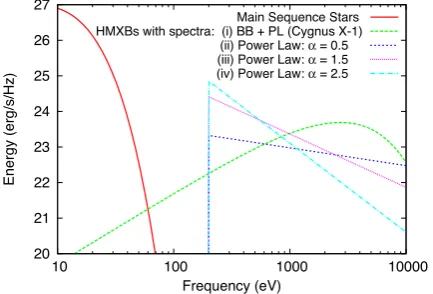
Figure 1. Choice of HMXB spectrum. Example spectrum snapshots from our Monte Carlo stellar population models, taken at 20 Myr, assuming a Kroupa IMF andfsur =1. The combined spectrum from all the
main-sequence stars is plotted in red. The other lines show the net spectral output from the HMXBs for four different choices of HMXB spectrum. Our fiducial blackbody and hard power-law spectrum, based on that of Cygnus X-1, are plotted as a light green dashed line. Power-law HMXB spectra withα=0.5, 1.5 and 2.5 are plotted as dark blue dotted, purple dotted and light blue dot– dashed lines, respectively.
HMXBs form when a primary ends its main-sequence life, pro-vided several conditions are met. First, the initial mass of the pri-mary must exceed 8 M, the threshold for neutron star formation (cf. fig. 1 of Heger et al. 2003). Next the secondary must have
M∗ 3 M; this fits the HMXB and intermediate-mass binary definitions. When the primary of a system fitting these conditions leaves the main-sequence branch, we estimate the remnant mass using fig. 3 of Heger et al. (2003), and calculate the revised binary parameters. If the system loses more than half of its mass in its supernova phase, it becomes unbound so is no longer a HMXB can-didate; this removes 70 per cent of all systems. A furtherfsurof the
population then survives, where, in this study, we assumefsur=1.
This parameter is discussed in detail in Power et al. (2009). We draw HMXB luminosities from a Weibull distribution, with a peak luminosity ofLX∼1038erg s−1, capped at an upper limit
ofLX1.26×1038(M/M) erg s−1so that they do not accrete
at super-Eddington rates. We then consider four alternative HMXB spectra.
(i) For our fiducial model, we base HMXB spectra on the galac-tic HMXB, Cygnus X-1, which alternates between a high lumi-nosity soft state and low luminosity hard state. In our model, if LX 1037 erg s−1, we assume a soft state, composite
black-body and power-law spectrum (cf. Dolan et al. 1977; Ogawara et al.1982). The blackbody temperature is calculated by assuming (LX/LCyg X-1)=(T /TCyg X-1)4, and the power law has a slope of
α= −1.1, normalized such that the ratio between the blackbody and power-law components matches that of Cygnus X-1. ForLX<1037
sources, we model a hard state power-law spectrum withα= −0.8 between 2 and 10 keV (cf. Gierli´nski et al.1997,1999).
The total SED of the HMXBs in the cluster at 20 Myr is plotted as a green dashed line in Fig.1. The contribution from hard state spectra is negligible. As such, this SED represents a sum of the most luminous soft state HMXB composite blackbody and power-law spectra. This model will be subsequently be referred to as a BB+PL spectrum.
(ii) A power-law spectrum,F(E)=E−α,α=0.5, in the observed
X-ray range of 0.2–30 keV, where the upper cut-off energy is based
onINTEGRALobservations of HMXBs from e.g. Lutovinov et al. (2005). The cumulative SED of all HMXBs in this model after 20 Myr is plotted in Fig.1as a dark blue dotted line.
(iii) A power-law spectrum;α=1.5, plotted in Fig.1as a fine purple dotted line.
(iv) A power-law spectrum;α=2.5, plotted in Fig.1as a light blue dot–dashed line.
Our model output is a global time-dependant SED, which is then used as an input for our radiative transfer calculations.
2.2 1D radiative transfer code
Our line-of-sight radiative transfer implementation is based on the algorithm described in detail in appendix B of Bolton & Haehnelt (2007), to which we refer the interested reader for further details. It is, itself, based on the radiative transfer algorithm originally developed by Abel, Norman & Madau (1999), which was sub-sequently extended to incorporate a multifrequency treatment by Bolton, Meiksin & White (2004). Here we limit ourselves to briefly describing the updates to the code relevant for this work.
The algorithm follows the radiative transfer of ionizing photons with energies in the range 13.6 eV<E<4 keV through a medium consisting of hydrogen and helium, with the option of using up to 80 separate photon energy bins over this range. Secondary ionizations by fast electrons are included, using the recent results presented by Furlanetto & Stoever (2010). The absorption probabilities for ionizing photons have furthermore been updated to match the form recently recommended by Friedrich et al. (2012). Finally, we have tested this code against the analytical result for an expanding H+ region in a uniform medium (see also Bolton & Haehnelt2007), as well as the recent results of McQuinn (2012) (their fig. 5), confirm-ing the code yields consistent results in both cases.
3 R E S U LT S
The ionizing energy output of a single stellar population is initially dominated by its most massive stars, until they end their short main-sequence lives. However, this may not be their only contribution to the ionizing power of the cluster; if they evolve to become accreting black hole systems, they can then provide further ionizing energy to their surroundings. Fig.2of Power et al. (2013) shows the stellar cluster’s total ionizing energy (13.6 eV<E<1 keV) against time, separated into a stellar component (red line) and a HMXB com-ponent (all other lines), where the energy produced by the HMXB component depends on the fraction of main-sequence binaries that evolve to become HMXBs (30 per cent×fsur; cf. Section 2.1). In this
study we showed that the ionizing energy from HMXBs becomes dominant after∼20 Myr, providedfsur0.5.
In the following section, we use the time-dependent SED of the same model cluster to study the ionization and heating of its sur-roundings. We compare our results for models with no post-main-sequence systems to those with HMXBs (fsur=1), and comment
on the additional effect a HMXB phase may have on the cluster’s environment.
3.1 Heating and ionization of a constant density medium
Heating of the IGM by HMXBs
2037
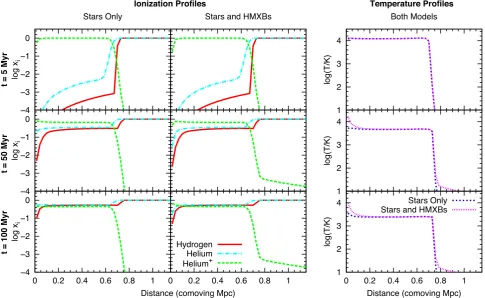
Figure 2. Heating and ionization from a model stellar cluster surrounded by a uniform density medium: including a HMXB phase. These plots show the ionization and temperature profiles surrounding our simulated stellar populations with and without HMXBs. Profiles were calculated using our one-dimensional time-dependent radiative transfer code, assuming a uniform density medium equal to the redshift-dependent average background density, for a 200-Myr simulation ending atz=10. In the left-hand and middle columns, the hydrogen neutral fraction (solid red line), helium neutral fraction (light blue dot–dashed line) and He+abundance (green dashed line) are plotted against distance. These are shown at 5, 50 and 100 Myr after the birth of the stellar cluster in the upper, middle and lower panels, respectively. The output from a model with only main-sequence stars (fsur=0) is plotted on the left while the panels in
the middle column show results from a model comprising both stars and HMXBs (fsur=1). The right-hand panels plot temperature against distance for both
models; the stellar-only simulation is represented by a dark blue dotted line and the model containing a further HMXB phase is plotted as a fine purple dotted line.
redshift. We then follow the cluster’s emission from its birth, at
z=14.5, for 200 Myr, untilz=10. The IGM density decreases over this time due to cosmological expansion.
We estimateElimin the same way as for Power et al. (2009), by
requiring thatσ(Elim)=(H(z)/c)/n(z), whereσ(E) is the ionization
cross-section of neutral hydrogen,H(z) is the Hubble parameter at redshiftz,n(z) is the mean baryon density andcis the speed of light. Forz10,Elim1 keV.
3.1.1 Ionization profiles
Snapshots from our radiative transfer calculation, at 5, 50 and 100 Myr (top, middle and bottom rows) after the birth of the cluster, are plotted in Fig.2. In the left-hand and middle columns, abun-dances are plotted against distance for a cluster with no HMXBs (left) and one with a HMXB phase (middle). The neutral hydro-gen fraction is plotted as a function of distance from the cluster, as a solid red line. Similarly the neutral helium fraction and He+ abundance are plotted as blue dot–dashed and green dashed lines, respectively.
In the stellar-only models (left-hand column) the hydrogen and helium ionization fronts begin by expanding rapidly into the gas. As the number of ionizing photons close to the outer edges drops, recombinations begin to stall the ionization fronts, so that their
maximum extent, at 5 Myr, is∼0.7 Mpc. Since the recombination rate is fairly uniform within the fully ionized zone, the neutral fraction then gradually increases to∼30 per cent at 50 Myr. By 100 Myr, the neutral fraction of the gas behind the ionization fronts has increased to∼50 per cent. An inner highly ionized region close to the source of radiation exists for hydrogen at both 50 and 100 Myr, though at later times it has significantly reduced in extent. A similar feature can be seen in the helium profile, which disappears by 100 Myr. After 100 Myr,∼40 per cent of the helium within 0.7 Mpc is He+,<0.1 per cent is He2+and the remainder is neutral.
The inclusion of HMXBs (middle column) has very little effect on any of the ionization profiles. Close to the source of radiation (<100 kpc), there is some additional ionization of hydrogen and helium at late times, but the extent of the main ionization fronts are identical to the purely stellar case. At early times, the harder photons from X-rays cause a very local (<20 kpc) ionized He2+
region close the cluster, which recombines at later times.
3.1.2 Temperature profiles
shown as a dark blue dashed line, and the model with a HMXB phase is plotted with a fine dotted purple line. Within 5 Myr, the region behind the ionization front is heated to∼104K, and cools
slowly, reaching∼2500 K after 100 Myr. The temperature profiles with and without HMXBs are similar in the main ionized zone, but after 50 Myr, they diverge in both the innermost region and just outside the ionization front. HMXBs are responsible for increased heating local to the source of radiation due to hydrogen and helium photoheating close to the source. At large distances, beyond the ion-ization front, a slightly extended heated region is visible, associated with the low level of He+ photoheating by hard X-ray photons at these distances.
3.1.3 Different spectra
The ionizing and heating potential of HMXBs will depend on their spectra. HMXBs with our fiducial model spectrum, a composite blackbody and high-energy power law (BB+PL), had negligible influence on their surroundings when added to the radiation al-ready present from main-sequence stars. We now test the alterna-tive, power law, spectra shown in Fig.1, withα=2.5, 1.5 and 0.5. Since the power-law spectra extend from 200 eV to 30 keV, dif-ferent slopes lead to difdif-ferent proportions of HMXB energy falling within the useful ionizing range, fromEmin=13.6 eV toEmax≈a
few keV, above which, photon mean free paths are too long for significant interaction with the local IGM. In fact, while 98 per cent of the energy forα=2.5 falls within the 13.6–4 keV energy range used in our radiative transfer code, just 84.5 and 30.9 per cent of the HMXB energy from spectra withα=1.5 and 0.5, respectively, fall within these bounds.
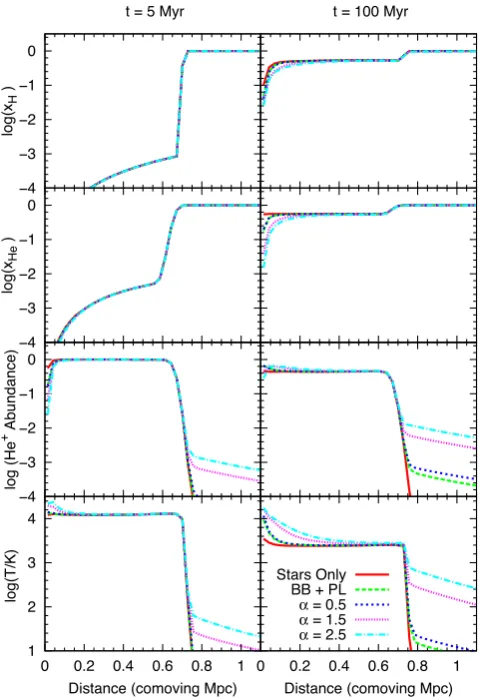
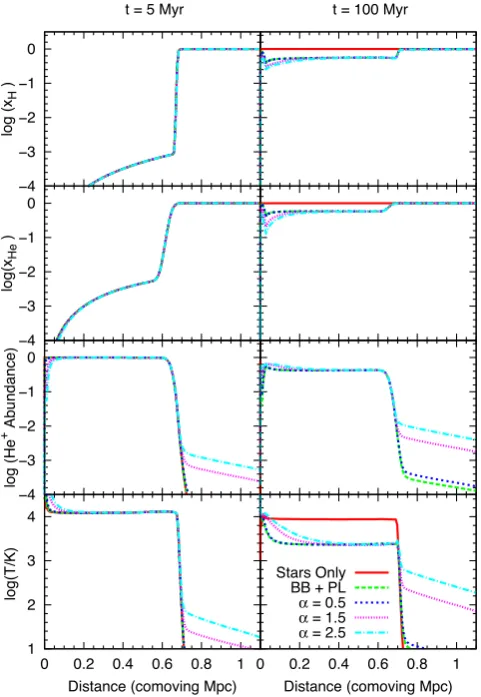
Fig.3shows the resulting ionization and temperature profiles generated by re-running our one-dimensional radiative transfer cal-culation with these different HMXB spectra. Results are shown at 5 and 100 Myr on the left- and right-hand panels, respectively. On the upper panels, the hydrogen neutral fraction is plotted as a func-tion of distance for five different models: our two previous models, without (solid red line) and with (green dashed line) HMXBs, as-suming a BB+PL spectrum, and our three new power-law models with spectral slopes, α, of 0.5 (dark blue dotted line), 1.5 (fine purple dotted line) and 2.5 (light blue dot–dashed line). At 5 Myr, there is no discernible difference in the ionization state of hydrogen between the models, as stellar radiation still dominates the ioniz-ing power. At 100 Myr, there are minor differences dependioniz-ing on HMXB spectra within 100 kpc of the radiation source. HMXBs with softer spectra are able to keep these nearby regions marginally more ionized than those with harder spectra. On the next row, the same results are shown for helium ionization, where HMXBs have the same effect; larger ionized fractions within 100 kpc for softer spectra. He+abundance is plotted against distance on the third row. At 5 Myr, the local He+ionization is higher for softer spectra. At both 5 and 100 Myr, some singly ionized helium is present outside the main ionization front, with low levels of secondary ionization. Here, harder spectra, such the BB+PL model, and a power law with
α=0.5, produce higher He2+fractions.
The temperature profiles for the different HMXB spectra are shown in the lower panels of Fig.3. Softer power-law spectra, with larger values ofα, increase the temperature of the inner 0.1 Mpc to a greater extent than the BB+PL model. They also have a visible effect on the temperature outside the ionization front, raising it to 150 and 400 K forα=1.5 and 2.5, respectively, at 1 Mpc from the cluster after 100 Myr. Softer power-law HMXB spectra lead to
Figure 3. Heating and ionization from a model stellar cluster surrounded by a uniform density medium: choice of HMXB spectrum. Plots comparing the effect of our choice of HMXB spectrum on the ionization and temper-ature profiles surrounding a model stellar cluster embedded in a uniform density medium. Calculations were made using our one-dimensional radia-tive transfer code, inputting the radiation from the cluster over 200 Myr, ending atz=10. The left- and right-hand panels show results at 5 and 100 Myr, respectively, after the birth of the cluster. Plotted as a solid red line is the output for a stellar-only simulation. Models including HMXBs are then plotted for a blackbody+power-law spectrum (dashed green line) and three power-law spectra:α=0.5 (dark blue dotted line),α=1.5 (fine purple dotted line) andα=2.5 (light blue dot–dashed line). From top to bottom, the panels show the hydrogen neutral fraction, helium neutral fraction, He+ abundance and gas temperature as a function of distance from the cluster.
higher temperatures because a larger proportion of their energy falls belowEmax. HMXBs with particularly soft spectra may therefore
be able to extend the volume heated by a typical starburst.
3.2 Heating and ionization from HMXBs within a galactic halo
[image:5.595.306.546.56.405.2]Heating of the IGM by HMXBs
2039
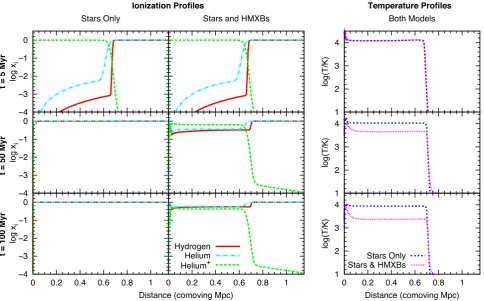
Figure 4. Heating and ionization from a model stellar cluster embedded in a 108M
NFW halo: including a HMXB phase. Ionization and temperature profiles for a stellar cluster, with and without HMXBs, embedded in a 108Mhalo following an NFW density profile. The stellar cluster simulation ran for 200 Myr, ending atz=10. The radiation from the cluster was then entered into a one-dimensional time-dependent radiative transfer code to calculate its effect on the surrounding medium. On the left-hand panels, hydrogen neutral fraction (solid red line), helium neutral fraction (light blue dot–dashed line) and He+ abundance (green dashed line) are plotted against distance from the cluster for a model containing main-sequence stars only. Panels on the upper, middle and lower rows show these profiles at 5, 50 and 100 Myr, respectively. In the middle column, the same plots are made for a second simulation that includes HMXBs in addition to stars. In the right-hand panels, the gas temperature has been plotted against distance for the stellar-only simulation (dark blue dotted line) and the model containing HMXBs (fine purple dotted line).
UV radiation cannot. To study the effect of such a density profile, we now use a simple model with a stellar cluster placed at the centre of a galaxy whose gas follows a radially dependent Navarro–Frenk– White (NFW) profile out to a fixed radius, beyond which the IGM is at mean density:
ρ(r)= ρcritδchar
r Rs
α
1+ r
Rs
(3−α). (3)
Here,Rsis the scale radius,ρcritis the mean density of the
Uni-verse, which we take to be 2.7755×10¹¹M
Mpc−3,
δcharis the
characteristic overdensity andαis the inner asymptotic slope of the profile.
For X-rays to propagate further than UV radiation, the central region needs to be dense enough to block the UV, but not so dense that the X-rays are also prevented from escaping. We force this scenario with an example halo with a chosen virial mass of 108M
and a concentration of 10. These parameters define both the virial radius and the scale radiusRs. We model a ‘cored’ galaxy, with
α=0, and assume that the baryon density follows the dark matter density, with a baryon fraction of 16 per cent. The halo extends to∼6 kpc; at greater radii, the medium returns to the constant IGM density used in the last model.
3.2.1 Ionization profiles
In Fig.4, we plot the hydrogen, helium and He+ionization profiles produced by a cluster without and with HMXBs (left-hand and middle panels, respectively), assuming a BB+PL HMXB spectrum. These are plotted at 5, 50 and 100 Myr after the birth of the cluster, from top to bottom rows.
In the first 5 Myr, the initial burst of UV radiation from the most massive stars in the cluster dominates its energy output. Since it is able to escape the inner regions of the galaxy, the ionization profiles at this time are the same, with and without HMXBs. In the stellar-only model, the ionized region produced by the most massive main-sequence stars has fully recombined by 50 Myr, and the volume remains neutral from then onwards.
Figure 5. Heating and ionization from a model stellar cluster embedded in a 108M
NFW halo: optical depths. The optical depths of UV (solid red line) and X-ray (dotted blue line) photons are plotted as a function of distance for a stellar cluster containing a HMXB phase embedded in an NFW density profile withMhalo=108M. The top panels show the
optical depth of photons with the UV threshold energy (13.6 eV) and X-rays (200 eV) to neutral hydrogen at 5 and 50 Myr in the left- and right-hand panels, respectively. For referenceτ=1 is shown as a green dashed line. Similarly optical depths are shown for neutral helium and He+in the middle and bottom panels, assuming UV ionization threshold energies of 24.5 and 54.4 eV, respectively, alongside X-ray energies of 200 eV.
containing a HMXB phase, with an ionization state corresponding to rows 1 and 2 of the middle column of Fig.4. X-ray energies (blue dotted lines) are represented at 200 eV, and UV energies (solid red lines) correspond to the threshold ionization energy for the relevant species: 13.6 eV for hydrogen, 24.5 eV for neutral helium and 54.4 eV for He+. Additionally,τ =1 is plotted as a green dashed line for comparison. Please note that the initial rise ofτfrom zero is not visible in these plots because of size of the galaxy (∼6 kpc) is too small to feature.
At 5 Myr, UV radiation is optically thin to hydrogen in the lo-cal IGM, but τH0 steadily increases with distance, surpassing 1
at∼0.45 Mpc, and sharply rising to∼103outside the initial
ioniza-tion front. X-ray radiaioniza-tion, however, is optically thin to hydrogen throughout the originally ionized volume, andτH0is only greater
than 1 beyond 0.8 Mpc from the cluster. Even at early times, there-fore, X-rays are able to propagate more freely through the ionized region, countering recombinations. After 50 Myr, both UV and X-ray radiation are optically thick to hydrogen. However, a small proportion of X-ray radiation (exp−τ ∼10−7) is able to propagate
through the IGM. The optical depth of UV radiation is a factor of 103higher, so it is almost completely confined within the host
galaxy. Although low, this fractional propagation of X-rays helps slow the recombination time-scale for the ionized region.
Similar results can be seen for helium, although τHe0 τH0.
Both UV and X-ray radiation are optically thick to He+ at 5 and 50 Myr. However the X-ray optical depth is a factor of∼50 lower than the UV value, so a small fraction of He+can be ionized when HMXBs are included in the starburst model.
Although X-rays enhance the lifetime of the ionized regions cre-ated by an initial burst of UV radiation, they do not extend the ionization front itself.
3.2.2 Temperature profiles
The temperature plots in the right-hand panel of Fig.4show iden-tical profiles at 5 Myr, exceeding 104K in the innermost regions,
and dropping off sharply at the edge of the ionization front. In the stellar-only model, as the ionized fraction rapidly falls, recombi-nations are the dominant cooling mechanism. However, the time-scales for cooling are too long for thermal equilibrium to be reached. Therefore, although fully neutral within 50 Myr, the gas temperature remains at∼104K, for the simulation lifetime. The partially ionized
IGM that remains when HMXBs are included has a considerably larger electron fraction. Consequently, inverse-Compton cooling becomes the dominant cooling mechanism, followed closely by Bremsstrahlung cooling. Therefore, although the heating rates are increased when HMXBs are included, the gas temperature decreases at a greater rate than in the stellar-only case, dropping to 5×10³K
after 100 Myr.1
3.2.3 Comparison between spectra
In rows 1–3 of Fig.6, the ionization profiles of hydrogen, helium and He+are compared for four different HMXB spectra, at 5 Myr (left) and 100 Myr (right) after the birth of the stellar population, where the same NFW profile has been assumed. The stellar-only model is plotted as a solid red line and the BB+PL spectrum HMXB model is plotted as a green dashed line. In addition, clusters containing HMXBs with power-law spectra, whereα=2.5, 1.5 and 0.5 are plotted as dark blue dashed, purple dotted and light blue dot–dashed lines, respectively. At 5 Myr there is no difference in the ionization profiles of hydrogen or helium, as the ionizing output is dominated by main-sequence stellar sources. After 100 Myr, however, some differences can be seen between HMXB spectra within 0.2 Mpc from the source. Models with soft spectra marginally increase the ionized fraction of material close to the source of radiation. The different shapes of the He+ profiles are comparable to those in the constant density case (cf. Fig.3), with harder spectra ionizing a larger proportion of He2+ions.
A comparison between the temperature profiles surrounding the 108M
halo with different HMXB spectrum choices is shown in the bottom panels of Fig.6. Altering the HMXB spectra leads to broadly similar effects to those seen in the constant density case (Fig.3), with softer spectra producing higher local temperature peaks and increased heating beyond the main ionization front at late times.
1Note that the computed temperature is actually the electron temperature
Heating of the IGM by HMXBs
2041
Figure 6. Heating and ionization from a model stellar cluster embedded in a 108M
NFW halo: choice of HMXB spectrum. Ionization state and temperature profiles of the gas surrounding five model stellar clusters con-taining (i) just stars (solid red lines), (ii) both stars and HMXBs, assuming our fiducial blackbody and hard power-law (BB+PL) HMXB spectrum (green dashed lines) and (iii–v) both stars and HMXBs, assuming a power-law HMXB spectrum, withα=0.5, 1.5 and 2.5 (dark blue dotted, fine purple dotted and light blue dot–dashed lines, respectively). Profiles were calculated using a one-dimensional radiative transfer code whereby radia-tion was propagated into a medium following an NFW density profile with
Mhalo=108M. From top to bottom panels, hydrogen neutral fraction,
helium neutral fraction, He+abundance and gas temperature are plotted as a function of distance from the cluster. Panels in the left-hand column contain outputs from 5 Myr after the birth of the cluster, while those in the right-hand column plot the same for 100 Myr.
4 D I S C U S S I O N
Although we have shown that the inclusion of a HMXB phase in the evolution of a stellar cluster can extend the lifetime of its surrounding ionized volume, this effect is only visible when column densities are high enough to prevent the escape of UV radiation from the cluster. When all of the cluster’s radiation is released directly into the IGM, X-rays from HMXBs have little effect on the ionization and heating of their surroundings. In both density profile choices, HMXBs were unable to extend the size of the ionization front.
These results do not support the recent arguments in favour of HMXBs having a significant effect on their surroundings at high redshifts. X-rays from HMXBs do not ‘pre-ionize’ distant regions or markedly raise temperatures, except in the case of particularly
soft power-law HMXB spectra. In this section, we aim to explain these findings by answering the following two questions: first, why, in these scenarios, are we seeing such a negligible effect from HMXBs? Secondly, under what conditions could HMXBs have an important influence on their surroundings and are these constraints physically reasonable?
4.1 Why do HMXBs in our model have insignificant effects on their surroundings?
We have modelled the HMXBs in our stellar population synthe-sis with careful comparisons to observed systems and population statistics. These include making reasoned choices for HMXB spec-tra, lifetimes and abundances. These parameters all influence the predicted contribution of HMXBs to the radiation emitted by the cluster. The lack of additional ionization and heating of the IGM by the inclusion of HMXBs can therefore be discussed in the context of these selections. The main reasons for the insignificant influence of HMXBs on their surroundings can be explained as follows.
4.1.1 HMXB radiation is dwarfed by that of its progenitors
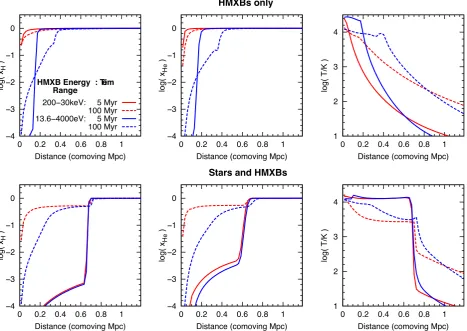
The red lines in the upper panels of Fig. 7 show the effect of HMXB radiation on its surroundings when all main-sequence stellar radiation is removed from the simulation. Here, we use a power-law HMXB spectrum, normalized between 0.2 and 30 keV, withα=1.5, as plotted in Fig.1. From left to right, the plots show the hydrogen neutral fraction, helium neutral fraction and gas temperature as a function of comoving distance. A uniform density with the same conditions as those in Section 3.1 has been assumed. The red solid lines show results at 5 Myr, and the red dashed lines show the profiles after 100 Myr. From these plots, we see that HMXBs can locally ionize hydrogen up to∼60 per cent (∼90 per cent) to distances of 100 (400) kpc at 5 (100) Myr after the birth the cluster. They heat their local IGM to temperatures greater than 104K. The gas then
cools slowly in the inner regions over time, but the temperature front moves outwards, raising the IGM temperature to 100 K at>1 Mpc after 100 Myr.
These results, if shown on their own, would predict a high in-fluence of HMXBs on their surroundings. However, all HMXBs have stellar progenitors, and form with other stars. Therefore, in the context of a stellar cluster, rather than as an isolated source, HMXBs have relatively low influence. This can be seen in the red lines on the bottom panel of Fig.7, where the radiation of both HMXBs and main-sequence stars is now included. In this case, the influence of stellar radiation, in particular the short-lived massive stellar progenitors of HMXB systems, is so high that the HMXB effect looks minimal and unimportant in comparison. This com-parison warns against considering HMXBs out of context, as they would have been born into a region already fully ionized by their stellar progenitors.
4.1.2 HMXBs do not radiate in useful frequency ranges
Figure 7. The effect of HMXB spectral energy range on their heating and ionizing potential. Upper panels: hydrogen neutral fraction, helium neutral fraction and temperature are plotted from left to right as a function of distance from the cluster for two model stellar populations emitting only HMXB radiation (the stellar component has been removed). Both models assume a power-law HMXB spectrum, withα=1.5. They have the same integrated luminosity, but this is distributed over two different frequency ranges: 200 eV–30 keV (red lines) and 13.6eV–4 keV (blue lines). Results at 5 and 100 Myr after the birth of the cluster are plotted as solid and dashed lines, respectively. Lower panels: ionization and temperature profiles from the same simulations, but with stellar radiation included. These calculations have all been made using a one-dimensional time-dependent radiative transfer code, assuming a uniform, redshift-dependent density medium. The models were run for 200 Myr, ending atz=10.
this case, a much larger proportion of HMXB energy is in the useful ionizing range. As shown in the top left-hand panel, HMXBs with these spectra could fully ionize hydrogen to a distance of 100 kpc after 5 Myr (solid blue line). The ionized zone then expands over time, with material out to 400 kpc remaining significantly ionized at 100 Myr (blue dashed line). Similarly, the helium ionization front extends to 100 kpc at 5 Myr, and propagates further as material behind the front slowly recombines. Local temperatures are also higher with this lower frequency spectrum.
In the blue lines on the lower figures, HMXB radiation is also moved into the 13.6 eV–4 keV range, but the main-sequence stellar component is included. Lowering the frequency of HMXB radiation results in higher hydrogen and helium ionized fractions, particularly after 100 Myr. The ionization fronts also extend marginally further. After 100 Myr, the temperatures are also higher, within∼1 Mpc for this altered HMXB spectrum.
These plots highlight the importance of our spectrum choice. The fact that HMXBs emit energy in X-rays (>200 eV) is an important factor in determining their ionizing and heating potential. The long mean free paths of these photons mean they do not add much to the ionizing and heating influence of stellar cluster, despite their high luminosities.
4.1.3 Ionization time-scales are too long
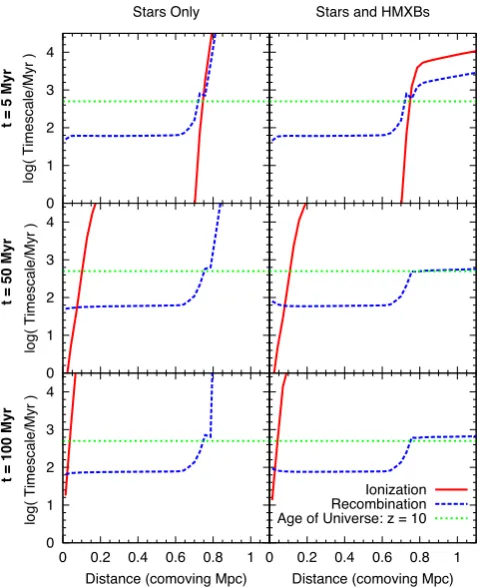
The reason that X-rays from HMXBs have little effect on their surroundings can be seen in Fig.8. Here, the hydrogen ionization and recombination time-scales for the models in Fig.2have been calculated as
Photoionization time−scale : tion= −1, (4)
Recombination time−scale : trec=(αne)−1, (5)
where is the photoionization rate (s−1),
αis the recombination rate (cm3s−1) andn
eis the electron density (cm−3) as defined in
appendix B4 of Bolton & Haehnelt (2007).
Heating of the IGM by HMXBs
2043
Figure 8. Ionization and recombination time-scales. Plotted in the upper, middle and lower panels are the hydrogen ionization (solid red lines) and recombination (blue dashed lines) time-scales at 5, 50 and 100 Myr, re-spectively, after the birth of a model stellar cluster. Results are shown for a simulation containing stellar radiation only (left-hand panels) and a model including both stars and HMXBs (right-hand panels) assuming a BB+PL HMXB spectrum (see Fig.1). These profiles were calculated using a one-dimensional time-dependant radiative transfer code over 200 Myr of the cluster’s lifetime, assuming a uniform, redshift-dependent density, with a final redshift of 10. Also plotted for comparison, as a dotted green line, is the age of the universe atz=10.
calculated forH0= 0.7,M =0.27 andvac= 0.73 using the
web-based cosmology calculator described in Wright (2006). At 5 Myr, for a main-sequence stellar radiation only model (left-hand panels), the ionization time-scale is extremely short (<1 Myr) out to∼0.7 Mpc – the edge of the fully ionized volume – before rising sharply to>10 Gyr. The recombination rate, which depends on the number of free electrons, is∼60 Myr behind the ionization front and also increases rapidly at 0.7 Mpc. The time-scale profiles for recombination do not change significantly in the next 100 Myr. However, 50 Myr into the cluster’s lifetime, only the inner 100 kpc has an ionization time-scale of<500 Myr, and after 100 Myr, the front has receded to just 50 kpc. Ionization is therefore slower than recombination at almost all distances within the initially ionized region, so it slowly recombines.
The right-hand profiles show the equivalent results for a cluster containing both stars and HMXBs. Within 0.7 Mpc, the ionization and recombination time-scales at 5, 50 and 100 Mpc are very similar to the stellar-only case. However, at 5 Myr during the era of the most luminous HMXBs, both the ionization and recombination time-scales are reduced to∼1 Gyr at the edge of the ionization front, gradually rising at greater distances. The ionization time-scale is approximately two times longer than the recombination time-scale. This implies that, after>103Myr, an equilibrium between
reionization and recombination could result in low level partial ionization of the distant IGM. However, this equilibrium cannot be reached in the lifetime of the cluster, so this solution could never form.
For comparison, we solve a static version of the photoionization– recombination equations to demonstrate the equilibrium solution that can be derived when time-scales are not accounted for. For this purpose, we have used the calculation described in Zaroubi & Silk (2005) and Zaroubi et al. (2007), which we write in the form
α(2)HIn 2
H(1−xHI)2= (r)nHxHI. (6)
Here, the case B recombination coefficient, αHI(2), is equal to
2.6×10⁻¹³(T
/104K)−0.85cm3s−1(cf. Kaplan & Pikel’Ner1970)
for a gas temperatureT, where we useT=104K. We evaluate the
mean number density of hydrogen,nH∼1.9×10⁻⁷(1+z)3cm−3
(Spergel et al.2007) atz=10. The ionization rate per hydrogen atom at distancerfrom the source is given by
(r)=
∞
E0
σ(E)N(E;r)
1+ E
E0
φ(E, xe)
dE
E, (7)
where σH(E) = σ0(E/E0)3 is the bound-free absorption
cross-section for hydrogen, withσ0=6×10⁻¹⁸cm2andE0=13.6 eV.
N(E;r) is the number of photons per unit time per unit area at a distancerfrom the source:
N(E, r)=e−τ(E;r)F(E) 4πr2 cm
−2
s−1, (8)
where the optical depth is evaluated as
τ(E;r)=
r
0
nHxHIσ(E) dr, (9)
and the spectrum,F(E), is inputted from our Monte Carlo model of the stellar population. The term [1+(E/E0)φ(E,xe)] accounts for
secondary ionizations, where
φ(E, xe)=0.3908[1−(1−xe0.4092) 1.7592
] (10)
andxe=1−xH(Shull & van Steenberg1985).
These equations are solved at 5 and 100 Myr, in the left- and right-hand panels of Fig.9. Note that the fully ionized zones are overesti-mated because the spectrum atris calculated asF(E) exp−τ/4πd2,
so that the photons used to ionize the material withinrhave not been removed. Furthermore, ionization history has not been accounted for, in the equilibrium calculation, which is why the ionized volume appears to recede over time, rather than recombining as a whole.
The upper panels of Fig.9show the hydrogen neutral fraction against time, while the lower panels show the ionization and recom-bination time-scales. In the upper panels, the stellar-only model is plotted in red, and a model with a HMXB phase, using a BB+PL HMXB spectrum, is shown in blue. At both 5 and 100 Myr, the addition of HMXB radiation leads to low level ionization of the distant IGM, beyond the fully ionized volume produced by the main-sequence stellar radiation.
Figure 9. Ionization profiles and time-scales determined using a static photoionization–recombination equilibrium calculation. In the top left-hand panel, the hydrogen neutral fraction is plotted against comoving distance from two model stellar clusters, without (solid red line) and with (solid blue line) a HMXB phase. These profiles were calculated by solving a static photoionization–recombination equilibrium calculation after inputting the radiation emanating from the clusters at 5 Myr. The top right-hand panel shows solutions to the same calculations at 100 Myr. On the bottom row, the static photoionization and recombination time-scales are plotted for each model as a function of distance from the cluster at 5 and 100 Myr on the left- and right-hand panels, respectively. The stellar-only model is plotted in red, and the model comprising both stars and HMXBs is plotted in blue, with solid lines for photoionization time-scales, and dashed lines for recombination time-scales.
higher than the recombination rate. This accounts for the partially ionized equilibrium visible in the upper panels.
Of course, all the time-scales outside the ionization fronts are longer than∼500 Myr, the age of the universe atz=10, which implies that the partially ionized equilibrium at these distances is unreachable. We include this discussion to highlight the limitations of simple calculations and general arguments used to argue in favour of alternative or additional ionizing sources. A boost in ionizing energy does not necessarily translate to increased ionization, as the spectrum of the new source needs to be considered; in the context of our isolated cluster model, X-rays may require too long a time-scale to have a significant influence because the sources are short lived.
4.2 Can HMXBs have an important feedback effect?
We have shown that, in the context of our starburst model, radiation from HMXBs does not produce significant additional ionization and heating of the IGM, either in a constant or varying density medium. Indeed, in the NFW density case, including HMXBs can only prolong the lifetime of previously ionized structures, which actually results in lower IGM temperatures. We now discuss the fate of the HMXB photons in our models, and the conditions required for their feedback effects to be non-negligible.
4.2.1 Escape fractions
One of the arguments in favour of an X-ray contribution to reion-ization cites their long mean free paths, compared to UV photons
(Power et al.2009; Mirabel et al.2011). This means photons are able to escape further into the IGM rather than being absorbed in their immediate surroundings.
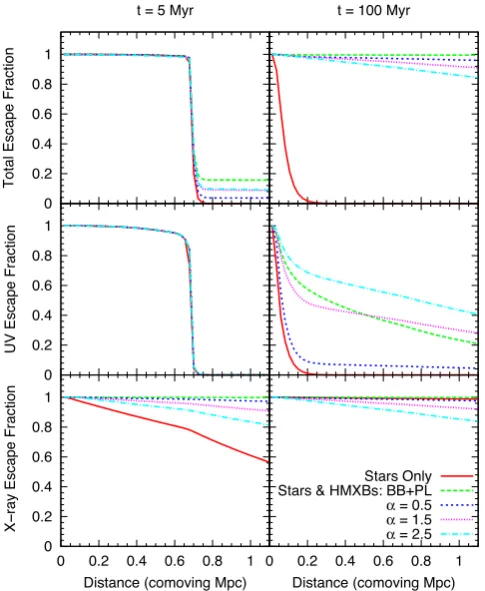
In the upper panels of Fig.10, we plot the escape fractions as a function of distance for our constant density IGM model, where the escape fraction is defined as
fesc(r)= 4 keV
13.6 eVF(E;r) dE 4 keV
13.6 eVF(E; 0) dE
, (11)
i.e. the proportion of ionizing energy emitted from the cluster that reaches a distancer.
Five models are plotted: a stellar-only simulation (solid red line) and four models including a HMXB phase with differing HMXB spectra: a BB+PL spectrum (dashed green line) and power-law spectra with α = 2.5 (dark blue dashed line), 1.5 (pink dotted line) and 0.5 (light blue dot–dashed line). The escape fractions are plotted at 5 and 100 Myr after the birth of a stellar cluster, in the left-and right-hleft-and panels. On the second left-and third rows, this escape fraction is split into a UV (13.6–200 eV) and X-ray (200 eV–4 keV) component, respectively.
Heating of the IGM by HMXBs
2045
Figure 10. Heating and ionization from a model stellar cluster surrounded by a uniform density medium: escape fractions. The escape fraction, the fraction of energy in a given frequency range that remains unabsorbed, is plotted as a function of distance from the cluster for different stellar population models. A constant redshift-dependent density profile has been assumed, and the calculations have been made using our one-dimensional radiative transfer code, over a cluster lifetime of 200 Myr, ending atz=10. The upper panels show the total 13.6 eV–4 keV escape fraction for five different models at 5 Myr (left-hand panel) and 100 Myr (right-hand panel) after the birth of the cluster. The models plotted are (i) stellar radiation only (solid red line), (ii) stars and HMXBs, with a blackbody+hard power-law HMXB spectrum (our fiducial model; green dashed line) and (iii–iv) power-law models withα=0.5, 1.5 and 2.5 (dark blue dotted, fine purple dotted and light blue dot–dashed lines, respectively). The panels on the second and third rows split this escape fraction into UV (13.6–200 eV) and X-rays (200–4000 eV), respectively.
radiation from main-sequence stars is negligible, so its divergence from the other lines in the bottom panel is unimportant.
After 100 Myr, radiation from HMXBs dominates the ioniz-ing emission from the cluster, so more pronounced differences are seen in the total escape fractions between models with and with-out a HMXB phase. In the stellar-only model, the escape fraction decreases sharply with distance from the source, with all energy absorbed within 0.2 Mpc. In the models involving a HMXB phase, however, most of the energy escapes, because the SED is much harder. The UV escape fraction is greater for harder spectra, and the X-ray escape fraction remains similar to the 5 Myr snapshot, with>80 per cent of the X-rays escaping beyond 1 Mpc in all models including a HMXB phase.
These escape fraction plots show that, as theory suggests, a sig-nificant proportion of HMXB energy penetrates deep into the IGM. It does not make an impression on the ionization state of the material at these distances because of long ionization time-scales. However,
should the X-ray background build up to greater levels, these time-scales could be reduced and an effect may be visible.
4.2.2 Greater HMXB number densities
We have established that the ionization time-scales for the X-rays from HMXBs are too long for them to exert a major effect on the ionization state of their distant surroundings, despite their high escape fractions. A higher number density of HMXBs might lower these time-scales. This could be achieved in three ways:
(i) increasing the HMXB to main-sequence star ratio;
(ii) modelling a larger starburst, so that more HMXBs can form; (iii) continuous star formation, allowing for more uniform X-ray production (see Section 4.4).
Our estimates of the proportion of stellar binaries that survive the primary’s supernova phase to become HMXBs (30 per cent) are observationally motivated. Additionally, we have assumedfsur=1
throughout this paper, thus neglecting any other evolutionary rea-sons for HMXBs failing to form. Therefore, increasing the ratio of HMXBs to main-sequence stars, as in option (i), would be implau-sible within the context of our simulations.
In Fig.11we investigate (ii) by increasing the size of our stellar clusters from 106 to 1010 stars. Here, the total energy from the
cluster with and without a HMXB phase is propagated through a constant density medium, as described in Section 3.1. From top to bottom, the hydrogen neutral fraction, helium neutral fraction, He+abundance, temperature and ionization time-scale are plotted against distance for a stellar-only model (red lines) and a stellar and HMXB model, with a BB+PL HMXB spectrum andfsur=1 (blue
lines). These are plotted at 5 Myr after the birth of the cluster (solid lines), and 100 Myr (dashed lines). Four different cluster sizes are shown from left to right, containing 107, 108, 109and 1010 stars,
respectively. Note that the horizontal scale is increased for more massive clusters, to incorporate the larger ionized volumes.
Since a greater X-ray background density results in shorter ion-ization time-scales, the relative influence of stars and HMXBs on their surroundings is non-linear. Therefore, although stars domi-nate the heating and ionizing influence of the cluster on the IGM, HMXBs show more significant effects as the cluster size increases. In a 107 star cluster, the hydrogen ionization profiles (top
left-hand plot) show little difference at 5 Myr. However, although the ionization front is not extended at this time, after 100 Myr a par-tially ionized zone remains that is marginally larger than the origi-nally ionized region. There is no matching increase in the volume of ionized helium, but recombinations are also quenched by HMXB radiation. As the number of stars in the cluster increases, towards the right-hand panel of Fig.10, the effect of HMXBs on their en-vironment increases relative to that of the main-sequence stellar component. In particular, the extent of the partially ionized regions after 100 Myr increases. However, at no point is the outer edge of the ionization front extended because the ionization time-scales (bottom panels), while much reduced by the inclusion of HMXBs, remain prohibitively long.
Figure 11. Heating and ionization from multiple clusters in a uniform density medium: boosting HMXB ionization and heating power. From left to right, we use our one-dimensional radiative transfer code to calculate the ionization and temperature profiles surrounding 10, 100, 1000 and 10 000 clusters. Their combined emission is propagated through a constant, redshift-dependent density medium, for 200 Myr of the cluster lifetime, ending atz=10. From top to bottom, the hydrogen neutral fraction, helium neutral fraction, He+abundance and gas temperatures have been plotted as a function of distance from the clusters for two models: without (red lines) and with (blue lines) HMXBs. Solid lines show the profiles at 5 Myr after the birth of the cluster, and dashed lines show the profiles after 100 Myr. Note that the horizontal scales are different in each column.
4.3 Mechanical feedback and local effects
We note that HMXBs may be able to exert influence on the IGM via alternative mechanisms that have not been considered in this study. For example, several ULXs are known to drive large-scale outflows (e.g. SS 433; Blundell et al.2001). These alternative feedback pro-cesses are addressed in Justham & Schawinski (2012). Furthermore, while this study may rule out any strong feedback effect of HMXBs on the IGM, we have not addressed the radiative and mechanical effects that HMXBs may exert on their host galaxies. Significant feedback within these dense environments may be plausible.
4.4 Further potential influence on the IGM
In our model, we treat star formation as a single burst over a short time-scale. While this may be relevant for e.g. globular clusters, star formation is likely to be a continuous process within young galax-ies. HMXBs are unable to sustain a sufficient ionizing background for significant ionization and heating under these conditions, due to their brief lifetimes. However, ongoing HMXB formation may be able to maintain a low level X-ray ionizing background, pre-ionizing and heating the distant IGM before UV radiation from main-sequence stellar sources penetrates these distances.
A further consideration is the fate of hard X-ray photons, with energies greater than the 4 keV limit used in our models. A neutral IGM is optically thin over a Hubble length to pho-tons with energies greater than Elim = 1.8[(1 + z)/15]0.5 keV,
where Elim 1 keV at z = 10 (Dijkstra et al. 2004). Hence,
it is extremely unlikely that hard X-ray photons would have been absorbed in their immediate surroundings. Consequently, these photons are unimportant for the photoionization calculations, within a few comoving Mpc of HMXBs, that we present in this work.
Note, however, that recent (model dependent) constraints on the 21-cm brightness temperature by the Precision Array for Probing the Epoch of Reionization (PAPER-32) imply that the IGM may have been partially heated by X-ray sources at redshiftz = 7.7 (Parsons et al. 2014). Fast electrons produced by hard X-ray and gamma-ray photons could lead to cascades, resulting in mul-tiple secondary ionizations. For a 1 MeV photon, 32 per cent of the energy is transferred to the IGM via ionization (Vald´es, Evoli & Ferrara2010). As a significant proportion of the radia-tion from HMXBs falls above Elim (e.g. Gierli´nski et al. 1999),
Heating of the IGM by HMXBs
2047
4.5 Conclusions
We have investigated the influence of HMXBs on the high-redshift IGM, using our model coeval stellar population, comprising main-sequence stars formed in a single burst followed by a later HMXB phase. With observationally motivated choices for HMXB abun-dances, spectra and lifetimes, we argue that our models provide a good estimate of HMXB emission in a plausible context. We used a one-dimensional radiative transfer code to predict the ionization and temperature profiles surrounding the population. We have con-sidered the interaction of the stellar radiation from our model cluster through a uniform density IGM fromz=14.5 to 10, and through a 108M
one-dimensional NFW profile, with and without a HMXB phase. For a constant density IGM, HMXBs produce negligible en-hanced ionization, except in the case of extreme HMXB spectra. This is because their high-energy SEDs and brief lifetimes leave insufficient time for an X-ray ionized background to build up. Ra-diation from massive main-sequence stars raises the temperature to 104K, but including a HMXB phase only increases the heating rate
in the inner∼0.1 Mpc. In the NFW profile case, UV radiation from the most massive stars initially ionizes a large IGM volume, which later recombines as the reduced stellar radiation is unable to pene-trate the high-density galactic core. HMXB photons stall recombi-nations behind the front, keeping it partially ionized for longer, but do not extend the outer edge of the ionized zone. The partially ion-ized regions have an increased number of free electrons, so enhance both inverse-Compton and Bremsstrahlung cooling. Consequently, HMXBs actually increase the cooling rate in these regions, halv-ing the gas temperature after 100 Myr. In neither case is thermal equilibrium reached during the simulation’s lifetime, so cooling is ongoing.
Although we have shown that HMXBs do not have a strong influence on the IGM in the context of our starburst model, they may nevertheless have a significant local influence within their host galaxies. It could be the case that HMXBs can influence the IGM through factors that are beyond the scope of our models: e.g. it is possible that multiple ionizations from hard X-ray photons, via high energy cascades, may have deposited heat and ionizing energy into the environment in addition to that seen in the models as presented here. However, we view this possibility as unlikely given the very low optical depths in the IGM for photons of energy1 keV. A more significant caveat is likely to be the assumption of HXMB formation via a starburst. Ongoing or persistent HMXB formation may be able to maintain a low level X-ray ionizing background, which could partially ionize the distant IGM.
AC K N OW L E D G E M E N T S
GK acknowledges the support of an STFC studentship. CP acknowl-edges the support of Australian Research Council Future Fellowship FT130100041. JSB acknowledges the support of a Royal Society University Research Fellowship. This research is supported by an STFC consolidated grant.
R E F E R E N C E S
Abel T., Norman M. L., Madau P., 1999, ApJ, 523, 66 Barkana R., Loeb A., 2001, Phys. Rep., 349, 125
Becker G. D., Bolton J. S., Haehnelt M. G., Sargent W. L. W., 2011, MNRAS, 410, 1096
Belikov A. V., Hooper D., 2009, Phys. Rev. D, 80, 035007
Blundell K. M., Mioduszewski A. J., Muxlow T. W. B., Podsiadlowski P., Rupen M. P., 2001, ApJ, 562, L79
Bolton J. S., Haehnelt M. G., 2007, MNRAS, 374, 493 Bolton J., Meiksin A., White M., 2004, MNRAS, 348, L43
Bolton J. S., Becker G. D., Raskutti S., Wyithe J. S. B., Haehnelt M. G., Sargent W. L. W., 2011, preprint (arXiv:e-prints)
Crowther P. A., Barnard R., Carpano S., Clark J. S., Dhillon V. S., Pollock A. M. T., 2010, MNRAS, 403, L41
Dijkstra M., Haiman Z., Loeb A., 2004, ApJ, 613, 646 Dixon K. L., Furlanetto S. R., 2009, ApJ, 706, 970
Dolan J. F., Crannell C. J., Dennis B. R., Frost K. J., Orwig L. E., 1977, Nature, 267, 813
Dray L. M., 2006, MNRAS, 370, 2079 Fragos T. et al., 2013a, ApJ, 764, 41
Fragos T., Lehmer B. D., Naoz S., Zezas A., Basu-Zych A., 2013b, ApJ, 776, L31
Friedrich M. M., Mellema G., Iliev I. T., Shapiro P. R., 2012, MNRAS, 421, 2232
Furlanetto S. R., Stoever S. J., 2010, MNRAS, 404, 1869 Furlanetto S. R., Oh S. P., Briggs F. H., 2006, Phys. Rep., 433, 181 Gierli´nski M., Zdziarski A. A., Done C., Johnson W. N., Ebisawa K., Ueda
Y., Haardt F., Phlips B. F., 1997, MNRAS, 288, 958
Gierli´nski M., Zdziarski A. A., Poutanen J., Coppi P. S., Ebisawa K., Johnson W. N., 1999, MNRAS, 309, 496
Glover S. C. O., Brand P. W. J. L., 2003, MNRAS, 340, 210 Gnedin N. Y., 2000, ApJ, 535, 530
Haiman Z., 2011, Nature, 472, 47
Haiman Z., Abel T., Rees M. J., 2000, ApJ, 534, 11
Heger A., Fryer C. L., Woosley S. E., Langer N., Hartmann D. H., 2003, MNRAS, 591, 288
Hui L., Haiman Z., 2003, ApJ, 596, 9
Jeon M., Pawlik A. H., Bromm V., Milosavljevic M., 2014, MNRAS, 440, 3778J
Johnson J. L., Khochfar S., 2011, ApJ, 743, 126 Justham S., Schawinski K., 2012, MNRAS, 423, 1641 Kaaret P., 2014, MNRAS, 440L, 26K
Kaplan S. A., Pikel’Ner S. B., 1970, Matter in Space – The Interstellar Medium. Harvard Univ. Press, Cambridge, MA
Kroupa P., 2001, MNRAS, 322, 231
Kuhlen M., Madau P., 2005, MNRAS, 363, 1069
Lutovinov A., Revnivtsev M., Gilfanov M., Shtykovskiy P., Molkov S., Sunyaev R., 2005, A&A, 444, 821
Machacek M. E., Bryan G. L., Abel T., 2003, MNRAS, 338, 273 McQuinn M., 2012, MNRAS, 426, 1349
McQuinn M., Lidz A., Zahn O., Dutta S., Hernquist L., Zaldarriaga M., 2007, MNRAS, 377, 1043
McQuinn M., Lidz A., Zaldarriaga M., Hernquist L., Hopkins P. F., Dutta S., Faucher-Gigu`ere C.-A., 2009, ApJ, 694, 842
Madau P., Meiksin A., Rees M. J., 1997, ApJ, 475, 429
Madau P., Rees M. J., Volonteri M., Haardt F., Oh S. P., 2004, ApJ, 604, 484 Marigo P., Girardi L., Chiosi C., Wood P. R., 2001, A&A, 371, 152 Marigo P., Chiosi C., Kudritzki R.-P., 2003, A&A, 399, 617 Mesinger A., McQuinn M., Spergel D. N., 2012, MNRAS, 422, 1403 Mesinger A., Ferrara A., Spiegel D. S., 2013, MNRAS, 431, 621 Mirabel I. F., Dijkstra M., Laurent P., Loeb A., Pritchard J. R., 2011, A&A,
528, A149
Ogawara Y., Mitsuda K., Masai K., Vallerga J. V., Cominsky L. R., Grunsfeld J. M., Kruper J. S., Ricker G. R., 1982, Nature, 295, 675
Oh S. P., 2001, ApJ, 553, 499
Parsons A. R. et al., 2014, ApJ, 788, 106P
Power C., Wynn G. A., Combet C., Wilkinson M. I., 2009, MNRAS, 395, 1146
Power C., James G., Combet C., Wynn G., 2013, ApJ, 764, 76
Raskutti S., Bolton J. S., Wyithe J. S. B., Becker G. D., 2012, MNRAS, 421, 1969
Reichardt C. L. et al., 2012, ApJ, 755, 70 Ricotti M., Ostriker J. P., 2004, MNRAS, 352, 547
Ricotti M., Ostriker J. P., Gnedin N. Y., 2005, MNRAS, 357, 207 Robertson B. E., Ellis R. S., Dunlop J. S., McLure R. J., Stark D. P., 2010,
Salvaterra R., Haardt F., Volonteri M., 2007, MNRAS, 374, 761 Shull J. M., van Steenberg M. E., 1985, ApJ, 298, 268
Sokasian A., Yoshida N., Abel T., Hernquist L., Springel V., 2004, MNRAS, 350, 47
Spergel D. N. et al., 2007, ApJS, 170, 377
Vald´es M., Evoli C., Ferrara A., 2010, MNRAS, 404, 1569 Venkatesan A., Giroux M. L., Shull J. M., 2001, ApJ, 563, 1 Visbal E., Loeb A., 2012, J. Cosmol. Astropart. Phys., 5, 7 Volonteri M., Gnedin N. Y., 2009, ApJ, 703, 2113 Wheeler J. C., Johnson V., 2011, ApJ, 738, 163
Wise J. H., Abel T., 2008, ApJ, 684, 1 Worseck G. et al., 2011, ApJ, 733, L24 Wright E. L., 2006, PASP, 118, 1711
Yoshida N., Bromm V., Hernquist L., 2004, ApJ, 605, 579 Zaroubi S., Silk J., 2005, MNRAS, 360, L64
Zaroubi S., Thomas R. M., Sugiyama N., Silk J., 2007, MNRAS, 375, 1269