Health Psychology
A Randomized Controlled Trial of an Appearance-Based
Dietary Intervention
Ross D. Whitehead, Gözde Ozakinci, and David I. Perrett
Online First Publication, March 25, 2013. doi: 10.1037/a0032322
CITATION
BRIEF REPORT
A Randomized Controlled Trial of an Appearance-Based Dietary
Intervention
Ross D. Whitehead, Gözde Ozakinci, and David I. Perrett
University of St. Andrews
Objective: Inadequate fruit and vegetable consumption precipitates preventable morbidity and mortality. The efficacy of an appearance-based dietary intervention was investigated, which illus-trates the beneficial effect that fruit and vegetable consumption has on skin appearance.Methods: Participants were randomly allocated to three groups receiving information-only or a generic or own-face appearance-based intervention. Diet was recorded at baseline and 10 weekly follow-ups. Participants in the generic and own-face intervention groups witnessed on-screen stimuli and received printed photographic materials to illustrate the beneficial effect of fruit and vegetable consumption on skin color.Results:Controlling for baseline diet, a significant effect of intervention group was found on self-reported fruit and vegetable intake among 46 completers who were free of medical and personal reasons preventing diet change. The own-face appearance-based intervention group reported a significant, sustained improvement in fruit and vegetable consumption whereas the information-only and generic appearance-based intervention groups reported no significant dietary changes.Conclusions:Seeing the potential benefits of fruit and vegetable consumption on own skin color may motivate dietary improvement.
Keywords:fruit and vegetables, diet, appearance-based intervention, skin color, carotenoids
Supplemental materials:http://dx.doi.org/10.1037/a0032322.supp
Inadequate fruit and vegetable consumption is estimated to lead to over 2.6 million premature deaths per year worldwide (Lock, Pomerleau, Causer, Altmann, & McKee, 2005), chiefly through incidences of ischemic heart disease (Yusuf et al., 2004), stroke (Dauchet, Amouyel, & Dallongeville, 2005), and potentially some cancers (Vainio & Weiderpass, 2006). Unfortunately, existing fruit and vegetable consumption interventions that go beyond informa-tion provision are expensive (Cobiac, Vos, & Veerman, 2010) and labor intensive (Pomerleau, Lock, Knai, & McKee, 2005).
Appearance offers an alternative framework for intervention. Interventions that illustrate graphically the detrimental effect of ultraviolet light exposure on faces have led to lasting sun-tanning behavior changes (Mahler, Kulik, Gerrard, & Gibbons, 2007).
Appearance-based smoking cessation interventions have also been successful in motivating behavior change (Semer et al., 2005). This style of intervention is potentially capable of motivating dietary change because of the effect that fruit and vegetable consumption has on skin appearance and attractiveness (Stephen, Coetzee, & Perrett, 2011).
Red-yellow carotenoid pigments are abundant in fruit and veg-etables. These pigments impart color to human skin (Alaluf, Hei-nrich, Stahl, Tronnier, & Wiseman, 2002), and individuals con-suming higher amounts of fruit and vegetables exhibit yellower and redder skin (Stephen et al., 2011). Modest dietary change is sufficient to elicit perceptible skin color changes within 6 weeks (Whitehead, Re, Xiao, Ozakinci, & Perrett, 2012), and raised levels of carotenoid-based skin coloration reliably enhance the apparent health and attractiveness of human faces (Stephen et al., 2011).
Existing appearance-based interventions (e.g., Mahler et al., 2007; Semer et al., 2005) typically perform illustrations on images of the participant’s own face to demonstrate the consequences of behavior for appearance. Personalizing intervention materials in this manner may serve to enhance the perceived relevance of the intervention. However, the personalization of an appearance inter-vention may be redundant if demonstrations with generic facial images are also effective in changing behavior. Moreover, generic images could be distributed at a low cost per participant.
In the present study, the effect of two appearance-based dietary interventions were evaluated: the first demonstrated the effect of
Ross D. Whitehead and Gözde Ozakinci, School of Medicine, University of St. Andrews, Fife, United Kingdom; David I. Perrett, Perception Lab, School of Psychology, University of St. Andrews.
This research was financially supported by the Economic and Social Re-search Council and Unilever ReRe-search. The funders had no role in study design, data collection and analysis, decision to publish, or preparation of the manuscript. The authors thank Lesley Ferrier, Pete Wilcox, Anne Perrett, and Dengke Xiao. This study is registered with www.clinicaltrials.gov as trial ID NCT01511484.
Correspondence concerning this article should be addressed to Ross D. Whitehead, School of Medicine, University of St. Andrews, St. Andrews, Fife, KY16 9JP, United Kingdom. E-mail: [email protected]
This
document
is
copyrighted
by
the
American
Psychological
Association
or
one
of
its
allied
publishers.
This
article
is
intended
solely
for
the
personal
use
of
the
individual
user
and
is
not
to
be
disseminated
broadly.
increased and decreased fruit and vegetable consumption on an image of the participant’s own face, and the second demonstrated the same skin color effects on generic young adult faces. These interventions were evaluated over a 10-week period relative to a “control” information-provision-only intervention, which is in line with British National Health Service (NHS) advice (National Health Service, 2009a, 2009b). Self-reported fruit and vegetable consumption is expected to increase (relative to control) when individuals receive an appearance-based intervention, and person-alization of this intervention is expected to further improve out-come.
Methods
Participants
Procedures were approved by the University of St. Andrews Ethics Committee, and prior informed consent was obtained in writing from all participants. Participants took part in the study between February and June 2011. Participants were reimbursed £5/hour. Seventy-three students/employees at the University of St. Andrews (49 females, 24 males,Mage⫽23.01, age range: 18 – 61,
1.4% African, 72.6% Caucasian, 17.8% East Asian, 1.4% West Asian, 6.8% mixed ethnicity) were recruited via advertisement describing the study as an investigation of diet and health and were randomly allocated to one of three conditions (n⫽25, 23, 25 for information-only, generic appearance, and own-face appearance intervention groups, respectively). One experimenter (R.W.) en-rolled and assigned participants using the sequential look up of a computer-generated random number list. The experimenter and participants could not be blinded to assigned condition. The ex-perimenter could also not be blinded to the study’s hypothesis.
At baseline, these groups were equivalent in terms of fruit and vegetable consumption, age, gender, and body mass index (Kruskal-WallisH, allpⱖ.356). Participants reported consuming an average of 4.97 (SE⫾0.38) fruit and vegetable portions per day at baseline (see online supplemental material for further demo-graphic details).
Fruit and Vegetable Information
NHS information on recommended portion sizes, meal plan-ning, and health benefits (National Health Service, 2009a, 2009b) was provided to all participants after baseline questionnaire com-pletion.
Generic Appearance Intervention
Participants in this group were presented with stimuli con-structed by averaging the facial shape and color of four males or females. Both resulting base faces were manipulated in color according to the spectrophotometer-derived effect of a 6-week change in consumption of fruit and vegetables (Whitehead et al., 2012) (see online supplemental material). The skin regions (ex-cluding eyes, hair, and background) of the base face photographs were transformed (Stephen et al., 2011) to obtain a continuum of 13 images, representing a maximum/minimum change of⫾10 fruit and vegetable portions per day between images 1 and 13, with the original face as image 7.
Gender-congruent images were displayed on a color-calibrated cathode ray tube monitor within a darkened booth. Participants could advance through the fruit and vegetable skin color contin-uum with horizontal movements of a computer mouse (Stephen et al., 2011) and were instructed to select the healthiest face color on two trials. The experimenter then explained how increased fruit and vegetable consumption changed skin color and that, in inde-pendent experiments, this made the faces appear healthier and more attractive. Participants were told the approximate difference in fruit and vegetable consumption between the baseline and the skin color they found healthiest.
Participants also received a color-calibrated photo-quality leaf-let presenting the skin color changes associated with eating ap-proximately 6.7 more or 6.7 fewer fruit and vegetable portions per day relative to the central starting image.
Own-Face Appearance Intervention
Participants in this group received similar materials to the ge-neric appearance intervention group, but illustrations were per-formed on images of each participant’s own face (see Whitehead et al., 2012 for photography methods). Participants viewed a demonstration (as above) in which they were able to manipulate the color of their own face according to the empirically derived fruit and vegetable skin color axis. These participants were asked to select what they perceived to be closest to their current skin color on two trials, followed by two trials selecting what they perceived to be the healthiest skin color from the available range. Participants received a leaflet, identical to that given to the generic appearance intervention group, except that the images were of the participant’s own face.
Procedure
First, all participants completed a six-category food-frequency questionnaire reporting consumption of fruit juice, fruit, vegetable juice, salad, vegetable soup, and vegetable portions consumed over the past 7 days in 10 response categories (0, 1, 2–3, 4 – 6 per week, 1, 2, 3, 4, 5,⬎5 per day), recoded as 0, 0.14, 0.36, 0.71, 1, 2, 3, 4, 5, and 6 portions/day, respectively. Illustrations of portion size guidelines (National Health Service, 2009a) were available to assist estimations. Participant’s responses were summed across items to estimate total fruit and vegetable consumption (range of 0 –36 portions/day). Participants were asked “Is there any reason, medical or otherwise, that prevents you from making changes to your diet?”
Body height and weight measurements were recorded using a wall-mounted stadiometer and Tanita SC-330. Participants in all intervention groups were asked to cleanse their face with a pro-vided wipe in preparation for a photograph taken 15 minutes later. Participants then received intervention materials and demonstra-tions as appropriate in the initial session in a quiet office. For the following 10 weeks, e-mails were sent reminding participants to complete the food-frequency questionnaire via the Internet each week.
Results
Square-root transforms were applied to non-normal data; when unsuccessful, nonparametric statistical tests were used. Missing
This
document
is
copyrighted
by
the
American
Psychological
Association
or
one
of
its
allied
publishers.
This
article
is
intended
solely
for
the
personal
use
of
the
individual
user
and
is
not
to
be
disseminated
broadly.
dietary data were imputed by carrying forward the last observed report. Analysis with average nonimputed fruit and vegetable consumption computed over two 5-week blocks revealed essen-tially the same main effects.
Color Manipulation
When selecting the healthiest skin color, participants in the generic appearance group on average chose a color equivalent to increased consumption of 6.23⫾3.79 portions of fruit and veg-etables per day above the baseline image (Wilcoxon’s Z ⫽
⫺3.931, p ⬍ .001). When selecting an image closest to their current skin color, participants in the own-face appearance group chose, on average, an image associated with a significantly (Z⫽
⫺3.476, p ⫽ .001) decreased fruit and vegetable consumption (⫺3.9⫾4.23 portions/day) relative to their actual starting appear-ance. When selecting the healthiest appearance, these participants selected images that were on average associated with a signifi-cantly (Z ⫽ ⫺2.332, p ⫽ .02) increased fruit and vegetable consumption (⫹3.17⫾5.72 portions/day) relative to each indi-vidual’s original photograph. The color difference between per-ceived current and healthiest appearances was associated with an increased fruit and vegetable consumption of 7.07⫾6.62 portions/ day (Z⫽ ⫺3.661,p⬍.001). These results remain when excluding seven participants unable to change their diet (generic appearance 5, own-face appearance 2).
Fruit and Vegetable Consumption
We eliminated from analyses nine participants who indicated they could not make changes to their diet (information-onlyn⫽2, generic appearancen⫽5, own-face appearancen⫽2). Because this is an investigation of long-term intervention efficacy, a further 18 participants who either permanently dropped out of the study before the final session (n⫽14) or missed the final session (n⫽
4) were excluded (information-onlyn⫽6, generic appearancen⫽
7, own-face appearancen⫽5, see online supplemental material for participant flow; average of 1.8 dropouts per week,SD⫾1.4). No difference was seen between completers and noncompleters in terms of baseline fruit and vegetable consumption, gender, or body mass index (all Mann–WhitneyU⬎335.5,p⬎.23). Completers were marginally older than noncompleters (U⫽315,p⫽.069). The remaining 46 participants (information-only 17, generic ap-pearance 11, own-face apap-pearance 18) completed an average of 9.6 (⫾0.68SD) follow-up questionnaires. For one participant (own-face group), the baseline dietary report was used to estimate missing data at the first week’s follow-up. This participant com-pleted all subsequent food-frequency questionnaires.
This sample was 69.6% Caucasian, 19.6% East Asian, and 10.9% mixed ethnicity. The number of follow-up sessions com-pleted by participants was marginally inconsistent across information-only, generic, and own appearance intervention groups (9.35, 9.91, 9.72,2⫽5.3,p⫽.071). Baseline fruit and vegetable consumption, gender, age, and body mass index were consistent across intervention group for these participants (all2⬍ 2.4,p⬎.306).
A repeated-measures analysis of covariance (ANCOVA) with self-reported fruit and vegetable intake as the dependent variable, time (10 weeks) as a within-subject factor, baseline intake as a
covariate, and intervention group as a between-subject factor re-vealed a significant effect of baseline intake (F(1, 42)⫽126.2,
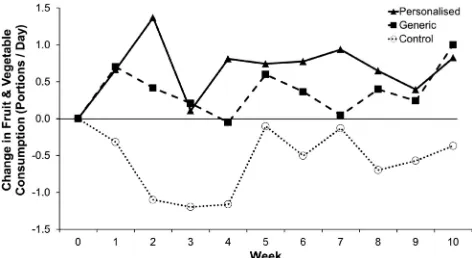
p⬍.001,p2⫽.75). A main effect of intervention group was seen on self-reported fruit and vegetable consumption over the 10-week period (F(2, 42)⫽ 3.8,p⬍ .05,p2 ⫽.15; Figure 1). No main effect of time and no interaction between the time and intervention group were found (p⫽.127,p⫽.854, respectively). Controlling for baseline consumption, the own-face appearance group reported a significant increase in their postbaseline fruit and vegetable consumption from baseline compared with the information-only group in post hoc tests (Bonferroni-corrected,p⫽.042). No other groups differed significantly (p⬎ ⫽.147).
The own-face appearance intervention group reported a significant increase in their postbaseline (average of 10 postbaseline reports) fruit and vegetable consumption from baseline (Bonferroni-corrected,
t(17)⫽ ⫺2.726,p⫽.042,dz⫽0.65). The other groups did not report significant diet change (p⬎ ⫽.534).
Discussion
The present study was the first randomized controlled trial to investigate the effect of an appearance-based dietary intervention. Our novel methodology involved visual presentation of the bene-ficial effect that fruit and vegetable consumption has on skin appearance according to an empirically derived color transform. The efficacy of personalized and generic imagery was compared; although personalized imagery proved effective, no clear evidence emerged regarding the utility of generic images.
Our results suggest that an appearance-based dietary interven-tion may be a valuable motivainterven-tional tool; participants perceived the illustrated skin color transform as healthy-looking and, after viewing the potential effects of improved diet to their own skin color, they initiated positive changes in self-reported diet with a significant elevation in consumption of fruit and vegetables sus-tained over the 10-week study period. Further, positive dietary changes were seen despite the sample population beginning at a level close to the recommended five portions of fruit and vegeta-bles per day. It is important to explore the efficacy of this strategy in those that consume fewer portions per day because these
indi-Figure 1. Change in fruit and vegetable consumption from baseline per intervention group. Participants completed an average of 9.6 (⫾0.68
SD) follow-up food-frequency questionnaires. Filled triangles indicate own-face appearance intervention, filled squares indicate generic ap-pearance intervention, and open circles indicate information-only con-trol group.
This
document
is
copyrighted
by
the
American
Psychological
Association
or
one
of
its
allied
publishers.
This
article
is
intended
solely
for
the
personal
use
of
the
individual
user
and
is
not
to
be
disseminated
[image:4.594.307.543.523.652.2]viduals may be most at risk from inadequate fruit and vegetable consumption.
Although the rate of attrition was consistent across the study, eliminating noncompleters could have introduced bias. Interven-tions may be most effective for those individuals who are most motivated to complete a longitudinal dietary study. Indeed, sup-plementary analysis showed that the longer the participants from our two appearance-based intervention groups remained in the study, the greater their average dietary change (n⫽40, ⫽0.336,
p⫽.034).
Personalization may be particularly beneficial in the context of an appearance-based intervention because own appearance is a potent motivator of behavior (Chung, Hoerr, Levine, & Cole-man, 2006; Markland & Hardy, 1993). Illustrating the conse-quences of diet on an individual’s own appearance may serve to enhance the salience and perceived relevance of the intended message.
Although the results of the present study are encouraging, they are preliminary. A sample of predominantly young adults was investigated. This group may have greater concern over appear-ance than other age groups (Chung et al., 2006). Nonetheless, appearance-based interventions at an early age could be important in establishing lifelong beneficial dietary habits. Further, our sam-ple was largely Caucasian. The effect of carotenoid pigments on skin color is perceived as healthy in an African culture, (Stephen et al., 2011), suggesting that our approach could be effective across different populations.
The size of our sample was limited by the labor-intensive creation of personalized stimuli. This prevented us from inves-tigating other potentially important determinants of intervention efficacy such as gender, ethnicity, and socioeconomic status. Although the transformation process used here was manual, the entire process has since been automated (Tiddeman, Perrett, & Hancock, 2012). The technology could ultimately be made available to practitioners, nutritionists, and the public using web or cell phone cameras. Further work will be required to ensure adequate color calibration with such image capture and to determine how appearance-based interventions compare with existing dietary interventions in terms of the cost-effectiveness. Because part of the appearance-based intervention participants received take-home images, the frequency with which participants referred to these resources could not be determined. It is necessary for further studies to investigate the effect of reminder e-mails and stimuli.
Although this preliminary randomized controlled trial of an appearance-based dietary intervention has been promising, much further work is required to determine whether it will be a useful public health tool.
References
Alaluf, S., Heinrich, U., Stahl, W., Tronnier, H., & Wiseman, S. (2002). Dietary carotenoids contribute to normal human skin color and UV photosensitivity.Journal of Nutrition, 132,399 – 403.
Chung, S. J., Hoerr, S., Levine, R., & Coleman, G. (2006). Processes underlying young women’s decisions to eat fruits and vegetables. Jour-nal of Human Nutrition and Dietetics, 19,287–298. doi:10.1111/j.1365-277X.2006.00704.x
Cobiac, L. J., Vos, T., & Veerman, J. L. (2010). Cost-effectiveness of interventions to promote fruit and vegetable consumption.PLoS One, 5,
e14148. doi:10.1371/journal.pone.0014148
Dauchet, L., Amouyel, P., & Dallongeville, J. (2005). Fruit and vegetable consumption and risk of stroke—A meta-analysis of cohort studies.
Neurology, 65,1193–1197. doi:10.1212/01.wnl.0000180600.09719.53 Lock, K., Pomerleau, J., Causer, L., Altmann, D. R., & McKee, M. (2005).
The global burden of disease attributable to low consumption of fruit and vegetables: Implications for the global strategy on diet.Bulletin of the World Health Organization, 83,100 –108.
Mahler, H. I. M., Kulik, J. A., Gerrard, M., & Gibbons, F. X. (2007). Long-term effects of appearance-based interventions on sun protection behaviors.Health Psychology, 26,350 –360. doi:10.1037/0278-6133.26 .3.350
Markland, D., & Hardy, L. (1993). The Exercise Motivations Inventory— Preliminary development and validity of a measure of individuals rea-sons for participation in regular physical exercise. Personality and Individual Differences, 15, 289 –296. doi:10.1016/0191-8869(93)90219-S
National Health Service. (2009a).5 a day, Just eat more (fruit & veg). London, United Kingdom: Author.
National Health Service. (2009b).5 a day, Just eat more (fruit & veg): What’s it all about?London, United Kingdom: Author.
Pomerleau, J., Lock, K., Knai, C., & McKee, M. (2005). Interventions designed to increase adult fruit and vegetable intake can be effective: A systematic review of the literature. Journal of Nutrition, 135,2486 – 2495.
Semer, N., Ellison, J., Mansell, C., Hoika, L., MacDougall, W., Gansky, S. A., & Walsh, M. M. (2005). Development and evaluation of a tobacco cessation motivational program for adolescents based on physical attrac-tiveness and oral health. [Research Support, Non-U.S. Gov’t].Journal of Dental Hygeine, 79,9.
Stephen, I. D., Coetzee, V., & Perrett, D. I. (2011). Carotenoid and melanin pigment coloration affect perceived human health.Evolution and Human Behavior, 32,216 –227. doi:10.1016/j.evolhumbehav.2010.09.003 Tiddeman, B. P., Perrett, D. I., & Hancock, P. (2012).2D, 3D and video
processing software for facial psychology research. Paper presented at the European Human Behaviour and Evolution Association Annual Meeting, Durham, United Kingdom.
Vainio, H., & Weiderpass, E. (2006). Fruit and vegetables in cancer prevention. Nutrition and Cancer, 54, 111–142. doi:10.1207/ s15327914nc5401_13
Whitehead, R. D., Re, D., Xiao, D. K., Ozakinci, G., & Perrett, D. I. (2012). You are what you eat: Within-subject increases in fruit and vegetable consumption confer beneficial skin-color changes.PLoS One, 7,e32988. doi:10.1371/journal.pone.0032988
Yusuf, S., Hawken, S., Ounpuu, S., Dans, T., Avezum, A., Lanas, F., . . . Varigos, J. (2004). Effect of potentially modifiable risk factors associ-ated with myocardial infarction in 52 countries (the INTERHEART study): case-control study. The Lancet, 364(9438), 937–952. doi: 10.1016/S0140-6736(04)17018-9
Received May 23, 2012 Revision received November 1, 2012
Accepted November 7, 2012 䡲
This
document
is
copyrighted
by
the
American
Psychological
Association
or
one
of
its
allied
publishers.
This
article
is
intended
solely
for
the
personal
use
of
the
individual
user
and
is
not
to
be
disseminated
broadly.